Author(s) Hordijk, Leen
Citation 知識創造場論集, 2(3): 1-27 Issue Date 2006-03
Type Research Paper
Text version publisher
URL http://hdl.handle.net/10119/5096 Rights
Description 北陸先端科学技術大学院大学 21世紀COE プログラム
知識創造場論集
第2巻 第3号
北陸先端科学技術大学院大学 科学技術開発戦略センター
2006年3月
環境システム分析の将来的な役割について
On the Future Role of Environmental Systems Analysis
Leen Hordijk
国際応用システム分析研究所・所長知 識 創 造 場 論 集
第2巻 第3号 発行日:2006年3月 編集・発行:北陸先端科学技術大学院大学 科学技術開発戦略センター 〒923-1292 石川県能美市旭台1丁目1番 TEL 0761-51-1839 FAX 0761-51-1767D
E
X
環境システム分析の将来的な役割について
Thank you, Mr. Chairman. It is a pleasure to be here. I have been at this Congress for about two days and have enjoyed many presentations and discussions. I would now like to draw from my experience in environmental systems analysis, in particular from the multidisciplinary collaboration and from the interaction with policy making. I will be using my experience in IIASA, my participation in the negotiations in Geneva about air quality in Europe and other systems analysis projects that I did in the Netherlands. I am trying to draw some lessons from the history of 30 years in applied systems analysis.
I would like to start with an anecdote. I am a professor of Environmental Systems Analysis at the Agriculture University of the Netherlands in Wageningen. But that field description came quite by coincidence, because when I was asked to apply for the job in Wageningen, the chair could not be called "Environmental Science", which was my preferred terminology. This impossibility was not because of the English words, but because of the Dutch word used: "Milieukunde". That word was not appreciated very much by the disciplinary people, because it suggested a well defined field that, according to these colleagues, was not the case. So at Wageningen, in 1991 we did not want to upset the atmospheric scientists, the aquatic people, et cetera, and "Milieukunde" was more or less forbidden. I had to invent another title for the chair: Environmental Systems Analysis (ESA). Of course I had to write the definition of this field and develop the teaching program. It was a learning process, implementing ESA in classes for Dutch and foreign students of environmental systems analysis.
The outline of my lecture is as follows. I'll first introduce IIASA as it is at the moment. Many people have heard of it. Quite a few in this conference are connected with IIASA, are alumni, or were visitors. They came from science, industry and governmental offices. Then I will present a few examples of environmental systems analysis as done at IIASA in the last 20 years. I will then turn to the goals and tools, of ESA. Thereafter I will address barriers and solutions to remove barriers in applying systems analysis in the field of the environment. Finally, I will draw conclusions and discuss priority topics as I see them.
The International Institute for Applied Systems Analysis (IIASA)
IIASA started about 33 years ago at the initiative of the Soviet Union and the United States who wanted a scientific institute in which they would collaborate rather than be involved in cold war issues. Through intensive discussion at very high political levels these countries had come to an agreement about the focus and the name of the institute. Systems analysis was found to be a neutral enough term to satisfy both camps. The name has not been changed until today.
Keynote Speech IFSR2005
The First World Congress of the
International Federation for Systems Research Nov. 14 - 17, Kobe, Japan
On the Future Role of Environmental Systems Analysis
Leen Hordijk
Director, International Institute for Applied Systems Analysis
していますが、自国の基準をこれらのモデルに組入れない限り、地域的レベル、少なくとも国別レベルで はほとんど活用されていません。ですから空間的特異性は今後もあまり利用されないでしょう。科学者は より詳細に分析したがるものですが、詳細な分析を追求すればモデルが非常に困難なものになり、また不 確定性も劇的に拡大します。 この種の研究には関係者の関与が極めて重要な点であると思います。RAINSモデル研究は、ジュネーブ の共同体、欧州、米国、ブリュッセルの産業界が共同で実施しなかったならば実現しなかったでしょうし、 モデル分析に成功することも影響を及ぼすこともなかったでしょう。この会議室にいる我々全員にとって の課題は、どうやってすべての関係者に関わりを持たせ、いかにして政治課題として取り上げてもらうか ということです。 全体的にみれば、私の経験から言うとこの分野の課題は科学と政治の橋渡しをする手段を確立すること です。システムアプローチの分野でもシステム分析アプローチの分野でも可能だと思います。このことを 私からのメッセージとしまして私のプレゼンテーションを終わらせていただきます。ご清聴ありがとうご ざいました。ご質問があればお伺いいたします。ありがとうございました。 [拍手] ※この文章は講演をもとにしています。
次に良好なコミュニケーションと個人的なつながりについて。この2つが重要なことは明白です。 さて2番目に関する私の推測と結論です。環境システム分析の応用方法は多種多様です。そして環境シ ステム分析において現在おこなわれている議論は標準化という主題です。しかし私は標準化の推進には賛 成しません。なぜならシステム科学や管理科学などからは多くのツールが生み出されており、他の分野で はまた別の形の分析ツールが必要となります。ですから標準化はあまり有効なツールであるとは思えま せん。 成功へのシナリオは存在しません。しかし評価モデルのもうひとつの成功要因は、多種多様の要因の組 合せにあります。今朝行われた第6シンポジウムでは、講演者が特定の研究が成功するためにはこのよう に様々な要因が極めて重要であると提示していましたが、そのスピーカーの方程式がここでも当てはまり ます。彼の分析モデルが逆に我々にその応用を提案しているのです。したがって、分析モデルの特定シス テムへの利用に関するこの種のストーリーの適用の可能性は極めて限られていると思います。学ぶべきこ とはあるでしょうが、以前に成功を収めたケースを他の地域やテーマにも同じ条件で利用できるとは思え ません。 社会科学は一般的に非常に重要な役割を持っていますが、環境システム分析においては過小評価されて います。私は環境システム分析における社会科学の関わりがいまだに極めて限られていると感じています。 これらのプロジェクトが実際に策定される方法に一部原因がありますが、社会科学の学者側が参加を渋っ ていることも原因しています。オランダの例をとりますと、気候研究プログラムには大勢の社会科学者が 参加しています。しかし国全体の関心はかなり限られています。実際に経済学者や社会学者、政治学者を 捜し出して参加を求め、有意義な結果を出すようにかなり努力しなければならないのです。これも相互関 係の一例です。 実質的な結論として言えることは、この種の研究の文書化と同じ方法での研究成果の文書化支援に成功 することは少なくともシステム関係や文献サイドでは非常に限られています。これまで社会科学分野で有 効な科学政策の例を表わす論文が少なくとも5つありましたが、これほどの定量分析を表した文献を他に 見たことがありません。 IIASAに関連する将来の優先課題は、不確定性解析、ロバスト性解析、さらにはこれらのモデル演習が 非常に重要です。これらすべての分析モデルが特に世界規模で焦点を当てなければならないのは不確定性 の問題であることは周知の事実です。将来的には不確定性の定義も必要であることもわかっています。将 来のシステム研究にとってのチャレンジと言えましょう。 空間的特異性にももっと関心が集まるべき問題です。グローバルな規模ではもちろんこのモデルを活用
IIASA was meant to be a research center to bridge the East and West, and it stayed that way for about 20 years. The Institute has fulfilled its role because scientists from the Soviet Union but also from countries such as Poland, Czechoslovakia, Hungary and the German Democratic Republic joined with their colleagues from Canada, the United Kingdom, Japan, The Federal Republic of Germany, the Netherlands, Sweden, and other Western European nations.
Of course the geopolitical situation changed drastically at the end of the 1980s, and thus the institute had to change. IIASA is still doing systems analysis but the Institute is much more focused on North-South issues and generally dedicated to research on global change; not just global environment change but also technology, economics and social systems.
Membership has also changed. We have added members from China and Egypt, and hopefully very soon also India and South Africa.
IIASA is independent, a characteristic that I will use later on when I explain why certain topics have been successfully addressed at IIASA which might not have been successful if carried out in another institute.
IIASA is non-governmental, and that means that our members are non-governmental organizations like academies or national research councils. In some countries there is a special committee for IIASA. Of course indirectly all the funding comes from governments because most science funding comes from governments.
IIASA is inter- or at least multi-disciplinary. It is not organized in faculties but in research areas, where natural scientists and social scientists work together on an issue, e.g. in environment, in agriculture, in energy, in technology or in forestry. We attempt to cross the disciplinary boundaries by putting people together in one research program.
We employ about 160 scientists annually, but many people come to IIASA for short periods or only part-time. The 160 people represent only 80 person years, and they come from over 25 different nations. About 40% of the scientists have a background in the social sciences, others come from natural sciences, mathematics and engineering.
IIASA has many collaborators across the globe. More than 3,000 scientists have worked at IIASA including many in Japan. Many of them continue to work with us after their return to their home countries or moving on to other institutes outside their nations. I am one example. My first visit to IIASA was at a conference in 1979, and then I worked as project leader from 1984 till 1987. I returned as Director of IIASA in 2002. There are many people like me who want to stay involved with IIASA for the rest of their lives.
The Institute's official goal is "to conduct international and interdisciplinary scientific studies to provide timely and relevant information and options, addressing critical issues of global environmental, economic and social change, for the benefit of the public, the scientific community, and national and international institutions". This is a long sentence and I would like to stress a few words. One is "international and interdisciplinary," which I already mentioned, but the other one is "issues of global environmental, economic and social change." We work for the benefit of the public, the scientific community, and national and international institutions. And the emphasis is on the word "applied," applied meaning to solve a problem and that is also what I will expand on in the next half hour.
IIASA's Governing Council approved our research program for the next five years just this June.
私の経験ではこの種の仕事に優秀な科学者を惹きつけることは困難です。自分の研究を同じ分野の科学 者の同僚がリビューする『サイエンスリポート』のような学術雑誌に論文として発表できるようになるま でには長い時間がかかります。我々が携わっているような研究を発表できる良い学術雑誌はそれほどたく さんありません。ですから非常に優秀な科学者はこの仕事に対して疑問を持つかもしれませんし、研究グ ループに参加する関心も持たないでしょう。したがって論文発表の機会をもっと生み出し、情報を交換す る場を持つ必要があります。 もうひとつ重大な障壁にコミュニケーション不足の問題があります。つまり物理的に離れていると問題 が発生します。RAINSのようなプロジェクトは一箇所で遂行しなければなりません。地域が離れていては できないのです。私がこのような結論に至った理由は、IIASAを1987年に離れてオランダに戻り、オラ ンダに適用する酸性雨モデルを作ろうとしましたが、最初の数年で失敗してしまったのです。というのも 研究に参加している者の何人かはユトレヒトにいてその他の研究員はアムステルダムに拠点を置いていま した。私は週に1度か1カ月に1度これらの研究者と会って作業しましたが、うまくいきませんでした。 したがって物理的に離れて共同研究を行うということはこの種の仕事にとっては、大きな障壁です。 それでは役に立っていることはあるでしょうか?物事には裏表があって、反対に良いことも起こりまし た。つまり、概念を共有する時間を持てたことや研究者が使う言語の調査などの成果が得られたことです。 また環境システム分析に関わる土壌科学者をたいしたことはないだとか、数学者としてはレベルが低いな どと見ないで、それぞれの専門分野で評価すべきです。他の専門分野の人々に自分の専門分野について伝 えるためには、まず自分自身の専門分野で秀でていなければならないからです。 研究提案は有効だと判断されるものでなければなりませんが、同時に若い研究員も自分の分野で能力を 発揮できるサブプロジェクトの存在も必要です。例えば過去には、土壌関係の雑誌で論文を発表したこと のある土壌科学者、水文地質学の学術雑誌で論文を発表したことのある水文地質学者が大勢いました。で すから自分の研究分野での学術雑誌にも研究リポートを発表しているということです。 知的作業への尊敬と社会的地位、これは先ほどスライドの図で説明しました。 長期間にわたるコミットメント、このテーマについては何度お話しても十分ではありません。とりわけ 資金提供者には長期コミットメントをお願いしたい点を特に強調したい。プロジェクトがこれから2年、 3年先に成功しなければ、資金提供が停止されてしまいます。IIASAでこのプロジェクトに携わっていた 当時、この点を非常に心配していました。しかし当時のディレクターは「あまり成果は見られないが、可 能性があるようなので、資金は今後も提供しよう」と言ってくれました。しかし前にも申し上げたように、 IIASAでは研究資金の調達において不運な経験も多くありました。
dynamic systems. The latter is more mathematically oriented with a focus on optimal control and game theory.
In the energy program we are quite known and experienced in developing global energy scenarios which have played and are playing an important role in the international climate negotiations.
The technology program tries to look into the "black box" of technologies and investigates diffusion through space and time. What are the most important factors for diffusion? Why do some technologies get used and others not?
Our theme "Environment and Natural Resources" includes four programs: evolutionary ecology, land use and agriculture, air pollution, and forestry. We do not have a separate program on water, although all of these four programs pay attention to water issues. I will come back to the atmospheric program because I use that program's model as an example of successful systems analysis.
The ecological program is on the one hand more theoretical. They publish at least once or sometimes twice in a year an article in the journals Science and Nature. On the other hand this program applies its knowledge in practical issues, such as fisheries.
The forestry program has a focus on the role of forests in the carbon cycle and a focus on forest governance issues.
The land use program's strategic goal is to support policy makers in developing rational, science based and realistic national, regional and global strategies that achieve long-term sustainability and environmental stewardship of land and water resource management for the production and distribution of food, fiber and bio-energy, while promoting rural development.
The third theme is "Population and Society". The programs in this theme have an orientation on the social sciences, although natural sciences are also present.
The "Population and Climate Change" program is funded by the European Young Investigators (EURYI) awards. We were very proud that last year a young brilliant scientist, of IIASA won that award and is now leading this program. His focus is on the behavior of consumer and households and their impact on climate change. This is very important because most research programs world wide focus on governments and industry.
The "World Population" program is known for its global population projections and has improved the methodology in this field, including probabilistic estimates.
The program "Processes of International Negotiations" is a network of collaborators across the globe that publishes books and gives courses in a variety of places including Cairo and Teheran.
Finally, this theme includes the "Risk and Vulnerability" program. Risk has been a research area at IIASA since its beginning. We will focus in the near future on risk and vulnerability rather than on risk as a single cost and consequence calculations.
Since the beginning of this year we have two special projects and a crosscutting activity. The last one, the greenhouse gas initiative, is a combination of work done in six of the other programs which all deal with an aspect of
ご覧いただければ興味深い研究資料であることがお分かりいただけるでしょう。 さてモデル分析をする上での問題点とは何でしょうか? これもテーマ・ボックスの中に入れるべきで しょう。つまり、これまでお話してきたシステムとはまた別の意味でのシステムを意味しているからです。 経験上申し上げると、科学者が専門分野を超えて協力作業をおこなう上での最も大きな障害は、命題が1 グループ側で形成されていることにあります。とりわけ気候変動分野ではこの傾向が顕著です。オランダ の気候変動プログラムの議長として私も何度か経験していますが、自然科学者側が命題を提示し、その後 ある日突然、社会科学的部分も存在していることを認めて、社会科学者の友人に電話をしてプロジェクト 提案に参加してもらえないかと依頼するケースが多々あります。また社会科学者たちも、社会科学が研究 作業の遅い段階で参加しても社会科学的要素はあまり反映されないだろうと主張しますし、分析過程にお いていずれ1年ほど経てば、好ましからぬハプニングが生じる可能性があるのです。したがって研究命題、 この分野での科学的課題は分野を超えて科学者が一丸となって策定しなければなりません。 次に概念の相違です。持続性という言葉がその良い例で、環境研究分野では専門的な流行語です。しか し政治家とエコノミストが「持続性」という言葉に対して持つ期待は異なっています。すべてのエコノミス トは「持続性」のなかに効率性や効果を見ていますし、生態学者はこの言葉に対して経済的な意味合いをお そらく持たないでしょう。 次に言葉の意味ですが、私はソフトシステムなどに使われる「ソフト」という言い方が好きではありませ ん。もちろん昔の意味とは異なる点は承知していますが、「ソフト」という言葉には「弱い」であるとか、 「保護不能」であるとか、「不良」といったマイナスのイメージがありました。ですから様々な人が共同作業 をするときにこのような言葉に出くわした場合、たとえば今朝ある女性が、「環境主義」という表現は好き ではない、と言っていました。なぜでしょう? 要するに言葉に対して人々が持つ意味合いの違いです。 したがって共同作業をおこなうとき、言葉は重要な役割を持っています。 「コミットメントの欠如」ももうひとつの問題です。なぜコミットメントを取り上げて言うかというと、 分析モデルを使って将来を解析する作業をおこない認められて利用されるまでには長い時間がかかるから です。 「立場と役割の誤解」という障害についてですが、たとえば「ソフトサイエンス」という表現があります。 ここでもまた当てはまるのですが、私も時折目にする自然科学者が社会科学者に対して示す態度と関係が あります。つまり、より具体例を挙げてお話すると、アムステルダムの水文地質学者の言葉を引用すると、 「社会科学者の多くが基本的には学者や大学教授である。」と言います。しかしこれも時にはある特定の科 学者が別の科学者の基となっている点を表しています。
climate change. We try to bring the people who work on climate together in one across-the-institute effort to be more effective and more helpful in climate change. Principal research activities include the development of long-term, global scenarios that meet the UN Framework Convention on Climate Change objective.
The special project "Integrated Modeling Environment" will start as of January 1, it will be led by Marek Makowski, chair of this afternoon, and it will also have a focus across the institute. The strategic goal of this project is to build capacity to meet IIASA's growing needs for integrated modeling support where commonly known methodology and/or general-purpose modeling tools are inadequate.
"Health and Global Change" is a new project that will look at the emerging issues of global influenza epidemics especially the socio-economic aspects of it.
Environmental Systems Analysis (ESA)
Environmental systems analysis is a quantitative and multidisciplinary research field aiming at combining, interpreting and communicating knowledge from the natural and social sciences and technology. It is a multidisciplinary effort trying to bring together in a quantitative way as many aspects of a real life problem as possible, including the communication of results of the systems analysis.
Figure 1. Graph of an Environmental Systems Analysis for the development of the national environmental outlook of the Netherlands in 1991.
The mission of ESA is to develop methodologies and tools and to apply these tools in strategic research topics which are mainly society-driven. ESA is thus not just for the sake of science, to improve our understanding, but it also tries to address topics of benefit for society. The applications of ESA describe and analyze the causes, mechanisms, effects and potential solutions for specific environmental problems. My own research has been focused air pollution as one of the fields of environmental problems with some links to water, soil and waste management.
RAINSモデルを引き継いだGAINSモデルや気候予測モデルのIMAGEおよびAIM、解説モデルのPEARLな ど、様々なモデルが存在します。これらは環境の一部分を分析する単純な形式を超えた分析モデルです。 また社会的経済的要因を含んでいます。 分析モデルには小説などで使われる言葉に当てはまる「将来の」シナリオやイメージ、筋書き、ビジョン などを創造する方法としての目標もあります。現在の状況を分析モデルに当てはめるだけでなく、将来の 状態を応用する意図もあります。時には管理的アプローチを採用することもありますが、将来の状態を応 用する際に利用してもらうことを意図しています。したがって大学には十分定義された環境システムモデ ルが必要です。その一例として欧州ではRAINSモデルが利用されていました。 さて皆様の専門分野に関連する一般的なツールについて触れておきます。まだまだ完成した形のモデル ではありませんが、いくつか例をあげたいと思います。私の専門は計量経済学ですので、推定するという ことは多かれ少なかれ私の血のなかに流れております。これらの一般的なツールには政策担当者とのやり とりに使用するツール、たとえば皆さんのご専門である最適化や多目的最適化、特定のシナリオ構築方法、 不確定性解析、指標、事例などが含まれます。 現在では、これらの環境システムは分析モデルと学問とを結び付けて応用します。私の経験上、これは 非常に大きい部分を占めています。私が鮮明に記憶しているところではRAINSプロジェクトでは水のアバ ンダンスセットモデルに関する議論がひとつ、大気モデルのように沈殿物をどのように測定するのがひと つ、さらには森林モデルですが、これを大気モデルから引出すのかといった議論がありました。水に関す る議論がもっとも刺激的でときには議論が感情的になったこともありました。 これらの分析ツールは世界中で実施されている環境評価の導入に用いられ、大気あるいは農業、その他 を含めた特定分野の全体像を科学的に把握するために用いられています。環境システムおよび分析モデル の応用についてですが、これらのモデルも先ほど申し上げたように、政策担当者に代替政策案を示し、彼 らを教育し、内容を述べるのではなく知らせることで将来像を描き、政策決定プロセスを支援するために 利用されます。つまり、政策策定において政策科学の自由な流れを促すために用います。 ハーバード大学の公共政策および政治学部がまもなく「将来像」について同大学の研究者が執筆した興味 深い研究を出版する予定です。ハーバード大学は大気分野、気候分野、あるいはエルニーニョなど分野を 問わず、世界の環境評価の成功例と失敗例を調査しました。環境システム分析が成功する上で考察すべき 極めて重要な3つの要素がこの調査から判明しました。その3つの要素とは、環境脆弱性、安定性、そし て調査の真実性と偶然性です。これらの要素を説明するには別の場を設けて詳しくお話する必要があるか と思いますが、この種のモデル応用にご興味のある方は、ジル・イエガーとアレックス・ファレルが地球 温暖化評価に関してこれから数週間のうちに出版する書籍も「将来像」についての研究を収めていますので Figure 1 is my standard scary picture for the students in Wageningen when I teach environmental systems analysis.
I am not inviting you to understand it or even have a close look at it because it is in Dutch. It is a diagram from1991, when the Netherlands National Institute of Public Health and Environment (RIVM) were preparing for the first time a national assessment of the environment. That was a full-blown environmental assessment, not just the quality of water and air, but also what one might call the social drivers of it, the economics, the energy use, the transportation, et cetera, et cetera.
This picture is an environmental systems instrument in which the causes of all environmental problems in the Netherlands have been brought together with the environmental consequences and options for alleviating these consequences. In the boxes you see the abbreviations (in Dutch) of models, data bases, and indicators that come from various research institutes and ministerial offices.
What we hoped to achieve with this picture is to get a handle on the very complicated issue of environmental quality in the Netherlands. It is important to note that this is not meant for forecasting, but just for projections.
Figure 2. The RAINS model of IIASA (around 1995)
Now I show a much simpler ESA picture that was also described by Marek Makowski in the first session of Symposium 6 in this conference. IIASA has developed a model called RAINS which stands for Regional Air Pollution Information and Simulation model. It consists of varying modules, and includes the socio-economic drivers of the air pollution problem in Europe. The work started in the 1980s with a focus on the major air pollution issue of those years, acid rain. Figure 2 shows the structure of RAINS in which you will note modules for socio-economic aspects (energy and agriculture), for technology and economics (the emission control options), for atmospheric dispersion, and for environmental impacts. The RAINS model has been and is still being used in two ways. The first type of use is to generate environmental impacts of energy and agricultural scenarios.
The second way of using RAINS is to find minimum cost solutions for emission controls given environmental targets. In the 1980s RAINS was used for finding least cost solutions for reducing the levels of acid rain to a given threshold. European negotiators had agreed on those thresholds and used the IIASA model as a basis for their discussions about sharing the cost of improving the environment. Today, RAINS includes many more air pollutants, such as nitrogen oxides, ammonia, hydrocarbons, and particles.
The use of RAINS in real life negotiations has been studied by many social scientists, because it is a rare example of practical use of environmental science in negotiations. Why was RAINS used? Which factors played an important role?
Getting RAINS used by practitioners has been a long process. Model development started in 1983, and is still continuing, but the first real success took place in 1994, ten years after the start of work, when the Second Sulfur Protocol was signed in Oslo (Norway). The model was not used as a recipe for the negotiators but as a menu to choose
たとえば1994年2月の数値をご覧いただくと変化が生じていることがわかります。これらのシミュレー ションモデルは活発な政策介入を促すことを意図しています。 さてモデルには3つのバリエーションがあります。そのすべてが今も進歩しており、分析対象として、 温室効果ガス、二酸化炭素、窒素酸化物、メタンガスなどが入っています。したがって、データ容量は非 常に大きく応用が難しくなりますが、それでも利用されています。 IIASAが携わっている農業関連プログラムには右側に表記しているように一対のモデルがあります。こ のモデルを使って解決方法を求めようとしているのは、世界の気候変動によって影響を受ける農業の脆弱 性です。気候変動は農業にとって重要な要素です。これは3年前にヨハネスブルグで開催された世界サミッ ト会議に提出した書類で、気候変動が生じた場合の農業に及ぼす影響を説明しています。 IIASAで使用しているシステム分析のもう一つの側面に、複数のステークホールダーが関与していると いう点があります。これはハンガリーで私が携わっているワークショップの写真です。極めて定期的に洪 水が発生している所で、リスク計画に従事するIIASAの研究員が自分たちの分析モデルと自らの知識とグ ループ関係者を結集して、洪水犠牲者を対象とする保険制度を新たに設立する方法を議論しています。簡 単にそう言っても実は非常に複雑な作業で多くの時間を費やさなければなりませんでした。影響を受ける 関係者の関与が必要でしたので、洪水被害に見舞われる村の住民、地方行政、さらには世界銀行や保険会 社も保険制度設立に参加しました。ですから、これも関係者の関与という環境システム分析のもうひとつ の側面を表す例で、おどろくべきことでは少しもありません。特にこれはハンガリー北部の小さな村で地 域住民と密接して実施した事例であり、IIASAが地域モデルの促進で知られていることからも私が気に入っ ているプログラムです。 IIASAのシステム分析能力を用いて、まもなく始まる新しいプロジェクトに、アジア大陸の大国で、森 林および木製品分野で、実際に何が起こっているかを調べようとしているプロジェクトがあります。統計 内容と衛星で入手できる情報がかなり食い違っているのを見ると、違法取引、違法な木材伐採あるいは 我々が知らない違法な行為がなされているに違いありません。そこで中国の国家組織とともに、IIASAの 森林プログラムを担当するステン・ニルソンが中国の森林の状況と木材生産の国家規模の数値を測定する システム計画を策定しました。インドでも同様のプログラムを展開してアジアの全体像を把握しようとし ています。 もう一度、少し具体的に環境科学分析の目標を申し上げると、総体的モデルではなく統合的モデルを構 築することにあります。総体的モデルを作ることは不可能ですが少なくとも統合的モデルは追及すること が可能だと思うのです。また分析技術についてご存知の方なら、我々がこれらのモデルの廃棄処分をおこ なうことがあることをお分かりだと思います。RAINS モデルについてはすでにご紹介しましたが、
from. A menu with numerous options for alternative clean air policies in Europe based on the latest state of science and on an agreed international data base.
As I have said in another session, one of the lessons I learned in this process, in the early life of the RAINS model, came from a very experienced Dutch negotiator in environmental issues who said to me, "Leen, I don't want a recipe from you; I need a menu to choose from." And I think that has guided the attitude of IIASA group over the years, that they will not be the scientists telling the negotiator what to do, the normative approach, but they gave them a set of options: if you decide to do this, then that will happen.
In 1994, at the signing of the Oslo Second Sulfur Protocol, there was a late hiccup because one of the countries, and I'm not at the liberty to say which one, one of the central European countries, all of a sudden came up with disagreement. Of course all of the European leaders were present in Oslo and wanted to sign the Protocol; thus they had to find a solution very quickly. We were asked to meet the negotiators in a room with doors closed and to do a quick calculation: what would the impact on neighboring countries be if that particular country would not sign the agreement and if they would sign a lower percentage of emission reduction. We could do that in a few minutes to satisfy the ministers and the ceremony could continue.
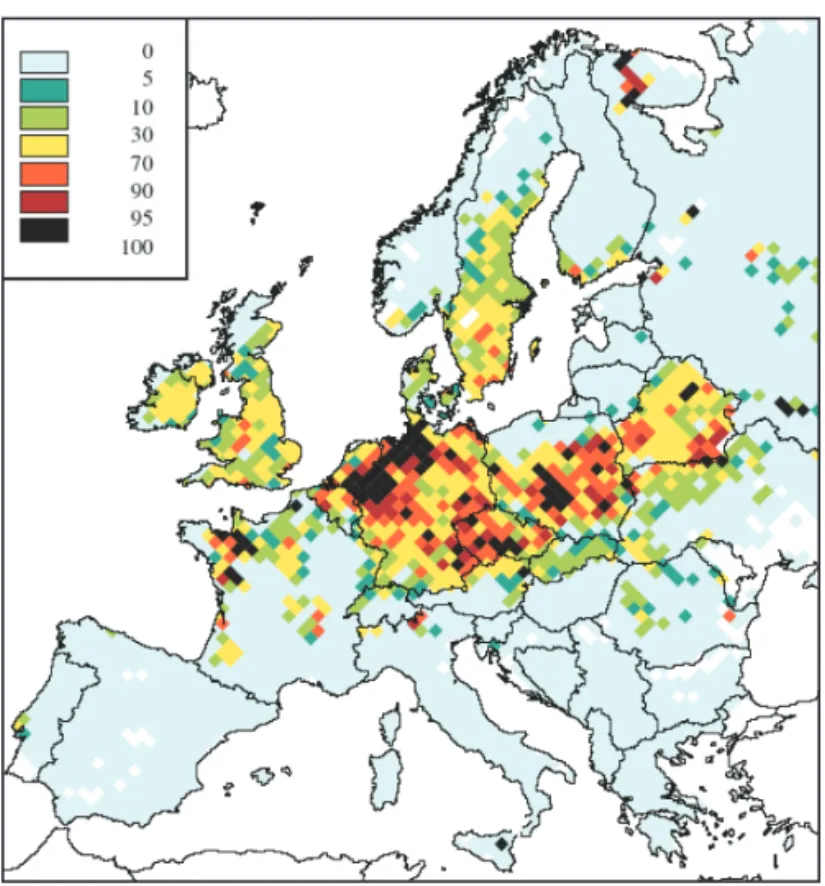
The Convention on Long-range Transboundary Air Pollution (LRTAP) celebrated its 25th anniversary last December; and we dug up a few of the old pictures. Figure 3 shows a European soil acidification map as output of the RAINS model in 1984, Figure 4 shows RAINS output 20 years later, again for impacts of air pollution. This map is being used in the Clean Air For Europe (CAFE) program of the European Union.
このモデル分析は長期プロセスです。1983年末に初めてこのモデル分析が開始されましたが、現在も 継続しています。最初に実際にモデルを使用し、成功したのは1994年のことですから、開始から10年経 過しています。したがってRAINS は皆さんの国あるいは国際レベルで政策を策定しながら、チューニン グを繰り返しつつ発展してきました。 希望としては、半分の5年間でモデル使用すべてに成功すべき だったでしょう。なぜなら10年間かかるとなると成果が半分しか得られないからです。短期にすること によってもっと多くの成果が得られたのです。現在、大気汚染防止に関する欧州協定あるいは国際協約で も、あらゆる国の環境基準に関する国際条約もRAINSモデルをベースにしていないとか、RAINSが法制 化過程で役に立たないなどというのではなく、国際的な議論の場や交渉における情報源としてRAINSモデ ルを使用すべきでしょう。 他のセッションでも申し上げましたが、RAINSモデル応用の早期に私が学んだことのひとつは、あるオ ランダ人の環境問題に関するベテラン外交官との会話から生まれました。その外交官は私に次のように言 いました。「リーン、君たちに求めているのはレシピなんかじゃないんだ。選ぶべき結果が必要なんだよ」 この言葉によってそれから先数年のIIASAグループの姿勢が決まりました。つまり、政策担当者には何を すべきか、つまり規範を示すのではなく、一連の教訓を与えるということです。もしこれを実施すれば、 このようなことが起こりますよということを示すのです。オンライン・モデルは、以前は保守的なアプ ローチでしたが、このモデルは極めて相互作業的なプロセスです。もちろんサイトについては私も注視し ていました。 硫黄酸化物削減に関する第二次オスロ議定書が1994年に採択されようとしていた時、会議参加国のう ちのひとつが、国名はいえませんが、中央ヨーロッパのうちのひとつですが、最終段階で突然議定書の採 択に反対しました。もちろん、その場にいた各国の閣僚代表は調印しようと構えていたわけですから、解 決の道を即座に見つけなければなりませんでした。私も後継者のジャスパーもその場にいました。我々は、 会議室のドアを閉めて、ひとつの国が議定書採択に反対し調印しない場合と、削減率を低くして調印した 場合に近隣諸国に与える影響の規模はいかなるものかを即座に計算するように求められました。我々は会 議中に即座に計算し、各国閣僚に満足していただくことができたのです。これが政策担当者との迅速かつ、 威厳を保ちつつもしなやかともいえる相互作用の一例です。 さて欧州の現状ですが、いわゆる欧州環境条約が昨年12月に25周年を迎えました。そこで少し古い写 真を取り出してみました。これは1984年のRAINSモデルの1.1バージョンですが、酸性雨による硫黄排出 が1984年当時のペースで継続すればその25年後の2010年には、土壌の状態がどうなるかを示していま す。極めて初歩的な分析方法として、欧州の国家境界線に照合しています。さらには問題が発生すると予 想されるこの影の部分もご覧いただけます。 昨年、欧州連合(EU)のカフェ計画で、同じようなシミュレーションを同じ年に照合して実施しました。 Figure 4. RAINS output in 2004 used in EU policy making
Today the RAINS model has been extended with many other air pollutants and most recently it has been coupled with greenhouse gases. The resulting GAINS model can be used to jointly analyze air pollution and climate change. This new model will have different versions for different parts of the world: Europe, Asia, Latin America and Africa
Figure 5. The RAINS model extended with greenhouse gases can now be used for the joint analysis of air pollution and climate change
の質を示しているだけでなく、経済や統計、社会指標などいわゆる社会的要因も表しています。 この図は、環境システム分析指標とでもいえるものです。つまりオランダで発生するすべての環境問題 を考察する上で、様々な要因とそれらが環境に及ぼしうる可能性とを合わせて表しています。またここで は、たとえばオランダの交通モデル、エネルギー利用モデル、農業モデル、農薬など環境に影響を与える すべての要素を取り上げています。 この図をもとに我々が達成しようとしているのは、少なくともオランダの環境の質に関わる極めて複雑 な問題について少しでも理解し、そこからどの方向に進むべきかを考えることにあります。したがってこ の図は環境問題の行方を予想するのでななく、実際にどのような行動を起こしていくかを見定めることに あります。この一連の要素を観察して、何か特別な予想ができるでしょうか? 重ねて申し上げますが、 これはひとつの国の環境システム分析を図に表した一例で、社会的要因、経済的要因、環境要素などを考 察しているものです。すべての要因を統合した分析図がこの図となったわけです。 本会議のシンポジウム6の最初の部会でマレック・マコウスキー氏が、今わたくしが申し上げたすべて の点を非常にシンプルにした形で少し紹介されました。地域酸性化情報シミュレーションモデルの頭文字 をとって短くRAINSと呼ぶモデルがあります。このモデルは1980年代に酸性雨を引き起こしたと考えら れるヨーロッパの様々な社会的経済的要因を指標にして構成されています。たとえば大気とコストの面、 技術的要因、汚染防止技術コスト、さらには環境における影響などです。したがって様々なモデルを組み 合わせて2つの異なる方法で利用しています。1つはシナリオ分析的に使用する方法です。たとえば欧州 の地理的経済発展を考える場合、このシナリオ分析を利用して温室効果ガス排出の影響についてその内容 を測定します。昔は、温室効果ガス排出によるインパクトは二酸化硫黄だけに限られていました。しかし 別のスライドをご覧いただくと、インパクト曲線がいかに大きくなっているかがお分かりいただけると思 います。 RAINSモデルの2つ目の応用は、環境に関わるすべての関係者が最適化を試みる際に使用するアプロー チです。1980年代のヨーロッパでは、硫黄排出量は年間1平方メートルにつき特定量を超えてはいけな いというものでした。これが環境問題を考え始めた当時の考え方と対処法でした。しかし今では世界の状 況は極めて複雑化しており、全体的な重点分野がかなり異なってきています。しかし始め方はそうだった のです。 これは実際に使用されてきたモデルです。後のわたくしの結論はこの視点に基づいています。なぜこの 科学モデルは実際に使われ、私が認識している他のケースでは実際に使われない科学モデルがあるのかわ かりません。実験モデルとして科学者の間で使用されても、実際には使われない場合があるのです。
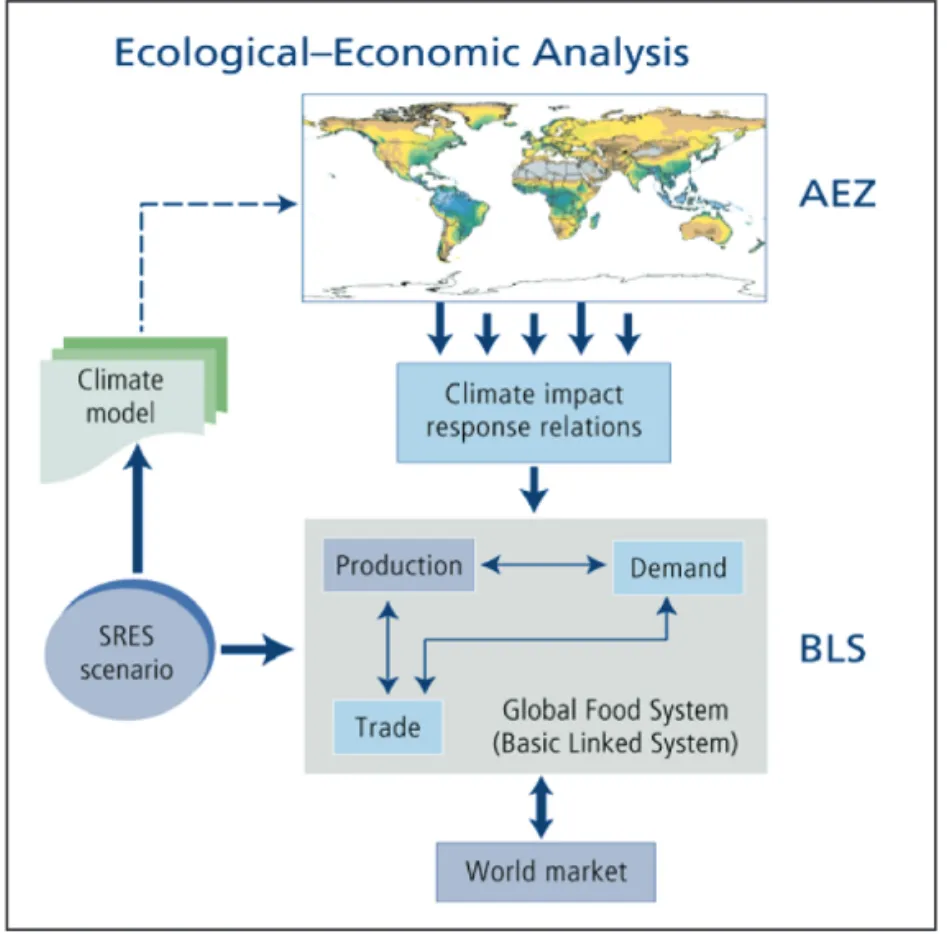
The land use and agriculture program of IIASA has a set of models that has been used to analyze the expected impact of climate change on agricultural vulnerability (See Figure 6). The IIASA team has combined emission scenarios (SRES), with results of four climate models (Global Circulation Models), an agro-ecological data base (AEZ), and an international trade model (BLS). The analysis has shown that already vulnerable countries in Africa, Asia and Latin America will become even more vulnerable due to long term effects of climate change. These results have been discussed at the World Summit on Sustainable Development in Johannesburg, 2002.
Figure 6. Set of coupled models for analyzing climate impact on agriculture
It is more and more important to involve stakeholders in environmental systems analysis. The RAINS example that I presented before is an example of successful stakeholder involvement. Another example comes from the IIASA program on Risk and Vulnerability. They have used their systems models about economic consequences of flooding in a poor region of Hungary. In a series workshops with local population, local and regional authorities and representatives from an insurance company and the World Bank they developed a new insurance scheme for potential victims of the next floods.
は組織形体で取り組んできました。近い将来、費用対効果を測定するにあたりリスクだけを単独で扱うの ではなく、リスクと脆弱性の両方に重点を置くことになろうかと思います。 次に2つの特別プロジェクトについてご紹介します。来年この2つのプログラムが順次開始されます。 最後のプロジェクトは温室効果ガス排出削減計画で、これは今ちょうど私がご紹介しました他の6つのプ ログラムを合わせたプロジェクトです。これら6つのプログラムはすべて気候変動に関して何らかの側面 に取り組んでいますが、気候変動に対してより効率的に有益に対応するために、様々な分野で研究する科 学者を集めてIIASA全体で取り組もうとしています。 環境統合モデルは本日午後議長を務めておられるマレック・マコウスキー氏が1月1日付けで完成させ る予定ですが、これもIIASA全体で集中して議論しているテーマです。 健康および地球規模の変化は新しいプロジェクトで、まだ承認はおりていませんが、来週には委員会の 公認を受け、AIDSを始めとする世界中を席捲しているインフルエンザウィルスなど次々に発生している 問題に取り組みます。 以上、IIASAの組織および取り組んでいるテーマについて少しご紹介させていただきました。 次に、環境システム分析と言うとき、何を意味しているかについて考えたいと思います。私はワゲニン ゲン大学の教授として、環境システム分析が自然科学、社会科学および技術面から得られる知識を組合せ、 理解し、それを他者に伝えることを目指した数量的かつマルチディシプリナリーな研究分野であるとお話 しました。つまり技術を排除せずにできるだけ数量的かつマルチディシプリナリーな取り組みを行って他 者に伝えることを意味しています。 したがって環境システム分析の使命は、方法論と手段をさらに発展させ、主に社会への貢献を中心とし た戦略的研究テーマに応用することにあります。これも環境システム分析の特徴です。科学研究に取り組 むことだけが目的ではなく、科学に対する理解を深めて社会の利益になるテーマに取り組んでいるのです。 環境システム分析の応用によって特定の環境問題の原因やメカニズムさらにはその影響と可能な解決策を 説明し、分析を支援します。私自身の研究テーマは環境問題の1分野である大気汚染に重点を置いてきま したが、このテーマは水や土壌さらには廃棄物汚染にも関連しています。 この図はワゲニンゲン大学の学生にデータ・システム分析を教える際に使用している標準的な図です。 部分的にオランダ語で表記していますので、皆様方にはこの図をご理解いただくことも、じっくりとご覧 いただく必要もございません。ただこの図は1991年、実際には1990年に遡ることですが、オランダ国立 環境衛生研究所が初めて国家規模で環境評価を準備していた当時の様子を示す図です。また単に水や大気 Figure 7. The CATSIM model is used for stakeholder meetings about catastrophes
The Forestry Program is about to start a new project for a solid analysis of development trends of the Chinese forest sector and the implications to other countries of this development. There is contradicting data and lack of relevant consistent official statistics and independent reviews. Therefore, there is a lack of consistent information for understanding and assessment of the implications of the development of the Chinese forest sector.
Tools of Environmental Systems Analysis
The goals of environmental science analysis are to build integrated models and to use these models for generating what I call "futures": scenarios, images, story lines, visions. It is also the intent to have others use those futures to obtain insight in the problems they are addressing. An example of this is the RAINS model and how it was used in Europe.
The tools of ESA are related to your fields of expertise: modeling, estimation (from my own background in econometrics), optimization (which is more in your field), multi-criteria analysis, scenario construction, uncertainty analyses, indicators, example, and communicating to the policy-making area. The latter belongs to the field of the social sciences.
A large part of ESA is devoted to the use of models. Models connect disciplines. And that role constitutes a large part of my own experience. I remember most vividly discussions in the RAINS project in the 1980s about the ways in which we connect models from different disciplines with each other. For example, the atmospheric model calculates the deposition of air pollutants and the forest soil model uses that as input for its calculation of air pollution impact on forest health. We had discussions about the "forest filtering factor", the degree to which trees, in particular the edges of a forest, catch air pollutants effectively form the air that passes the forest. The forestry colleagues thought that this would be part of their model and the atmospheric colleagues deemed it their turf. This led to discussions which were sometimes very emotional.
ることで知られています。またこのような国際エネルギー計画はこれまでも気候変動国際会議で重要な役 割を演じ、現在もその役割は続いています。 この分野の技術はまだ新しいものであるため、時間と空間を介して技術分野での「ブラックボックス」を 開ける鍵の探求に焦点を置いています。何が最も重要な要素であるのか、応用される技術と応用されない 技術があるのはなぜなのか、それがいかにして空間的に拡散するのかといった点を追求しています。 我々が優先課題として挙げているプログラムには、「進化」、「農業」、「進化生態学」および「森林管理」の 4つのテーマがあります。水について個別に取り上げているプログラムは特にありませんが、前述の4つ のプログラムはすべて何らかの形で水問題を扱っています。大気計画はシステム分析の成功例および手段 として活用していますので、このテーマについては後で再度説明させていただきます。 生態学プログラムはより理論的な面を有しています。少なくとも年に1回、時には2回、「The Science of Nature」という論文を出版しています。一方、生態学者は知識を応用して短期的な変動要因を見つけ出 そうと努めています。 森林管理プログラムも我々の研究例として論文を発表しました。 3番目の主題は、人口と社会で、社会科学的な立場で問題に取り組んでいます。プログラムが開始され た当初は多くの社会科学者および経済学者がプログラムに深く関わっていました。問題は、このプログラ ムに参加する研究者の40%が経済学など社会科学のバックグラウンドを有し、残りの60%が自然科学、 工学あるいは数学の研究者である点です。 人口および気候変動プログラムの分野では、昨年、欧州社会科学財団が若い優秀な科学者を表彰する制 度を設けましたが、IIASAの若い科学者の1人がこの賞を受賞し、受賞対象となった研究が、人口および 気候変動プログラムをリードしていることを非常に誇りに思っています。他の研究が政府や産業界を対象 としているのに対してこの賞を受賞した彼の研究は消費者および個人世帯に焦点を当てています。 世界人口プログラムは国際規模で人口問題を予想していることで知られており、不確定性など各国によ る人口問題への取り組み方法を改善してきました。 国際交渉プログラムは、定期的に会議を開催し、出版物を発行し、様々な機会に講演をおこなうなど、 世界規模の協力者ネットワークで成り立っています。 リスクと脆弱性について話します。IIASAは設立以来多かれ少なかれ、リスクについて異なる形あるい
ESA also provides tools for Integrated Environmental Assessments or IEA. IEA is used to bring together all we know about a certain problem such as waste, climate, acid rain and so on. These assessments are aimed at being used in policy preparation to generate alternative options for policy, but also to educate policy makers. Again the RAINS work is a nice example of this.
An interesting study on Global Environmental Assessment which is about to be published by researchers in a project of the Kennedy School of Government (Harvard University) analyzes global environment assessments of air quality in Europe, global climate change, El Nino, and so forth. The authors found three factors that are important for the success of Integrated Environmental Assessment: credibility, legitimacy and relevance. Credibility refers to the scientific and technical believability of the assessment to a defined user of that assessment. The assessment has to satisfy users that it is scientifically and technically sound. Users accept assessments as credible when the information is consistent with other information already available, when they trust the source as authoritative or when the assessment process has been according to scientific standards. Legitimacy refers to the political acceptability or perceived fairness to a user of that assessment. The assessment has to satisfy users that the assessment process has been fair and that the users' interests and concerns have been taken into account. Salience (or, in more common terms: relevance) refers to the extent to which an assessment and its results address the particular concerns of the user. In the first place the user has to be aware of the assessment and the assessment must be relevant to current policy and behavioural decisions. The assessment has to address questions that are relevant for the user.
Stumbling blocks for interdisciplinary collaboration in ESA
What are the problems when building and using models, when carrying out environmental systems analysis?
In my experience a major stumbling block for collaboration across disciplines is that the research questions are formulated by one side, in most cases by the colleagues from the natural sciences. And this is particularly so in areas like climate change, where research proposal initiatives are taken by physicists, meteorologists, and biogeochemists. It happens frequently that natural scientists formulate the research questions and then very late in the process realize themselves that they need social science involvement. They call a colleague from another faculty or another university and ask "Can you join in this proposal?" Thus the social science aspects of, for example, climate change will not be very well integrated in the research proposal and later on in the research project itself. This most frequently leads to problems in the collaboration after a year or so. Also the output of such research is frequently judged to be not policy relevant.
A second stumbling block is that concepts in scientific disciplines differ. Sustainability, the buzz word in environmental research since the Brundtland report in 1989 is an example. I am pretty sure that if you put a biologist and an economist together they have different explanations of the word "sustainability", because economists of all sorts have some notion of efficiency or effectiveness in relation to sustainability, whereas for an ecologist it is probably not related to economic notions.
Thirdly, interdisciplinary collaboration is threatened by semantics. Earlier in this conference I attended sessions where a heated debate took place between hard and soft systems science. Various colleagues heavily discussed the boundaries of these two approaches and fought about their turf and the perceived underdog role of 'soft systems science'. First of all I don't like the word "soft" in relation to systems, because it has a connotation of 'not reliable', 'not good
さきほども申し上げましたがIIASA は非政府機関です。つまり組織メンバーは学術研究機関やそれぞれ の国の研究機関など、非政府機関であるということです。IIASA特別委員会を設置している国もあります。 科学研究資金の資金源の多くが政府であるため、当然ながら政府が間接的な拠出源となっています。 IIASAでは年間160名の科学者を雇用します。科学者の多くが短期間あるいはパートタイムで勤務して います。したがって160人の人員は年間では80%のフルタイム勤務です。またこれらの人々の出身地は 25ヵ国以上に上ります。写真でもご覧いただけますように、これらの科学者は27の異なる国籍を有して います。昨年IIASAが統計をとったところ、160名の科学者の出身国は27ヵ国に上りました。 現在、「地球規模での変化」が一般的な主題となっています。我々の組織は単独で活動しているのではな く、世界中にある様々なネットワークを活用しています。といいますのも、これらネットワーク関係者の 多くが以前IIASAでも働いた経験があり、任務終了後母国の研究機関に戻った後もIIASAに関与している 人たちであるからです。私もそのうちの一人です。私は1979年に開催された会議ではじめて IIASAを訪 れ、その後1987年に、あるプロジェクトでIIASAに勤務した経験があり、数年前にもIIASAにいました。 ですから私のように任務終了後もIIASAに何らかの関係を持ちたいと望んでいる人は大勢います。 IIASAには公式目標がありません。ここでは長い文章で説明していますが、私はいくつかの点を強調し て申し上げたいと思います。最初の言葉は「インターナショナル」と「インターディシプリナリー」です。 これについては既に述べました。もうひとつは「世界の環境、経済および国際社会の変化」です。後ほど技 術変革についても触れますが、すでに資料のなかでも触れています。一般市民、科学界、国家機関、さら には国際機関の利益のために、「応用」分野を重視しています。つまり、科学技術を問題解決に応用すると いう意味です。残りの半時間を使って、この言葉について説明を加えさせていただきたいと思います。 IIASAの組織メンバーには国家機関がありますが、西側諸国および東側諸国に加盟組織が片寄っている 点に皆さんもお気づきでしょう。しかし南側諸国や機関もメンバーに加わりつつあります。 IIASA委員会はこの6月に向こう5年間の研究計画をまとめたばかりです。このスライドはプログラム 内容を詳細に紹介するスライド2枚のうちの1枚です。ここでは詳しくは述べませんが、簡単にそれぞれ のプログラムで何をしているかご紹介しましょう。 エネルギーおよび技術分野では、エネルギー、技術、および動的システムの3つを主題とする計画を展 開しています。最後の動的システム計画は数学的要素が色濃く、最適制御に重点をおいており、データ解 析にも多少及んでいます。 エネルギー分野では、IIASAは長期的な国際エネルギー計画策定における知識および経験を豊富に有す enough'. I know it was developed in the history of systems science, and it served its role to discuss different approaches
in systems science. However, it has not served to provide a bridge between the natural sciences and the social sciences. Semantics, language is very important in interdisciplinary collaborations.
Lack of commitment is the fourth stumbling block. Interdisciplinary work requires teamwork and teams are not easily built. It also takes time to understand each other and to devote enough attention to it. In my experience in air pollution and climate change work I realized myself that these topics are closer to the heart of the natural scientists than to the social scientists. I noticed much more commitment by the first and less by the latter. It could be that social scientists have so many other policy related topics to address like transportation, forest management and globalization that the environment is just another issue among many.
In the fifth place, I see the stumbling block 'misconception of roles and place'. I could again refer to "hard and soft science", but this stumbling block has also to do with the attitudes that I sometimes have noticed with natural scientists with regard to social scientists. They see themselves as the leaders of the projects and the social scientists as those who make their, the natural scientists', work policy relevant. They have a misconception of their role and down play the value of the social sciences.
It is difficult to attract good scientists to interdisciplinary collaboration in environmental systems analysis. Young and very good scientists are under constant pressure to 'publish or perish', to publish in disciplinary peer reviewed journals with a high impact factor. There are not many good and high impact journals that publish ESA results. Thus the very good scientists might be in doubt, and they might fear for their careers if they join these projects. They might not be interested in joining these groups, and thus we have to create opportunities for publication and exchange.
Another and final important stumbling block is poor communication and what I call physical separation. The RAINS project was carried out by a group at IIASA with offices in one corridor, which facilitated easy and daily communication between the scientists working on different parts of the model.
After I left IIASA in 1987 and went back to the Netherlands, I was in charge of a project to build an acid rain model for the Netherlands, but that failed in the first year. A major cause was that some scientists were located in Utrecht and others were in Amsterdam and Wageningen. It was not until I had brought everybody to one building at RIVM (the Netherlands Institute Public Health and Environment) that the model was really being built as a joint interdisciplinary effort.
Solutions
What helps; how to get rid of the stumbling blocks? Of course one line of attack is to realize the importance and presence of all the above stumbling blocks and to avoid or counteract these. That means invest time and effort in drafting proposals, research questions and work plans together. Project leaders should search for the top scientists in the respective disciplines and avoid the situation that environmental systems analysis is being seen as the dumping ground for not-so-good soil scientists or not-so-good mathematicians, or, in general, not-so-good people in their field. In order to be able to communicate well with others about their fields and subjects, you should be good in your own subject. To attract excellent young researchers, environmental systems analysis projects and integrated assessments should include
さて私のプレゼンテーションの概略を申し上げます。まずIIASAの現状について少し触れます。多くの 方々がすでにお聞きおよびと思いますが、今年大勢の関係者、IIASAの元メンバーや政府関係者がIIASA を訪問しています。それから過去20年間、IIASAが実施した環境システム分析についていくつかの例を挙 げてご紹介します。その後、IIASAの目標、その達成手段、いくつかのハプニングや将来学んでいくべき 分野など、さらには国際レベルでの環境インベントリー分野におけるシステム分析応用の成功要因につい てお話させていただきます。最後にいくつかの結論と私が考える優先課題について触れたいと思います。 IIASAは旧ソビエト連邦および米国の主導により冷戦問題に関わるよりは、むしろ協力関係を推進した いとの意図から、約30年前に設立された科学研究機関です。高官レベルで十分な議論を重ねた結果、重 点分野および研究機関の名称に関して同意が達成され、「システム分析」との呼称が中立的で極めて適切で あること、また米ソ両国にとっても満足のいく機関名称であるとして受入れられるに至りました。その後 様々な課題が解決されましたが、現在も解決しなければならない課題として残っているものもあります。 したがってIIASAは東と西を結ぶ研究センターとしての使命を持っており、20年間その形で存続してき ました。その間旧ソビエト連邦を始めとしてポーランド、旧チェコスロバキア、ハンガリー、東ドイツな どの東側諸国の科学者がカナダ、英国、オランダ、スウェーデンなどの西側諸国の科学者と交流する場と しての役割を果たしてきました。 もちろん1980年代末までに国際状況はかなり変化し、IIASAも変化を余儀なくされました。今なおシ ステム分析を行ってはいますが、現在では南北問題により重点を置き、全般的に環境面だけでなく、技術、 経済、および社会制度など地球規模の変化への対策に専念しています。 加盟国のメンバー構成も変わってきています。中国やエジプトが新たに加盟国として加わり、インド、 南アフリカもまもなくの加盟が期待されています。 IIASAは非政府機関です。各国政府や外郭団体との交流は活発ですが、独立機関であります。特に「独 立」という表現は後ほどお見せするスライドのなかで、なぜIIASAがいくつかの点で成功できたのか、 IIASA以外の機関であればおそらく成功できなかったであろうという点を説明する際にも使用します。 IIASAの特徴は、インターディシプリナリー、あるいは少なくともマルチディシプリナリーである点で す。学術研究者別に構成されているのではなく、研究分野によって組織されています。この点について後 で詳しく述べますが、つまり自然科学者と社会科学者が、たとえば環境問題、農業問題、あるいは林業分 野について協力して取り組む仕組みとなっています。ひとつの研究プログラムに研究分野の境界を超えて 専門の異なる人々を集めるという試みがあるのです。
some sub-projects that are well defined and limited in scope. That will present these young scholars with opportunities to publish in the disciplines that they were trained in.
Proposals for research should be judged by multidisciplinary panels of review to be valid. In my time as chairman of the Social Science Council of the Netherlands, we established those panels because it had become clear that many funding proposals failed to pass the review. Disciplinary review of an ESA project led to rejections because these did not live up to the standards of, for instance, the chemists, economists and meteorologists. Reviewers did not appreciate renewal in these proposals and they found them not to be at the edge of their disciplines. Of course they were not, they were not meant to be. The panels worked well in providing a fair chance in competing for scarce research money.
Intellectual respect and respectability are difficult to achieve because they are related to the long held view that social science is not really a science. Building mutual respect will be hard and requires experienced project leadership.
Long-term commitment is needed for a successful ESA project. It is, however, difficult to achieve because most funders of research want to see results quickly. They run out of money and patience when results take time. In an institute like IIASA long term commitment can be built. In my case it was the IIASA director, Thomas Lee, who in 1986 said "I haven't seen any success of the acid rain project yet, but I think it has potential to become a flagship of IIASA." And thus he continued to fund it, and it became a flagship indeed.
Conclusions
1 ) Applications in environmental systems analysis are manifold. There is not a single method or recipe for success and thus I do not support the sometimes heard call for standardization in the field. Different applications of ESA require different sets of combinations of tools of ESA. That is why transferability of methods is limited. The method used to make a successful ESA model for integrated assessment of acid rain in Europe is not necessarily a successful method for the global impacts of climate change. Of course, one can learn from each other's successes and failures, but that does not need standardization.
2 ) Social science plays a very important role in policy advice, but is underrepresented in environmental systems analysis. I still see limited involvement of these colleagues. That is partly due to the way in which the projects are actually formulated, but it is also because of the unwillingness of some of the disciplines in social science. My example is from the Netherlands where the national climate research program has a large number of social science questions related to climate issues. But the interest in the country was rather limited. One really had to go out and find economists and sociologists and political scientists to reach significant involvement. It is a two-way street: natural scientists should be more willing to involve social scientists in the early stages of development of research plans and social scientists should be more willing to educate themselves about the basics of the relevant natural sciences.
3 ) The documentation of ESA and integrated assessment is rather limited. We see descriptions of models, but seldom an analysis of the processes of collaboration, of building a team, of communication with stakeholders and of applications in the policy formation process. The exception is the application of RAINS in the European context of air quality policy. I have seen at least four doctoral theses in social sciences that used the RAINS case to illustrate useful interaction between science and policy based on environmental systems analysis.