PYROCLASTIC FLOW FROM THE KRAKATAU GROUP,
INDONESIA
著者
OBA Noboru, TOMITA Katsutoshi, YAMAMOTO
Masahiko, ISTIDJAB Mohamad, BADRUDDIN M.,
PARLIN M., SADJIMAN, DJUWANDI Arief, SUDRADJAT
Adjat, SUHANDA Totong
journal or
publication title
鹿児島大学理学部紀要. 地学・生物学
volume
15
page range
41-76
別言語のタイトル
インドネシア・クラカタウ火山群の溶岩流・噴出物
・火砕流の地球科学的研究
URL
http://hdl.handle.net/10232/5932
GEOCHEMICAL STUDY OF LAVA FLOWS, EJECTA AND
PYROCLASTIC FLOW FROM THE KRAKATAU GROUP,
INDONESIA
著者
OBA Noboru, TOMITA Katsutoshi, YAMAMOTO
Masahiko, ISTIDJAB Mohamad, BADRUDDIN M.,
PARLIN M., SADJIMAN, DJUWANDI Arief, SUDRADJAT
Adjat, SUHANDA Totong
journal or
publication title
鹿児島大学理学部紀要. 地学・生物学
volume
15
page range
41-76
別言語のタイトル
インドネシア・クラカタウ火山群の溶岩流・噴出物
・火砕流の地球科学的研究
URL
http://hdl.handle.net/10232/00012446
GEOCHEMIGAL STUDY OF LAVA FLOWS, EJECTA
AND PYROGLASTIG FLOW FROM THE
KRAKATAU GROUP, INDONESIA
ByNoboru Oba*, Katsutoshi Tomita*, Masahiko Yamamoto*, Mohamad Istidjab**, M. Badruddin**, M. Parlin**, Sadjiman**, Arief Djuwandi**, Adjat
Sudradjat*** and Totong Suhanda*** (Received July 1, 1982)
Abstract
Geochemical and lithological studies of volcanic rocks, ejecta and pyroclastic 且ow, those of which were collected from the Krakatau Group, Anak Krakatau, Small Rakata, Rakata and Sertung, locating in the Sunda Strait waters between Sumatra
●
and Jawa, were carried out. Phenocrystic minerals from the volcanic rocks were also investigated by the electron-probe microanalyzer. Thermally altered products and related minerals, and pyroclastic丑ow and ejecta were examined by the X-ray
powder dはraction method and the scanning electron microscope.
Rocks and ejecta of Anak Krakatau apparently represent almost the same●
characteristic features not only lithologically but also geochemically, common to
●
basaltic andesites of typical volcanoes of island arcs. Phenocrystic olivmes, clinopyroxenes and orthopyroxenes are similar in chemical composition to those of volcanic rocks of island arcs and oceanic islands. It is noted that a new volcanic ash has some conspicuous difference; the ash is more basic in chemical composition than
●
the volcanic rocks.
Volcanic rocks from Rakata can lithologically be distinguished into three rock types; augite-hypersthene andesite with the hyalopilitic texture of lava且ow, augite andesite with the intergranular texture of lava 丘ow, and olivine basalt w辻h the intersertal texture of dike. It became clear that in mineral composition the rock having been called tridymite andesite which looks rhyolite at a glance is augite-hypersthene andesite with cavities丘Iied with tridymite, which was identi丘ed by X-ray powder diffraction analysis.
●
Pyroclastic丑ow, which is believed to have been formed in the 1883 Krakatau eruption, is characterized by a large amount of volcanic glass being in a vesiculatmg
●
state that gases were expanding and escaping, and by the high-contents of SiO包・
●
Na2O and K20, while by the low-contents of MgO, FeO and CaO; it is lithologically andesitic and geochemically dacitic.
Granitic xenoliths of quartz monzonite in mineral composition were found from the pyroclastic丑ow of Sertung. From several evidences, it should be considered that the granitic xenoliths came from the underlying complex at depths, where the xenoliths were captured as foreign materials by the magma, from which the
●
pyroclastic且ow would have been produced. Meanwhile, the pyroclastic且ow
signifi-* Institute of Earth Sciences, Faculty of Science, Kagoshima University, Kagoshima, Japan.
Geochemical Laboratory, V.S.I., Yogyakarta, Indonesia.
●
42 N. Oba, K. Tomita, M. Yamamoto, M. Istidjab, M. Badruddin
cantly differs in both mineral and chemical compositions against all volcanic rocks
of仇e Krakatau Group. Thus, it may possibly be considered that the pyroclastic
丑ow might have been related with the underlying granitic complex with respect to the generation of its source magma.
Introduction
The famous Krakatau eruption took place in 1883. A great huge amount of the materials was ejected out. It is well known that the ejecta travelled repeatedly around the globe. Due to the great eruption, the Sumatra and Jawa sea-coasts were com-pletely destroyed and approximately 36,000 people were killed by th tsunami reaching a height of 30m (Sudradjat, 1981).
Some of calderas of Japan, such as Aira and Ata, Kagoshima, South Kyushu, are believed to have had such a great eruption called HKrakatau-type". Therefore, geochemical study of the Krakatau Volcano and its related caldera will be worthful to
make comparison with these calderas and related volcanoes, and to obtain the informations concerning the mechanisms of eruption and magma generation.
●
Fig. 1. Location of islands of the Krakatau Group.
Geological survey and collection of samples ●
were made in 1981 at islands of Anak Krakatau, Small Rakata, Rakata and Sertung, those of which are located in Sunda Strait between Su-matra and Jawa (Fig. 1). These four islands have as a whole been called Krakatau volcano complex, Krakatau island complex or Krakatau volcano island complex (Sudradjat, 1981), and the
Kra-katau group (De N丘ve, 1981b). In convenience, simple the Krakatau Group will be used in this paper for the whole islands.
●
Courses where geological surveys were taken and localities where samples were collected at the Krakatau Group are shown in Figs. 3 and 5. Following to the鮎Id work, analyses of mineral
●
and chemical compositions, and X-ray studies, ■ ●
differential thermal analysis, scanning electron microscopy and infrared absorption spectra have been carried out for rocks of lava flows, ejecta, pyroclastic flow, thermally altered products and related minerals and
oth-●
● ●
ers. Major attention will be given in this paper to the geochemical and lithological natures of these volcanic products.
Development history of the Krakatau Group
Development history of the Krakatau Group has recently been reported by De N去ve (1981a, b) and Sudradjat (1981) from its morphological aspects. According to
Sudradjat (1981), it will briefly be summarized as follows. Schematic models looking southeast-wards of the Krakatau Group showing its development history of the
pre-● and posL1883 eruption are presented in Fig. 2.
It was assumed that in the very early stage a gigantic stratovolcano, called ●
HAncient Krakatau Volcano" (Escher, 1919, cited from Sudradjat, 1981) (Fig. 2, A), of approximately 10-12 km in diameter and 2,000 m high rose in the Sunda Strait waters.
A plinian type-eruption took place and destroyed the volcano itself leavir唱tbe
●
rum of three islands; Rakata, Sertung and Panjang (Fig. 2, B) several centuries before. An ancient caldera with 7 km in diameter was formed at the third century AD (De Neve, oral communication, 1981, cited from Sudradjat, 1981). 、
Volcanic activities presumably of vulcanian type continued and built up a stratovolcano, called Rakata Volcano of the pre-1883 eruption, with approximately 5 km m diameter and 800 m in height (Fig. 2, C). The volcanic activities at the Rakata Volcano shifted northwest-wards to the center of the ancient caldera and produced two volcanoes, Danan and Perbuatan, around 15 centuries. An island combined with three
′ 膏‥一、-、、
PJ \ヽ S .′ ヽ ′ 、、___、∴年串争′ ■■ ■■ ′/^
i I \ ヽ ヽ ■■牽
ヽ ヽ -ヽ f%* ∫; />
′ l ′ ヽ <*7Trmn _ ′ ヽ 一 一 ● ● - ■ 一 一 -._‥_g3Sサ・一 D、 盛観一、、
′圃』AK
Fig. 2. Schematic models looking SE-wards of the Krakatau Group showing its development history of the pre- and posト1883 Krakatau eruption. A. Ancient Krakatau Volcano. B. The plinian type erutpion took place and destroyed the volcano leaving the rum of three islands, Rakata (R), Sertung (S) and Panjang (PJ). An ancient Krakatau caldera was formed. C. Volcanic activity continued at Rakata. D. Glowing up of Rakata (R) before the 1883 Krakatau explosion. Volcanic activities shifted NW-wards the center of the ancient Krakatau caldera and produced two volcanoes, Danan (DA) and Perbuatan (PR). An island combined with three volcanic bodies was referred to as "Krakatau" of the pre-1883 eruption. E. Two volcanoes of Danan and Perbuatan and a portion of Rakata burst out and a new caldera occurred NW of Rakata in the 1883 explosion. F. Birth and growth of Anak Krakatau (AK). SR: Small Rakata. Figures after Sudradjat (1981).
44 N. Oba, K. Tomita, M. Yamamoto, M. Istidjab, M. Badruddin
volcanic bodies was sometimes referred to as "Kratkatau" of the pre-1883 eruption (Fig. 2, D).
At the 1883 eruption, two volcanoes of Danan and Prbuatan and a portion of Rakata Volcano were burst out (Fig. 2, E). A caldera with a depth of more than 250 m occurred northwest of Rakata Island. The submarine crater formed after the 1883 eruption was measured approximately 9--10 km in length and about 2 km in width at the depth of 100 m below sea-level.
During the period from 1883 to 1919, no signiacant change occurred at the ● ●
sumbarine bottom of the caldera crater. After 1919, the northeastern upper inner slope of the submarine crater was being丘Iied by the volcanic deposits produced by the newly born submarine Anak Krakatau Volcano.
Steaming of several ten meters high was丘rst noticed in 1927 and a new volcano ●
island with 8-10 m in diameter and 8.93 in height, like a sand-dune, Anak Krakatau, i.e., Child of Krakatau, was born and its growing up continued by 1930 (Fig. 2, F).
The volcano had the stages of the development and destruction during the period ●
from 1930 to 1950. A new volcanic cone was born in 1950 as an inner cone, i.e., a parasit cone, within the outer ring of the volcano. The new inner cone has been characterized by the lava-outpuring since the 1960-1963 period. At the present time, the summit of the inner cone achieves 199.29 m in height and that of the outer
cone 151.66m m height above sea-level.
As seen from the above-mentioned, a steeply inclined wall forming the northern ● ●
seacoast of Rakata Island (Fig. 15, C), which is the remnant of the past HKrakatau. shows a portion of the caldera wll formed at the 1883 eruption, and it seems that the submarine calderas or craters duplicated by the ancient caldera and the 1883 caldera
may exist within the submarine bottom surrounded by the present three islands.
Geolo皇y 1. Anak Krakatau
Anak Krakatau Volcano Island, for which simple Anak Krakatau will be used here, is composed of two main parts; an outer cone and an inner cone, a parasit cone (Fig. 13, B and C), which was born within the outer ring. That is, the volcano is a double cone. The activity of Anak Krakatau is characterized by the lava-outpouring in 1960-1963,
● ●
1972-1973, 1975 and 1979 (Sudradjat, 1981). At present, the frequent summit eruption of volcanic ejecta with gases at the crater of the inner cone is continuing
● ●
(Fig. 13, A).
Geologic map of Anak Krakatau was tentatively compiled from a map showing
● ●
the distrib山ion of lava且ows, received in 1981 from Volcanological Survey of Indoensia, ●
and a geologic map made by this work. A map showing the distribution of 1972--1973 lava且ow and 1975 lava且ow, reported by R.D. Hadisantono and L. Pardyanto (Volcanol. Soc. Japan and IAVCEI, 1980), and a sketch of 1979 lava且ow by D. Sumpena (Volcanol. Soc. Japan and IAVCEI, 1981) were also referred. The compiled
____- Dec.5, 1981
1 ●- - Dec.6, 1981
….…-・- Dec.7, 1981
Fig. 3. Courses where geological surveys were made at Anak Krakatau. Solid circles and numbers represent localities where samples were collected.
distribution map of 1963, 1972-1973, 1975 and 1979 lava且ows is shown m Fig. 4. The 1972 lava且ow and the 1973 lava丑ow are drown as the 1972-1973 lava丑ow on the map, because the boundary between them could not be settled in 1981. The mode of occurrence of the 1972-1973 lava且ow is shown in Fig. 14, C.
(1) Outer cone
●
On the steep crater wall m the western inside of the outer ring, one yellow-colored and layered deposit, which looks like a lava且ow, was observed (Fig. 14, A). As a result of a field observation, this was not a lava丑ow, but a stratified deposit of thrown-out debris, i.e., a pyroclastic deposit, which strikes N 400E and dips 20oE and is 7 m in thickness, composed mainly of scoria (Fig. 14, B). This is called, in convenience, the yellow-colored and strati丘ed pyroclastics in this paper. Most of scoria are 1-5 cm in diameter, and the maximum in size 30 cm.
It is not certain whether the whole body of the outer cone′ above sea-level is
intercalated with a lava且ow. There is a report that a newly born Anak Krakatau has had a sand dune-like shape (Sudradjat, 1981). Judging from the fact that the whole of the steep crater wall in the western inside of the outer ring is made up of the
●
strati鮎d pyroclastics and no lava且ow is observable, the outer cone may possibly be a pryoclastic cone.
46 N. Oba, K. Tomita, M. Yamamoto, M. Istidjab, M. Badruddin r T T T■ t r ▼ ▼-//// //// A AAA AAA A
臣詔3
△△△△ △△△△ L L L L 蝣W 月 ちk^*J <mmzw2 /\/\ \/\/Fig. 4. Geologic map of Anak Kra-katau, compiled from the pub-lished geologic maps and this
●
work. Stratigraphic sequence: 1, Alluvial deposits; 2. 1979 lava丑ow; 3, Lava且ow of un-known age; 4, 1975 lava且ow; 5. 1975 (?) lava且ow; 6, 1972-1973 lava且ow; 7, 1963 lava丘ow; 8, Scoria and lithic block of the inner cone; 9, Scoria and hthic block of the outer cone.
A large number of thread bomb, bread-crust bomb and lithic bomb are observed on
the eastern slope of the outer cone. An ellipsoidal bread-crust bomb, one of them, shown in Fig. 14, D, reaches nearly 2m in an elongated diameter. This bomb
S
S
a.1
thought to be one itself which was reported from the Scienti丘c Event Alert Network,
NHB9, Smithonian Institution, Washington, D. C, U.S.A. (Geotimes, 1979), that is,
the bomb which fell as far away as 400 m from the crater at the end of September, 1979. 0n the eastern foot and along the southeast-seacoast of the outer cone, fall deposits composed mainly of scoria and volcanic sand are developed (Fig. 14, E).
(2) Inner cone
Volcanic activity of bulcanian type, represented by both the summit frequent eruption of volcanic eJecta with gases and lava-outpouring, at the inner cone is similar
● ●
to that of SakuraJima Volcano, locating on the rim as a central cone within the Aira
● ●
caldera, Japan. The volcanic activity of Sakurajima Volcano has containued for 26 years since 1955. Lava且ows of Anak Krakatau are blocky and sometimes very porous, then some are aa-type.
2. Samall Rakata, Rakata and Sertui嶋
Three islands of Small Rakata, Rakata and Sertung facing towards Anak Krakatau,
i
roughly speaking, correspond to the caldera wall of the ancient Krakatau Volcano or the 1883 Krakatau Volcano (Fig. 2). A steeply inclined wall seen at the northern seacoast
X
0 1 こ-__⊥」_」kn
^ . Y
Fig. 5. Courses where geologic inspections were taken and localities where sam-pies were collected at each islands, Small Rakata, Rakata and Sertung, of the Krakatau Group.
Numbers are collected sample no.
of Rakata typically represents the remnant of the 1883 Krakatau explosion caldera.
●
● ●
Such a relation is, as a whole, quite similar to a relation between Sakruajima
active volcano and its surrounding caldera wall of the Aira caldera which is believed
to have had the so-called HKratakatau-type eruption". Submarine volcanoes with
craters are present within the Aira caldera which is丘Iied by sea-wster. One of them is still active and has fumaroles emanating volcanic gases of high temperature.
Therefore, the geochemical comparison between both the Krakatau caldera and its related Anak Karakatau active volcano and both the Aira caldera and its related
● ● ●
Sakurajima active volcano will be worthful to obtain the informations concerning the mechanism of eruption and magma generation.
Pyroclastic且ow ejected out in the 1883 Krakatau explosion occurs at Small Rakata,
●
Rakata and Sertung, and overlays the basement complex composed mainly of volcanic rocks, most of which are lava且ows of basaltic andesite, of these islands. It is very
similar to the so-called "Shirasu pyroclastic且ow prevailing over South Kyushu,
Japan, in many respects such as petrographic appearance and constituent materials.
(1) Small Rakata
●
According to the geologic map, received in 1981 from Volcanological Survey of Indonesia, Small Rakata Island (Fig. 14, F) consists of tridymite andesite, which makes the basement of the island, and the products of the 1883 Krakatau eruption.
48 N. Oba, K. Tomita, M. Yamamoto, M. Istidjab, M. Badruddin
southern most of the island (see Fig. 5), agglutinate lava且ow (Fig. 15, A), which strikes
N 50 W and dips 30-S, of olvine-bearing hypersthene-augite andesite occurs and
●
is overlaid by pumice fall of lOm in thickness. The pumice fall is overlaid by pyroclastic deposit of 2 m in thickness, which lies under pyroclastic且ow (Fig. 15, B) of about 20 m in thickness. The pyroclastic且ow is the product of the 1883 Krakatau eruption. Both the pyroclastic deposit and the underlying pumice fall are unknown at present m their relationship.
Rakata
Accordir唱to the geologic map from Volcanological Survey of Indoenisa, Rakata ● ●
Island (Fig. 15, C) geologically consists of the basement complex, comprising basalt, tridymite andesite and hypersthene andesite, and of the products of the 1883 Krakatau eruption.
●
At the point where samples of nos. 806-808 were collected at the seacoast facing north of the NNE-side of Rakata (see Fig. 5), dark grey-colored augite-hypersthene andesite with cavities丘Iied by tridymite crystal (sample no. 806) of lava且ow which looks like rhyolite at a glance is exposed. Some blocks of black-colored olivine basalt (sample no. 807) are observed.
Meanwhile, at the point where samples of nos. 809 and 810-A-C were collected at the seacoast facing northwest of the northwestern side of the island (see Fig. 5), many dikes of olivine basalt (sample no. 810-A--C) which cut lava且ow of augite andesite (sample no. 809) can be observed (Fig. 15, D and E).
(3) Sertung
According to the geologic map from Volcanological Survey of Indoensia, Sertung ● ●
Island (Fig. 15, F) is geologically composed of the basement complex, which comprises tndymite andesite and hypersthene andesite, and of the products of the 1883 Krakatau eruption which overlays the basement complex.
At the point where samples nos. 811--812 were collected at the southeastern seacoast of the island (see Fig. 5), agglutinate lava flow of olivine-hypersthene-augite andesite (sample no. 812) and pyroclastic丑ow (Fig. 15, G) (smaple no. 811) with a bed of pumice fall are observed. A schematic model showing a geologic relation among them is given in Fig. 6.
●
The agglutinate lava且ow is 30 m in thickness on appearance at the exposure and occupies a main portion of the basement of the island. The pumice fall, strati丘ed air fall deposit, of 2 m in thickness overlays the basement lava且ow and lies under the pyroclastic且ow. Pumice is 10--20 cm in diameter at the lower part and 1---5 cm in
′ヽ′ヽ′ ヽ′ヽ′ ヽ八八 ′ヽ ハ‥ /ヽ ′ \ ′ l / \ ノ . -ヽ ′ ヽ / \ ′ l ′ ヽ ′ ヽ ′ ヽ ′ ヽ ′ ヽ / ヽ′ \′ ヽ′ ヽ′ ヽ/ヽ′ヽ ′ヽ ′\ ′ヽ ′ヽ /I ′l ′l ′\ x X X Y ハ . X X ..ユ yへ t i J O S t I
Fig. 6. Schematic model showing a geologic relation between agglutinate lava 且ow (Agl), pumice fall (P) and pyroclastic且ow (Pcf) at the SE-seacoast of Sertung.
diameter at the upper part of the bed. The pyroclastic且ow is non-strati丘ed massive here and about 30 m in thickness. The pumice fall is the preceeding product prior to the successive great eruption accompanied by a huge amount of the pyroclastic且ow in 1883. As will be discussed later, granitic xenoliths were found from the pyroclastic 且ow.
Petro皇raphy
Thirty eight samples, in which twenty three from Anak Krakatau,丘ve from
●
Small Rakata, seven from Rakata and three from Sertung, of rocks of lava且ows, eJecta, pyroclastic且ows, thermally altered products and others were collected at the Krakatau
Group for geochemical investigations. Sample noリIocalities and rock types of
collected samples are listed in Table 1.
Thin sections were made of丘fteen samples of rocks, pyroclastic且ow, volcanic ash and others in question for microscopic examination. Another thin sections more than 丘ve were prepared for chemical analysis of phenocrystic minerals by means of the
● electron-probe microanalyzer (EPMA).
Table 1. Rock types and localities of samples collected from the Krakatau Group
SAMPLE NO. LOCALITIES ROCK TYPES 401 (c) Anak Krakatau Volcanic ash and
SCOrla 501 (*,c) Anak Krakatau Olivine-bearing
hypersthene-augite andes土te
502 Anak Krakatau Altered basaltic andes土te
503 Anak Krakatau Altered basaltic andes土te
504 (*,c) Anak Krakatau Olivine-bearing hypersthene-augite ancles土上e
505 Anak Krakatau Altered basaltic andes土te 506 Anak Krakatau Basalt土c andes土te 507 Anak Krakatau Basaltic andesite 601-A Anak Krakatau Lapilli and block
601-B Anak Krakatau Scoria
602 Anak Krakatau Metamorphosed tuff ?)
603 Anak Krakatau Tuffaceous sandstone 604 Anak Krakatau でuffaceous sandstone
605 (*,c) Anak Krakatau Olivme-hypersthene-augite andesite 606-A Anak Krakatau Basalt土c andes土te
606-B Anak Krakatau Basalt土c ancles土te
607 Anak Krakatau Basalt
608 Anak Krakatau Tuffaceous sandstone 701-A Anak Krakatau oria
IMti山軸 1963 lava White-colored hydro-thermally altered 1963 lava Yellow-colored hydro-thermally altered 1963 lava 1972 or 1973 lava Hydrothermally altered 1963 1ava
Lava of unknown age 1972 or 1973 lava Stratified
pyro-elastics; coarse grain in size
Strat土f土ed pyro-elastics; fine gram in si ze
Block at beach
Block at beach Xenolith within
ande-site; block at beach 1975 lava
1972 or 1973 aggluti-nate lava (?) 1972 or
1973 aggluti-nate lava (?); red-colored
Bread-crust bomb Block at beach Yellow-colored
50 N. Oba, K. Tomita, M. Yamamoto, M. Istidjab, M. Badruddin
Table 1. (Continued)
SAMPLE NO. LOCALITIES ROCK TYPES 701-B Anak Krakatau Scoria
702-A (*,c) Anak Krakatau Olivine-bearmg hypersthene-augite andesite
702-B (*/C) Anak Krakatau Olivine-hypersthene-augite andes土te 703 Anak Krakatau Basaltic andesite 801 Small Rakat Pyroclast土c flow 802 Small Rakata Alt色red andes土te
803 Small Rakata Pyroclastic rock
804 Small Rakata 805 (★ Small Rakata 806 ★ Rakata 807 (*) Rakata 808 Rakata 809 (★ Rakata 810-A Rakata 810-B ★ Rakata 810-C (★ Rakata 811 (*,c) Sertung 811-1 (*) Sertung 812 (*) Sertung Pyroclastic rock Oliv土ne-bearing hypersthene-augite andesite Augite-hypersthene andesite Ol土vine basalt Pumice Augite andesite Olivine basalt Ol土vine basalt Olivine basalt Pyroclastic flow Biotite granodiorite Ol土vme-hypersthene-augite andesite NOTE Yellow-colored stratエー fied pyroclast土cs Bread-crust bomb
Xeno1土th within bread-crust bomb No. 702-A Bomb
Due to 1883 eruption Debris from pyroclastic
rock
Coarse grain in size; cross-laminated Fine grain in size;
cross-laminated Agglutinate lava
With tridymite crystals
Block As a block
Intruded by dike No. 810-A・-C
Dike: east side-margin of dike No. 810-A-C Dike: core of dike No.
810-A-C
D土ke: west side-margユn of dike No. 810-A-C Weakly welded; due to
1883 erupt土on From the
1883 pyro-clastic flow Unknown age
Total 38 samples
●
* represent those which thin-section was made for microscopic observation.
c represent those which chemical analysis was made.
●
Modal analyses of volcanic rocks of lava且ows and dike from the Krakatau Group, and granitic xenolith from Sertung are tabulated in Tables 2 and 5. Mineral compositions, expressed by the relative abundance of minerals on appaearance, oi volcanic ash from Anak Krakatau and pyroclastic且ow from Sertung are given in
● Tables 3 and 4.
1. Anak Krakatau
● ●
A geologic map, compiled from the published geologic maps and this work, is shown m Fig. 4. Volcanic rocks are, as Table 2 shows, apparently basaltic andesites, represented by olivme-hypersthene-augite andesite of the 1975 lava且ow (sample no. 605) and olivine-bearing hypersthene-augite andesites of the 1963 lava丑ow (sample no. 501) and the 1972-1973 lava且ow (sample no. 504). Microphotograph of the rock of
●
the 1963 lava且ow, one of typical rocks, is shown in Fig. 16, A.
Phenocrystic minerals are plagioclase, augite, hypersthtne, olivine and titanom-●
Table 2. Modal compositions (%) of volcanic rocks from the Krakatau Group Island AK AK AK AK AK SR Sample no. 501 504 605 702-A 702-B 805 Analyst TI TI TI TI TI TI Phenocryst 01 Cpx Opx Ore pl Others Groundmass OI Cpx Opx Ore plm V Texture ^ oo ifl m ^h w a ● ● ● ● ● ■ ■ O <# CM r-i CO O 2 6 C O H N ( D t サ C O ●● CO r-( O CO O 2 6 0 C O I O C O C O O O 一 ● ● ● 10 cq o ^ 0 2 6 i n c m t > n ^ h i n ●一 C O r H r H t o O 2 6 + + l n + + 十 十 + a + + Ⅴ -+ h < > + + i H c + + + + + + E サ + h + + l f l + + -+ + + d + + >> + si + + l c ! + + + + + + + >> + + h 806 807 809 810-B SK SK SK SK C O O C O O 4 5 N ^ tD ffl N a O O O 0 0 O 9 H OO "* CO O C! o o o o ^ 9 W CO CO t> t> <* ●● rH CO rH O (N O 2 7 ワ + + i H n 十 + + + + d + + t > > 十 h O- + + O + + + 1-1 + + -H + p C^- + + rH cs + + +- + + a + + >> + h + + n ・ュ + c ^ + + + -p O C D O ^ S r + + e 1 4 3 l O H N C O f l G ^ O O r H + + n ・⊥ r g + + e a + + + +j t * < # O r H f l c ! f l C O < M 0 0 I T ) 1 7 2 S ュ K 8 S 7 ウ 一 m c o t * m c 蝣 H < t f < N J O t -i 2 6 n + + + + + +++ ++++ ++ ++++ inters hyal
Abbreviations: AK, Anak Krakatau; SR, Small Rakata; R, Rakata; S, Sertung; TI, T. Ishii; SK, S. Kiyosaki; 01, Olivine; Cpx, Clinopyroxene; Opx, Orthopyroxene; Ore, Opaque mineral; PI, Plaigoclase; Plm, Plaigoclase microlite; V, Volcanic glass; hyal, hyalopolitic; pilo, pilotaxitic;
inters, intersertal; interg, intergranular. Symbols representing the relative abundance of
constitutent minerals of the groundmass: ++++>+++>++>+. n: Not observable.
agnetite. Ilmenite occurs only in the rock of the 1972-1973 lava 且ow. The groundmass is assembled by plagioclase microlite, augite, hypersthene, titanomagnetite,
●
and brown volcanic glass, and has the hyalopilitic texture. Apatite is accompanied as an inclusion. Most phenocrystic olivines show the corroded form with the reaction rim consisting of aggregates of pyroxene and opaque mineral.
A xenolith of olivine-hypersthtne-augite andesite (sample no. 702-B), found from a bread-crust bomb of olvine-bearing hypersthtne-augite andesite (sample no. 702-A) which is thought to be the bomb ejected in
1981, is quite di鮎rent in its texture of the
groun-dmass from both its host rock and other rocks of lava且ows; the xenolith does not porous, but dense and much more glassy.
A new volcanic ash, collected on December 4, 1981, at the eastern seacoast of the outer cone, as Table 3 shows, is composed of plagioclase,
hyper-●
sthene, augite, a small amount of olvine and ore mineral and a large amount of volcanic glass. That is, major mineral constituents of the volcanic ash
●
are essentially the same as those of most volcanic rocks of Anak Krakatau. The followings are
char-Table 3. Mineral composition of volcanic ash from Anak Krakatau Sample no. 401 01 0px Cpx Ore lai V + ++ ++ + +++ ++++ Abbreviations and symbols are the same as those in Table 2.
52 N. Oba, K. Tomita, M. Yamamoto, M. Istidjab, M. Badruddin
actenstic: the presence of plagioclases in which micrograins of brown-colored volcanic
●
glass are arranged parallel to cleavage; and the presence of volcanic glasses containing
●
small bubbles which show that gases were expanding. 2. Small Rakata
Rock of agglutinate lava且ow (sample no. 805), which is thought to be one of the basement constituents of Small Rakata Island, is olivine-bearing hypersthene-augite
●
andesite. Under the microscope, the rock is characterized by the distinctive structure looking an amygdaloidal pattern, while the groundmass of the rock has the pilotaxitic texture characterized by felted microlites in glassy matrix (Fig. 16, B).
In part of the groundmass, there are observed xenoliths showing an intergranular
●
texture consisting of phenocrystic minerals and interstitial augite micrograins which 丘11 lath-shaped plagioclase microhtes (Fig. 16, C). The phenocrystic minerals and the groundmass texture of the xenoliths are quite the same as those of augite andesite, sample no. 809, from Rakata. This fact suggests that the xenoliths were captured from the underbeneath, where augite andesite may have been one of the constituents of the Krakatau Volcano before the present Rakata or the ancient Krakatau Volcano.
Pyroclastic且ow which occurs at Small Rakata will be discussed later in connection with that of Sertung. X-ray data and observation by the scanning electron microscope of pumice fall, which is interculated between the agglutinate lava且ow and the pyroclastic
●
deposit under the pyroclastic且ow, will also be given later. 3. Rakata
Augite-hypersthene andesite (sample no. 806)
Rock collected at the north-seacoast of Rakata has been called tndymite andesite and looks rhyolite at a glance at the exposure. Phenocrystic minerals are, however, plagioclase, hypersthene, augite and opaque mineral, and the groundmass has the
●
hyaloplitic texture (Fig. 16, D). Accordingly, the rock is, in mineral composition, augite-hypersthene andesite with cavities丘Iied with tridymite crystal, but not rhyolite. Crystals丘Ilir唱cavities, like druths, developed in the rock were determined by the X-ray powder diffraction analysis to be tridymite.
●
Augite andesite (sample no.
Rock of lava 且ow, which occurs at the northwest-seacoast of Rakata is ● ● characterized by phenocrystic plagioclase and augite, and the groundmass showing an intergranular texture (Fig. 16, E) composed of lath-shaped plagioclase microlite and interstitial augite microgram; that is, the rock is augite andesite. The lava flow of this rock is intruded by many dikes (Fig. 15, D), one of which is olivme basalt (Fig. 15, E). Olivme basalt (sample nos. 810-B and 807)
Rock sample, no. 810-B, collected from the core part of a dike (Fig. 15, E), which cuts augite andesite lava且ow at the northwest-seacoast of Rakata, was examined under the microscope. The rock is olivine basalt characterized by abundant phenocrystic olivine and the groundmass giving the intersertal texture that lath-shaped
plagioclase microlites are interstitially丘Iied by micrograins of pyroxene and volcanic
●
glass (Fig. 16, F).
Rock collected from a block at the north-seacoast of Rakata (sample no. 807) is
lithologically quite the same as olivine basalt (sample no. 810-B) of the dike which
occurs at the northwesトseacoast of the same island not only in mineral composition,
●
but also in the texture of the groundmass. Thus, it is clear that the block came from
●
either the extention of the same dike or one of dikes which have the same lithological feature.
4. Sertun皇
Pyroclastic丑ow (sample no. 811)
Light grey---white-colored pyroclastic且ow was sampled at Sertung. Pumices oJ 2-3 cm in diameter are contained as the essential material in the pyroclastic且ow, but not so abundant. The matrix of the pyroclastic且ow is quite the same as pumice itself in mineral composition. Granitic xenoliths are contained, as will be mentioned later. In the pyroclastic鮎w at Small Rakata, altered andesitic xenoliths are also contained.
The pyroclastic且ow is, as Table 4 shows, composed of plagioclase, hypersthene, augite, a
●
large amount of volcanic glass with microlite, and a small amount of ore mineral. An accompany-mg apatite as an inclusion is present. That is, the pyroclastic且ow is andesitic in mineral com-position.
Most of volcanic glasses are colorless and transparent irregular shaped 且akes and splits, and some are dusty and brown-colored volcanic glasses. As shown in the scanning electron microphotographs (Fig. 17, A-D) taken for frac-tions less than 2 /tm in size, the volcanic glasses occur in such a form as acicular and丘brous glasses,
Table 4. Mineral composition of the 1883 pyroclastic且ow of Sertung Sample no. 811 0rthopyroxene Clmopyroxene Ore mineral Plagioclase +++
Volcai豆c glass ++++
Symolbs are the same as those in Table 2.
and vesicle- and tube- or
hole-bearing glasses. Many tubes or holes observed within the volcanic glasses show the fact that gases passed through.
Granitic xenoliths found from pyroclastic且ow
One granitic xenolith (sample no. 81ト1), holocrystalline in texture, of 5 cm m diameter was found from the pyroclastic且ow at the southeast-seacoast of Sertung. Later, another one grain of 2 mm in size of granitic xenolith was found from the collected sample itself of the same pyroclastic且ow at laboratory. This fact suggests that this kind of xenolith may be contained much more in the pyroclastic且ow・
The granitic xenolith is composed of quartz, plagioclase, potash feldspar, biotite ●
as chlontized pseudomorph, and opaque mineral. Apatite is accompanied as an inclusion. According to the classi丘cation and nomenclature of plutonic rocks by the
54 N. Oba, K. Tomita, M. Yamamoto, M. Istidtab, M. Badruddin
Table 5. Modal composition (%.) of granitic xeno拙h found
from the 1883 pyroclastic 丑ow Sample n0. 811-1 Quartz ● Plagioclase Potash feldspar Biotite, as chlorltized pseudomorph Ore mineral Analyst: S. Kiyosaki. ll.5 54.0 24.9 6.4 3.1
IUGS Subcommission on the Systematics of Igneous Rocks (1973), as modal composition (Ta-ble 5) shows, the xenolith belongs to quartz monzonite.
The presence of many welトdeveloped myト mekites, which appear typically in granodiorite,
●
quartz monzonite and adamellite, is characteristic (Fig. 16, G). The myrmekite consists of inter growth of quartz and plagioclase in the portion
●
where plagioclase abuts on potash feldspar. Po-tash feldspars show dusty appearance in many cases. Quartz is not so abundant.
Ma丘c minerals are psuedomorphs after bio-tites, because most of maac minerals show且akes elongated parallel to basal cleavage (Fig. 16, H). Primary biotites are converted into pale green chlorites with secondary magnetite-dust, and, sometimes, with zoisite micr0-grains also.
Olivine-hyperstheneTaugite andesite (sample no. 812)
● Rock collected from lava且ow which occurs at the southeasトseacoast of Sertung is olivine⊥hypersthene-augite andesite. Phenocrystic minerals are plagioclase, hypersthene, augite, and titanomagnetite as an opaque mineral. The groundmass has the hyalopilitic texture. The following features are characteristic: most phenocrystic plagioclases are saussuritized in their cores; some phenocrystic olivines
●
are serpentmized in their borders, and very often along cleavages and cracks, and, sometimes, even in cores; and some phenocrystic pyroxenes are chloritized. These facts reveal that the rock was subjected to the weathering.
●
Geochemistry 1. Bulk Chemistry
Rocks of the 1963 lava且ow (sample no. 501), the 1972-1973 lava且ow (sample no. and the 1975 lava且ow (sample no. 605), one volcanic bomb (sample no. 702-A), one xenohth (sample no. 702-B) from the volcanic bomb (sample no. 702-A) and one volcanic ash (sample no, 401), those of which were collected at Anak Krakatau, and one pyroclastic且ow (sample no. 811) collected at Sertung were chemically analyzed by a combination of the gravimetric method for SiO2 and H20士, the colorimetric method for TiO2 and P205, the atomic absorption method for A1203, total Fe, MnO, MgO, CaO, Na2O and K20, and the volumetric method for FeO. The rocks and ejecta were pulverized by a vibratir唱mill and the pyroclastic且ow was sieved under 32 mesh in particle and pulverized in advance for analysis.
●
Chemical analyses are given in Table 6, together with their CIPW normative
Table 6. Chemical analyses and CIPW norms of volcanic rocks from the Krakatau Group
R o c k N o . 5 0 1 5 0 4 6 0 5 7 0 2 - A 7 0 2 - B 4 0 ー 8 一一 ★ S i O o 5 3 , 7 4 5 4 ○7 4 5 3 . 7 6 5 4 . 3 8 5 3 . 7 2 5 2 . 6 0 6 5 . 2 2 5 3 . 4 ー T i CL 1 . 0 4 0 . 9 9 0 . 8 3 1 . 1 0 ー●0 5 1 . 0 1 0 . 7 1 0 . 7 9 A 1 2 0 3 1 7 . 9 5 1 7 . 5 6 1 8 . 1 5 1 7 .8 8 1 8 . 0 1 1 7 . 8 1 1 4 . 1 8 1 7 . 7 5 F e 2 ー3 2 . 4 7 2 . 3 4 2 . 3 0 2 . 9 6 3 . 2 9 2 . 6 8 1 . 3 9 3 . 2 4 F e 0 6 .4 4 6 ●6 ー 6 . 6 0 5 . 8 8 5 . 7 6 6 . 0 0 2 . 1 6 6 . 2 5 M n 0 0 . 1 9 0 . 1 9 0 . 1 9 0 . 1 9 0 . 1 9 0 . 1 9 0 . 1 3 0 . 1 7 M g 0 4 . 3 4 4 . 4 4 . 4 3 4 . 1 6 4 .4 0 4 . 7 7 1 . 1 0 4 . 7 8 C a 0 8 . 3 7 8 . 1 0 8 . 0 5 7 .9 0 8 . 2 8 8 . 5 7 2 . 5 4 9 . 5 4 N a 2 ー 3 . 5 5 3 . 5 4 3 . 5 1 3 . 6 9 3 .6 2 3 . 5 5 4 . 9 1 2 .6 0 K 2 0 0 . 8 4 0 ○8 5 0 . 8 8 0 . 9 3 0 ●8 ー 0 . 7 6 2 . 1 5 0 .6 8 H 2 0 + 0 . 5 8 0 . 3 6 0 . 7 7 0 . 4 9 0 .4 8 1 . 4 1 4 . 7 6 0 .4 8 H 2 0 - 0 . 0 2 t r . t r ● 0 ○0 4 t r ● 0 . 1 2 0 . 5 8 0 .2 3 P 2 ー5 0 . 2 5 0 . 3 1 0 . 3 3 0 . 3 2 0 . 3 3 0 . 2 7 0 . 1 5 0 . 1 4 T o t a 9 9 . 7 8 一o o . 0 0 9 9 . 8 0 9 9 . 9 2 9 9 . 9 4 9 9 . 7 4 9 9 . 9 8 一o o .0 6 q 4 . 3 5 5 . 6 4 4 . 2 9 5 . 6 4 5 .0 6 3 . 1 8 2 1 . 1 9 7 .4 7 0 r 4 . 9 6 5 . 0 2 5 . 2 0 5 . 5 0 4 . 7 9 4 . 4 9 1 2 . 7 1 4 .0 2 A b 3 0 . 0 4 2 9 . 9 6 2 9 . 7 0 3 1 . 2 3 3 0 .6 3 3 0 . 0 4 4 1 . 5 5 2 2 . 0 0 A n 3 0 . 5 6 2 9 . 5 2 3 1 . 1 7 2 9 . 4 8 3 0 .5 0 3 0 . 4 2 1 0 . 3 0 3 4 . 7 6 M O 3 . 8 9 3 . 6 1 2 ○7 8 3 ●ー8 3 .5 2 4 一3 2 0 . 5 5 4 . 8 7 D i E n 2 . l l 1 . 9 3 1 .4 6 1 . 8 3 2 . 1 0 2 . 5 2 0 . 3 1 2 . 8 1 F S 1 . 6 5 1 . 5 7 一〇2 2 1 . 2 1 1 .2 4 1 . 5 9 0 . 2 2 1 . 8 4 H y E … 8 . 7 0 9 . 0 6 9 . 5 7 8 . 5 3 8 .8 6 9 . 3 6 2 .4 3 9 . 1 0 6 . 7 8 7 . 3 6 7 . 9 9 5 ○6 7 5 .2 4 5 . 9 0 1 .6 7 5 . 9 7 M t 3 . 5 8 3 . 3 9 3 . 3 3 4 . 2 9 4 . 7 7 3 . 8 9 2 . 0 2 4 . 7 0 Ⅰ1 1 . 9 8 1 . 8 8 1 . 5 8 2 . 0 9 1 .9 9 1 . 9 2 1 . 3 5 1 .5 0 A P 0 . 5 8 0 . 7 2 0 . 7 6 0 . 7 4 0 07 6 0 .6 3 0 . 3 5 0 . 3 2
Arithmetic mean of basaltic andesites of island arcs (Ewart, 1976). Analyst: M. Yamamoto.
compositions. An arithmetic mean of basaltic andesites of island arcs by Ewart (1976) is also given in the same table for comparison.
(1) Lava丑ows and ejecta of Anak Krakatau
As suggested from Table 6, apparently all rocks and eJecta from Anak Krakatau
●
represent geochemically almost the same and simple characteristic feature, common to basaltic andesites of typical volcanoes of island arcs of western and northern Paci丘c
●
and Caribbean regions (Ewart, 1976).
The SiO2-content of the analyzed rocks and ejecta ranges from 53 to 55 wt. %.
According to the classi丘cation of volcanic rocks from active volcanic arcs and continental margins in the world (Carmichael et al., 1974), the volcanic rocks and●
ejecta of Anak Krakatau are basaltic andesite in chemical composition. It is noted that the volcanic ash, which is believed to be a new e】ecta at Anak Krakatau, has some
● ●
conspicuous di鮎rence; the SiOォ-content and the value of normaltive quartz are lower as compared with those of lava且ows and volcanic bomb.
Plotting of the analyzed volcanic rocks of Anak Krakatau on Kuno's (1966) SiO2-(Na20+K2O) diagram (Fig. 7) regarding the general boundaries between the tholeiite
56
=二二
N. Oba, K. Tomita, M. Yamamoto, M. ISTIDJAB, M. BADRUDDIN
●● 6 ム 」
%
"
l
*
¥
O
f
y
*
0
3
*
N
2 Alkali ./--一一一一一一 ■■ ■■ ■■ ■■■■ 一■一一■■ ,.′ High-alumiワシ一一一一一-一一一一一 ノー ′■ ′■ ′■ ′ ′′ e払/-ノー ′/一′ Tholeiitic ′ ノ■ El ノ■ 40 50 60 70 SiO2 wt.%Fig. 7. Plots of the analyzed volcanic rocks of Anak Krakatau (open circles) on Kuno's (1966) SiO2-(Na20+K90) diagram for the late Cenozoic volcanic rocks of the Japanese island arcs. Two dashed lins denote the general boundaries between the tholeiite series, the high-alumina series, and the alkali olivine-basalt series. Plus represents an average composition of basaltic andesites of typical volcanoes of island arcs of
●
western and northefn Paci丘c and Carribean regions (data from Ewart, 1976).
0 1 2 3
T.FeO/MgO ratio
4 5
Fig. 8. Plots of the analzyed volcanic rocks of Anak Krakatau on Miyashiro's (1974) SiO2-total FeO/MgO diagram. The dashed line represents the general boundary between the calc-alkalic rocks series and the thole-iitic series for non-alkalic volcanic rocks oi western Paci丘c island arcs. Symbols are the same as those in Fig. 7.
volcanic rocks of the Japanese island arcs, the plots fall within a丘eld of the high-alumina series. Taking account of the total FeO/MgO ratio against the SiO2-content, the plots of the volcanic rocks of Anak Krakatau fall within a丘eld of the tholeiitic series
on Miyashiro's (1974) diagram (Fig. 8) regarding the general boundary between the
CIPW normative composition, normative Q and Wo are calculated in all analyzed
volcanic rocks of Anak Krakatau; the rocks are Q-normative and metaaluminous rocks.
Besides, it is noted that the Fe3+/(Fe2++Fe3+) ratios of both the volcanic bomb and the
xenolith from the same volcanic bomb are higher than those of the lava且ows. (2) Pyroclastic且ow of Sertung
Pyroclastic 且ow collected at Sertung is signi丘cantly different in chemical
●
composition from the volcanic rocks and ejecta of Anak Krakatau ; characteristically the pyroclastic 且ow is rich in SiO2 and alkalies, while, in contrast, poor in MgO, FeO and CaO. Naturally, a large amount of normative quartz and orthoclase are calculated. Thus, it can be said that in chemical composition the pyroclastic且OW IS dacitic.
2. Geochemistry of Phenocrystic Minerals
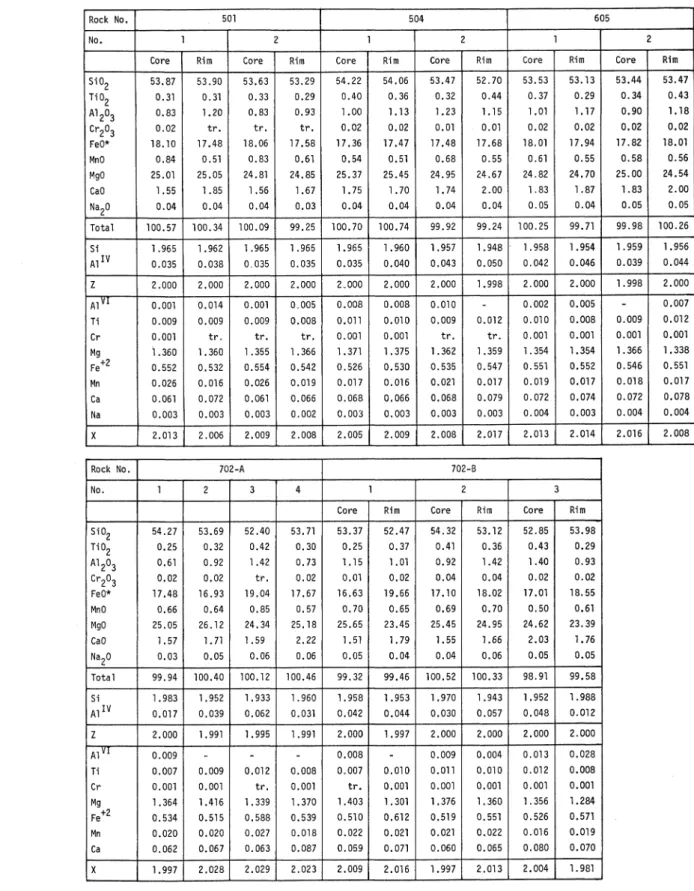
Phenocrystic olivines, clinopyroxenes, orthopyroxenes and plagioclases of volcanic rocks, sample nos. 501, 504, 605, 702-A and 702-B, collected at Anak Krakatau were chemically analyzed by means of the electron-probe microanalyzer (EPMA). Electron-probe microanalyses of olivines, clinopyroxenes and orthopyroxenes were determined by the general method and corrected by the Bence-Albee method, and those of plagioclases were measured by the rapid method proposed by Yusa (1975).
The electron-probe microanalyses of phenocrystic olivines, clinopyroxenes and orthopyroxenes are tabulated in Tables 7, 8 and 9, respectively, together with their respective structural formulas. The structural formulas were calculated on the basis of 4 0xygens per formula unit for olivine, and 6 0xygens per formula unit for clmopyro-xene and orthopyroclmopyro-xene. Anorthite-contents of phenocrystic plagioclases, represented
● by the anorthite molecular percent for core and rim of the zoned phenocryst, are given m Table 10, together with types of zonning.
●
MgSiO3 Mole. % FeSiO3
Fig. 9. Plots of the analyzed phenocrystic olivmes, clinopyroxenes and orthopyroxenes of volcanic rocks from Anak Krakatau on Brown's (1957) diagram showing the Skaergaard pyroxene trends (dashed lines). Symbols: open squares, open circles and solid circles represent olivines, clinopyroxenes and orthopyroxenes, respectively.
58 N. Oba, K. Tomita, M. Yamamoto, M. Istidjab, M. Badruddin
As a result, the analyzed phenocrystic olivines, clinopyroxenes and orthopyroxenes are, as seen from Fig. 9, similar in composition to phenocrystic olivines, clinopyroxenes and orthopyroxenes of volcanic rocks of island arcs (e.g., Nicholls, 1971), as well as those of basaltic and andesitic rocks of oceanic islands (e.g., Carmichael, 1967).
(1) Olivines
The analyzed phenocrystic olivines range in composition from Fa22 (chrysolite) to Fa39 (hyalosiderite) (see Fig. 9). An individual phenocrysts of olivine show zonnmg.
The compositional variation is less than 5 mole. % in the component of fayalite within
the zoned olivines. Meanwhile, phenocrystic olivines of the volcanic bomb (sample no. 702-A) have slightly normal zone in compositional change (see nos. 1 and 3 in Table 7). In the NiO-content, the analyzed phenocrystic olivines are lower than phenocrystic olivines of basaltic rocks of oceanic islands (e.g., Moore and Evans, 1967).
(2) Clinopyroxenes
The analyzed phenocrystic clinopyroxenes range in composition from Wo44Fs12
to Wo38Fs17 ; that is, they belong to augite according to the classi丘cation of clmopyroxenes
by Poldervaart and Hess (1951). The compositional variation is less than 5 mole. %
m the components of wollastonite and clinoferrosilite within the zoned augite grains. A tendency of a slight decreasing of the wollastonite-component, and, in contrast, a
●
tendency of a slight increasing of the clinoferrosilite-component, from core towards
I
rim, are as a whole recognized in the individual augite grains (see sample nos. 605 and 702-B m Table 8). The values of the Fe2+/Mg ratios are fairly uniform throughout the analyzed phenocrystic augites of the volcanic rocks from Anak Krakatau. In the contents of A1203 and Cr203, most of the analyzed phenocrystic augites are much lower as compared to those of phenocrystic clinopyroxenes of basaltic rocks of oceanic islands (e.g., Carmichael, 1967).
(3) Orthopyroxenes
The analyzed phenocrystic orthopyroxenes range in composition from Fs26 (bronzite) to Fs31 (hypersthene). No zonning can be observed in phenocrystic orthopyroxenes of sample nos. 501, 504 and 605, rocks of lava flows. Microphenocrystic orthopyroxenes of volcanic bomb (sample no. 702-A) have a slight compositional di鮎rence grain by gram. A weak normal zonning is found only in phenocrystic orthopyroxenes of a xenolith (sample no. 702-B) from the volcanic bomb, though the compositional variation
within the zoned phenocryst is less than 5 mole. % (see Table 9).
(4) Plagioclases
The analyzed plagioclases, large and intermediate phenocrysts is size, of rocks ●
of sample nos. 501, 504 and 605, lava鮎ws, and sample no. 720-A, volcanic bomb,
range m composition from An83 (bytownite) to An59 (labradorite) (Fig. 10, left); and those of a xenolith (sample no. 702-B) from the volcanic bomb range in composition from An90 (bytownite) to An67 (laboradorite) (Fig. 10, right). The anorthite-composition of microphenocrystic plagioclases were also measured to be An70--An55. Most of the
LD ∼ a , i の ● u ⊃ 0 0 C O i- 0 0 r- r■- c o m oo i∫) ∼ Ln L ⊂3 0 0 C O i- 「 . + -> M ● ⊂⊃ ⊂⊃ S- r- IT i ⊂〉 ⊂) 0 ⊂⊃ ⊂> 4 -> Lf一 寸 ⊂> ⊂) ⊂) O U C0 ⊂) ⊂⊃ ⊂⊃ Cn ⊂つ く> M N M C hC n r-●O● i-●O● O●O● O● I-≡ Cr > i- lo c sj o j 卜、 N N ⊂> 卜、 CM O ¥ V、O C T > <」 > CO 、■D ⊂> ⊂〉 00 00 CM i-● ● ● ● ● ● ● ● C n ● ⊂> ⊂⊃ L 寸 ⊂> r- ⊂> ⊂⊃ ⊂) ⊂D + 蝣> C O W ⊃ ⊂> ⊂⊃ ⊂> ⊂) u ⊃ .I -⊃三 卜、 O ⊂> 卜、 ⊂> M ⊂> ⊂〉 M N の C h くn i-●O● i-●O● O●O● O● q J L O 寸 LD 卜、 くn vr > o ⊂⊃ ∼ r- CNJ i- i- 寸 r- U ⊃ N LO O O 寸 CT > CM r-● ● ● ● ● ● ● ● Lr ) ● O ⊂〉 ⊂) C h ∝〉 r- O ⊂> O ⊂> ⊂> C O Un ⊂> ⊂〉 ⊂) くつ U F、M ⊂> O N<」 > O 寸`、つ ⊂> O O l r-●O●⊂⊃● -●o● ⊂>●⊂)● ● ォ3 -⊂) LO M ≡ ⊂⊃ ● 卜、 Ln 寸 cr > o o ⊂) M ID CV I サ Ki⊃ ⊂) CM LO W 卜、 し く⊃ lo in ⊂D r- i- ∼ ● ⊂d o s- a 、 卜、 ー- ⊂) ⊂) . 4 -> O C > 一-> 0 0 IT ) ⊂〉 ⊂) O C」 r、M o inN ⊂⊃ MID O ⊂> C nC n i-●C D● r-●⊂)● ⊂⊃●⊂>● ⊂>● <D L CV J C O <T サ ト、 M 卜、 C n O 、 C h の M r- 卜、 CO CM ID CM LD ⊂⊃ O CM IT > ⊂) r- ⊂〉 ● ● ● ● ● ● ● ● 0 0 ● C n ⊂3 O CO Cn r- ⊂) ⊂) O l ⊂) ⊂⊃ c o in C > ⊂) ⊂⊃ O U 卜、 ⊂⊃ ⊂) tD ⊂> in ⊂> ⊂) の N rり C h O 、 ⊂>●⊂)●⊂)●ド-■ ⊂● >● ⊂〉 ⊂● )● ⊂〉● ∼ ≡ .I-`=ヒ 寸 Ln M 寸 の M 0 0 p- i- in u s r、 Ln M ⊂> L ⊂D CM Cり C O r- i-. 4-> . . . * . * 卜、 ● ⊂3 O S- CM Ln ⊂) ⊂⊃ ⊂> O O + 蝣> IS ) 句- ⊂> ⊂} ⊂〉 C n ⊂⊃ r- ⊂) C h ⊂) ⊂> M N M ⊂) ⊂) I-● ● ● ● ● ● ● i- O r- O O C D O C} L ⊂3 i- CT ¥ C O C O 卜、 C 0 I- 卜、 M ● 寸 ⊂> ロ、 in c¥j LO S- i- 、 寸 卜、 r- ⊂〉 4 -> ○ 0 0 ● Cr サ o s- r一一 Lrー ⊂〉 ⊂⊃ ⊂⊃ <r > o + > in 寸 ⊂> ⊂⊃ ⊂) O U C 0 ⊂) ⊂) ⊂) O 、 ⊂) ⊂) M N M C hC n ● ● ●o● o●o● o● ● 一一■ ≡ LO C O <T サ ト、 卜、 ⊂> r- u ⊃ N . の 卜、 Cr > lt > cm M L ⊂3 C O C O CM r- r- 、0 ● C n ⊂ S- 0 0 0 ⊂) ⊂) ⊂> . 4 -> 0 、 ⊂> lP 寸 LL, ⊂> ⊂⊃ O .J-α M00 O C ON C 〉 C Or一一 ⊂> ⊂> ⊂>⊂> I-● ● ● ● ● ● ● ⊂) ⊂⊃ 「 ⊂) ⊂> ⊂) ⊂> <D i-ロ、 CM LfJ C O LO ⊂〉 ト N M 匂 CM - r - ⊂> ⊂5 Lf> C O 卜、 ⊂⊃ ⊂) LD 寸 U > i- 蝣 蝣 -● ● ● ● ● ● ● ● 卜、 ● cr > o s- 卜、 N r- ⊂⊃ ⊂〉 C h ⊂) + 一 句蝣 LO ⊂) ⊂) ⊂) O U の卜、 くつ ⊂) のN ⊂> 卜の、 ⊂⊃ ⊂) αCh O●O● r-●O●O●⊂)● ⊂>● r-rr) ∼ I-● ○ ≡ ● 卜、 u ⊃ u ⊃ M C n 卜、 ⊂⊃ C n 「、 Lf ) U 5 C O ID CM CM Lf) C O CV J ⊂⊃ ● ● ● ● ● ● ● ● O ⊂> 0 、 0 の ⊂> ⊂> u ー ● ⊂〉 C0 ⊂> ⊂D C O LO - ⊂> ⊂⊃ C n C ) ⊂) の 、D ⊂) ⊂〉 ⊂⊃ I-凸三 LDM N rり ⊂> r-● ● ● ● ● ● ● ● O O O r- O O O O C} 」_ <T > r - ⊂> ⊂) 、D 卜、 ⊂> N LO 卜、 M ● ⊂} ⊂> M 、JD M c r> o i- 寸 U ) C O CM r -● ● ● ● ● ● ● ● 卜、 ■ 0 1 ⊂⊃ L 寸 寸 r- ⊂) ⊂> C n ⊂D + 蝣> C O KO ⊂> O ⊂> O U ≡ ■ u ) くつ ⊂> C0 ⊂⊃ M ⊂⊃ ⊂⊃ M N の O lO 、 o●o● -●o● o●o● o● ⊂⊃ i- 0 0 rー ⊂3 CT > CVJ ∼ N rり ● 卜、 寸 寸 L n M r- ⊂) ⊂> C0 、.0 0 0 i- i-● ● ● ● ● ● ● ● 卜、 ⊂⊃ ⊂⊃ C0 ⊂3 C O O O 卜、 ● ⊂⊃ C h ⊂⊃ L 寸 寸 rl- ⊂> ⊂⊃ C n ⊂D -P C O U 3 ⊂> ⊂) ⊂) ● ● ● ● ● ● r■ -亡と qJ L C O C¥J C ー ⊂> r -I ○ CD O r- C D O CD O ⊂⊃ u ー ● 0 2 1 j* 句 ■ 寸 ⊂5 CO i- i- r- O の ⊂⊃ M r ⊂ C¥ J CT ¥ C¥ J LL , ⊂⊃ i- <t > in ir > c o r-. . . I . . . ⊂) ● O ⊂> O 卜、 O f- ⊂) ⊂> ⊂⊃ ⊂⊃ ⊂〉 C O i」 ⊃ ⊂) ⊂⊃ ⊂⊃ ○ 卜、 ⊂⊃ ⊂) u ⊃ ⊂) 寸 ⊂⊃ ⊂⊃ ⊂> ● ● ● ● ● ● ● ● r- O C 3 i- O ⊂> ⊂> ⊂) U ≡ ● M N rり ⊂〉 rI ⊂⊃ 寸 LD 、JD if ) 寸 O L∫, ⊂⊃ C¥J C¥J r- 卜、 M N 、■D M CO O ⊂〉 in tn 卜、 N r-● ● ● ● ● ● ● ● 卜、 ⊂> ⊂> 卜、 ⊂> 寸 ⊂⊃ ⊂> M N M u ⊃ ● ⊂⊃ ⊂> r-の O ⊂> 卜、 ー- r- O ⊂> ロ、 ⊂> O C O VD ⊂) ⊂> ⊂> r■ 凸亡 C} L O U ● ● ● ● ● ● ● ● O O O r- O O O O 寸 の 卜、 寸 寸 C O CT > r- L0 O N r 一 C rサ <」 > c¥ j in csj M ⊂) ⊂) 寸 u ー u ⊃ ● ● ● M ● ⊂⊃ ⊂) I- r-ーづ O l ⊂⊃ ⊂> ⊂D CO i- O ⊂⊃ o ^ o o 寸 L n ⊂> O ⊂⊃ ● ● ● ● ● ● ● ● O O O r- O O O O ∼ ○ 卜、 O ⊂⊃ u ⊃ ⊂⊃ -∫) ⊂⊃ ⊂) M N M M C¥J C VJ O * U ⊂> くつ N ⊂) ⊂> ⊂> ⊂⊃ ⊂⊃ JJ + 0 ⊂〉 α ⊇= ∽ ト- < C Ll . ≡: E U Z ト一 ∽ く〔 ト- E LL ≡= U Z r L d 召 月 e r s T i r e 己 y o q ^ 1 0 s s p o j o i i t b o j o a x n o j t j s a u i A i p j o s o s A ¥ 相 良 O j o i u i 9 q o j d -u o j : q -0 9 j 3 [ ト a i q ^ x
N. Oba, K. Tomita, M. Yamamoto, M. Istidjab, M. Badruddin 60 s u a S A x o 寸 叫 O S 叫 s -e q o q r j . u o p a ^ j n o r e o o x e 詔 l n 百 i o i T ' B j e n ^ o n j ^ c ' O a j T s b a j r e ^ o t * ロコ -∼ ⊂) 卜、 ∩ ∈≡ L O C O U D 卜、 卜、 u ⊃ 卜、 N M 0 0 C¥ J r- 0 0 T、 卜、 LO CO M ⊂> O N 卜、 0 0 i- r-● ● ● ● ● ● ● ● 卜、 ⊂⊃ ⊂) ⊂> 寸 ⊂) ⊂) t` 〉 ● の の ⊂〉 ⊂D 0 0 C O i- ⊂) ⊂) O l ⊂〉 ⊂D C O LO ⊂) ⊂⊃ ⊂) ● ● ● ● C 」 u ⊃ M N M の ● ● ● ● O O O i- O O O O C} iI 00 M C O 卜、 C0 ⊂) 卜、 (=0 M lo co ⊂⊃ N ∝ 〉 Ln N N ⊂) ⊂) td ■ 卜、 c r> r- o ● ● ● ● ● ● ● ● 卜、 ● C h ⊂ S- CT > CT > ⊂) ⊂〉 O l ⊂0 4 -> C O LT > ⊂) ⊂⊃ ⊂⊃ くつ U M卜、 ⊂ 〉 ⊂> tDN ⊂> 寸m ⊂⊃ O のCh O● OO i- O O O O ∼ ≡ ● 0 0 r- 卜、 M 寸 CO 0 0 寸 M C O CM C O CO 卜、 LD C O N ⊂) ⊂⊃ LL, 卜、 l∫, r 【 ● ● ● ● ● ● ● ● 卜、 ⊂〉 ⊂> ⊂> 寸 ⊂⊃ ⊂) LO ●■ ⊂⊃ C n ⊂) L 「 、 ⊂) ⊂〉 O l ⊂⊃ 4 -> CO V」 > ⊂) ⊂) ⊂⊃ ● ● ● r-凸:: M 「 、∼ の ⊂⊃ I-● ● ● ● o < o o o d} i . の r- 卜、 一、 UD i- <^3 0 LD ⊂0 CM r- の 卜、 Ln N O l ⊂) O M 卜、 U D i- 「ー■ ● ● ● ● ● ● ● ● ⊂> ● C n ⊂ S- 0 0 r- ⊂⊃ ⊂⊃ C n ⊂> + J CO 、D ⊂> ⊂〉 ⊂⊃ くつ U LDM ⊂> O 卜、N O q ■rり ⊂> O ⊂⊃⊂> f-● ● ● ● ● ● ● 0 ⊂> r ⊂> O O ⊂> r-≡ ● LO CM CO VO ⊂> <r > a 〇 N Ln 寸 寸 ● 卜、 <d- 、」 } LO C O r- ⊂) r- 寸 「、 CM ォ- i-● ● ● ● ● ● ● ● 一、 ⊂) ⊂) 卜、 ⊂) ● 0 、 ⊂〉 S- <」 > I- r- O ⊂) の ⊂) 一-> CO <O O ⊂⊃ ⊂> ● r ■ ⊂ピ CO C¥ J ⊂⊃ 寸Cり ⊂⊃ ⊂⊃ ⊂>⊂> r-● ● ● ● ■ ● O O r- O O O Q C } L N 0 u ⊃ O 寸 CO 0 0 寸 ∼ C O Lft . O J O 卜、 Ln M CM S- r- 寸 卜、 LD i- 一一 4 > ur > ● O l ⊂〉 L 「、 ⊂) ⊂) の ⊂) 一J (Y ー し`) ⊂> O ⊂⊃ くつ U 卜、 ⊂) 卜、 ⊂> 匂 ■ ⊂> ⊂) M N rり ⊂> ⊂) I-● ● ● ● ● ● ● o o o o < c I ∼ ⊂> 卜、 LO M ≡ ● CX > r - r- M O 、 卜、 ⊂⊃ C0 C O q o o c o cr > 10 O si 寸 ⊂> r∼ 寸 co 0 1 c¥j ⊂⊃ ● ● ● ● ● ● ● ● C0 ⊂> ⊂⊃ ⊂> ⊂> ⊂⊃ 、D 1 ● ⊂> ⊂) ⊂ S- CO CO ⊂> ⊂〉 ⊂) ⊂⊃ ⊂〉 一一J 寸 u ー ⊂) ⊂⊃ ⊂〉 ● ● r■ 也 : M 寸N く、DY ー ⊂> ド ● ● ● ● ● r■- ⊂) r O ⊂> くつ くつ (U L id r- ro °) N r - ロ、 C0 ⊂ > M 寸 ● ⊂> 匂 ■卜、 Ln N 寸 ⊂ O CO O - ⊂) ● ● ● 一 ● ● ● ∼ ● O 、 ⊂〉 L 廿 u ー ⊂> ⊂) ⊂) O l ⊂> 一-> LO 寸 O ⊂〉 ⊂> (⊃ U (X⊃CO ⊂⊃ ⊂) r-C¥ J ⊂> ⊂)ォd - ⊂⊃ ⊂> ■8 r■ ● ● ● ● ● ● ● O O i- O O O O ∼ ≡ C0 . 「 、 O 寸 t寸■ 卜、 M M 寸 cvi <y 、 CM O LO 0 0 C0 し こ) C0 寸 LL, 「 ■一 rN ⊂> ● C h ⊂ 〉 S . ID CM 一一■ ■⊂) ⊂) . 4-> O l ⊂ ) ■←一 寸 LL, ⊂> ⊂⊃ O a n 卜、CO ⊂) CMの ⊂> 卜、P O ⊂> ⊂) `= >⊂> r-● ● ● ● ● ● ● ⊂> ⊂) 【 ⊂) ⊂> ⊂) ⊂) 4 , O寸 S- i-r - 0 0匂■ 匂 -CO r -CO r -卜、 i-寸 LD0 0 ⊂) ro . vo r- ⊂3 m c o ● ⊂> の ⊂ 〉 SL 00 i- i- ⊂> ⊂> i-0 ● 4-> . . . . C0 ⊂> M ⊂〉 の ⊂> ⊂> ロ、 ⊂⊃ 一J q - UD ⊂> ⊂) ⊂) ● ● ● ● ● ● ● U M N `Y, ⊂) I. o o o o I-M ∼ ● ○ ■ ≡ ● M N r り U D IT ) LO VO r- r- tD 寸 ● r- 「 - LO CO W r- O r 一 寸 VD CO C M r ● ● ● ● ● ● ● ● O ⊂ 5 CO O <T > ⊂⊃ ⊂ > ド ● ⊂> O 、 ⊂ 〉 L Ln 卜、 rI- ⊂〉 ⊂⊃ C h ⊂3 + 蝣> C M 卜、 ⊂〉 ⊂> ⊂) ● ● ● ー■■ 凸こ C , L くつ tD M M N ⊂ 〉 r-● ● ● ● ⊂> く⊃ r O ⊂> ⊂> ⊂> 卜、 V O i- 一〇、 c o in lo c o 寸 、D 卜、 r- CO くー■ 寸 卜、 M N ⊂) N C > Ln 卜、 CNJ I-● ● ● ● ● ● ● ● tD ⊂> O r ⊂> O O ⊂> M ● ロ、 C h く⊃ ⊂) l∫ー ⊂) くつ Cft O O CM 卜、 0 0 ⊂) ● ● ● ● ● ● ● ● 0 - ≡● CO C O C O C n o o o o o o o ko in c o o o i- cm r ■ N 0 0 N 寸 i- <¥ J LO CVJ VD 0 0 CV J O r- C¥ J IT ) 0 0 C¥ l r-● ● ● ● ● ● ● ● ト ⊂) ⊂) ⊂> ⊂> ⊂ > め ● o o o ⊂ 〉 CO r- ⊂> ⊂〉 C h ⊂ > ⊂> 寸 m ⊂> ⊂> 0 ● ● r-D 亡 4 , L ォ」 > O Lfi M \N `、つ ロ、 くJ 、 ● ● ● ● ■ ● ⊂> ⊂> ⊂3 r - O O O C > 「 ■● 「、 寸 の 卜、 00 i- CV J C I D ( O W in CM M ⊂⊃ O 寸 LO VO 一一一 r-● ● ● ● ● ● ● ● M ● ⊂3 0 & - 0 0 0 、 rI- ⊂⊃ ⊂) ⊂> ⊂> ■←> C O Lf > ⊂> ⊂⊃ ⊂) ⊂) u ⊃ ● (⊃ z : 上` 0 0 ≡ 卜、 O ⊂> LO O 寸 ⊂) ⊂) M N M C nC h r-● O● r-● O● O● O● O● 卜、 r- L O 0 0 C h M Cr > i- ex > ro 卜、 L n N M ⊂) ⊂> ⊂> CO C Tサ i- ⊂ > ● ● ● ● ● ● ● ● ⊂> ● C h ⊂> L q ■ 卜、 O ⊂ 〉■ ⊂) Cr > o + j lo 寸 O ⊂> O 5 C0 ⊂⊃ O O ⊂) O 、 ⊂) ⊂) の N r り M N N ⊂ > 半 C h の I-ーロ ● ● ● ● ● ● ● O O f- O O O O ∼ U ⊂> ⊂⊃ N ⊂ > ⊂> ⊂) ⊂⊃ ⊂) + J + くつ ○ ⊂亡 2 : ∽ ト- c t U . E E U Z L I. ∽ < ト- E LL E U Z ( p a t i u m i o o ) 」 9 ¥ q e j i
i_n ∼ CD L tナ Ln qナ G l ロ、 ■C n 寸 卜、 寸 LD CO N ⊂) ⊂〉 M 、r > in cm C n C 0 ∝) ド- ■ L∫, q U "> i- U ⊃ CS J ID ID M ● ● ○ ○ ● ● ● ● ● rll-● O l ⊂) CO t- ⊂>⊂〉 ⊂) 卜、 寸 ⊂⊃ (O i-O O O C O cM O O O O ct-⊂⊃ O U ⊂⊃ ⊂⊃■N ⊂⊃ 卜、 ⊂3 U O r- ⊂〉 in i- o j C nC n r● ⊂)● ● ∼ ⊂D●O●⊂⊃●⊂)●⊂⊃●⊂>●⊂⊃●⊂>● ∼● I-E C O C O C O N 、D ⊂) C0 卜、 M O 、 J- ⊂⊃ u ⊃ en r- O 、 c r> r く一一 ⊂) C n 、■D LD C h ⊂⊃ C O C O ID V」 > CM ● ● ● ● ● ● ● ● ● <d -● i - 0 0 C h ⊂) ⊂〉⊂) ⊂⊃O i-⊂) O⊂3 LO0 0 O OCM ⊂> C 0 ⊂> ∼⊂) ⊂) LD C」 rI ⊂> rI ⊂〉 C n o in ⊂⊃ ⊂> in r - o j ⊂⊃⊂> 「ー■■ ● ● i- O ∼● ⊂⊃●⊂)● ⊂)●⊂⊃●⊂⊃●⊂)●⊂>●⊂⊃● ∼● q J i _ の 卜、 r- CO KO <J ¥ ⊂) 寸 卜、 、D LD 可■ ⊂> 卜、 m r- LD ⊂0 CM r- ⊂> Ln i- <>」つ の ⊂〉 、D M 寸 CO CM ● ● ● ● ● ● ● ● ● ∼ ● ⊂) の Cn ⊂) ⊂)⊂> ⊂⊃⊂> rIl⊂) ⊂⊃⊂⊃ LL,C 0 N卜、 r-⊂〉 C 0LO O sJ⊂> M⊂) o U r■- ⊂⊃ N ⊂) C 0 ⊂〉 Lf > r- ⊂) lJ ー r- CVJ ⊂)⊂⊃ 「 -● ● r- O ∼● ⊂〉●⊂〉● ⊂>●⊂⊃●⊂>●⊂>●⊂⊃●⊂>● ∼● 寸 ⊂> LO rI M ≡ ● 匂■ r- ⊂5 M CM r- CO 0 0 f、 M 吋● tO ⊂) M ⊂) r - 0 0 寸 M C 0 ⊂) 卜、 卜、 卜、 く:0 ⊂) r一 寸■ 寸 卜、 N M N 卜、 Cn ⊂> ● ● 「 .■ ⊂> ⊂⊃ ⊂> ● ∼ ⊂⊃ N ⊂) L∫ー ∞ ぐJ N O O O C O CVJ O O O O ● ● ● ● ● ● ● ● o o o o o o o o ∼ ⊂) ● N ■ ● ● ● ○ ⊂> ⊂⊃ C n ⊂⊃ LLー ⊂〉 ⊂⊃ ⊂)● r-一⊃ご I-LO J- r- C M ⊂〉 r-CD NC O LDu ⊃ 一kO、 ⊂⊃<N J r -C 0 寸Cn LnO 、 卜、卜、 OM ● ● ● ● ● ● ● ● ● 0 0 O l ● 寸 u ) ■N 卜、 ⊂) ⊂〉 ⊂⊃(\J r-、`D i-O LOC O C O⊂) U ⊃r - 匂■ NCO M 匂■M i. Cn ⊂) ⊂> ⊂⊃ くつ ⊂⊃ 0 0 C ー ⊂> C O ⊂) ⊂⊃ O U rdLO ⊂⊃ rl- ⊂⊃ C h ⊂> 寸i- ⊂)CM ⊂⊃ C n C n r-● O● ∼● ⊂⊃●⊂>● ⊂)■⊂⊃●⊂)●⊂>●⊂⊃●⊂〉● ∼● ∼ 卜、 C n LD 寸 M ⊂⊃ u ⊃ 寸 Ln 匂● lo ir > ⊂⊃ ⊂3 <T > r- O 、 r- ⊂> C n ∞ 卜、 匂■ u ⊃ rM ⊂〉 ○ くYー u ⊃ Ln c j ド- i- 0 0 Ch ⊂> ● ● p- O ⊂⊃ ⊂> ● ∼ ⊂3 VO C O t- r- r -⊂) ⊂⊃ ⊂D CO C¥ i ⊂〉 C 0 ⊂> ● ● ● ● ● ● ● ● ⊂⊃ ⊂> ⊂⊃ ⊂⊃ ⊂> ⊂) ⊂⊃ ⊂) ∼ ⊂) ● ∼ ≡ ● ● ● ● ● ■ ● ● ● ● ⊂⊃ N ⊂) ⊂⊃ ⊂⊃ ● Ill -α i- o c¥ j o <y ¥ o u ー ⊂) LO f- C¥J ⊂) ⊂⊃ ー■ -Q) L r- N IT ) CM 寸 寸 M ⊂) C0 C n LO LT> ⊂⊃ O ⊂〉 rN u ⊃ C O t- LO ⊂⊃ u ⊃ r- 卜、 rl∼ ⊂⊃ CO CO CO CO C O ● ● ● ● ● ● ● ● ● IT ) ● r- (ココ C n ⊂) ⊂〉 ⊂〉 r- CVJ ⊂⊃ Ln m r- i- CM ⊂) ⊂⊃ ⊂⊃ C O N ⊂つ くX⊃ ⊂) ∼⊂) o U rIL`ー∼ ⊂⊃ N ⊂) Cn ⊂) Lnr- ⊂〉∼ ⊂> ロ、 0 、 I--●⊂⊃● ● ∼ ⊂)●⊂⊃● ⊂⊃●⊂>●⊂)●⊂>●⊂>●⊂⊃● ∼● rl -M ∼ I-● 0 ≡ ● u ⊃ ⊂) 卜、 CS J i- 00 C¥ J 卜、 O , ∼ ⊂) ⊂〉 ⊂) Jl . ⊂) r∼ ⊂) 卜、 C¥J LO i- 卜、 L n 卜、 ⊂⊃ ⊂⊃ LD CO CO LD N t∫) CM O C⊃ Cn ⊂〉 ● ● r- O ⊂) ⊂⊃ ● ∼ rI N ⊂5 W CM r - O O W ⊂〉 ⊂) ⊂⊃ C0 m ⊂> 卜、 ⊂> ● ● ● ● ● ● ● ● ⊂⊃ ⊂⊃ ⊂〉 ⊂⊃ ⊂) ⊂⊃ ⊂⊃ ⊂> ∼ ⊂) ● ∼ o c vj o o o Ln o ^ o ●■ r■■■ 凸= O ) L 「 - O C O O 、 in i- i- r-一一 ⊂) ⊂) rlII 匂■ 卜、 u ⊃ M r- 卜、 Cr > ir > CO ⊂> Cr > r- ⊂) ID C h i- 0 0 ⊂⊃ cvj ir > ⊂⊃ ⊂〉 C0 LD O l ⊂5 CO CO CM 寸 N ● ○ ∼ ● N 卜、 ひ ⊂> ⊂>⊂) C 〉 ⊂⊃ ⊂つ⊂D くC O寸蝣 CT >M r-⊂) r-C O CMC > ∼C > O U ≡ r∼ ⊂) r- ⊂) 0 1 ⊂> Ln C > ⊂) LO r- C\J ⊂⊃ ⊂〉 I-● ● 「 ■■ ⊂⊃ ∼● ⊂)● ⊂)● ⊂)● ⊂⊃●⊂⊃●⊂⊃●⊂>●⊂)● ∼● Ln o cv j r- 卜、 i- co en 卜、 寸 M 卜、 ⊂) て「 「、 ● 卜、 M M ⊂⊃ ⊂) 寸 、D tJ⊃ u ⊃ ⊂⊃ LD 寸 卜、 U D C¥J ● ● ● ● ● ● ● ● ● u ⊃ ● M 、D q 、 O ⊂⊃⊂> ⊂3⊂⊃ p-⊂⊃ 4 ->S C O卜、 ⊂3C ー i-⊂⊃ CT >一、 C O⊂) ∼⊂> cxl qJ i-P∼ C D i- ⊂> C h ⊂5 Lrt CT i ⊂〉 LT i I 1 C nC n r-● O● ∼● ⊂)●⊂⊃● ⊂>●くつ●⊂)●⊂)●⊂⊃● CM● LL, LO L O f- CO rq CT > CX> C¥J ∩) 寸 寸 C 0 くナ Lf) LO '寸● M LO 卜、 in ld 寸 ⊂〉 ⊂) せ r O 、 N ● ● ● ● ● ● ● ● ● 寸 ● M ID C n ⊂> C nC n l-⊂) ■ト〉L ⊂>cr > i-co i-⊂> VD卜、 i -⊂> ∼⊂> O U ≡ r ⊂> r- ⊂⊃ ⊂) ⊂) ID CO C ⊃ LO i- r- I C nC n ■一●一 ⊂>● r-● I ⊂⊃ ⊂) ⊂⊃ ⊂⊃ ⊂> ⊂> ∼● C n 、.」 > LO r- 00 ⊂) N Cn O 〇 C 0 Uf> LO ⊂〉 ⊂⊃ CO C O CO 寸 ⊂) LO C0 卜、 r- ⊂⊃ 匂● 寸 r- r- O J ● ● ● ● ● ● ● ● ● ∼ ● r∼ 0 〇 O l ⊂> ⊂)⊂> t-⊂〉 ⊂⊃CV J 4 ->S- 匂●00 CMO l r ■⊂)■ 「 ■C0 N⊂⊃ ∼⊂> c L <D L O ⊂〉 ⊂) N ⊂〉 C n ⊂:> in ⊂) ⊂) LO r - CM C hC n r -● O● ∼● ⊂⊃●⊂⊃● ⊂>● ⊂⊃● ⊂>● ⊂⊃●⊂⊃● ∼● ⊂⊃ Ln ● `⊃ " Z . 15` ID CM W rつ 00 <」 > 00 i- ー tD ∼ Ln ir > ⊂) C0 ⊂〉 r- 寸 ⊂D r- UO C n の LD 卜、 r- ⊂3 en n r o 寸 N ● ● ● ● ● ● ● ● ● r- ⊂) N ⊂) CO 〔) Ln ⊂> O C n ● C n N 卜、 C n ⊂> ● ・ ⊂) ⊂) ■ r- CM O IT ) 0 0 i- i- I -O O O OO cvJ O C O O ● ● ● ● ● ● ● ● I-⊂) ● U ≡ LO i- CVJ C n i- O ∼ ⊂⊃ ⊂⊃ ⊂) ⊂) ⊂) ⊂> ⊂つ く⊃ ∼ O CM CM 卜、 寸 t ナ 卜、 ト M ∝〉 N ⊂> 仇 の ● N 寸 寸 N ⊂> 寸 ⊂> 0 0 LO S- 0 0 ォ5ア LO 卜、 N . . . -4_> o o ● ⊂) O l O l ⊂) ⊂〉⊂〉 ⊂⊃I- CV J⊂Z> + JS- 一0 0、 CVJCO ⊂⊃r- 卜、Lf> CSJ⊂> ● ∼⊂> 5 1 a, L O O IT ) 00 O LO r- i- i- C nC n r -● O● ∼● ⊂>●⊂⊃● ⊂>● ⊂⊃● ⊂)● ⊂)● ⊂>● ∼● 卜、 C 0 ⊂) 可蝣 00 CO qナ u ⊃ LD LD O 、 r- ⊂〉 U 3 W r - C O N r-■ N C h LD M ■、 寸 ⊂⊃ ID CO LO 00 C¥J ● ● ● ● ● ● ● ● ● r-● C n ⊂> C O r - ⊂>⊂> ⊂>⊂〉 ⊂⊃N ⊂⊃⊂⊃ r、C 0 M⊂) ー⊂⊃■■ ⊂>C0 r-⊂> M⊂⊃ O U ⊂⊃LO ⊂⊃ N ⊂) ロ、 ⊂3 r-LO 「 -IO 、 ⊂⊃ M rr 〉 N N ⊂> ⊂> * ⊂⊃ C n O l I-LC ● ● r- O > ● ∼ ∼ ● ● ● ● ● ● ● ● ⊂〉 ⊂⊃ ⊂つ く⊃ ⊂) ⊂⊃ ⊂⊃ ⊂> ∼ ● ∼ >< U くつ ⊂〉 ⊂> N N ⊂) ⊂> ⊂> ⊂) ∼ i- !- r- S (D `= ⊂n ーq d + J O .r-I r-+ !- i- ⊂n C } ⊂ニ ーq rt5 α ≡ ∽ ト- < r o u _ ∑ ∑ U Z ト一 ∽ < < ト● U ∑ LL ∑ U Z n d 召 出 v x y i 5 f e u y o q ^ 叫 O S 5 T O O J C O T t r e O T O A 8 0 j j s o i i o x o x ^ d o i i i p j o s a s A p s S O J O T 百 a q o i d -u o x p a T 叫 8 m v x