第 55 卷 第 4 期
2020
年 8
月
JOURNAL OF SOUTHWEST JIAOTONG UNIVERSITY
Vol. 55 No. 4
Aug. 2020
ISSN: 0258-2724 DOI:10.35741/issn.0258-2724.55.4.40
Research articleEducation
L
ANGUAGE
A
SSESSMENT IN
E
NGLISH
LANGUAGE
TEACHING
:
A
W
ASHBACK OF
I
NDONESIAN
S
TUDENTS
’
T
EST IN
COVID
19
S
ITUATION
英語語言教學中的語言評估:印尼學生在 19 情景中的測試後退
Syafrizal Syafrizal a, *, John Pahamzah aa Department of English Education, Sultan Ageng Tirtayasa University
Banten, Indonesia, *[email protected]
Received: April 12, 2020 ▪ Review: June, 24 2020 ▪ Accepted: July 13, 2020
This article is an open-access article distributed under the terms and conditions of the Creative Commons Attribution License (http://creativecommons.org/licenses/by/4.0)
Abstract
The objectives of this research were to discover the lecturer’s perceptions of the English formative assessment through online classroom testing and to determine the washback of students’ formative assessments through online classroom tests in English language teaching. This research employed the qualitative method, specifically a case study as a research design. The participants involved an eleventh-grade English lecturer and 25 students University students who were selected purposively. Semi-structured interviews and the students’ open-ended questionnaires were used to collect the data. The data were analyzed qualitatively through Miles and Huberman’s procedures. Data analysis revealed that: (1) an eleventh grade English lecturer had positive perceptions concerning the formative assessment understanding and several strategies of follow-up actions through online classroom tests by giving some feedback to the students in comprehending the materials and test; (2) the washback of formative assessments through online classroom was dominated by more positive washbacks than negative washbacks in the language testing. The results of 60% students indicated that they tend to be relaxed to complete the online test, 48% students regarded that their English lecturer had reviewed all of the materials at the end of the unit, including the exercise in online test-taking preparation, and 44% students assumed that an English lecturer provided the feedback for improvement. Therefore, it can be concluded that an English lecturer’s perception was appropriate with the positive washbacks that were obtained in the formative assessment through online classroom by giving feedback for the students.
Keywords: Washback, Formative Assessment, Online Classroom Test
摘要 這項研究的目的是通過在線課堂測試發現講師對英語形成性評估的理解,並通過在線課堂測
設計。參與者包括一位 11 年級的英語講師和 25 名有針對性的大學生。使用半結構化訪談和學生 的開放式問卷調查收集數據。通過 Miles 和胡伯曼 的程序對數據進行了定性分析。數據分析顯 示:(1)一位 11 年級的英語講師對形成性評估理解有積極的看法,並通過在線課堂測試通過給 學生一些理解材料和測試的反饋,對採取後續行動的幾種策略產生了積極的看法; (2)在語言 測試中,通過在線課堂進行的形成性評估的反洗更多地是積極的反洗而不是消極的反洗。 60%的 學生的結果表明,他們傾向於放鬆地完成在線考試; 48%的學生認為英語講師已經復習了單元末 尾的所有材料,包括在線考試準備練習,有 44%的學生認為英語講師會提供反饋以改善自己的情 況。因此,可以得出結論,英語講師的觀點與通過在線課堂進行的形成性評估中通過在線課堂獲 得的積極反洗是適當的。 关键词: 回洗,形成性評估,在線課堂測試
I. I
NTRODUCTIONLanguage teaching is related to language testing since it can evaluate achievements. In language ability and achievement, language testing is essential since it the information to know about the students’ achievement or ability. Another aspect of language testing that is important is assessment. It is also considered to affect what and how lecturers teach. Thus, the effect in language testing is regarded as washback [1]. As a principle of language assessment, washback is very crucial to provide ongoing feedback. It could be applied by instructors to improve the teaching method and to improve the students’ learning, particularly in the formative assessment. Formative assessment means the variation of methods which can be implemented by lecturers in the evaluations process related to students’ understanding, learning needs, and academic progress in each end of learning chapter or unit. By conducting formative tests, lecturers are able to determine the success of the teaching and learning pprocess, particularly a specific lesson. Therefore, they can decide what the next actions to the students are. One of ways of collecting data for assessment is by using tests. Tests are a particular kind of assessment usually used by lecturers to know to what extent students have mastered the lessons. One such assessment is the achievement test [2]. Besides, the function of tests is to measure a person’s ability, knowledge, and performance [3]. Therefore, tests were one of the things that must be focused on in this research, especially through online classroom tests.
After conducting the test, the lecturer will assess, and the result overall will be washback. Washback is the impact of the tests or assessments in teaching, learning, and testing the students’ language understanding. It can be positive or negative, both for students and English language lecturers in ELT classrooms
[4]. The amount and type of washback depend on the extent to which the status of the test and the level of the test relate to the ongoing teaching practices and the willingness of the lecturers and the textbook authors to do the innovation. Positive washback may occur when lecturers, after deploying assessments, attempt to reflect on their method of teaching and then modify or make it better to facilitate students to learn better in ELT classroom; or students, after taking the test, maybe well motivated to learn more to fulfill their needs in English Foreign Language (EFL) [5]. Conversely, negative washback occurs when students are discouraged or less motivated to learn after taking the test and lecturers dominate their teaching by coaching for testing sessions or
examinations. Those negative washbacks
happened when the tests uncovered worthless decisions in teaching and learning.
Lecturers tend to use scores as rewards and punishments for the students’ goals description; their orientation is to maximize the scores as the students’ performance goals or ethos in the classroom rather than learning goals. They ignore the learning objectives and curriculum program by replacing the teaching and learning process with the test instruction [6]. Thus, this may weaken the students’ perception of the tests. It
could affect the attitude, behavior, and
motivation of lecturers and students. Thus, the washback certainly existed when the tests were conducted in the classroom practice, especially through online classroom practice nowadays. Another impact of washback was found when the students and the lecturer are preparing a formative test. Commonly, lecturers teach the students by giving tests related to the real test and the students are made familiar with the type of test; however, the teaching-learning activities only discussed a certain type of test. This phenomenon is quite different from the main purpose of teaching and learning. Thus, by
knowing washback, we can decide further action in an online classroom because of tests. Therefore, based on the background of the study
above, the researcher was interested in
conducting the research titled “Language
Assessment on ELT: A Washback of Students’ English Formative Assessment through Online Classroom Test” which employed the following
research questions:
1) What
is an English lecturer’s
perception of the English formative
assessment through online classroom
testing?
What is the washback of students’
formative
assessment
through
online
classroom testing in ELT?
II. L
ITERATURER
EVIEWThe connection between language testing and language teaching can be seen in a bond called
washback effects. The washback effect
acknowledged in the early 1990s by Alderson is assumed to be the effect of the teaching, learning, and testing language. He argued that washback means the test that influences the language lecturers and learners to do things they would not otherwise do that inhibit the language teaching and learning process. In other words, washback is the effects of teaching, learning, and testing [7]. Washback is the degree to which a test affects the curriculum that is related to it. In other words, washback is regarded as the side effects of testing.
Besides, the washback effect could be
categorized generally in two major types, positive and negative. Washback is considered positive or negative as long as it either encourages or
obstructs the achievement of educational
objectives organized by learners or program creator [8]. Besides, tests have their effects on the stakeholders which are related to teaching and learning, there is no doubt in it, yet what is the direction of these effects and how much influential these effects are, is still hard to trace. The lecturers use tests to make their students pay more attention to learning, it is a positive influence of testing. If the lecturers' narrow curriculum to make their students sharper on the exams and tests bring anxiety both to lecturers and students, it will be a negative impact on the students’ learning and testing. It can be concluded that the washback effect is defined as the impact or influence of testing or teaching-learning processes. It can be either positive or negative depends on the quality of the test
(testing procedures). Washback will be
successful (positive) if the lecturers and learners
have a good mindset towards the test and actively work towards their goals. In the meantime, washback can be negative if the lecturer or learner does not want to teach or learn and there is a discrepancy between the content and the test.
A. The Concept of Formative Assessment
Assessment is one of the important parts of the educational system. It constantly gave information about the students’ improvement and achievement. It is also quite important in language instructions and it is not an end in itself but a vehicle for educational improvement. Besides, assessment is simplest when it reflects on understanding of getting to know as multi-level, incorporated, and performance-revealed over time and should be authentic [9]. The assessment process that occurs at the end of the college is not just about giving the value of numbers or letters, but it can be a tool to measure a student's understanding of the material taught, attempt to decide what students know and what they can do.
The forms of assessment are differentiated into summative assessment, self-assessment, peer assessment, and formative assessment. One of the assessments that were discussed in this research is formative assessment. Formative assessment refers to observations that allow one to determine the degree to which students know or can perform a given task. The formative assessment contains all those tasks (given by lecturers and carried out by students) at the end of the chapter that includes information used as input so that the teaching-learning strategy can fulfill the students’ requirements. It can also include lecturer
assessment, feedback, and feed-forward.
Formative evaluation is aimed to give feedback for the lecturer as a basis to improve the teaching-learning process and make a remedial program for the students [10]. Therefore, in the context of washback, if we provide the formative test and it was found the students’ and lecturer’s weaknesses in teaching and learning processes, thus the lecturer or instructor should evaluate it in the order it can create the positive washback after testing and the otherwise. If the students had joined the test and it can’t bring a significant result, it didn’t change their learning styles or target after they were tested and their result was still failed, thus it means that the developed test did not give the washback at all. In conclusion, a formative test is a kind of test that is conducted after one unit or one lesson finished given by the lecturer. By conducting the formative test, the lecturers can know how far the success of the teaching-learning process, especially for one
lesson. Thus, they can decide what the next actions to the students are.
B. The Concept of Online Classroom Test
Testing is a specific form of assessment which tends to focus on obtaining a specific sample in the students’ performance. The implicit assumption of testing is the lecturer or instructor creates the specific tasks in designing a test that will result in a performance that can make the inferences we intend to make about the student characteristics, individual, and group. The classroom tests are usually designed based on particular classroom decisions that are based on the lecturers’ lesson plan and the school curriculum. They reflect standard and basic competencies that would be obtained by the students. Therefore, in the educational system, the tests are tools of educational improvement and accountability and are also used to encourage the teaching and learning process [11]. Testing was also defined as the method for measuring the capacity, knowledge, or performance of the person in a particular area. A test is a standardized technique instrument for analyzing and explaining one or more of the student's qualities using either a nominal system or a structured process. Moreover, the test is needed to prove the students’ learning achievement and
performance while the government and
policymaker believed that the test could bring prove and change in an educational program. The tests are decided as a potential way to make the students obtain the standards of educational performance. The school system and its curriculum seem to be driven by the assessment and the test ultimately. There is so much media delivery for giving or providing the test, especially in this digital era. One of them through online classroom testing. The use of online classroom test is now widely used among schools and universities in the world, especially in Indonesia. Assessment is the way of using the internet for informing, analyzing, and reporting the content of the exam, and, when properly used, it can greatly increase the efficacy of online learning [12]. Online classroom test prepares the distance of the students with the capability to act the learning needs, value the outcomes of learning activity, and accelerate learners to the professional credentialing by utilizing an efficient delivery of the internet system.
III.
METHODS/M
ATERIALSThe objective of this research was to investigate the washback of an online formative test. This study employed a qualitative approach
to answer the research questions. A case study is an empirical study that examines the complex current phenomenon in its real-life setting [13]. A case study was chosen in this context because the present study shares some characteristics with it. The participants of this study were an eleventh grade English lecturer and 25 eleventh grade students of a University in the academic year 2019–2020. Purposive sampling was used to access people having in-depth knowledge about particular issues by experience. Thus, when researchers purposively select participants, they select individuals who will best help them understand the research problem and the research questions. In this research, there were two
different data collection techniques. The
researcher used an English lecturer’s semi-structured interview to respond to the first research question, and open-ended questionnaires to respond to the second. Additionally, the researchers also included the results of the students’ English formative assessment from their online classroom test in the second semester of the academic year 2019–2020. Based on the data collection techniques, the open-ended questionnaires and the semi-structured interview were analyzed through descriptive qualitative research. The research questions involved data reduction, data display, conclusion drawing, and verification [14]. In the first step, the researcher read the data carefully for data reduction analysis. Then, the researcher reduced the unrelated information, selecting data from the results of the open-ended questionnaires. After that, the selected data from each respondent was analyzed using a certain code based on the theme of data. Meanwhile, the semi-structured interview was transcribed firstly into the textual form. The result of the lecturer’s transcriptions was read carefully and it was analyzed and coded based on the theme and appropriate theories. Second, in the step of data display analysis, the data of open-ended questionnaires were displayed and described qualitatively based on the pie chart displays. Meanwhile, the data of the semi-structured interview was displayed through descriptive qualitative after it was transcribed. Third, in the step of drawing conclusion and verification analysis, it was obtained from the data reduction up to data display. The qualitative analyst interpreted what things mean by noting patterns and explanations. Therefore, after reduced and displayed data, those data were concluded based on the data analysis and decided what the result meant. Finally, the conclusion of those data was verified as the analyst proceeds.
IV. R
ESULTS ANDD
ISCUSSIONBased on the first analysis of the semi-structured interview results, which involved an
eleventh-grade English lecturer in the
implementation of formative assessment, it was found that the eleventh-grade English lecturer had a positive perception of the formative assessment understanding and several strategies of following up actions through an online classroom test. Further elaboration of each item was presented as follows:
A. Lecturers' Understanding of Formative Assessment
One of the forms of assessment that is usually used by lecturers is formative assessment. It is mainly implemented by a lecturer, especially an English lecturer in the teaching and learning activity, to enhance their instructional tasks to improve the students’ achievement. Therefore, a
comprehensive understanding of formative
assessment is essential for the lecturers to be able to improve the English lecturer’s teaching and learning strategies and to prepare the language or performance testing for the students. In this section, the English lecturer’s understanding of the nature of formative assessment and feedback was given to the students, and it was discussed to provide overall views of the lecturer’s understanding of formative assessment through an online classroom test. Based on the semi-structured interview, which involved an eleventh-grade English lecturer, it was found that the English lecturer had a sufficient understanding of formative assessment and a certain view of the purposes of formative assessment. The English lecturer’s understanding of formative assessment was reflected in their teaching ability.
“For me, formative assessment is conducted to determine the extent to which students understand the lesson. I usually do this assessment at the end of every unit of learning material. Assessments that I have done are usually conducted at the end of every unit of learning. My teaching goal is to make the students understand the learning materials, and not just get a high score during the learning activities.”
That statement showed that the English lecturer had sufficient understanding and understanding of formative evaluation. She had some understanding of the principles of formative assessment and the purpose of formative assessment implementation. This lecturer had used the results of the formative
assessment to improve learning and conducted formative assessments at the end of every learning unit or chapter. It can be seen that the English lecturer had some awareness of the purpose of formative assessment that was carried out to improve the students’ learning and
achievement of the learning objectives.
Formative assessment helps lecturers identify the differences in their target goal and existing knowledge, understanding, or abilities, and guides them through the actions required to achieve this purpose. Therefore, having a
comprehensive understanding of formative
assessment becomes essential for the lecturers to decide effective follow-up actions. Besides, other findings were indicated from how the formative assessment was conducted by the English lecturer. The ability to use appropriate test format was also a reflection of the lecturer’s understanding of formative assessment. The lecturers seemed to have adequate knowledge of various types of tests that should be used for formative assessment. They mainly used various particular types of tests and utilized various forms of assessment.
“I think that if we have used test based application or online platforms, there are several various types of questions which had provided automatically to give the users a chance in exploring their answers. But, the most frequent I used such as multiple-choice, matching technique, short answer technique, true or false, etc...”
The result of the interview above shows that the lecturer did not dominate the class by asking questions to the students by giving chances for the students to clarify the questions or asking other types of questions. This indicates that a
lecturer comprehensively understands the
principles of formative assessment. It also proved that the lecturer’s ability in assessing the students indicates that she had a good understanding of formative assessment and tried to encourage the students to enhance their learning skills.
B. Lecturers’ Understanding about the Students’ Learning Feedback
Lecturer’s ability in giving correct feedback on the students’ learning accomplishment is a part of the lecturer’s understanding of formative assessment. Appropriate feedback may certainly increase the students’ willingness to learn more and build up their curiosity about something that they need to learn. An English lecturer in this study had given the students the feedback and developed different forms of formative testing to
give them some insight into their level of understanding.
“Of course feedback is important for students. I think if the feedback is given, both students and the lecturer become benefited. The students become very happy if the feedback is given individually. In giving feedback, I usually tend to publicly inform my students about their achievement in learning of one particular topic or test and then discuss each student's weaknesses and strengths individually.”
According to an English lecturer, feedback is useful for the students to make them aware of their ability and inspire them to make further
improvements. An English lecturer gave
feedback to the whole class or individual students mostly in the form of oral or written feedback. Formative assessment refers to a process or procedure undertaken by the lecturers and students in the classroom to give feedback on the teaching and learning process to enhance the students’ learning achievement in reaching the educational goals. Therefore, providing feedback was expected to reach the learning objectives, particularly either before or after completing the test. Besides, that became an example of positive feedback given to the students by English lecturers. Lecturers must provide positive feedback to encourage the students to learn more and be willing to do what the lecturers suggest.
“I usually give the students’ score for their achievement in learning. I also try to give some feedback. It is not easy to give feedback to each student because there so many students in one class. I am not just teaching one class in a day. I usually teach two or three classes a day. Most of my feedback is about how they improve their learning so they get a better score during the exam. However, sometimes I suggest them to learn more diligently at home so they can understand more about the lesson. Most of the time I just tell them what to learn at home so really well-pared themselves for an upcoming exam.”
This study also revealed that an English lecturer had difficulty in finding appropriate ways of giving feedback to make the students aware of their weaknesses. [15] This is because in some circumstances some students were reluctant to receive feedback openly in public and to follow up the feedback properly. Lecturers
must provide feedback properly so that the students know about their learning progress so that they can modify their learning styles to improve themselves. On the other hand, the lecturer felt pressured by the demand of the curriculum which required the students to be successful on the high stakes mid or final exam. One of the lecturers claimed during her interview that she had to “teach for the exam” even though she thought that it would be better for the students to have a good understanding of the lesson rather than getting a high score without proper understanding. Due to the pressure, the purpose of her assessment was merely to know the students’ scores. She carried out a formative assessment to determine whether the indicators of learning could be achieved by the students. The main goal was to find out the students’ scores so they could prepare themselves better for the final exam.
C. Follow up Actions after the
Implementation of Formative Assessment
Follow up action is an important thing for the lecturers to do after implementing the formative assessment. In this study, it was found that an English lecturer had utilized the formative assessment results to make several changes to their teaching styles. An English lecturer described that she had used the results as the basis to develop their teaching strategy, teaching technique, and learning material for the upcoming lesson.
“I change my teaching style and develop my teaching material to be more contextual to the students’ learning environment. I design the material from the easier to the more difficult material and also design better instructional media to help my teaching and to help my students prepare the test. So, if there’s the result of the formative assessment, I can modify my teaching strategy, provide the peer discussion, and after knowing the result of the test, I will direct to follow up some actions.”
That statement showed that an English lecturer had used the formative assessment results to do a follow-up action by revising her teaching preparation especially in developing instructional material, media, and strategy that suited the students’ needs better. The follow-up actions taken by lecturers is even more important because these actions are the essence of formative assessment, which directly benefit the students’ learning [15]. The lecturers’ follow up actions in response to students’ learning
problems are compulsory to make learning activities successful and meaningful for students [16]. Without appropriate actions, students’ learning achievement will be stagnant. Thus, from the result of the interview above, an English lecturer made a great attempt to contextualize the material to the students’ learning environment in designing material. An online classroom test was used by an English lecturer as a part of her teaching improvement in terms of using more creative and innovative instructional media for teaching, learning, and testing. Giving reward, and remedial were incorporated in the learning activity, especially after implementing an online classroom test as a follow-up action after considering the results of the formative assessment. Based on the results of the semi-structured interview, it can be concluded that an eleventh grade English lecturer had a
positive perception about the formative
assessment sufficient understanding and several strategies of follow up actions. It occurred because an English lecturer had applied the formative assessment purposes for the students’ learning improvement and achievement
in the formative assessment to reach the learning objectives. Besides, an English lecturer had
implemented various types of formative
assessments and given some feedbacks for the students to encourage them in comprehending the materials and test. Moreover, an English lecturer had used the formative assessment results to do a follow-up action by revising her teaching preparation especially in developing instructional material, media, and strategy that suited the students’ needs.
D. The Washback of Students’ Formative Assessment through Online Classroom Test
Based on the second data analysis of the students’ open-ended questionnaire results, it was found that a washback of formative assessment through online classrooms mostly revealed the positive washbacks than negative washbacks in the language testing. Positive washbacks that were obtained from data analysis showed that most of the students feel relaxed when completing the formative assessment through online classroom test, most the students’ strategies in online test-taking preparation were completed, and an English lecturer’s efforts to
provide the good feedbacks for the
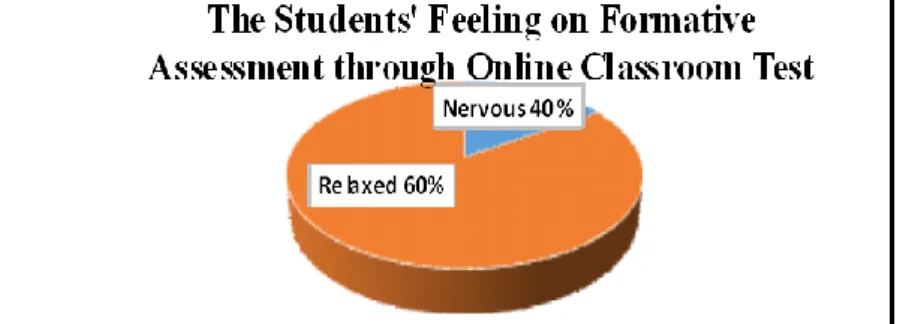
Figure 1. Students' Feeling on Formative Assessment through Online Classroom Test
students. Further findings and discussions are presented as follows. The first washback in this study showed that most of the students indicated that they tended to be more relaxed when completing the online test. They said they had sufficient time to think and to complete the online test.
From the analysis of the students’ open-ended questionnaires above, it can be concluded that 60% felt relaxed when completing the formative assessment through an online classroom test and that only 40% felt nervous when taking the online test (see Fig.1). This indicates that
formative assessment through an online
classroom test created a positive washback for most of the students. Positive washbacks are considered to be achievable and beneficial for
carrying out meaningful change, encouraging
positive teaching-learning processes, and
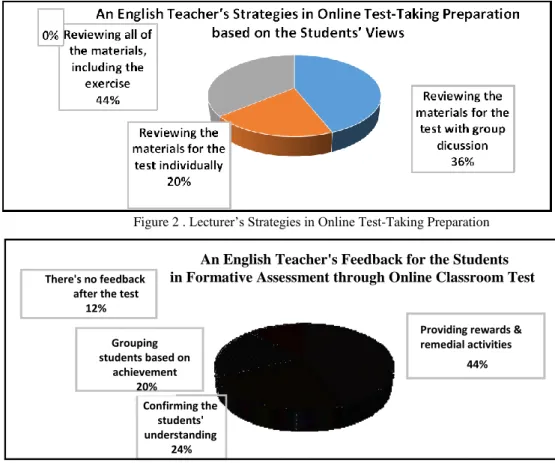
fostering a positive outlook towards testing that encourages working towards its goals. Negative washbacks of student testing, on the other hand, may include dissatisfaction and rejection of the test, competitiveness, and falling grades that affect school evaluations [17]. The second washback in this study showed that most of the students thought that their English lecturer had delivered adequate materials and had ensured the students’ online test-taking preparation was satisfactory. An English teacher’s strategies in online test-taking preparation are presented in Fig.2
.
Figure 2 . Lecturer’s Strategies in Online Test-Taking Preparation
Figure 3. An English Lecturer's Feedback for the Students in Formative Assessment through Online Classroom Test
The analysis of the students’ open-ended questionnaires above also showed that 48% of the students believed that their English lecturer had reviewed and explained all the material to be covered by the test, including the online test-taking preparation exercises, while 32% of the students said they reviewed the materials with group discussions. Only 20% of the students assumed that the English lecturer had asked them to review the materials individually. Overall, most of the students agreed that the lecturer’s strategies for online test-taking preparation were excellent. They indicated that he or she had implemented good methods in the teaching-learning process, as well as providing adequate materials to ensure their students were well prepared. Washback affects what and how a lecturer teaches and can encourage a positive attitude toward language learning when lecturers make sure that students understand and are prepared for what a test demands of them. Therefore, the data analysis above showed that positive washback in the students’ strategies in online test-taking preparation was prevalent. The third analysis of washback in this study showed that their English lecturer had evaluated and
provided feedback concerning the online
formative assessment and that this feedback motivated the students in language testing.
The above analysis of the students’ open-ended questionnaires (see Fig.3) demonstrated
that 44% of the students indicated that their English lecturer rewarded the students who had high scores on the test and provided a remedial program and additional discussion for the students who failed it. This appears to be a result of the students’ view of the importance of feedback on the online English test about their improvement. Also, 24% of the students suggested that the English lecturer had reviewed or confirmed the students’ understanding before and after the test, while 20% of students said that an English lecturer grouped low and high achievers by creating group discussions. Only 12% of the students answered that there was no feedback from an English lecturer. Data analysis is essential for lecturers to provide proper feedback to make students aware of their learning progress so that they can modify their learning styles to improve achievement. Besides, feedback is useful for motivating students. Testing motivates students to study harder; after taking a test, the sense of accomplishment creates a positive washback that can enhance learning.
Based on the results of students’ open-ended questionnaires, it can be concluded that positive washback had been mostly obtained. This occurred because most of the students felt relaxed when completing the formative assessment through an online classroom test. After all, most of the students’ strategies in online test-taking preparation were very good, and because an
Providing rewards & remedial activities 44% Confirming the students' understanding 24% Grouping the students based on
achievement 20% There's no feedback
after the test 12%
An English Teacher's Feedback for the Students in Formative Assessment through Online Classroom Test
English lecturer provided the students with useful feedback. Also, the students felt that their English lecturer had made some positive changes in his or her way of teaching and had prepared the students before implementing the test. After an English lecturer obtained the students’ results, some feedback was provided concerning the students’ learning progress and for encouraging them to be more motivated in language testing.
V. C
ONCLUSIONIn conclusion, washback refers to the effect or impact of testing, which can be positive or negative in teaching-learning activities [18]. Those effects depend precisely on testing steps, the language learning objective, authentic tests, students’ autonomy, and self-assessment, and testing results in feedback. Positive washback occurs when tests encourage students to work hard while providing a sense of achievement that can boost their learning, promote better teaching-learning activities, and are incorporated as a useful process. In contrast, the negative effect of washback happens when a test brings anxiety both to lecturers and students and hurts their performance. As a result, students may be unable to acquire real-life knowledge, instead of learning discrete points of knowledge on which they are to be tested and, as a result, developing a negative washback toward tests. Besides, lecturers are required to possess an understanding of the strategic role of formative assessment. Such an understanding enables an English lecturer to take appropriate actions to follow-up the feedback obtained from assessments and to improve learning and teaching processes for better student achievement. Besides, a proper understanding of formative assessments and appropriate follow-up actions taken by lecturers will improve students’ learning achievement on formative assessments. Therefore, a better understanding of formative assessments and the ability to properly follow up will make assessment programs more meaningful for lecturers and students. [19] The lecturers will be more reflective, and the students will be motivated to learn more to achieve the instructional goals, which will help them attain higher achievement.