Total Synthesis and Structural Revision of
Cyclotetrapeptide Asperterrestide A
著者
Kosuke Ohsawa, Masato Sugai, Linnan Zhang,
Yuichi Masuda, Masahito Yoshida, Takayuki Doi
journal or
publication title
Journal of Organic Chemistry
volume
84
number
11
page range
6765-6779
year
2019-05-09
URL
http://hdl.handle.net/10097/00131263
doi: 10.1021/acs.joc.9b00526Total Synthesis and Structural Revision of Cyclotetrapeptide Asperterrestide A
Kosuke Ohsawa,† Masato Sugai,† Linnan Zhang,†, ¶ Yuichi Masuda, †,‡ Masahito Yoshida,†,§ and Takayuki Doi*,†
† Graduate School of Pharmaceutical Sciences, Tohoku University, 6-3 Aza-aoba, Aramaki, Aoba-ku, Sendai,
980-8578, Japan
*Corresponding Author
E-mail address: [email protected] Phone number: +81-22-795-6865
Fax number +81-22-795-6864
ORCID: Takayuki Doi 0000-0002-8306-6819
Present Address
¶ Faculty of Pharmaceutical Engineering, Shenyang Pharmaceutical University, No.26 Huatuo Rd, High & New
Tech Development Zone, Benxi, Liaoning, 117004, P.R.China
‡ Graduate School of Bioresources, Mie University, 1577 Kurimamachiya-cho, Tsu, 514-8507, Japan
§ Department of Chemistry, Graduate School of Pure and Applied Sciences, University of Tsukuba, 1-1-1
Abstract Graphic
Abstract
The structural revision of cyclotetrapeptide asperterrestide A has been achieved based on the total synthesis
and molecular modeling. For these studies, (2R,3S)-MePhe(3-OH) and (2S,3S)-MePhe(3-OH) suitably protected for peptide synthesis, were prepared via a stereoselective reduction of a ketone precursor, derived from L- or D-serine, using L-Selectride or DIBAL-H. The synthesis of the proposed structure of asperterrestide A (1a) was
accomplished by solution-phase synthesis of a linear precursor followed by macrolactamization. The NMR spectra of our synthetic 1a were not identical to those reported for the natural compound. Molecular modeling studies suggested that the correct structure (1b) was one in which the stereochemistry at the α-positions of the Ala and MePhe(3-OH) residues is the opposite to that of the proposed structure. This was confirmed by the total synthesis of 1b and its subsequent structural characterization.
N NH HN N H O O O O HO HO O NHBoc NH Cl O TBSO NH2 OH O H2N O OtBu asperterrestide A (1a, proposed) Anthranilic acid (2R,3S)-MePhe(3-OH) D-Ala D-allo-Ile N NH HN N H O O O O HO asperterrestide A (1b, revised) Anthranilic acid (2S,3S)-MePhe(3-OH) Ala D-allo-Ile 1) peptide elongation 2) Macrolactamization * * in situ genarated acid chloride
INTRODUCTION
Naturally occurring cyclopeptides exhibit unique biological activities and often possess nonproteinogenic amino acid residues: β-amino acids, D-amino acids, N-methylamino acids, and other highly functionalized amino
acids.1, 2 Among them, anthranilic acid (Ant)-containing peptides are known to be attractive three-dimensional
scaffolds of peptidomimetics because anthranilic acid is one of the most rigid β-amino acids and gives conformational rigidity to the corresponding cyclic and even linear peptides.3–9
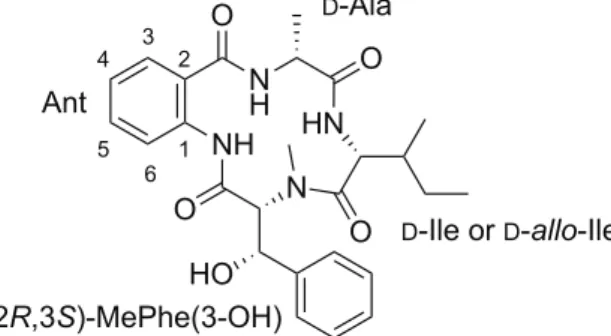
Asperterrestide A (1), a cyclotetrapeptide isolated from a fermentation broth of marine-derived fungal strain Aspergillus terreus SCSGAF0162 in 2013,10 was reported to consist of four nonproteinogenic amino acids:
D-Ala, Ant, (2R,3S)-MePhe(3-OH), and D-Ile or D-allo-Ile (Figure 1). The stereochemistry at the α-positions of
Ala and Ile was determined by chiral-phase HPLC analysis and Marfey’s methods after acidic degradation, whereas the D-Ile or D-allo-Ile residue was not differentiated in the original report. Asperterrestide A (1) exhibits
cytotoxicity for human carcinoma cell lines with IC50 values of 6.4 µM against U937 and 6.2 µM against
MOLT4 and inhibits influenza virus strains with IC50 values of 15 µM against A/WSN/33 (H1N1) and 8.1 µM
against A/Hong Kong/8/68 (H3N2), respectively. Because Ant-containing 13-membered cyclotetrapeptides are rare in nature11 compared with cyclopenta-12–14 and cyclohexapeptides,15–17 it is worthwhile to reveal the
three-dimensional macrocyclic conformation of 1 for the design of novel peptidomimetics. Herein, we report the total synthesis of asperterrestide A (1) via solution-phase peptide elongation, followed by macrolactamization and its structural revision based on the molecular modeling and NMR analysis of the synthesized peptides.
Figure 1. Reported structure of asperterrestide A (1)
N NH HN N H O O O O HO D-Ala Ant (2R,3S)-MePhe(3-OH) D-Ile or D-allo-Ile 1 2 3 4 5 6
RESULTS AND DISCUSSION
There have been recent reports for the structure elucidation of ambiguous configuration of enantiomeric isoleucine residues to be D-allo-Ile in cyclic peptide natural products18-20 and it would be likely produced by the
epimerization of L-Ile at the α-position in secondary metabolites not that at both α- and β-positions, though some
examples having a D-Ile reside as a component are in literature.21,22
Cyclo-[D-allo-Ile−(2R,3S)-MePhe(3-OH)−Ant−D-Ala] (1a), thus, was speculated to be the structure of natural
asperterrestide A. Our retrosynthetic analysis for 1a is illustrated in Scheme 1. The macrolactamization is a key step for the total synthesis of 1a. The cyclization site should be carefully selected considering i) the nucleophilicity of N-terminus and ii) possible side reactions after the activation of C-terminus. Aromatic amines involved in resonance and sterically hindered N-methylamines are generally inappropriate as the N-terminus of the macrolactamization site due to low nucleophilicity. Besides, the activated carboxylic acid group of an Ant residue might induce benzoxazinone formation during the cyclization process.7, 23, 24 Therefore, we planed the
macrolactamization between N-terminus D-allo-Ile and C-terminus D-Ala of the linear tetrapeptide 2a.
Furthermore, we anticipated that the conformationally rigid Ant residue would be turn-inducing and support the access of both reaction sites. The cyclization precursor 2a would be provided by peptide elongation using four amino acids: D-allo-Ile, (2R,3S)-MePhe(3-OH), Ant and D-Ala.
Our study began from the stereoselective synthesis of a nonstandard (2R,3S)-MePhe(3-OH) residue. Structurally similar β-hydroxy-p-iodo-N-methylphenylalanine derivatives bearing anti configurations have been synthesized by Boger and coworkers via asymmetric epoxidation or dihydroxylation of cinnamic acid derivatives;25 however, there are no reports describing the synthesis of N-methylated syn derivatives. The
nucleophilic addition of alkyl metal species to the Garner’s aldehyde is one of the reliable methods to give facile and stereoselective access to 2-amino-1,3-dihydroxypropyl substructures.26 However, highly reactive
organometallic species react with the Garner’s aldehyde to give a mixture of syn and anti products with low diastereomeric ratios (dr) due to a competition between steric (Felkin-Anh) and chelation effects. Therefore, two additional steps (oxidation of the hydroxy group to the ketone followed by stereoselective reduction of the ketone back to the alcohol) are required to give the syn or anti product in high dr.27–29 Thus, a step-economical
and stereoselective approach to (2R,3S)-MePhe(3-OH) is desirable.
Our synthetic approach to Fmoc-(2R,3S)-MePhe(3-OTBS)-OH (9a) is shown in Scheme 2. In initial studies for the synthesis of 9a, we found that the late-stage N-methylation of β-hydroxyphenylalanine derivatives had poor reproducibility due to side reactions such as β-elimination of the hydroxy group under acidic and basic conditions. Therefore, we chose to introduce a methyl group on the nitrogen in the absence of a carboxyl group. Starting from commercially available Boc-L-Ser-OH, the phenyl ketone 3 was prepared according to the reported
N NH HN N H O O O O HO N NH N H O O O HO NH2 HO O NHBoc NH OH O TBSO NH2 OH O O OH H2N O OtBu asperterrestide A (1a, proposed) 2a D-Ala D-allo-Ile Ant (2R,3S)-MePhe(3-OTBS) 2 3
procedures by Appella and coworkers.30 The stereoselective reduction of the ketone 3 via the Felkin-Anh model
successfully proceeded with L-Selectride, providing syn-enriched 4a in 86% yield (syn:anti = 89:11). After the TBS-protection of the resulting alcohol in 4a, the methylation of the amino group in 5a using excess amounts of
NaH and MeI31 furnished the N-methylcarbamate 6a. The Boc group in 6a was removed by
TMSOTf/2,6-lutidine32, 33 without losing acid-labile TBS groups, and the subsequent protection with an Fmoc
group gave the Fmoc amine 7a in 97% yield over two steps. The selective cleavage of the primary TBS ether in
7a using HF·pyridine was then carried out. The syn-product and minor anti-diastereomer were separated by silica
gel column chromatography in this step, and the alcohol 8a was obtained in 64% yield as a single diastereomer. Finally, the oxidation of the primary alcohol using TEMPO/NaOCl/NaClO234 furnished the desired carboxylic
acid 9a.
Scheme 2. Synthesis of (2R,3S)-Fmoc-MePhe(3-OTBS)-OH (9a)
NFmoc OH O TBSO NBoc TBSO TBSO NHBoc TBSO O NHBoc TBSO HO 3 L-Selectride THF –78 °C, 2 h 86%, dr 89:11 MeI NaH THF rt, 24 h 82% 1) TMSOTf, 2,6-lutidine CH2Cl2, rt, 40 min 2) FmocOSu sat. aq NaHCO3, THF rt, 17 h, 97% (2 steps) NFmoc TBSO TBSO TEMPO, NaClO2 5% aq NaOCl MeCN/pH 6.8 buffer rt, 1 h 90% 4a 6a 7a 9a NHBoc TBSO TBSO 5a TBSCl, imidazole, DMAP DMF 40 °C, 24 h 73% HF·Py pyridine THF rt, 4 h 64% NFmoc HO TBSO 8a
With synthetic 9a in hand, compound 1a was prepared as outlined in Scheme 3. H-D-Ala-OtBu and
Fmoc-Ant-OH were coupled with EDCI·HCl/HOBt to give the dipeptide 10 in 88% yield. The benzoxazinone formation was not observed under this coupling condition. After removal of the Fmoc group in 10 with 20% Et2NH/MeCN, we performed the acylation of the low-nucleophilic Ant amine with sterically hindered carboxylic
acid 9a. The in situ generated amino acid chloride of 9a using triphosgene/2,4,6-collidine35–38 is useful for the
acylation of the aromatic amine, and the desired tripeptide 11a was obtained in 90% yield without epimerization at the α-position. The Fmoc group in 11a was removed in the same manner as described above, and we next attempted the coupling between the sterically hindered N-methylamine and bulky Boc-D-allo-Ile-OH. After trials
of several coupling reagents (HATU/DIEA, PyBroP/DIEA, triphosgene/2,4,6-collidine, and COMU/DIEA), we found that COMU completed the coupling reaction to provide the tetrapeptide 12 in 57% yield. The concomitant removal of the Boc, tert-butyl, and TBS groups in 12 with 50% TFA in CH2Cl2 furnished the cyclization
precursor 2a as its TFA salt. Subsequent macrolactamization of 2a was performed using HATU/DIEA under high dilution conditions (1 mM). No epimerization at the α-position of the Ala residue was observed during the cyclization process, and the resulting crude cyclopeptide was purified by normal-phase silica gel column chromatography and preparative thin-layer chromatography to isolate the proposed structure of asperterrestide A (1a) in 36% yield from 12.
The 1H and 13C NMR spectroscopic data of synthetic 1a, however, are not identical to those of natural
asperterrestide A, as shown in Figure 2 and Table S1 (Supporting Information). In particular, the chemical shifts and coupling constants on the main chain (NH, NMe, CHα and C=O) are hardly matched between natural 1 and
synthetic 1a. Besides, NOESY correlations between MePhe(3-OH) Hβ / MePhe(3-OH) NMe, and Ala Hα / Ile
NH, which were observed in the natural compound, were not found in synthetic 1a (see Supporting Information). We suspected that the stereochemistry at the α-carbons in natural asperterrestide A is different from the proposed structure of 1a because the sign of the specific rotation was mismatched (see Scheme 3). The HPLC analysis of acid hydrolysates of natural 1 reported by Qi10 was reexamined, and it was found that the absolute configuration
1) 20% Et2NH/MeCN rt, 2.5 h 2) 9a, triphosgene 2,4,6-collidine, MeCN rt, 13 h, 90% (2 steps) EDCI·HCl HOBt, DIEA CH2Cl2 rt, 16 h 88% H2N O OtBu ·HCl N H O OtBu O NH O NFmoc N NH N H O O O HO NH2·TFA O OH N H O OtBu O NHFmoc TBSO 50% TFA/DCM rt, 11 h 10 11a HATU DIEA CH2Cl2 (1 mM) rt, 22 h 36% (2 steps) H-D-Ala-OtBu·HCl OH O NHFmoc + Fmoc-Ant-OH N NH N H O O O TBSO NHBoc O OtBu 1) 20% Et2NH/MeCN rt, 2.5 h 2) Boc-D-allo-Ile-OH COMU, DIEA CH2Cl2, rt, 23 h 57% (2 steps) N NH HN N H O O O O HO asperterrestide A (1a, proposed) 12 2a (TFA salt) [α]23 D +28 (c 0.66, MeOH) lit. [α]30D –13 (c 0.03, MeOH)
of the Ala residue was unclear. Chiral HPLC analysis with authentic L-Ala and D-Ala did not show clear
differences in their retention times. 1-Fluoro-2,4-dinitrophenyl-5-alanine-amide (FDAA) derivatives of the acid hydrolysates might suggest containing both L-Ala and D-Ala on the HPLC chromatogram. Because the
epimerization of the α-position during hydrolysis process was indicated, it is not possible to prove the absolute configuration of the Ala residue. In addition, the stereochemistry of the α-position of (2R,3S)-MePhe(3-OH) is ambiguous. The stereochemistry of the β-position is assigned to be S using the modified Mosher’s ester method for the natural compound. On the other hand, there is no spectroscopic evidence that a large coupling constant (3J
H,H = 10.0 Hz) between α- and β-protons of the MePhe(3-OH) residue suggests a syn arrangement in
conformationally constrained cyclotetrapeptides because the relative configuration was deduced in reference to previously reported β-hydroxy-Tyr-containing cyclooctapeptides39 and other acyclic fragments (3J
H,H = 3.5–4.8
Hz for anti and 4.6–6.6 Hz for syn, respectively).40–42 Jung’s group has recently reported that a large coupling
constant (3J
H,H = 9.5 Hz) between α- and β-protons of the MePhe(3-OH) residue was observed in a 12-membered
cyclotetrapeptide named tentoxin B.43 The absolute configuration was assigned to be (2S, 3S) by the modified
Mosher’s method followed by the comparison of the lowest energy-conformer obtained by molecular modeling to the X-ray crystallographic structure of its dehydroxy analog. These analytical reports by Jung and the fact that our synthetic syn-product 1a showed a small coupling constant (3J
H,H = 2.5 Hz) strongly support the relative
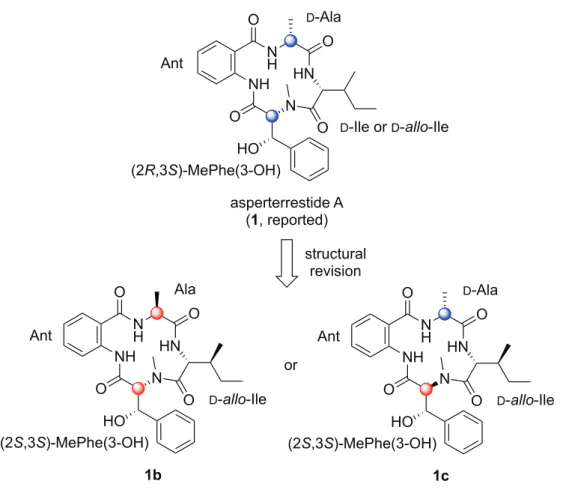
configuration of natural 1 to be anti. Therefore, the absolute configuration in the MePhe(3-OH) should be (2S,3S), not (2R,3S). In summary, we deduced the absolute configuration of the natural asperterrestide A to be
cyclo-[D-allo-Ile−(2S,3S)-MePhe(3-OH)−Ant−Ala] (1b) or
Figure 2. (a) Δδ(1H), and (b) Δδ(13C) values of constituting four amino acids in synthetic 1a in CDCl 3. Δδ =
δsynthetic 1a (ppm) – δnatural 1 (ppm). Table S1 (Supporting Information) summarizes NMR spectroscopic data of 1a. -2.5 -2 -1.5 -1 -0.5 0 0.5 1 1.5 α β γ γ γ’ δ NH α β C2 /C 6 C3 /C 5 C4 N -M e C3 C4 C5 C6 NH α β N H Δ δ( 1H ) i n ppm D-allo-Ile
(2R,3S)-MePhe(3-OH) Ant D-Ala
(a) -6 -4 -2 0 2 4 6 8 10 12 14 α β γ γ’ δ C=O α β C1 C2 /C 6 C3 /C 5 C4
C=O N-Me C1 C2 C3 C4 C5 C6 C=O α β C=O
Δ δ( 13C ) i n ppm D-allo-Ile
(2R,3S)-MePhe(3-OH) Ant D-Ala
Figure 3. Putative structures of natural asperterrestide A (1)
To narrow down the putative candidates of natural asperterrestide A, we conducted molecular modeling studies using the MacroModel program (Maestro Version 10.1.018).44–46 The correlation between the observed
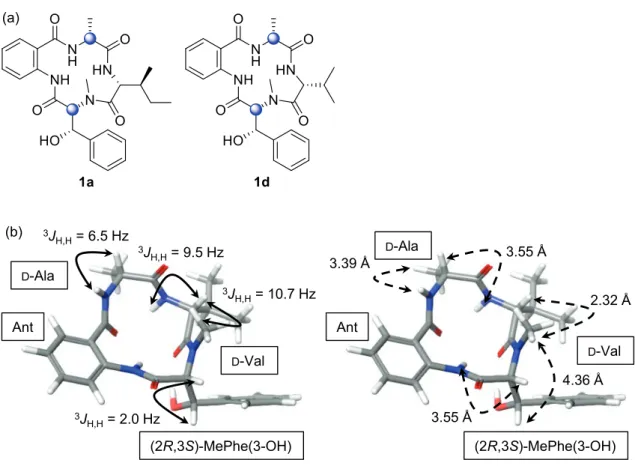
NMR spectroscopic data and calculated values by the molecular modeling was verified using our synthetic 1a prior to putative 1b and 1c. The sec-butyl group in the Ile residue was replaced with an isopropyl group to simplify the calculation; thus, cyclo-[D-Val−(2R,3S)-MePhe(3-OH)−Ant−D-Ala] (1d) was selected as a model
cyclotetrapeptide of 1a (Figure 4a). A conformational search was performed using 10,000 steps of torsional sampling based on the mixed-torsional/low-mode sampling method. An OPLS-2005 force field was applied, and the calculation was conducted without solvents. The obtained lowest-energy conformer of 1d is shown in Figure 4b. The calculated dihedral angles in 1d were then converted to coupling constants based on the Karplus equation.47 Focused on J
H,H coupling constants involved in the main chain, the calculated values in 1d were N NH HN N H O O O O HO asperterrestide A (1, reported) D-Ala Ant (2R,3S)-MePhe(3-OH) D-Ile or D-allo-Ile N NH HN N H O O O O HO 1b Ala Ant (2S,3S)-MePhe(3-OH) D-allo-Ile N NH HN N H O O O O HO 1c D-Ala Ant (2S,3S)-MePhe(3-OH) D-allo-Ile or structural revision
found to be in good agreement with those observed in our synthetic 1a, not the natural product (Table S9, Supporting Information). Theoretical distances between proximal protons in 1d also fit the result of NOE correlations observed in 1a. Among five NOE correlations observed in the natural 1, the calculated distances in
1d between MePhe(3-OH) Hβ / MePhe(3-OH) NMe (4.36 Å) and Ala Hα / Val NH (3.55 Å) seem to be long to
get NOE correlations as well as 1a (Table S10, Supporting Information). These main chain-derived correlations should be important to define the three-dimensional structures of conformationally constrained cyclopeptides. Therefore, we concluded that the molecular modeling using the model tetrapeptide is a reliable and adoptable method for estimating the stereochemistry of natural asperterrestide A.
Figure 4. (a) Chemical structures of the synthetic 1a and its model tetrapeptide 1d. (b) The lowest-energy conformer of 1d. The calculated distinctive coupling constants (plain, left) and theoretical distances between proximal protons (dashed, right) are shown in double-headed arrows. Tables S9 and S10 (Supporting Information) summarize calculated data of 1d.
(a) 3JH,H= 2.0 Hz 3J H,H= 10.7 Hz 3JH,H= 9.5 Hz Ant (2R,3S)-MePhe(3-OH) D-Val D-Ala (b) 3.55 Å Ant (2R,3S)-MePhe(3-OH) D-Val D-Ala 4.36 Å 2.32 Å 3.55 Å 3.39 Å 3J H,H= 6.5 Hz
According to the procedure mentioned above, the molecular modeling of our putative structures of asperterrestide A was carried out. Conformational searches of cyclo-[D-Val−(2S,3S)-MePhe(3-OH)−Ant−Ala]
(1e) and cyclo-[D-Val−(2S,3S)-MePhe(3-OH)−Ant−D-Ala] (1f) (Figure 5a) that are corresponding model
tetrapeptides of 1b and 1c gave the lowest-energy conformers as shown in Figures 5b and 5c. The calculated dihedral angles and distances between proximal protons are summarized in Tables S11 and S12 (Supporting Information), respectively. Focused on the MePhe(3-OH), the calculated 3J
H,H coupling constants between
MePhe(3-OH) Hα / MePhe(3-OH) Hβ in both 1e and 1f (3JH,H = 9.5 Hz, respectively) are as large as that of the
natural 1 (3J
H,H = 10.0 Hz). In addition, all the theoretical distances of the protons involved in NMe and Hα of
the MePhe(3-OH) residue in 1e and 1f are relatively short within 3.0 Å, satisfying the NOE observation in the natural compound. These calculated results strongly supported our suggestion that the absolute configuration of the MePhe(3-OH) residue in the natural 1 should be (2S,3S). The calculated values related to the Ala residue in
1e are also in good agreement with those of the natural 1, whereas relatively small 3J
H,H coupling constants
between Ala NH / Ala Hα (3JH,H = 6.5 Hz) and long distances between Ile NH / Ala Hα (3.55 Å) and Ala NH /
Ala Hβ (3.39 Å) were found in D-Ala-containing 1f. Therefore, the component in the natural product was
speculated to be L-Ala, not D-Ala. Considering these results, we argued that
cyclo-[D-Val−(2S,3S)-MePhe(3-OH)−Ant−Ala] (1e) would follow the stereochemistry of natural asperterrestide
A, and the stereochemistry of natural asperterrestide A should be corresponding to cyclo-[D-allo-Ile−(2S,3S)-MePhe(3-OH)−Ant−Ala] (1b).
Figure 5. (a) Chemical structures of model tetrapeptides 1e and 1f. (b) The lowest-energy conformer of 1e. (c) The lowest-energy conformer of 1f. The calculated distinctive coupling constants (plain, left) and theoretical distances between proximal protons (dashed, right) are shown in double-headed arrows. Tables S11 and S12 (Supporting Information) summarize calculated data of 1e and 1f.
3JH,H= 10.7 Hz 3JH,H= 9.5 Hz Ant (2S,3S)-MePhe(3-OH) D-Val Ala 3J H,H= 7.7 Hz 3J H,H= 9.5 Hz (a) (b) Ant (2S,3S)-MePhe(3-OH) D-Val Ala 2.38 Å 2.84 Å 2.29 Å 2.21 Å 2.44 Å 3J H,H= 9.2 Hz 3J H,H= 9.5 Hz Ant (2S,3S)-MePhe(3-OH) D-Val D-Ala 3J H,H= 6.5 Hz 3J H,H= 10.7 Hz (c) Ant (2S,3S)-MePhe(3-OH) D-Val D-Ala 2.42 Å 2.29 Å 2.27 Å 3.55 Å 3.39 Å
To validate our revised structure of natural asperterrestide A, it was necessary to prepare (2S,3S)-MePhe(3-OH) (Scheme 4). Conditions had to be developed such that the stereoselective reduction of the ketone ent-3, prepared from Boc-D-Ser-OH, provided anti product 4b instead of the previously obtained syn
product 4a. After investigation of several reductants (DIBAL-H and LiAlH(OtBu)3)48 and conditions (solvents
and temperatures), the chelation-controlled reduction of ent-3 was found to be successful using DIBAL-H to afford anti-enriched 4b in 79% yield with good stereoselectivity (anti:syn = 87:13). Further conversions, including N-methylation and oxidation, were conducted according to the established procedure as that of 9a (see Experimental Section), providing the desired (2S,3S)-9b. We herein established the synthetic route for both syn and anti diastereomers of 9 by simply switching the reductants for the phenylketone 3.
Scheme 4. Synthesis of (2S,3S)-Fmoc-MePhe(3-OTBS)-OH (9b)
The synthesis of the revised structure of asperterrestide A (1b) was carried out as illustrated in Scheme 5. In situ generation of the amino acid chloride of 9b using triphosgene/2,4,6-collidinewas also adopted for the acylation of the corresponding aromatic amine of ent-10 regardless of the relative configuration of the MePhe(3-OH) residue, and the tripeptide 11b was obtained in 88% yield. In the next peptide elongation, we initially attempted the synthesis of the tetrapeptide from 11b similar to the preparation of 12. However, the coupling of the corresponding N-methylamine of 11b with Boc-D-allo-Ile-OH did not proceed under various
coupling conditions (HATU/DIEA, PyBroP/DIEA, triphosgene/2,4,6-collidine, and COMU/DIEA) but recovered the N-methylamine. Therefore, we decided to remove the TBS group in 11b before the peptide
NHBoc TBSO O NHBoc TBSO HO DIBAL-H THF –78 °C, 4 h 79%, dr 87:13 4b ent-3 NFmoc OH O TBSO 9b same procedures
for the synthesis of 9a
31% (6 steps)
elongation. Exposure of the β-hydroxyl group would not only help the approach of activated carboxylic acid due to less-steric bulkiness but also give another pathway, such as O-to-N acyl transfer, as well. The TBS group in
11b was removed by HF·pyridine to afford the alcohol 13 in 76% yield. After removal of the Fmoc group in 13,
the coupling between the resulting N-methylamine and Boc-D-allo-Ile-OH was investigated, and the details are
summarized in Table 1. The best results were obtained using COMU/DIEA, which gave the tetrapeptide 14 in a 45 % yield along with a small amount of the O-acylated compound 15, after separation by silica gel column chromatography followed by preparative TLC (entry 1). The combined yield of 14 and 15 was improved using highly reactive acid chlorides generated from triphosgene/2,4,6-collidine, whereas the O-acylation was prior to the N-acylation to give both the amide 14 in 28% yield and the ester 15 in 34% yield, respectively (entry 2). The facts that the O-to-N acyl transfer from isolated 15 to 14 did not proceed even under harsh conditions (DMSO, 180 °C under microwave irradiation, 5 min × 6 times) indicated that the amide bond in 14 was directly formed without going through the ester 15. DMT-MM49, 50 gave only 14 as the product; however, the yield was very low
(12%, entry 3).
Although the yield of the tetrapeptide 14 was disappointing, we continued the synthesis to determine the absolute configuration of 1b (Scheme 5). The revised structure of asperterrestide A (1b) was obtained by treating
14 with TFA/DCM, followed by cyclization of the resulting TFA salt 2b using HATU/DIEA under high dilution
conditions, and subsequent purification (41% yield over two steps). The epimer at the Ala residue was not observed in the crude cyclization product.
Table 1. Peptide elongation from the tripeptide 13 to the tetrapeptide 14
1) 20% Et2NH/MeCN rt, 2 h 2) 9b, triphosgene 2,4,6-collidine, MeCN rt, 13 h, 88% (2 steps) N H O OtBu O NH O NFmoc N NH N H O O O HO NH2·TFA O OH N H O OtBu O NHFmoc TBSO 50% TFA/DCM rt, 19 h ent-10 11b HATU DIEA CH2Cl2 (1 mM) rt, 18 h 41% (2 steps) N NH N H O O O HO NHBoc O OtBu 1) 20% Et2NH/MeCN rt, 2 h 2) Boc-D-allo-Ile-OH conditions see Table 1 N NH HN N H O O O O HO asperterrestide A (1b, revised) 14 2b (TFA salt) N H O OtBu O NH O NFmoc HO 13 HF·pyridine THF rt, 9 h 76% [α]26 D –33 (c 0.085, MeOH) lit. [α]30D –13 (c 0.03, MeOH) N NH N H O O O HO NHBoc O OtBu 1) 20% Et2NH/MeCN rt, 2 h 2) Boc-D-allo-Ile-OH conditions 14 N H O OtBu O NH O NFmoc HO 13 NH NH N H O O O OtBu 15 O O NHBoc +
Entry Reagents Temp. (°C) Time (h) Product a (Yield%) Ratio of 14/15 b 1 c COMU, DIEA rt 26 14 (45), 15 (7) 88:12 2 d triphosgene 2,4,6-collidine rt 19 14 (28), 15 (34) 38:62 3 e DMT-MM·nH 2O 60 48 14 (12) >95:5
a Isolated yield. b The ratio was determined by crude 1H NMR. c Performed in DMF. d Performed in MeCN. e
Performed in MeOH.
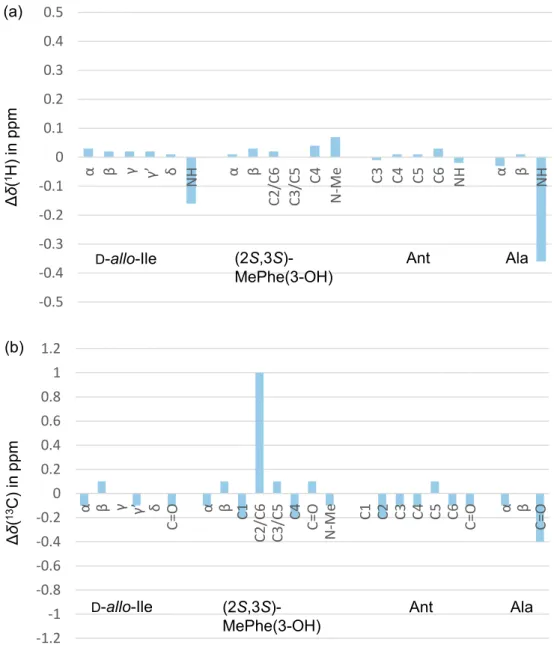
The 1H and 13C NMR spectroscopic data of synthetic 1b are in good agreement with those of the natural
compound, except for the chemical shift of concentration-dependent amide proton of the Ala and Ile residues, as shown in Figure 6 and Table S2 (Supporting Information). Large 3J
H,H coupling constants between
MePhe(3-OH) Hα / MePhe(3-OH) Hβ (3JH,H = 9.5 Hz) and Ala Hα / Ala NH (3JH,H = 7.9 Hz) were observed in
synthetic 1b as well as those of the natural 1 (3J
H,H = 10.0 and 8.0 Hz, respectively). In addition, NOE
correlations between MePhe(3-OH) Hβ / MePhe(3-OH) NMe and Ala Hα / Ile NH were observed in 1b, which
were not found in 1a (see Supporting Information). It should be noted that the spectroscopic data observed in the synthetic 1b were fully satisfied with not only those of the natural compound but also those suggested by the molecular modeling using the model tetrapeptide 1e. We thus concluded the absolute configuration of natural 1 to be cyclo-[D-allo-Ile−(2S,3S)-MePhe(3-OH)−Ant−Ala].
Figure 6. (a) Δδ(1H), and (b) Δδ(13C) values of constituting four amino acids in synthetic 1b in CDCl 3. Δδ =
δsynthetic 1b (ppm) – δnatural 1 (ppm). Table S2 (Supporting Information) summarizes NMR spectroscopic data of 1b.
The cytotoxicity of the synthetic 1a and 1b against three selected cancer cell lines (U937, MOLT4 and A549) was evaluated byCellTiter-Glo2.0 assay after 72 h treatments, and their IC50 values are depicted in Table 2. The
synthetic 1a, the proposed structure of asperterrestide A, did not show sufficient potency against all three cancer cell lines, thereby it is clear that the structure of 1a is not that of the natural compound. On the other hand, the
-1.2 -1 -0.8 -0.6 -0.4 -0.2 0 0.2 0.4 0.6 0.8 1 1.2 α β γ γ’ δ C=O α β C1 C2 /C 6 C3 /C 5 C4
C=O N-Me C1 C2 C3 C4 C5 C6 C=O α β C=O
-0.5 -0.4 -0.3 -0.2 -0.1 0 0.1 0.2 0.3 0.4 0.5 α β γ γ’ δ N H α β C2 /C 6 C3 /C 5 C4 N -M e C3 C4 C5 C6 N H α β N H Δ δ( 1H ) i n ppm D-allo-Ile
(2S,3S)-MePhe(3-OH) Ant Ala
(a) Δ δ( 13C ) i n ppm D-allo-Ile
(2S,3S)-MePhe(3-OH) Ant Ala
synthetic 1b exhibited potent activity against U937 and MOLT4 cells with the IC50 values of 5.6 and 18.1 µM,
respectively, which are comparable with those of the natural compound.10 No cytotoxicity of 1b against A549
cells might also be similar as the value evaluated for the natural compound was not indicated.51 These results
also suggested that the structure of asperterrestide A should be 1b. It should be noted that the stereochemistry of the main chain is essential for the potent activity in the constrained cyclotetrapeptides.
Table 2. IC50 values of cytotoxicity of natural and synthetic asperterrestides against cancer cell lines
IC50 (µM)a
Cancer cell
line tissue Natural 1
b Synthetic 1a (proposed) Synthetic 1b (revised) Mitomycin C c U937 blood 6.4 >20 5.6 0.067 MOLT4 blood 6.2 >20 18.1 0.031
A549 lung not indicated >20 >20 0.19
a The IC
50 values were determined by derivation of the best-fit dose response line of triplicate experiments. b
Data extracted from ref 10. c Mitomycin C was evaluated as a control.
CONCLUSION
In summary, we have demonstrated the structural revision of natural asperterrestide (1) based on the total synthesis and molecular modeling. Suitably protected D-syn-N-methyl-β-hydroxyphenylalanine 9a was prepared
as a single isomer via the stereoselective reduction of the phenyl ketone 3. The established synthetic route was adopted to synthesize L-anti-N-methyl-β-hydroxyphenylalanine 9b by selecting the reductants for the phenyl
ketone ent-3. During the peptide elongation process to the tetrapeptide 12, the use of the in situ generated amino acid chloride of 9a and COMU was found to be useful for the acylation of low-nucleophilic aromatic amine and sterically hindered N-methylamine, respectively. We achieved the first total synthesis of the proposed structure of asperterrestide (1a) by macrolactamization of the cyclization precursor 2a; however, the discrepancy of the 1H
and 13C NMR spectroscopic data indicated that the stereochemistry of the natural compound is incorrect from the
proposed structure of 1a. The absolute configuration of natural asperterrestide A was then deduced to be cyclo-[D-allo-Ile–(2S,3S)-MePhe(3-OH)–Ant–Ala] (1b) or cyclo-[D-allo-Ile–(2S,3S)-MePhe(3-OH)–Ant–D-Ala]
(1c) based on the reexamination of the reported HPLC analysis of acid hydrolysates of the natural product and the analysis of NMR spectroscopic data of synthetic 1a. We next conducted the molecular modeling of structurally simplified D-Val-containing asperterrestides 1d-1f on the MacroModel program to narrow down the
putative candidates of natural asperterrestide A. Comparison between synthetic 1a and corresponding 1d revealed that 3J
H,H coupling constants and NOE correlations observed are in good agreement with those
calculated in the lowest-energy conformer of the corresponding model tetrapeptide. Because the theoretical values of L-Ala-containing 1e are more consistent with those observed in the natural 1 than D-Ala-containing 1f,
we estimated the stereochemistry of natural asperterrestide A to be corresponding 1b. The synthesis of 1b was then performed to validate our speculation according to the established synthetic procedures of 1a. In contrast to the synthesis of the tetrapeptide 12, the anti-configuration of the MePhe(3-OTBS) residue was revealed to interrupt the acylation of the N-methylamine by the steric repulsion of the TBS group. Thus, the desired tetrapeptide 14 was provided after removal of the TBS group in 11b. We accomplished the total synthesis of the revised structure of asperterrestide A (1b) by the deprotection followed by macrolactamization, and the 1H and 13C NMR spectroscopic data of synthetic 1b are identical with those of natural 1. Therefore, we concluded the
absolute configuration of natural asperterrestide A to be cyclo-[D-allo-Ile−(2S,3S)-MePhe(3-OH)−Ant−Ala]. It is
noteworthy that the 3J
H,H coupling constant and NOE observation of 1b were fully satisfied with not only the
reported data of the natural 1 but the results obtained by the molecular modeling of the model cyclotetrapeptide
1e as well. These results strongly suggest that molecular modeling is an efficient and reliable tool to predict
of synthetic 1a and 1b against three selected cancer cell lines revealed that the stereochemistry of the main chain is important for the potent activity. A structure-activity relationship study based on the three-dimensional structure of 1b and its derivatives is underway.
EXPERIMENTAL SECTION
General Techniques. All commercially available reagents were purchased from commercial suppliers, and
used as received. Dry THF and CH2Cl2 (Kanto Chemical Co.) were obtained by passing commercially available
pre-dried, oxygen-free formulations through activated alumina column. All reactions in solution-phase were monitored by thin-layer chromatography (TLC) carried out on Merck silica gel plates (0.2 mm, 60F-254) with UV light, and visualized by p-anisaldehyde H2SO4–EtOH solution or phosphomolybdic acid–EtOH solution or
ninhydrin–AcOH–1-BuOH solution. Silica gel 60N (Kanto Chemical Co. 100–210 µm) was used for column chromatography, and Merck silica gel plate (2.0 mm, 60F-254) was used for preparative thin-layer chromatography. 1H NMR spectra (400 and 600 MHz) and 13C NMR spectra (100 and 150 MHz) were recorded
on JEOL JNM-AL400 and JEOL JNM-ECA600 spectrometers in the indicated solvent. Chemical shifts (δ) are reported in units parts per million (ppm) relative to the signal for internal TMS (0.00 ppm for 1H) for solutions in
CDCl3. NMR spectral data are reported as follows: chloroform (7.26 ppm for 1H) or chloroform-d (77.0 ppm for 13C), and dimethyl sulfoxide (2.50 ppm for 1H) or dimethyl sulfoxide-d
6 (39.5 ppm for 13C) when internal
standard is not indicated. Multiplicities are reported by the following abbreviations: s (singlet), d (doublet), t (triplet), q (quartet), quin (quintet), m (multiplet), dd (double doublet), dt (double triplet), dq (double quartet), td (triple doublet), brs (broad singlet), brd (broad doublet) and J (coupling constants in Hertz). High-resolution mass spectra were measured on Thermo Scientific™ Exactive™ Plus Orbitrap Mass Spectrometer (for ESI). IR spectra were recorded on a JASCO FTIR-4100. Only the strongest and/or structurally important absorption are
reported as the IR data afforded in wavenumbers (cm−1). Optical rotations were measured on a JASCO P-1010
polarimeter. Melting points were measured with Round Science Inc. RFS-10, and are not corrected. Analytical HPLC was performed using Daicel Chiralpak OD-H.
Fmoc-Ant-OH. To a suspension of H-Ant-OH (3.50 g, 25.5 mmol) in dioxane (80 mL) were added a solution of Na2CO3 (13.5 g, 128 mmol) in water (16 mL) and FmocCl (7.26 g, 28.1 mmol) at 0 °C. After being stirred at
room temperature for 23 h, the reaction mixture was concentrated in vacuo. The aqueous layer was washed with Et2O, acidified with 3 M aqueous HCl until pH 2, and extracted three times with EtOAc. The combined organic
layers were washed with brine, dried over MgSO4, and filtered. The filtrate was concentrated in vacuo, and the
resulting residue was suspended in Et2O. The precipitate was filtered, washed with Et2O, and dried under
vacuum to afford Fmoc-Ant-OH (7.13 g, 78%) as a white solid. mp 188–189 °C; 1H NMR (400 MHz,
DMSO-d6) δ 12.0 (brs, 1H), 8.11 (d, 1H, J = 8.1 Hz), 7.96 (d, 1H, J = 7.7 Hz), 7.91 (d, 2H, J = 7.4 Hz), 7.68 (d,
2H, J = 7.4 Hz), 7.40–7.46 (m, 3H), 7.34 (t, 2H, J = 7.4 Hz), 7.02 (t, 1H, J = 7.7 Hz), 4.44 (d, 2H, J = 4.4 Hz), 4.33 (t, 1H, J = 4.4 Hz); 13C{1H} NMR (100 MHz, DMSO-d
6) δ 170.0, 152.8, 143.7, 140.74, 140.73, 132.7,
131.3, 127.7, 127.1, 125.0, 121.4, 120.2, 118.8, 117.8, 66.1, 46.5; IR (neat) 2948, 1738, 1665, 1586, 1523, 1211 cm−1; HRMS (ESI-TOF) m/z: [M+H]+ Calcd for C
22H18NO4 360.1230; Found 360.1229.
tert-Butyl (S)-(3-((tert-butyldimethylsilyl)oxy)-1-oxo-1-phenylpropan-2-yl)-carbamate (3).26 To a solution of
Boc-Ser-OH (5.00 g, 24.5 mmol) in dry CH2Cl2 (80 mL) were added MeNH(OMe)·HCl, (2.39 g, 24.5 mmol),
NMM (2.8 mL, 25.7 mmol) and EDCI·HCl (4.74 g, 24.8 mmol) at −15 °C under an argon atmosphere. After being stirred at the same temperature for 2 h, the reaction mixture was quenched with 1 M aqueous HCl. The organic layer was separated, and the aqueous layer was extracted with CH2Cl2. The combined organic layers
were washed with saturated aqueous NaHCO3 and brine, dried over MgSO4, and filtered. The filtrate was
with hexane, and dried under vacuum to afford the Weinreb amide (5.43 g, 89%) as a white solid.
To a solution of the alcohol (4.80 g, 19.3 mmol) in dry CH2Cl2 (60 mL) were added imidazole (2.63 g, 38.6
mmol) and TBSCl (3.21 g, 21.3 mmol) at 0 °C under an argon atmosphere. After being stirred at room temperature for 1.5 h, the reaction mixture was quenched with water at 0 °C. The organic layer was separated, washed three times with 10% aqueous citric acid, saturated aqueous NaHCO3 and brine, dried over MgSO4, and
filtered. The filtrate was concentrated in vacuo, and the resulting residue was purified by column chromatography on silica gel (eluted with hexane/EtOAc = 19:1) to afford the TBS ether (6.95 g, 99%) as a yellowish oil.
A solution of PhMgBr (1.0 M in THF) was prepared from PhBr (5.5 mL, 52.8 mmol), Mg tuning (2.57 g, 106 mmol), catalytic amount of I2, and dry THF (53 mL). To a solution of the Weinreb amide (6.00 g, 16.5 mmol) in
dry THF (80 mL) was added above solution of PhMgBr dropwise at 0 °C under an argon atmosphere. After being stirred at room temperature for 3 h, the reaction mixture was quenched with 1 M aqueous HCl at 0 °C. The organic layer was separated, and the aqueous layer was extracted with EtOAc. The combined organic layers were washed with brine, dried over Na2SO4, and filtered. The filtrate was concentrated in vacuo, and the
resulting residue was purified by column chromatography on silica gel (eluted with hexane/EtOAc = 19:1) to afford the phenyl ketone 3 (4.89 g, 78%) as a yellowish oil. The spectroscopic data of 3 were in good agreement with those reported in the literature.30 [α]28
D +37 (c 1.0, CHCl3).
tert-Butyl ((1S,2S)-3-((tert-butyldimethylsilyl)oxy)-1-hydroxy-1-phenylpropan-2-yl)carbamate (4a). To a solution of the ketone 3 (2.00 g, 5.27 mmol) in dry THF (20 mL) was added a solution of L-Selectride (1.0 M in THF, 11.6 mL, 11.6 mmol) dropwise at −78 °C under an argon atmosphere. After being stirred at the same temperature for 2 h, the reaction mixture was quenched with 1 M aqueous Rochelle salt at 0 °C. The mixture was stirred at room temperature. The organic layer was separated, and the aqueous layer was extracted twice with
EtOAc. The combined organic layers were washed with saturated aqueous NaHCO3 and brine, dried over
Na2SO4, and filtered. The filtrate was concentrated in vacuo, and the resulting residue was purified by column
chromatography on silica gel (eluted with hexane/EtOAc = 19:1) to afford the alcohol 4a (1.73 g, 86%, dr 89:11) as a yellowish oil. The diastereomeric ratio of 4a was determined by chiral column OD-H (eluted with hexane/iPrOH = 9:1; flow rate: 0.5 mL/min; retention time: 7.8 min for C1 diastereomer of 4a, 8.3 min for 4a). [α]28
D +38 (c 1.0, CHCl3); 1H NMR (400 MHz, CDCl3) δ 7.24–7.37 (m, 5H), 5.16 (d, 1H, J = 6.4 Hz), 5.00 (d,
1H, J = 3.2 Hz), 3.66–3.84 (m, 4H), 1.37 (s, 9H), 0.93 (s, 9H), 0.08 (s, 6H); 13C{1H} NMR (100 MHz, CDCl 3) δ
156.2, 141.2, 128.2, 127.5, 126.1, 79.6, 74.8, 64.9, 56.5, 28.3, 25.8, 18.6, −5.57, −5.60; IR (neat) 3443, 2955, 2929, 1696, 1497, 1171, 838 cm−1; HRMS (ESI-TOF) m/z: [M+H]+ Calcd for C
20H36NO4Si 382.2408; Found
382.2405.
tert-Butyl ((5S,6S)-2,2,3,3,9,9,10,10-octamethyl-5-phenyl-4,8-dioxa-3,9-disila-undecan-6-yl)-carbamate (5a). To a solution of the alcohol 4a (1.60 g, 4.19 mmol) in DMF (20 mL) were added imidazole (856 mg, 12.6 mmol), DMAP (512 mg, 4.19 mmol) and TBSCl (948 mg, 6.29 mmol) at 0 °C under an argon atmosphere. After being stirred at 40 °C for 23 h, the reaction mixture was quenched with water. The aqueous layer was extracted twice with Et2O. The combined organic layers were washed three times with brine, dried over Na2SO4, and filtered.
The filtrate was concentrated in vacuo, and the resulting residue was purified by column chromatography on silica gel (eluted with hexane/EtOAc = 29:1) to afford the TBS ether 5a (1.53 g, 73%) as a yellowish oil. [α]24
D +37 (c 1.0, CHCl3); 1H NMR (400 MHz, CDCl3, 4:1 rotamer mixture) δ 7.20–7.33 (m, 5.0H), 5.01 (d, 1.0H, J = 2.7 Hz), 4.83 (d, 0.8H, J = 9.3 Hz), 4.66 (d, 0.2H, J = 8.8 Hz), 3.64–3.70 (m, 0.8H), 3.49–3.59 (m, 2.2H), 1.34 (s, 7.2H), 1.21 (s, 1.8H), 0.93 (s, 9.0H), 0.90 (s, 9.0H), 0.08 (s, 3.0H), 0.07 (s, 3.0H), 0.05 (s, 3.0H), −0.15 (s, 3.0H); 13C{1H} NMR (100 MHz, CDCl 3, 4:1 rotamer mixture) δ 155.5, 142.7, 142.5, 127.9, 127.1, 126.3, 79.3, 78.9, 72.0, 71.5, 62.2, 61.8, 59.9, 58.3, 28.4, 28.0, 25.9, 18.2, 18.1, −4.6, −5.2, −5.3, −5.4; IR (neat) 3445, 1954, 1929,
1721, 1492, 1101, 838 cm−1; HRMS (ESI-TOF) m/z: [M+H]+ Calcd for C
26H50NO4Si2 496.3273; Found
496.3272.
tert-Butyl methyl((5S,6S)-2,2,3,3,9,9,10,10-octamethyl-5-phenyl-4,8-dioxa-3,9-disilaundecan-6-yl)-carbamate (6a). To a solution of the amine 5a (1.40 g, 2.82 mmol) in dry THF (15 mL) were added MeI (1.4 mL, 22.6 mmol) and NaH (60% in mineral, 338 mg, 8.46 mmol) at 0 °C under an argon atmosphere, and the mixture was stirred until H2 evolution was completed. Then, same amount of MeI (1.4 mL, 22.6 mmol) and NaH (60% in
mineral, 338 mg, 8.46 mmol) were added to above mixture at 0 °C. After being stirred at room temperature for 24 h, the reaction was quenched with water. The organic layer was separated, and the aqueous layer was extracted twice with Et2O. The combined organic layers were washed with brine, dried over Na2SO4, and filtered.
The filtrate was concentrated in vacuo, and the resulting residue was purified by column chromatography on silica gel (eluted with hexane/EtOAc = 19:1) to afford the N-methylamine 6a (1.18 g, 82%) as a colorless oil, which was solidified under vacuum. mp 56–57 °C; [α]24
D +43 (c 1.0, CHCl3); 1H NMR (400 MHz, CDCl3, 3:2 rotamer mixture) δ 7.21–7.32 (m, 5.0H), 4.94 (brs, 0.6H), 4.90 (d, 0.4H, J = 4.8 Hz), 4.17 (brs, 0.6H), 3.58–3.77 (m, 2.4H), 2.92 (s, 1.8H), 2.91 (s, 1.2H), 1.38 (s, 3.6H), 1.18 (s, 5.4H), 0.89 (s, 5.4H), 0.88 (s, 5.4H), 0.85 (s, 7.2H), 0.03 (s, 7.2H), −0.04 (s, 1.8H), −0.26 (s, 1.8H), −0.32 (s, 1.2H); 13C{1H} NMR (100 MHz, CDCl 3, 3:2 rotamer mixture) δ 156.0, 142.6, 142.5, 128.00, 127.97, 127.4, 127.2, 127.0, 126.6, 78.9, 78.8, 74.5, 73.4, 62.2, 61.2, 28.4, 28.1, 25.8, 25.7, 18.03, 18.01, 17.9, −4.6, −4.7, −5.31, −5.38, −5.42, −5.48, −5.54, −5.6; IR (neat) 2955, 2929, 1697, 1152, 837 cm−1; HRMS (ESI-TOF) m/z: [M+H]+ calcd for C
27H52NO4Si2 510.3429; found
510.3425.
(9H-Fluoren-9-yl)methyl
methyl((5S,6S)-2,2,3,3,9,9,10,10-octamethyl-5-phenyl-4,8-dioxa-3,9-disila-undecan-6-yl)carbamate (7a). To a solution of the N-Boc amine 6a (1.10 g, 2.16 mmol) in dry CH2Cl2 (15 mL) were added 2,6-lutidine (2.0 mL,
17.3 mmol) and TMSOTf (1.6 mL, 8.63 mmol) at 0 °C under an argon atmosphere. After being stirred at room temperature for 40 min, the reaction mixture was quenched with brine and MeOH at 0 °C. The organic layer was separated, and the aqueous layer was extracted twice with CH2Cl2. The combined organic layers were washed
with 10% aqueous citric acid and brine, dried over Na2SO4, and filtered. The filtrate was concentrated in vacuo,
and the crude amine was used for next reaction without further purification.
To a solution of the crude amine in dry THF (8.0 mL) were added saturated aqueous NaHCO3 (8.0 mL) and
FmocOSu (729 mg, 2.16 mmol, 1.0 equiv) at 0 °C. After being stirred at room temperature for 17 h, the reaction mixture was quenched with 10% aqueous citric acid. The aqueous layer was extracted with Et2O. The organic
layer was washed with brine, dried over Na2SO4, and filtered. The filtrate was concentrated in vacuo, and the
resulting residue was purified by column chromatography on silica gel (eluted with hexane/EtOAc = 29:1) to afford the N-Fmoc amine 7a (1.32 g, 97% in 2 steps) as a colorless oil. [α]25
D +41 (c 1.0, CHCl3); 1H NMR (400 MHz, CDCl3, 1:1 rotamer mixture) δ 7.74–7.78 (m, 2.0H), 7.58–7.62 (m, 1.5H), 7.52 (d, 0.5H, J = 7.1 Hz), 7.23–7.42 (m, 9.0H), 5.02 (d, 0.5H, J = 6.8 Hz), 4.89 (brs, 0.5H), 4.04–4.37 (m, 4.0H), 3.60–3.66 (m, 2.0H), 3.05 (s, 3.0H), 0.85–0.89 (m, 18.0H), 0.03 (s, 3.0H), 0.04 (brs, 3.0H), −0.02 (s, 3.0H), −0.27 (brs, 1.5H), −0.28 (s, 1.5H); 13C{1H} NMR (100 MHz, CDCl 3, 1:1 rotamer mixture) δ 157.0, 144.5, 144.4, 144.2, 144.0, 142.2, 141.3, 141.2, 128.13, 128.07, 127.6, 127.5, 126.94, 126.92, 126.8, 125.19, 125.15, 125.0, 119.9, 73.8, 73.1, 67.2, 62.9, 61.2, 60.9, 47.34, 47.30, 25.8, 25.7, 18.1, 17.9, −4.6, −5.3, −5.6; IR (neat) 2953, 2928, 1700, 1254, 1100, 836 cm−1; HRMS (ESI-TOF) m/z: [M+Na]+ Calcd for C
37H53NO4Si2Na 654.3405; Found 654.3403.
(9H-Fluoren-9-yl)methyl
((1S,2S)-1-((tert-butyldimethylsilyl)oxy)-3-hydroxy-1-phenylpropan-2-yl)(methyl)carbamate (8a). To a solution of the TBS ether 7a (1.10 g, 1.74 mmol) in dry THF (15 mL) were added pyridine (1.4 mL, 17.4 mmol) and HF·pyridine (950 µL, 52.2 mmol) at 0 °C under an argon atmosphere, and the mixture was stirred for 30 min at
the same temperature. After being stirred at room temperature for 4 h, the reaction mixture was poured into saturated aqueous NaHCO3 at 0 °C. The aqueous layer was extracted three times with EtOAc. The combined
organic layers were washed with 10% aqueous citric acid and brine, dried over Na2SO4, and filtered. The filtrate
was concentrated in vacuo, and the resulting residue was purified by flash column chromatography on silica gel (eluted with hexane/EtOAc = 4:1) to afford the alcohol 8a (575 mg, 64%) as a white amorphous solid and a mixture of 8a and its diastereomer (150 mg, 17%) as a white amorphous solid. Rf: 0.23 for 8a, 0.29 for C1
diastereomer of 8a (hexane/EtOAc = 2:1); mp 55–56 °C; [α]25 D +44 (c 1.0, CHCl3); 1H NMR (400 MHz, CDCl3, 3:2 rotamer mixture) δ 7.76–7.79 (m, 2.0H), 7.57–7.60 (m, 2.0H), 7.20–7.60 (m, 8.6H), 7.12 (brs, 0.4H,), 5.06 (d, 0.6H, J = 6.8 Hz), 4.64 (brs, 0.4H), 4.44 (dd, 0.6H, J = 10.4, 6.8 Hz), 4.34 (brs, 0.4H), 4.26 (dd, 0.6H, J = 10.4, 6.8 Hz), 4.18 (t, 1.0H, J = 6.8 Hz), 4.11 (brs, 0.4H), 3.88 (brs, 0.4H), 3.55–3.66 (m, 1.6H), 3.43 (brs, 0.4H), 2.94–3.00 (m, 3.6H), 0.84 (s, 5.4H), 0.80 (brs, 3.6H), −0.02 (s, 3H), −0.30 (s, 1.8H), −0.36 (brs, 1.2H); 13C{1H} NMR (100 MHz, CDCl3, 3:2 rotamer mixture) δ 157.3, 144.1, 143.9, 141.8, 141.6, 141.4, 141.3, 141.23, 141.17, 128.20, 128.15, 127.74, 127.71, 127.62, 127.59, 127.14, 127.0, 126.9, 126.7, 126.5, 125.1, 125.0, 119.9, 73.9, 73.2, 67.4, 61.1, 60.2, 47.24, 47.20, 25.7, 25.6, 17.84, 17.80, −4.8, −5.2; IR (neat) 3444, 2954, 2929, 1684, 1451, 758 cm−1; HRMS (ESI-TOF) m/z: [M+Na]+ Calcd for C
31H39NO4SiNa 540.2541; Found 540.2538.
(2R,3S)-Fmoc-MePhe(3-OTBS)-OH (9a). To a solution of the alcohol 8a (500 mg, 966 µmol) in dry MeCN (4.0 mL) and pH 6.8 buffer (4.0 mL) were added TEMPO (30.2 mg, 193 µmol), NaClO2 (80% grade, 328 mg,
2.90 mmol) and 5% aqueous NaOCl (287 µL, 193 µmol) at room temperature. After being stirred at the same temperature for 1 h, the reaction mixture was quenched with 10% aqueous Na2S2O3, and acidified with 10%
aqueous citric acid. The aqueous layer was extracted three times with EtOAc. The combined organic layers were washed with brine, dried over Na2SO4, and filtered. The filtrate was concentrated in vacuo, and the resulting
167–168 °C; [α]25 D +40 (c 1.0, CHCl3); 1H NMR (400 MHz, CDCl3, 2:1 rotamer mixture) δ 7.72–7.76 (m, 2.0H), 7.23–7.44 (m, 11.0H), 5.50 (d, 0.7H, J = 4.6 Hz), 5.33 (d, 0.3H, J = 4.9 Hz), 5.21 (d, 0.7H, J = 4.6 Hz), 4.93 (d, 0.3H, J = 4.9 Hz), 4.24–4.32 (m, 1.0H), 4.00–4.16 (m, 2.0H), 3.15 (s, 2.0H), 3.10 (s, 1.0H), 0.89 (s, 6.0H), 0.85 (s, 3.0H), 0.07 (s, 2.0H), 0.04 (s, 1.0H), −0.18 (s, 2.0H), −0.25 (s, 1.0H); 13C{1H} NMR (100 MHz, CDCl 3, 2:1 rotamer mixture) δ 174.3, 174.2, 157.2, 156.1, 144.1, 143.7, 141.3, 141.2, 140.3, 140.1, 128.3, 128.2, 128.0, 127.7, 127.6, 127.1, 127.02, 126.98, 126.7, 126.4, 125.2, 125.0, 124.93, 124.86, 119.9, 75.0, 74.8, 68.0, 67.7, 65.0, 64.3, 47.12, 47.06, 25.71, 25.66, 18.0, 17.9, −4.5, −4.6, −5.48, −5.51; IR (neat) 3021, 2954, 2930, 1703, 1253, 758 cm−1; HRMS (ESI-TOF) m/z: [M+Na]+ Calcd for C
31H37NO5SiNa 554.2333; Found 554.2328.
Fmoc-Ant–D-Ala-OtBu (10). To a solution of H-D-Ala-OtBu·HCl (1.00 g, 5.50 mmol) in dry CH2Cl2 (22 mL)
were added DIEA (1.1 mL, 6.06 mmol), Fmoc-Ant-OH (2.18 g, 6.06 mmol), HOBt (819 mg, 6.06 mmol) and EDCI·HCl (1.16 g, 6.06 mmol) at 0 °C under an argon atmosphere. After being stirred at room temperature for 16 h, the reaction mixture was quenched with 1 M aqueous HCl. The organic layer was separated, and the aqueous layer was extracted twice with EtOAc. The combined organic layers were washed with saturated aqueous NaHCO3 and brine, dried over MgSO4, and filtered. The filtrate was concentrated in vacuo, and the
resulting residue was purified by column chromatography on silica gel (eluted with hexane/EtOAc = 6:1) to afford the dipeptide 10 (2.36 g, 88%) as a white amorphous solid. mp 122–123 °C; [α]27
D −8.1 (c 1.0, CHCl3); 1H NMR (400 MHz, CDCl 3) δ 10.7 (s, 1H), 8.35 (d, 1H, J = 7.9 Hz), 7.76 (d, 2H, J = 7.4 Hz), 7.66 (d, 2H, J = 7.4 Hz), 7.55 (dd, 1H, J = 7.9, 1.3 Hz), 7.46 (dt, 1H, J = 7.9, 1.3 Hz), 7.40 (t, 2H, J = 7.4 Hz), 7.32 (t, 2H, J = 7.4 Hz), 7.04 (d, 1H, J = 7.9 Hz), 6.91 (d, 1H, J = 6.9 Hz), 4.66 (quin, 1H, J = 6.9 Hz), 4.42 (d, 2H, J = 7.4 Hz), 4.30 (t, 1H, J = 7.4 Hz), 1.53 (d, 3H, J = 6.9 Hz), 1.51 (s, 9H); 13C{1H} NMR (100 MHz, CDCl 3) δ 172.1, 168.2, 153.6, 143.9, 141.2, 139.9, 132.8, 127.7, 127.1, 126.8, 125.3, 122.0, 120.0, 119.9, 119.5, 82.5, 67.3, 49.1, 47.0, 27.9, 18.6; IR (neat) 3336, 2979, 1733, 1646, 1590, 1522, 1450, 1215, 757 cm−1; HRMS (ESI-TOF) m/z:
[M+Na]+ Calcd for C
29H30N2O5Na 509.2047; Found 509.2036.
Fmoc-(2R,3S)-MePhe(3-OTBS)–Ant–D-Ala-OtBu (11a). To a solution of the N-Fmoc amine 10 (150 mg, 308
µmol) in dry MeCN (2.4 mL) was added Et2NH (0.6 mL) at 0 °C under an argon atmosphere. After being stirred
at room temperature for 2.5 h, the reaction mixture was concentrated in vacuo. The resulting residue was azeotroped three times with toluene, and dried under vacuum. The crude amine was used for next reaction without further purification.
To a solution of the acid 9a (246 mg, 462 µmol) in dry MeCN (1.5 mL) were added triphosgene (45.7 mg, 154 µmol) and 2,4,6-collidine (124 µL, 924 µmol) at 0 °C under an argon atmosphere. After being stirred at the same temperature for 5 min, a suspension of the crude amine in dry MeCN (1.5 mL) was added to the above mixture at 0 °C. After being stirred at room temperature for 13 h, the reaction mixture was quenched with 10% aqueous citric acid, and concentrated in vacuo. The aqueous layer was extracted twice with EtOAc. The combined organic layers were washed with 10% aqueous citric acid, saturated aqueous NaHCO3 and brine, dried over
Na2SO4, and filtered. The filtrate was concentrated in vacuo, and the resulting residue was purified by column
chromatography on silica gel (eluted with hexane/EtOAc = 6:1) to give desired product containing a small amount of impurities. Further purification by column chromatography on silica gel (eluted with toluene/EtOAc = 14:1) afforded the tripeptide 11a (215 mg, 90% in 2 steps) as a white amorphous solid. mp 88–89 °C; [α]23
D +63 (c 1.0, CHCl3); 1H NMR (400 MHz, CDCl3, 3:2 rotamer mixture) δ 11.72 (s, 0.4H), 11.71 (s, 0.6H), 8.65 (d, 0.6H, J = 8.3 Hz), 8.61 (d, 0.4H, J = 8.3 Hz), 7.72–7.78 (m, 2H), 7.66 (d, 0.8H, J = 7.3 Hz), 7.17–7.56 (m, 12.2H), 7.05–7.11 (m, 1.0H), 6.81 (d, 0.6H, J = 7.0 Hz), 6.78 (d, 0.4H, J = 7.0 Hz), 5.72 (d, 0.6H, J = 4.7 Hz), 5.57 (d, 0.4H, J = 5.4 Hz), 5.26 (d, 0.6H, J = 4.7 Hz), 5.04 (d, 0.4H, J = 5.4 Hz), 4.46 (quin, 0.4H, J = 7.0 Hz), 4.17–4.40 (m, 3.2H), 4.08 (dd, 0.4H, J = 10.1, 7.0 Hz), 3.37 (s, 1.8H), 3.22 (s, 1.2H), 1.45 (s, 3.6H), 1.44 (s, 5.4H), 1.21 (d, 3H, J = 7.0 Hz), 0.88 (s, 5.4H), 0.84 (s, 3.6H), 0.13 (s, 1.8H), 0.10 (s, 1.2H), −0.15 (s, 1.8H),
−0.20 (s, 1.2H); 13C{1H} NMR (100 MHz, CDCl 3, 3:2 rotamer mixture) δ 172.2, 167.8, 167.7, 167.6, 167.4, 157.3, 156.3, 144.3, 144.2, 144.10, 144.06, 141.5, 141.4, 141.1, 139.41, 139.35, 132.71, 132.68, 128.2, 128.0, 127.6, 127.53, 127.52, 127.49, 127.46, 126.98, 126.96, 126.94, 126.91, 126.6, 126.5, 125.4, 125.3, 125.2, 125.1, 123.0, 122.9, 121.12, 121.09, 119.9, 119.80, 119.79, 119.7, 82.4, 82.3, 74.0, 73.4, 68.1, 66.8, 66.7, 48.9, 48.8, 47.2, 47.1, 33.5, 27.9, 25.8, 25.7, 18.41, 18.37, 18.0, 17.9, −4.5, −4.6, −5.2, −5.3; IR (neat) 3339, 2954, 2929, 1693, 1518, 1448, 114, 757 cm−1; HRMS (ESI-TOF) m/z: [M+H]+ Calcd for C
45H56N3O7Si 778.3882; Found
778.3880.
Boc-D-allo-Ile–(2R,3S)-MePhe(3-OTBS)–Ant–D-Ala-OtBu (12). To a solution of the N-Fmoc amine 11a (150
mg, 193 µmol) in dry MeCN (1.6 mL) was added Et2NH (0.4 mL) at 0 °C under an argon atmosphere. After
being stirred at room temperature for 2.5 h, the reaction mixture was concentrated in vacuo. The resulting residue was azeotroped three times with toluene, and dried under vacuum. The crude amine was used for next reaction without further purification.
To a solution of the crude amine in dry CH2Cl2 (2.0 mL) were added Boc-D-allo-Ile-OH (66.9 mg, 289 µmol),
DIEA (101 µL, 579 µmol) and COMU (124 mg, 289 µmol) at 0 °C under an argon atmosphere. After being stirred at room temperature for 23 h, the reaction mixture was quenched with 10% aqueous citric acid. The organic layer was separated, and the aqueous layer was extracted three times with EtOAc. The combined organic layers were washed with saturated aqueous NaHCO3 and brine, dried over Na2SO4, and filtered. The filtrate was
concentrated in vacuo, and the resulting residue was purified by column chromatography on silica gel (eluted with hexane/EtOAc = 6/1) to give desired product containing a small amount of impurities. Further purification by column chromatography on silica gel (eluted with toluene/EtOAc = 9:1) afforded the tetrapeptide 12 (85.0 mg, 57% in 2 steps) as a white amorphous solid. mp 84–85 °C; [α]24
D +80 (c 1.0, CHCl3); 1H NMR (400 MHz,
8.3 Hz), 7.17–7.59 (m, 7.0H), 7.03–7.10 (m, 1.25H), 6.80 (d, 0.75H, J = 7.1 Hz), 5.77 (d, 0.25H, J = 3.2 Hz), 5.70 (d, 0.75H, J = 4.4 Hz), 5.61 (d, 0.75H, J = 4.4 Hz), 5.53 (d, 0.25H, J = 10.3 Hz), 4.90 (d, 0.75H, J = 10.4 Hz), 4.70 (d, 0.25H, J = 3.2 Hz), 4.52–4.66 (m, 1.75H), 3.67 (dd, 0.25H, J = 10.3, 6.6 Hz), 3.37 (s, 2.25H), 3.15 (s, 0.75H), 1.98–2.04 (m, 0.75H), 1.64–1.71 (m, 1.0H), 1.42–1.51 (m, 21.0H), 0.97 (t, 2.25H, J = 7.4 Hz), 0.85 (s, 2.25H), 0.84 (s, 6.75H), 0.62–0.79 (m, 4.0H), 0.50–0.58 (m, 0.25H), 0.13 (s, 0.75H), 0.08 (s, 2.25H), −0.14 (s, 0.75H), −0.19 (s, 2.25H); 13C{1H} NMR (100 MHz, CDCl 3, 3:1 rotamer mixture) δ 173.6, 172.9, 172.3, 172.1, 170.0, 167.7, 167.5, 166.8, 155.44, 155.41, 141.5, 141.2, 140.0, 139.4, 133.1, 132.8, 128.4, 128.0, 127.6, 127.5, 126.73, 126.67, 126.61, 126.5, 122.94, 122.86, 121.3, 121.0, 119.8, 118.8, 82.7, 82.5, 79.3, 28.9, 74.34, 74.26, 67.3, 64.0, 53.7, 52.8, 48.9, 48.8, 36.8, 36.5, 34.4, 34.3, 28.4, 27.9, 27.0, 26.6, 25.8, 18.8, 18.6, 18.02, 17.96, 14.2, 13.6, 11.9, –4.6, –5.3; IR (neat) 3346, 2961, 2931, 1711, 1649, 1517, 1449, 1158, 756 cm−1; HRMS
(ESI-TOF) m/z: [M+Na]+ Calcd for C
41H64N4O8SiNa 791.4386; Found 791.4377.
The proposed structure of asperterrestide A (1a). To a solution of the N-Boc amine 12 (60.0 mg, 78.0 µmol) in dry CH2Cl2 (0.5 mL) was added TFA (0.5 mL) at 0 °C under an argon atmosphere. After being stirred at room
temperature for 11 h, the reaction mixture was concentrated in vacuo. The resulting residue was azeotroped three times with toluene, and dried under vacuum. The crude amine·TFA salt 2a was used for next reaction without further purification.
To a solution of the crude linear tetrapeptide 2a in dry CH2Cl2 (78 mL) were added DIEA (136 µL, 780 µmol)
and HATU (89.0 mg, 234 µmol) at 0 °C under an argon atmosphere. After being stirred at room temperature for 22 h, the reaction mixture was quenched with 1 M aqueous HCl, and concentrated in vacuo. The aqueous layer was extracted twice with EtOAc. The combined organic layers were washed with 1 M aqueous HCl, saturated aqueous NaHCO3 and brine, dried over MgSO4, and filtered. The filtrate was concentrated in vacuo, and CHCl3
concentrated in vacuo, and the resulting residue was purified by silica gel column chromatography (eluted with hexane/EtOAc = 1:1) to give desired product containing a small amount of impurities. Further purification by preparative TLC (eluted with toluene/EtOAc = 2:1) afforded the proposed structure of asperterrestide A (1a) (13.3 mg, 36% in 2 steps) as a white solid. mp 175–176 °C; [α]23
D +28 (c 0.66, MeOH); 1H NMR (600 MHz, CDCl3) δ 9.83 (s, 1H), 8.32 (d, 1H, J = 8.1 Hz), 7.47–7.50 (m, 1H), 7.44 (d, 2H, J = 7.3 Hz), 7.41 (dd, 1H, J = 7.7, 1.4 Hz), 7.38 (t, 2H, J = 7.3 Hz), 7.31 (t, 1H, J = 7.3 Hz), 7.11 (td, 1H, J = 7.7, 0.9 Hz), 6.92 (brs, 1H), 6.16 (d, 1H, J = 9.5 Hz), 5.79 (brs, 1H), 4.66 (t, 1H, J = 9.5 Hz), 4.06 (dq, 1H, J = 7.3, 3.8 Hz), 3.94 (brs, 1H), 3.84 (d, 1H, J = 2.6 Hz), 2.77 (s, 3H), 1.73–1.75 (m, 1H), 1.56–1.61 (m, 1H), 1.40 (d, 3H, J = 7.3 Hz), 1.13–1.18 (m, 1H), 0.91 (t, 3H, J = 7.4 Hz), 0.87 (d, 3H, J = 6.8 Hz); 13C{1H} NMR (150 MHz, CDCl 3) δ 174.9, 172.8, 170.0, 166.5, 141.2, 136.7, 132.2, 128.6, 127.8, 125.91, 125.88, 123.7, 123.6, 122.9, 72.9, 72.5, 53.8, 53.7, 40.5, 37.3, 25.5, 16.3, 14.3, 11.1; IR (neat) 3317, 3202, 2963, 1698, 1622, 1516, 1444, 755 cm−1; HRMS (ESI-TOF) m/z:
[M+Na]+ Calcd for C
26H32N4O5Na 503.2265; Found 503.2258.
tert-Butyl (R)-(3-((tert-butyldimethylsilyl)oxy)-1-oxo-1-phenylpropan-2-yl)-carbamate (ent-3).26 By following
the procedure described above for 3, the amidation of Boc-D-Ser-OH (4.20 g, 20.5 mmol) afforded the Weinreb
amide (4.56 g, 90%). The silylation of the alcohol (4.80 g, 19.3 mmol) afforded the TBS ether (7.02 g, quant). The 1,2-addition to the Weinreb amide (6.66 g, 18.4 mmol) afforded the phenyl ketone ent-3 (5.98 g, 86%). The spectroscopic data of ent-3 were in good agreement with those reported in the literature except for the sign of the specific rotation.30 [α]23
D –29 (c 1.1, CHCl3).
tert-Butyl ((1S,2R)-3-((tert-butyldimethylsilyl)oxy)-1-hydroxy-1-phenylpropan-2-yl)carbamate (4b). To a solution of the ketone ent-3 (1.70 g, 4.48 mmol) in dry THF (45 mL) was added a solution of DIBAL-H (1.0 M in hexane, 14.8 mL, 14.8 mmol) dropwise at −78 °C under an argon atmosphere. After being at the same temperature for 4 h, the reaction mixture was quenched with MeOH at −78 °C and 1 M aqueous Rochelle salt at
0 °C. The mixture was stirred at room temperature for 4 h. The organic layer was separated, and the aqueous layer was extracted twice with EtOAc. The combined organic layers were washed with saturated aqueous NaHCO3 and brine, dried over Na2SO4, and filtered. The filtrate was concentrated in vacuo, and the resulting
residue was purified by column chromatography on silica gel (eluted with hexane/EtOAc = 6:1) to afford the alcohol 4b (1.35 g, 79%, dr 87:13) as a colorless oil. The diastereomeric ratio of 4b was determined by chiral column OD-H (eluted with Hexane/IPA = 9:1; flow rate: 0.5 mL/min; retention time: 8.0 min for 4b, 8.7 min for C1 diastereomer of 4b). [α]24 D −6.0 (c 1.0, CHCl3); 1H NMR (400 MHz, CDCl3) δ 7.36–7.37 (m, 4H), 7.26–7.30 (m, 1H), 5.35 (d, 1H, J = 6.8 Hz), 4.93 (dd, 1H, J = 7.8, 3.2 Hz), 4.12 (d, 1H, J = 7.8 Hz), 3.82–3.85 (m, 1H), 3.67 (brs, 2H), 1.45 (s, 9H), 0.91 (s, 9H), 0.06 (s, 3H) 0.04 (s, 3H); 13C{1H} NMR (100 MHz, CDCl 3) δ 155.6, 141.5, 128.3, 127.3, 125.7, 79.5, 76.3, 63.0, 55.2, 28.3, 25.8, 18.1, −5.7; IR (neat) 3444, 3060, 2940, 2888, 2586, 1697, 1497, 1371, 836 cm−1; HRMS (ESI-TOF) m/z: [M+H]+ Calcd for C
20H36NO4Si 382.2408; Found
382.2399.
tert-Butyl ((5S,6R)-2,2,3,3,9,9,10,10-octamethyl-5-phenyl-4,8-dioxa-3,9-disila-undecan-6-yl)-carbamate (5b). By following the procedure described above for 5a, the silylation of the alcohol 4b (1.35 g, 3.54 mmol) afforded the TBS ether 5b (1.67 g, 95%) as a yellowish oil. [α]27
D +9.5 (c 1.0, CHCl3); 1H NMR (400 MHz, CDCl3, 4:1 rotamer mixture) δ 7.21–7.34 (m, 5.0H), 4.87 (brd, 0.8 H, J = 5.2 Hz), 4.69 (brs, 0.2H), 4.59 (brd, 0.8 H, J = 8.0 Hz), 4.40 (brs, 0.2H), 3.77–3.82 (m, 1.8H), 3.58 (brs, 0.2H), 3.48–3.56 (m, 1.0H), 1.34 (s, 7.2H), 1.25 (s, 1.8H), 0.88 (s, 18.0H), 0.01–0.03 (m, 9.0H), −0.19 (s, 3.0H); 13C{1H} NMR (100 MHz, CDCl 3,4:1 rotamer mixture) δ 155.4, 141.6, 127.9, 127.2, 126.8, 78.8, 73.8, 72.0, 61.0, 58.3, 58.0, 28.3, 28.0, 25.89, 25.87, 25.80, 18.2, 18.1, −4.8, −5.2, −5.4, −5.5; IR (neat) 3457, 2955, 2930, 2886, 2858, 1721, 1496, 1173, 837, 777 cm−1; HRMS
(ESI-TOF) m/z: [M+H]+ Calcd for C
26H50NO4Si2 496.3273; Found 496.3260.
(6b). By following the procedure described above for 6a, N-methylation of the amine 5b (900 mg, 1.82 mmol) afforded the N-methylamine 6b (842 mg, 91%) as a colorless oil. [α]27
D +13 (c 0.85, CHCl3); 1H NMR (400 MHz, CDCl3, 3:2 rotamer mixture) δ 7.20–7.34 (m, 5.0H), 4.95 (brs, 0.6H), 4.59 (brs, 0.4H), 3.86–4.23 (m, 3.0H), 2.80 (s, 1.2H), 2.59 (s, 1.8H), 1.34 (s, 5.4H), 1.25 (brs, 3.6H), 0.86 (s, 18.0H), −0.04–0.02 (s, 9.0H), −0.27– −0.33 (m, 3.0H); 13C{1H} NMR (100 MHz, CDCl 3, 3:2 rotamer mixture) δ 142.5, 127.9, 127.7, 127.5, 127.2, 126.8, 126.7, 78.7, 74.2, 73.58, 73.57, 65.8, 63.0, 60.6, 60.3, 28.3, 28.2, 25.84, 25.80, 25.74, 25.71, 18.11, 18.07, 17.99, 17.94, 15.2, −4.62, −4.65, −5.18, −5.24, −5.44, −5.49, −5.51; IR (neat) 2956, 2930, 2889, 2858, 1695, 1472, 1254, 1157, 1065, 861 cm−1; HRMS (ESI-TOF) m/z: [M+H]+ Calcd for C
27H52NO4Si2 510.3429;
Found 510.3417.
(9H-Fluoren-9-yl)methyl
methyl((5S,6R)-2,2,3,3,9,9,10,10-octamethyl-5-phenyl-4,8-dioxa-3,9-disila-undecan-6-yl)carbamate (7b). By following the procedure described above for 7a, N-Fmoc protection of the N-Boc amine 6b (754 mg, 1.65 mmol) afforded the N-Fmoc amine 7b (758 mg, 65% in 2 steps) as a colorless oil. [α]28
D +8.0 (c 0.82, CHCl3); 1H NMR (400 MHz, CDCl3, 3:2 rotamer mixture) δ 7.75–7.77 (m, 2.6H), 7.20–7.45 (m, 9.8H), 7.08 (brs, 0.6H), 5.04 (brs, 0.6H), 4.53 (brs, 0.4H), 3.60–4.56 (m, 6.0H), 2.87 (s, 1.2H), 2.79 (s, 1.8H), 0.85–0.89 (m, 18.0H), −0.03–0.04 (m, 9.0H), −0.27 (s, 1.8H), −0.33 (s, 1.2H); 13C{1H} NMR (100 MHz, CDCl 3, 3:2 rotamer mixture) δ 144.2, 144.14, 144.12, 142.3, 141.8, 141.33, 141.27, 141.19, 128.0, 127.9, 127.6, 127.55, 127.50, 127.1, 127.0, 126.91, 126.90, 126.7, 126.5, 125.22, 125.19, 124.9, 119.9, 119.8, 67.1, 62.8, 60.7, 60.6, 60.1, 48.2, 47.4, 47.1, 25.85, 25.80, 25.75, 25.71, 18.14, 18.08, 17.98, 17.93, −4.65, −4.73, −5.1, −5.3, −5.5, −5.6; IR (neat) 3065, 3030, 2954, 2929, 2890, 2857, 1702, 1471, 1254, 1089, 836 cm−1; HRMS (ESI-TOF) m/z: [M+H]+ Calcd for C
37H54NO4Si2
632.3586; Found 632.3570. (9H-Fluoren-9-yl)methyl
((1S,2S)-1-((tert-butyldimethylsilyl)oxy)-3-hydroxy-1-phenylpropan-2-yl)(methyl)carbamate (8b). By following the procedure described above for 8a, desilylation of the TBS ether 7b (738 mg, 1.17 mmol) afforded the alcohol
8b (350 mg, 58%), its diastereomer (46.0 mg, 8%) and a mixture of 8b and its diastereomer (94.0 mg, 16%) as a
colorless oil, respectively. Rf: 0.29 for 8b, 0.23 for C1 diastereomer of 8b (hexane/EtOAc = 2:1); [α]29D +8.0 (c
0.98, CHCl3); 1H NMR (400 MHz, CDCl3, 2:1 rotamer mixture) δ 7.74–7.79 (m, 2.0H), 7.58 (t, 0.7H, J = 8.2 Hz), 7.15–7.48 (m, 9.6H), 6.86 (d, 0.7H, J = 6.0 Hz), 5.13 (d, 0.7H, J = 8.4 Hz), 4.28–4.56 (m, 2.3H), 4.15–4.18 (m, 1.0H), 4.04 (brs, 1.3H), 4.39 (dd, 0.5H, J = 7.1, 10.7 Hz), 4.32 (dd, 0.5H, J = 7.1, 10.7 Hz), 4.15–4.19 (m, 0.6H), 4.04 (brs, 1.0H), 3.62 (brs, 1.3H), 2.88 (brs, 0.7H), 2.71 (brs, 0.7H), 2.56 (s, 2.0H), 0.87 (s, 6.0H), 0.84 (s, 3.0H), 0.05 (2.0H), −0.11 (s, 1.0H), −0.25 (s, 2.0H), −0.41 (s, 1.0H); 13C{1H} NMR (100 MHz, CDCl 3, 2:1 rotamer mixture) δ 156.8, 144.1, 143.9, 143.8, 142.3, 141.5, 141.3, 128.2, 128.0, 127.7, 127.6, 127.2, 127.1, 126.98, 126.96, 126.6, 126.4, 125.0, 124.6, 120.1, 120.0, 119.9, 75.2, 73.5, 68.2, 67.3, 66.2, 61.9, 47.5, 47.2, 35.3, 25.73, 25.71, 18.0, 17.9, −4.7, −4.8, −5.2, −5.3; IR (neat) 3446, 3066, 3034, 2954, 2929, 2891, 2857 1682, 1451, 1252, 740 cm−1; HRMS (ESI-TOF) m/z: [M+H]+ Calcd for C
31H40NO4Si 518.2721; Found 518.2708.
(2S,3S)-Fmoc-MePhe(3-OTBS)-OH (9b). By following the procedure described above for 9a, the oxidation of the alcohol 8b (300 mg, 579 µmol) afforded the carboxylic acid 9b (270 mg, 88%) as a white solid. mp 79– 80 °C; [α]25 D −15 (c 0.97, CHCl3); 1H NMR (400 MHz, CDCl3, 2:1 rotamer mixture) δ 7.72–7.78 (m, 2.0H), 7.55–7.60 (m, 0.7H), 7.19–7.42 (m, 9.7H), 7.07 (d, 0.7H, J = 6.4 Hz), 5.36 (d, 0.7H, J = 9.0 Hz), 4.90 (d, 0.3H, J = 9.6 Hz), 4.66 (brd, 0.3H, J = 8.0 Hz), 4.55 (d, 0.7H, J = 9.0 Hz), 4.47 (dd, 0.3H, J = 10.2, 5.8 Hz), 4.23–4.32 (m, 1.3H), 4.07–4.17 (m, 1.4H), 2.81 (s, 1.0H), 2.68 (s, 2.0H), 0.84 (s, 6.0H), 0.83 (s, 3.0H), 0.08 (s, 2.0H), 0.02 (s, 1.0H), −0.24 (s, 2.0H), –0.32 (s, 1.0H); 13C{1H} NMR (100 MHz, CDCl 3, 2:1 rotamer mixture) δ 173.9, 172.8, 156.7, 155.4, 143.9, 143.8, 143.7, 143.6, 141.31, 141.26, 140.2, 139.6, 128.5, 128.4, 128.3, 128.2, 127.67, 127.63, 127.11, 127.08, 127.06, 126.99, 125.04, 124.97, 124.8, 120.0, 119.9, 73.3, 73.1, 68.0, 67.5, 67.2, 64.4,