〔Article〕
The Question of Well-informedness in the Pre-Departure Programs to
the Overseas Filipino Workers bound for the “Middle East”: A Case
of the United Arab Emirates
Akiko WATANABE
要 旨 フィリピンは世界で有数の労働力送出国である。同国政府は、労働移動の促進と管理をすすめてい るが、渡航先で様々な困難に直面する労働者は後を絶たない。そのため、政府は、渡航先について 情報を持たない出稼ぎ希望者に、「十分な知識を与える」ことで、自らを守ることができる労働者を 育成しようと試みている。では、かれらにはどのような情報が提供されているのだろうか。また、 かれらはどのような知識を欲しているのだろうか。本研究では、フィリピン人の海外労働者のなか でもっとも脆弱であるとみられている、「中東」で働く家事労働者を対象とした渡航前研修に焦点を あて、その歴史と展開、家事労働者自身による渡航前研修の評価、および渡航先の現状から、同国 における渡航前研修の利点と限界性について探っていく。 キーワード 渡航前セミナー(PDOS)、「中東」、労働者保護、「十分な知識を持つこと」、家事労働者Introduction
The Philippines has been one of the major labor-sending countries in the world. While the government has been promoting and managing labor migration, it has also been trying to protect its own people abroad. This has been a highly essential issue especially for the household service workers—otherwise known as domestic helpers—bound for the Middle Eastern countries, the most vulnerable and the largest occupational group among all the Overseas Filipino Workers (OFWs) in “a diffi cult work environment.” One of the important approaches is making the innocent/ignorant applicants into “well-informed” workers, as represented by the logo campaigning for the Pre-Departure Orientation Seminar (PDOS), prepared by the Overseas Worker Welfare Administration (OWWA), saying “sa PDOS ako’y informed worker (With the PDOS, I become an informed worker)”.
How informed are the people? Prior to leaving for the destination, how did they imagine and why did they select the country of destination, and what did they expect from the programs? What kind of information is disseminated by the government institution and other related sectors to the prospective workers? Above all, what are the gaps between the contents of the programs and the recognition of the reality after their actual exposures to the country of destination? This study aims to shed light on the pre-departure programs done in the Philippines toward the household service workers bound for the Middle East, especially the United Arab Emirates (UAE). The UAE is selected as this country faces the most rapid increase in the number of workers, including household service workers, within the last decade. In so doing, the author tries to explore whether
1 The International Labor Organization’s “Asian and Pacific Project for Labor Administration (ARPLA) Inter-country Seminar for Training Labor Administration Offi cials in Overseas Employment Administration” held in the Philippines in 1986 is an example. In this seminar, offi cials from labor-sending countries like Nepal, Sri Lanka, Pakistan, Bangladesh, Indonesia, and Thailand—together with personnel from Hong Kong, a labor-receiving country—discussed problems of managing labor migration. They achieved a consensus on the emphasis of the PDOS in managing overseas labor forces (ILO 1987).
pre-departure programs in the Philippines provide ways for the workers to conceive their overseas work and working situation, as well as tangible capability to solve problems, thereby seeking to clarify preeminence and challenges of these programs.
Here, the pre-departure program is a common designation for skill training and awareness programs provided by governmental agencies, civil groups and private institutions toward those planning to work abroad as contract workers. A special focus is put on the PDOS as it is the main component of the pre-departure programs managed by the Philippine government. The author also uses “Middle East” for the perspective of the ordinary Filipino citizens, and the Middle East for the recognition of the Philippine government. The “Middle East” mainly indicates Saudi Arabia, the UAE, Kuwait and Qatar—the major receiving countries of the OFWs with Muslim law. Because of this deviation, the image of the Filipinos toward the society of “Middle East” is usually refl ected in those countries. On the other hand, the category used by the Philippine government covers fi fteen countries: the Gulf Corporation Council (GCC) countries and Egypt, Libya, Israel, Syria, Lebanon, Jordan, Iran, among others.
The Philippines is known not only as a major labor-sending country but also as having an institutionalized system of well-informed policies compared to other countries, with “best practice” (Siddiqui, Rashid, and Zeitlyn 2008). It is one of the first countries to develop pre-departure programs, such as information campaigns, pre-departure skill training, and education. As early as mid-1980s, the overseas labor administration of the Philippines has been introduced, with the initiative of the international organizations, as a model case to other neighboring countries.1
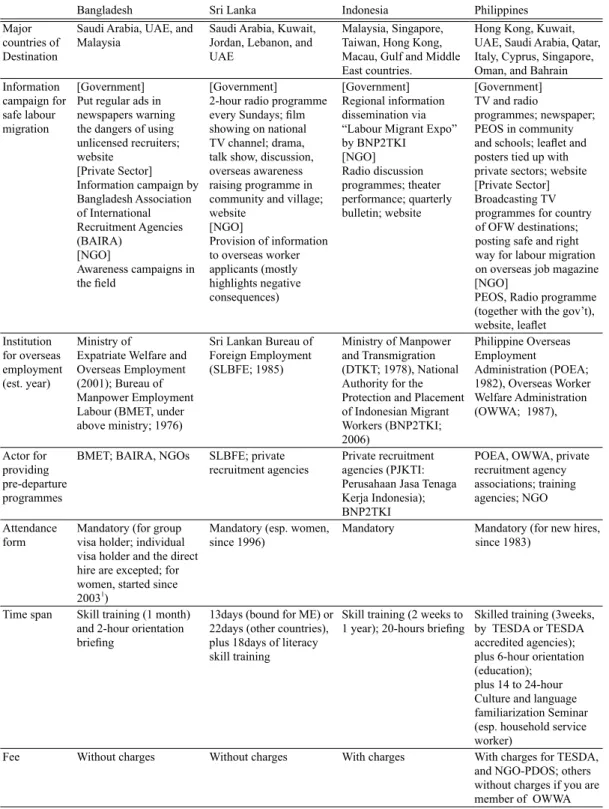
With the advisory of the International Organization of Migration (IOM), many of the labor-sending countries have started implementing similar programs to the prospective workers. As seen in Table 1, Bangladesh, for example, has no private media on information dissemination; pre-departure orientation trainings are mandatory. The two-hour briefi ng is comprised of dos and don’ts, country-specifi c information, rights, health etc. of relevance to outgoing migrants. For Sri Lanka, another major labor-sending country to the Middle East, it is managed by Sri Lankan Bureau of Foreign Employment. They provide a two-hour radio program once a week, fi lm showing, community/village-based awareness programs, and thirteen-day mandatory pre-departure orientation training for household service workers, including a spouse- and family-involved orientation on the last day.
In the Philippines, on the other hand, there are radio programs intended for information campaign; mandatory PDOS with region- (and some country-) specifi c trainings for migrants by the government and/ or government-accredited agencies; and information campaign by various nongovernmental organizations (NGOs) (Siddiqui, Rashid, and Zeitlyn 2008). In sum, compared with other labor-sending countries, public and private sectors in the Philippines are providing more information and educational opportunities toward its prospective workers.
2 This paper is an output of a three-year project titled “Filipino Diasporas in an Open City” funded by Japan Society for the Promotion of Science from CY 2008 to 2010 (no.20401007).
These pre-departure programs, however, have been criticized for its defectiveness. Baggio and Taguinod (2004) claim a commercialization of these programs and exploitation of the workers within the system. Guevarra (2009) states functional problems of the PDOS. She argues that the PDOS has been used as an excuse for the government; by providing information to workers and making them into “responsible” individuals, the PDOS shifts the government’s responsibility of supporting them to the migrants themselves. She also noted that the PDOS has become a medium to turn prospective applicants into “economically profi table” workers by providing them the employer’s needs and teaching them how to behave to have added-value to the laborer. This, as pointed by Parreñas (2003), resembles the situation in which workers are coerced to be “good Filipino domestic workers” in Hong Kong to win over a competitive labor market.
Observing the PDOS, Rodriguez (2010) puts it as a factor of the neoliberal Philippine “Labor Brokerage State.” These seminars have an educational façade to empower the workers belonging to the vulnerable category, thus daring them to embark on an adventure in the foreign countries. Though these are some faces of PDOS, it is still uncertain how the pre-departure programs in the Philippines was developed, what aspects need improvement, and what the attendees expect from the seminar itself. Thus, this paper aims to shed a fresh light on the preeminence and challenges of the preparation given by the government and/or agencies, so as to seek further progress within the system and some guidance to other labor-sending countries.
Data and arguments used in this paper are based mainly on quantitative and qualitative researches in the Philippines as well as in the UAE from 2009 to 2011.2 The author had conducted the following researches:
distribution of a total of 230 questionnaires to PDOS attendees at the POEA and the OWWA in Manila, key informant interviews with individuals working at the POEA, the OWWA, and recruiting agencies in August 2009; observation of the PDOS and interviews with the PDOS-providing NGOs in September 2010; and interviews with the labor attaché in the POLO, expats, and several runaway Filipinas in a shelter in the UAE from February to March 2011.
I Contemporary Labor Migration from the Philippines to the Middle East
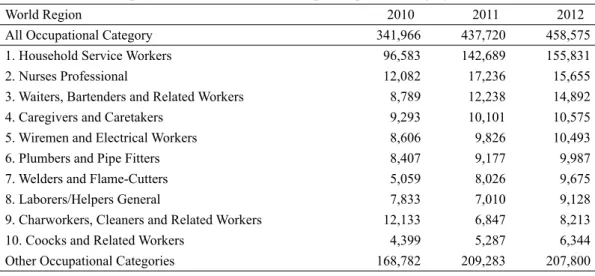
For the last forty years, overseas labor migration has been an integral part of the Philippine society, economy, and politics. It has become more conspicuous with more than one million deployments annually for the last fi ve years. As of 2010, 9.5 million Filipinos—nearly 10 percent of the total population—are working and living in 217 countries and regions (CFO 2011). 1.47 million contract workers, whose term ends every six months to two years, leave the country to work abroad
As stated earlier, there is a high concentration of the destination for household workers in the Middle East. Figure 2 shows that the 6 among top 10 labor-receiving countries of household service workers as of 2010 were GCC countries, altogether recognized by Filipinos, as the “Middle East,” a region with political system, society, and culture relatively unfamiliar with those of the Philippines.
On the other hand, the Filipinos are regarded as “low-cost Americans” for their language ability in English, and recognized of their “top quality” performances (Dumia 2009, 59). Thus, with the number of the
3 See May (1997) and Guevarra (2006) for details.
4 In 2003, Republic Act No. 9189, the Overseas Absentee Voting Act, was passed.
household service workers accounting for 25 percent of all workers, the Philippines has gained an unfavorable reputation as “a country of DHs (domestic helpers)” (Gancayco 1996, 73).
The hard-earned dollars of the OFWs in the Middle East, often said as Katas ng Saudi (sweat in the Saudi), have been financially supporting the families left in the Philippines. Their economic contribution in the form of the remittances, together with other overseas Filipino immigrants in North America, is now consisting some 12 percent of the GDP in the Philippines . This amount places third in the world, after India and Mexico. Because of their sweat and sacrifi ce, the government in the early 1990s labeled the OFWs as bagong bayani, literally meaning the new national heroes in recognition of their economic contribution. Guevarra (2009, 33) explains that these moves were to “attempt to downplay the absence of any governmental protective mechanisms for the country’s overseas workers during this period.”
In fact, the protection of the rights and welfare of the OFWs, especially the household workers, became an essential issue for policymakers. By mid-1980s, the feminization of export labor occurred as the market increased the deployment of predominantly-female household service workers. It was during this time that cases of culture and crime, welfare, contract and payment, and health and death have increased (Gonzalez 1998). The height of it were the cases of two household workers Flor Contemplacion in 1995 and Sarah Balabagan in 1996, which resulted in an uproar in the Philippines and led politicians and ambassadors to exert themselves in tackling the prevention of their execution.3 Candidates of local and national election have
to be mindful of the OFWs since 2003.4 National image is deeply related to the OFWs as well. Accordingly,
managing overseas labor migration and protection of Filipinos abroad are considered to be very important lest it bring about social unrest in the country.
II Evolution of the Pre-Departure Programs
1) Brief History
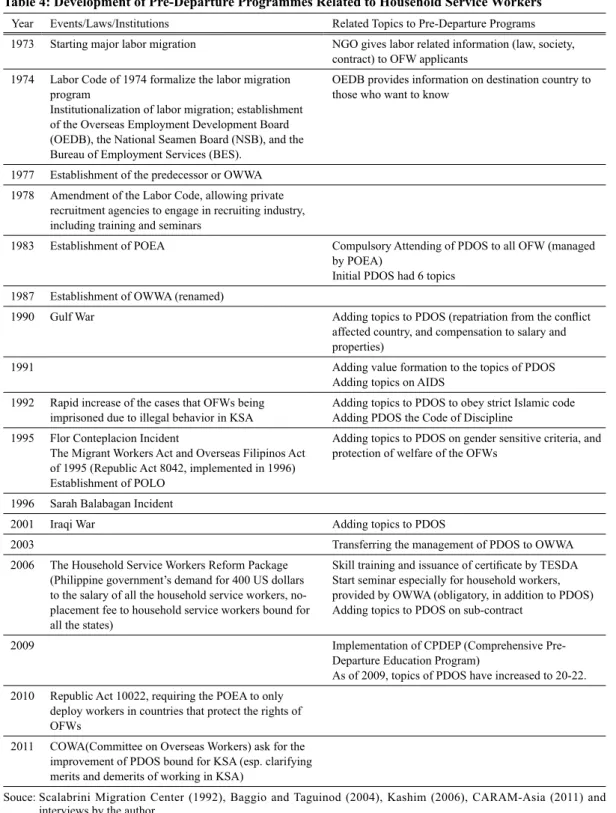
The pre-departure programs related to the overseas workers were developed with events concerning these laborers. It was in the early 1970s when the opening of a channel to the human fl ow of Filipinos has begun as oil boom in the Gulf States entailed workers in the building of infrastructures especially for oil industries. In this stage, the need for manpower was so large that the workers were deployed at a fast schedule with little knowledge of their country of destination. Thus it was inevitable that they would face difficulties, which sometimes had aggravated to cases. These cases covered theft, illegal entry, violation of Muslim and host country’s law, maltreatment, substitution or inobservance of contract, unpaid/delayed salary, and various abuses.
Before long, with the request of the migrant workers and their family, religious organizations and migrant-concerned NGOs started providing prospective OFWs information on the labor contracts of and living conditions in their destination. This later became a prototype of the PDOS (Scalabrini Migration Center 1992). As early as 1974, the OEDB (Overseas Employment Development Board) took over the role and
5 The POEA Memorandum of Circular, No. 3, Series of 1983.
provided information on the recruitment procedures and country of destination, among others, as free-for-all orientation seminars to the prospective workers. These orientation programs were developed to help prepare migrant workers for the life that awaits them overseas, and to disseminate the intension of the government. With the creation of the POEA (Philippine Overseas Employment Administration) in 1983, this information-education program was institutionalized as the PDOS, and became mandatory for all the departing labor migrants. Whether they are fi rst-timers or “ex-abroads” (those experienced working in other country), as long as they are newly hired, the applicants had to go through this procedure.
In the early years, the contents of the PDOS were merely six topics, which partook more of preventive measures so the migrant would avoid facing troubles in the countries of destination. These were: the codes of discipline and obligation of OFWs (family responsibilities, taxes, remittances, etc.); the terms and conditions of employment (contract); the jobsite or the vessel (for the sea-based); the host country’s social, religious, economic, legal, and political background; the government services to workers overseas; and travel tips.5
They vary by the region of the worker’s destination: North America, Europe, Middle East (and Africa), Southeast Asia, East Asia, and Taiwan (Scalabrini Migration Center 1992).
In due course, the contents of PDOS were gradually extended to 20 to 22 topics to meet the new realities of the overseas workers. The Gulf War in 1990 has added topics on the means of evacuation from the confl ict-affected country and demand on compensation to salary and properties. When there was an alarming number of the OFWs’ imprisonment due to illegal behavior in Saudi Arabia, topics were added to obey strict Islamic code. In 1995, additional topics on gender sensitive issues and protection of welfare of the OFWs, such as the ways to prevent sexual assaults especially for female workers, were covered in the PDOS to comply with the Migrant Workers and Overseas Filipinos Act of 1995. More topics on welfare issues were discussed. It was thought that the more information was given, the safer the migrants would become.
Today, the features of the PDOS have changed not only preventively, but also extensively and proactively. Aside from explaining duties and obligations to oneself, to family, to fellow OFWs, to country, and to employer, the PDOS also covers financial literacy, as witnessed in a seminar taken place in the POEA on August 14, 2009. With the involvement of a former state-owned bank, a remittance bank, and a telecommunication company, the attendees were advised to make their own bank accounts. They were told not to send all their earnings, but promoted more “wise” ways of using money, such as saving and investment to overcome suceptible failure of sending all earned money—a strategy embraced by the President Arroyo regime.
The subjunctions of the PDOS topic illustrate the stances and concern of the government at times. However, the distinctive features related to the PDOS in the Philippines are brought out by the engagement of various sectors.
2) The Actors involving Provision and Revision of the PDOS Topics
6 In 2003, the POEA’s responsibilities regarding PDOS were transferred to the OWWA, so that the overseas workers would realize the benefi t of their being member of the OWWA. Indeed, each prospective overseas worker has to pay USD 25 for the OWWA membership and PHP 900 for the health insurance. The OWWA members receive social benefi ts (e.g., burial benefi t), education and training benefi ts (e.g., scholarship), social services (e.g., reintegration programs), workers assistances and on-site services (e.g., repatriation assistance).
7 The PDOS done by the recruitment agency itself is called “in-house PDOS.” However, there are always allegations that they would not explain the applicants the things that are disadvantageous to the agency, such as the rights of the OFWs and contents of the contracts.
8 See the website of OWWA (http://www.owwa.gov.ph/wcmqs/pdos/). There were 62 PDOS providing agencies accredited by the OWWA as of May 2010 (OWWA 2010).
9 Among the 34 POLO branches, 11 are located in Asia, 13 in the Middle East, 7 in Europe, and 3 in the Americas. As part of its protective mechanism, POLO is strict in their pre-qualifi cation system to determine the employer’s fi tness to hire domestic workers, including personal interview of the employer.
various institutions in 2010 (DOLE 2011).6 The providers of the PDOS vary according to the type of hiring
and job category. While some are conducted by government agencies like the OWWA (Overseas Workers Welfare Administration) and the POEA (for government-placed and direct-hired contract workers, like engineers and nurses), most of them are conducted by institutions accredited by the OWWA. These are the agency/industry associations such as the PASEI (Philippine Association of Service Exporters, Inc.; for skilled workers of their member agencies), the recruitment agencies (for their own skilled workers),7 and the NGOs
(for the household service workers).8 There, orientations are given to prospective workers that are suited for
their job and destination.
The contents of PDOS topics have been revised every year by the interactions with various institutions and demands by different sectors (Figure 3). Some of the offi cial channels are the advices and messages from the Philippine Overseas Labor and Offices (POLOs)9, the POEA, the Department of Foreign Affairs, and
the Offi ce of the Vice President. Information is provided by other private sectors (that supply materials such as brochures) to foster OFWs’ economic activities. Dialogues with the NGOs bring up rights and physical/ psychological health issues; the media covers news as well as speaks for public sentiments on the OFWs. In this way, it is ensured that humane information is provided to overseas workers to prevent them from becoming mere commodities of labor.
III Contemporary Pre-Departure Programs to the Household Workers bound for the Middle East
At this point, special concern is given to household service workers, such as stay-in caregivers, nannies, baby-sitters, cooks, drivers, and other household related laborers, who are more prone to various types of abuses. 1) The Accumulation of the Pre-Departure Programs
With the competency to the global market as well as protection of the household service workers, the components of the pre-departure programs have been made more complex in the last three decades. This consists of the Pre-Employment Orientation Seminar (PEOS), the Technical and Educational Skills Developing Authority (TESDA), the PDOS, and the “Language and Culture Familiarization Program,” to equip the worker with information. The prospective workers are approved to leave the country when
10 Interview to a POEA employee (August 2009).
11 Procedures and Guidelines in applying for HSW NC II, Technical Education and Skills Development Authority (http:// www.tesda.gov.ph/program.aspx?page_id=48).
12 It is interesting to note that in some NGOs run by Filipino Muslims, some verses of the Qur’an were chanted to begin the seminar, followed by that of Christianity. This was one of the ways to familiarize applicants to the Muslim culture. certifi cations from the latter three are acquired.
Since 1997, the POEA has been conducting the several-hour long PEOS in high schools and colleges in the region for those thinking or dreaming of working abroad. In the seminar, it lobbies on the potential OFWs to evaluate their own priorities in life, skills, and physical and mental readiness to work abroad. Using modules such as overview of migration, updates on the employment market, application process, actual conditions of laborers, rights of workers, existence of illegal recruitment, and health risks, the PEOS aims for the attendees to have second thoughts of working abroad, and suggests them to stay in the Philippines. The intention of the PEOS is to discourage Filipinos from working abroad.10 Nevertheless, with the one million
OFWs deploying annually, the well-informedness seems to be a question of its effectiveness.
With the Reform Package of 2006, departing household service workers are required to complete a National Certificate for Household Workers issued by the TESDA. This is a training seminar covering household chores like cooking, washing clothes, ironing, and cleaning (living room, dining room, bedroom, toilet, and kitchen) by using electric appliances, provided by the TESDA itself or a TESDA-authorized training center.11 The duration of training—ranging from fi fty hours to more than two months—depends on
the provider. Such training is required to maintain good relationship with the madam, the female employer. A good number of reported cases involve household service workers being reproached for the poor performances in household chores and the inept use of electronic appliances. This stems largely from the gap in living conditions of the employer and the worker—the expectation from the madam in profi ciency and the experience of the household service workers who, in general, have grown up in the provinces.
The PDOS provided by the OWWA-accredited NGOs is supposed to be an eight-hour seminar; yet as far as the author has observed, it lasts only four hours. The participants of the PDOS are presented a comprehensive module with topics on contract familiarization (verifi cation of the righteous contract so as not to be victimized, profi le of the region of destination (culture and laws in depth), stages of the OFW’s life (how to cope socially and financially with oneself and family), health and safety, airport procedures, and other government programs (who and what to do when facing abuses and contract inobservance).12 The licensed
trainers—college graduates who have worked or stayed in the region that the prospective workers are destined to—explain these topics with actual cases so the attendees will realize that these are not events isolated from their own lives. The trainers encourage them not to deprecate their job as mere household service workers; rather they are desired people of brilliance, cleanliness, hard work, trust, and English profi ciency compared to other nationalities in the host country. In the end, the attendees are to bring out their reasons and goals for working abroad to make fi rm resolutions to “complete the two-year contract and come home” and to “improve their lives.”
Moreover, in 2006, the Language and Culture Familiarization Program came in as part of the Reform Package, and the OWWA offered a three-day (twenty-four hours) program to the prospective workers. In
13 For the Middle East class, the contents of the program include language (1. Arabic Script; 2. Arabic numerals; 3. Vocabulary; 4. Sentence construction; 5. Personal/ interrogative pronouns; 6. Greetings of expression; 7. Expression of thanks and apologies; 8. Expression of time/day/week/month/year; 9. Parts of the house; 10. Home appliances and kitchen utensils; 11. Household chores; 12. Foods [vegetable, meat, fruits, fi sh] and condiments; 13. Cooking and cleaning terms; 14. Beverages and drinks; 15. Measurements and colors; 16. Parts of the body; 17. Family members and relatives; 18. Common illnesses; 19. Caring for the sick and children; and 20. Phone conversation / How to make emergency calls) and culture (1. Geography; 2. Islam in the Middle East; 3. Arab cuisine; 4. Culture, values, traditions; 5. Holidays and ways of celebration; 6. General culture inside the home; 7. Dress codes; 8. Standards of social behavior; 9. Respect for the elderly; 10. Dining manners).
14 In 2009, this four-day program was renamed the Comprehensive Pre-Departure Education Program .
15 Agencies usually receive job orders for workers through the POEA. The Philippine Embassy or the POLO attests the job order. Yet, there is a malpractice that some agencies "reprocess" job orders for work abroad. A "Repro" job order refers to non-existent work, work different from the actual work abroad, or work with a different employer. For example, a worker’s job is indicated as “waiter,” but in reality his work is “cleaner.” Applicants who seek for “fast deployment” sometimes become willing victims of these means. See also Batistella and Asis (2011).
this program, the fi rst two days are spent for learning the language useful for household chores, and the last day is spared for stress management and cultural familiarization.13 For workers bound for the Middle East,
basic Arabic suitable for the household work is taught by Muslim Filipino trainers who graduated from college in the Middle Eastern countries, such as Egypt and Saudi Arabia. For the stress management, ways of coping with loneliness, labor condition without holiday, and sexual harassment are discussed interactively. The attendees are also taught to cope with a diffi cult work environment in the Middle East for the household service workers in the session of cultural familiarization. There the ex-abroads become resource persons to share their experiences.14
The components of the pre-departure programs have been extensive and multi-tiered and seem to be giving enough information to the applicants to be “well-informed.” What are the responses of the attendees? What can further be done?
2) Responses of the Attendees
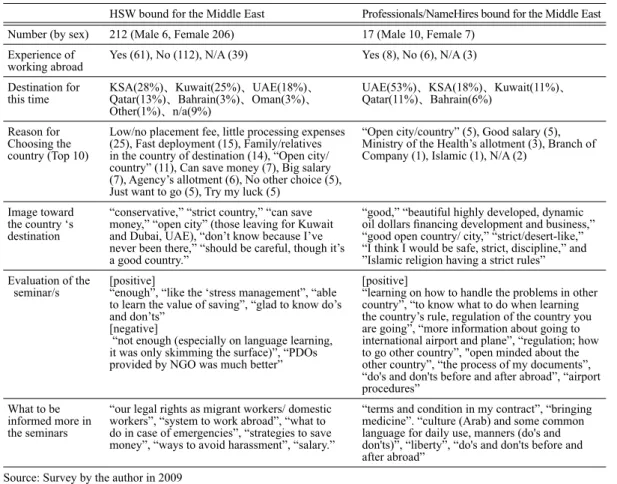
The survey was conducted on August 29, 2009 at the OWWA building in Manila for the household workers destined to the Middle East. It was undertaken just after they have completed the familiarization program. All of the participants had already attended PDOS provided by respective NGOs and agencies. There were 212 respondents, with 206 female and 6 male. Among the respondents, 32 are Muslims and the rest are Christians. As regards their experience of working abroad, 61 people had experienced, whereas 112 people had not worked abroad, and non-applicable answer was 39.
Their motivations of working in these countries vary from positive perspectives such as “can earn money,” “my family/relative is/was working there,” to passive notions like “only place for me to work” and “agency’s allotment” (Table 5).15 These answers can be categorized into three: economic-, family-,
and individual-oriented. Among the top ten reasons, four of them were economic-oriented. This means that workers pay little attention to where they go and what culture and laws that the country of destination have; they were eager to be deployed right away, thus risking possibilities of careful consideration on what to learn in the PDOS.
16 This was posted in the website of the OWWA (http://www.owwa.gov.ph/wcmqs/about/) in July 2011, but as of August 2011, no UAE-specifi c PDOS is conducted.
The images toward the country of destination vary: “conservative,” “strict country,” “can save money,” “open city” (those leaving for Kuwait and Dubai, UAE), “different culture, although we believe in the same religion” (Muslim respondent), “do not know because I have never been there,” and “should be careful, though it’s a good country”. These voices support the analysis of the motivation above that the culture and societies of destination do not matter very much to them, rather they assume their country of destination as a mere place to earn money (Table 6).
Their comments on the seminar contain both positive and negative aspects: “enough.” “like the stress management,” “able to learn the value of saving,” “glad to know the dos and don’ts”. “not enough (especially on language learning, it was only skimming the surface)”, “PDOS provided by NGO was much better.” Indeed, a respondent told the author that the PDOS she attended was provided by a Muslim lecturer who was formally a household service worker in the Middle East and had eventually set up a law fi rm. The lecturer eloquently shared her experiences of saving income and pursuing the study, and most of all, keeping up the will to achieve her goal. It seems that she has come out well in portraying herself as a model of a successful OFW.
The answers to “What would you want to learn more in the PDOS?” vary covering crucial information such as: “our legal rights as migrant/domestic workers,” “system to work abroad,” “what to do in case of emergencies,” “strategies to save money,” “ways to avoid harassment” and even “salary.” It is surprising that there were no big differences between the fi rst-timers and ex-abroads in their evaluation of the PDOS. This indicates that many of the workers did not build knowledge from the information provided to them, nor learn through experiences.
IV Evaluation from Filipinos in the United Arab Emirates
In this part, special attention is set on the UAE for three reasons: a notable increase in the number of the UAE-bound OFWs since 2003; a report by a human rights-concerned NGO condemning the UAE as one of the two countries where the most atrocious cases of violence against Filipino migrants originate; and the OWWA’s intention of having country-specifi c PDOS,16 leading to necessity for special care for the OFWs.
1) Image and the Actual Condition in the UAE
In the earlier part of this paper, the author mentioned that the “Middle East” meant Saudi Arabia, the UAE and some other GCC countries that have “diffi cult working conditions.” However, Dubai, as represented by a Filipino fi lm titled Dubai (screened in 2004 by a Filipino TV production), has been portrayed as an “open country/city,” where not so much as the United State and Europe, the Filipinos are enjoying relatively affl uent urban lives, not the restricted ones. There are malls and churches; alcohol drinking, gatherings, relationships, and moderate attires are allowed for the expatriates under certain conditions; and opportunities for wealth and success seem to lie there.
17 Some have stayed in detention before moving to the shelter, and others face cases fi led by the employer.
These might be partially true to professionals and skilled workers. The household service workers, who usually have no or little day-offs, can hardly be part of that community. They are, by large, staying in the house/compound of the employer, with limited actual interactions with their fellow countrymen. The “open country/city” reflects the social sphere for the expatriates, who comprise majority of the population, but allotted to the temporarily-compartmentalized surface of a multi-layered society in the country. Without this in mind, the Filipino workers would have to face the diffi culties after their deployment.
2) Evaluation from the Filipinos in the UAE
The experiences of OFWs vary. In order to know the effi cacies and challenges of the pre-departure programs, comments from the overseas Filipinos were collected during the author’s research from February to March 2011.
The labor attaché in the POLO-Abu Dhabi Offi ce pointed out that the majority of the problems arise from the household service workers and their ill-preparedness. Some of them sought for assistance from the POLO offi ce, but they failed to bring any copy of processing documents and passport, and they do not know the full name of the employer and the home addresses. Others—not knowing that their contract was “repro,” or fi nding out that the contract was substituted upon arrival—did not seek help from the POLO for fear that they will be brought back to the Philippines until the things has become aggravated. They should have gone to the recruitment agency and asked for proper reprocessing. The labor attaché said that these were included in the topics of the PDOS, and the trainers must have told them what to do to protect themselves. It was probable that the workers did not simply wanted to go home without a fruit, or else, they expected they can wriggle out of it likewise in the Philippines.
Moreover, fast deployment and casual try of the Filipinos often lead to easy relations with the others. Some became in good terms with other expats, ending up pregnant without legal procedures. In time of seeking help, the man would be nowhere to be found in the country. Some receive money and get pregnant in the end, only to be deported. Sex education is needed in the PDOS, and not just avoiding sexual harassment. Problems and maladjustment may be attributed to poor linguistic skills. Regarding Arabic language, a post-arrival language classes was held in POLO-Abu Dhabi for the newcomers in the past years (for those who are allowed to go out at their will), but it has been terminated at the time of interview. Although many employers can speak English, literacy in Arabic would make the OFW’s life more convenient. It seems advisable that the moment an applicant starts going through the processing procedure of the recruitment, he/ she should start learning the language in depth, together with the knowledge of the society and behavior of the people. This is one of the responses to the survey done by the author in 2009 that the applicants wanted longer and proper language training at the pre-departure programs. Linguistic ability can be a resource not only as an OFW, but also as a job candidate.
As for the OFW’s point of view, some runaway maids temporarily staying at the shelter of the POLO-Abu Dhabi offices also shared their experiences.17 The reasons behind taking refuge are diversified as
18 See “Guide to Safe Living: Dos and Don’ts in the UAE,” Gulf News May 19, 2011 (http://gulfnews.com/news/gulf/uae/ general/guide-to-safe-living-dos-and-don-ts-in-the-uae-1.809786).
was additionally ordered to take care of the elderly and small children; was almost raped by the male relative of the employer; was verbally and physically abused by the madam; unable to adjust to the staple food of the African employer whom she just met after arrival; and was threatened to shoulder the processing fee paid by the employer when she asked to have the employer changed at the agency.
In the PDOS, the workers were taught what to do or where to seek help when they face troubles: fi rst, talk to the employer; if not solved, ask friends; if no changes, consult agency; and for the last, seek assistance from the Philippine embassy/consulate (including the POLO and the OWWA) and local police. Yet, from these voices, some other consolidation of the system is deemed necessary to narrow the differences between the seminar and reality (i.e.-culture), to provide actual contact information of these legal/ governmental institutions and social associations, to disclose some information of the employer, to make arrangements that the employee can change the employer in a certain period of time without fi nancial burden, and above all, to implement the pre-hiring orientation seminar for the employer to learn about the background of the workers and their rights.
Recently, Filcom, a group comprised of Filipino community leaders in Dubai and the northern emirates came up with fi fty-page safety awareness book with tips for the newly arrived countrymen, while emphasizing the importance of attending the PDOS.18 The brochures include dos and don’ts for the daily life
of the Filipinos in the UAE and were distributed during the Philippine Independence Day celebration in June 2011. This shows the insuffi ciency in the structure of the current pre-departure programs and effectiveness of the cooperation between the expats and the Philippine governmental institutions in the UAE to protect the compatriots.
Conclusion
In this paper, the author has introduced the evolving policies and institutions for the protection of the OFWs by the Philippine government, and evaluated the contents of the pre-departure programs, especially the PDOS. Overall, the study showed the preeminence of the programs as being able to provide various information before leaving abroad, such as advice on stress management, values education for gender awareness, and the importance of saving. The accumulative procedures and multi-structured system, in terms of differentiation by the deploying region and by the major occupation, are aimed at giving more detailed assistance to the workers, as well as enriching them with skills and information.
However, there are limitations as well. It can be pointed out from both attendees’ and providers’ side. For the attendees’ issue, the problem relates to prospective OFWs’ ill-preparation or lack of imagination of themselves being involved in these problems. For the providers’ sides, one might question whether their information is true enough, as they could not discourage the outbound OFWs to make the last minute withdraw. Another problem is the lack of information about the specific receiving country. Many of the Middle East countries share similarities, but they also differ in politics, law system, society, and culture.
They cannot be taken monolithically. The best thing is to know the real living and working condition of the respective country and cities by the same occupational category as the living conditions and life styles between the different job strata in their destinations vary. Conversely, it is deemed desirable to share household workers’ experiences with other institutions and organizations of the major labor-sending powers like India, Bangladesh, Sri Lanka, and Indonesia to seek solutions for the common issues in the host countries.
Considering the entry status of the Filipinos in other country, especially the case of the UAE, the undocumented workers—most likely the visit visa holders—enter the country without attending the PDOS, which results in their presence not being acknowledged by the Philippine embassy. This creates larger problems to the workers themselves. What is preferable is to go through an orientation along with the registration at the embassy as an OFW once hired. Hence two things are recommended for the improvement of the situation. First, it is necessary for the PDOS to be more country- and profession specifi c and be held in cooperation with the migrant-concerned NGOs. Second, there needs to be an implementation of post-arrival programs in the host countries to follow-up hastiness of the OFWs including visit-visa entries.
In this age of globalization, the Philippine government has been sending its people as laborers, and has created a situation where more than one-tenth of its population is residing around the world. Such expansion of the Philippine society beyond the national boundaries has changed the consciousness of the Filipinos and has brought about easy overseas labor migrations. The easiness is especially relevant to the household service workers, which calls for little processing requirements. They assume the job as something everyone can do, and leave the country in a hasty attempt by saying, “mag-DH na lang ako (I’ll just work as a domestic helper).” Formally, abundant information is provided through the pre-departure programs, but these are not fully digested by the workers to be “well-informed.” The household service workers are the people who have to go into the deeper layers of the host society. It calls for more risks and determination on how they want to understand the workplace where they will spend the next two years of contract. “Well-informedness” is achieved only after the worker is able to utilize the information as their knowledge, with the will to understand the society of the host country. It may be said that whether or not the workers can maximize their efforts of overseas experience rests on the their well-informedness and the extensive institutional, legal, and social supports that surround them.
References
Asis, Maruja M. B. 1992. “The Overseas Employment Program Policy,” in Philippine Labor Migration: Impact and Policy, ed. Graziano Battistella and Anthony Paganoni. 68-112. Quezon City: Scalabrini Migration Center.
Baggio, Fabio and Michelle Taguinod. 2004. Pre-Departure Orientation Seminars: A Positive Joint Venture between GOs and NGOs in the Philippines. Workshop H50. Fostering cooperation among NGOs, academe and governments. Regional experiences.
CARAM (Coordination for Action Research on AIDS and Mobility)-Asia. 2011. Reality Check! Rights and Legislation for Migrant Domestic Workers across Asia. Malaysia: Polar Vista Sdn Bhd.
Commission on Filipino Overseas (CFO). 2011. Stock Estimate of Overseas Filipinos, As of December 2010. Manila:Philippines.
http://www.cfo.gov.ph/index.php?option=com_content&view=article&id=1340:Stock-estimate-of-overseas-fi lipinos&catid=134:Statisticsstock-estimate&Itemid:814 (accessed August 20, 2011). Department of Labor and Employment (DOLE). 2011. Benefi ts and Services for Overseas Filipino Workers,
Philippines: 2009 - Second Quarter 2011. Current Labor Statistics (October 2011) http://www.bles. dole.gov.ph/PUBLICATIONS/Current%20Labor%20Statistics/STATISTICAL%20TABLES/Tab46.pdf (accessed August 20, 2011)
Dumia, Mariano A. 2009. Of Dreams, Sweat, and Teas: The Kingdom of Saudi Arabia and the Modern Filipino Heroes. Quezon City, Philippines: New Day Publishers.
Gancayco, Emilio A. 1996. “Resonse from the Bureaucracy: the Gancayco Commission Report.” In Filipino Women Migrant Workers: At the Crossroads and Beyond Beijing, ed. Ruby Palma-Beltran and Gloria Rodriquez, 69-80. Quezon City, Philippines: Giraffe Books.
Gonzalez, Joaquin L, III. 1998. Philippine Labor Migration: Critical Dimensions of Public Policy. Manila: De La Salle University Press.
Guevarra, Anna Romina. 2006. Managing “Vulnerabilities” and “Empowering” Migrant Filipina Workers: The Philippines’ Overseas Employment Program. Journal for the Study of Race, Nation, and Culture 12 (5): 523-41.
Guevarra, Anna Romina. 2009. Marketing Dreams, Manufacturing Heroes: The Transnational Labor Brokering of Filipino Workers. New Brunswick, New Jersey, and London: Rutgers University Press. International Labor Organization (ILO). 1987. Managing Contract Migration: Philippine Experience
Observed. (Proceedings of ARPLA/ILMS/POEA Inter-country Seminar for Training Labor Administration Officials in Overseas Employment Administration Manila, 9-20 September 1986) International Labor Organization, Asian and Pacific Project for Labor Administration (ARPLA): Bangkok.
International Organization for Migration (IOM). 2005. Labor Migration in Asia: Protection of Migrant Workers, Support Services and Enhancing Development Benefi ts.
International Organization for Migration (IOM). 2010. Labor Migration from Indonesia: An Overview of Indonesian Migration to Selected Destinations in Asia and the Middle East.
Kashim, Abdulhusin. 2006. An Assessment of the Pre-Departure Orientation Seminar as A Management Strategy to Prevent the Commission of Abuses against the OFWs and Ensure their Success while Working Abroad. Dissertation. International Academy of Management and Economics. Manila. May, R. J. 1997. “The Domestic in Foreign Policy: The Flor Contemplacion Case and Philippine-Singapore
Relations.” Pilipinas 29: 63-75.
Parreñas, Rhacel Salazar. 2003. Servants of Globalization: Women, Migration, and Domestic Work. Ateneo de Manila University Press. Manila.
Philippine Overseas Employment Agency (POEA). 2006. OFW Global Presence: Compendium of OFW Statistics 2008. Manila: Philippines.
http://www.poea.gov.ph/stats/2008_stats.pdf (accessed August 19, 2011)
http://www.poea.gov.ph/stats/2008_stats.pdf (accessed July 31 2009)
Philippine Overseas Employment Agency (POEA). 2011a. Compendium of OFW Statistics 2010. Manila. http://www.poea.gov.ph/stats/2010_stats.pdf (accessed July 13, 2011)
Philippine Overseas Employment Agency (POEA). 2011b. OFW Deployment per Country and Skill – New hires. Full Year 2010.
http://www.poea.gov.ph/stats/2010%20Deployment%20by%20Destination,%20Occupation%20 and%20Sex%202010%20-%20New%20hires.pdf (accessed August 20, 2011)
Philippine Overseas Workers Welfare Administration (OWWA). 2010. OWWA-Pre-Departure Orientation Seminar Accredited PDOS Providers Landbased/NGOs/IA/CS As of May 15, 2010.
http://www.owwa.gov.ph/wcmqs/pdos/providers/Land-based+accredited+PDOS+providers+as+of+Ma y+15,+2010.pdf (Accessed July 31, 2009)
Rodriguez, Robyn Magalit. 2010. Migrants for Export: How the Philippine State Brokers Labor to the World. Minnesota University Press.
Scalabrini Migration Center. 1992. Pre-Employment and Pre-Departure Services for Filipino Migrant Workers, Prepared by the Scalabrini Migration Center, Inc. on behalf of the La Trobe University Regional Social Development Centre and International Social Service Migrant Worker Project for the Interational Labor Organization, Quezon City, Philippines.
Scalabrini Migration Center. 2005. Preparing to Work Abroad: Filipino Migrants’ Experiences Prior to Deployment. Manila.
Siddiqui, Tasneem, Rozana Rashid, and Benjamin Zeitlyn. 2008. Information Campaigns on Safe Migration and Pre-Departure Training. DRC Research Reports. Development Research Centre on Migration, Globalization and Poverty.
http://www.migrationdrc.org/publications/research_reports/Information_Campaigns_and_Pre_ Departure_ Training.pdf (accessed February 28, 2011)
Scalabrini Migration Center. 1992. Pre-Employment and Pre-Departure Services for Filipino Migrant Workers, Prepared by the Scalabrini Migration Center, Inc. on behalf of the La Trobe University Regional Social Development Centre and International Social Service Migrant Worker Project for the Interational Labor Organization, Quezon City, Philippines.
Table 1: Comparison of Information Campaign and Pre-Departure Programs among Three Major Sending Countries of Household Service Workers (2008-2009)
Bangladesh Sri Lanka Indonesia Philippines
Major countries of Destination
Saudi Arabia, UAE, and Malaysia
Saudi Arabia, Kuwait, Jordan, Lebanon, and UAE
Malaysia, Singapore, Taiwan, Hong Kong, Macau, Gulf and Middle East countries.
Hong Kong, Kuwait, UAE, Saudi Arabia, Qatar, Italy, Cyprus, Singapore, Oman, and Bahrain Information
campaign for safe labour migration
[Government] Put regular ads in newspapers warning the dangers of using unlicensed recruiters; website [Private Sector] Information campaign by Bangladesh Association of International Recruitment Agencies (BAIRA) [NGO] Awareness campaigns in the fi eld [Government]
2-hour radio programme every Sundays; fi lm showing on national TV channel; drama, talk show, discussion, overseas awareness raising programme in community and village; website [NGO] Provision of information to overseas worker applicants (mostly highlights negative consequences) [Government] Regional information dissemination via “Labour Migrant Expo” by BNP2TKI [NGO] Radio discussion programmes; theater performance; quarterly bulletin; website [Government] TV and radio programmes; newspaper; PEOS in community and schools; leafl et and posters tied up with private sectors; website [Private Sector] Broadcasting TV programmes for country of OFW destinations; posting safe and right way for labour migration on overseas job magazine [NGO]
PEOS, Radio programme (together with the gov’t), website, leafl et Institution for overseas employment (est. year) Ministry of
Expatriate Welfare and Overseas Employment (2001); Bureau of Manpower Employment Labour (BMET, under above ministry; 1976)
Sri Lankan Bureau of Foreign Employment (SLBFE; 1985)
Ministry of Manpower and Transmigration (DTKT; 1978), National Authority for the Protection and Placement of Indonesian Migrant Workers (BNP2TKI; 2006) Philippine Overseas Employment Administration (POEA; 1982), Overseas Worker Welfare Administration (OWWA; 1987), Actor for providing pre-departure programmes
BMET; BAIRA, NGOs SLBFE; private recruitment agencies
Private recruitment agencies (PJKTI: Perusahaan Jasa Tenaga Kerja Indonesia); BNP2TKI
POEA, OWWA, private recruitment agency associations; training agencies; NGO
Attendance form
Mandatory (for group visa holder; individual visa holder and the direct hire are excepted; for women, started since 20031)
Mandatory (esp. women, since 1996)
Mandatory Mandatory (for new hires, since 1983)
Time span Skill training (1 month) and 2-hour orientation briefi ng
13days (bound for ME) or 22days (other countries), plus 18days of literacy skill training
Skill training (2 weeks to 1 year); 20-hours briefi ng
Skilled training (3weeks, by TESDA or TESDA accredited agencies); plus 6-hour orientation (education);
plus 14 to 24-hour Culture and language familiarization Seminar (esp. household service worker)
Fee Without charges Without charges With charges With charges for TESDA, and NGO-PDOS; others without charges if you are member of OWWA
Contents Dos and don’ts, country specifi c information, rights, healthcare, others
Skill Education on household management, language and general learning (1 to 12th day),;
seminar together with spouse and family (13th
day)
Briefi ng (situation and cultures of country of destination, risks of overseas labour, language skill, rights and duties as Indonesian migrant workers); skill training (skills of household work— language, cooking, how to use household electronic appliances)
Country or regional specifi c information on climate, law, culture, people; obligation and rights of OFWs; language skill training; stress-management
Other NGO Roles
Conduct educational skill programmes for women
Seek solution to the problems of returnees (NGOs are barred out from advising and monitoring pre-departure information seminars)
Conduct PDOS; Advice on the contents of PDOS;
Roles for international organizations (ILO, IOM)
Aid funding and development of text materials; conduct workshop on migrant worker’s rights; publish country- specifi c information leafl et (labour circumstances, law, important addresses, health- related topics, and remittance means); collaborate publish booklet for AIDS awareness; Provide training manual for PDOS trainers
Invite resource persons, fi nancial aid for training and module development , provide leafl ets for country-specifi c information and on human traffi cking
Conduct campaigns to educate and to raise awareness of migrant workers;
Conduct impact evaluation on policy for migrant workers; advice for improvement of PDOS; develop videos for PDOS and PEOS
Source: IOM (2005, 2010), Siddiqui, Rashid, and Zeitlyn (2008), and CARAM-Asia (2011)
T
able 2: Job Categories of
T
op-Four
Middle East Countries being Host Country of the Household Service
W orkers (2010) Kuwait United Arab Emirates Saudi Arabia Qatar Male Female Total % to Total Male Female Total % to Total Male Female Total % to Total Male Female Total % to Total
Administrative and Managerial Workers
14 11 25 0.1 84 109 193 0.4 170 58 228 0.2 48 23 71 0.2
Agricultural Animal Husbandry and Forestry Workers, Fishermen and Hunters
16 1 17 0.1 40 45 85 0.2 571 5 576 0.5 10 0 10 less than 0.1
Clerical and Related Workers
290 459 749 2.8 1,138 2,748 3,886 8.4 1,966 637 2,603 2.2 890 846 1,736 4.8
Production and Related Workers Transport Equipment
1,1 17 703 1,820 6.7 6,190 2,858 9,048 19.5 47,889 6,349 54,238 46.0 15,076 607 15,683 43.1
Professional Technical and Related Workers
234 468 702 1.6 2,177 1,1 12 3,289 7.1 13,322 10,246 23,568 20.0 2,815 478 3,293 9.1 Sales W orkers 146 269 415 1.5 1,328 2,048 3,376 7.3 1,493 245 1,738 1.5 421 375 796 2.2 Service Workers 1,124 22,244 23,368 86.2 3,201 23,385 26,586 57.2 8,221 26,859 35,080 29.7 2,700 12,096 14,796 40.7
(Domestic Helpers and Related Household Workers)
(141) (21,413) (21,554) (79.5) (83) (13,101) (13,384) (28.9) (344) (1 1,238) (1 1,582) (9.7) (51) (9,886) (9,937) (27.0) Total 2,941 24,155 27,096 100.0 14,409 32,370 46,779 100.0 74,806 44,469 119,275 100.0 22,350 14,444 36,794 100.0 Source: POEA (201 1b)
Table 3: Number of Deployed Landbased OFWs by Top Occupation Category, New hires (2010-2012)
World Region 2010 2011 2012
All Occupational Category 341,966 437,720 458,575
1. Household Service Workers 96,583 142,689 155,831
2. Nurses Professional 12,082 17,236 15,655
3. Waiters, Bartenders and Related Workers 8,789 12,238 14,892
4. Caregivers and Caretakers 9,293 10,101 10,575
5. Wiremen and Electrical Workers 8,606 9,826 10,493
6. Plumbers and Pipe Fitters 8,407 9,177 9,987
7. Welders and Flame-Cutters 5,059 8,026 9,675
8. Laborers/Helpers General 7,833 7,010 9,128
9. Charworkers, Cleaners and Related Workers 12,133 6,847 8,213
10. Coocks and Related Workers 4,399 5,287 6,344
Other Occupational Categories 168,782 209,283 207,800
Source: POEA (2013)
Source: POEA (2010)
Figure 1: Remittances of Overseas Filipinos by Top Ten Country-Source, 2003-2010 (In Thousand US Dollars)
0 5,000,000 10,000,000 15,000,000 20,000,000 2003 2004 2005 2006 2007 2008 2009 2010 United States Canada Saudi Arabia United Kingdom Japan Singapore United Arab Emirates or eg on
ccu at ona ate or 341,966
Source: POEA (2011a)
Figure 2: Number of Deployed Household Service Workers by Top Ten Destinations, New hires: 2004-2010
0 5,000 10,000 15,000 20,000 25,000 30,000 35,000 2004 2005 2006 2007 2008 2009 2010 Hong Kong Kuwait UAE Saudi Arabia Qatar Singapore Bahrain Oman Cyprus Italy or eg on
Table 4: Development of Pre-Departure Programmes Related to Household Service Workers
Year Events/Laws/Institutions Related Topics to Pre-Departure Programs 1973 Starting major labor migration NGO gives labor related information (law, society,
contract) to OFW applicants 1974 Labor Code of 1974 formalize the labor migration
program
Institutionalization of labor migration; establishment of the Overseas Employment Development Board (OEDB), the National Seamen Board (NSB), and the Bureau of Employment Services (BES).
OEDB provides information on destination country to those who want to know
1977 Establishment of the predecessor or OWWA 1978 Amendment of the Labor Code, allowing private
recruitment agencies to engage in recruiting industry, including training and seminars
1983 Establishment of POEA Compulsory Attending of PDOS to all OFW (managed by POEA)
Initial PDOS had 6 topics 1987 Establishment of OWWA (renamed)
1990 Gulf War Adding topics to PDOS (repatriation from the confl ict affected country, and compensation to salary and properties)
1991 Adding value formation to the topics of PDOS
Adding topics on AIDS 1992 Rapid increase of the cases that OFWs being
imprisoned due to illegal behavior in KSA
Adding topics to PDOS to obey strict Islamic code Adding PDOS the Code of Discipline
1995 Flor Conteplacion Incident
The Migrant Workers Act and Overseas Filipinos Act of 1995 (Republic Act 8042, implemented in 1996) Establishment of POLO
Adding topics to PDOS on gender sensitive criteria, and protection of welfare of the OFWs
1996 Sarah Balabagan Incident
2001 Iraqi War Adding topics to PDOS
2003 Transferring the management of PDOS to OWWA
2006 The Household Service Workers Reform Package (Philippine government’s demand for 400 US dollars to the salary of all the household service workers, no-placement fee to household service workers bound for all the states)
Skill training and issuance of certifi cate by TESDA Start seminar especially for household workers, provided by OWWA (obligatory, in addition to PDOS) Adding topics to PDOS on sub-contract
2009 Implementation of CPDEP (Comprehensive
Pre-Departure Education Program)
As of 2009, topics of PDOS have increased to 20-22. 2010 Republic Act 10022, requiring the POEA to only
deploy workers in countries that protect the rights of OFWs
2011 COWA(Committee on Overseas Workers) ask for the improvement of PDOS bound for KSA (esp. clarifying merits and demerits of working in KSA)
Souce: Scalabrini Migration Center (1992), Baggio and Taguinod (2004), Kashim (2006), CARAM-Asia (2011) and interviews by the author
Table 5: Top 10 Reasons for Worker’s to Choose the Country of Destination (Household Service Workers)
Reason Number of Respondents
1. Low/no placement fee, little processing expenses 25
2. Fast deployment 15
3. Family/relative in the country of destination 14
4. Open city/country 11
5. Can save money 7
6. Big salary 7 7. Agency’s allotment 6 8. No other choice 5 9. Just want to go 5 10. Try my luck/talent 5 N/A, others 112
Source: Survey done by the author in 2009
Figure 3: Diagram of Related Actors in PDOS Module/ Topic Revision (As of 2009)
Source: Interviews by the author
Abbreviations: OWWA(Overseas Workers Welfare Agency), DOLE (Department of Labor Employment), POLO (Philippine Overseas Labor Offi ce), DFA (Department of the Foreign Affairs)
Reason Number of Respondents
Posting, Coverage Civil Society e.g.-migrant-concerned NGO, church organization Migrant and migrant’s family Dialogue on rights and health issues Demand Demand, Advice Promulgate instruction (Memorandum Of Circular/ Instruction) Demand Critical coverage Media Accession Provide brochures Provide brochures Provide own information campaign Demand PDOS-provider Association e.g.- Migrant NGO Forum Private sectors e.g.-banking companies, telecommunication companies
OWWA (thru DOLE, POEA, POLO, DFA, Office of the Vice President, etc.)
Industry PDOS-provider/ Association e.g.-PASEI Provide information, Coverage NGO PDOS-provider Demand, Advice Cooperation Posting
Table 6: Profi le of the Respondents to PDOS
HSW bound for the Middle East Professionals/NameHires bound for the Middle East Number (by sex) 212 (Male 6, Female 206) 17 (Male 10, Female 7)
Experience of
working abroad Yes (61), No (112), N/A (39) Yes (8), No (6), N/A (3) Destination for
this time KSA(28%)、Kuwait(25%)、UAE(18%)、Qatar(13%)、Bahrain(3%)、Oman(3%)、 Other(1%)、n/a(9%) UAE(53%)、KSA(18%)、Kuwait(11%)、 Qatar(11%)、Bahrain(6%) Reason for Choosing the country (Top 10)
Low/no placement fee, little processing expenses (25), Fast deployment (15), Family/relatives in the country of destination (14), “Open city/ country” (11), Can save money (7), Big salary (7), Agency’s allotment (6), No other choice (5), Just want to go (5), Try my luck (5)
“Open city/country” (5), Good salary (5), Ministry of the Health’s allotment (3), Branch of Company (1), Islamic (1), N/A (2)
Image toward the country ‘s destination
“conservative,” “strict country,” “can save money,” “open city” (those leaving for Kuwait and Dubai, UAE), “don’t know because I’ve never been there,” “should be careful, though it’s a good country.”
“good,” “beautiful highly developed, dynamic oil dollars fi nancing development and business,” “good open country/ city,” “strict/desert-like,” “I think I would be safe, strict, discipline,” and ”Islamic religion having a strict rules” Evaluation of the
seminar/s [positive]“enough”, “like the ‘stress management”, “able to learn the value of saving”, “glad to know do’s and don’ts”
[negative]
“not enough (especially on language learning, it was only skimming the surface)”, “PDOs provided by NGO was much better”
[positive]
“learning on how to handle the problems in other country”, “to know what to do when learning the country’s rule, regulation of the country you are going”, “more information about going to international airport and plane”, “regulation; how to go other country”, "open minded about the other country”, “the process of my documents”, “do's and don'ts before and after abroad”, “airport procedures”
What to be informed more in the seminars
“our legal rights as migrant workers/ domestic workers”, “system to work abroad”, “what to do in case of emergencies”, “strategies to save money”, “ways to avoid harassment”, “salary.”
“terms and condition in my contract”, “bringing medicine”. “culture (Arab) and some common language for daily use, manners (do's and don'ts)”, “liberty”, “do's and don'ts before and after abroad”