Contents Ⅵ -1 Introduction Ⅵ -2 Methodology Ⅵ -3 Agricultural law
3.1. Characteristic of ancient Mesopotamian agriculture : Irrigation based on canal system
3.1.1 Irrigation 3.1.2 Farmer
3.1.3 Canal construction and its maintenance 3.1.4 Flood
3.1.5 Salinisation
3.1.6 Source of Mesopotamian culture 3.2 Landlord, tenant farmer, and gardener 3.2.1 Cultivation of wasteland
3.2.2 Various contracts among landlord , tenant farmer (as buyer) and laborer
《論 文》
Morphological, Anatomical and Statistical
Analyses on The Four Ancient Mesopotamian Law
Codes Including The Hammurabi Law Code:
—— Part
Ⅵ Agricultural law, and law of retaliation ——
3.2.3 Landlord and tenant farmers: Examples of unfulfillment for contracts
3.2.4 Farmer and his neighbors 3.2.5 Landlord and gardener
3.2.6 Fine and compensation of economic crime Ⅵ -4 Law of retaliation
4.1 Was the Hammurabi law code the retaliation law? 4.2 The retaliation law transmitted in the Old Treatment. 4.3 Is the law code of retaliation (lex talionis) cruel? Ⅵ -5 Miscellaneous
5.1 Domestic animals
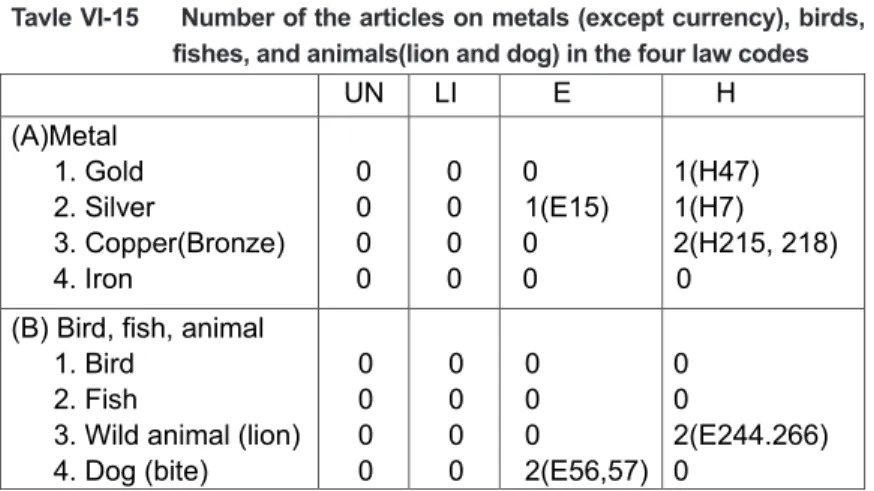
5.2 Plants and agricultural products 5.3 Metals, birds, and wild animals 5.4 Disease and medical treatment Ⅵ -6 Conclusion
Ⅵ -7 Overall Summary Ⅵ -8 Reference
Ⅵ -1 Introduction
In the previous sections the five comprehensive analyses were performed for the four ancient Mesopotamian laws on the following topics :
PartⅠ Survey of Size, Contents, and Transfer1. PartⅡ Social Class and Development of Professions2. PartⅢ Legal Litigation, Penal Law Code, and Civil Law Code3. PartⅣ Written Contents and Commercial Laws4.
PartⅤ Analysis on the fundamental data base of prehistoric Mesopotamian sites5.
In this paper, as Part Ⅵ of this study, agricultural law and law of retaliation are analyzed
Agriculture is the most important industry in the ancient Mesopotamia where the canal-irrigation farming is well known. How, when and where had the above farming been developed are not yet very clear. In the PartⅤ some eighty sites are analyzed in detail and progress of agriculture was discussed to understand accurately the real history of progress of agriculture and human lives. In this paper, an attempt will be made to disclose light and shadow of the canal-irrigation agriculture at the period of its maturity by materializing its relish. Legal involvement in this first industry in the Old Babylonians dynasty also will be discussed.
In the second section of this paper the law of retaliation will be discussed in detail in the four ancient law codes (UN, LI, E and H laws), in particular on the following topics.
(1) Was the Hammurabi law code the retaliation law?
(2) The retaliation law transmitted from the H law to the Old Testament. (3) Is the law code of retaliation (lextralionis) cruel?
Ⅵ -2 Methodology
We employ as the primary materials the legible articles translated, literally from Sumerian or Akkadian to Japanese in Iijima’s work6, from Lipit-Ishtar (LI)7, Eshnunna(E)8, and Hammurabi(H)9 law codes. In addition, the articles of the Ur-Nammu (UN), translated by Kobayashi10 from Sumerian to Japanese sentences are also used.
Ⅵ -3 Agricultural law
3.1. Characteristics of Ancient Mesopotamian Agriculture :
Irrigation based on Canal system
3.1.1 Irrigation
(A) Transition of the dry-farming, rain-fed agriculture to canal-based irrigation ; The most probable path
Fig. Ⅴ -1 Illustrates the transition of the dry-farming, rain-fed agriculture to the canal-based irrigation agriculture.
3
from Sumerian or Akkadian to Japanese in Iijima’s work, to Lipit-Ishtar (LI), Eshnunna(E)8, and Hammurabi(H)9 law codes. In addition, the articles of the
Ur-Nammu (UN), translated by Kobayashi10 from Sumerian to Japanese
sentences are also used.
If needed, the following references are quoted11~44. Ⅵ-3 Agricultural law
3.1. Characteristics of Ancient Mesopotamian Agriculture : Irrigation based on Canal system
3.1.1 Irrigation
(A) Transition of dry-farming, rain-fed agriculture to canal-based irrigation ; The most probable path
Fig.Ⅴ-1 illustrates the transition of the dry-farming, rain-fed agriculture to the canal-based irrigation agriculture.
Agriculture Pattern Period Hunting and gathering ・Palaeolithic
・Holocene
・Early Neolothic
Primitive rain-fed agriculture
Rain-fed agriculture (dry farming) ・Hassuna and Samarra
Primitive irrigation ・natural water way ・Halaf~Ubaid ・simple gravity-feed, canal ・Halaf~Ubaid
Agriculture canal
Primitive artificial canal irrigation ・Ubaid
Short distance canal irrigation
4
Long distance canal irrigation UN law ・UrⅢ
Net-work canal irrigation H law ・Old Babylonian
Chart.Ⅵ-1 The most probable path of transition of the dry-farming, rain-fed agriculture to the canal-based irrigation
Growing concerns on acquisition of food of human kind with their environment (nature): A narrow bent evolutional path leading to ‘Irrigation’ agriculture (→the first civilization)
(Ⅰ) Fear against nature and appeasement to nature: gather and Hunting,
and cave
(Ⅱ) Passive utilization of nature : puddle, pond
(Ⅲ) Positive utilization of natural product : natural water way, simple gravity
feed canal
(Ⅳ) Artificial remodeling of nature (conversion of nature for mankind’s benefit): short artificial waterway →long distance water path→
canal network→ in addition to water supply, navigation of ship in major canals→transportation of residents and cargos→effective and efficient availability of river water, positive protection of natural disaster such as draught.
Flowing statements suggest the proto-type canal irrigation system.
People in Eridu period, existed the northern Halaf period, probably performed small scale drainage and irrigation in very limited small area of marsh45.
Ubide settlements lie on natural water ways or simple gravity-feed canals46.
Flood plains mixed with a dry land on natural bank (formed by alluvium soil transported by river water from upstream in the mountains (alluvium bank)47,
where cultivation of plants are impossible without irrigation and a damp uninhabitationable land without draining48.
Yamamoto and Maekawa affirmed on the southern Mesopotamian(Sumer) agriculture that except agriculture based on artificial irrigation reproduction of community cannot be performed49.
Growing concerns on acquisition of food of human kind with their environment (nature): A narrow bent evolutional path leading to ‘Irrigation’ agriculture (→the first civilization) is
(Ⅰ) Fear against nature and appeasement to nature: gather and
hunting, and cave.
(Ⅱ) Passive utilization of nature : puddle, pond.
(Ⅲ) Positive utilization of natural product : natural water way, simple
gravity fed canal.
(Ⅳ ) Artificial remodeling of nature (conversion of nature for
mankind’s benefit): short artificial waterway → long distance water
path → canal network → in addition to water supply, navigation of ship in major canals → transportation of residents and cargos → effective and efficient availability of river water, positive protection of natural disaster such as draught.
Flowing statements suggest the proto-type canal irrigation system:
1. People (Eridu), existed in the northern Halaf period, probably performed small scale drainage and irrigation in very limited small area of marsh45. 2. Ubide settlements lie on natural water ways or simple gravity-feed
canals46.
3. Flood plains mixed with a dry land on natural bank (formed by alluvium soil transported by river water from upstream in the mountains (alluvium bank)47, where cultivation of plants are impossible without irrigation and a damp uninhabitationable land without drainage48.
4. Yamamoto and Maekawa affirmed on the southern Mesopotamian (Sumer) agriculture that except agriculture based on artificial irrigation
reproduction of community cannot be performed49.
We can summarize approximately the evolvement route of food acquisition and preproduction system as :
Hunting and gathering (mountains) →rain-fed agriculture (high land) →dry~ rain fed agriculture (foot hill) →proto- irrigation farming→ canal- irrigation farming (Sumer) [see, V-4-3-3(a) and V-4-1-5(b)].
Note that the canal-irrigation farming is not native of the Sumer and is also not emerged there, but was developed from proto-irrigation farming in the north Mesopotamia and then, transmitted to the Sumer.
Proto-irrigation cultivation emerged using : 1. accumulated rain-water
2. natural pond→ artificial pond
3. flood water remained at hollow (which ruined farmer by salinisation) 4. natural water way (simple gravity-fed water way) →artificially constructed
short canal (from banks of river to the farmland close to the bank) In these periods (the Husunna-Samarra and the Halaf) the tools for civil engineering were not available due to the lack of metallurgy.
Usability of large canal
Large canal was utilized in the following areas as the main artery of transportation :
1. Supply of irrigation water to farmland
(main function).
2. Navigation of ships
b. transportation of commercial goods (barley) (long distance trade).
3. Minimization of possible flood damage
(B) Advances of irrigation technology : Advantages and disadvantages
TableⅥ-1 shows comparison of the irrigation farming with the rain-fed agriculture.
TableⅥ -2 summarizes the historical data on the productivity of barley in the southern Mesopotamian plain (Lagash). The corresponding data at the Rome, medieval England, and contemporary Japan are included in the table for comparison. If the time range is limited during 2,370BC ~2,110 BC, the ratio decreased significantly and this change can be explained by salinisation (see, TableⅥ -5). If wheat and barley are sowed after the first winter rain these cereals can be rather easily cultivated with high yield50.
9
ChartⅥ-2 illustrates the role of irrigation in ancient Mesopotamian agriculture.
Rain-fed
Agriculture ×
Irrigation Agriculture Craftsman;
Culture
surplus
administration technology
Productivity(yield) Expansion of
efficiency
irrigation scale
(Long distance
Irrigation)
Expansion of
arable land
a surplus above their domestic needs
Chart Ⅵ-2 Role of irrigation in agriculture
3.1.2 Farmer
(A) Tenant farmer (Group laborers in the Ur dynasty to tenant farmer in the Old Babylon dynasty
Generally, landlord and tenant farmer are in charge of agriculture for cereal production. Of course, owner farmers were, probably, existed, but their proportion in the whole famers was small. The article of the Hammurabi law code, which is concerned with the independent farmer, is H47 alone. In this case (H47) when an owner farmer failed to earn income of the operation running cost due to some causes, and if wished, he became a tenant famer. This is a case of down fall of an owner farmer.
Then, cereals had been the most widely cultivated in the ancient northern Mesopotamia. During the third millennium the yield/seed ratio at Lagash (Sumer) was constantly above 20~30, ranging mainly 50~80 (except Herodotus’s data). All these data were obtained by the canal-irrigation farming showing an extremely high productivity, comparable to the present agriculture. The ratio in the ancient Mesopotamia shows a tendency of slight decrease with time. In ancient Rome and medieval England rain-fed farming was exclusively employed.
3.1.2 Farmer
(A) Tenant farmer (Group laborers in the Ur dynasty to tenant farmer in the Old Babylon dynasty)
Generally, landlord and tenant farmer were in charge of agriculture for cereal production. Of course, owner farmers were, probably, existed, but their proportion in the whole famers was rather small. The article of the Hammurabi law code, which is concerned with the independent farmer, is H47 alone. In this case (H47) when an owner farmer failed to earn income of the operation running cost due to some causes, and if wished, he became a tenant famer. This is a case of downfall of an owner farmer. Tenant farmer made contracts with landlord (see, PartⅣ-3.3, p264-265).
The tenant contracts were quite important document59 (see, 3.2.2).
When the royal territory was not extraordinary large scale a direct administration regime of the territory was adapted before the UrⅢdynasty. Then, this ‘large-scale’ direct management agriculture had been reasonably efficient procedure at those times. In the Old Babylonian dynastyⅠ (Hammurabi period), the royal territory exploded rapidly becoming too large in scale to be managed by single administrative body. The royal territory had numerous employees and had heavy duty to pay to all the members (including even slaves) in form of rationing of barley, seed oil, and wool. Mass labor utilized in the UrⅢdynasty was fitted only for the rough-and simple-cultivation and was not expected to be applicable to the high-level, delicate, and much sophisticated canal-irrigated cultivation.
In addition, this big administrative regime had middle ~ lower managements (indirect labor force). More over, the king’s territories were scattered over the new kingdom, and isolated each other. Then, it is clear
that large scale management by palace or royal family is now very tedious, inefficient, and even expensive at the period of the Hammurabi.
Direct management regime was abolished and the land was granted, in place of pay, to all the employees (all ranks), [tax-collector, judge, clerk, fortune-teller, coachman (car for festival), fisherman, cook, herder, bird catcher, hand craft man, black smith, gold smith, straw mat knitter, roofer, weaver, basket knitter]60 of the royal farm. In this case, ‘Signatured certification assignment of land (with name of receiver)’ was in advance presented to them61.
Area of land granted varied from 1 búr (6.5 ha)~12 búr (80 ha)62.
When the granted land was lost by natural disaster and (when) the occupant met the difficulty, the land was again granted to the victim63. Peoples, granted the land are surprisingly almost ordinary peoples and their kind of occupations are as the Babylonian society (see, PartⅡTableⅡ -14).
‘Service’ in this case should strictly be distinguished from service to landlord in the medieval England. The former had very wide works by various kinds of professions and the later was only limited to cultivation and at most home work by farmers. Then ‘service’ in the Old Babylonian period is not the same as service which is mainly limited to cultivation and home (family) labor of England manor.
Popularization of the tenant farming occurred from the large-scale direct management of farmland in the Old Babylonian period.
ChartⅥ-3 illustrates the transition of large-scale, directly managed agriculture (by palace or royal family) to the tenanted agriculture.
第 17 巻 —— 131
11
ChartⅥ-3 illustrated the transition of large-scale, directly managed agriculture (by palace or royal family) to the tenanted agriculture.
Agricultural area
Royal territory in the new territory
before Hammurabi + by new conquest in Private land BabylonⅠdynasty
Royal territory (public institution) independent
farmer
contract contract
Granted to high-ranking employees (tenant fee) (tenant fee)
Governmental official : granted farm
Landlord tenant farming Contract: tenant fee (service)
Contract Tenant farmers farmers tenant fee
Contract; tenant fee
Contract
Tenant fee Sub tenant Sub-tenant farmers farmers
Chart Ⅵ-3 Transition of large-scale, directly-managed agriculture (palace or royal family) to tenanted agriculture
Food production system changed during the UrⅢdynasty and the Old Babylonian dynasty, from mass labor at public institution to tenant farmers at private(their own farms). That was ‘process of privatization’ starting from the third millennium. Tenant farmers had full responsibility against the results, which grossly depended on his efforts as well as skill management
paid in the process of cereal cultivation.
Now we can regard tenant farmers in the Hammurabi period as a specialist with some degree of an expertise on the cereal cultivation by irrigation, and also him a playing manager, and not a simple laborer, much less seave.
(A). Case of a tenant farmer Ubarrum64
(1) Time and place
From Babylonia Document (time) : Abi-eshuh (1711~1684 BC) (place): Northern Babylonia, suburb
(2) Economical activity performed by Ubarrum and his family
①employee of Royal territory ◎ granted farm 1búr(=6.4 ha) 65,66 ◎ service 20 day/year
②lease of cultivated land ◎ co-operative tenant farming
(involving his brother)
③rental of cultivated land ④commission grazing of cattle ⑤loan on credit
Income ①+③+⑤; expenditure ②+④ . (3) Was Ubarrum a simple tenant farmer?
His granted farm was evidently too small to support his family.
Then, he was forced to widen his economical activity beyond tenant farmer. As mentioned above, in the Hammurabi period, plots farm was not large enough to permit simple dry farming by a tenant farmer. Canal cultivation
was extremely delicate needing highly sophisticated skill and delicate attention being not suitable for management of huge land by slaves, big families, or assembly of small families. Mieroop67 stated that ‘thus there were a large number of farmers who worked on small plots of land on those estates as well.’
The plot of a tenant farmer was surrounded by neighbors of farms of almost same size and water supply ended at the edge of individual farm land68.
(B). Cultivation technology
Double cropping was applied widely in Sumer.
Cultivation technology after introducing canal-irrigation can be deduced from the farmer’s calendar69-72.
(1) Summer cultivation
1: In rise period (early summer ~October ) the river water is induced to arable land (fallow), by opening the watergate of water-path (irrigation channel), looking out over flow of the water.
2: Cattles are browsed (pastured) on the farmland. Cattles trample down weed to make the land flat surface (preliminary ploughing ) and at the same time the land is minuses (harrowing).
3: In the dry season farmer levels the land with a hoe and the land is dug using two types of plow.
4. Until the end of November sowing and plowing with use of cow-driven plow concurrently. (Seeds could often not be sown until the first rain after the long dry summer73).
5: Winter rainfall is too small, then the land is irrigated at least three times. 6: Harvest time and reaping.
7: Threshing with help of cattle and sheep. 8: Off season (December ~ Spring).
(2) ‘Instruction of Farmer’
We can speculate the cultivation of barley at ancient Mesopotamia from the documents other than farm calendar. That is the text book 「Instruction of Farmer」, which had been used as text book at school74.
The source of the book is said to be based on the documents of ‘Management of cultivation of land at the end of the third millennium BC’, written in the UrⅢdynasty (the eighteenth century BC or the seventeenth century BC). In this book, farming works (Irrigation – drainage – ploughing – sowing – harvest -threshing) during April ~ May ~ next spring are concisely outlined75.
Note that even after irrigation technology was introduced, fallowing was essential. At present the fallow system is widely employed at the rain-fed agriculture area. If only the winter cultivation was continued fallow for at least one year or more was indispensable76.
At present (~1973), in the Iranian district where the farming is carried out without irrigation the farmer meets serious bad crop of 2~3 years in 5 years span77.
Did the Mesopotamian farmers become rich thanks to successful development of irrigation-farming? (or did this development enrich only the ruling class?).
Now we can evaluate the real income index for two cases : (1) dry-farming and (2) irrigation-farming. Here we assume the area of farmland is the same.
Case (1), independent farmer, who had no duty to pay tax, pre-irrigation (i.e., dry farming, ruin-fed agriculture). Single crop/year ; Yield ratio (= Barley/seed) = 6; frequency of poor crop, two times during five years ; Annual income index = 1× 6×1.0×3/5 = 3.6.
Case (2), irrigation tenant farmer ; double (one and half)* crops/year ; Yield ratio = (60 even at poor harvest) ; tax = 50% of barley harvest as income tax and tenant fee ; Annual income = 1.5*×60×0.5×1.0= 45.
(* a half year’s fallowing in two years yields 1.5 crop/year).
Average income of an ordinary farmer in case (2) is roughly estimated about 12.5 times of case(1).
Off-season(winter) service labor for maintenance of water path is an additional of tax. It is now evident that income of a tenant farmer increased remarkably by introducing the irrigation-farming.
What is the basic character of the Old Babylonian dynasty? Several historian’s comments:
1. M.Kishimoto’s comment (1968)114
The surprisingly advanced culture was utterly monopolized by king and his small number of aristocrats and priests, who enjoyed their prosperity, under the pitiful sacrifice of ordinary peoples, complied to work hard. A prevailed idea that tyranny, dictatorship, and autocrat are Asian’s character was formed from the above-mentioned facts.
2. K.Kuroda’s comment (1969)115
Babylon Ⅰ Dynasty was the most typical nation, the Orient formed by deprivation from the masses.
3. R. Cameron comment(1997)116
In early temple cities of Sumer.・・・, the social structure was definitely hierarchical, The mass of peasants and unskilled workers.・・・,lived in a state of servitude, if not outright slavery; they had no rights,
property or other.,・・・, but nowhere in ancient civilization did
private property, in modern sense, constitute the legal foundation of
society or state.
4. Paul Kriwaczek’s comment (2010)117
Many of the judgements(in the Hammurabi law code*) strike the modern reader as fair and reasonable,(*; added by Kamide).
5. George Roux’s comment (1992)118
The Code of Hammurabi, in many of laws is surprisingly close to our modern idea of justice.
It is self evident from PartⅠ~Ⅴ in this study that appropriateness of the above-mentioned comments have already been inspected.
3.1.3 Canal construction and its maintenance
High silt contamination in the Mesopotamian rivers together with extreme small flatness of the southern Mesopotamian plain brought about a high risk that every thing on the surface of the earth are buried by silt in short period, leading to the flood or shortage of supplying irrigation water.
Following construction and repair were performed in off-season of cultivation78.
1. Construction of banks and their repair (to prevent river flood)79. 2. Opening and digging of canals and their repair.
3. Incessantly dredge of water ways (to avoid the canal buried in the sand).
Master plans of new construction of canal network were primarily designed by estate architects with high specialty and by contractors with numerous track records.
This was a big national projects and materialized. The upper grade officers were in charge of ①procurement of labors,②pay of wage, ③ construction materials,④process management,⑤supply of food to all employees, and ⑥management of works according to process chart. Sometimes, king(Hammurabi ) supervised directly.
The tenant farmer was entirely responsible for the maintenance of the water path (i.e., branch of canal, flowing directly to the farmer’s land). In the Hammurabi law articles declare the farmer’s duty of maintenance and punishment for violation of the laws. The projects such as digging of canal, construction of bank, or dredging of water path are obviously public works.
The funds (capital) of employment of laborers were a burden of coast inhabitants. Wage for the labors were collected in the form of barley from them80. The water path was made as high as its surroundings, having narrow bank at the both sides of the path. Often the water path turned at right angle and the water flowed further. Owners along the water path had responsibility against main maintenance of the above banks. This rule was also applied to wide canal. The owners, whose boundary of the farmers were in contact with each other, had to make the above contact always (clear) in order. In this case, canal was administrated all the time by king’s officer, that is 「Bureau of Irrigation Facilities」. From the Bureau of King’s inspector was dispatched, besides a local representative king had the similar authority on the matter of canal and irrigation (an example,
Siniddinam)81.
For working a large number of employed laborer were needed. For them wage barley was paid, depending on the width of bank occupied by the owner.
3.1.4 Flood
(A) Some meteorological and geological characteristics of the flood in Mesopotamia
1. Resources of flood water originates from snow melting at the Zagros and Armenia mountains, composed of lime stone. During relatively narrow period large amount of water flows down from the upstream. After the snow melting in the maintain area are exhausted river flow diminished quickly82,83.
2. River water contains five times thicker silt than the Nile84(in the form of calcium carbonate CaCO2)85.
Then , riverbed is readily buried under the silt, precipitated, in particular, at hill-fan or evaporated at farm.
3. Flood occurred abruptly and further without predictable sign86.
4. Extremely flat plain in the southern Mesopotamia brought about changeableness of water-path and in addition, the flood was very restrictive. The flood washed away farmlands, houses, canals87, and even cities.
5. Although the flood was almost seasonal, but irregular.
6. The Tigris and Euphrates have wider river-basin than the Nile. Arable land in Egypt is limited :To a long rectangle a few to 30km wide on the both sides of the Nile88.
8. Attack of huge floods on the area of Ur, Kish, and Shuruppak was confirmed by archaeological study on the strata, corresponding to Ubaid and early ED periods89.
(B) Some archaeological and geological evidences of flood
1. River water flowing through river, whose bed became shallow due to accumulation of soil and sand, broke the bank itself, washing away the everything. If one digs down layered village ruins, called Tel, he will reach a thick clay layer. Often he discovers the ruin of dwelling under the clay layer. This is above all direct evidence of the flood tales90.
2. From the third millennium layer, a thick layer of pure clay deposit some eight feet thick, which separated the Ubaid layer from what Leonard Woolley considered the ‘Sumerian’ strata; The evidence for the flood in Sumerian history and legend91.
3. Certain archaeological evidences are discovered on the sites such as Ur. Kish, Shruppk and etc. in the Ubaid and ED periods. Attempt of relating the flood legend to the actual flood layer is absolutely fantasy and only quess92.
Did canal route change by the flood?
Adams93 investigated the map of canal between Nippur and Urk over the time spun EDI (Early dynasticⅠ) period(2900BC)~ED period(1763BC) (more than 1000 years) and Crawford94 reproduced three maps in her book. It is very interesting to note that location of canal networks in Sumer including Nippur, Issin, Shuruppak, Adab, Umma, ZabAlam, Bad Tibura, Urum and Larsa, seems likely not to be very significantly altered during almost 1000years, although the rise and fall of the above cities are, of course, observed.
(C) Flood and farmer
In Mesopotamian agriculture natural disasters, mentioned above, including flood and drought, were the largest danger factor. Once flood attacked the farm in Sumer, the farm was washed away by the flood and no longer further cultivation of the farm became impossible. What is more, the flood washed away not only farmland , but also houses, and even cities (see 3.1.4(A)4). Restoration of the farm required tremendously long time and huge expense by far beyond the capability for single or few plot owners. They were expected to escape first from the flood damage. Residential area of Sumer is located along the water way.
In drought water way (including bank of canal) will be naturally ruined merely to mass of sand.
In both (flood and drought) cases the harvest is of course zero and the victims cannot pay the tax, tenant free, operating costs, and debt if any. The Hammurabi law codes have four articles (H45,H46, H47 and H48) on the flood.
In this way there is no room to doubt that in the Mesopotamian agriculture (natural disaster) flood was the largest danger factor.
Amount of damage of farmers suffered, due to by his neighbor’s careless negligence in maintenance of the water path, should be fully compensated by the perpetrator (H53, H54, H55, and H56). The above damage was considered as a kind of personal economical outbreak.
Detailed conditions of tenant contract are not very clear. The article H47 suggests some landed farmers probably belong to among unsuccessful farmers . In addition to tenant farmers, the landed farmers who suffered from natural disaster, such as flood, drought, gale and tsunami frequently attacked, on the plain of southern Mesopotamia, had zero or almost zero
harvest(income), and were forced to be ruined to tenant farmer.
The contract was formed by an initiative of the victim farmer and was made, at least perfunctorily, on the basis of mutual agreement between landlord and farmer under the predominantly disadvantageous circumstances for the farmer side. In the words such contracts are made under very favorable conditions for the landlord. Note , also, that in the above case victim farmer was not limited to only one family, but a large number of victims may have applied to the new contract.
Basic contract of reclamation between landlord and farmer was effective usually for three years (H44).
Landowner cannot claim his ownership after flood and the farmers cannot expect any assistance from the state for his loss of house and cattle. The state constructed new canal (and its network) and maintained them. New farms were built along the new canals.
(D) Level of damage caused by the flood
Table Ⅵ-4 shows change in the rights of ownership for farm, house and cattle before and after the flood.
An exceptional case:
When granted farm was attacked by flood and washed away the farmer(owner of the above farm) suffered from poverty king granted again new farm to the victim95.
(E) Measure against floods ; a human’s ingenuity
Were inhabitants in Mesopotamia afraid of flood simply considering that it was anger of god?
At most they reinforced the banks and dredged the river bottom (i.e., passive attitude). In the case when the flood attacked canals the habitants threw away their dwellings and farms and scattered. There are some resources of king’s measures against the flood96.
Hammurabi informed his officer (Shamash-hazir) that an attack of flood of Euphrates is passing through Babylon and approaching Larsa. To minimize the possible damage by the flood he(Shamash-hazir) opened the gate leading to marsh. Water was guided to swamp near Larsa to diminish the flood in order to prevent the ruinous destruction of the bank equipments and to avoid the flood’s uncontrollable damage.
3.1.5 Salinisation
(A) Decay of wheat production at Lagash
TableⅥ-5 summarizes the farming area, farming portion(weight), and yield of wheat at Lagash.
20 Ta bl e Ⅵ -4 Change in agr ic ulture before , in , af ter flood in S ume r B ef ore floo d Floo d Af te r f lo od Farm (lan dlor d) : o w ne rship Hou se (te na nt fa rm er) : te na ncy Cat tle (ten an t f ar m er) : o w ne rship o r te na nt Lo ss of f ar m Lo ss o f h ou se Lo ss o f ca ttle all rig hts of ow ne rship and tena ntry New n atio na l New ca na l New fa rm ers projec t (Ow ne r-nat ional ) ta x Ne w lan d l oa d In com e ta x an d s erv ice Land l oad Te nant farm er Hou se ca ttle
During 3,000-2,000 BC wheat cultivation sharply declined at Lagash in the southern Mesopotamia at that time. Productivity (or yield ℓ/ha) of wheat markenly lowered from 2,500 ℓ/ha in 2400 BC to about 900 ℓ/ha in 1700 BC. In other words, in 1700 BC wheat production decreased by 65% at Lagash. In the southern Mesopotamia wheat cultivation converted to barley. However, wheat production survived (until present) in the norther Mesopotamia.
(B) Salinisation : phenomenon and its mechanism
This phenomenon is said due to ‘so-called’ salinisation.
i.e., accumulation of calcium carbonate (white fine powders) on the soil surface of farm and this compound interrupts absorption of water through the root of cereal plants, leading finally to their death97-101.
about its decline, even if the same cultivation technology as before (see,
3.1.2(B)) were continued faithfully.
The phenomena illustrated in TableⅣ-5 was caused by an undesirable accumulation of alluvium, contaminating calcium carbonate (white fine solid particle) on the surface of land. It was due to insufficient drainage of irrigation river water and also lack of fallowing. These phenomena were empirically well recognized by native farmers soon after adaption of irrigation (as deposit of white solid (salt) on) farm. Once the salinisation occurred on the farm, the farm could not never be recovered again to the virgin soil, because this white powder could not be removed completely from the farm.
This is a typical example of environmental pollution. In this way the advanced technology (canal- irrigation agriculture networks and their operation systems) had attained unbelievably highly productivity of cereals, but it induced simultaneously the serious damage, which could not permit the sustainability of this technology.
(C) Conversion of wheat to barley
Wheat was weaker in resistance than barley against salinisation and also the former needed longer period of growth than the latter. Wheat was replaced by barley in the southern Mesopotamia. Since then, wheat cultivation was severely limited to the northern Mesopotamia.
The dirted space of farm was finally abandoned, resulted in significant diminish of the total area of arable land.
Effective remedy to avoid salinisation recommended at that time was : 1: Complete drainage of irrigation water from the farm(to make residue of
river water used for irrigation as little as possible). 2: Enough preliminary ploughing (3.1.2.(b)).
(to prevent rise of underground water through capillary action).
3 : Fallowing of at least one~ two years after harvest ( to recover soil fertility and to suppress rising of underground water level to the ground surface, keeping the level undeneath the surface).
3.1.6 Source of Mesopotamian culture.
Canal-irrigation cultivation network system is evidently the origin of ancient Mesopotamian culture.
Farmer individual was fully responsible for the end of the system and king had responsibility for the whole system.
An opinion (theory ? or delusion?), that the above system was formed by 23
Landlord
Peasant farmer
Gardener
Cultivation A
fforestationWasteland
Field Orchard
○
2Irrigation
Farm land
: human factor, : land, :technology
ChartⅥ-4 Cultivation of wasteland to farmland and then afforestation
to orchard
3.1.6 Source of Mesopotamian culture.
Canal-irrigation cultivation network system is evidently the origin of ancient Mesopotamian culture.
Farmer individual was fully responsible for the end of the system and king had responsibility for the whole system.
As opinion (theory ? or delusion?), that the above system was formed by (slave’s compulsory mass labor with their blood and sweat, lacks any definite certificate.
3.2 Landlord, tenant farmer, and gardener 3.2.1 Cultivation of wasteland
(A) Ordinary farmers in ancient Mesopotamia
1. There were two kinds of farmers in ancient Mesopotamia, landed farmer and tenant farmer.
○3
slave’s compulsory mass labor with their blood and sweat, lacks any definite certificate.
3.2 Landlord, tenant farmer, and gardener
3.2.1 Cultivation of wasteland
(A) Ordinary farmers in ancient Mesopotamia
1. There were two kinds of farmers in ancient Mesopotamia, landed farmer and tenant farmer.
2. In the Hammurabi law code, a number of articles are found on debt of tenant farmer from merchant (H 48, H 49, H 50). The articles on landed farmer are not numerous (H47). In the Old Babylonian period landlords directly cultivated a part of his farm and other parts were rented to tenant farmers. They made the contract of tenant farming. 3. Cultivation of barley, date (palm) and sesame had played a detective
central role at that times.
4. The plantation of dates was exclusively performed by another different specialist (gardener) under the contract agreed between landlord and gardeners.
5. Success or failure of agricultural management was determined depending on the changeable climate or weather, together on the effort of the farmers.
6. Flood and drought were the two major uncontrollable factors, governing the yields (H48).
7. Flood and tsunami are stated in H45 and H46, and overflow and drought are found in H48.
8. In addition to the above, personal factor cannot be ignored : Negligence of cultivation (H43, H44) and defective maintenance of water
path(H53~H56).
9. When the management of landed farmers is at a dead rock, they ruined. Shifting of his business was decided by himself (H47). Man under inferior circumstance was usually forced to make a disadvantageous contract to landlord(In the Hammurabi law this was regarded as ‘fair dealing’.).
10. Landed farmers were in debt for money to merchant from a sured (collateral) loans (H49, H50, H51).
11. For conversion of desolate wilderness a contract, which was valid approximately three years, was made between the landlord and a settler (H44).
12. We cannot overlook the relations between merchant as money lender and farmers (including tenant farmers).
13. Even tenant famers took for management all responsibility. At final phase he sold himself (H54). He made his family (wife and children) debt slaves with three years limit (H117).
14. Against damage committed by the farmer to a third party compensation was collected strictly. Any farmer was responsible for proper maintenance of water path (and bank) linking the end of water-path and his farm (H53, H54, H55, H56).
15. The literacy rate of ordinary people is suggested fairly high, in particular, the ability to read (see, also, Ⅳ 3.1.3B).
16. It cannot be considered that farmers had their houses within the area of his farmland. Their houses were surround under by fence, within walking distance, for sake of security. They gathered on the mound (hill). Many houses were built close together and densely populated. 17. The farmer and his neighbors did not have ‘Joint responsibility for the
person concerned.
18. In the south Mesopotamia many houses were connected to form a village.
19. Ordinary tenant farmer’s property were : house, farmland, cattle, and plow.
20. Tenant farmer had not surplus to buy other properties.
(B) Conversion of wasteland to farm and orchard
ChartⅥ-4 shows the scheme of conversion of wasteland to farmland via field by farmer, and then, afforestation of field (or farm) to orchard by gardener.
(1). wasteland ① (field) ② farm
Conversion of wasteland to farm was expected to consume four years (H44). Westland should be located nearby canal and also the right of water utilization for irrigation was attached to the wasteland
(2). Field’s ground was leveled. In this case the canal water was not yet supplied to the field. But, dry-farming, if he wants, will be carried out, although very ineffective and law yield . Yield by canal-irrigated land has 20-30 times of yield by dry-farming.
(3). Water path connecting canal (previously opened) with the field was installed (probably by public authority) and farmland was finally developed. Thus, the contract was completed.
(4). After completion of farm, the settler will become tenant farmer by new contract between settler (now, tenant farmer) and landlord.
(5). Gardener makes a contract of development of garden from field (or wasteland) in 5 years (H60, H63).
seeds of palm to grow up to yield fruit is about four years. (In Japan three years are usually necessary to harvest peach and chestnut). (7). Date palm is a native plant in Mesopotamia and acclimatized well to
severe circumstance (low rainfall, salinisation, hot summer, flood). Then, palm cultivation was rather easy business for grower than cereal cultivation, because the above-mentioned climate did not make gardener neuroses.
(8). After 4 years (completion of the contract), the harvest will be divided equally between landlord and gardener.
(9). Management of the garden was entrusted to the gardener (H64) and 2/3 of harvest was taken by the landlord and 1/3 was for gardener. In this sense, the gardener of orchard was a kind of a partner of an enterprise.
(10). For about four years gardener had no income. He must have some funds or property. In addition, he made a part of not-yet completed garden temporary farmland to cultivate barley on the basis of dry-farming.
(C) Income tax or tenant fee of farmers
Kishimoto described that 1/2~1/3 of barley income were robbed as the tenant fee87. This is his typical misunderstanding of charge as tax.
The tenant fee contains, for examples, the expense for repair of canal (wage of contract laborers), for bank maintenance of water path, operation of canal system. Who constructed the irrigation system? Who received enormous economical benefit by using irrigation water for barley cultivation? The increase in cultivation field and increase in barley harvest, were contributed at a high rate to multiplier increase in income of the state finance. If he (Kishimoto) understood “beneficiary payment principle” ,
which is at the present extensively agreed and accepted concept. The kings committed to the reclamation of deserts and marshes in the southern Mesopotamia, with (investment ) large outlay. The tenant farmer had the right of employment of day laborer and use of water for irrigation. If we accept the principle of “beneficiary payment principle”, then it becomes very natural to pay some amount of money (barley) to the landowner.
3.2.2 Various contracts among landlord , tenant farmer (as buyer) and laborer
In the Old Babylonian period, formats of contracts including landlord (employer), tenant farmer (buyer of land), and any laborer were almost formed. Some examples are shown below :
A. Contract of tenant farming102
1. Property of tenant farming (farmland and orchard (date palm, wasteland)).
2. Name of property (its size and location). 3. Name of creditor.
4. Purpose of object.
5. Tenant fee (barley or silver) ; fixed ratio, or fixed amount.
6. Witness(8 persons with their father’s names, including a village mayor). 7. Date.
8. Period of tenant farming ; usually 3 years.
B. Buying and selling contract
An example103:
1. Buyer men who were far from wealthy and lived in quite modest house. The document contained following items : Here, bracket means
Podany’s excavation data103. 2. Their size (8 acres).
3. Location (city of Terga, just north of Mari).
4. The names of the men who owned neighboring properties. upper long side; (Yakum-Addu, son of Yasa-Addu), lower long side ; field of (Kinau, priest of Dagan), upper short side ; field of (Kinau, priest of Dagan), lower short side ; field of (the palaces).
Farmers had to be careful to make sure that their canals did not flood their neighbor’s field.
5. Names of the following peoples with their father’s names: (5-1) the neighbors, (5-2) sellers, (5-3) buyers, (5-4) the governor, (5-5) seventeen witnesses , and (5-6) a scribe (and the king).
6. Price (1 mina, 10 shekels (about 0.58 kgs) of silver (≃5 shekels per acre). The document was kept in his own home.
C. Contract of employment of laborer104
1. Name of laborer. 2. Purpose of employment.
3. Period (usually, one month or one year).
4. Pay (depending on talent needed for the work, kind of work, and the period).
5. Board (or staff meal) is added or not beside pay.
6. Special regulation : responsibility for storage of working tools and cattle; commission to the laborer; responsibility for labor interruption by escape of laborer and for violation against guarantee that they should start work until the planed due date.
D. Impoverishment of small-sized landed farmers and tenant farmers
1. Landlord had always legal priority to tenant farmers.
Barley cultivation was a nation’s key industry, supplying the food to citizens and earning the foreign currency. The export of barley was a sole method to get foreign money and then to buy the foreign necessity products. Under these peculiar conditions king gave priority protection for landlord and merchant. Sometimes a single man played the two persons roles as landlord, and merchant.
2. In contract, small-sized landed farmers and tenant farmer (i.e., ordinary people) were put at disadvantageous position, and as result many ordinary people became poor. Impoverishment became serious social problem.(see, below chart).
The society brought about a relative increase in the poorest segment in the populations
3. Hammurabi and his successors, including (the tenth king) Ammis (1642-26 BC)107,108 and (the seventh king) Samsuiluna107,108 (1749-12 BC), promulgated the annulment of debts several times in order to help the people suffered from poverty. In the Old Babylonia period (2025-1595 BC), law of exempt personal debt from poor people were promulgated more than one hundred times109.
28
and earning the foreign currency. The export of barley was a sole method to get foreign money and then to buy the foreign necessity products. Under these special conditions king gave priority protection for landlord and merchant. Sometimes a single man played the two persons roles as landlord, and merchant.
2. In contract, small-sized landed farmers and tenant farmer (i.e., ordinary people) were put at disadvantageous position, and as result many ordinary people became poor. Impoverishment became serious social problem.(see, below chart).
Land farmer → tenant farmer daily laborer debt slave as cultivator
Process of impoverishment
The society brought about a relative increase in the poorest segment in the populations
3. Hammurabi and his successors, including (The tenth king) Ammis (1642-26 BC) and (the seventh king) Samsuiluna107,108 (1749-12 BC), promulgated the
annulment of debts several times in order to help the people suffered from poverty. In the Old Babylonia period (2025-1595 BC), law of exempt personal debt from poor people were promulgated more than one hundred times109.
E. Document of land assignment Granted by King
The man, who was assigned, on the basis of document to issued by the royal institution to him, is ultimately the person, who has the right of occupation and cultivation of the land. The farmer having the document (document holder ) does the practice of the cultivation or not is a legal problem.
3.2.3 Landlord and tenant farmers: Examples of unfulfillment for contracts
Table Ⅵ-6 illustrates some examples of unfulfillment of contract.
1. The contract on development of waste field was valid to three years. Then, negligence (abandonment longer than three years) is regarded as breach to the contract.(A).(H44).
E. Document of land assignment granted by King
The man, whom the royal institution issued document of land assignment to is ultimately the person, who has the right of occupation and cultivation of the land. The farmer having the document (document holder ) does the practice of the cultivation or not is a legal problem.
3.2.3 Landlord and tenant farmers: Examples of unfulfillment for contracts
Table Ⅵ-6 illustrates some examples of unfulfillment for the contract. 1. The contract on development of waste field was valid to three years.
Then, negligence (abandonment longer than three years) is regarded as breach to the contract.(A), (H44).
2. In the case the rent of farm was paid simultaneously at conclusion of the contract on the rental of farm the tenant farmer is responsible for any possible damages suffered by flood since then. (B.1), (H45).
3. In the case when the rent was not paid (to the landlord) the harvest (if any) is divided between the owner and the farmer according to the contract. (B2), (H46).
4. These two cases (B1 and B2) imply that immediately after the payment of rental fee the farmer can manage the lent farm at will and at the same time he should have all responsibility for the result.
5. B3 is the case when the (owner) farmer went broke (default).
6. B4 is concerned with merchant (not lord) vs. farmer : merchant was often at that time landlord. In this case reduction of the conditions in the original contract was approved.
7. In the case of no yield the tenant farmer should pay the same amount of rent as neighbors. Here, the cause of no yield is not problem. When the
neighbors get no yield the farmer and his neighbors do not pay the rent. Equal treatment with neighbors are principle in the Hammurabi law, and special treatment to a particular farmer as an exception was not permitted. In addition, joint liability was not accepted there.
8. For any personal(individual) specific situation was not considered at all. 9. A close investigation of the contracts above illustrated here shows
immediately at once that the contracts made about 3000~4000 years before are basically identical to the present-day contracts. All the necessary items for the present day contracts are included even in ancient contracts, and the latter were formed at least perfunctorily on the basis of mutual agreements. It should not be over-emphasized that ancient Mesopotamia culture is essentially different from that of the contemporary world.
3.2.4 Farmer and his neighbors
TableⅥ-7 shows some examples of agricultural outrage by tenant farmer against neighbors.
1. Tenant farmer had the duty of secure maintenance of bank of water path. 2. The length of the path for which the farmer had responsibility is the
length of path, with which his farm is directly contracted.
3. Water path was safely maintained by hardening by hand or foot or some tool and widening of bank (H53, H54). The path bottom was weeded and dredged. lost of cereals in farm(H53).
4. Gate was opened for irrigation and closed after irrigation submersion of neighbor’s farm(H55), damage to neighbor’s products (barley )(H56).
referred to negligence or miss management of irrigation by the farmer. In all (seven) articles the farmer is an assailant and the remaining victims in four articles are at the same time tenant farmers.
6. Table Ⅵ-7 indicates that in order to operate the canal-water irrigation agriculture smoothly the end of the system should be carefully maintained
(Note)
Here, I have no idea to answer whether victims in (B) and (C) in the table are strictly neighbors or not. But, in broad sense, they (landlord, palace) can be considered as inhabitants in the same district.
Comparison of H57 with H58 indicates that compensation to the victim of farmer (H57) (ordinary landlord) is only 1/3 of the latter (H58) (palace) and that outrage against palace is heavily punished (be careful!).
3.2.5 Landlord and gardener
Contract between landlord and gardener
1. The conversion of farm (or field) to orchard (forest of palm trees) takes 4 years (H64).
2. If gardener starts the above conversion from wild field (moor), the gardener receives 10 gur/ 10 iku of barley as an extra reward (H 63 ). 3. There are two kinds of contracts:
①1st contract ; development of palm forest (4 years).
② 2nd contract : management of the forest (palm garden). The gardener’s share is 1/3 of the harvest (H64) : dates (Phoenix dacty lifern).
4. Gardener’s daily tasks are :
②feed of water (irrigation water) to young plants. ③artificial pollination.
④construction of fence around the garden. ⑤insect extermination. ⑥watch. ⑦harvest of palm. ⑧ripeness of fruits. ⑨processing of fruits. ⑩shipment.
5. Date palm is native of Mesopotamia and has a high adaptability to sever climate of the southern Mesopotamia (dry, hot, salinization land,・・・). 6. Excessive attention to irrigation to the garden is not necessary
7. Date has the following various merits as food105,106. ①highly nutritious food.
②sweeter (sap).
③delicious fruit as desert.
④preserved (dry) food (for home and for travel, and for export). ⑤fermented products (wine).
⑥nectar (sweetener).
Date palm may have been utilized in the southern Mesopotamia for construction of houses (pillar, riff, and wall). On the periods of Sumer and Old Babylonia processing of agricultural products (dates) were populated to yield processed food industry at embryo state then, new value was added to the primary product (date fruit).
TableⅥ-8 shows some examples of unfulfillment of the contracts between landlord and gardeners.
3.2.6 Fine and compensation of economic crime
TableⅥ-9 collects compensation and fine for economic crimes.
When person (assailant) gave some economic damage to man (victim) assailant pays (or compensates) some amount of goods which is χ (χ is larger than one) times of the victim’s loss.
1. In the articles containing ‘compensate’(iriaab or irriab) the assailant (attacker) had to pay goods or money not less than 10 times (X=10) of
the real value of damaged goods (H265, H8). Articles of the case X=
2. When the ‘compensations’ in the range of X = 5~6 ; ‘iliqi2 (pay)’ or ‘inaaddin(pay)’ was used to denote ‘pay’.
(H120, H124, H126 and H254 for X = 2~3 (inaaddin), and H107 for X =6
(inaaddiin), and H 107 for X =6 (inaaddin),(this is an exceptional case?).
3. In H12 ( X = 5) iliqis (pay) was used.
4. Inaaddiin was used for X = 2 (i.e., two fold) (from articles) and X = 6 (one
article) and then, Akkadian verb ‘Inaaddiin’ was utilized for fine.
5. It seems that usage of Akkadian verb to mean pay or compensate in the H laws has close co-relations with X value.
6. Delicate difference in nuance between iliqi2 and Inaaddiin is not clear. 7. Theft of goods (including cattle and sheep) in palace or shrine were
regarded as felony and a kind of grave challenge to the authority of the kingdom.
Ⅵ-4 Law of Retaliation
The retaliation is formal act (by public prosecutor) of punishing assailant (attacker) in return for what he has done to the victim.
4.1 Was the Hammurabi law code the retaliation law?
Table Ⅵ -10 collects the body injury and penalty for it in the Ur-Nammu(UN), Eshnunna (E) and Hammurabi(H) law codes. In the table,
a in a → m, for example, is assailant and m is victim : a is awilum, m is
muskenum, and s is slave.
The law of retaliation was applied only to the case when both assailant and victim were awilum. Other cases such as a → m, a → s, m → a, m → m, s → a, s → m, and s → s were allowed to employ the substitute
There is no article of retaliation law in the UN and E laws except homicide and for any injury in all cases the substitute payment was utilized. This suggests that the retaliation law had been first adopted in the Hammurabi law in the Mesopotamia. Homicide was the death penalty in UN1 and it is supposed that the retaliation law had been applied to murder in the four mesopotamian law.
In the case a → a, when the victim was died caused by quarrel the retaliation law was not applied and silver 1/2 mana was the penalty (H207, see TableⅢ-14). This is an exception of the principle of retaliation law.
4.2 The retaliation law transmitted in the Old Treatment.
Were ‘Eye for Eye’ and ‘Tooth for Tooth’ accepted or recognized in the ancient Mesopotamia and in the Mid-east ? It is said that the Hammurabi-law code had given significant influences to the Assyrian Hammurabi-laws. More than about 800 ~ 1,000 years later than the enactment of the Hammurabi law code the Old Testament was formed (or issued?)112.
Table Ⅵ-11 and Table Ⅵ-12 summarize the correspondence of the Hammurabi low codes to the Old Testament (Exodus, Leviticus, Deuteronomy, and (the New Testament) Matthew on the retaliation articles. In the last column of Table Ⅵ-11 ⊕means Exodus is more strict than the H law, =○is almost the same degree on rigidity, and ⊖ indicates that Exodus is less severe than the H-law. Among nine items, when comparison of the both can be made, three articles in the Bible are severe than the H-laws and other six articles are almost the same in rigidity. Therefore, we can conclude that the both are approximately in same nature.
MATTHEW 5:23-38
37 Ta ble VI -10 Bod y a nd pe nal ty for i t in the Ur -Nam mu, es hnun na , a nd Ham mura bi l aw c odes P osition Law c ode Ur -Nam m u E shnu nn a Hamm urab i a → a a → m m → m a → s 1 e ye (ii n, inu m ) 1 man a (60 siq lu) [E 4 2] ey e [H 196 ] * 1 man a (60 siq lu) [H 198] hal f pr ic e o f sl av e [H 199] 2. nos e ( ap pe2 ) 2/ 3 m ana (40 siq lu) [UN 2 0] 1 man a( 60 siq lu) [E 4 2] 3. to ot h ( Ŝiin ,Ŝ innu m ) 2 g in (2 siq ul) [UN 2 2] 1 man a (6 0siq lu) [E 4 2] to oth * [H 2 00 ] 1/ 3 m ana (2 0 siq lu) [H 2 01 ] 4. e ar (uz nu) 1/ 2 m ana (30 siq lu) [E 4 2] 5. lip (m en ess) 10 siq lu [4 2] 6. bo ne (g ir3 paddu) 1 man a (60 siq lu) [UN 1 9] bon e* [H 1 97 ] 1 man a( 60 siq lu) [H 1 98 ] hal f pr ic e o f sl av e [H 199] 7. fo ot 10 g in (1 0 siq lu) [UN 1 8] 8. f ing er 2/ 3 m ana (4 0 siq lu) [E 4 3] * La w o f ret ali atio n
39
Table Ⅵ-11 Correspondence of the Hammurabi law code to Exodus on retaliation
Case Hammurabi low code ‘Old’testament exodus chap 21
Note 1.man who strikes
father (or mother )
Cutting of hand ; H195
death ; Exodus 21:15 + 2.man who kidnapped
child (or man)
death ; H14 death ; Exodus 21:16 = 3. man who strikes
pregnant and she lost child through miss carriage
10 siqlu ; H 209 fine ; Exodus 21:22 =
4. in 3 victim died death of man (in 3)’s daughter ; H210
death ; Exodus 21:23 = 5.injury of eye eye ; H196 eye ; Exodus 21:24 = 6. injury of tooth tooth ; H200 tooth ; Exodus 21:24 = 7. injury of hand see E43 (finger) hand ; Exodus 21:24 = 8. wound Oath for god and pay
cost of medical care ; H206
wound; Exodus 21:25 + 9. death caused by
injury
Oath for god 1/2 mana ; H207
death ; Exodus 21:23 + 10. bone (a →a) bone; H197
(a→m) 1 mana; H198 (a → s) half price of slave ; H199
11. foot see UN 18 (silver 10 gin)
foot ; Exodus 21:23 12.masterwho injured
his slave’s eye
emancipation of the victim slave
-13. master who injured
his slave’s eye
emancipation of the victim slave
-However, I say to you. Do not resist him that is wicked : but whoever slaps you on your right cheek. Turn the other also him.」
5:23-38 is not the article H196, but probably was Exodus 21:24 . Note that
when Christ was alive ordinary people did not know that H196 had been enacted about eighteen hundred years before.
4.3 Is the law code of retaliation (lextalionis) cruel?
In the Ur-Nammu and Eshnunna laws all body injures (except murder) could be compensated by the money (substitute payment) as illustrated in Table Ⅵ-10. Compensatory payment ranged from silver two gin (tooth) in
40
Table Ⅵ-12 Comparison of articles on bodily injuring in the Hammurabi laws with those in Testaments
Position Hammurabi Exodus Leviticus Deuteronomy Matthew 1. eye for eye H196(a),
H199(s)
21:24 24:20 5:38 19:21
2.tooth to tooth H200, H201(m)
24:20 5:38 19:21
3.bone for bone H197(a), H198(m) H199(s)
24:20
4.hand for hand 21:24 19:21
5.foot for foot 21:24 19:21
6.cheek H202(m → a) H203(a → a) H204(m → m) H205(s→a) 21:25 7.(wound) (death of victim) H206 H207 8. bull 21:28 21:29
9. soul for soul H229, H230 21:23 24:21 19:21
4.3 Is the law code of retaliation (lextalionis) cruel?
In the Ur-Nammu and Eshnunna laws all body injures (except murder) could be compensated by the money (substitute payment) as illustrated in Table VI-10. Compensatory payment ranged from silver two gin (tooth) in UN to silver one mana (bone in UN and eye, nose, and tooth in E). In the all four laws for homicide the law of retaliation was strictly applied. On the other hand only in the case of a →a (i.e., assailant and victim are all awilum) all bodily injuries (eye,
tooth and bone) are judged by the law of retaliation. Can we say that the latter law (H) is less stern than the former two laws (UN and E).
In the Old Babylonian period evolution of job specialization (see, Table Ⅱ -14) progressed significantly in comparison of those in UN and E periods (including appearance of numerous daily labors), resulting in large gap-widening of the rich and the poor in the society.
UN to silver one mana (bone in UN and eye, nose, and tooth in E). In the all four laws for homicide the law of retaliation was strictly applied. On the other hand only in the case of a →a (i.e., assailant and victim are all
awilum) all bodily injuries (eye, tooth and bone) are judged by the law of retaliation. Can we say that the latter law (H) is less stern than the former two laws (UN and E).?
In the Old Babylonian period evolution of job specialization (see, Table Ⅱ -14) progressed significantly in comparison with those in the UN and E periods (including appearance of numerous daily labors), resulting in large gap-widening of the rich and the poor in the society.
The transition of tenant farmers (see Chart Ⅵ-3) may be one of the various factors accelerated the above gap.
“In the previous paper (PartⅡ3.3.3) I pointed out that the transfer of rather
homogeneous awilum class to much highly heterogeneous and broad awilum class occurred with mass or volume expansion during the Old Babylonian period.” In the H law, all awilum irrespective of his job, including upper elite and lower daily laborer and tenant farmer, had absolutely equal legal status. In Babylonia, there was no legal rank (compare with four professions with different status (samurai, farmer, craftsman, and merchant) among ‘awilum’ majority of members, constituting the society of the Edo period in Japan).
Suppose the following two cases ; (case 1) a poor tenant farmer injured a japanese funeral lord (Daimyo) and (case 2) the above lord killed the above-mentioned farmer. Nobody cannot image that the same legal article may be applied to these two cases equally. (This was the same in the medieval England)113.
murder by the farmer. If the substitute payment system is valid for the above two cases, the compensation will not be any burden for the upper elite awilums, such as large landowner, big merchant and senior public officer. On the other hand, for the poor, the compensation will be too much to pay, (see, TableⅣ-9, and Ⅳ-10), otherwise they should sell themselves. 「If you are rich you can do anything (even illegal ) by paying small (for you )
money」. It is now clear that substitute payment will be advantageous to the upper elite awilum but unfair to the other majority. The Hammurabi law lies on the principle of equity and equality saying that, any assailant
should feel the same pain (damages), irrespective to his social status and
value of any human being is equal and immense and cannot be replaced by the money. This may be effective for protection of the poor
from ill-treatment by upper awilum. In this sense, the law of retaliation is a true 「poor law」.
Ⅵ-5 Miscellaneous
5.1 Domestic animals
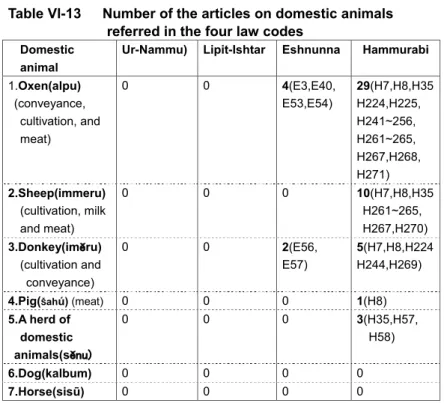
Table Ⅵ-13 summarizes the number of the articles on domestic animals referred in the four law codes.
The parenthesis in the table means main fields of utilization. Oxen was extensively used as animals for convenience, cultivation and meat. The sheep was used for cultivation (threshing at harvest) and also for milk and meat.
Articles on the oxen occupies 64% of the total articles on domestic animals, and ten articles among them are concerned with rental. In the four law codes no article is discovered on horses. Maeda110 stated that in these times use of horse had not yet been popularized. Kobayashi111 showed two

![Table VI-10Body and penalty for it in the Ur-Nammu, eshnunna, and Hammurabi law codes PositionLaw code Ur-NammuEshnunnaHammurabi a→aa→mm→ma→s 1 eye (iin, inum)1 mana (60siqlu) [E 42]eye [H 196]*1 mana (60 siqlu)[H198]half price ofslave [H 199] 2.nose (appe](https://thumb-ap.123doks.com/thumbv2/123deta/7826021.1232414/46.629.114.504.119.797/table-penalty-nammu-eshnunna-hammurabi-positionlaw-nammueshnunnahammurabi-ofslave.webp)