Japan Advanced Institute of Science and Technology
JAIST Repository
https://dspace.jaist.ac.jp/Title A proportional 3-tuple fuzzy linguistic screening
evaluation model in new product development Author(s) Guo, Wen-Tao; Huynh, Van-Nam; Nakamori, Yoshiteru
Citation
Proceedings of The 14th International Symposium on Knowledge and Systems Sciences (KSS'2013): 82-88
Issue Date 2013
Type Conference Paper
Text version author
URL http://hdl.handle.net/10119/12336
Rights
Copyright (C) 2013 JAIST Press. Wen-Tao Guo, Van-Nam Huynh, Yoshiteru Nakamori, Proceedings of The 14th International Symposium on Knowledge and Systems Sciences (KSS'2013), 2013, 82-88. Description
A Proportional 3-Tuple Fuzzy Linguistic Screening Evaluation Model in
New Product Development
Wen-Tao Guo Van-Nam Huynh Yoshiteru Nakamori
School of Knowledge Science
Japan Advanced Institute of Science and Technology
1-1 Asahidai, Nomi, Ishikawa 923-1292, Japan
[email protected]
Abstract
It is particularly important for companies to screen new products before new products are launched to the markets. So far, lots of ap-proaches have been excavated. However, due to uncertain, vague and incomplete information as well as dynamically complex process regarding to new product development (NPD), many ap-proaches face with various limitations and re-strictions, which lead to a dilemma that evalua-tors can’t take into account the aspects related to human nature, such as confidence levels, integ-rity of subject judgments, to evaluate new prod-ucts reasonably. In this paper, we propose a proportional 3-tuple fuzzy linguistic evaluation model for screening new products and related computation operator based on canonical char-acteristic values (CCV). It is shown that this new model has a good ability to reflect human nature through the probability and the variable repre-senting missing information. Thus, it not only can reflect the confidence levels of evaluators in the way of probability, but is also able to refract accuracy of subject judgment, whereby improv-ing the precision and reasonability of final result. Keywords: Confidence Levels, Linguistic Mod-eling, Missing Information, New product screening, Proportional 3-Tuple
1 Instructions
New product development (NPD) is a dy-namically complex and an overall process in-cluding strategy, organization, concept genera-tion, product and marketing plan creation and evaluation, and commercialization of a new product [2], [9]. Faced with intense global com-petition, rapid change in technology, a dynamic
economical situation and short product life cycles, in contrast to new products being a major con-tributor to the growth, profitability of a company, and providing access to new markets, companies have realized that NPD has become one of the most important strategies, which is crucial for their survival and competitive success [4], [10].
However, due to inevitable consequences of volatile markets and customer preferences, im-precise and uncertain information, NPD is also a dynamically complex process with high-risk rate of failure, which often leads to substantial mon-etary and non-monmon-etary losses[3], [7]. In such situation, screening new product projects be-comes the first critical evaluation in the NPD process before a company launching a successful new product [5], [13]. Hence, there is an in-creasing emphasis raised by both researchers and practitioners to dramatically enhance screening new product projects in NPD process.
Screening new product projects is a very complicated problem. One of main reasons is that evaluators have to cater for many interrelated criteria of both quantitative and qualitative nature in a rational way simultaneously, especially un-der uncertain. Another main reason is related to human nature. Evaluators often lack confidences when they supply subject judgments. This probably results from the reality that evaluators have to be conducted on the basis of both precise numbers and subjective judgments that are im-precise, vague and incomplete in nature. Such uncertainties can be incurred and leads to in-complete evaluation results due to a lack of evi-dence and understanding or human’s inability of providing accurate judgments on the evaluation process [6]. Although there are many approaches which have been excavated to screen new prod-ucts, most of these approaches face with various limitations and restrictions, which lead to a di-lemma that evaluators cannot take into account
the aspects related to human nature, such as confidence levels, integrity of subject judgments, to evaluate new products reasonably.
Given the foregoing, this research proposes a proportional 3-tuple fuzzy linguistic screening evaluation model and related computation oper-ator to deal with the problems mentioned above. In this research, linguistic information is repre-sented by a so-called proportional 3-tuple, that is, 2 subject judgments with probabilities and a numerical value, such as (0.3A, 0.6B, 0.1). It means someone gives linguistic evaluation as 30% A, 60% B, and 10% missing information. Compared with proportional 2-tuple [14], it is more flexible and allows evaluators to supply incomplete subject judgments under uncertainty. By combining proportional 3-tuples with lin-guistic evaluation framework [12], a proportional 3-tuple fuzzy linguistic screening evaluation model has been developed. It is shown that this new model has a good ability to reflect human nature through the probability and the variable representing missing information. Thus, it not only can reflect the confidence levels of evalua-tors in the way of probability, but is also able to refract the accuracy of subject judgment, whereby improving the precision and reasona-bility of final result.
The rest of this paper is organized as follows. In section 2, after introducing the notion of pro-portional 3-tuple based on symbolic proportion and canonical characteristic values (CCV), we will introduce a computation operator of propor-tional 3-tuples based on CCV. Section 3 develops a proportional 3-tuple fuzzy linguistic screening evaluation model. Section 4 presents an example to illustrate the proposed method. Finally, Sec-tion 5 points out some concluding remarks of this paper.
2 Proportional 3-Tuple and Computation
Operator
2.1 Proportional 3-tuple
Let’s first recall some notions from previous literature [14].
Let S = {s0, s1,..., sn} be an ordinal term set
with s0< s1<…<sn, I= [0, 1] and
IS≡I × S = {(α, si): α
[0, 1] and i = 0, 1,..., n}.Given a pair (si, si+1) of two successive ordinal
terms of S, any two elements (α, si), (β, si+1) of IS
are called a symbolic proportion pair and α, β are called a pair of symbolic proportions of the pair (si, si+1) if α + β ≤ 1. A symbolic proportion pair
(α, si), (β, si+1) will be denoted by
1 if 0) , ) 1 ( , ( 1 if ) , , ( 1 1 ii i i s s s s (1)
where ε represents missing information. The set of all the symbolic proportion pairs is denoted by
S*, i.e., S*= {(αsi, βsi+1, ε): α, β
[0, 1], ε
[0, 1)and i = 0, 1,..., n-1}. The set S* is called the or-dinal proportional 3-tuple set generated by S and the members of S* are called ordinal proportional 3-tuples, which can be used to represent evalua-tors’ linguistic assessments with confidence lev-els and the integrity of subject judgments.
Remark: since for i = 1,…, n-1, ordinal term si
can use either (0si-1, 1si, 0) or (1si, 0si+1, 0) as its
representative in S*, by no abuse of notion, we will only use the latter.
2.2 Position index function
Let S = {s0, s1,..., sn} be an ordinal term set and S* is the ordinal proportional 3-tuple set gener-ated by S. Define π: S*→[0, n] by ) 1 ( ) , s , ( 1 si i i i (2) where i = 0, 1,…, n-1, and α
[0, 1]. Here, π is called the position index function of proportional 3-tuples. Under the identification convention, the position index function becomes a bijection fromS* to [0, n] and its inverse π-1: [0, n] → S* is de-fined by ) , , ) 1 (( ) ( 1 1 x si si (3)
where i = E(x), E is the integral part function, and
θ = x-i.
2.3 Canonical characteristic values
The semantics of elements in a term set, which is used to represent the linguistic infor-mation in the linguistic approach is given by fuzzy numbers that are defined in the [0, 1] in-terval. For each fuzzy number, we can find re-lated crisp values (CV) to summarize its infor-mation. The crisp values are called characteristic values. For example, for a symmetrical triangular
fuzzy number T[c-δ, c, c+δ], we can find a set of characteristic values { 1 , 2 ,..., n} T T T T C C C CV , which
are crisp values. In previous literature, various types of CV have been excavated, such as Ex-pected Value (EV), Center of Gravity (CG), Mean of Maxima (MM), λ Mean Area Measure Value (λMAMV), Mean Area Measure Value (MAMV) etc., and used for different purposes, e.g., in the defuzzification methods, ranking fuzzy numbers and so on. Actually, it is enough for us just only to choose one value from the set of characteristic values to represent the fuzzy number’s meaning.
In view of symmetrical triangular fuzzy numbers that will be used in this research, while for a symmetrical triangular fuzzy number T[c-δ,
c, c+δ], its expected value equals c, i.e. EV(T) = c.
Hence, for convenience, EV(T) will be used as a canonical (representative) characteristic values (CCV) of T in this research.
2.4 Computation operator of proportional 3-tuple
Let S = {s0, s1,..., sn} be an ordinal term set
with s0 < s1< …<sn, and S *
is the ordinal propor-tional 3-tuple set generated by S. Define CCV of proportional 3-tuple (αsi, βsi+1, ε) as follows:
CCV: S *→ [0, 1] ) ), ) 1 ( (( ) ), ( ) ( ( ) , , ( 1 1 1 i i i i i i c c s CCV s CCV s s CCV (4) and call it the corresponding canonical charac-teristic value function on S* generated by CCV on
S. Here, ci
[0, 1] with c0<c1<…<cn is the CCVof si, i= 0, 1,..., n, and CCV is a bijection from S * to [c0, cn] ([0, 1]). Define a function f: [0, n] → [c0, cn] by ) ( ) 1 ( ) (x ci ci1 ci f (5) where i= E(x), E is the integral part function, and
θ = x-i. Then, f is a bijection. Since
)) s , ) 1 (( ( ) ( ) ( ) 1 ( ) 1 ( ) s , ) 1 (( 1 1 1 1 i i i i i i i i i s f i f c c c c c s CCV (6)
for all i = 0, 1,…, n-1, θ
[0, 1], thus
f
CCV . So CCV is a bijection. The inverse
of CCV is denoted by CCV-1.
3 Proportional 3-Tuple Fuzzy Linguistic
Screening Evaluation Model
Based on 2-tuple linguistic evaluation framework [12], the procedure of proportional 3-tuple fuzzy linguistic screening evaluation model is as follows:
1) Proportional 3-tuple linguistic transfor-mation and unification: This step aims at trans-forming original linguistic information of an NPD project assessed by evaluators against a set of criteria into a unified representation by means of proportional 3-tuples. It includes converting original linguistic assessments of merit ratings and weights.
2) Aggregate the average merit ratings and the average important weights of criteria: For No. d criterion, the computation and aggregation of the average merit rating and average weight repre-sented by proportional 3-tuples are as follows.
In terms of the merit ratings (αsp,i, βsp,i+1, εp,d),
the average merit rating (αsi, βsi+1, εd) is given by
))) ) -1 ( , ( ( 1 ( ))) , ( ( 1 ( ) , ( 1 1 , , , 1 1 1 , , 1 1
q p i p d p i p q p i p i p i i s s CCV q CCV s s CCV q CCV s s (7)
q p d p d q 1 ,
(8)with p representing the current evaluator, p
[1,q], and d representing the No. d criterion.
In terms of weights(p,i ,p,i1 ,'p,d), the average weight (i ,i1 ,d') is given by
))) ) -1 ( , ( ( 1 ( ))) , ( ( 1 ( ) , ( 1 1 , ' , , 1 1 1 , , 1 1
q p i p d p i p q p i p i p i i CCV q CCV CCV q CCV (9)
q p d p d q 1 ' , '
(10)with ω representing the weights of evaluation criteria.
3) Compute the overall figure of merit: The overall figure of merit (λri, ηri+1, ε) typically
ex-presses the evaluation rating regarding the NPD project under consideration, that is,
k d i d i d k d i d i d i d i d i i CCV CCV s s CCV CCV r r 1 1 , , 1 1 , , 1 , , 1 1 ) , ( ) , ( ) , ( ) , ( (11)
k d k d d 1 ' d 1 ' d
(12)with r representing the overall figure of merit and
d
[1, k].4 Illustrative Application Example
In this section, we will consider an example so as to illustrate the practical application of pro-portional 3-tuple fuzzy linguistic screening evaluation model in NPD.4.1 Select evaluation criteria
A new product project is very complicated and characterized by a variety of features of both quantitative and qualitative in nature. Selecting a set of criteria that can reflect a variety of features of new products and other indispensable traits is really difficult. Previous researches have identi-fied criteria for assessing and screening new product projects, which provide a gauge for companies to assess design approaches and, in turn, select the most suitable design [1], [11]. By reference to previous studies, we can easily find many sets of criteria for screening different new products. One can adopt and further modify them according to respective features of new products. For the purpose of just taking an illustrative example, we choose a list of general criteria, which are suitable for explanation of our model, from the following two literatures [8], [13], as shown in Table 1.
Table 1. The evaluation criteria of new product Criteria
C1 Product differential advantage
C2 Diversification strategy C3 Project financing C4 Marketing timing C5 Marketing competencies C6 Size of market C7 Marketing attractiveness C8 Price superiority C9 Product life
C10 Technological and product synergy
C11 Material specialization
4.2 Select linguistic term sets and associated semantics
It’s essential and imperative to define lin-guistic term sets and associated semantics to supply evaluators with an instrument, by which they can naturally express their assessments against different criteria. One of main approaches is to directly define a finite linguistic term set associated with a fuzzy set representation of its linguistic terms distributing on a scale on which a total order is defined. Another often used ap-proach in literatures is to adopt and modify the linguistic terms and corresponding membership functions from previous studies so as to incor-porate the specific requirements of respective application examples. For the sake of conven-ience, this research will use the latter approach.
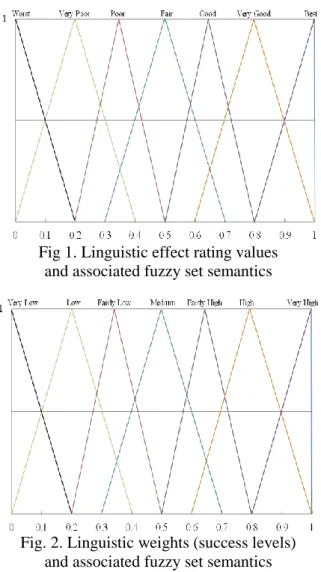
1) The first term set is used to linguistically evaluate the merit ratings of criteria:
)} Best ( ), Good Very ( ), Good ( ), Fair ( ), Poor ( ), Poor Very ( ), Worst ( { 1 6 1 5 1 4 1 3 1 2 1 1 1 0 1 s s s s s s s S (13)
and the associated fuzzy set semantics is shown in Fig.1.
2) The second term set is used to linguistically evaluate the relative importance of different cri-teria: )} High Very ( ), High ( ), High Fairly ( ), Medium ( ), Low Fairly ( ), Low ( ), Low Very ( { 2 6 2 5 2 4 2 3 2 2 2 1 2 0 2 s s s s s s s S (14)
and the associated fuzzy set semantics is shown in Fig.2.
3) The third term set is used to linguistically express the success levels of the new product project:
)} High Very ( ), High ( ), High Fairly ( ), Medium ( ), Low Fairly ( ), Low ( ), Low Very ( { 3 6 3 5 3 4 3 3 3 2 3 1 3 0 3 s s s s s s s S (15)
and the associated fuzzy set semantics is shown in Fig.2.
Fig 1. Linguistic effect rating values and associated fuzzy set semantics
Fig. 2. Linguistic weights (success levels) and associated fuzzy set semantics
4.3 Assess criteria merit ratings and weights using linguistic terms
In case criteria have been carefully chosen, linguistic variables and associated membership functions have been elaborately defined, four evaluators denoted by p= {E1, E2, E3, E4} need to
give linguistic assessments of merit ratings and weights of criteria.
It is worth to mention here, in this research, evaluators are able to make linguistic evaluations with confidence levels, in other words with probability, rather than numerical assessments of the selected factors. This is because the nature of
human judgments on uncertainty responses a basic bias with probability. More specifically, due to ambiguity and uncertainty about tech-nology and the competitive environment with the limitations imposed by both nature and the timing of NPD, evaluators are allowed to supply in-complete assessments, such as (0.3s4, 0.5s5, 0.2)
in * 1
S . It means that this evaluator evaluates the
current criterion as follows: 30% possibility is Good, 50% possibility is Very Good, and the other 20% possibility is uncertain that he cannot determine.
The assessment results of merit ratings and the important weights of the selected criteria are shown in Table 2 and Table 3 respectively. 4.4 Compute evaluation results of propor-tional 3-tuple fuzzy linguistic screening eval-uation model
After information aggregation and unification, the average merit ratings and the average im-portant weights as well as the average missing information of criteria represented by propor-tional 3-tuples can be got via (7) and (9), (8) and (10) respectively, as shown in the last columns of Tables 2 and 3. Then, the overall value reflecting the overall figure of merit regarding the NPD project can be obtained by (11) and (12), i.e.,
) 10.3% Good, Very % 9 . 37 Good, % 8 . 51 ( ) 0.103 , 379 . 0 , 518 . 0 ( s14 s15
which is then converted into the related propor-tional 3-tuple of linguistic success levels in *
3 S .
Because the fuzzy set semantics of merit ratings and success levels is the same, the CCV of S1 and
S3 are also the same, the overall figure of merit
can directly express the success levels. Hence, ) 10.3% High, % 9 . 37 High, Fairly % 8 . 51 ( ) 0.103 , 379 . 0 , 518 . 0 ( ) 0.103 , 379 . 0 , 518 . 0 ( 14 15 43 53 s s s s
that is, the proportional 3-tuple indicates that the possible success level of this new product project is 51.8% fairly high, 37.9% high, and 10.3% missing information, which gives the decision makers a reference whether it is suitable to launch this new product project or not.
5 Concluding Remarks
In this paper, we have defined the notion of proportional 3-tuple, which endows screening evaluation model with a particular feature to
aggregate multi-evaluators’ assessments and reveal the nature of NPD process. Then, a pro-portional 3-tuple fuzzy linguistic screening evaluation model and related computation oper-ator based on CCV have been proposed. It is shown that this new model has a good ability to reflect human nature through the probability and the variable representing missing information,
which can support evaluators to express assess-ments more accurately with confidence and im-prove the precision and reasonability of final result.
It is worth to mention here, Yang et al. [15] developed a new evidential reasoning approach for MADA under both probabilistic and fuzzy
Table 2. Linguistic assessments of merit ratings of criteria represented by proportional 3-tuples Criteria Evaluators Average E1 E2 E3 E4 E C1 (0.3s4, 0.7s5, 0) (0.3s5, 0.6s6, 0.1) (0.3s5, 0.5s6, 0.2) (0.3s4, 0.6s5, 0.1) (0.74s5, 0.16s6, 0.1) C2 (0.3s2, 0.6s3, 0.1) (0.3s3, 0.7s4, 0) (0.7s2, 0.2s3, 0.1) (0.3s2, 0.5s3, 0.2) (0.15s2, 0.75s3, 0.1) C3 (0.4s2, 0.5s3, 0.1) (0.6s2, 0.3s3, 0.1) (0.8s2, 0s3, 0.2) (0.2s2, 0.6s3, 0.2) (0.5s2, 0.35s3, 0.15) C4 (0.5s5, 0.4s6, 0.1) (0.6s5, 0.3s6, 0.1) (0.4s5, 0.5s6, 0.1) (0.4s5, 0.5s6, 0.1) (0.48s5, 0.42s6, 0.1) C5 (0.3s5, 0.6s6, 0.1) (0.2s5, 0.7s6, 0.1) (0.4s5, 0.3s6, 0.3) (0.1s5, 0.8s6, 0.1) (0.25s5, 0.6s6, 0.15) C6 (0.7s5, 0.2s6, 0.1) (0.6s5, 0.3s6, 0.1) (0.4s5, 0.6s6, 0) (0.2s5, 0.6s6, 0.2) (0.48s5, 0.42s6, 0.1) C7 (0.8s5, 0.1s6, 0.1) (0.7s5, 0.2s6, 0.1) (0.6s5, 0.3s6, 0.1) (0.4s5, 0.5s6, 0.1) (0.63s5, 0.27s6, 0.1) C8 (0.7s4, 0.2s5, 0.1) (0.3s4, 0.7s5, 0) (0.8s4, 0.2s5, 0) (0.4s4, 0.5s5, 0.1) (0.55s4, 0.4s5, 0.05) C9 (0.3s5, 0.5s6, 0.2) (0.6s5, 0.4s6, 0) (0.6s5, 0.3s6, 0.1) (0.5s4, 0.4s5, 0.1) (0.69s5, 0.21s6, 0.1) C10 (0.6s3, 0.3s4, 0.1) (0.4s3, 0.5s4, 0.1) (0.7s3, 0.2s4, 0.1) (0.5s3, 0.4s4, 0.1) (0.55s3, 0.35s4, 0.1) C11 (0.7s2, 0.3s3, 0) (0.6s2, 0.3s3, 0.1) (0.6s3, 0.3s4, 0.1) (0.6s2, 0.2s3, 0.2) (0.4s2, 0.5s3, 0.1)
Table 3. Linguistic assessments of weights of criteria represented by proportional 3-tuples
Criteria Evaluators Average
E1 E2 E3 E4 E C1 (0.4s4, 0.6s5, 0) (0.8s4, 0.1s5, 0.1) (0.1s4, 0.9s5, 0) (0.3s4, 0.6s5, 0.1) (0.4s4, 0.55s5, 0.05) C2 (0.6s2, 0.4s3, 0) (0.3s3, 0.5s4, 0.2) (0.2s3, 0.6s4, 0.2) (0.6s3, 0.4s4, 0) (0.67s3, 0.23s4, 0.1) C3 (0.3s4, 0.6s5, 0.1) (0.3s4, 0.6s5, 0.1) (0.7s4, 0.2s5, 0.1) (0.8s4, 0.1s5, 0.1) (0.53s4, 0.37s5, 0.1) C4 (0.5s4, 0.4s5, 0.1) (0.3s4, 0.6s5, 0.1) (0.3s4, 0.5s5, 0.2) (0.4s4, 0.6s5, 0) (0.37s4, 0.53s5, 0.1) C5 (0.3s4, 0.6s5, 0.1) (0.6s4, 0.4s5, 0) (1s5, 0s6, 0) (0.6s4, 0.3s5, 0.1) (0.37s4, 0.58s5, 0.05) C6 (0.3s2, 0.6s3, 0.1) (0.6s2, 0.4s3, 0) (0.2s2, 0.7s3, 0.1) (0.4s2, 0.6s3, 0) (0.37s2, 0.58s3, 0.05) C7 (0.7s4, 0.2s5, 0.1) (0.7s4, 0.2s5, 0.1) (0.3s4, 0.7s5, 0) (0 s4, 0.8s5, 0.2) (0.43s4, 0.47s5, 0.1) C8 (0.3s3, 0.6s4, 0.1) (0.6s3, 0.3s4, 0.1) (0.7s3, 0.2s4, 0.1) (0.5s2, 0.4s3, 0.1) (0.75s3, 0.15s4, 0.1) C9 (0.2s3, 0.8s4, 0) (0.6s3, 0.4s4, 0) (0.6s2, 0.3s3, 0.1) (0.4s2, 0.5s3, 0.1) (0.9s3, 0.05s4, 0.05) C10 (0.5s3, 0.3s4, 0.2) (0.3s3, 0.7s4, 0) (0.6s3, 0.2s4, 0.2) (0.6s3, 0.4s4, 0) (0.5s3, 0.4s4, 0.1) C11 (0.2s4, 0.7s5, 0.1) (0.6s4, 0.4s5, 0) (0.2s4, 0.8s5, 0) (0.4s4, 0.5s5, 0.1) (0.35s4, 0.6s5, 0.05)
uncertainties. This evidential reasoning approach used a distributed fuzzy belief structure to model precise data, ignorance and fuzziness under the unified framework. Although proportional 3-tuple fuzzy linguistic screening evaluation model and the new evidential reasoning approach both can exhibit good performances under in-completeness, probabilistic and fuzzy uncertain-ties, the way that they deal with the problems of fuzziness is different. The former uses label in-dex rather than membership functions which are employed by the latter to handle fuzzy assess-ments. Compared with membership function, label index method perhaps is more easily to operate when transforming fuzzy assessments grades. Hence, an interesting direction for future work perhaps could be combining proportional 3-tupel and the new evidential reasoning ap-proach to screen new products under complicated contexts.
Acknowledgment
The authors would like to thank the anony-mous referees for their detailed comments and suggestions that helped significantly improve the version of this paper.
References
[1] T. Astebro. Key success factors for techno-logical entrepreneurs’ R&D projects. IEEE
Transactions on Engineering Management, 51(3):
314–328, Aug., 2004.
[2] P. Belliveau, A. Griffin, and S. Somermeyer.
The PDMA Toolbook for New Product Devel-opment. New York, John Wiley & Sons, 2002.
[3] U. de Brentani. Do firms need a cus-tom-designed new product screening model?
Journal of Product Innovation Management,
3(2):108–119, 1986.
[4] U. de Brentani. Success and failure in new industrial services. Journal of Product
Innova-tion Management, 6(4): 239–258, 1989.
[5] R. J. Calantone, C. A. di Benedetto, and J. B. Schmidt. Using the analytic hierarchy process in new product screening. Journal of Product
In-novation Management, 16:65–76, 1999.
[6] K. S. Chin, J. B. Yang, M. Guo, and J. P. K. Lam. An evidential-reasoning-interval-based method for new product design assessment. IEEE
Transactions on Engineering Management, 56(1):
142–156, February, 2009.
[7] R. G. Cooper. Stage-Gate systems: a new tool for managing new products,” Business Horizons, 33(3): 44–45, 1990.
[8] R. G. Cooper, and U. de Brentani. Criteria for screening new industrial products. Industrial
Marketing Management, 13(3): 149–156, August,
1984.
[9] A. Craig, and S. Hart. Where to now in new product development research. European
Jour-nal of Marketing, 26(11):2–49, 1992.
[10] A. Griffin. PDMA research on new product development practices: updating trends and benchmarking best practices. Journal of
Innova-tion Management, 14(6):429–458, 1997.
[11] K. M. M. Holtta and K. N. Otto. Incorpo-rating design effort complexity measures in product architectural design and assessment.
Design Studies., 26(5):463–485, 2005.
[12] V. N. Huynh, and Y. Nakamori. A linguistic screening evaluation model in new product de-velopment. IEEE Transactions on Engineering
Management, 58(1):165–175, 2011.
[13] C. T. Lin, and C. T. Chen. New product go/no-go evaluation at the front end: a fuzzy linguistic approach. IEEE Transactions on
En-gineering Management, 51(2):197–207, 2004.
[14] J. H. Wang, and J. Hao. A new version of 2-tuple fuzzy linguistic representation model for computing with words. IEEE Transactions on
Fuzzy Systems, 14(3):435–445, June, 2006.
[15] J. B. Yang, Y. M. Wang, D. L. Xu, and K. S. Chin. The evidential reasoning approach for MADA under both probabilistic and fuzzy un-certainties. European Journal of Operational