JAIST Repository
https://dspace.jaist.ac.jp/
Title Openization, Standardization and Diversification in the Case of Robotics Software Sector in Japan Author(s) XIE, Zhongquan; MIYAZAKI, Kumiko
Citation 年次学術大会講演要旨集, 24: 603-606
Issue Date 2009-10-24
Type Conference Paper
Text version publisher
URL http://hdl.handle.net/10119/8704
Rights
本著作物は研究・技術計画学会の許可のもとに掲載す るものです。This material is posted here with permission of the Japan Society for Science Policy and Research Management.
㪦㫇㪼㫅㫀㫑㪸㫋㫀㫆㫅㪃㩷㪪㫋㪸㫅㪻㪸㫉㪻㫀㫑㪸㫋㫀㫆㫅㩷㪸㫅㪻㩷㪛㫀㫍㪼㫉㫊㫀㪽㫀㪺㪸㫋㫀㫆㫅㩷
㫀㫅㩷㫋㪿㪼㩷㪚㪸㫊㪼㩷㫆㪽㩷㪩㫆㪹㫆㫋㫀㪺㫊㩷㪪㫆㪽㫋㫎㪸㫉㪼㩷㪪㪼㪺㫋㫆㫉㩷㫀㫅㩷㪡㪸㫇㪸㫅㩷
䂾㪱㪿㫆㫅㪾㫈㫌㪸㫅㩷㪯㪠㪜㪃㩷㪢㫌㫄㫀㫂㫆㩷㪤㪠㪰㪘㪱㪘㪢㪠㩷
㩿㪞㫉㪸㪻㫌㪸㫋㪼㩷㪪㪺㪿㫆㫆㫃㩷㫆㪽㩷㪠㫅㫅㫆㫍㪸㫋㫀㫆㫅㩷㪤㪸㫅㪸㪾㪼㫄㪼㫅㫋㪃㩷㪫㫆㫂㫐㫆㩷㪠㫅㫊㫋㫀㫋㫌㫋㪼㩷㫆㪽㩷㪫㪼㪺㪿㫅㫆㫃㫆㪾㫐㪀㩷
Abstract
The purpose of this paper is to discuss the how institutions affect innovation, diffusion and structural change of a sector in the case of robotics software (RSW) in Japan. With the quick development of next generation robot, there is increasing requirement of RSW to integrate many kinds of software and technologies. Because of the complexity and difficulty of RSW development, openization, standardization and diversification are very important for the innovation of RSW sector, which is going through restructuring. After the analysis of these institutions and their effects on innovation and diffusion of RSW, the paper draws some implications.
Keywords: robotics software, institutions, openization, standardization, diversification, innovation 1. Introduction
Over time, a sectoral system undergoes process of change and transformation through the coevolution of its various elements (Malerba, 2005). Moreover, in all sectoral systems, institutions play a major role in affecting the rate of technological change, the organizations of innovative activity, and performance (Malerba, 2005). Different institutions have different effects on sectors, e.g. in software (Steinmueller, 2004), standards and standard setting organizations are important and IPR plays a major role in strengthening appropriability. Thus, the effects of institutions should be discussed in specific sector.
Robotics industry is undergoing a shift from industrial robots to non-industrial robots (Kumaresan and Miyazaki, 1999) and an increasing trend, especially non-industrial robot (JARA, 2001; IFR, 2008). “Innovation trajectory” in the case of the Japanese robotics industry is influenced not only by technology factors, but also by various structural factors, such as products, market, actors, competitive or socio-economic (Kumaresan and Miyazaki, 2001). The success of next generation robot (non-industrial robot) heavily depends on the development of robotics software (RSW). There is an increasing need in robot technologies for integration of many kinds of technologies and components into robot; thus, there must be some more efficient software services that glue all of these technologies and components. The rapid growing importance of RSW has received increasing attention now, thanks to some particular events, e.g. Microsoft moved into RSW sector by releasing Microsoft Robotics Studio in 2006.
Japan owns great international competitiveness in industrial robot products, according to the report of JARA, in 2007, over 71% of world industrial robots were produced by Japanese firms and 58.9% of the produced robots were exported to other countries. Japanese governments have already made and will make great efforts to building the common platform
technologies for the next generation robot; the very important technology being the software platform. The efforts from government, universities, institutes and industries are combined together to do research and develop on RSW.
Based on the background, RSW sector was chosen as a case study on how institutions affect innovation and structural change of a sector. Because of specific characteristics of RSW sector, the openization, standardization and diversification are discussed in this paper.
Case study is the main methodology of the paper. Based on evolution trends of RSW sector and data from government/firm reports, related website (such as sourceforge.net), and statistics, the paper uses both theoretical and quantitative analysis. In aspects of openization, standardization, and diversification, the paper firstly analyzes the institution status of RSW then discusses the reason behind them in view of technology, innovation and diffusion, following the effects of these processes.
2. Openization
In RSW sector, the openization here involves open software architecture for robotics and open source software (OSS) for robotics.
2.1. Open software architecture
Open architecture is a type of architecture that allows adding, upgrading and swapping components. To make robotics technology (RT) become widely used, and to make various robots appear in the market for commercial use, the robotic parts (mechanism, hardware, and software) should be reproduced, reused and integrated with open structure. In Japan, there are several projects and activities making great effort to popularize the open software architecture, co-evolving with open hardware architecture, such as ORiN (Open Robot Interface for the Network), ORCA (Open Robot Controller Architecture), and Open-R (An Open Architecture for Robot
2D14
Entertainment).
As one of subsystems of robotics, RSW is highly dependent on robotics hardware. Because of the much greater complexity of RT and the RT’s close relationship with human being, RSW is data intensive, integrated, and have to with the characteristics of reliability and safety. The needs for quality, reliability, safety, openness, adaptability/dynamic reconfigurability, interoperability, plug-and-play extensions, etc. provide some “guideposts” for the innovation process. Open software architecture is one way to provide some of the “guideposts”. With the open interface, we can make use of robot components to build a wide variety of robot systems, which results in the fast robot development and cost-reducing.
2.2. Open source software (OSS) for robot
The OSS movement has penetrated the RSW field, such as the OROCOS (Open Robot Control Software), Player/Stage platform, Orca, ROS, CARMEN, and Japanese OpenRTM-aist and OpenHRP 3.
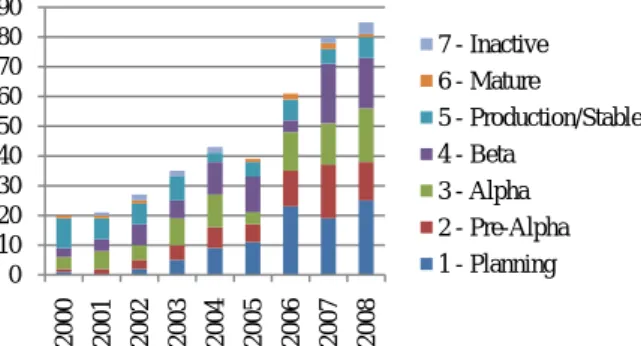
Searched from sourceforge.net on September 10th, 2009, 539 projects have been identified related to robotics (including internet robot). Among them, 223 projects/OSSs could be downloaded directly from sourceforge.net; 320 are under GNU General Public License (GPL), 35 under GNU Library or Lesser General Public License (LGPL). Most of these projects are using Linux and MS windows operating systems, and tend to be designed suitable for many OS platforms. Also, there is a trend that robot software tends to be developed based on Linux, because Linux is open. Undoubtedly, there is an increasing trend of OSSs on RSW (Fig. 1). Seen from Fig. 1, more and more OSSs on RSW are in the stage of planning, more and more OSSs already exist on sourceforge.net and become mature, and only few of them is inactive. Among these projects, only a few of them are Japanese sponsored.
In the movement of OSS, most attractive OSSs in Japan, OpenRTM-aist and OpenHRP3 cannot be found sourceforge.net. OpenRTM-aist is based on Robotic Component Specification standard of OMG (Object Management Group), under LGPL. OpenHRP3 allows the users to inspect an original robot model and control program by dynamics simulation under Eclipse Public License (EPL) v1.0.
This openization process highly contradicts the fact
that most robot manufacturers keep their software hidden. Open source software has played a major role in computer, but its role has been much less significant in robotics. As time goes by, OSS will become much more important in RSW. Governments, agencies, hobbyists, and associations are the main contributors to the OSS on robotics, while lots of firms are unwilling for this process. Undoubtedly, openization makes reuse of RSW possible, which can reduce large repeated work in the development of RSW.
3. Standardization
Recently, there have been lots of activities seeking standards based on the commonality of robotics design and functions in various fields, both in robotics architecture and software framework. For example, In the US, The National Institute of Standards and Technology proposed JAUS (Joint Architecture for Unmanned Systems) standard; In Europe, OROCOS also aims at as standard RSW platform.
In Japan, OpenRTM, ORiN and RSi are promoted as the Japanese robot software standard, as well as the world standard. Take the OpenRTM promoted by NEDO, AIST and JARA as example, this RT-Middleware provides a common platform for the RT technology and aims at boosting the efficiency of the research and development in robotics, extending the scope of its applications and fostering the emergence of new markets. On September 25-29, 2006, an international standard specification (unified proposal) for modularization of robot software developed through collaboration between Japan and the United States was adopted as an OMG standard specification proposal1
OMG standard specifications are available at no cost to anyone who wants to develop and sell software complying with such specifications. This standardization in RT will lower the cost of robot system development, which to date has been very expensive, maybe more than hundreds of million yen. As a result, commercialization of various types of domestic robots will become possible. The introduction of RT-middle of will make the robot sector two possible businesses model: ready-made (big market) robotic products and custom-made robotic products; IT vendors, home electronics makers, parts makers (mechanical, IC, and sensor), software vendors, toy makers, etc. entering the robot market. All these . RT-middleware and RTC were adopted as the standard framework. OpenRTM-aist by AIST is used as a basic specification/implementation framework of RTC, which doesn't depend on application. Japanese governments and firms consider the RT middleware standardization as the key to gain comparative advantages in the robot industry all over the world and implement several big projects on RT standardization, including software standardization.
1 Documents associated with Robotic Technology Component
(RTC), Version 1.0, formal/2008-04-04 0 10 20 30 40 50 60 70 80 90 2000 2001 2002 2003 2004 2005 2006 2007 2008 7 - Inactive 6 - Mature 5 - Production/Stable 4 - Beta 3 - Alpha 2 - Pre-Alpha 1 - Planning
make the robot sector much more complicated, and new type of businesses, such as robot engineering and robot services are emerging.
4. Diversification
With openization and standardization, the RSW sector is diversifying. These diversifications reconstruct the RSW sector and even robotics industry. There are several aspects of diversification:
Firstly, with the openization and standardization, RSW is being disintegrated under the development requirement. This disintegration has two aspects, disintegration from hardware of RT, and disintegration of RSW into many layers and components. Thus, special software vendors are emerging, such as vendors of developing debugger, editor, builder, middleware, simulation, application, OS, etc., and the competition among middleware, simulation, and OS is becoming much more fierce. These different software vendors are shaping the RSW value chain.
Secondly, with the openization, OSSs and property software coexist and make some contradictions and there is an increasing trend that OSSs is becoming more important in development of RSW. Many firms already have made their robot software platforms open, while some firms still keep their software platforms secret, and just sell their RT products with embedded RSW.
Thirdly, free RSW and non-free RSW coexist. For example, Microsoft Robotics Studio is free of charge for hobbyists, students and academics, but priced $399 for commercial robot developers. OpenHRP and OpenRTM-aist are widely used in Japan freely. Some robot makers sell their own off-line robot or product packages, e.g., NEC is selling a very expensive software platform RoboStudio for the robots developed by NEC; Yokogawa sells XviewerEYE in 2009 priced 300,000 yen; Mitsubishi sells MELSOFT iQ Works for its FA devices priced 220,000 yen.
Fourthly, there are different RSW development ways and distribution channels. For example, software platforms for service robotics can be logically split into three categories--“pure software frameworks” (Microsoft, Gostai, OROCOS, and Player), “off-the-shelf robotic brains” (MobileRobots, Skilligent), and “in between” (Evolution Robotics, iRobot AWARE) (Somby, 2008).
Fifthly, with the standardization process, many RT manufacturers and RSW vendors are outsourcing their RSW development to reduce their cost.
In addition, RSW is becoming much more network-related by improving the communication skills of RT. Under the network environment of RSW, maybe one day, RSW viruses exist. Because of the complexity, ant-virus RSW also may exist.
5. Effects on Innovation and Diffusion
As one kind of embedded software (ESW), RSW has different characters of innovation and diffusion, compared to general PC software.
Innovation of RSW is defined as the first attempt to embed the RSW into robot or robotics products or first attempt to make a new RSW tool for development of RSW or improve it. There are some reasons RSW is an innovative product: with the property right in software, software can’t be copied in illegal way; robots can not be easy copied; and RSW are programmed according to the design of robots. Thus, innovation of RSW involves product innovation and process innovation. Product innovation means the novelty of a new RSW embedded into robot. Process innovation is the process improvement for higher quality and faster development of RSW product. Organizational innovation and service innovation in RSW are also involved in RSW, but less; thus out of discussion in the paper. Product innovation and process innovation in RSW always happen simultaneously. Because RSW cannot be easily copied compared to packaged software, every new developed RSW is innovation. Process innovation happens from learning from the development of producing RSW accumulatively.
Openization is a way to promote the process innovation of RSW by providing a big community all over the world. Openization also provides an environment for combining all kinds of technologies and components of RSW together, which improve the product innovation and process innovation of RSW.
Openization and standardization of RSW increase the diffusion speed of RSW innovation. Innovation is the key event in triggering technology change, but the speed and degree to which innovations are diffused determine effects of innovation on an economy’s performance. In RSW, diffusion of process innovation will determine the effect of RSW in shifting of robotics industry. This is the reason Japan makes great efforts on RSW platform for the next generation robots. The former chairman of Microsoft, Bill Gates pointed out “The emergence of the robotics industry, which is developing in much the same way that the computer business did 30 years ago” (Gates, 2007). Actually, in our view, in some ways the situation is very different. Firstly, RSW is some kind of diffusion from PC software, not wholly creating a new sector. Secondly, robot is much more difficult and complex than PC, which means that RSW is much more difficult and complex than PC software. Thirdly, the standardization of robot is much more difficult than PC, resulting difficult standardization of RSW. Thus, openization and standardization are very important for the innovation and diffusion of RSW sector.
Openization and standardization are the ways to reduce the negative influence on diffusion because of some characteristics of RSW. During this early stage of the RSW development, a principal problem is that knowledge is locally accumulative or firm/institute/university-specific and the conceptual language available for the generalization or characterization of problems are limited and idiosyncratic. Thus, the innovation in RSW is mainly
incremental innovation. Different firms or research labs (both universities and institutes) tend to use different operating system to develop robot or to build their own research platform. Importantly, most robot manufacturers keep their software hidden. This is because these companies do not intend their customers to do their own programming and they sell complete proprietary application packages rather than general purpose software. If robotics systems are to be deployed in everyday human settings and enter the consumer market, there is a pressing need to engineer the software development process to reduce the cost and time-to market of robotic applications while preserving their efficiency, robustness, safety, and reliability (Brugali and Prassler, 2009). Openization, and standardization, as well as diversification are the ways to meet this pressing need.
6. Implications
Key problems in robotics software in the industrial and academic practice are a chronic lack of standardization, interoperability and reuse of software libraries, both proprietary and open source (Bruyninckx, 2008). Combining with the many kinds of requirement for RSW, these key problems result in the openization, standardization and diversification in RSW sector. These factors influence innovation and diffusion of RSW greatly.
If standardization can work in RSW sector, it must be open, because of the complexity and difficulty of RSW development. However, because of the complexity of robotics, it is very hard to standardize on common robotics. Thus, standardization of components and framework of RSW will be reasonable. The collaboration among different actors (such as relationships among software developers, engineer, customers, etc.) is very important.
During these processes, Japan has made and will make great efforts to stand at the top of robotics industry, by improving the quality and time-to-market of RSW. However, there are some challenges for Japanese RSW sector, which may become development obstacles of robotics industry.
Firstly, most of Japanese robot manufacturers keep their RSW hidden and accumulate it by themselves, facing big challenges from open structure software and OSS. If they reject openization, firms will be in a difficult situation. Japanese firms need to grasp this trend to develop RT and RSW.
Secondly, although Japan has made great efforts on standardization of RSW, especially RTM, RSW includes many tools, such as OS, builder, debugger, editor, simulations, etc.; with development of RSW sector, each of these tools will become a big market, most importantly, the competition among OSs of RSW will become much more fierce compared to other countries, especially the countries with great competitiveness on software development.
Thirdly, facing the diversification of RSW and
robotics industry, especially the disintegration of hardware and software, the strengths of Japan on RSW will become weak, if the situation that Japanese software sector is not good at packaged software, continues. Japanese PC software developed not as well as other sectors, because it was multiple standards (Cottrell, 1996). If this situation continues in RSW sector, RSW sector in Japan may face difficulty in the development of next generation robotics.
Out of the discussion before, one fundamental element should not be left out of our consideration, the education on RSW and knowledge workers. This is the key to develop RSW, as well as RT and robot industry. With development of robot sector and RSW, more and more knowledge workers, especially highly trained engineers on RSW and its related education would be needed. The report from METI on ESW shows an inadequate trend in ESW, which may influence the development of RSW, because the diffusion of ESW from other field to robot is very significant in the evolution of RSW sector. Thus, the competition on RSW sector will depend more on the RSW talents.
References
[1] Brugali, D., Prassler, E., 2009. Software Engineering for
Robotics. IEEE Robotics & Automation Magazine, 26 (3), p. 9, 15.
[2] Bruyninckx, H., 2008. Robotics Software: The Future
Should Be Open. IEEE Robotics & Automation Magazine, March, 9-11.
[3] Cottrell,T., 1996. Standards and the Arrested
Development of Japan’s Microcomputer Software Industry. In: David Mowery, 1996. The International Computer Software Industry, New York: Oxford University Press, 131-164.
[4] Gates, B., 2007. A Robot in Every Home. Scientific
American, January.
[5] IFR, 2008. World Robotics. October 15, 2008.
[6] JARA, 2001. Summary Report on Technology Strategy
for creating a “robot society” in the 21th century May.
[7] Kumaresan, N. and Miyazaki, K., 1999. An Integrated
Network Approach to Systems of Innovation—The Case of Robotics In Japan. Research Policy, 28, 563-585.
[8] Kumaresan, N., Miyazaki. K., 2001.Management and
Policy over shifts in Innovation Trajectories: The Case of the Japanese Robotics Industry. Technology Analysis & Strategic Management, 13 (3), 433-462.
[9] Malerba, F., 2005. Sectoral Systems: How and Why
Innovation Differs Across Sectors. In: Fagerberg, J. Mowery, D. C., Nelson, R. R., 2005. The Oxford Handbook of Innovation. Oxford University Press, New York, 380-406.
[10] Steinmueller, W. E., 2004. The European Software sectoral system of innovation. In: Malerba, F. (Eds.), Sectoral Systems of Innovation: Concepts, Issues and Analysis of six Major Sectors in Europe, Cambridge University Press, Cambridge.