Existence of singular solutions with bounds of linear partial differential equations in the complex domain
大内 忠 (上智大学)
Sunao
\={O}UCHI
(Sophia Univ.)\S 0
IntroductionIn this paper
we
consider alinear partial differential equation in thecom-plex domain in $\mathbb{C}^{d+1}$ , $L(z, \partial)u(z)=f(z)$
.
$L(z, \partial_{z})$ isan
$m$-th linear partial
differential operator with coefficients
are
holomorphic in aneighborhood $U$of $z=0$ in $\mathbb{C}^{d+1}$ The inhomogeneous term $f(z)$ has singularities
on
acom-plex hypersurface $K$. The author reported the results concerning the growth
properties and the asymptotic behaviors of solutions, and those
concern-ing the existence of solutions with asymptotic expansion, when $f(z)$ has
an
asymptotic expansion, at the conference held here,
RIMS
of Kyoto Univ.(see$[5],[6],[7]$ and [8]$)$
.
In the present paperour
concern
is the existence ofs0-lutions, when $f(z)$ has not necessary asymptotic expansion, but the
singu-larities
are
tempered, that is, singularitiesare
of the fractional order. The details will be given elsewhere.\S 1
Notations
and DefinitionsIn order to state
our
problem and resultsmore
precisely, letus
introduce notations, function spaces and characteristic polygon.1.1. Notations. $z=$ $(z_{0}, z_{1}, \cdots, z_{d})=(z_{0}, z’)\in \mathbb{C}\cross \mathbb{C}^{d}$ . $|z|=$
$\max\{|z_{i}|;0\leq i\leq d\}$ and $|z’|= \max\{|z_{i}|;1\leq i\leq d\}$
.
Its dual variablesare
$\xi=(\xi_{0}, \xi’)=(\xi_{0},\xi_{1}, \cdots, \xi_{d})$
.
$\partial_{i}=\partial/\partial z_{i}$, and $\partial=(\partial_{0}, \partial_{1}, \cdots, \partial_{d})=(\partial_{0}, \partial’)$.$\mathbb{Z}$ is the set of all integers and $\mathrm{N}$ is the set of all nonnegative integers. For a
multi-index
a
$=(\alpha_{0}, \alpha’)\in \mathrm{N}\cross \mathrm{N}^{d}$, $| \alpha|=\alpha_{0}+|\alpha’|=\sum_{i=0}^{d}\alpha_{i}$.
For apolydisk$U=U_{0}\cross U’$ in $\mathbb{C}^{d+1}$ , where
$U_{0}=\{z_{0}\in \mathbb{C};|z_{0}|<R_{0}\}$ and $U’=\{z\in \mathbb{C};|z’|<$
$R\}$, set Uo(6) $=\{z_{0}\in U_{0}-\{0\};|\arg z_{0}|<\theta\}$ and $U(\theta)=U_{0}(\theta)\cross U’$. $U(\theta)$
is
asectorial
region with respect to $z_{0}$.
$K$ is acomplex hypersurface through$z=0$ in $U$
.
We choose the coordinateso
that $\{z\in U;z_{0}=0\}$$\mathrm{e}$-mail [email protected]
KEY WORDS: complex partial differential equations, asymptotic expansion, existence of
singular solutions. 1991 Mathematical Subject Classification(s): Primary $35\mathrm{A}20$
;Sec-ondary $35\mathrm{A}07,35\mathrm{G}20$
数理解析研究所講究録 1211 巻 2001 年 112-119
1.2. Function spaces. For aregion U in C, $O(U$ is the set of all
holomorphic functions
on
U.Definition 1.1. (i). $\mathcal{O}_{temp,c}(U(\theta))$ is the set
of
all $u(z)\in \mathcal{O}(U(\theta))$ suchthat
for
any 0’ with $0<\theta’<\theta$(1.1) $|u(z)|\leq C|z_{0}|^{c}$ $z\in\Omega(\theta’)$ holds
for
a constant $C=C(\theta’)$.(ii). $\mathcal{O}_{temp}(U(\theta))=\bigcup_{c\in \mathbb{R}}\mathcal{O}_{temp,c}(U(\theta))$
.
We say that $u(z)\in \mathcal{O}_{temp}(U(\theta))$ istempered singular,
or
regular singular, on $K$ in $U(\theta)$.Definition 1.2. $A_{\{\kappa\}}(U(\theta))(0<\kappa \leq+\infty)$ is the set
of
all$u(z)\in \mathcal{O}(U(\theta))$such that
for
any 0’ with $0<\theta’<\theta$(1.2) $| \partial_{0}^{N}u(z)|\underline{<}AB^{N}\Gamma(N(1+\frac{1}{\kappa})+1)$
for
$z\in U(\theta’)$holds
for
all $n\in \mathrm{N}$ andfor
some constants $A=A(\theta’)$ and $B$ $=B(\theta’)$.$u(z)\in A_{\{+\infty\}}(U(\theta))$
means
that $u(z)$ is holomorphic at $z=0$. $A_{\{\kappa\}}(U(\theta))$is coincident with $Asy\{\kappa\}(U(\theta))$ in the preceding papers $[5],[7]$ and [8], which
consists of all $u(z)\in \mathcal{O}(U(\theta))$ with asymptotic expansion of Gevrey type,
that is, for any 0’ with $0<\theta’<\theta$
(1.3) $|u(z)- \sum_{n=0}^{N-1}u_{n}(z’)z_{0}^{n}|\leq AB^{N}|z_{0}|^{N}\Gamma(\frac{N}{\kappa}+1)$
for
$z\in U(\theta’)$,where $u_{n}(z’)\in \mathcal{O}(U’)(n\in \mathrm{N})$, $A=A$(?’) and $B$ $=B(\theta’)$. The notation
$u(z)\sim 0$ in $A\{\kappa\}(U(\theta))$
means
that $u_{n}(z’)\equiv 0$ for all $n$ in (1.3).1.3. Characteristic polygon. Let $L(z, \partial)$ be
an
$m$-th order linear partial differential operator with holomorphic coefficients in aneighborhood of $z=0$,(1.4) $L(z, \partial)=\sum_{|\alpha|\leq m}a_{\alpha}(z)\partial^{\alpha}$
.
We introduce the characteristic polygon of $L(z, \partial)$ with respect to
hypersur-face $K=\{z_{0}=0\}$, which is indispensable for
our
purpose, to study theexistence of solutions with bounds. Let
us
introduce anotation $\lrcorner(a, b):=$$\{(x, y)\in \mathbb{R}^{2} ; x\leq a, y\geq b\}$ , which
means
an infinite rectangle. Let $j_{\alpha}$ be thevaluation of $\ovalbox{\tt\small REJECT}.(\ovalbox{\tt\small REJECT})$ with respect to zO) that is, if $a.(z)$
S
0, $\mathrm{a}\mathrm{a}(\mathrm{z})\ovalbox{\tt\small REJECT}$ $z\ovalbox{\tt\small REJECT}\ovalbox{\tt\small REJECT}’ b.(z)$with 6.(0,$\mathrm{z}’)$
f
0 and set $\ovalbox{\tt\small REJECT} 7_{\mathrm{D}}\ovalbox{\tt\small REJECT}$ $\circ \mathrm{p}$ for $a.(z)\ovalbox{\tt\small REJECT}$0.
Define(1.5) $e_{L,\alpha}=j_{\alpha}-\alpha_{0}$,
where $e_{L,\alpha}=+\infty$ if $a_{\alpha}(z)\equiv 0$
.
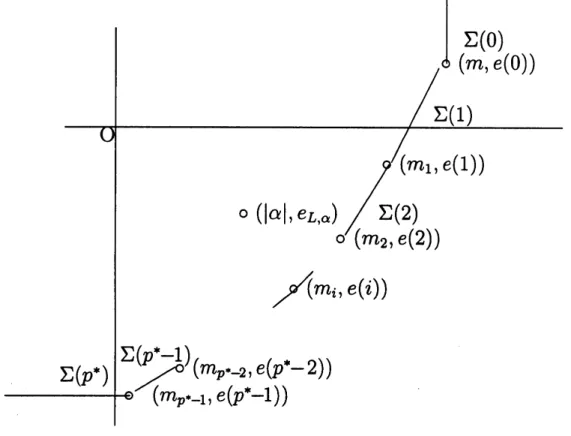
The characteristic polygon of $\Sigma$ is defined by
$\sum:=the$
convex
hullof
$\cup\lrcorner(|\alpha|, e_{L,\alpha})\alpha$.
The boundary of $\Sigma$ consists of avertical half line $\Sigma(0)$ and ahorizontal
half line $\Sigma(p^{*})$ and $p^{*}-1$ segments $\Sigma(i)(1\leq i\leq p^{*}-1)$ with slope $\gamma_{i}$,
$0=\gamma_{p^{\mathrm{r}}}<\gamma_{p^{*}-1}<\cdots<\gamma_{1}<\gamma_{0}=+\infty$
.
Let $\{(m_{i}, e(i))\in \mathbb{R}^{2} ; 0\leq i\leq p^{*}-1\}$ be vertices of $\Sigma$, where
$0\leq m_{p^{*}-1}<$
$\ldots<m_{i}<m:-1<\cdots<m_{0}=m$
. So
the endpoints of $\Sigma(i)(1\leq i\leq p^{*}-1)$are
$(m_{i-1}, e(i-1))$ and $(m_{i}, e(i))$.
We call the slope $\gamma_{i}$ of $\Sigma(i)$ the i-thcharacteristic index of $L(z, \partial)$ with respect to $K=\{z_{0}=0\}$
.
$\rfloor(m,e(0))\Sigma(0)$ $\Sigma(p^{*})$ $\{$ $\Sigma$ $1$ $(m,e(0))\Sigma(0)$ $|(|1)$ $\mathrm{o}$ $(|\alpha|, e_{L,\alpha})\nearrow_{\Sigma(2)}^{(m}1$ ,‘ $\circ$ $(m_{2}, e(2))$ $\nearrow(/m_{i}, e(i))$ $\Sigma(p^{*}-1)\nearrow_{/_{m}}$ . $(m_{p^{*}-2},e(p^{*}-2))-\Delta/-^{*}-\rceil\backslash \backslash$ $’\supset(1))$
$\backslash \prime\prime bp^{\mathrm{s}}-1,$$\circ\backslash P-[perp]//$
Figure 1:
Characteristic
polygonLet $\ovalbox{\tt\small REJECT}\ovalbox{\tt\small REJECT}(\mathrm{i})$ be asubset of multi-indices and
$l_{\ovalbox{\tt\small REJECT}\ovalbox{\tt\small REJECT}}$ E N(0 $\ovalbox{\tt\small REJECT}$i $\ovalbox{\tt\small REJECT}$p’–l) defined by
(1.6) $\{\begin{array}{l}\Delta(i)..=\{\alpha\in \mathrm{N}^{d+1}\cdot.|\alpha|=m_{i},e_{L,\alpha}=e(i)\}l_{i}\cdot.=\max\{|\alpha’|..\alpha\in\Delta(i)\}\end{array}$
Define asubset $\triangle_{0}(i)$ of $\triangle(i)$ and apolynomial $\chi_{L,i}(z’, \xi’)$ in $\xi’$ $(0\leq i\leq$
$p^{*}-1)$ by
(1.7) $\{\begin{array}{l}\triangle_{0}(i)=\{\alpha\in\triangle(i)\cdot,|\alpha’|=l_{i}\}\chi_{L,i}(z’,\xi,)=\sum_{\alpha\in\Delta_{0}(i)}b_{\alpha}(0,z’)\xi^{\alpha’}\end{array}$
$\chi_{L,i}(Z_{)}’\xi’)$ is homogeneous in
4’
with degree $l_{i}$.\S 2
Existence of singular solutions Let us return to the equation(Eq) $L(z, \partial)u(z)=f(z)\in \mathcal{O}(U(\theta))$.
The existence of singular solutions
are
studied by [2], [4], [10] and other papers referred in these papers. More generallywe
haveTheorem 2.1. Suppose that $\chi_{L,0}(0, \xi’)\not\equiv 0$. Then there is
a
solution $u(z)\in$$\mathcal{O}(V$(?))
of
(Eq)for
some
V $\subset U$.
In this paper we consider the
case
$f(z)$ has tempered singularitieson
$K$.We have asolution $u(z)$ by Theorem 2.1, but $u(z)$ has not always tempered
singularities. We
can
generally show $|u(z)|\leq A\exp(c|z_{0}|^{-\gamma_{1}})$ for $z\in V(\theta’)$$(0<\theta’<\theta)$. So
our
interest is to find asolution $u(z)\in \mathcal{O}_{temp,c’}(V(\theta^{l}))$ ofthe equation
$L(z, \partial)u(z)=f(z)\in \mathcal{O}_{temp,c}(U(\theta)))$
for some polydisc $V\subset U$ and constants $c’$ and $0<\theta’<\theta$.
Let us give conditions $(C_{i})(0\leq i\leq p^{*}-1)$
.
For fixed $i$, $0\leq i\leq p^{*}-2$$(C_{i})$ $j_{\alpha}=0$
for
$\alpha\in\triangle \mathrm{o}(i)$ and $\chi_{L,i}(0, \xi’)\not\equiv 0$.
For $i=p^{*}-1$
$(C_{p^{*}-1})$ $|\alpha’|\leq l_{p^{*}-1}$
for
$ce\in\{\alpha\in \mathrm{N}^{d+1},\cdot e_{L,\alpha}=e(p^{*}-1)\}$ and$\chi_{L,p^{*}-1}(0, \xi’)\not\equiv$ $0$.Our
main existence theorem isTheorem 2.2. Suppose $p^{*}\geq 2$ and $(C_{i})$ hold
for
all $0\leq i\leq p^{*}-1$. Let$f(z)\in \mathcal{O}_{temp,c}(U(\theta))$ and$\theta’$ be
a
constant with $0< \theta’<\min\{\theta, \pi/2\gamma_{1}\}$. Thenthere is
a
solution $u(z)\in \mathcal{O}_{temp,c’}(V(\theta’))$of
(Eq)for
some
polydisc $V$ and $a$constant $c’$
.
We note that the opening angle
0’
of sectorial region is restricted by $\gamma_{1}$.We need two theorems in order to show Theorem
2.2.
One
isTheorem 2.3. Suppose $p^{*}\geq 2$ and $L(z, \partial)$
satisfies
$(C_{p-1}*)$. Let $f(z)\in$$\mathcal{O}_{temp,c}(U(\theta))$ and 0’ be
a
constant with $0< \theta’<\min\{\theta, \pi/2\gamma_{p-1}*\}$.
Thenthere is
a
$v(z)\in \mathcal{O}_{temp,c},(V(\theta’))$for
some
polydisc $V$ anda
constant $c’$ suchthat (Rf)(z) $:=(L(z, \partial)v(z)-f(z))\sim \mathrm{O}$ in $A_{\{\gamma_{\mathrm{p}^{*}-1}\}(V(\theta’))}$
.
The other is
Theorem 2.4. Suppose$p^{*}\geq 2$ and$L(z, \partial)$
satisfies
$(C_{i})$for
$i=0,1$,$\cdots$p’-2and let $f(z)\in A_{\{\gamma_{p^{*}-1}\}}(U(\theta))$
.
Thenfor
any $0< \theta’<\min\{\theta, \pi/2\gamma_{1}\}$ thereis $u(z)\in A_{\{\gamma_{\mathrm{p}^{*}-1}\}}(V(\theta’))$ satisfying $L(z, \partial)u(z)=f(z)$ in $V(\theta’)$
for
some
polydisc $V$.
Theorem 2.4 is given in [8] and [9], where
we
considered the existence of solutions with asymptotic expansion under the condition that $f(z)$ in (Eq)has
an
asymptotic expansion. We exclude$p^{*}=1$ in the preceding theorems,however,
we
have from results in [4]Theorem 2.5. Suppose $p^{*}=1$ and $(C_{0})$ holds. Let $f(z)\in \mathcal{O}_{temp,c}(U(\theta))$.
Then there is
a
solution $u(z)\in \mathcal{O}_{temp,c’}(V(\theta))$of
(Eq)for
some
polydisc $V$and
a constant
$c’$Theoperators of Fuchsiantype (see [1]) satisfy the conditions of Theorem
2.5.
Example. Let
(2.1) $L(z, \partial)=\partial_{1}^{5}+A_{1}(z)\partial_{1}^{3}\partial_{0}+A_{2}(z)\partial_{0}^{2}$, $z=(z_{0}, z_{1})\in \mathbb{C}^{2}$,
where $A_{i}(z)=z_{0}^{j_{i}}B_{i}(z)$, $j_{i}\in \mathrm{N}$, $B_{i}(0)\neq 0$ for $i=1,2$
.
According to thevalues of $j_{1}$ and $j_{2}$, several
cases occur.
However the conditions in Theorem2.2 or the conditions inTheorem
2.5
hold for anycase. So
$L(z, \partial)u(z)=f(z)$has always asolution $u(z)$ with tempered singularities in asectorial region
for $f(z)$ with tempered singularities.
\S 3
Outline of the proof of Theroem 2.3.In order to find $v(z)$ in Theorem
2.3
we construct aparametrix of$L(z, \partial_{z})$.
The method of construction ofthe parametrix is amodification of that in [6]. We may assume $e(p^{*}-1)=0$ and $\theta_{0}$ be aconstant with $0<\theta_{0}<\pi/2\gamma_{p^{*}-1}$
.
$v(z)=(Gf)(z)$ is constructed of the form
(3.1) (Gf)(z) $:= \int_{S}G(z, w)f(w)dw$, $w=(w_{0}, w_{1}, \ldots, w_{d})=(w_{0}, w’)$,
where $S$ is achain in $V(\theta_{0})$. The kernel $G(z, w)$ has the form
(3.2) $G(z, w)= \frac{1}{2\pi i}\int_{\lambda_{0}}^{\infty}z_{0}^{\lambda}w_{0}^{-\lambda-1}K(z, w’, \lambda)d\lambda$.
We can find $K(z, w’, \lambda)$ with the following:
1. $K(z, w’, \lambda)$ is holomorphic $\{z_{0};0<|z_{0}|<r_{0}, |\arg z_{0}|<\theta_{0}\}\cross\{(z’, w’);|z_{j}|$
$r_{1}<r_{2}<|w_{j}|<r_{3},1\leq j\leq d\}$ and holomorphic in Ain
some
infiniteregion.
2. $K(z, w’, \lambda)$ has
an
asymptotic expansion$K(z, w’, \lambda)\sim\hat{K}(z, w’, \lambda)=\sum_{n=0}^{\infty}k_{n}(z, w’, \lambda)z_{0}^{n}$,
where $\hat{K}(z, w’, \lambda)$ is aformal power series of
$z_{0}$
.
3. $\hat{K}(z, w’, \lambda)$ satisfies formally
$L(z, \partial)(z_{0}^{\lambda}\hat{K}(z, w’, \lambda))=\frac{z_{0}^{\lambda}}{(2\pi i)^{d}}\prod_{j=1}^{d}\frac{1}{(w_{j}-z_{j})}$
.
As for $G(z, w)$ we have
(3.3) $L(z, \partial)G(z, w)=\delta(z, w)+R(z, w)$,
where
(3.4) $\{\begin{array}{l}\delta(z,w)=\frac{\mathrm{l}}{(2\pi i)^{d+1}}(\int_{\lambda_{0}}^{\infty}z_{0}^{\lambda}w_{0}^{-\lambda-1}d\lambda)\prod_{j=1}^{d}\frac{\mathrm{l}}{(w_{j}-z_{j})}|R(z,w)|\leq C\mathrm{e}\mathrm{x}\mathrm{p}(-c|z_{0}|^{-\gamma_{p^{*}-1}})\end{array}$
It follows from (3.3) and (3.4) that (Rf)(z) $=L(z, \partial)v(z)-f(z)$ satisfies the
conclusions of Theorem
2.3.
References
[1] Baouendi,
M.S.
and Goulaouic, C, Cauchyproblems withcharacteris-tic initial hypersurface,
Comm.
Pure Appl. Math., 26 (1973),455-475.
[2] Hamada, Y., Leray, J. et Wagschal, C., Syst\‘eme d’equation
aux
de-riv\’ees partielles \‘a
caracteristic
multiples; probleme de Cauchy ramifie;hyperbolicite partielle, J. Math. Pures Appl, 55 (1976),
297-352.
[3] Ouchi, S., Characteristic Cauchy problems and solutions of formal power series ,
Ann.
L ’institut Fourier,33
(1983),131-176.
[4] $\overline{\mathrm{O}}$
uchi, S., Existence of singular solutions and null solutions for linear partial differential operators, J. Fac.
Sci. Univ.
Tokyo, 32 (1985),457-498.
[5] $\overline{\mathrm{O}}$
uchi, S., Singular solutions with asymptotic expansion of linear par-tial differential equations in the complex domain, Publ. RIMS Kyoto
Univ., 34 (1998),
291-311.
[6] Ouchi, S., Growth property and slowly increasing behavior of singular solutions of linear partial differential equations in the complex domain,
J. Math.
Soc.
Japan. 52 (2000),767-792
[7] $\overline{\mathrm{O}}$
uchi, S., Asymptotic expansion of singular solutions and the charac-teristic polygon of linear partial differential equations in the complex domain, Publ.
RIMS
Kyoto Univ., 36 (2000),457-482
[8] Ouchi, S., Existence of weakly singular solutions to linear partial dif-ferential equations with holomorphic coefficients, Kokyiroku
of
RIMS Kyoto Univ., Complex Analysis and Microloca Analysis, 1158 (2000) 66-72.[9] Ouchi, S. Existence of solutions with asymptotic expansion of linear partial differential equations in the complex domain, (preprint)
[10] Persson, J., Singular holomorphic solutions of linear partial differential
equations with holomorphic coefficients and nonanalytic solutions with
analytic coefficients, Asterisque 89-90, analytic solutions