Execution
and
verification of
2nd order
interval
temporal
logic
Shinji
Kono
$\mathrm{e}$
-mail:[email protected]
Sony
Computer
Science
Laboratory
Inc.
3-14-13,
Higashi-gotanda,
Shinagawa-ku, Tokyo 141,
Japan
November 16, 1995
Process is the value of second order interval propositional temporal logic ($2\mathrm{I}\mathrm{T}\mathrm{L}$here
after). Not only temporal relation-ship
among
events, but alsoprocesses
are
directlydefined interms oftemporal logic. Since it
can
expressa
negation ofa
process, itcovers
different
range
from process algebra. Process includes finite state machine, fairness,a
scheduling mechanism, inverse specification, and various temporal logicformula. In this
paper
we
show $2\mathrm{I}\mathrm{T}\mathrm{L}$as a
subset of interval temporal logic. $2\mathrm{I}\mathrm{T}\mathrm{L}$ is undecidable, butthrough investigations
on
verification procedures,we
find decidable subset of ITL. Its automatic verificationis also presented.1
Interval Temporal
Logic
as
Second
Order
Temporal
Logic
Interval temporal logic (Ref. [12] ITL here after) is investigated by various researchers, but because of its undecidability (Ref. [12]), researches
are
restrictedon
Local Interval Temporal Logic (Local ITL here after). In Local ITL, variables represents events dependingon
a
clock period like otherTemporal Logics. On the other hand, variables of full set ITL represent series of events in intervals
oftime. We
can
think the variablesrepresent processes since it includes possiblyan
infinite streamof events. This is
a
new
view point ofITL, that isa
logicon processes.
In
case
of classical logic, second order propositional logic is trivial, because the value of thesecond order variable is either $T$
or
$F$. Thereare
no
differences between second order logic andnormal logic. But in
case
oftemporal logic, value of second order variable is changed from time to time. It looks like first order logic, but the value of the variable is nota
return value ofa
function,which is determined by arbitrary nested function calls. First order logicis undecidable because first
order value
can
be arbitral nested term. But the value of the second order propositional variable is restricted in the meaning of the temporal logic, whichcan
bea
finitely represented state machine.Like
a
first order logicon
enumerable term,a
second order temporal logiccan
be decidable.2Expressiveness of
Various
Temporal
Logic
After the discovery of
a
limitation of Linear Time Temporal Logic (LTTL here after. Ref. [13]),complex hierarchy of temporal logic expressiveness is researched. A big surprise is that LTTL is
less expressive than $\omega$-Regular expressions
on
logicformula.
Wecan
prove similar limiton
LocalITL (Appendix). But
we
find sucha
limitation is not serious.The limit is easily solved by adding quantifier
or
adding closure operationon
logics. QuantifiedPropositional TemporalLogichas $\omega$-Regular model(Ref. [13]). Actually it isquite
easy
to constructa
representation of arbitrary finite state machine (here after FSM) using quantified variables. Wecan
use
quantified variables for 1-hot encoding ofa
FSM (Ref. [9]). A closure $\mathrm{o}\mathrm{p}\mathrm{e}\mathrm{r}\mathrm{a}\mathrm{t}\mathrm{o}\mathrm{r}*\mathrm{i}\mathrm{s}$ alsosufficient to construct
a
FSM by using well-known algorithmon
Regular Expression (Ref. [7]). Aclosure $\mathrm{o}\mathrm{p}\mathrm{e}\mathrm{r}\mathrm{a}\mathrm{t}\mathrm{o}\Gamma*P$
means
finiteor
infinite repetition ofa
temporal logic formula$\cdot$$P$
.
This is easilydemonstrated by
an
example called evenp.evenp$(p)$
means
$P$ is trueon every even
clock period. Weuse
small letters $p,$$q,$$r$ for eventvariables. In Regular Expression, $(\mathrm{P}\mathrm{T})*$. It is proved evenp$(p)$ is not expressed in LTTL
nor
Local ITL (Appendix). But it is easily expressed by QPTL; evenp$(p)\equiv\exists q,$$q$A $\square$ (
$(qarrow \mathrm{O}\neg q)$ A $(\neg qarrow \mathrm{O}q)$ A $qarrow p$).
It is also easily expressed by closure $\mathrm{o}\mathrm{p}\mathrm{e}\mathrm{r}\mathrm{a}\mathrm{t}\mathrm{o}\mathrm{r}*\mathrm{l}\mathrm{i}\mathrm{k}\mathrm{e}$this;
evenp$(p)\equiv*$((($p$ A length(l))&length(l)) Vempty).
&is a
chop operator which isone
clock overlapped concatenation of two intervals. Intervalsare
finite
or
infinite clock period.P&Q
$\mathrm{P}$
$\mathrm{Q}$
empty
means
the length of the interval is $0$.$\mathrm{e}\mathrm{m}\mathrm{H}^{\mathrm{P}^{\mathrm{t}\mathrm{y}}}$
But
on
theseextenslons, verlticationson
thelogicrequlres exponential computationalcomplexityon
the length offormula. Polynomial orderor
lower complexity is preferable of course, but recentresearches
on
BDD based verification (Ref. [2]) showwe can
still verify useful exampleseven
in
case
of exponential computational complexity, ifwe
takes enough effort to keep statespace
representation small.
From the view point of automatic verification, closure operator is superior. Because quantifier
generates exponential computation
on
number ofvariables, which corresponds number of edge ofstates. Even classicalpropositional quantified logic requires $\mathrm{P}$-spacecomplexity. In
case
ofclosure,it generates exponential computation
on
depth oftemporal logic operator, which increases number3Expressiveness
and
Decidability
of Interval
Temporal
Logic
ITL and LTTL both feature discrete time, but ITL has the end of the time. Unlike LTTL, ITL
has
a
modelon
top of Regular expression noton
top of$\omega$-Regular expression. In another words,ITL has compact discrete time. It has pros and
cons.
ITL cannotexpress
fairness like LTTL. Forexample, $\square \mathrm{O}p$ does not
means
$p$ is true infinitely many times but itmeans
$p$ is trueon
the end ofthe
interval.. In.
$\mathrm{f}\mathrm{a}\mathrm{c}\mathrm{t}\wedge\cdot’$.
$\square \dot{\mathrm{O}}Prightarrow fin(P)$
is
a
theorem in Local ITL. Herewe use
capital letter $P,$ $Q,$$R$ (other than $F$ and $T$) forsecond ordervariable
or
interval variable. Herefin
$(P)$means
$P$ is trueon
the end of the interval and theseare
defined in Local ITL
using&as
follows; ’fin
$(P)$ $\equiv$ (T&(empty A $P$))$\square P$ $\equiv$ $\urcorner(T\ \urcorner P)$
$\mathrm{O}P$ $\equiv$ T&P
The theoremis not trivial but it is easy to prove and it
means
the lack offairness in Local ITL. But this makesa
verification procedure easier, becausewe
don’t have to check state loop after tableau expansionas
in M\"uler automaton. Ifwe
haveno
falseon
the leaves of the FSM, the formula is valid.Now
we
know Local ITL with closure has Regular Expression expressiveness. We also havea
FSM generation algorithm for Local ITL with closure (Ref. [9]). This shows
Theorem 1 Local $ITL$
wit.h.
closure has exact Regular Expression expressiveness.In
case
of full ITL, thingsgoes
badly. It is quiteeasy
to show ITLcan
express Context FreeGrammar and Context Dependent Grammar. An interval variable contains
a
series ofstates whichis
a
mapping of event variables. Wecan
use an
event variable mappingas
a
terminal symbol andan
interval variableas a
non-terminal symbol ingrammar
rule. For example,means a
context dependentgrammar
rule: $PQarrow RS$. Here a $P$means
a
formula $P$ is true in allsub-intervals ofthe interval. It is defined
as
follows;$\mathrm{a}(P)\equiv$
\neg (T&\neg P&T).
This is rarely used in Local ITL specification, but important in $2\mathrm{I}\mathrm{T}\mathrm{L}$. Since satisfiability problem
on
Context Dependent Grammar is undecidable, full ITL is also undecidable. This is another proof$\mathrm{o}\mathrm{f}[12]$.
Theorem 2 Full $ITL$ is undecidable.
But closer look of this problem gives
us
another insights. S. Kimura shows the undecidabilityof ITL
comes
from interval variable itself (Ref. [8], in Japanese). An interval variablecan
beinstantiated with
an
arbitrary finiteor
infinite sequence, which includesa
sequence generated bya
context dependentgrammar.
This is thesource
ofundecidability. $\mathrm{W}\mathrm{e}’ 11$ investigate this problemLocal variables
or
eventsare
restricted form of interval variable, which has thesame
valueon
empty interval of the beginning of the interval. This restriction makes ITL decidable, it is Local
ITL. Locality of$P$ is characterized by next proposition;
beg(P)\leftarrow \rightarrow P&T
where $beg(P)=$ (($\mathrm{e}\mathrm{m}_{\mathrm{P}^{\mathrm{t}\mathrm{y}}}$,P)&T). But
we
can
think another restrictionon
it.If
we
restrictinterval variablescan
be instantiated by RegularExpression generated sequence,we
have Regular ITL instead ofLocal ITL. Unfortunately Regular ITL is still undecidable. Remember
we
can
express Context Free Grammar (here after CFG) in ITL. Wecan
constructan
ITL formulawhich checks
a
CFG is Regularor
not. Fora
given CFG, construct ITL formula, for example,$P\wedge \mathrm{a}c_{ramm}er(P)$. If this is satisfiable in Regular ITL, the CFG is Regular. It is known that
whether
an
context freegrammar
is Regularor
not isundecidable (Ref.[7]). So there isno
proced.
ure
to check whether Regular model for ITL exists
or
not.Theorem 3 Regular $ITL$ is undecidable.
In this paper, $\mathrm{w}\mathrm{e}’ 11$ show
some
other restrictions which makes ITL decidable. The most simpleone
is length restriction. These restrictions defined in terms of tableau expansion. Insome
sense, itcan
be called operational restriction of interval variables. These restrictionsare
model restrictions.In
case
of verificationon
first order logic, theyuse
incomplete decision procedure. It will notterminate
or
$\mathrm{t}\mathrm{e}\mathrm{r}\mathrm{m}^{l}\mathrm{i}\mathrm{n}\mathrm{a}\mathrm{t}\mathrm{e}$ but gives incomplete results. Our logic issound and complete in terms of
automatic verification procedure. But completeness is defined
rather.ad-hoc
way which is definedin operation in the tableau method.
This is something like
a
restrictionon
programming methodology. Wecan
program
anythingon
Turing Machine, but not all the
program
is goodone.
Ifwe use a
restricted programming method,we
can
extend reliability of theprogram.
The restrictions of interval variablesare
thoughtas
such restrictions. Since it isa
restrictionon
second ordervariables, the expressiveness ofthe logic is still equivalent to Regular Expressions. This corresponds the fact thata
programming methodologydoes not restrict the power of programming.
4
Specification Examples
Since
a
second order variable representsa
mechanism to terminatean
interval, it is possible tothink it
a
fairness.$\mathrm{O}_{S}P\equiv S\ P$
$\mathrm{O}_{S}P$
means
$P$ is eventually trueon
fairness $S$, eventuality-S. Unlikefairness in LTTL,many
kindsof different fairness
can
be defined in $2\mathrm{I}\mathrm{T}\mathrm{L}$. In fact the value of second order variable is differenton
each clock period,so
it defines different fairnesson
each clock period. To define clock period independent fairness,a
time constant second order variable isnecessary.
We discussit later section.We
can
think this isan
abstraction of watch dog timeror
counter. The mechanism of the timercan
be defined in terms ofITL;$\mathrm{a}(S=leSS(2))$
This
means
$S$assures
an
interval which is less than 2 clocks. less$(n)$ operatorcan
be definedusing $\mathrm{n}$-times nested weak next operator; less(2)
$\equiv \mathrm{O}\mathrm{O}\mathrm{e}\mathrm{m}_{\mathrm{P}^{\mathrm{t}\mathrm{y}}}.\cdot$ This is
a
simple watch dog timerFor another example, using second order variables,
we can
directly prove axiom schema. Ourverifier is based
on
model construction,so we
can
verifysome
axioms. For example;$\mathrm{a}((\mathrm{a}(P)arrow P))arrow(((\Phi(\mathrm{a}(P)))arrow \mathrm{a}(P)))))$.
This is called $\mathrm{Z}$ discreteness (Ref. [5]). Thisis valid in LTTL, but not valid in ITL.
Of course,
we can use
second ordervariablestodefinea
processby recursion like process algebra.$\mathrm{a}(Parrow$ ($(a$ A $\mathrm{O}P)\vee(b$A $\urcorner a\wedge$ empty))
But
we
have to consider the $\mathrm{r}\mathrm{e}\dot{\mathrm{s}}$trictions of second order variables in these process representations
in
case
of verification.If
we
try to writea
practical specification in temporallogic, it isusuallynon
valid formulaeven
ifwe
quantified all variables. This is because thereare
hidden assumptionson
input variables. Theseassumptions
can
be abstracted using second order variables. Using the result of tableau expansion,we can
analyze the nature ofthe assumption. Insome sense
this is kind ofreverse
specification.5
Undecidability from
a View Point
of Tableau
Expan-sion
In this section,
we
discusson a
tableau method of$2\mathrm{I}\mathrm{T}\mathrm{L}$. In Tableau methodon
discrete temporallogic, temporal logic terms
are
decomposed into two parts. One part is depending onlyon
current clock period and the other part only dependson
nextor
later interval.Here
we
showan
example of decomposition ofa
chop operator. Assume $P,$$Q$ is alreadyde-composed into empty parts $PE,$ $QE$, current clock dependent parts $PN_{i},$$QN_{i}$ and next interval
dependent parts $PX_{i},$ $QX_{i}$ in disjunctive normal form.
$P$ $=$ $PE$ Aempty$\vee\bigvee_{i=0}^{k}$($PNi$ A $@PX_{i}$)
$Q$ $=$ $QE$ Aempty $\bigvee_{i=0}^{k}$($QNi$ A $@QX_{i}$)
Where @ is next operator with $\neg \mathrm{e}\mathrm{m}\mathrm{p}\mathrm{t}\mathrm{y}$ and it is called strong next. Then
P&Q
is decomposed inthis way.
P&Q
$=$ $(PE\wedge Q)\vee$$\mathrm{V}_{i=0}^{k}$($PNi$ A $@(PX_{i}\ Q)$)
In practical tableau expansion, BDD standard form and deterministic expansion is necessary, but
these
are
discussed in (Ref. [4, 3, 9]).In
case
of second order variableor
interval variable, the value of the variable is dependon
theboth begin-time and end-time of the interval. Since
we
are
workingon
propositional case, it lookslike
we can
replace the value of the variable by $T$or
$F$. Yes, the value is $T$or
$F$, but the valuedepends
on
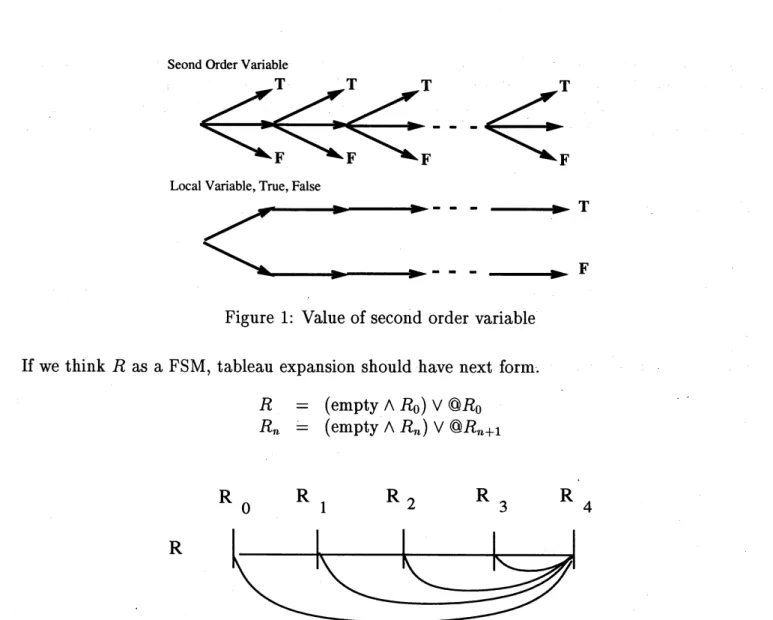
the interval (Fig. 1). Sowe
cannot replace the second order variable with $T$or
$F$as
we
did in classical logic.This situation is demonstrated by
an
example:$\mathrm{a}(R=length(2))$
If
we
replace $R$ by $T$or
$F$, this example becomes unsatisfiable. But this is satisfiable ifwe
$\mathrm{S}\mathrm{e}\circ^{\mathrm{n}A\mathrm{n}\mathrm{P}}A\mathrm{a}\mathrm{P}1\gamma_{\mathrm{Q}\dot{\mathrm{r}}}\mathrm{o}\mathrm{h}\iota\wedge$
LocalVariable, True,False
$-arrow \mathrm{T}$
$-rightarrow \mathrm{F}$
Figure 1: Value of second order variable If
we
think $R$as a
FSM, tableau expansion should have next form.$R$ $=$ $(\mathrm{e}\mathrm{m}\mathrm{p}\mathrm{t}\mathrm{y}\wedge R_{0})@R_{0}$
$R_{n}$ $=$ $(\mathrm{e}\mathrm{m}\mathrm{p}\mathrm{t}\mathrm{y}\wedge R_{n})\vee@R_{n+1}$
$\mathrm{R}0$ $\mathrm{R}1$ $\mathrm{R}2$ $\mathrm{R}3$ $\mathrm{R}4$
$\mathrm{R}$
$R_{n}$ is n-th state of R. $R_{n}$ is also
a
second order variables. $R_{n}$ is independent each other if $n$ isdifferent. This is because $R_{n}$ has different start point and $R$ has different truth value in different
interval. Using existential quantifier
on
second order variable,we can
write;$R$ $=$ $(\mathrm{e}\mathrm{m}\mathrm{p}\mathrm{t}\mathrm{y}\wedge R)\vee@$ $\exists SS$.
During the tableau expansions, $n$ increases infinitely. Actually $n$ represents the interval length of
$R$. In
case
ofa
formula like $\square R$, infinitely many $R_{n}$are
generated. In this way, undecidability offull ITL
or
$2\mathrm{I}\mathrm{T}\mathrm{L}$ happens in the tableau expansion.Projection operator and quantifier
on
second order variables is not considered in this paper.Since projection operator requires
a
nest time structure, the time marking of$R$ have to bea
nestedmarkings. It looks like possible to implement it, but
we
have not yet tested yet.5.1
Length
Restriction
and
Count Restriction
The simplest stopper of the undecidability is length limit.
$R$ $=$ $\mathrm{e}\mathrm{m}\mathrm{p}\mathrm{t}\mathrm{y}\wedge R_{0}\wedge@R_{0}$
$R_{n}$ $=$ $\mathrm{e}\mathrm{m}\mathrm{p}\mathrm{t}\mathrm{y}\wedge R_{n}\wedge@R_{n+1}$ if $n<k$
$R_{n}$ $=$ $beg(Rn)\mathrm{i}\mathrm{f}n\geq k$
$R_{n}$ is generated
on
every
clock. But ifwe
have onlyone
$R_{n}$,we
don’t have touse
specific $n$.Any other number is also $\mathrm{o}\mathrm{k}$. We
can
compact the numbersequence
by sort and renaming. Butthe order of the number have to be preserved. After renaming, $n$ represents number of $R_{n}$ in
a
formula. We
can
call this restriction count limit. The count limit is usefulon a
formula like this:R&T.
In this example, $R_{n}$
increases
$n$ by 1. This generatesa
series like this.R&T,
$R_{1}\ \tau,$$R_{2^{\ T,\ldots R_{n}\ T}}$If
we
think $R$ and $R_{1}$are
equivalent, this example is expanded to itself. Roughly speaking,in countlimit method,
we
haveno
limiton one
time R-eventuality.5.2
More
Complex
Restrictions
But above restrictions does not work well
on
a
formula like T&R that is OR. In this example, expanded formula hasa
form after $n$ clocks;$R_{0}R_{1}$ V... V $R_{n}\vee T\ R.$
After $R_{n}$ reaches the limit, it becomes $T$
or
$F$. In this case, renaming of $R_{n}$ becomes identityand useless. Looking at the formula carefully,
we
find every $R_{n}$ exists onlyonce.
The meaning ofthis formula is not depends
o
$\mathrm{n}$- the particular
name
of$R_{n}$ and $R_{n}$ is independent each other. It is
possible to
remove
$R_{n}$ from the formula. This is called singleton removal.Singleton removal is possible and it extends possible meanings of second order variables. But
currently
we
have rather complex translation of the formula which generates alot of states. Besideseven
after the singleton removal, $R$ still possible to generate increasing complex logical expressionson a
formula with multipleoccurrence
of$R_{n}$. $2\mathrm{I}\mathrm{T}\mathrm{L}$is ofcourse
undecidable with singleton removal.Singleton removal is not practical because it $\mathrm{g}\mathrm{e}\mathrm{n}\sim$erates big state space. In this reason,
we
don’tinvestigate singleton removal further
h\‘ere.
Here
we
show several restriction methodson
decidable $2\mathrm{I}\mathrm{T}\mathrm{L}$;length limit Effects of$R$ has time $\mathrm{l}\mathrm{i}\mathrm{n}\dot{\mathrm{u}}\mathrm{t}$,
count limit Number of $R$ is limited,
singleton removal Number of interrelated $R$ is limited.
These
are
defined inan
operational way in the tableau expansion.To make $2\mathrm{I}\mathrm{T}\mathrm{L}$ decidable, finiteness of $2\mathrm{I}\mathrm{T}\mathrm{L}$ term is necessary. What
we
need is define finiteclassification of subset of $R_{n}$. Here
we
intr.o
$.$$\mathrm{d}$
uce
some
of simple classifications, but therecan
bemore
useful classifications. ..Computational complexity of $2\mathrm{I}\mathrm{T}\mathrm{L}$ verification is determined by the restriction. Local ITL
verification requires exponential complexity of the length ofthe formula, that mostly
comes
fromdetermination of expanded states. In the worst case, all combination of the sub terms have to be
computed. $R_{n}$ terms increase the number the sub term,
as
result in effect of $2^{n}$. Inour
experience,6Execution
of 2nd
Order Interval
Temporal
Logic
In the tableau expansion based verification (Ref.[9]),
a
deterministic FSM is generated. This isa
method of logic synthesis
or program
generation.$-$
In
case
of$\mathrm{L}_{\mathrm{o}\mathrm{C}}\mathrm{a}1$.ITL, all variables
are
events. Anexecution of the FSM is something like flipping traffic rights.
An execution of $2\mathrm{I}\mathrm{T}\mathrm{L}$ is not
so
simple. Besides conditionson
eventsvariable, it also contains
conditions
on
second order variables. The conditions $\mathrm{d}\mathrm{e}\mathrm{p}\mathrm{e}\mathrm{n}\mathrm{d}_{\mathrm{o}\mathrm{n} ,-}$the restriction methods.Length limit is the most simple
one.
It contains two kind of eventson
$R$.termination $R$ is terminated in $T$
or
$F$ in less than length $n$ interval.time out the limit of $R$ expired and results $T$
or
$F$.These
are
markson
the FSM and define FSMs for $R$on
each clock period. It also definea
trace of$R$ in the execution.
In
case
of count limit,we
have to consider renaming of $R_{n}$. Othersituation
is similar to thelength limit
case.
Therenaming is assignedto each transitionin thegeneratedFSM. Using renaminginformation,
we can
finda
FSM definition of$R$on
each clock period.Since
we
omit the detail ofsingleton removal,we
cannot discuss execution in singleton removal,here.
7
Time
Constant
Second
Order Variable
In $2\mathrm{I}\mathrm{T}\mathrm{L}$,
a
FSM assigned toa
second order variable is variedon
the interval. If
we
assignone
fixedFSM
on
the variable,we
have time constant second order variable.The.effect
of the assignmentcan
be represented usin$\mathrm{g}$- ITL formula, for example,
$\mathrm{a}(R=leSS(2))$.
If there is
a
model for time constant second order variable, there must bea
model fornon
time constant variable. For particular execution
path:
we can
easily check ifsome
of $R$ tracesare
conflicted. But currently
we
haveno
method to find out constant FSM for $R$.8
Execution and Verification Examples
In this section,
we
see
actual output ofour
verifier, which is written in Prolog.8.1
Example: Length
Operator
and
Second Order Variable
We
can
demonstratethe difference oflengthlimit and countlimit byusingsimple example: $R\wedge(R=$$length(10))$. Here
we assume
limit is 5. length(10) is expressed by nested strong next operator andthis becomes the first state.
In
case
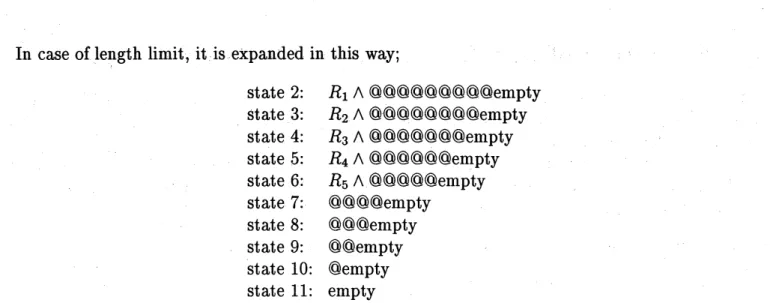
of$\mathrm{l}\mathrm{e}\mathrm{n}$.gth limit, it is expanded in this
way;
state 2: $R_{1}$ A @@@@@@@@@empty state 3: $R_{2}$ A @@@@@@@@empty state 4: $R_{3}$ A @@@@@@@empty state 5: $R_{4}$ A @@@@@@empty state
6:
$R_{5}$ A @@@@@empty state7:
@@@@empty state 8: @@@empty state 9: @@empty state 10: @empty state 11: emptyIn state 5, $R_{6}’ \mathrm{s}$ truth value is fixed. $R_{6}$ is false entire formula is false otherwise @@@@empty
remains. The resulted state diagram is show in (Fig.2). Using this FSM,
we can
find executions.An execution is shown like this.
LengthLimit
Kenamung $A\wedge\cdot\cdot,\mathrm{r}’\prime 1\backslash$
Figure 2: FSM for Length Example
$|?-$ ex$((^{\wedge}\mathrm{r}, (\mathrm{l}\mathrm{e}\mathrm{n}\mathrm{g}\mathrm{t}\mathrm{h}(10)=\wedge \mathrm{r})))$
.
0.46299999999999963 sec. 11 states 16 subterms 23 state transitions counter example: $0:+\mathrm{r}^{\wedge}0$ false $|?-\mathrm{e}\mathrm{x}\mathrm{e}$
.
execution: $0:2$ 1: 3 2: 4 3: 5 4: 6 $5:+_{\mathrm{O}}\mathrm{v}\mathrm{e}\mathrm{r}(\mathrm{r},5^{)}7$ 6: 8 7: 98: 10 9: 11 10: $0$
yes
$\wedge \mathrm{r}$ is the second order variable notation in
our
verifier. The first number is clock value andsecond is the number of state. $+_{\mathrm{O}\mathrm{V}\mathrm{e}\mathrm{r}}(\mathrm{r},5)$
means
$R_{5}$ is reached the limit and fixed to $T$ and thisis
a
transition condition of the FSM.In
case
of count limit,we
have renumbering of $R_{n}$. The FSM and execution is shown below.$+\mathrm{r}^{\wedge}1$
means
$R_{1}$ is$T$ in theempty interval at the clock. This result looksmore
correct thanpreviousone.
state 2: $R_{1}\wedge@@@@@@@@@\mathrm{e}\mathrm{m}\mathrm{P}\mathrm{t}\mathrm{y}$ state 3: $R_{1}\wedge@@@@@@@@\mathrm{e}\mathrm{m}_{\mathrm{P}^{\mathrm{t}}\mathrm{y}}$ state 4: $R_{1}\wedge@@@@@@@\mathrm{e}\mathrm{m}_{\mathrm{P}^{\mathrm{t}}\mathrm{y}}$ state 5: $R_{1}\wedge@@@@@@\mathrm{e}\mathrm{m}\mathrm{P}\mathrm{t}\mathrm{y}$ state 6: $R_{1}\wedge@@@@@\mathrm{e}\mathrm{m}\mathrm{P}\mathrm{t}\mathrm{y}$ state7:
$R_{1}\wedge@@@@\mathrm{e}\mathrm{m}\mathrm{P}\mathrm{t}\mathrm{y}$ state 8: $R_{1}\wedge@@@\mathrm{e}\mathrm{m}\mathrm{P}\mathrm{t}\mathrm{y}$ state 9: $R_{1}\wedge@@\mathrm{e}\mathrm{m}\mathrm{P}\mathrm{t}\mathrm{y}$ state 10: $R_{1}\wedge@\mathrm{e}\mathrm{m}_{\mathrm{P}^{\mathrm{t}\mathrm{y}}}$state 11: $R_{1}\wedge \mathrm{e}\mathrm{m}\mathrm{p}\mathrm{t}\mathrm{y}$
$|$ $?-$ ex((
$\mathrm{r}$, (length(10) $=\wedge \mathrm{r}$))).
0.5179999999999998 sec. 11 states. 12 subterms 23 state transitions
yes
$|?-\mathrm{e}\mathrm{x}\mathrm{e}$.
execution: $0:2$ 1: 3 2: 4 3: 5 4: 6 5: 7 6: 8 7: 9 8: 10 9: 11 $10:+\mathrm{r}1- 0$In above examples, limit has
no
effecton
verification. We have 5 clock limiton
$R$, but it doesnot restrict the length of the interval. The limit restrict the behavior of the variable. The verifier
$R$A $\mathrm{a}(length(4)=R)$ is such example. We
can
write expanded state ina
simplifiedway;
state 2: $R\wedge \mathrm{a}(length(4)=R)\wedge$
($R_{1}$ A
:
(length(3) $=R_{1})\ T$)state
3:
$R$A $\mathrm{a}(length(4)=R)\wedge$$(R_{1}\wedge:(length(3)=R_{1})\ T)\wedge$
$(R_{2}\wedge:(length(2)=R_{2})\ T)$
state 4: $R\wedge \mathrm{a}(length(4)=R)\wedge$
$(R_{1}\wedge \mathrm{i}(length(3)=R_{1})\ T)\wedge$
($R_{2}$ A
:
(length(2) $=R_{2})\ T$)$\wedge$$(R_{3}\wedge:(length(1)=R_{3})\ T)$
state 5: $R\wedge \mathrm{a}(length(4)=R)\wedge$
($R_{1}$ A
:
(length(3) $=R_{1})\ T$)$\wedge$$(R_{2}\wedge \mathrm{i}(length(2)=R_{2})\ T)\wedge$
($R_{3}$ A
:
(length(1) $=R_{2})\ T$)$\wedge$ $(R_{4}\wedge \mathrm{i}(length(\mathrm{O})=R_{4})\ T)$Here $\mathrm{i}R\equiv\neg(\neg R\ T)$. In this example, a is decomposed by $\mathrm{i}$ .
a$Prightarrow\square$
:
$R$.The generated FSM is executed in
length4-
intervalas we
expected.$|$ $?-$ ex(( $\mathrm{r}$, ’ $[\mathrm{a}]$ ’(length(4) $=\wedge \mathrm{r}$))).
2.362 sec. 7 states 18 subterms 15 state transitions yes $|?-\mathrm{e}\mathrm{x}\mathrm{e}$
.
execution: $0:-\mathrm{r}^{\wedge}02$ $1:-\mathrm{r}^{\wedge}$0-rl- 3 $2:-_{\mathrm{r}^{\wedge}0-_{\mathrm{r}^{\wedge}12}}-_{\mathrm{r}}\wedge 4$ $3:-\mathrm{r}^{\wedge}0^{-}\mathrm{r}1--\mathrm{r}2--\mathrm{r}3\wedge 5$ $4:-\mathrm{r}^{\mathrm{s}}0-\mathrm{r}arrow 1-\mathrm{r}^{\wedge}2-_{\mathrm{r}3+}- \mathrm{r}^{\wedge}40$yes
$-\mathrm{r}^{\wedge}\mathrm{n}$
means
$R_{\tau\iota}$ is $F$ at the clock period $\mathrm{a}\mathrm{n}\mathrm{d}+_{\mathrm{r}^{arrow}}\mathrm{n}$means
$R_{n}$ is $T$.Of
course
we can
provea
theorem like this;$\mathrm{a}(R=lesS(\mathit{3}))arrow((R\ R\ R)arrow lesS(\mathit{9}))$.
The length limit is working
on
each $R$ anda
complex term like (R&R&R)can over
$\mathrm{c}\mathrm{o}\mathrm{m}$. $\mathrm{e}$ the limit
with extra computation. This is because only
one
$R$ is active at each clock.$|?-$ ex((’ $[\mathrm{a}]$ ’ ( $\mathrm{r}=$ less(3)) $-\rangle((^{\wedge}\mathrm{r}$ & $\wedge \mathrm{r}$ & $\wedge \mathrm{r})-\rangle$ less(9)))).
27.989999999999995 sec. 100 states 35 subterms 629 state transitions valid yes
The execution of this formula is not interesting because this is
a
theorem. It succeeds in anyinterval. To
see an
interesting one;$|?-$ ex((’ $[\mathrm{a}]$ ’ ( $\mathrm{r}=$ less(3)) , $((^{\wedge}\mathrm{r}$
a
$\wedge \mathrm{r}$a
$\wedge \mathrm{r}))$)).2.519999999999996 sec. 15 states 29 subterms 37 state transitions yes $|?-$ exe(7). $0:+\mathrm{r}^{\wedge}0$ 2 $1:+_{\mathrm{r}^{\wedge}}0+\mathrm{r}^{\wedge}1$ 3 $2:+_{\mathrm{r}^{\wedge}}\mathrm{o}+_{\mathrm{r}}1- \mathrm{r}^{\wedge}+2$ 4 $3:+_{\mathrm{r}^{\wedge}}0+\mathrm{r}^{-}1+\mathrm{r}^{-}2^{-}\mathrm{r}arrow 3$ 5 $4:+\mathrm{r}^{\wedge}\mathrm{o}+_{\mathrm{r}}\wedge 1+\mathrm{r}^{arrow}2-_{\mathrm{r}\mathit{3}4}--\mathrm{r}^{\wedge}$ 6
$5:+\mathrm{r}0-+_{\mathrm{r}^{arrow}1}+\mathrm{r}arrow 2^{-}\mathrm{r}^{\sim}\mathit{3}-\mathrm{r}^{-}4^{-\mathrm{r}^{\wedge}}5$-over(r,5) 8 $6:+\mathrm{r}0-- 1+\mathrm{r}+\mathrm{r}2^{-\mathrm{r}}-- 3-\mathrm{r}^{\wedge}4^{-\mathrm{r}^{\wedge}}5$ $0$
yes
Clearly $\wedge \mathrm{r}$ is $T$ in each interval which length is less than 3 and $F$ otherwise.
As
an
example of limitation, $R$A $\mathrm{a}(length(10)=R)$ is unsatisfiable ifwe
have length limit 5or
count limit 5. Since this example contains T&R type expression, thereare no
bigdifference
between length limit and count limit.
$|?-$ ex(( $\mathrm{r}$, ’ $[\mathrm{a}]$ ’ (length(10) $=\sim_{\mathrm{r})})$).
3.2110000000000003 sec. 7 states 24 subterms 14 state transitions yes $|?-\mathrm{e}\mathrm{x}\mathrm{e}$
.
execution: unsatisfiable8.2
Example:
$\mathrm{Z}$discreteness and Diodorean discreteness
Diodorean discreteness (Ref. [5]) is
$\mathrm{a}(\mathrm{a}(((Rarrow \mathrm{a}R)arrow R)))arrow\phi\iota\iota Rarrow \mathrm{a}R$.
We
can
easilyprove
it under the count limit restriction.$?-$ ex$(’[\mathrm{a}] ’ (’[\mathrm{a}] ’ (((^{\wedge}\mathrm{r}^{-}>’[\mathrm{a}] ’ (^{arrow}\mathrm{r}))->\wedge \mathrm{r})))->’<\mathrm{a}>’(’[\mathrm{a}] ’ (^{\wedge}\mathrm{r}))->)[\mathrm{a}]$’ $(^{arrow}\mathrm{r}))$
.
15 states
24 subterms
98 state transitions
valid yes
In
case
of $\mathrm{Z}$ discreteness;$\mathrm{a}((\mathrm{a}(R)arrow R))arrow(((\Phi(\mathrm{a}(R)))arrow \mathrm{a}(R)))))$.
We have counter example.
$?-$ ex(’ $[\mathrm{a}]$ ’((’ [al ’ $(^{\wedge}\mathrm{r})->\wedge \mathrm{r}))->’<\mathrm{a}>$ ’ (’ $[\mathrm{a}]$ ’ $(^{arrow}\mathrm{r}))->’[\mathrm{a}]$ ’ $(^{\wedge}\mathrm{r})$).
30.710000000000008
sec. 23 states 24 subterms 149 state transitions counter example: $0:+_{\mathrm{r}^{\wedge}}0$ 2 $1:+_{\mathrm{r}^{\wedge}}0-\mathrm{r}^{arrow 1}$ false8.3
Example:
Grammar Rules or Recursive Process
A $2\mathrm{I}\mathrm{T}\mathrm{L}$formula,
$R\wedge \mathrm{a}$ ($(Rarrow((a$ A @R) V $(\neg a\wedge b\wedge \mathrm{e}\mathrm{m}\mathrm{p}\mathrm{t}\mathrm{y})))$)
represents
a grammar
ruleor
$\mathrm{C}$CS likeprocess.
Butwe
are
using discrete time and ituse
$\mathrm{a}$operator, the verifier generates rather big FSM.
$|?-$ ex(( $\mathrm{r},$ ’ $[\mathrm{a}]$ ’ (( $\wedge \mathrm{r}-\rangle$ (($\mathrm{a}$,@ $\wedge \mathrm{r}$) $;(^{\sim}\mathrm{a},\mathrm{b}$,empty)))))).
76.817 sec. 128 states 22 subterms 264 state transitions yes $|?-$ exe(5). $0:+\mathrm{a}^{-_{\mathrm{r}^{-}0}}3$ $1:+\mathrm{a}^{-}\mathrm{r}^{-}0-\mathrm{r}\mathrm{i}\wedge 67$ $2:+\mathrm{a}^{-}\mathrm{r}^{-}0-\mathrm{r}^{\wedge}1-\mathrm{r}2\wedge 99$ $\mathit{3}:+\mathrm{a}-\mathrm{r}^{\wedge}0-\mathrm{r}^{\wedge}1-\mathrm{r}^{\wedge}2-_{\mathrm{r}\mathit{3}}\mathrm{s}115$ $4:-\mathrm{a}+\mathrm{b}+\mathrm{r}\mathrm{o}\wedge 1+\mathrm{r}^{-}+\mathrm{r}2\wedge+\mathrm{r}^{\wedge}\mathit{3}+\mathrm{r}^{\wedge}40$ yes $|?-$ exe(10). no
$+\mathrm{a}$
means
a is $T$ and -ameans
a is F. exe(10) requests at least length 10 example and it hasno
solution because of count limit 5. The solution should bea
Regular Expression $\mathrm{a}*\mathrm{b}$, butwe
cannot find out the solution because of the undecidability of $2\mathrm{I}\mathrm{T}\mathrm{L}$.
In this example,
we can
replace a by $\square$. This reduce the number of state to 7 but it gives the9
Comparisons
Several methods has been developed for real-time specification.
$\bullet$ Timed automaton (Ref. [1])
$\bullet$ Process Algebra (CCS (Ref.[11]) etc.)
$\bullet$ Higher Order Logic (Ref.[6])
$\bullet$ Temporal Logic (Ref.[5])
Timed automaton
can
bea
basic model of real-time specification. Process algebra providesa
program
oriented syntax by recursion style. Temporal logic provides naturallanguag.e.
like anddeclarative syntax ofspecification.
Using closure operator and second order variable, temporal logic effectively includes timed
au-tomaton and process algebra. But there
are
several differences. First,our
logic has discrete timemodeland based
on
events, that is,every
event is synchronized witha
global clock. Process $\mathrm{a}\mathrm{I}\mathrm{g}\mathrm{e}\mathrm{b}\mathrm{r}\mathrm{a}$has
no
such globalclock. $2\mathrm{I}\mathrm{T}\mathrm{L}$itself is not suitable for asynchronous specification but suitable forsynchronous
or
clocked specification. The second different point is there isno
summation $+\mathrm{i}\mathrm{n}$ $2\mathrm{I}\mathrm{T}\mathrm{L}$. Disjunctioncan
be usedas a
summation, but it hasno
$\mathrm{m}\mathrm{e}\mathrm{c}\mathrm{h}\mathrm{a}\mathrm{n}\mathrm{i}_{\mathrm{S}\mathrm{m}}$. of commitment. Or using
Prolog jargon
we
can
say,we
haveno
cut inour
language.In process algebra, all processes
are
defined by recursions. Propositional temporal logic cannotdescribe recursions, but $2\mathrm{I}\mathrm{T}\mathrm{L}$
can.
Chop operator’s role is very important here. Ifwe use
LTTLand Until operator,
even
ifwe use
second order variable, recursive process is not expressed. But recursion is nota
perfect because ofour
second order variable restriction.Corresponding part ofverificationin process algebrais complex hierarchyof$\mathrm{b}\mathrm{i}- \mathrm{s}\mathrm{i}\mathrm{m}\mathrm{u}\mathrm{l}\mathrm{a}\mathrm{t}\mathrm{i}_{0}\mathrm{n}.\sim’ \mathrm{S}\dot{\mathrm{i}}\mathrm{n}:$
’
ce
$2\mathrm{I}\mathrm{T}\mathrm{L}$is logic, failureset andsuccess
set is compliment of each other. This corrupts the hierarchy of$\mathrm{b}\mathrm{i}$-simulation, and it is defined
as
temporal logic relation. Ifwe
want to check fine grain differenceamong
process including $\epsilon$ events, discrete timecan
be used. But it requires extra computationon
the verification. The other important feature in process algebra, restriction
or
hiding isex.pressed
by
an
existential quantifier.First order logic
or
higher order logic is also knownas
powerful tool of $\mathrm{s}\mathrm{p}\mathrm{e}\mathrm{c}\mathrm{i}\mathrm{f}\mathrm{i}_{\mathrm{C}}\mathrm{a}\mathrm{t}\mathrm{i}\mathrm{o}\mathrm{n}’$ . $\mathrm{Z},$$\mathrm{M}^{\backslash }\mathrm{L}$
,
HOL and other HDL
are
successful tools. Of course, formal specification itselfis very important, but in these tools not only human aided proof and simulation, automatic verificationcan
bean
important part of these systems.
Our verifier
can
beuse as a
Model checker (Ref. [10]) also. Actually,a
FSMcan
be usedas
a
part oftemporal logic formula. There
are
twoways to expressa
FSM inour
temporallogic. One istodefine the FSM
as
a new
temporallogic operator, the otherone
is touse a
temporallogic formulawhich represents the FSM. In later case, the translated formula could be big in general, but ifthe
formula is small, it is superior than former method because the verifier
can
extract informationfrom the structure of the formula. Using these FSM in ITL formula,
we
can.
$\mathrm{p}.\mathrm{e}$.rform
a
modelc.hecking
methodon
the second orderin.terval
temporal logic verifier.10
Future
direction
Current method works well
on
small examples, butwe
cannotsay
it is practical. It requires hugecomputation to verify second order variable and the expressiveness of the variable is restricted.
One possible direction is to construct theorem
prover
on
for example HOL. The other direction isto find out
more
practical restrictions.We
can
extends the restrictions inmany way.
Actually restrictionson
real-timeprocess
are
easily found in programming technology. An interrupt signal processing
or
pre-empt processing isusually time limited. Number of preemptable
process
are
limited also. Under these constraints,we
can
prove
the reliability of real-time computation. Ifwe
find another useful restrictions, itmay
become
a
criteria of verifiable and dependable real-time programming.The expressiveness of restricted $2\mathrm{I}\mathrm{T}\mathrm{L}$ is equal to Regular Expression and full $2\mathrm{I}\mathrm{T}\mathrm{L}$ includes
context dependent
grammar.
One question is this. Is there any restriction which makes $2\mathrm{I}\mathrm{T}\mathrm{L}$context free
grammar
expressiveness?Extension ofthis method to projection operator is possible. This is also related to the
compu-tational difficulty of singleton removal.
Asynchronous events, edge triggered $\mathrm{e}\mathrm{v}\mathrm{e}\mathrm{n}\dot{\mathrm{t}}\mathrm{S}$
or
dense timeare
also future research direction. :Appendix: Local
ITL is
less
expressive
than
Regular
Ex-pression
First
we
defined Local ITL using mapping function. Weuse a
mapping function $M_{\sigma_{0}..\sigma_{n}}(F)$ todefine the meaning ofLocal Interval Temporal Logic (Local ITL)
on
an
interval oftime. $n$can
be$\omega$ in Local ITL. $\sigma_{i}$
means a
state ofa
clock period, which isa
mapping of event variable. A statedefines truth value mappings of events. $\sigma_{0}..\sigma_{n}$ represents
a
finiteor
infinite interval.Local Interval Temporal Logic has
Constants $T/F,$ $M_{\sigma_{0}..\sigma_{\mathfrak{n}}}(T)=T,$ $M_{\sigma\sigma}0\cdot\cdot n(F)=F$
empty $M_{\sigma_{0}..\sigma_{n}}$(empty) $=T$if $n=0$ otherwise $F$.
Local variable $p,$$q,$$r$. $M_{\sigma_{0}..\sigma_{n}}(p)=M_{\sigma_{0}}(p)=T/F$. The truth value of
a
local variable is definedat the first time ofthe interval.
Chop operator In $\sigma_{0}..\sigma_{n}$, there is
a
state $\sigma_{7r\iota}$ such that, $M_{\sigma_{0}..\sigma_{n}}$($F_{S}$&.F
t) $=T$ if and only if$M_{\sigma_{0}..\sigma_{m}}(F_{S})=T$ and $M_{\sigma_{n1}..\sigma_{n}}(Ft)=T$.
Classical operator Negation and disjunction
as
usual.Weak Next $M_{\sigma_{0}..\sigma_{l}},(\mathrm{O}P)=T$if$M_{\sigma_{1}..\sigma_{\mathfrak{n}}}(P)=T$
or
$n=0$.Closure operator This is defined in
a
recursive way. In $\sigma_{0}..\sigma_{n}$, there isa
state $\sigma_{m}$ such that,$j$ $M_{\sigma_{0}..\sigma_{n}}(*F)--T$ if and only if $M_{\sigma\sigma_{n}\mathrm{t}}(0\cdot.F)=T$ and $M_{\sigma_{n\mathrm{z}}..\sigma n}(*F)=T$. $\mathrm{I}\acute{\mathrm{n}}$
this proof
wedon’t-
use
closure operator. We alsoomitt\‘ed
Next operator to make the proofconcise:
The proofcan
be extended to include next operator but it may long.Now
we
prove
Evenp$(p)$ is not expressed in this Local ITL.,
We
assume a
formula $P$ is satisfiable inan
infinite interval $\sigma_{0}..\sigma_{\omega}$. Incase
ofno
next operatorcase, satisfiability in
a non
empty finite interval is sufficient.Using tableau expansion, there is
a
finite state machine (here after FSM) derived from $P$. Eachstate marked by logic formula ofsub terms of $P$. The interval is satisfiable by the FSM. If
a
FSMcan
be converted toa
form in which at leastone
state hasa
next state transition to itself,we
call the FSM has single looped state. $\mathrm{U}\mathrm{s}\mathrm{i}.\mathrm{n}..\mathrm{g}$ determinization and $\mathrm{m}\mathrm{i}\mathrm{n}\mathrm{i}_{\mathrm{Z}\mathrm{a}}\mathrm{t}\mathrm{i}\mathrm{o}\mathrm{n}.\mathrm{t}\mathrm{h}\mathrm{i}\mathrm{i}\mathrm{s}.\cdot \mathrm{p}\mathrm{r}\mathrm{o}\mathrm{P}\mathrm{e}\mathrm{r}\mathrm{t}\mathrm{y}$can
be easily checked.Now
we
ar.e
going toprove
next theorem.Theorem 4
If
Local$ITL$formula
$P$ issatisfiable
inan
infinite
interval, the derived $FSM$from
$P$has single looped state in the
satisfiable
interval state.For example,
p&q
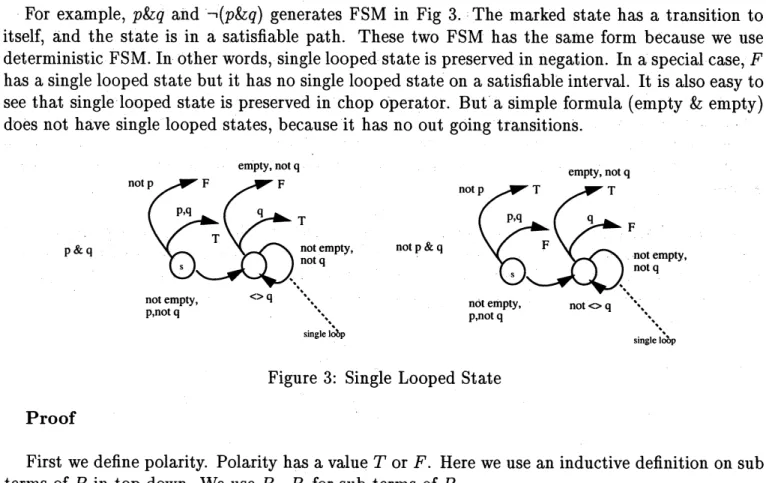
and $\neg(p\ q)$ generates FSM in Fig 3. The marked state hasa
transition toitself, and the state is in
a
satisfiable path. These two FSM has thesame
form becausewe use
deterministic FSM. In other words, singlelooped state is preserved in negation. In
a
specialcase, $F$has
a
single looped state but it hasno
single looped stateon a
satisfiable interval. It is alsoeasy
tosee
that single looped state is preserved in chop operator. Buta
simple formula (empty&empty)does not have single looped states, becauseit has
no
out going transitions.p&q notp&q
Figure 3: Single Looped State
Proof
First
we
define polarity. Polarityhasa
value $T$or
$F$. Herewe
use an
inductive definitionon
subterms of $P$ in top-down. We
use
$P_{s},$ $P_{t}$ for sub terms of$P$.Initial Case $P’ \mathrm{s}$ polarity is $T$.
Negation Case $P$ has
a
form $\neg P_{s}$. The polarity ofsub terms $P_{s}$ is negation of$P$.Otherwise Polarity of sub terms has the
same
polarity ofparent term.Next,
we
want to prove this. Ifa
formula does not have single looped states, thereare
positive polarized empty in all positive polarized disjunction leaves, negative polarized conjunction leavesand chop leaves. It is proved by another bottom up induction
on
ITL formula.Initial Case If$P$ is local variable, $T$
or
$F$, it hasa
single looped state.Initial Empty
Case
Positive polarized empty does not have single looped states. Negativepo-larized empty has
a
single looped state.Chop Case $P$ has
a
form $P_{s}\ P_{t}$. If either $P_{s}$or
$P_{t}$ has thea
single looped state, $P$ hasa
singlelooped state.
Negation Case $P$ has
a
form $\neg P_{s}$. If $P_{s}$ hasa
single looped state, $P$ hasa
single looped state.Recall$F$ has
a
singleloopedstate andthe shapeof deterministic FSMis preserved innegation.Disjunction Case $P$ has
a
form $P_{s}P_{t}$. If polarity of $P$ is positive and if either $P_{s}$or
$P_{t}$ hasa
single looped state, $P$ has
a
single looped state. If polarity of $P$ is negative and if both $P_{s}$Conjunction Case $P$ has
a
form $P_{s}\wedge P_{t}$. Ifpolarity of$P$ is positive and ifboth $P_{s}$ and $P_{t}$ hasa
single looped state, $P$ has
a
single looped state. If polarity of $P$ is negative and if either $P_{s}$or
$P_{t}$ hasa
single looped state, $P$ hasa
single looped state.These
are
easily verified by the semantics of operators and characteristics of deterministic FSM.Roughly saying, the basic
case
showswe
haveno
single looped states if and only ifwe
have positiveemptyin it, and other induction
cases
show it is preserved in all LocalITL operators (except closureor
next).Assume $P$ does not have
a
single looped state in each state of the infinite satisfiable interval.Then in all positive polarized disjunction leaves, negative polarized conjunction leaves and chop leaves, all the sub terms have positive polarized empty. This
means
$P$ is only satisfiable inan
empty interval. It contradicts the assumption that $P$ is
satisfi..able
inan
infinite interval. EndProof
Evenp$(p)$
means
$p$ is true at everyeven
clock period. The FSM for Even$(p)$ iseasy
as
in Fig. 4and it does not have single looped state in the satisfiable interval. (But it has
a
single loop stateon
the unsatisfiable interval because it contains $F$ leaf) Sowe
cannot express Evenp$(p)$ in LocalITL, which is easily written in Regular Expression
or
QPTL.$\mathrm{T}$
evenp(p)
$\mathrm{p}$
Figure 4: FSM of Evenp
The extension of the proof for including next operator is possible but not
so
easy.
It requirescareful handling of empty and next interaction. We
can
express Evenp$(p)$ fora
fixed finite intervalusing next operator, but in
case
of infinite intervals, there isa
sub interval which is generated bynon
next restrictedway.
The sub interval has single looped state.It is easy to show that
a
closure operator does not keep the single looped state. $\mathrm{I}\dot{\mathrm{f}}$we
havea
quantifier, the form of FSM changes drastically by quantifier andwe
cannot extend the proof.Since Evenp$(p)$ is easily written with
a
closureor a
quantifier, Even$(p)$can
beus.ed
as
a
counterAppendix:
List
of
Definitions
$f\dot{i}n(P)$ $\equiv$ (T&(emptyA $P$))
$beg(P)$ $\equiv$ (($\mathrm{e}\mathrm{m}_{\mathrm{P}^{\mathrm{t}\mathrm{y}}}$ A P)&T) @P $\equiv$ $\neg \mathrm{e}\mathrm{m}\mathrm{p}\mathrm{t}\mathrm{y}\wedge \mathrm{O}^{P}$
$\mathrm{O}P$ $\equiv$
T&P
$\mathrm{O}_{S}P$ $\equiv$
S&P
$\square P$ $\equiv$ $\neg(T\ \neg P)$
$\Phi P$ $\equiv$
T&P&T
a $P$ $\equiv$ $\neg(T\ \neg P\ \tau)$
less (2) $\equiv$ OOemPty
length(2) $\equiv$ @@empty $\Phi P$ $\equiv$
P&T
$\mathrm{i}P$ $\equiv$ $\neg(\neg P\ T)$
References
[1] Rajeev Alur. The Theory of Timed
Automat.a.
In Real-time:Theory.
in Practice, LNCS 600.Springer-Verlag, 1991.
[2] R. E. Bryant. Graph-based algorithms for boolean function manipulation. IEEE Transactions
on
Computers, Vol. C-35, No. 8, pp. 667-691, August 1986.[3] Masahiro Fujita and Shinji Kono. Synthesis of Contrllers from Interval Temporal Loigc Spec-ification. In International
Conference
on Computer Design, October 1993.[4] Masahiro Fujita and Shinji Kono. Synthesisof Contrllers from Interval Temporal Loigc
Spec-ification. International Workshop
on
Logic Synthesis, May 23-26, 1993.[5] Robert Goldblatt. Logic
of
Time and Computation, volume 7 of CSLI Lecture Notes. CSLI,1987.
[6] M.J.C. Gordon and T.F. Melham. Introduction to the hol system. Technical report, Cambridge
University, 1994.
[7] J. E. Hopcroft and J. D. Ullman. Introduction to automata theory, language and computation.
Addison-Wesley, 1979.
[8] Shinji Kimura and Shuzou Yajima. Formal languages satifing temporal logic formula. IECE
Japan, Vol. J70-D, No. 1, pp. 117-123,
1987.
in Japanese.[9] Shinji Kono. A Combination of Clausal and Non Clausal Temporal Logic Program. In Exe-cutable Modal and Temporal Logics, volume LNAI-897. Springer-Verlag, 1994. Lecture Notes
in Artifificial Intelligence.
[10] K.L. McMillan. “symbolic model checking: An approach to the state explosion problem”.
Technical Report CMU-CS-92-131, Carnegie Mellon University, May
1992.
[11] R. Milner. A Calculus
of
Communicating Systems, volume 92 of Lecture Note in Computer[12] B.C. Moszkowski. Executing temporal logic
programs.
Technical Report 55, $\mathrm{c}_{\mathrm{o}\mathrm{m}\mathrm{u}}\mathrm{p}\mathrm{t}\mathrm{e}\mathrm{r}.\mathrm{L}\mathrm{a}\mathrm{b}\mathrm{o}-$ratory, Univ. of Cambridge,
1984.
[13] P. Wolper. Temporallogic