4. Comparison of the Supplier System in China
and Japan: Status in the Second Half of the
1990s
権利
Copyrights 日本貿易振興機構(ジェトロ)アジア
経済研究所 / Institute of Developing
Economies, Japan External Trade Organization
(IDE-JETRO) http://www.ide.go.jp
シリーズタイトル(英
)
Occasional Papers Series
シリーズ番号
40
journal or
publication title
Interfirm Relations under Late
Industrialization in China : The Supplier
System in the Motorcycle Industry
page range
65-82
year
2006
4
Comparison of the Supplier System in
China and Japan
Status in the Second Half of the 1990s
This chapter demonstrates, based on the findings of the on-site survey, that the sup-plier system of the motorcycle industry in China in the second half of the 1990s was an isolated type, in contrast to the united-type system that existed in Japan. There are clear differences between the Japanese and Chinese firms. In Japan, makers, sharing risks with suppliers, attempt to cooperate with them to learn ways to upgrade their capabilities. By contrast, in China, amid severe selective pressure, makers seek to upgrade their capability in an isolated manner, predominantly passing the risks on to suppliers.
Section I looks at China and Japan, comparing the division of roles between makers and suppliers. Section II discusses how makers make suppliers compete among them-selves, and Section III discusses the qualitative characteristics of the transaction relationship between makers and suppliers in the two countries. The analytical work established in Chapter 1 is mainly dealt with in Section III, but why the frame-work has to be this way is closely related with the characteristics discussed in Sec-tions I and II.1
This chapter is primarily based on the findings of the first survey conducted at the end of the 1990s, but also integrates the findings of the second survey from 2001 to 2003 and supplementary survey in 2004.
I. Greater Role of Suppliers and Weaker Makers
This section compares the division of parts between makers and suppliers in both qualitative and quantitative terms in the two countries, and the sharing of roles be-tween them in product development. As a conclusion, it is found that two Chinese makers, Jialing and Qingqi, differed only slightly from two Japanese makers, Honda
and Yamaha, in what kind of the parts they produced in-house or outsource, but their role in the development process was apparently smaller than that of their Japanese counterparts. Moreover, it is found that Zongshen, another Chinese firm, only had a very narrow scope of technological grip, and thus was a different type of maker from Jialing and Qingqi.
1. High Outsourcing Ratio
Our interviews with firms found that the outsourcing ratio2 of the Chinese makers
in the second half of the 1990s was 60–70% for Qingqi, 65% for Jialing, and about 90%3 for Zongshen. In contrast, the ratio was 80% for Honda’s Kumamoto Factory
(which specializes in small vehicles), about 70% for its Hamamatsu Factory (larger vehicles), and 73% for the entire motorcycle division of Yamaha. The outsourcing ratios of Jialing and Qingqi are slightly lower and that of Zongshen is considerably higher than its Japanese counterparts.
Looking at the outsourcing ratios, there are no major difference between Jialing and Qingqi and the Japanese makers. The lower outsourcing ratio of Jialing and Qingqi compared to their Japanese counterparts, by about 10 percentage points, seems to be a result of their in-house production of engine-related parts such as clutches, carburetors, valves, and flywheel magnetos and other electrical components that the two Japanese makers do not produce themselves.
Jialing and Qingqi frequently utilize purchased parts and in-house parts together, because from the outset they had high in-house production capability as a result of their full-fledged introduction of important technologies related to those parts, and because they increased the purchase of parts in the first half of the 1990s to respond to the sharp growth of production. However, in the second half of the 1990s, when production plunged, the makers gave priority to in-house parts. At the same time, there were cases when they had to use purchased parts for technical reasons. In other words, though they tried to absorb technologies for the parts they introduced, they were not necessarily successful in developing upgraded versions. They had to rely upon purchased parts for new models, while using in-house parts for the existing model.
For instance, Qingqi produced cylinders for larger-displacement engines in-house, but the cylinders for the old model of the 50 cc, two-stroke engine were mostly purchased from an external supplier. This is an example of outsourcing low-technol-ogy and low-value-added parts.4 On the other hand, Jialing’s carburetor is an example
of the outsourcing of a product that the maker could not develop well based on the absorbed technologies. When Jialing introduced technologies for 70 cc and 125 cc engines from Honda, it also introduced carburetor technology. Toward the end of the 1990s, in-house carburetors were primarily used for those engines. However, for 90 cc–100 cc derivative models and for models for export, which required stricter quality standard, it used purchased carburetors from supplier c, a Japanese joint venture, in which Jialing had a stake.5
Meanwhile, with the Japanese makers, there is no significant mixed usage of in-house and purchased parts. They also have a greater grasp than their Chinese
counter-parts of the technologies of purchased counter-parts. The most outstanding example is Honda which, along with Honda Engineering Co., Ltd., an affiliated engineering firm that develops and produces major experimental and manufacturing equipment for it, has more than twenty affiliated suppliers producing important parts. For example, it purchases carburetor chiefly from a subsidiary, Keihin Corporation. Keihin’s new product development is essentially conducted as an integral part of Honda’s develop-ment activities. Although Honda has enormous knowledge and capability for devel-oping carburetors, it apparently believes that, by outsourcing the development, it can focus its resources on more valuable activities. The outsourcing ratio of Honda’s overseas plant in Indonesia is 77 percent, of which 55 percent is bought from eleven suppliers affiliated with its group. If this is categorized as in-house sub-production and combined with in-house production, the outsourcing ratio falls to as low as 35 percent.6 The very essence of being a dominant maker is the development and
accu-mulation of total technologies for whole products and sharing this knowledge with main suppliers.
2. Active Utilization of Purchased Parts
Zongshen, at the time of the survey, was almost totally dependent on purchased parts except for the engine case machining (which is directly related to appearance design, its main source of differentiation) and frame (which is also important since it is the structural backbone of the motorcycle), which were processed and produced by a subsidiary. Zongshen, after rapidly becoming a maker of engines and finished vehicles, relying totally on standardized external parts, was trying to gradually ex-pand the scope of its own technological grip. This stands in stark contrast to Jialing and Qingqi, which tried to acquire parts technologies in bulk since the 1980s. How-ever, when compared with their Japanese counterparts, the three makers, though different in degrees, had a similarly narrow technological grip of whole motorcycles. Due to their inability to develop their own models, large state-owned makers had to increase their line-ups to respond to changes in demand in the latter half of 1990s (see Chapter 3) by actively utilizing purchased parts. This can be seen most prominently in the purchase of engines.
Qingqi, as of 1998, was producing vehicles loaded with five engine models by displacement and twelve models by type (Wang 1998). It introduced two-stroke technology from Suzuki in the first half of the 1990s. When four-stroke engine models became the mainstream in the market, it first attempted in-house development. But, then, it began purchasing engines and assembling them to the body in an attempt to rapidly expand its line-up, having found that the level of challenge for new model development was high and that suppliers were already available that could produce the necessary parts.7
3. Dependence on Suppliers for Product Development
In China, makers rely heavily on suppliers for product development.
Table 4-1 shows the source of originals of products, such as design drawings and sample parts, of two suppliers interviewed in the first survey. Of the
twenty-two suppliers, twenty-one received design drawings or sample parts from makers. Not a single supplier answered that it did the job itself starting from the basic design.8 The
only supplier that answered it did primarily in-house was a cowling supplier, an (mentioned in Note 32 of Chapter 3). Just like makers, suppliers were also carrying out minor-change type development.
In the second half of the 1990s, Chinese makers and suppliers became engaged in joint development, but the engineering observed therein was neither complicated nor technologically deep.
In China, both “drawings supplied” and “drawings approved” methods (see Note 17 of Chapter 3) were used for determining detailed designs. Jialing and Qingqi are more inclined toward the “drawings supplied” method.
In the late 1990s, Qingqi was supplying detailed design drawings of parts for conventional models to four (three suppliers of engine parts and one frame supplier) out of five suppliers surveyed. It was using the detailed design of the two-stroke model introduced from Suzuki virtually unchanged. In addition, it had launched a four-stroke model with minor-change based engineering, using firms l, n, and p to produce parts, supplying them with detailed designs. However, the design was far from being complete and tolerance requirements were loose. Suppliers modified them in accordance with their own technologies and the available equipment, and had the maker approve them.9 In this sense, procedure-wise, it was “drawings approved.”
Zongshen also employs the “drawings approved” method as a matter of form. New product development for the maker in the late 1990s meant imitating the latest model whose standardized parts were not yet in circulation. The targeted new product was purchased in the domestic or foreign market, disassembled into parts, which were given to major suppliers as samples, who then conducted measurements, material analysis, and processing analysis, and developed the final design to make the same product. Suppliers, through consultations with the maker, added design changes, which were approved by Zongshen.10
At that time, the precision requirements were low, and neither Zongshen nor its suppliers had adequate measurement and experimentation equipment. The processing precision requirements (tolerance) were much looser. For example, a precision
re-TABLE 4-1
SOURCEOF ORIGINALSIN PRODUCT DEVELOPMENT (N = 22)
Source No.
Mainly supplied by makers: 21
Chiefly both drawings and samples 15
Chiefly samples only 6
Have experience procuring by themselves 6
Mainly developed by themselves: 1
Developed based on existing parts purchased by themselves 1
Designed by themselves from basic planning 0
quirement of plus or minus 0.02 mm at a certain point of a crankshaft in 2003 was plus or minus 0.05 mm in the late 1990s. Products were tested in a subjective manner, i.e., shock absorbers were pressed by hand to check the feeling and then final design was determined. In retrospect, the mutual coordination was very crude.11
4. Suppliers Participate in Development by Taking Risks
One large difference between China and Japan is the rule for risk bearing. As shown in Table 4-2, in the latter half of the 1990s, seventeen out of twenty-two suppliers bore all the cost for dies and molds when developing new parts. In no cases were the entire cost borne by the maker. The risk of new product development for parts is borne by suppliers. In other words, in the motorcycle industry in China, the suppliers are the major players in developing parts.
Meanwhile in Japan, the practice is for all (or in some cases a portion) of the actual cost for dies and molds and for trials to be borne by the ordering side, i.e., the makers. Generally speaking, Chinese makers had weak leadership toward joint develop-ment in collaboration with suppliers.
TABLE 4-2
SHARINGOF COSTSFOR DIESAND MOLDS (N = 22)
Sharing No.
Fully paid by suppliers 17
Partially paid by makers 5
of which 50% paid by makers 1
Source: Same as Table 4-1.
II. Open and Isolated Transactional Relationships
This section considers how makers compelled suppliers of the same parts to compete against each other.
1. Open Transactional Relationship
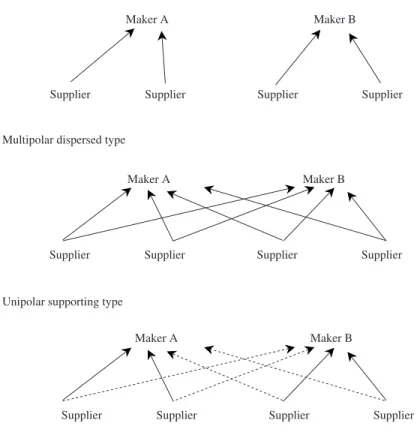
As an illustration of the degree of openness (or closedness) and degree of indepen-dence (or depenindepen-dence) of the relations between makers and suppliers, we can identify a “unipolar concentrated type” (hereafter, unipolar type) and “multipolar dispersed type” (hereafter multipolar type) (Figure 4-1). The unipolar type is a closed hierarchi-cal organization, in which multilayer groups of suppliers, trading only with a specific maker, exist under the maker. A multipolar type is an open network-type organization, in which independent suppliers are equidistant from multiple makers and freely enter transactional relationships with them. In reality, any firm of any industry can be positioned somewhere in between the two types.
In the case of the Japanese motorcycle industry, each maker, while maintaining an influential supplier called its “main supplier” for important functional parts, does
business with one or two other suppliers, called “competing suppliers.” It is often a “unipolar supporting type,” in which suppliers keep a special relationship with one maker as a major partner, while also trading with other makers.
On the other hand, judging from the interviews, the image of the Chinese motor-cycle industry seems closer to a multipolar type, than the Japanese counterparts.
Eighteen surveyed suppliers of Jialing, Qiangqi, and Zongshen were supplying their major products to on average of 15 makers other than the above three, and 5 of the 18 were supplying to over 20 makers. On average, 40.5 percent of the sales of the major products of those 18 suppliers were accounted for by their major maker part-ners. These figures are only for major products of each supplier, and since most of the suppliers were producing other types of parts, their business partners should have been more multifactorial.
By contrast, in Japan, for example, 90 percent of the sales of one electrical parts supplier, a subsidiary of Yamaha, came from Yamaha, (equivalent to 60 percent of Yamaha’s total demand). In the case of one Honda-affiliated supplier of shock
absorb-Unipolar concentrated type
Multipolar dispersed type
Unipolar supporting type Maker A
Maker A Maker B
Maker A Maker B
Supplier Supplier Supplier Supplier
Supplier Supplier Supplier Supplier
Supplier Supplier Supplier Supplier
Maker B
ers, 63 percent of sales came from Honda (93 percent of Honda’s total demand).
2. Endless Pressure for Competition by Multisourcing Identical Parts
In Japan, when certain parts are jointly developed, it is a general practice for them to be supplied by a single supplier for as long as the model is under production. Meanwhile, the maker simultaneously purchases parts (of the same category) for other models from other suppliers and by comparing their performance, chooses one supplier to participate in the future development of new products. Thus, it circum-vents the moral hazard involved in single-sourcing.12
In China, as shown in Table 4-3, makers purchased identical parts from two or more, and very often three or more suppliers at the time of mass production. Typi-cally, they made decisions regarding the purchase in the following manner: In devel-oping a new product, one supplier was chosen for parts development. If the product was a success in the market and mass production began, the maker asked the second and the third suppliers to produce parts of exactly the same design.13 The maker
ranked its suppliers by their performance in QCD (quality, cost, delivery), using A, B, C, and D grades, and distributed purchase shares accordingly, e.g., 60 percent share to rank A suppliers, 30 percent to rank B, and 10 percent to rank C. The ranks changed frequently, often once every few months, or even monthly in extreme cases. Even if a supplier succeeded in the development, it was subject to constant pressure, and never received exclusive benefits from the success.
The merit of multisourcing was to create pressure for improved QCD and reduce risks of contingencies (delivery failure due to accidents, for example). Further, in many cases, multisourcing was utilized because many small-size suppliers were un-able to keep up with the rapid growth of the motorcycle industry and thus the makers’ demand could not be met by a single supplier.
Multisourcing was often observed in the development phase. It was quite common for a supplier, following a request by the maker to develop certain parts, to carry out a trial, but for a product developed by another supplier in response to the same request from the maker to be adopted, meaning that the former had wasted its development cost.14 Suppliers were constantly subject to such risks.
TABLE 4-3
MULTISOURCINGOF IDENTICAL PARTS (N = 22)
Sourcing No.
Usually multisourcing: 20
Two suppliers 2
Three or more suppliers 18
Usually single-sourcing 2
Source: Same as Table 4-1.
III. Risk Management: System of Risk Shifting
In the following two sections, mechanisms for risk management between makers and suppliers and for the promotion of capability upgrading based on the framework presented in Chapter 1 are examined.
1. Shifting Development Risk
The “failure rate” of development is high. In other words, parts are developed in response to the request of a maker, but the maker often fails to reach the stage of mass production, and the supplier is unable to depreciate the development cost. Of the seventeen suppliers questioned, twelve replied that they often experienced develop-ment failures. Supplier t, a shift transmission gear manufacture, said, “Out of ten requests to develop new products, three are generally cancelled in the process of development. In another three cases, the prototypes are produced but not adopted, and in two cases, the products are adopted but not mass produced and therefore the costs cannot be depreciated. The remaining two reach mass production and lead to profits.” In Japan, a new product, once developed by a maker, seldom fails to reach mass production. As was discussed in Chapter 3, development in Japan involves a relatively high degree of originality, and therefore, potentially involves a high market risk. However, due to the thoroughgoing marketing and painstaking organizational engi-neering with suppliers, the risk is kept low before the launching of mass production.15
In China, since development is “minor-change type,” the market risk is inherently low if the base model is a model that is selling well in the market (Figure 3-2 in Chapter 3). However, in the process of subsequent localization, the market risk may rise. As a result of immature marketing and organizational engineering capability, it may be difficult for makers to create products that are of good quality and highly agreeable to consumers. Rather, as they lack knowledge of what sells well, Chinese makers seem to adopt a method under which they quickly develop products, placing the risks on the suppliers, and then launch them in the market. If they sell well, they are mass-produced, and if not, the production is simply discontinued, with the cost borne by suppliers.
This is most typically shown by the system of whole-lot returns and loss-compen-sation when defective parts are found. If a sales failure occurs due to a problem with certain parts after the launching of mass production, makers unilaterally return not only the problematic parts but all related parts (e.g., a full set of engine parts is returned if the crankshaft is defective). Five suppliers, when asked about the return rate, said that unit-wise, between 10–30 percent of their sales to the three makers were returned as of the end of the 1990s, and that 50–80 percent of them were returned for reasons that had nothing to do with the suppliers.16 The payment for parts was made to
suppliers following a varied schedule, i.e., when the parts were assembled on the maker’s line, after the maker shipped vehicles to dealers or upon the makers’ receipt of sales proceeds, but in any case, in the phase of mass production, suppliers produce large numbers of parts without receiving payment. The risk of wasting these parts
seems high. Furthermore, a compensation system is generally included in contracts, under which the “loss” suffered by the maker as a result of returns from users after shipment is wholly or partially compensated by the supplier who caused the problem. In general, immaturity in terms of marketing and organizational engineering capa-bility on the part of the maker seems to be redeemed by shifting the risks to suppliers. What is important in this context is that makers fail to seriously pursue the indi-vidual causes of defects. If this practice continues, it will likely bring about serious long-term technological stagnation in this industry, where incremental technological innovation is a key. This point will be reexamined in Chapter 6.
2. Nonpayment
The risks to suppliers are raised even higher by the problem of uncollected pay-ments, which in the survey was clearly distinguished from normal waiting for cash payments of bills (normally two-three months). De facto practice in the industry at the time of the first survey was for the payment of the first transaction a maker owed to its supplier to be made at the time of the second or subsequent transaction as the need arose. The maker would not make payment for the first delivery, and if it liked the parts and wanted more of them, would make a payment (partial in some cases) to the supplier, and in return would receive the second delivery. The transaction would then continue in this manner.
According to the interviews with twenty-six suppliers, all makers with the excep-tion of three Japanese affiliates had payments due to them, and none of the suppliers were free from uncollected payments.
Uncollected payments seemed serious with the transaction with Jialing and Qingqi, while they were relatively fewer with Zongshen. According to the five suppliers who were asked about specific amount, the ratio of uncollected proceeds in 1998 to annual sales in 1997 was 10%, 12%, and 15% for firm m, o, and d respectively, major suppliers of Jialing and Qingqi, whereas the ratio for Zongshen’s suppliers, firm t and
r were 6% and 5% respectively. This fact is consistent with the general recognition in
the industry at that time that the problem of uncollected proceeds was more serious in dealing with state-owned makers.
3. Response of Suppliers
There are three forms of countermeasures taken by suppliers to whom makers pass on high risks: (i) minimizing risks; (ii) spreading risks; and (iii) shifting risks to a third party.
First, out of fear of risk-taking, suppliers avoided transaction-specific investments to the greatest extent possible, and tried to utilize existing technologies and equip-ment for as many clients as possible. It was a general practice to use dies and molds, as well as jigs and tools developed to serve a certain maker, to process parts for another maker. As such, a “de facto standardization” of products was progressing, starting with the phase of parts development, not only due to the intention of makers, but also in an unorganized manner by suppliers under the spontaneous and earnest wish to minimize risk.
As a measure to spread risks, suppliers were trying to diversify their clients. Suppliers have always looked for second and third makers who were willing to use the parts they had developed. In fact, many makers were producing numerous minor-change models over a few base models, and especially, for odds-and-sods makers in the third layer and in the after market, there was ample demand for de facto compat-ible parts that somehow “fit into” the motorcycles that just “run” (meaning that bad drivability or performance was not seriously considered by consumers).
Another measure, which was more important for suppliers, was the shifting of risks to second- or lower-tier suppliers. The first-tier suppliers did not pay the second-tier suppliers in the same manner as makers. For instance, supplier r, a producer of crankshafts, had secondary suppliers do the cast and forging of most of the parts, and engaged only in the processing and assembly. All the risks involved in the dies and molds were assumed by secondary suppliers. It appears that risks were shifted from makers to the first-tier suppliers, from the first to the second, and from the second to the third, as if they were minutely dispersed into the vast surplus production capacity made up of firms and surplus workers who wanted orders and jobs, no matter how risky.
Another response is for suppliers to add a risk premium onto the price at the point of sale. According to a privately owned supplier r, when selling parts of the same cost, it charged about 15 percent more to state-owned makers than to privately owned makers. Ten percent was for proceeds collection failures, and 5 percent for kickback to the makers’ staff in charge of purchasing.17
IV. Promotion of Capability Upgrading: Isolated Development under Harsh Competitive Pressure
1. Promotion of Capability Upgrading in Japan
First, let us discuss the example of a Honda-affiliated supplier, in order to identify the mechanism under which capability upgrading is incorporated in the Japanese supplier system.
(1) Establishing Common Objectives and Taking Leadership
Supplier jc, a Honda-affiliated shock absorber manufacturer, received capital par-ticipation from Honda in the 1970s, when the firm fell into a management crisis. In subsequent years, by following the path led by Honda, the supplier developed into one of the leading manufactures of its product in the world.18 Initially, it had frequent
quality problems, but Honda did not make large reductions in the order volume.19
Instead, it dispatched several specialists in quality control and manufacturing tech-nologies as staff on loan, who gave guidance to the supplier until the first half of the 1980s. This guidance involved basic manufacturing areas, and the experts never interfered with the expertise of shock absorbers themselves. As jc’s technological level improved, the loaned employees left. This is an example of a maker nurturing basic capabilities of a major supplier under its control.
At the time of the interview, jc saw the following means as effective for upgrading its capabilities in its transaction with Honda: (i) strengthening management, produc-tion, and technologies by setting up objectives and tasks in its “medium-term strat-egy”; and (ii) disclosure of information of future products. An example of (i) was the various reform plans imposed on group companies by Honda for management im-provement, such as the introduction of ISO environmental standards. The supplier said that, “by being within Honda’s circle, we are involved and committed and learn new methods unknowingly.” Item (ii) involves the prompt disclosure to group firms of product concepts and new technologies that Honda plans to develop in the next term, and the development and acquisition of new technologies through joint development. These activities aim to promote mutual improvements in the area of management control, in case (i), and in product and technological development in case (ii), through synchronized and cooperative efforts with the establishment of common objectives, with Honda at the center. This is different from guidance and nurturing, as we saw in the past experience of jc. What Honda provides at present is not technology or know-how. Rather, it is a plan with foresight and leadership to guide the group, which draws forth the commitment of suppliers and promotes their own upgrading.
(2) Technological Commitment and Broad Capabilities
This does not mean that technological strength is not needed for the maker. Rather, as mentioned in Chapter 3, Honda’s strength lies in the fact that it possesses a broad range of technologies that enable it to do what suppliers are doing if the need arises. Particularly, at a time when the engineering capabilities of suppliers were not as complete as they are today, Honda often developed expertise for suppliers, and pro-vided them with guidance.
For instance, in the 1970s, Honda was troubled by breakages of chains, but the supplier argued that it was a problem with the material, and no improvements were made. Then Honda, using specially designed experimental equipment in its manufac-turing equipment division (later Honda Engineering Co., Ltd.) to analyze the break-age, discovered that the individual link plates that constituted the chain had varied strength, and that this was caused by improper heat treatment by the supplier. Honda then developed heat treatment equipment to correct the problem, and provided the supplier with the equipment. The Honda engineer in charge of this problem said, “Suppliers have more technological knowledge in their field of speciality. However, we as users, had to somehow find a technical solution, because we were the ones being troubled by it.” (Matsuura 2004)20
The above example illustrates that Honda developed and accumulated technologies along with its suppliers even in areas of supplier expertise, and that to achieve this, it nurtured adequate internal resources, such as large numbers of engineers in related departments, with some of them producing various experimental equipment and tooling.
Generally speaking, a dominant maker has capability for future planning and pow-erful leadership, as well as a broad range of technological capabilities and a large amount of capital. Over time, the maker and its suppliers will have mutually enhanced
their capabilities in the process of the suppliers responding to and pursuing the common objectives established by the maker. This is a commonly cited merit of a united-type supplier system led by a powerful maker as mentioned in Chapter 1; the formation and sharing among firms of a wide range of capability/knowledge that facilitate better product quality and development performance.
2. Promotion of Capability Upgrading in China
During the interviews in the first survey, Chinese makers said they wanted their major suppliers to strengthen their capabilities. However, only limited practicable measures were being taken to this end. There was little in terms of the cooperative efforts that we find in Japan. Makers were relatively passive in making efforts to upgrade the capability of suppliers, while suppliers were striving to improve their capability in an isolated manner amid harsh competitive pressure.
In this subsection, I will examine measures taken for “supplier development” (Chapter 1), including those categorized as infrastructural arrangements (information sharing via increased communication) and as transaction-specific arrangements (per-sonnel interchanges, technological guidance, and financial support), as well as simple measures to create chances for them within the competitive pressures (Table 4-4). (1) Lack of Information Sharing
For the three Chinese makers, the main measures for information sharing involved daily routine business transactions, and, with the exception of Zongshen’s approach, which had just been started, the content was fairly simple. Namely, in the product
TABLE 4-4
SUPPORTAND COMMUNICATIONFROM MAKERS TO SUPPLIERS (N = 22)
Support and Communication No.
(1) Receive frequent technological guidance:
Yes 1a
No 21
. . . .
(2) Have received long-term dispatching of personnel:
Yes 1b
No 21
. . . .
(3) Opportunities for official information sharingc are available:
Yes 5d
No 17
. . . .
(4) Have ever received financial supporte:
Yes 7
No 15
Source: Same as Table 4-1.
a Regarding CAD system.
bDirector dispatched by the parent firm (maker). c Annual suppliers’ conference is excluded.
dAttending board of management of the parent firm (maker). e Provision of current capital and security etc.
development phase it involved requests for specifications regarding size and function, in the trial phase involved evaluations, and in the mass production phase involved requests for quality improvement.
Makers did not have a grasp of the details of their suppliers’ technologies such as the level of engineers and equipment and quality control measures, so that they were unable to evaluate their actual costs. Pricing mostly involved simply following market prices and results of suppliers’ rationalization efforts, and the distribution of the proceeds between them was not an issue. Occasionally, makers unilaterally presented rationalization requirements to suppliers, which often were not fulfilled because they were not based on the correct shared information.21
With regard to opportunities for information sharing, all twenty-two suppliers were taking part in annual (or biannual) conferences with makers. The main agendas of these conferences included annual production, the outlook for product development, and cost reduction requirements. Due to the drastic market fluctuations at the time, however, the contents of the conferences were rarely abided by for the subsequent twelve (or six) months. The conferences failed to act as platforms for establishing common objectives, as they did in Japan. Also, there were few cases with other official communication channels. Among the suppliers who answered that they had such channels (Table 4-4-(3)), three were subsidiaries of Qingqi, which attended board of directors meetings of the Qingqi Group. And as will be seen in the next chapter, even these subsidiaries did not share common strategies and trust.
Zongshen, however, was sharing information on a frequent and informal basis, by communicating with the owners of its privately owned suppliers as needed. In addi-tion, in 1998, along with suppliers, it launched a monitoring system for quality control in the workshop, called a “quality assurance system,” in an attempt to achieve mutual improvements. As will be discussed in detail in the next chapter, Zongshen was successful in drawing forth suppliers’ commitment.
(2) Personnel Interchanges and Technological Guidance
At the time of the survey, hardly any technological guidance was being provided by makers to suppliers. Generally speaking, with regards to expertise on individual functional parts, makers actually had very little technological strength to guide sup-pliers. However, as is the case with Zongshen’s “quality assurance system,” some arrangements were being observed to bring together technological know-how and to conduct monitoring by dispatching personnel for short periods of time.
Hardly any supplier received personnel (managers or engineers) from makers for long periods. Two suppliers, both subsidiaries of Qingqi, said that they had received permanent directors, but not technical personnel. No technical staff was sent presum-ably because the makers did not have a clear technological advantage, and because minor-change-type development does not require cooperative work at the same level as required by the joint development of state-of-the-art products and technologies in Japan.
(3) Investment and Financial Support
(ex-cept for investment) from makers. Of the seven suppliers who said they did, three were Qingqi subsidiaries, who had received credit guarantees at the time they raised their current capital. Four suppliers received assistance for development from Zongshen, but only in small sums (see Chapter 5 for details). The relationship between Zongshen and its suppliers is seen as identical with the personal relationship between the owners, and thus a small sum can generate greater commitment.22 In Japan, too,
makers provide little financial support to suppliers without capital affiliations, and there is little difference between the two countries in this respect.
(4) Providing Competitive Chances
What Chinese makers then recognized as the most effective way to nurture suppli-ers was to place ordsuppli-ers to supplisuppli-ers in as stable a manner as possible and have them participate in the development process rather than giving them direct assistance. Suppliers also saw the merit of entering into a close relationship with a makers as follows: given equal conditions of quality and price, their products would be given preference over rival suppliers and they would be given priority in cases of important product development.
A short-term merit for a supplier for participating in product development is a relatively high profit rate.23 However in the multisourcing system described earlier,
upon the end of the period when parts for the new product were made by one supplier, no high profit could be expected. What is more important for a supplier is to upgrade its own capabilities by taking part in the product development launched by makers. This point was recognized by most of the suppliers interviewed. Product development indeed involves risks, but for suppliers who desire to climb the industry ladder, taking part in development was the major tool for improving their own technological capa-bilities.
In sum, in the second half of the 1990s, makers had few tools for providing direct support to suppliers. Although Zongshen had made a conscious effort to launch cooperative actions by setting up common objectives, it had yet to develop a totally mature system. The fact that giving chances to suppliers was the greatest support indicates that the most important driving force for promoting the upgrading of suppli-ers’ capability came from the pressure of market competition. Compared with Japan, the commitment of makers to upgrading the capability of their suppliers was passive, and the method was immature. It may well be that in China toward the end of the 1990s, amid the pressure to compete against a constantly emerging stream of firms, makers and suppliers alike were seeking to upgrade their capability in isolation.
V. Summary
The supplier system of the two Japanese makers was a united type. Fixed members, given a direction under a leader (the maker), made efforts toward a given but shared objective. Suppliers had a decreased freedom of choice for the future, but felt secure. Under such a system, transaction-specific investment is required, and makers absorb
the risk to a great extent. This makes it easy to undertake bold product development, and technology and knowledge can be shared and accumulated through continuing cooperative development.
On the other hand, the system adopted by the three Chinese makers in the latter half of the 1990s was generally an isolated type. The relationship between makers and suppliers was less binding and they had larger freedom to choose their business partners. Under such a system, makers have a smaller burden, as they pass on risks to suppliers. Suppliers, in an attempt to circumvent risks, avoid transaction-specific investment and try to find other business partners. Competitive pressure is a chief tool for the upgrading of suppliers’ capability, and there are relatively few information sharing and cooperative efforts.
The above is a broad classification of business relationships between China and Japan observed at a point in the late 1990s.
This clear dichotomy captures, the author believes, some important long-term characteristics of industrial development in the two countries. However, when seen in more detail, in view of how their systems have formed historically, it can be easily understood that the firms are not inherently so from the beginning, and, at the same time, that firms are not uniform in either China or Japan. In China, for example, Zongshen, compared with Jialing and Qingqi, clearly carried out less shifting of risks to suppliers, and thus had elements of a united type organization in that it made unique efforts to establish transaction rules and common objectives to acquire a commitment from suppliers. On the other hand, with Jialing and Qingqi, the opportu-nistic shifting of risks was normal practice, and their transactions lacked discipline.
The following chapter discusses how this isolated-type supplier system, and in particular the isolated-type system of mal-discipline that prevailed in the latter half of the 1990s, was formed, by observing the individual development paths of the three makers.
Notes
1 For the structure of this chapter, the author has referred to the method used by Fujimoto (1998).
2 Ratio of externally purchased materials and parts to total manufacturing cost.
3 Ninety percent is an estimated figure. For the reason for the estimation, see Note 30 of Chapter 5.
4 Interview with Qingqi and supplier l. Qingqi stated, “Products with high quality require-ment are produced in-house. But outsourcing to specializing suppliers has better cost efficiency. The purpose of using suppliers is to secure volume, and suppliers are utilized as a buffer.”
5 Interview with supplier c.
6 Interview at PT Astra Honda Motor in Indonesia on September 25, 2004. The factory produces only a few models and thus has relatively little need to diversify its source of supply. In addition, there are very few capable indigenous suppliers that can act as first-tier
suppliers. From these reasons, the factory may as well be more heavily dependent on group suppliers than in Japan. Yamaha in Japan, unlike Honda, has only a few major affiliated suppliers providing electrical parts, casting, etc. And yet, the firm also has advanced technological knowledge, as it has subsidiaries dealing in basic industrial technologies for motorcycle production in such fields as casting equipment, machine tooling, and EFI (electric fuel injection).
7 Qingqi had a four-stroke engine produced by a joint venture maker with Suzuki, but it was not directly linked with Qingqi’s own production. In 1998 in Chongqing, the maker estab-lished a joint venture (firm O) with a local privately owned firm to manufacture four-stroke engines (mostly C100 and CG125 type), but major parts were purchased from the common suppliers of Zongshen and Jialing.
8 In the case of suppliers c and am, both Japanese affiliates, the original basic design was done by the Japanese manufacturer making the investment. The suppliers themselves had no such function and only engaged in design changes for local adaptation.
9 According to supplier l, the detailed design drawings of conventional models were from Suzuki, with slight modifications by Qingqi. This fact also indicates that Qingqi had a lack of capability for conducting substantive development at the time. The interviewee stated that this also applied to supplier l.
10 Interview of the owner of Zongshen in 1998.
11 Interviews with suppliers t, v, w, y, and z. They answered unanimously that the number of exchanges they had with Zongshen—involving design drawing by the maker, prototyping by the supplier, and testing and re-drawing by the maker—was generally two or three times, and at the most four. The number of exchanges remains the same today, but the accuracy requirements are much higher and the process is more systematic as a result of the introduc-tion of inspecintroduc-tion equipment and well-organized procedural arrangements (Chapter 6). 12 This rule is the same as the automobile industry in Japan, as described in Asanuma (1989). 13 Many makers said that, generally, there was an article in the contract prescribing that multisourcing should begin when the product entered the phase of mass production and not before the supplier completed depreciating the cost for dies and molds and for the trials. However, suppliers said in the interviews that this clause was not strictly observed, and that multisourcing often began before reaching the agreed purchase lot necessary for depreciat-ing the development cost.
14 Eight out of eighteen have experienced this.
15 Both makers and suppliers said that in Japan, suppliers had virtually no risk accompanying transactions with makers, such as product development. The risk was to a great extent absorbed by the makers. For a quantitative analysis of automobile makers’ absorption of suppliers’ risks including risks due to demand fluctuation, see Kawasaki and MacMillan (1987) and Asanuma and Kikutani (1992).
16 Responses to the question about the percentage at the end of the 1990s in the second survey (firms c, t, v, w, and x). The returned parts were left in stock or sold to other makers or the aftermarket, depending on the supplier. According to firm c, a Japanese affiliate, the return rate in Japan is less than 0.1 percent.
17 Though not fully analyzed in this study, the widespread rent-seeking activities and nepo-tism of maker’s staff in charge of parts purchase seems to be one of the important factors making transactions unstable in China.
18 In the interview with jc, the directors and senior managers shared the feeling that they had been “nurtured by Honda.”
in quality, and exchanged them with proper products made by rival suppliers without notifying jc. This illustrates Honda’s patience in nurturing capable suppliers.
20 The chain supplier had no capital affiliation with Honda. Matsuura, the actual engineer who developed the method, in the 1970s, also developed a method to improve spark plug quality by changing the shape of the insulator, and provided it to the spark plug supplier. There are many engineers in Honda taking on such challenges (Matsuura 2004).
21 For instance, starting in 1997, Qingqi urged suppliers to reduce their annual costs by 30 percent. A 30 percent cost reduction was established as a goal for every supplier, irrespec-tive of its conditions. There were neither incenirrespec-tives available for achieving the objecirrespec-tive, nor institutionalized penalties. From the very beginning, suppliers regarded it as a slogan and made no effort (Interview with firm l). On the contrary, Japanese makers try to grasp, more or less, the details of supplier’s technologies (and hence costs) such as, for example, the processing costs of bending, cutting, heat treatment, and grinding. Once they decide the price of the parts or the maker requests the supplier further rationalization, the parties have discussions based on such shared information.
22 The personal relationship between owners was nearly always mentioned by the privately owned suppliers in interviews.
23 Zongshen guaranteed 10–15 percent of profits to suppliers for parts involved in new prod-uct development and 5 percent for conventional parts.