202
A
structured pattern
matrix
algorithm for
multichain
Markov
decision
processes
宮崎大学・教育文化学部 伊喜 哲一郎 (Tetsuichiro IKI)
Faculty of Education and Culture, Miyazaki University
東京電機大学・情報環境学部 堀口 正之(Masayuki HORIGUCHI)
School of Information Environment, Tokyo Denki University
千葉大学・教育学部 蔵野 正美 (Masami KURANO)
Faculty of Education, Chiba University
Abstract
In this paper, we
are
concerned with a new algorithm for multichain finitestate Markov decisionprocesses whichfinds an average optimal policy through
the decomposition of the state space into
some
communicating classes and atransient class. For each communicating class,
a
relatively optimal policy isfound, which is usedto find
an
optimal policy by applying the value iterationalgorithm. Using
a
pattern matrix determining the behaviour pattern of thedecision process, the decomposition of the state space is effectively done,
so
that the proposed algorithmsimplifiesthestructured
one
givenbythe excellentLeizarowitz’s paper (Mathematicsof Operations Research, 28, 2003, 553-586).
Also, a numerical example is given to comprehend the algorithm.
Key words: multichain Markov decision processes, structured algorithm,
communicating class, transient class, value iteration.
1
Introduction and
notation
In this paper, we are concerned with the structured pattern matrix algorithm for
mul-tichain finite state Markov decision processes (MDPs) with an averagereward criterion.
The efficient algorithm for finding
an
optimal policy in average rewardMDPs have beenstudied by many authors (cf. [5, 8, 11, 12, 14]). For the unichain or communicating
case, the optimal policy
can
be found by solving a single optimality equation (cf. [11]).However, for the multichain case, the optimal policy is characterized by two equations,
called the multichain optimalityequations, which are solved, for example, by linear
pro-gramming (cf. [6, 11]) or policy iteration algorithms (cf. [7, 8]),
Recently, Leizarowitz[10] have developed the
new
algorithm for multichain averagereward MDPs, in whichtheproblem is broken into several communicating models and a
transient modeland for eachmodel, anoptimal policyis found by solving the
correspond-ing single optimality equation. The objective of this paper is to propose
a
structured
algorithm for the multichain finite state MDPs which simplify the Leizarowitz’s
sug-gestive algorithm by
use
ofpattern matrix representation of transition probabilities inMDPs and the idea of the value iteration algorithm (cf. [5, 11]), That is, by the
203
several maximum communicating classes and a transient class and easily find the
max-imum sub-MDPs. In addition, the findingof an optimal policy is done by applying the
value iteration algorithm.
In the reminder ofthissection,
we
will define finite state MDP$\mathrm{s}$to be examined anddescribe the basic results for the communicating
case.
We define
a
controlled dynamic system witha
finite state space denoted by $S=$$\{1,2, \ldots, N\}$
.
Associatedwith each state$\mathrm{i}\in S$isa
non-empty finite set $A(\mathrm{i})$ ofavailableactions. Whenthe system is instate$\mathrm{i}\in S$ and action $a\in A(\mathrm{i})$ istaken, thenthesystem
moves
to a new state $j\in S$ with probability $q_{i\mathrm{j}}(a)$ where $\sum_{j\in S}q_{ij}(a)=1$ for all $\mathrm{i}\in S$and $a\in A(\mathrm{i})$ and the reward $r(i, a)$ is earned. The process is repeated from the
new
state $j\in S$
.
Thisstructure
is called a Markov decision process, denoted byan
$\mathrm{M}\mathrm{D}\mathrm{P}$$\Gamma=$ $(S, \mathrm{A}(\mathrm{i})$ : $\mathrm{i}\in S$
},
$Q,$$r$), where $Q=(qij(a) : \mathrm{i}, j\in S, a\in A(\mathrm{i}))$ and $r=r(\mathrm{i}, a)\in \mathrm{R}$for all $\mathrm{i}\in S$ and $a\in A(\mathrm{i})$ and $\mathbb{R}$ is the set of all real numbers. The set of admissible
state-action pairs will be denoted by
$\mathrm{K}$$=\{(\iota, a) : i\in S, a\in A(\mathrm{i})\}$.
The samplespace isthe product space $\Omega=\mathrm{K}^{\infty}$ such that the projection $(X_{t}, \triangle_{t})$ on the
t-thfactor describes the state andaction at the $t$-thtime of the process $(t\geqq 0)$. A policy
$\pi=$ $(\pi_{0}, \pi_{1?}\ldots)$ is asequenceofconditionalprobabilitieswith$\pi t(A(xt)|x0, a0, \ldots, xt)=1$
for all histories $(x_{0}, a_{0}, \ldots, x_{t})\in \mathrm{K}^{t}S(t\geqq 0)$ where $\mathrm{K}^{0}S=S$. The set of all policies is
denoted by $\Pi$. A policy $\pi=$ $(\pi_{0}, \pi_{1}, \ldots)$ is called randomized stationary ifa conditional
probability $\gamma=(\gamma(\cdot|i) : \mathrm{i}\in S)$ given $S$ for which $\pi(\backslash |x_{0}, a_{0}, \ldots, x_{t})=\gamma(\cdot|x_{t})$ for all $t\geqq 0$
and (Xt,$a_{0},$
$\ldots,$$x_{t}$)
$\in \mathrm{K}^{t}S$. Such a policy is simply denoted by $\gamma$. We denote by $F$ the
set of functions on $\mathrm{S}$ with $f(\mathrm{i})\in A(?.)$ for all $i\in S$. A randomized stationary policy $\gamma$ is
called stationary if there exists a function $f\in F$ such that $\gamma(\{f(\mathrm{i})\}|\mathrm{i})=1$for all $\mathrm{i}\in S$,
which is denoted simply by $f$. For each $\pi\in\Pi$, starting state $X_{0}=\mathrm{i}$, the probability
measure
$P_{\pi}(\cdot|X_{0}=\mathrm{i})$ on $\Omega$ is defined in an usual way. The problemwe are
concernedwith is the maximization of the long-run expected average reward per unit time, which
is defined by
(1.1) $\psi(\mathrm{i}, \pi)=\lim_{Tarrow}\inf_{\infty}$$\frac{1}{T}E_{\pi}(\sum_{t=0}^{T-1}r(X_{t}, \triangle_{t})|X_{0}=i)$ ,
where $E_{\pi}(\cdot|X_{0}=i)$ is the expectation w.r.t. $P_{\pi}(\cdot|X_{0}=\mathrm{i})$.
A policy $\pi^{*}\in$ II satisfying that
(1.2) $\psi(i, \pi^{*})=\sup_{\pi\in\Pi}\psi(\mathrm{i}, \pi):=\psi^{*}(\mathrm{i})$ for all
$\mathrm{i}\in S$
is called to be average optimal or simply optim al.
The structured algorithm treated with in this paper is based on a
com
municatingmodel
introduced
by Bather[l]. We say that the MDP $\Gamma$ is communicating if thereexists
a
randomized stationary policy $\gamma=$ $(\gamma(\cdot|\mathrm{i}) :\mathrm{i}\in S)$ satisfying that the transitionmatrix$Q(\gamma)$ induced by$\gamma$ defines a irreducibleMarkov chain where
$Q(\gamma)=(q_{ij}(\gamma))$ with
Lemma 1.1. For the communicating MDP $\Gamma$, there exists a constant g and a vector
v $=$ $(v_{i}$: i $\in S)$ such that
(1.3) $v_{i}+g= \max_{a\in A\langle i)}\{r(i, a)+\sum_{j\in S}q_{\iota j}(a)v_{j}\}(\mathrm{i}\in S)$
and any stationary policy$f^{*}$ such that $f^{*}$ attains the maximum
of
(1.3) is optimal with$g=\psi(\mathrm{i}_{7}f’)$ $= \sup_{\pi\in\Pi}\tau\ell(\mathrm{i}, \pi)$
for
all $\mathrm{i}\in S$.We note that the algorithm for finding anoptimal policy in Lemma 1.1
are
given asthe value iteration
or
policy iteration algorithms (cf. [11]).In Section 2, the methods ofclassifying the set of states by use of the corresponding
pattern matrices is proposed, whichisused to find
a
optimal policy bythevalue iterationalgorithm in Section 3. In Section 4,
a
numerical example is given to comprehendour
structured algorithm.
2
Pattern
matrices
and
state classification
In this section,
we
define a pattern matrix for the transition matrix of the MDPs whichis used to classify the state space and find the maximum sub-MDPs.
For a non-empty sub set $D$ of $S$, if, for each $\mathrm{i}\in D$, there exists a non-empty subset
$\overline{A}(i)\subset \mathrm{A}(\mathrm{i})$ with$\sum_{j\in D}q_{ij}(a)=1$ for all$a\in\overline{A}(\mathrm{i})$,
we can
consider thesub-MDPwiththerestricted state space $D$ and available action space $\overline{A}(i)$ for $\mathrm{i}\in D$, which is denoted by
$\overline{\Gamma}=$ $(D, \{\overline{A}(\mathrm{i}) : \mathrm{i}\in D\}, Q_{D}, r_{D})$where $Q_{D}$ and
$r_{D}$ are restriction of $Q$ and $r$ on
{
$(i, a)$ : $\mathrm{i}\in D$,$a\in\overline{A}(\mathrm{i})\}$. Forany sub-MDP$\overline{\Gamma}=(D, \{\overline{A}(\mathrm{i}) :\mathrm{i}\in D\}, Q_{D}, r_{D})$, anon-emptysubset$\overline{D}$ of
$D$ is a communicating class in$\overline{\Gamma}$
if$\overline{D}$
is closed, that is, $\sum_{g\in\overline{D}}qij(a)=1$ for all$\mathrm{i}\in\overline{D}$
and $a\in\overline{A}(\mathrm{i})$ and the sub-MDP $(\overline{D}, \{\overline{A}(\mathrm{i}) :\mathrm{i}\in\overline{D}\}, \mathrm{Q}\mathrm{D}, r_{\overline{D}})$ is communicating Also,
$\overline{D}$
is maximum communicating class if it is not strictly containedin any communicating
class.
For any positive integer 1, let $\mathbb{C}^{f}$ and $\mathbb{C}^{l\mathrm{x}l}$ be the sets of $l$-dimensional
row
vectorsand $l\mathrm{x}$ $l$ matrices with
{0,
1}-valued
elements, respectively. Thesum
$(+)$ and product($\cdot$) operators among elements in
$\mathbb{C}^{l}$ and $\mathbb{C}^{l\mathrm{x}l}$
is defined by $a+b= \max\{a, b\}$ and $a\cdot$ $b=$
$\min\{a, b\}$ for $a$,$b\in\{0,1\}$.
For each $\mathrm{i}\in S$ and $a\in A$, we define $m_{i}(a)=(m_{i1}(a), m_{i2}(a),$
$\ldots$ ,$m_{iN}(a))\in \mathbb{C}^{N}$ by
$(2.1\rangle$ $m_{ij}(a)=\{$1 if
$q_{i\mathrm{i}}(a)>0$,
0
if $q_{ij}(a)=0$,$(j\in S)$.
For a sub-MDP $\overline{\Gamma}=$ $(D\rangle\{\overline{A}(\mathrm{i}) : i\in D\})Q_{D)}r_{D})$ with $D=$
{
$\mathrm{i}_{1}$,i2,$\ldots$ ,
$\mathrm{i}_{l}$
},
we
put$m_{i}(\overline{\Gamma})=(m_{ii_{1}}(\overline{\Gamma}), m_{ii_{2}}(\overline{\Gamma})$,
. .. ,$m_{ii_{l}}( \overline{\Gamma}))=\sum_{a\in\overline{A}(i)}m_{i}(a|\overline{\Gamma})(\mathrm{i}\in D)$, where$m_{i}(a|\overline{\Gamma})$ $=(m_{ii_{1}}(a), m_{ii_{2}}(a),$$\ldots$ ,$m_{ii_{l}}(a))(x$ $\in$ $D$, $a\in\overline{A}(\mathrm{i}))$
.
Using $m_{i}(\overline{\Gamma})(\mathrm{i}\in D)$,we
define apattern matrix $M(\overline{\Gamma})$ for the sub-MDP205
$\overline{\Gamma}$by
(2.2) $M(\overline{\Gamma})=(\begin{array}{l}m_{i_{\mathrm{l}}}(\overline{\Gamma})\vdots m_{i_{f}}(\overline{\Gamma})\end{array})$ $\in \mathbb{C}^{l\mathrm{x}l}$.
We note that for $i$,$j\in D$, $m_{ij}(\overline{\Gamma})=1$
means
that there exists $a\in\overline{A}(\mathrm{i})$ with $q_{ij}(a)>0$.The pattern matrix defined above is called a communication matrix (cf. [10]).
How-ever,since $M(\overline{\Gamma})$ determines the behaviour pattern of thesub-M DP
$\overline{\Gamma}$
,
we
callit apatternmatrix in this paper. For the pattern matrix $M(\overline{\Gamma})$,
we
define $\overline{M}(\overline{\Gamma})\in \mathbb{C}^{ll})\langle$ by(2.3) $\overline{M}(\overline{\Gamma})=\sum_{k=1}^{N}M(\overline{\Gamma})^{k}$.
Then,
we
have the following.Lemma 2.1. For a non-empty subset$\overline{D}$
of
$D$, $\overline{D}$is a communicating class
if
and onlyif,
for
each $\mathrm{i}\in\overline{D}$,$\overline{m}_{ij}(\overline{\Gamma})=\{$
1if
$j\in\overline{D}$,
0if
$j\not\in\overline{D}$,where $\overline{m}_{ij}(\overline{\Gamma})$ is the $(\mathrm{i},j)$ element $of\overline{M}(\overline{\Gamma})$ and $\overline{M}(\overline{\Gamma})=(\overline{m}_{ij}(\overline{\Gamma}))$.
Proof.
See Appendix.1By reordering the states in $D$, $\overline{M}(\overline{\Gamma})$
can
be transformed to the standard form:(2.4) $\overline{M}(\overline{\Gamma})=(\begin{array}{lll}E_{1} ---- \overline{\overline{E}}_{2}--\backslash )1 ---- 0.---,-.-.--.-|---0_{\downarrow\overline{E}_{d_{\underline{t}}^{1}}^{\iota_{!}}}\overline{R}\prime\overline{\overline{K}}\vee---\neg \end{array})$ $(d\geqq 1)$,
where $E_{j}$ is a square matrix whose elements are all 1 $(1\leqq j\leqq d)$ and $[RK]$ does not
include a sub-matrix having the above form.
For any sets $U,$ $V$, if $U\cap V=\emptyset$,
we
write the union $U\cup V$ by $U+V$.Here,
we
get the classification ofthe state space.Theorem 2.1. For a sub-MDP $\overline{\Gamma}=$ $(D, \{\overline{A}(\mathrm{i}) : i\in D\})Q_{D)}r_{D})$, the state space $D$ is
classified
as
follows;(2.5) $D=U_{1}+U_{2}+\cdots+U_{d}+L(d\geqq 1))$
where $U_{j}$ is a comrmrnicating class
for
$\overline{\Gamma}(1\leqq j\leqq d)$ and$L$ is not closed.
Proof.
See $\mathrm{A}\mathrm{p}\mathrm{p}\mathrm{e}\mathrm{n}\mathrm{d}\mathrm{i}\mathrm{x}_{\mathrm{I}}$.
The algorithm of obtaining the state-decomposition (2.5) through (2.4) by
use
of thepattern matrix willbe called Algorithm A.
When the not-closedclass $L$ in (2.5) is non-empty,
we
goon
with the stateclassifica-tion of $L$ by finding the maximum sub-MDP. The basic idea of the following algorithm
Algorithm B:
1. Set $K_{1}=L$.
2. Suppose that $\{K_{i} : 1\leqq \mathrm{i}\leqq n\}$ with $K_{1}\neq\supset K_{2}\neq\supset\ldots\neq\supset K_{n}(K_{n}\neq\emptyset)$ is given.
Then, set $V=S-K_{n}$ and each $\mathrm{i}\in K_{n}$, set $A_{1}(i)=A(i)-T(\mathrm{i})$, where $T(i)=$
$\{a\in A(\mathrm{i})|\sum_{j\in V}m_{ij}(a)=1\}$.
Set
$K_{n+1}=\{\mathrm{i}\in K_{n}|A_{1}(\mathrm{i})\neq\emptyset\}$.3.
The following threecases
happen:Case 1: $K_{n+1}\neq\emptyset$ and $K_{n}\supset K_{n\dagger 1}\neq$.
For this case, put $n=n+1$ and go to Step 2 with $\{K_{i} : 1\leqq \mathrm{i}\leqq n +1\}$
.
Case 2: $K_{n+1}=K_{n}$.
For this case, set $\overline{D}:=K_{n+1}$. Then, $\overline{\Gamma}=\{\overline{D}, \{A_{1}(\mathrm{i}) : \mathrm{i}\in\overline{D}\}, Q_{\overline{D}}, r_{\overline{D}}\}$ is $\mathrm{a}$
maximum sub-MDP in $L$
.
Apply Algorithm A for this sub-MDP$\overline{\Gamma}$
.
Case 3: $K_{n+1}=\emptyset$. Step the algorithm.
For this case, the set $L$ does not include any sub-MDP and it holds that
(2.6) $\max_{i\in L,\pi\in\Pi}P_{\pi}(X_{n}\in L|X_{0}=\mathrm{i})<1$.
Starting with the MDP $\Gamma=$ $(S, \{A(\mathrm{i}) : \mathrm{i}\in S\}, Q, r)$ given firstly, we apply Algorithm
A and $\mathrm{B}$ iteratively, so that
we
get the following.Theorem 2.2. Let $\Gamma=$ $(S, \{A(\mathrm{i}) : \mathrm{i}\in S\}, Q, r)$ be the
fixed
$MDP$. Then, there exists $a$sequence
of
sub-MDPs$\Gamma_{k}=$ $(S_{k}, \{A_{k}(\mathrm{i}) : \mathrm{i}\in S_{k}\}, Q_{S_{k}}, r_{S_{k}})(k=0, 1, \ldots, n^{*})$
satisfying the following $(\mathrm{i})-(\mathrm{i}\mathrm{i})$.
(i) $S_{0}=S\supset S_{1}\neq\neq..\neq\supset.\supset g_{n^{*}}$
(i) The state space $S$ is decomposed to:
(2.7) $S=U_{0}+U_{1}+\cdots+U_{n}*+L$,
where
(2.8) $U_{k}=U_{k1}+U_{k2}+\cdots+U_{kl_{k}}(0\leqq k\leqq n^{*})$,
$U_{kj}(1\leqq j\leqq l_{k})$ is a mctzirrvum communicating class $(m.c.c.)$
for
the sub-MDP$\Gamma_{k_{1}}$ and $L$ is
a
transient class, that is,for
any $\mathrm{i}\in L$ and $a\in A(\mathrm{i})_{f}$ there existsan
integer$n\geqq 1$ such that
(2.9) $\max P_{\pi}(X_{n}\in L|X_{0}=\mathrm{i})<1$.
207
Applying Lemma 1.1 to each communicating sub-MDP $\Gamma_{kj}=(U_{kj}$,
{
$A_{k}(\mathrm{i})$ : $\mathrm{i}\in$$U_{kj}\}$,$Q_{U_{kj}}$,$r_{U_{kj}})$,
we
get an optimal stationary policy $f_{kj}$ andan
optimal average reward$g_{kj}$ for
$\mathrm{s}\mathrm{u}\mathrm{b}arrow \mathrm{M}$ DP $\Gamma_{kj)}$ called relatively $0.\mathrm{p}$. and relatively $\mathrm{a}.\mathrm{r}.$, respectively, which is
summarized in Table 2.1.
Table 2.1: Relatively $0.\mathrm{p}$. and $\mathrm{a}.\mathrm{r}$.
We note that a stationary policy $f_{0j}$ is absolutely optimal on $U_{0j}(1\leqq j\leqq l_{0})$ because
optimization is done in the MDP $\Gamma$.
3
Algorithm for
obtaining
an
optimal
policy
In this section,
we
givea
value iterative algorithm basedon
datain Table 2.1 to findan
(absolutely) optimal policy for the $\mathrm{M}\mathrm{D}\mathrm{P}\Gamma$.
Let $K_{L}:=$
{
$(\mathrm{i}$,$a$)$|\mathrm{i}\in L$ and $a\in A(\mathrm{i})$}
and $B(L)=\{v|v : Larrow \mathbb{R}\}$. For any function $d$ on $K_{L}$, the map $T_{d}$ : $B(L)arrow B(L)$ will be definedas
(3.1) $T_{d}v( \mathrm{i})=\max_{a\in A(i)}\{d(i, a)+\sum_{j\in L}q_{ij}(a)v(j)\}(\mathrm{i}\in L)$.
We need the following lemma to treat with thetransient class L in Theorem 2.2.
Lemma 3.1. (of. f3]) Thefollowing holds:
(i) The map $T_{d}$ is an $n$-step contraction, that is, $||T_{d}^{n}v-T_{d}^{n}v’||\leqq\beta||v-v’||$
for
some
$0<\beta<1$ ancl$v$,$v’\in \mathrm{B}(\mathrm{L})$, where $n$ is
as
that in (2.9).(ii) $T_{d}$ is monotone, that is,
if
$v\leqq v’$,$T_{d}v\leqq T_{d}v’$.(Hi) Denote by$v\{d\}$ a unique
fixed
pointof
$T_{d}$. Then,if
$d\leqq d’$,$v\{d\}\leqq v\{d’\}$.Proof
See $\mathrm{A}\mathrm{p}\mathrm{p}\mathrm{e}\mathrm{n}\mathrm{d}\mathrm{i}\mathrm{x}_{1}$.Let $\mathcal{K}=\{(s,j)|0\leqq s\leqq n^{*}, 1\leqq j\leqq l_{s}\}$ where $n^{*}$ and $l_{s}$
are
given in Theorem 2.2.For $D\subset S$, let $q_{i}(D|a):= \sum_{j\in D}q_{ij}(a)$. In the ensuring discussion,
we
give the valueiteration algorithm, called Algorithm $\mathrm{C}$, for finding
an
optimal policy starting withdata in Table 2.1.
Algorithm C.
1. Set $n=1$,$g_{sj}(1)=g_{sj}$ for $(s,j)\in \mathcal{K}$ and $g_{i}(1)=v\{d_{1}\}(\mathrm{i})$ for $\mathrm{i}\in L$,
2. Suppose that $\{g_{sj}(n) : (s, j)\in \mathcal{K}\}$ and $\{g_{i}(n) : \mathrm{i}\in L\}$
are
given $(n\geqq 1)$.Let for $\mathrm{i}\in S-L$,
(3.2) $g_{i}= \max_{a\in A(i)}\{d_{n}(\mathrm{i}, a)+\sum_{j\in L}q_{ij}(a)g_{j}(n)\}$,
where $d_{n}( \mathrm{i}_{7}a)=\sum_{(s,j\}\in \mathcal{K}}q_{i}(U_{sj}|a)g_{sj}(n)$.
Let $g_{sj}(n+1)= \max_{i\in U_{sj}}g_{i}$ and $g_{i}(n +1)=v\{d_{n}\}(\mathrm{i})$ for $\mathrm{i}\in L$.
3. Let $n=n+1$ and go to Step 2.
Concerning with Algorithm $\mathrm{C}$,
we
have the following.Lemma 3.2. In Algorithm C,
we
have:(i) It holds that
(3.3) $gsj(n+1)\geqq g_{sj}(n)$
for
$(s, j)\in \mathcal{K}$, and(3.4) $g_{i}(n +1)\geqq g_{i}(n)$
for
$i\in L$.(ii) The Algorithm $\mathrm{C}$ converges, $\mathrm{i}.e.$, rnhen $narrow$ oo $g_{sj}(n)$ $arrow\overline{g}_{sj}$
for
$(s,j)\in \mathcal{K}$ and$g_{i}(n)arrow\overline{g}_{i}$
for
$\mathrm{i}\in L$.Proof
See $\mathrm{A}\mathrm{p}\mathrm{p}\mathrm{e}\mathrm{n}\mathrm{d}\mathrm{i}\mathrm{x}.\iota$For $\overline{g}_{sj}$ and $\overline{g}_{i}$ in Lemma 3.2,
we
have the following.(3.5) $\overline{g}_{sj}=\max_{a\in A(\mathrm{z})}\{d(\mathrm{i}, a)+\sum_{j\in L}q_{i_{J}}(a)\overline{g}_{j}\}$ for
$\mathrm{i}\in U_{sj}$ and $(s,j)\in \mathcal{K}$,
and
(3.6) $\overline{g}_{i}=\max_{a\in A(i)}\{d(\mathrm{i}, a)+\sum_{j\in L}q_{ij}(a)\overline{g}_{j}\}$ for
$\mathrm{i}\in L$,
where $d( \mathrm{i}, a)=\sum_{(s,j)\in \mathcal{K}}q_{i}(U_{Sji}|a)\overline{g}_{sj}$ .
Let $f^{*}$ be any stationary policy such that
(3.7) $f^{*}(\mathrm{i})=\{$
$f_{\mathrm{o}j}(i)$ for $i\in U_{0\mathrm{j}}(1\leqq j\leqq l_{0})$
any maximizer in (3.5) and (3.6) for $i\in S_{1}$.
Theorem 3.1. The stationary policy $f^{*}$ is optimal and
$\psi(\mathrm{i}, f_{/}^{*})=\overline{g}_{sj}$
for
$\mathrm{i}\in U_{sj}$, $(s, j)\in \mathcal{K}$, and $\psi(\mathrm{i}, f^{*})=\overline{g}_{i}$for
$\mathrm{i}\in L$.Proof
See $\mathrm{A}\mathrm{p}\mathrm{p}\mathrm{e}\mathrm{n}\mathrm{d}\mathrm{i}\mathrm{x}_{\mathrm{I}}$.The dynamic programming (DP) algorithm associated with MDPs has to compute
a
suitablydefinedvaluefunction onthe state space, which gives rise to the difficulties called
$‘(\mathrm{c}\mathrm{u}\mathrm{r}\mathrm{s}\mathrm{e}$ofdimensionality” whenapplyingthe DP algorithm to theproblem involvingvery
large state space (cf. [2, 4]). In the structured algorithm developed in this section, the
state spacemay be partitioned into several classes ofa small number of states. This may
be
a
waytoovercome
thedifficulties mentioned above. The availability ofour
algorithmdepends deeply
on
the structure of the model.So
that it may have the possibility ofreducingthe amountofcomputationandthe number ofstepsrequired inthe computation
2Ofl
4
A
numerical
example
Inthissection, wegive
a
numerical exampleto comprehendour
structured algorithm forthe multichain
case.
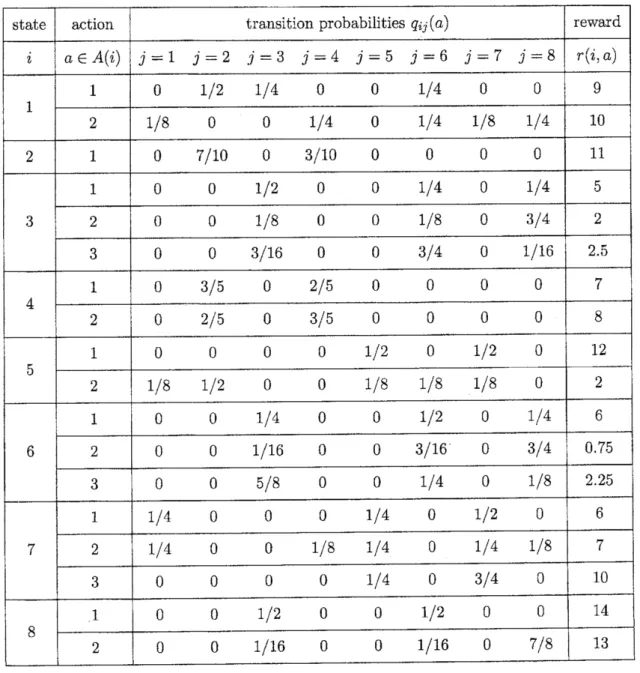
Let
us
find theoptimality policy for the eight-state MDP with$S=\{1,2,3,4,5,6,7,8\}$and $A(1)=\{1,2\}$,$A(2)=\{1\}$,$A(3)=\{1,2,3\}$,$A(4)=\{1,2\}$,$A(5)=\{1,2\}$,$A(6)=$
$\{1,2,3\}$,$A(7)=\{1,2\}$ and $A(8)=\{1,2,3\}$, whose transition probability matrix and
rewards
are
given in Table4.1.
Table 4.1: A numerical example
$M=(m_{ij})$ in (2.2) and $\overline{M}=(\overline{m}_{ij})$ in (2.3)
are
easily computed, whichare
shownas
follows.
123 4 5 6 7 $\mathrm{s}$ 123 4 5 6 7 8
M $=$
86543271
$\ovalbox{\tt\small REJECT}$0000011100001111000011110000111100000011
0OOIIIII
0000011100011111
$\ovalbox{\tt\small REJECT}$ ,$\overline{M}=$
37654821
$\ovalbox{\tt\small REJECT}$00000111
00011111
00111111
0001111100000111
00111111
0000011100111111
$\ovalbox{\tt\small REJECT}$.
By reorderingofthe states, $\overline{M}$
is transformed
as
follows (abusing the notation).3 6 s 2 4 1 5 7
$\overline{M}=$
43728651
$\ovalbox{\tt\small REJECT}-.---,\ulcorner^{---\neg---}\downarrow---arrow"‘---.\ovalbox{\tt\small REJECT} 11111_{\iota}^{\mathfrak{l}}11_{\iota}^{t}|011_{j}^{1}1111111111111111\tilde{1}\overline{1}\overline{1}\overline{1}1\overline{1}\overline{1}\overline{1}0^{\mathrm{I}}111_{1}^{1}0\mathfrak{l}11\mathrm{i}.11$,Observing the above, we have
$S=U_{01}+U_{02}+L$,
where $U_{01}=\{3_{7}6, 8\}\rangle U_{02}=\{2,4\}$, $L=\{1,5,7\}$.
Now,
we
apply Algorithm $\mathrm{B}$ to $L=\{1, 5, 7\}$. For $n=1$,we
get the following:$K_{1}=L=\{1,5,7\}$,$V=S-K_{1}=\{2,3,4,6_{2}8\}$,$T(1)=\{1,2\}$,
$T(5)=\{2\}$,$T(7)=\{2\}$,$A_{1}(1)=\emptyset$,$A_{1}(5)=\{1\}$,$A_{1}(7)=\{1, 3\}$.
So that $K_{2}=\{5,7\}$. Thus,
we
have found the maximum sub-MDP:$\Gamma_{1}=(S_{1}=\{5,7\})\{A_{1}(\mathrm{i}) : \mathrm{i}\in S_{1}\}$,$Q_{S_{1}}$,
$r_{S_{1}}$$)$.
Applying Algorithm A to Fi,
we
find that $\Gamma_{1}$ is communicating. In the end, thedecomposition of$S$ in (2.7) is shown
as:
$S=U_{01}+U_{02}+U_{11}+L$ with $L=\{1\}$ and data211
Table 4.2; Relatively $0.\mathrm{p}$. and $\mathrm{a}.\mathrm{r}$. for a numerical example
Here, to find
an
optimal policy, we apply Algorithm $\mathrm{C}$ to Table 4.2, Since, $/\mathrm{o}\mathrm{i}$ and/02
are
absolutely optimal, it holdsthat $g_{01}$$(n)=11.333$ and$g_{02}(n)=9.714$ for all$n$$\geqq 1$
and $f^{*}(3)=f^{*}(6)=f^{*}(8)=2$,$f^{*}(2)=1$,$f^{*}(4)=2$. For $n=1$,$g_{11}(1)=$
10.667
and$g_{1}(1)=v\{d_{1}\}(1)=$ lC1776 is obtained
as
a unique solution of the following equationfrom Lemma 3.1:
$g_{1}(1)= \max\{\frac{1}{2}g_{01}(1)+\frac{1}{2}g_{02}(1)$, $\frac{1}{2}g_{01}(1)+\frac{1}{4}g_{02}(1)+\frac{1}{8}g_{11}(1)+\frac{1}{8}g_{1}(1)\}$
$= \max\{10.524,9.429$$+ \frac{1}{8}g_{1}(1)\}$ .
By $(3,2)$,
we
get that $g_{5}=$10.667
and $g_{7}=10,694$.
So, $g_{11}(2)= \max\{g_{5}, g_{7}\}=10.694$and $g_{1}(2)=$
10.776.
Similarly,we
get that $g_{11}(3)=10.794$,$g_{1}(3)=10.779$ and $g_{11}(4)=$10.731,$g_{1}(4)=$
10.782.
We proceed withrepeating thestep $n$until $|g_{11}(n)-g_{11}(n+1)|<$$\epsilon=10^{-4}$ and $|g_{1}(n)-g_{1}(n+1)|<\epsilon$ simultaneously. Then, we find that $\overline{g}_{11}\cong 10.794$
and $\overline{g}_{1}\cong$
10.794.
From Theorem 3.1,we
get optimal policy in other statesas
$f^{*}(5)=$$1$,$f^{*}(7)=3$,$f^{*}(1)=2$ and the optimal value $\psi^{*}(3)=\psi^{*}(6)=\psi^{*}(8)=11.333$ $\psi^{*}(2)=$
$\psi^{*}(4)=$ 9.714,$\psi^{*}(5)=\psi^{*}(7)\cong 10,794,$$\psi^{*}(1)\cong 1$(1794
Appendix
ProofofLemma 2.1
Let $\overline{D}$ be
a
communicating class. By the definition,$\overline{D}$ is closed, so that for $\mathrm{i}\in\overline{D}$ and
$j\not\in\overline{D}$, $P_{\pi}(X_{t}=j|X_{0}=\mathrm{i})=0$ for all $t\geqq 1$ and $\pi\in\Pi$, which
means
$\overline{m}_{ij}(\overline{\Gamma})=0$. Also,
there exists a randomized stationary policy $\gamma$ such that
$Q_{\overline{D}}(\gamma)$ determines
a
irreducibleMarkov chain, so that for $\mathrm{i},j\in\overline{D}$, $P_{\gamma}(X_{t}=j|X_{0}=\mathrm{i})>0$ for
some
$t(0\leqq t\leqq N)$.Thus, $\overline{m}_{ij}(\overline{\Gamma})=1$ follows for $\mathrm{i},j\in\overline{D}$. The proof ofthe “if” part follows
$\mathrm{o}\mathrm{b}\mathrm{v}\mathrm{i}\mathrm{o}\mathrm{u}\mathrm{s}1\mathrm{y}_{1}$.
Proof ofTheorem 2.1
Let $U_{j}$ and $L$ be the sets of states corresponding to $E_{j}$ and $K$ in (2.4), respectively,
$(1 \leqq j\leqq d)$. Then, from Lemma 2.1, $U_{j}$ is
a
communicating class. If $L$ is closed,$\overline{\overline{\Gamma}}=$
$(L, \{\overline{A}(\mathrm{i}) : \mathrm{i}\in L, Q_{L}, r_{L})\}$ is a sub-MDP. Applying the above discussion,
we
get$\overline{M}(\overline{\overline{\Gamma}})$is
rewritten into a matrixwhich has the
same
structureas
(2.4), which isa contradiction..
Proof ofLemma 3.1
By (2.9), (i) clearly holds (cf. [3]). Also, (ii) follows from the definition. Let $d\leqq d’$.
.
Then, we have thatThis completes the proofof (iii).1
Proof of Lemma 3.2
Since $Usj$ is a communicating class, by the definition for each $\mathrm{i}\in U_{sj}$, there exists
$a\in A(\mathrm{i})$ such that $q_{i}(U_{sj}|a)=1$, which implies from (3.2) that $g_{i}\geqq g_{sj}(n)$. So, we get $g_{sj}(n+1)\geqq g_{sj}(n)$. Also, Lemma
3.1
(Hi), from $d_{n}\geqq d_{n-1}$ it follows that $g_{i}(n+1)=$$v\{d_{n}\}(\mathrm{i})\geqq v\{d_{n-1}\}(\mathrm{i})=g_{i}(n)$ for $\mathrm{i}\in L$. Since $\{g_{sj}(n)\}$ and $\{g_{i}(n)\}$
are
bounded, (ii)follows from (i). 1
Proofof Theorem 3.1
For any stationary policy $f$, let denote by $Q(f)$ the corresponding transition matrix.
The decomposition of the state space $S$ w.r.t. $Q(f)$ will be denoted by
$S=O_{1}+\cdots+O_{l}+L’$,
where $O_{i}(i=1,2, \ldots, l)$ is
an
ergodic class and $L’$ is a transient class (cf. [9]). For each$O_{k}$, since $L$ is a transient class it is impossible that $O_{k}\subset L$. Thus, recalling that each
$Usj$ is a maximum communicating class, $O_{k}\subseteq U_{sj}$ for
some
$(s,j)\in \mathcal{K}$, which implies $\psi(\mathrm{i}, f)\leqq\overline{g}_{sj}$ for $\mathrm{i}\in O_{k}$. Also, by (3.5)-(3.6)$)$
$\psi(i, f)\leqq\psi(\mathrm{i}, f^{*})$for $\mathrm{i}\in L’$. Theotherhalf
part of theorem holds obviously.i
References
[1] John Bather. Optimal decision procedures for finite Markov chains. II.
Communi-cating systems. Advances in AppL Probability, 5:521-540,
1973.
[2] Richard Bellman. Dynamic programming. Princeton Univeristy Press Princeton,
N. J.,
1957.
[3] Eric V. Denardo. Contractionmappings in the theory underlying dynamic
program-ming. SIAMRev., 9:165-177,
1967.
[4] Eric V. Denardo. Dynamic programming: models and applications, Prentice-Hall,
Inc., Englewood Cliffs, N. $\mathrm{J}_{\}}$
.1982.
[5] A. Federgruen and P. J. Schweitzer. Discounted and undiscounted value-iteration
in Markov decision problems: a survey. In Dynamic programming and its
applica-tions (Proc. Conf.,. Univ. British Columbia, Vancouver, B. C., 1977), pages 23-52,
Academ ic Press, New York,
1978.
[6] A. Hordijk and L. C. M. Kallenberg. Linear programming and Markov decision
chains. Management Sci., 25(4):352-362, 1979/80.
[7] Arie Hordijk and Martin L. Puterman. On the convergence of policy iteration in
finitestateundiscounted Markovdecision processes: theunichain
case.
Math, Oper.213
[8] Ronald A. Howard. Dynamic programming and Markov processes. The Technology
Press ofM.I.T., Cambridge, Mass., 1960.
[9] John
G.
Kemeny andJ. LaurieSnell. Finite Markov chains. The University Series inUndergraduate Mathematics. D. Van Nostrand Co., Inc., Princeton,
N.J.-Toronto-London-New York, 1960.
[10] Arie Leizarowitz. An algorithm to identify and compute average optimal policies in
multichainMarkov decision processes. Math. Oper. Res., 28(3):553-586, 2003.
[11] Martin L. Puterman. Markov decision processes: discrete stochastic dynamic
pro-grarnming. John Wiley
&
Sons Inc., New York, 1994. A Wiley-IntersciencePubli-edition,
[12] Paul J. Schweitzer. Iterative solution of the functional equations of undiscounted
Markov renewal programming. J. Math. Anal Appl, 34:495-501, 1971.
[13] E. Seneta. Nonnegaiive matrices and Markov chains. Springer Series in Statistics.
Springer-Verlag, New York, second edition,
1981.
[14] D. J. White. Dynamic programming, Markov chains, and the method of successive