Combinatorial
structure
of
group
divisible designs
and their
constructions
Tomoko
Adachi
DepartmentofInformation Sciences, Toho University
2-2-1 Miyama, Funabashi, Chiba, 274-8510, Japan
E-mail: [email protected]
Abstract Group divisible (GD) designscanbe classified into the threetypes (1)singular, (2)
semi-regular and (3) regular, where the first case holds iff$r=\lambda_{1}$. Since $r\geq$ $\lambda_{1}$ always holds, the case
$r$ $>\lambda_{1}$ willcoverthe other two types. In this paper, at first, thecombinatorialstructureofGDdesigns
with $r\geq\lambda_{1}+1$isdiscussed. Next, the combinatorial structure ofGD designs isdiscussedfrom another
point of viewof assuminglocal structurein each group. We characterize GD designs bya new point
ofview and provide
some
constructions ofregular GD designs basedon
the characterization.Keywords: Group divisibledesign; Balanced incomplete block design;Hadamardtournament;Strongly
regulargraph
1. Definition and classification of group divisible designs
Let $V$ bea finiteset and
6
bea
collection of subsets of thesame
sizeof$V$. A pair $(V, B)$ is calleda blockdesign,
or
simplya
design. Elements of$V$ and$B$are
calledpointsand blocks, respectively. Let$v=|V|$ and $b$ $=|B|$
.
In discussingthe combinatorial problems on designs, weadopt the terminology“points” instead oftreatments used usually. For a block design $(V, B)$, let $V=\{p_{1},p_{2}, \cdots,p_{v}\}$ and
$B$ $=\{B_{1}, B_{2}, \cdots, B_{b}\}$, and the $v\mathrm{x}$ $b$ matrix $N=(n_{ij})$, called
an
incidence matrix ofa
blockdesign$(V, B)$, is defined
as
$n_{\mathrm{i}j}=1$when$p_{i}\in B_{j}$, and$n_{ij}=0$when$p_{i}\not\in B_{j}$.
The complement ofa
designwiththe incidence matrix $N$ is the design with the incidence matrix $\overline{N}$ which is obtained by exchanging
$\mathrm{O}’ \mathrm{s}$and I’sin$N$
.
Now a group divisible (GD) design is defined. Let $u=mn(m,n\geq 2)$, $b$, $r$, $k$, $\lambda_{1}$, $\lambda_{2}$ be positive
integers. A $GD$ designwith parameters$v=mn$, $b$, $r$, $k$, $\lambda_{1}$, $\lambda_{2}$ is
a
triplet$(V,B\mathcal{G}\})$, where$V$ isatf-setofpoints, $B$is
a
collection of$bk$-subsets, called blocks, of$V$ and $\mathcal{G}=\{G_{1}, \cdots, G_{m}\}$ isapartition of$V$into$m$
groups
of$n$ points eachsuch that anytwo distinct pointsinthesame
groupoccur
together inexactly $\lambda_{1}$ blocksof$B$, while thosein different groups
occur
together inexactlyA2
blocks ofS.
Here,$r$ is the number ofblocks containing
a
given point. Note that $r$ is a constant not dependingon
thepoint chosen. Among parameters ofaGD design, it holds that
$bk$$=$vr (1.1)
$\lambda_{1}$$(n-1)$ $+\lambda_{2}n(m-1)$ $=r(k-1)$
.
(1.2)When$\lambda_{1}$ equals$\lambda_{2}$, aGDdesign is calleda balancedincomplete block (BIB) designwith parameters $v$, $b$, $r$, $k$, A $(=\lambda_{1}=\lambda_{2})$, whichsatisfy (1.1) and
$r(k-1)$ $=$A$(v -1)$. (1.3)
Let $N$bean incidence matrix ofaGD design and$N^{l}$ be the transpose of$N$. In the analysis ofthe
design ofexperiment, the eigenvalues of the matrix $NN’$ play
an
important role. For the incidencematrix $N$ofaGD design with parameters $v$, $b$, $r$, $k$, $\lambda_{1}$ and $\lambda_{2}$, the determinant of$NNf$ is given by
$|NN’|=rk(r-\lambda_{1})^{m(n-1)}(rk -v\lambda_{2})^{m-1}$
and the eigenvalues of $NN’$ are $rk$, $r-\lambda_{1}$, $rk-$ VX2 with multiplicities 1, $m(n-1)$ and $m-1$,
respectively (see,forexample, Raghavarao [14, pp.127-128]).
Bose and Connor [7] classified GD designs into three types in terms of the eigenvalues of$NN’$ as
follows:
(1) Singular if$r-\lambda_{1}=0$,
(2) Nonsingular if$r-\lambda_{1}>0$
(2a) Semi-regular if$rk-v\lambda_{2}=0$
(2b) Regular if$rk-v\lambda_{2}>0$.
Now,we briefly explain propertiesforeach typeofGD designs. We refer thereader to [5] and [11]
forrelevant design-theoretic terminology.
(i) Singular group divisible designs
SingularGD designs
are
characterized by the relation$r=\lambda_{1}$.
It is obvious that theexistence ofa
BIB design with parameters $v^{*}$, $b^{*}$, $r^{*}$, $k^{*}$, $\lambda^{*}$ is equivalent to the existence ofa singularGD design
with parameters $v=v^{*}n$, $b=b_{7}^{*}r=r^{*}$, $k=k^{*}n$, $\lambda_{1}=r^{*}$, $\lambda_{2}=\lambda^{*}$ for every$n$, since the$n$points in
the
same
group ofasingularGDdesignmust occurinthesame
blockby therelation$r=\lambda_{1}$. Hence,asingular
GD
designis derivable from acorrespondingBIB design.(ii) Semi-regular group divisible designs
Semi-regular GD designs are characterized by the relations $r>\lambda_{1}$ and $rk=\mathrm{v}\mathrm{X}2-$ In this case,
the matrix $NN’$ has the eigenvalue 0with multiplicity $m-$ $1$, and then$v-m+1=$ rank(N#’) $=$
rank(TV) $\leq b$
.
Hence, it follows that $b\geq v-m+1$ holds for asemi-regular GD design.Bose and Connor [7] showed that the block size $k$ is divisible by $m$ for
a
semi-regularGD
designand that,if$k=cm$, every block contains $\mathrm{c}$pointsfromeachgroup (see,for example,Raghavarao [14,
p.132, Theorem 8.5.6]).
Especially in
case
of $c=1$, a semi-regular GD design is referred to as a transversal design. Atransversaldesign with parameters
$v=mn$,$b=n^{2}\lambda_{2}$,$r=n\lambda_{2}$,$k=m$,$\lambda_{1}=0$,A2,$m$,$n$ (1.4)
is equivalent to an “orthogonal array of strength 2.” Moreover, the existence ofa transversal design
with parametersgiven in (1.4) implies the existence of the semi-regular GD design with parameters
$v=m_{1}n$, $b=n^{2}\lambda_{2}$, $r=n\lambda_{2}$, $k=m_{1}$, $\lambda_{1}=0$, $\lambda_{2}$,
$m_{1}$, $n$, where $m_{1}$ can be any integer satisfying
$0<m_{1}<m$. A transversal design is alsoobtained by considering the dual structure of an “affine
resolvable BIB design” (see, for example, Raghavarao [14]). For constructions ofa semi-regular GD
design with$c>1$,
see
[10].(iii) Regular
group
divisible designsRegular GD designs
are
characterized by the property $r>\lambda_{1}$ and $rk>\mathrm{v}\mathrm{X}2$.
By considering therank of$NN’$, it follows that $v\leq b$holds in the
case
ofa
regular GD design similarly to thecase
ofa
Several methods of constructingGD designs are given by Bose etal. [9]. There
are
also methodsof constructing regular GD designs from known BIB designs. For example, by omitting the blocks
containing agiven point $\theta$ of
a
BIB design with parameters $v^{*}$, $b^{*}$, $r^{*}$, $k^{*}$, $\lambda^{*}=1$, weobtain a GDdesign with param eters $v=v$’ – 1, $b=b^{*}-r^{*}$, $r=r^{*}-1$, $k=k^{*}$, $m=r^{*}$, $n=k^{*}-1$, $\lambda_{1}=0$,
$\lambda_{2}=1$
.
Here,
we
will state several known constructions of regular GD designs in connection with ourconstructions in this thesis. In view of the existence of the “affine resolvable BIB designs” with
parameters $v^{*}=s^{2}$, $b^{*}=s(s+1)$, $r^{*}=s+1$, $k^{*}=s,$ $\lambda^{*}=1$ when $s$ is aprimeor a primepower, it
can
beseen
thata
seriesof symmetric regularGD designs with parameters $v=b=s^{2}-1$, $r=k=s$,$m=s+1$,$n=s-1$, $\lambda_{1}=0$, $\lambda_{2}=1$ alwaysexists.
Ageometricalmethodof constructing symm etricregular GDdesigns is givenbySprott [20]. When
$s$ is aprime
or a
prime power, there exists aregular symmetric GD designwith parameters $v=b=$$s(s-1)(s^{2}+s+1)$, $m=s^{2}+s+1$, $n=s(s-1)$, $r=k=s^{2}$, $\lambda_{1}=0$, $\lambda_{2}=1$
.
We can also construct
a
GD design by the method of differences. The scope of the method ofdifferences canbe further extendedbyusing the concepts of the partial cycleofRao [15]. Arasu and
Pott [4]
gave
constructions of symmetric GD designs using “divisible difference sets.”Many studies for symmetric GD designs have been taken by Ryser $[16, 17]$, Bose [6], Bose and
Shrikhande[8] ,Sathe andPradhan [18],and so
on.
Ourresults in this paper also presentconstructionsofGD designs including
a
symmetriccase.
2. Group divisible designs with $r\geq\lambda_{1}+1$
For
a
singular GD design $r=\lambda_{1}$ holds, while in case ofanonsingular GD design $r>\lambda_{1}$ holds. Itmay benatural toinvestigatethe
case
of$r=\lambda_{1}+1$, since it mayhavesome
interconnecting property(the next saturated case) between singular and nonsingular
cases.
Inthissection,
we
will characterizethecombinatorial structure ofGD designswith$r=\lambda_{1}+1$, andthat of GD designs with $r=\lambda_{1}+2$ and $n=3,4$
.
All the results in this section are due to [19], $[13^{1}\mathrm{J}$,[1] and [2].
To state theresults,
we
will givesome
basic notations. We denote the identity matrix oforder $s_{2}$an$s\mathrm{x}t$ matrix all of whose elements areunity and
an
$s\mathrm{x}t$matrix all of whose elements
are
zero, by $I_{s}$, $J_{s\mathrm{x}t}$ and$\mathit{0}_{s\mathrm{x}t}$, respectively. Irt particular, let $J_{s}=JsXs$ and $O_{\theta}=O_{s)(S}$.
Moreover,$\mathrm{i}\mathrm{e}\mathrm{t}$
$1_{n}=$Jixn
and $0_{n}=\mathit{0}_{1\cross n}$
.
Hence the above $\overline{A}=1_{v}’1_{b}-A=JvXb$ - $A$. Here $1_{n}’$means
the transpose of$\mathrm{l}\mathrm{n}$.
$A$(&B denotes the kroneckerproduct ofmatrices $A$ and $B$.
A symmetric BIB design with parameters $v$, $k=(v-1)/2$, $\lambda=(v-3)/4$ is called
a
Hadamarddesign. For
a
tournament, i.e.,a
completesimpledigraph, with the$vxv$ adjacency matrix$N$, if$N$istheincidence matrix of
a
Hadamard design, thenthe tournament iscalleda
Hadamard tournamentof
order$v$ (see [11]). A simple undirected graph iscalled
a
strongly regular graphiffor anytwo distinctvertices$\mathrm{i}$and$j$,there
are
$p_{11}^{1}$or
$p_{11}^{2}$ verticeswhichare
connectedtobothof vertices2 and$j$,accordingas $i$ and $j$
are
connectedor
not. We refer the reader to [12] and [21] for relevant graph-theoreticterminology.
2.1. Group divisible designs with
r
$=\lambda_{1}+1$The combinatorialproperty ofaGD design with$r=\lambda_{1}+1$
was
first investigated byShimata andKageyama [19] who showed that aGD design with$r=\lambda_{1}+1$ must besymmetric and regular. Jimbo
and Kageyama [13] completely characterized a GD design with $r=\lambda_{1}+1$ in terms of Hadamard
tournaments andstrongly regular graphs.
In fact, in
a
GD design with parameters $v=mn(m,n\geq 2)=b$, $r=k=\lambda_{1}+1$, $\lambda_{2}$, by theresultgiven in [19],the$v\mathrm{x}v$ incidence matrix$N$ofthe
GD
design is dividedintosuch as $N=(N_{xj})$, where $N_{11}=N_{22}=\cdots=N_{mm}=I_{n}$ or $J_{n}-I_{n}$, and $N_{\mathrm{i}j}=J_{n}$ or $\mathit{0}_{n}$for $\mathrm{i}\neq j$.
The incidence matrix $N$is completely characterized interms ofHadamard tournamentsand strongly
regulargraphs fromthe viewpoint oftheconstruction as follows.
Theorem 2.1 (Jimboand Kageyama [13]). Let N be the incidence matrnx
of
a
regular GD designwithr $=\lambda_{1}+1$ or
of
its complementsuch that$N_{ii}=I_{n}$for
anyi.(i) When$n\geq 3$ and$\lambda_{2}\equiv 2$ (mod$n$), theincidencematrix
of
thedesign is givenby$N=I_{m}\otimes I_{n}+(J_{m}-$$I_{m})\otimes J_{n}$
for
general $m$ and $n$, which leads to a symmetric regular $GD$ design with parameters$v=b=mn$, $r=k=\{m-1$)$n+1$, $\lambda_{1}=(m-1)n$,
A2
$=(m-2)n+2$ .(ii) When$n\geq 2$ and$\lambda_{2}\equiv 1$ (mod $n$) $(\mathrm{i}.e.,$ $v=b=mn$,
$r=k=n(m-1)/2+1$
, $\lambda_{1}=n(m-1)/2$,$\lambda_{2}$ $=n(m-3)/4+1)$$C$the existence
of
the design is equivalent to the existenceof
a Hadamardtournament
of
order$m\equiv 3$ (mod 4).(iii) When$n=2$ and $\lambda_{2}$ is even $(\mathrm{i}.e., v=b=2m, r=k=2s+1, \lambda_{1}=2s, \lambda_{2}=2s^{2}/(m-1))$ $C$the
existence
of
the designis equivalent to the existenceof
a strongly regular graph with parameters$v=m$, $k=s,$ $p_{11}^{1}=x$, $p_{11}^{2}=x+1$, where$s^{2}=(x+1)(\mathrm{m}-1)$. Fence A$2=2(x+1)$
.
Remark. A regular GD design exists only when the parameters satisfy the conditions (i), (ii) or(iii).
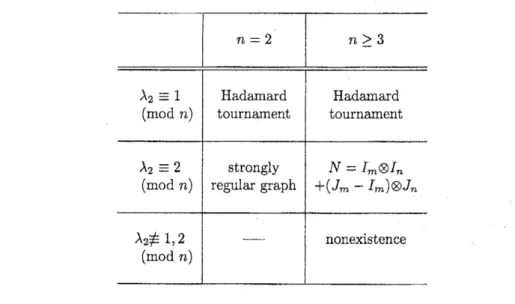
Theorem 2.1reveals that the inner structure ofGDdesigns with$r=\lambda_{1}+1$ischaracterizedinterms
of Hadamard tournaments and strongly regular graphs,
as
in Table 1. For Hadamard tournamentsand strongly regular graphs, there
are
some available existenceor
non-existence results.
Hence, theexistenceornonexistence problem of
GD
designs with$r=\lambda_{1}+1$can
be reduced to thoseof Hadamardtournaments and strongly regular graphs.
Table 1: The combinatorial structureofGD designs with$r=\lambda_{1}+1$
$n=2$ $n\geq 3$
$\ovalbox{\tt\small REJECT}_{-}^{(\mathrm{m}\mathrm{o}\mathrm{d} n)\mathrm{t}\mathrm{o}\mathrm{u}\mathrm{r}\mathrm{n}\mathrm{a}\mathrm{m}\mathrm{e}\mathrm{n}\mathrm{t}\mathrm{t}\mathrm{o}\mathrm{u}\mathrm{r}\mathrm{n}\mathrm{a}\mathrm{m}\mathrm{e}\mathrm{n}\mathrm{t}}\lambda_{2}\not\equiv 1,2\mathrm{n}\mathrm{o}\mathrm{n}\mathrm{e}\mathrm{x}\mathrm{i}\mathrm{s}\mathrm{t}\mathrm{e}\mathrm{n}\mathrm{c}\mathrm{e}\lambda_{2}\equiv 2\mathrm{s}\mathrm{t}\mathrm{r}\mathrm{o}\mathrm{n}\mathrm{g}\mathrm{i}\mathrm{y}N=I_{m}\otimes I_{n}\lambda_{2}\equiv 1\mathrm{H}\mathrm{a}\mathrm{d}\mathrm{a}\mathrm{m}\mathrm{a}\mathrm{r}\mathrm{d}\mathrm{H}\mathrm{a}\mathrm{d}\mathrm{a}\mathrm{m}\mathrm{a}\mathrm{r}\mathrm{d}(\mathrm{m}\mathrm{o}\mathrm{d} n)(\mathrm{m}o\mathrm{d}n)\mathrm{r}\mathrm{e}\mathrm{g}\mathrm{u}1\mathrm{a}\mathrm{r}\mathrm{g}\mathrm{r}\mathrm{a}\mathrm{p}\mathrm{h}+(J_{m}-I_{m})\otimes J_{n}$
As the next interesting
case we can
consider a GD design with $r=\lambda_{1}+2$.
However,a
generalcharacterization
seem
$\mathrm{s}$tobedifficult. Thenapartialcase
has been taken. GD designs with$r=\lambda_{1}+2$and $n=3$ are characterized by Adachi [1], who shows that in
a
GD design withparameters $v=3m$ $(m\geq 2)$, $b$, $r(=\lambda_{1}+2<b)$, $k$, A2) in which$r=\lambda_{1}+2$ and $n=3$, the$v\mathrm{x}$$b$ incidence matrix $N$ofsuch aGD designis, after an appropriate permutation ofcolumns, divided into $m^{2}3\mathrm{x}6$submatrices
such as$N=(N_{ij})$, where$N_{11}=N_{22}=\cdots=N_{mm}=(I_{3}$ :
#3
$)$ or$(J_{3}-I_{3} : J_{3}-I_{3})$, and$N_{ij}$ (\^i j) isa
matrix in$ll$ $=$
{
$1_{3}’\otimes(x_{1},x_{2}$,Z3,$\overline{x}_{1}$,$x-2,\overline{x}_{3}$)$|x_{\dot{\mathrm{z}}}=0,1,\overline{x}_{i}=1-x_{i}$,$\mathrm{i}=1,2,3$}
$\cup\{O_{3\cross 6}, J_{3)\mathrm{e}6}\}$.
Moreoverin this case, it holds that $b=2\mathrm{w}$. Therefore,
we
obtain that thereare no
symmetric GD designssatisfying$r=\lambda_{1}+2$ and $n=3$.
As the next characterization, we will investigate the combinatorial structure of GD designs with
$r=\lambda_{1}+2$ and $n=4$
.
Let $N$ be the $v\mathrm{x}b$ incidence matrix of a GD design with parameters $v=4m(m\geq 2)$, $b$, $r$ $(=\lambda_{1}+2<b)$, $k$, $\lambda_{1}$, $\lambda_{2}$. Further let $\mathcal{H}_{1}=\{1_{4}’\otimes(x_{1}, 2, x_{3}, x_{4},\overline{x}_{1},\overline{x}_{2},\overline{x}_{3},\overline{x}_{4})|x_{i}=0,1,\overline{x}_{i}=$
$1-x_{i},\mathrm{i}=1$,2, 3,
4}
$\mathrm{U}\{O_{4\mathrm{x}8}, J_{4\cross 8}\}$ andGt2
$=${
$1_{4}^{l}\otimes(x_{1},x_{2},x_{3},x_{1}$,$x_{2}$,X3)$|x_{i}=0,1$,$\mathrm{i}=1,2$,3}.
Thentfiefollowing main theorem can beestablished.
Theorem 2.2 (Adachi, Kageyama and Jimbo [2]). A $GD$ design with $r=\lambda_{1}+2$ and $n=4$ is
regular and its $v$xb incidence matrix $N$ is,
after
an appropriate permutationof
rows and columns,divided into$m^{2}$ submatrices as
follows:
$N=$ $(\begin{array}{llll}N_{11} N_{12} N_{\mathrm{l}m}N_{21} N_{22} N_{2m}\vdots \vdots \ddots \vdots N_{m1} N_{m2} N_{mm}\end{array})$ , $\langle$2.1)
where$N\{j$ satisfy one
of
the following:(i) For$\mathrm{i}\neq j$, $N_{ij}$ are 4x8 matrices in$\mathcal{H}_{1}$ and
$N_{11}=N_{22}=\cdots=N_{mm}=$$(I_{4} : I_{4})$ or (J4–$I_{4}$ : $J_{4}-I_{4}$).
Inthis case, $b=2v$ holds
(ii) For\^i $\mathrm{j}$, $N_{\dot{x}j}$ are$4\mathrm{x}6$ matrices in$\mathcal{H}_{2}$ and
$N_{11}=N_{22}=$ .$..=N_{mm}=(\begin{array}{llllll}1 1 1 0 0 01 0 0 0 1 10 \mathrm{l} 0 1 0 10 0 1 1 1 0\end{array})$ ($=S$,say).
In this case, $b=3v/2$ holds
Remark. There are
no
symmetricGD designs satisfyingr $=\lambda_{1}+2$ and n $=4$.
The difficulty of a characterization of GD designs with $r=\lambda_{1}+2$ and general $n(\geq 5)$ is to have
to take into account possible complicated inner structure with $n$
rows
corresponding to each grouppartitioning
a
set of$v$ points. On account of such complexity, the structure willnot be able to becharacterizedinageneral form. Hence
we
may have todeviseanother approach toa
characterizationofGD designs with$r=\lambda_{1}+2$.
Once
the value of$n$ is given, acharacterization ofGD designsin thisset-up may be possible after tedious consideration. However, its task is troublesome and sometimes
3. Group divisible designs without $\mathrm{a}$-resolution class
Inthis section,wewillcharacterize the combinatorial structureofGDdesignswithout “$\mathrm{a}$-resolution
class” in eachgroup. All the results in this section
are
dueto [3].3.1. Definition ofana-resolution class
Inthis subsection,
we
define an $(r, \lambda)$-design and ana-resolutionclass, which will beutilizedwhenwe
considersome
substructureineachgroupofGD designs.For positive integers $v$, $r$, $\lambda$, an $(r, \lambda)$-designwith parameters $v$, $r$, A is
a
pair $(V, B)$ where $V$ isa
v-set of points and $B$ is acollection ofsubsets of$V$ such that every point of$V$ occursin $r$ blocks of
$B$, and that anytwo distinct pointsof$V$
occur
together inexactly A blocks of$B$.
In particular, whenevery block has the
same
size ($=k$, say), an $(r, \lambda)$-designis exactlya
BIB design.For
a
subcollection $B’(\subset B)$, if every point of$V$ occurs in exactly a blocks $(1\leq \mathrm{a}\leq r)$ in $B^{t}$, then$B’$ iscalled an$\alpha$-resolntion class of $(V, B)$. An a-resolution class is said to be trivial when$\alpha=r$, and
nontrivialwhen $1\leq\alpha\leq r-1$
.
In thispaper,ana-resolution classimpliesa nontrivial a-resolution classif it is not specified.
Here,
we
will give examplesofa-resolution classes, in whichone
has nontrivial $\mathrm{a}$-resolution class,while the other does not.
Example 3.1. Thefollowing design is
a
$(3,1)$-design with nontrivial 1-resolution classes.S$=$ $(\begin{array}{llllll}1 1 1 0 0 01 0 0 0 1 10 1 0 1 0 10 0 1 1 1 0\end{array})$
Example 3.2. Thefollowing design is a $(3,1)$-design withno nontrivial a-resolution class.
T$=\ovalbox{\tt\small REJECT}$
0010011
0100011
00001110000111000011100001110000111
$\ovalbox{\tt\small REJECT}$3.2, Combinatorial structure of thesedesigns
Let $N$ be the $v$xb incidence matrix of
a GD
design with parameters $v=mn(m, n\geq 2)$, $b$, $r$$(<b)$, $k$, $\lambda_{1}$, $\lambda_{2}$. Any groups$G_{l}(l=1,2, \cdots, m)$ ofthe GD design have the $n\mathrm{x}b$ incidencematrices
$B_{l}=$ $(N_{l}^{*} : J : O)$ after appropriate permutations of columns, where $N_{l}^{*}$
are
the incidence matricesof$(r_{l}^{*}, \lambda_{l}^{*})$-designs withparameters $v_{l}^{*}=n$, $b_{l}^{*}$, $r_{l}^{*}(<b_{l}^{*})$, $\lambda_{l}^{*}(<r_{l}^{*})$ and withblock sizeslessthan$n$.
In this paper,
we
suppose that all $(r_{l}^{*}, \lambda_{l}^{*})$-designs with the incidence matrices $N_{l}^{*}$ do not have any$\alpha$-resolution classes, if not specified. Wecallsuch design aGDdesign without
$\alpha$-resolutionclasses in
each group. Then thefollowing twomain theorems
can
be established.Theorem 3.1 (Adachi, Jimbo and Kageyama [3]). Suppose that a
GD
design without a-resolutionmatrix$N$
of
the $GD$ design is,after
an appropriatepermutationof
rowsandcolumns, representedby$N=($ $o_{n\mathrm{x}b}o_{n\mathrm{x}b}^{N_{1}^{*}}.\cdot.$
;
$oo$ $N_{2}^{*}n.\cdot.\mathrm{x}b^{*}n\cross b.$’
$\cdot$
.. $o_{n\mathrm{x}b}^{n\mathrm{x}b}o_{N_{m}^{*}}.\cdot.:$
)
$+D\otimes J_{n\mathrm{x}b}\cdot$, (3.1)where all
of
$N_{l}^{*}$ are the incidence matricesof
$BIB$ designs with thesame
parameters$v_{l}^{*}=n$, $b_{l}^{*}=b^{*}$,$r_{l}^{*}=r^{*}$, $k_{l}^{*}=k^{*}$, $\lambda_{l}^{*}=\lambda^{*}$, and$D=(\mathrm{d}\mathrm{i}\mathrm{j})$ is an$m\mathrm{x}m$ matrixwith entries0 or 1 and$d_{\tau i}=0$
for
all$\mathrm{i}$.
Since$N$ is theincidencematrix ofa GD design, each
row
of$D$ has the samenumber of 1’s. Let $s$$(\geq 1)$ be the number of 1’s in each rowof $D$. For convenience,
we
denote the first term of (3.1), bydiag$(N_{1}^{*}, N_{2}^{*}, \cdots, N_{m}^{*})$.
Theorem 3,2 (Adachi, Jimboand Kageyama[3]). Let$N$ be theincidence matr$x(3.1)$
of
a $GD$de-signwithout$\alpha$-resolutionclasses in each group. Thenthe $GD$designis regular and$N$ ischaracterized
as
follows:
(i) When $b^{*}\neq 2r^{*}$ and $\lambda_{2}\equiv 0$ (mod $b’$), the incidence matrix
of
the $GD$ design is given by $N=$Iiag$(N_{1}^{*}, N_{2}^{*}, \cdots,N_{m}^{*})$
for
general$m$ and $n$, that is, $D=O_{m}$, which leads to a $GD$ design withparameters $v=mn$, $b=mb^{*}=mnr^{*}/k^{*}$, $r=r^{*}$, $k=k^{*}$, $\lambda_{1}=r^{*}(k^{*}-1)/(n-1)$, $\lambda_{2}=0$.
(ii) When $b^{*}\neq 2r^{*}$
ant
$\lambda_{2}\equiv 2r^{*}$ (mod $b^{*}$), the incidence matrixof
the $GD$ design is given by $N=$diag$(N_{1}^{*}, N_{2}^{*}, \cdots, N_{m}^{*})+(J_{m}-I_{\mathrm{m}})\otimes J_{n\mathrm{X}b^{*}}$
for
general$m$ and $n$, that is, $D=J_{m}$ –$I_{m}$, whichleads to a $GD$ design with parameters$v=mn_{2}b=mb^{*}=mnr^{*}/k^{*}$, $r=r^{*}(mn-n+k^{*})/k^{*}$,
$k=k^{*}+(m-1)n$, $\lambda_{1}=r^{*}\{(m-1)n(n-1)+k^{*}(k^{*}-1)\}/\{k^{*}(n-1)\}$, $\lambda_{2}=r^{*}(mn-2n+2k^{*})/k’$.
(iii) When $\lambda_{2}\equiv r^{*}$ $($mod $b^{*})_{;}D$ is the adjacency matrix
of
a Hadamard tournamentof
order$m\equiv 3$(mod 4), which leads to a $GD$ design with parameters $v=mn$, $b=mb^{*}=mnr^{*}/k^{*}$, $r=$
$r^{*}(mn-n+2k^{*})/(2k^{*})$, $k=k^{*}+(m-1)n/2_{2}\lambda_{1}=r^{*}\{\langle m-1)n(n-1)+2k^{*}(k^{*}-1)\}/\{2k^{*}(n-1)\}$,
$\lambda_{2}=r^{*}(mn-3n+4k^{*})/(4k^{*})$
.
Inthis case, the existenceof
the $GD$ design is equivalent to thatof
a Hadamard tournamentof
order$m$.(iv) When $b^{*}=2r^{*}$ and $\lambda_{2}\equiv 0$ (mod $b^{*}$), $D$ is the adjacency matrix
of
a strongly regular graph withparameters $\tilde{v}=m,\tilde{k}=s$, $p_{11}^{1}=x$, $p_{11}^{2}=x+1$, where $s^{2}=(x+1)(m-1)$, which leads to
a $GD$ design with parameters $v=mn$, $b=mb^{*}=2mr^{*}$, $r=(2s+1)r^{*}$, $k=n(2s+1)/2$ ,
$\lambda_{1}=r^{*}\{4(n-1)s+n-2\}/\{2(n-1)\}$, $\lambda_{2}=2(x+1)r^{*}$
.
In this case, the ecistenceof
the $GD$designis equivalent to that
of
a strongly regulargraph.Corollary 3.1. Theorem 2.1 is a special case
of
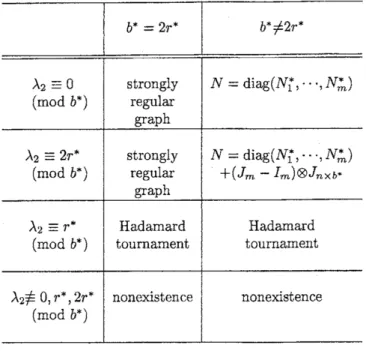
Theorem3.2.ByTheorem 3.2,
we
seethat thestructureofGD designswithout$\alpha$-resolution classesineach groupischaracterized in terms of Hadamard tournaments andstrongly regular graphs,
as
inTable 2.4.
Constructions
of regular group divisible designsBy virtueofthecharacterizationinTheorem 3.2,weobtain
new
constructionsof regular GD designsTable 2: The inner structure of GD designswithout a-resolution classesineachgroup
$\ovalbox{\tt\small REJECT} b^{*}--2r^{*}b^{*}\neq 2r^{*}$
$\lambda_{2}\equiv 0$ (mod $b^{*}$) strongly regular graph $N=\mathrm{d}\mathrm{i}\mathrm{a}\mathrm{g}(N_{1}^{*}, \cdots, N_{m}^{*})$ $\lambda_{2}\equiv 2r^{*}$ (mod $b^{*}$) strongly regular graph $N=\mathrm{d}\mathrm{i}\mathrm{a}\mathrm{g}(N_{1}^{*}, \cdots, N_{m}^{*})$ $+(J_{m}-I_{m})\otimes J_{n\mathrm{x}b^{*}}$ $\lambda_{2}\equiv r^{*}$ (mod $b^{*}$) Hadamard
tournament tournamentHadamard
$\lambda_{2}\not\equiv 0$,$r^{*}$,$2r^{*}$
(mod $b^{*}$)
nonexistence nonexistence
Theorem 4.1. The existence
of
a Hadamard tournamentof
order $m\equiv 3$ (mod 4) and a $BIB$design with parameters $v^{*}$, $b^{*}$, $r^{*}$, $k^{*}$, $\lambda^{*}$ implies theexistence
of
a regular$GD$ design with parameters$v=mv^{*}$, $b=mb^{*}$, $r=r^{*}+b^{*}(m-1)/2$, $k=k^{*}+v^{*}(m-1)/2$, $\lambda_{1}=\lambda^{*}+b^{*}(m-1)/2$, A$2=$
$r^{*}+b^{*}$$(m-3)/4$. As a special case, when the initial$BIB$ design is symmetric, the $GD$ design is also
symmetric.
Proof. Let $D$ bethe
rrvxm
adjacency matrix ofthe Hadam ard tournament of order$m\equiv 3$ (mod4). Let $N$’be the$v^{*}xb^{*}$ incidence matrix ofthe BIB design. We define the $mv^{*}\mathrm{x}mb^{*}$ matrix $N$
as
follows:
$N=\{$
$N^{*}$ $\mathit{0}_{v\cross b}.$
.
$\mathit{0}_{v^{*}\mathrm{x}b’}\backslash$ $O_{v^{*}\mathrm{x}b^{*}}$ $N^{*}$ $\mathit{0}_{v^{*}\cross b^{\mathrm{P}}}$.
$\cdot$ . . $\cdot$ ...
. $\cdot$ . $o_{v^{*}\mathrm{x}b^{*}}$ $O_{v^{*}\mathrm{X}b}$.
$N^{*}$ , $+D\otimes J_{v\mathrm{x}b}..$. (4.1)Then there are $(m-1)/2$ 1’s in eachrow of $D$
.
Thus any twopoints in thesame
group ofthe GDdesign
are
containedin$\lambda_{1}=r^{*}+b^{*}(m-1)/2$ blocks. On theotherhand,in anytworowsof$D$, thereare
$(m-3)/4$ columnshaving Fs in thoserows, Thus, $\lambda_{2}=r^{*}+b^{*}(m-3)/4$, which implies that$\square N$
is
an
incidencematrix ofaGD design. Especially, if$v^{*}=b^{*}$, theGD design is also symmetric.Theorem 4.2. The eistence
of
a
strongly regular graph withparameters $\tilde{v},\tilde{k}=\sqrt{p_{11}^{2}(\overline{v}-1)}$, $p_{11}^{1}$,$p_{11}^{2}=p_{11}^{1}+1$ and a $BIB$ design with parameters $v^{*}=2k^{*}$, $b^{*}=2r^{*}$, $r^{*}$, $k^{*}$, $\lambda^{*}$ implies the existence
of
a regular $GD$ design withparameters $v=\tilde{v}v_{J}^{*}b=\tilde{v}b^{*}$, $r=r^{*}+\tilde{k}b^{*}$, $k=k^{*}+\tilde{k}v^{*}$, $\lambda_{1}=\lambda^{*}+\tilde{k}b^{*}$, $\lambda_{2}=p_{11}^{2}b^{*}$.
Proof. Let $D$ bethe $vxv$ adjacency matrix of the strongly regular graph. Let $N^{*}$ be the $v^{*}\mathrm{x}$$b^{*}$
incidence matrix of the BIB design. Then
we
define a$\tilde{v}v^{*}\mathrm{x}\tilde{v}v^{*}$ matrix $N$ofaGD design in thesame
manner as in (4.1). Let $V_{1}=\{x_{1}, x_{2}, \cdots, x_{\overline{v}}\}$ bethe set of vertices of$D$ and $V_{2}=\{y_{1}, y_{2}, \cdots, y_{v^{\mathrm{r}}}\}$
be the set of points of$N^{*}$. Then the set ofpointsofaGD designisdefined by$V_{1}\mathrm{x}$ $V_{2}$. For any two
points $(x_{i}, y_{j})$and $(x_{i’}, y_{j})$ in the
same group
occur
together,in$\lambda_{1}=r^{*}+\tilde{k}b^{*}$.
Nowwetaketwopoints$(x_{i}, y_{j})$ and $(x_{t’}, y_{j’})$ in the distinct groups. If $(x_{i}, x_{\mathrm{z}’})$ is an edge of $D$, then there are$p_{11}^{1}$ columns
in $D$ which has 1’s in both ofthe
rows
corresponding to $x_{i}$ and $xi’$.
In this case, A$2=2r^{*}+p_{11}^{1}b^{*}$.While, if $(x_{i}, x_{i’})$ is not an edge, then there
are
$p_{11}^{2}$ columns in $D$ which has l’s in both of the rowscorresponding to$x_{t}$ and $x_{i’}$, in this case, $\lambda_{2}=p_{11}^{2}b^{*}$
.
By the assumption,$-2r^{*}+p_{11}^{1}b^{*}=p_{11}^{2}b^{*}$ holds,thus $\lambda_{2}$ is also constant. It iseasy to show that the block size $k=k^{*}+kv^{*}$ is constant. Hence the
theoremisproved. $\square$
Now
we
consider a regular symmetric GD design which is obtained by Theorem 4.2. By theassumptionofthetheorem,$v^{*}=b^{*}=2r^{*}=2k^{*}$ holds. Thus by relation(1.3),$\lambda^{*}(2k^{*}-1)=k^{*}(k^{*}-1)$
musthold. By solving this equationfor As’,$4\lambda^{*2}+1$must be
a
square ofan
integer, whichis possibleonlyin the
case
of v*=b*=2r*=2&’ $=2$ and$\lambda^{*}=0$.
By this investigation we obtainthe followingcorollary:
Corollary 4.1. The existence
of
a strongly regular graph with parameters$\mathrm{v},\tilde{k}=\sqrt{p_{11}^{2}(\tilde{v}-1)}$, $p_{11}^{1}$,$p_{11}^{2}=p_{11}^{1}+1$ implies the existence
of
a regular symmetric $GD$ design with parameters $v=b=2\tilde{v}$,$r=k=2\tilde{k}+1$, $\lambda_{1}=2\tilde{k}$, $\lambda_{2}=2p_{11}^{1}$
.
As an example of Corollary 4.1,
a
regular symmetric GD design with param eters $v=b=20$,$r=k=7$, $\lambda_{1}=6$, $\lambda_{2}=2$
can
be obtained by utilizing the Petersen graph. Moreover, there existsa strongly regular graph with parameters $\tilde{v}=q=4t+1$ (for prime power $q$), $k\sim=2t$, $p_{11}^{1}=t-1$,
$p_{11}^{2}=t$, which is called the Paleygraph (see [10, pp.668-683]). Paley graphs satisfy the conditionof
Theorem 4.2. By utilizingPaley graphs,we obtain the following corollary.
Corollary 4.1. For aprime power q $=4t+1$, there exists a regular symmetric GD design with
parameters v $=b=2q,$
r
$=k=4t+1=q$, $\lambda_{1}=4t$, $\lambda_{2}=2t$.
References
[1] T. Adachi,
Combinatorial
structureof
groupdivisible designs utithr $=\lambda_{1}+2$ and n$=3$, CongressusNumerantium, 149 (2001), pp.
129-141.
[1] T. Adachi,S.KageyamaandM.Jimbo, Discretestructure
of
group divisibledesignswith r$=\lambda_{1}+2$and n $=4$, In: N. Balakrishnan, N. Kannan and M. R. Srinivasan (eds.), Statisticall Methods and
Practice - RecentAdvances,2003, Narosa Publishers Ltd. (Springer affiliate), pp.
233-254.
[3] T. Adachi, M. Jimbo andS.Kageyama, Combinatorial structure
of
group divisibledesigns without$\mathrm{a}$-resolution classes in eachgroup, Discrete Math, 265 (2003),Issues 1-3 , pp. 1-11.
[4] K. T. Arasu and A.Pott, Variations onthe McFarland andSpence constructions
of
difference
sets,Australas. J. Combin., 10 (1994), pp.
199-204.
[6] R. C. Bose, Symmetric group divisible designs with the dual property, J. Statist. Plann.
Inference
1 (1977), pp.
87-101.
[7] R. C. Bose and W. S. Connor, Combinatorialproperties
of
group divisibleincomplete blockdesigns,Ann. Math. Statist, 23 (1952), pP. 367-383.
[8] R. C.Bose andS. S. Shrikhande, Baersubdesigns
of
symmetric balancedincomplete block designs,Essays in Probability and Statistics, pp. 1-16, Shinko Tsusho, Tokyo, 1976.
[9] R. C. Bose, S. S. Shrikhande and K. N. Bhattacharya, On the construction
of
group divisibleincomplete block design, Ann. Math. Statist, 24 (1953) pp.
167-195.
[10] C. J. Colbournand J. H. Dinitz, CRCHandbook
of
CombinatorialDesigns, CRC Press, 1996.[11] M. Hall, Jr., Combinatorial Theory, JohnWiley, New York, 1967.
[12] N. Ito, Hadamard tournaments with transitive automorphism groups, European J. Combin. 5
(1984), pp.
37-42.
[13] M. Jimbo and S. Kageyama, Discrete structure
of
group divisible designs withr
$=\lambda_{1}+1$,ICA
Bulletin, 32 (2001), pp. 29-36.
[14] D. Raghavarao, Constructions and Combinatorial Problems in Design
of
Experiments, JohnWi-ley, New York, 1971.
[15] C.R.Rao,
Difference
sets andcornbin torial arrangements derivablefrom finite
geometries,Proc,Math. Inst Sci. India, 12 (1946) pp. 123-135.
[16] H. J. Ryser, Subsets
of
afinite
set that intersect each other in at most one element, J. Combin.Theory, Ser. A, 17 (1974) pp. 59-77.
[17] H. J. Ryser, The
factor
of
a design matrix, J. Combin. Theory,Ser.
A, 22 (1977) pp. 181-193.[18] Y. S. SatheandM. Pradhan, On existence
of
dualproperty in symmetric group divisible designs,J. Statist. Plann.
Inference
5 (1981), pp. 377-380.[19] T. Shimataand S. Kageyama, Symmetry
of
a group divisible design with r $=\lambda_{1}+1$, J. Statist.Plann. Inference, 106 (2002), pp. 31-37.
[20] D. A. Sprott, A series
of
symmetric group divisible designs, Ann. Math. Statist, 30 (1959)pp. 249-251.
[21] V. D. Tonchev, Combinatorial Configuratio