Partitioned Runge-Kutta methods for
partial
differential equations
TOSHIYUKI Koto 小藤 俊幸
Department of Computer Science
The University of ElectrO-Communications
電気通信大学 情報工学科
e-mail:[email protected]
Abstract
We consider implicit-explicit Runge-Kutta (IMEX$\mathrm{R}\mathrm{K}$) schemes for
time-dependent semi-linear partial differential equations. We show that theerrorof
ascheme isof$O(\Delta t^{2})$ in time undersomeconditions, whereAt isthestepsize.
This result is, in asence, optimal. The s0-called order reduction phenomena
occur, i.e., the error of ascheme based on apartitioned RK method whose
order $\geq 3$ behaves as $O(\Delta t^{2})$, which is shown numerically.
1. Introduction
We consider initial-boundary value problems of the form
$\frac{\partial u}{\partial t}=Lu+g(t, x, u)$, $0\leq t\leq T$, $x\in\Omega$, (1.1)
$\Phi_{b}u(t, x)=\varphi(t, x)$, $0\leq t\leq T$, $x\in\partial\Omega$, (1.2)
$u(0, x)=u^{0}(x)$, $x\in\Omega$. (1.3)
Here, $u=u(t, x)$ is an $R^{m}$-valued unknown function, $\Omega$ is abounded domain in
$R^{d}$ with the boundary
an,
$L$ is alinear partial differential operator with constantcoefficients with respect to $x$, $\Phi_{b}$ is aboundary operator. Various reaction-diffusion
equations andnonlinearSchrodingerequations such
as
theGross-Pitaevskii equation(see, e.g., [4]) are typical examples of (1.1).
Manynumerical schemes for evolutionalproblems inpartial differential equations
(PDEs)
are
derived and implemented along the idea of the method of lines (MOL).In this approach aPDE is first discretized in space by finite difference or finite
element techniques to be converted into asystem of ordinary differential equations
(ODEs). We consider the grid $\Omega_{h}$ defined by $\Omega_{h}=\Omega\cap hZ^{d}$ for $h>0$, and MOL
approximations of (1.1)-(1.2) in the form
$\frac{\mathrm{d}U_{h}}{\mathrm{d}t}=L_{h}U_{h}+\varphi_{h}(t)+g_{h}(t, U_{h})$
.
(1.4)Here, $U_{h}$ is
an
approximate function of $u$ on $\Omega_{h}$, $L_{h}$ is adifference approximationof $L$, $g_{h}$ is the restriction of
$g$ onto $\Omega_{h}$, and $\varphi_{h}(t)$ is afunction determined from the
boundary condition (1.2)
数理解析研究所講究録 1320 巻 2003 年 60-70
The ODE (1.4) is usually astiff equation, not easily treated with the standard
explicit methods. In some cases (e.g.,$[11])$, theequation (1.4) is solved by ascheme
of the form
$U_{h}^{n+1}=U_{h}^{n}+\Delta t(L_{h}U_{h}^{n+1}+\varphi_{h}(t_{n+1}))+\Delta tg_{h}(t_{n}, U_{h}^{n})$, (1.5)
where At is the stepsize, given by $\Delta t=T/N$for
some
integer $N$ $\geq 1$, $t_{n}=n\Delta t$, and$U_{h}^{n}$ is an approximate value of$U_{h}(t_{n})$
.
The scheme (1.5) is obtained by applying thebackward Euler formula to thelinear part of (1.4) and the forward Euler formulato
the nonlinear part. This type of scheme is called implicit-explicit (IMEX) scheme,
or semi-implicit scheme.
The scheme (1.5) is offirst order in the sense oforder ofconvergence. There are
two ways of improving (1.5) in accuracy:
one
is along the idea of linear multistepmethods [1, 3, 12]; the other is along the idea of Runge-Kutta (RK) methods [2, 6, 8].
We follow the latter approach.
Let us consider apair of two RK methods defined by the arrays
000.
.
.
0 000.. .
0 $c_{2}$ $a_{21}$ $a_{22}$ 0. . .
0 $c_{2}$ $\hat{a}_{21}$ 0. . .
0 $c_{3}$ $a_{31}$ $a_{32}$ (Z33.
$\cdot$.
, $c_{3}$ $\hat{a}_{31}$ $\hat{a}_{32}$ 0 $.$.
. (1.6) . $\cdot$.
...
$\cdot.$.
0...
.
$\cdot$.
...
0 $\mathrm{c}_{s}$ $a_{s1}$ $a_{s2}$. . .
$a_{s,s-1}$ $a_{ss}$ $c_{s}$ $\hat{a}_{s1}$ $\hat{a}_{s2}$. . .
$\hat{a}_{s,s-1}$ 0$b_{1}$ $b_{2}$ $\cdots$ $b_{s-1}$ $b_{\mathit{8}}$ $\hat{b}_{1}$ $\hat{b}_{2}$
$\cdots$ $\hat{b}_{s-1}$ $\hat{b}_{s}$
0 $c_{2}$ $c_{3}$ $.\cdot$
.
$c_{s}$ 0 0 $\ldots$ 0 $a_{21}$ $a_{22}$ 0. . .
0$a_{31}$ $a_{32}$ $a_{33}$
.
$\cdot$
.
...
$\cdot$..
0
$a_{s1}$ $a_{s2}$
...
$a_{s,s-1}$ $a_{ss}$$b_{1}$ $b_{2}$
.
..
$b_{s-1}$ $b_{\mathit{8}}$ 0 $c_{2}$ $c_{3}$ $..$.
$c_{s}$ 0 0 $\ldots$ 0 $\hat{a}_{21}$ 0.
..
0 $\hat{a}_{31}$ $\hat{a}_{32}$ 0...
.
$\cdot$.
...
0$\hat{a}_{s1}$ $\hat{a}_{s2}$
. . .
$\hat{a}_{s,s-1}$ 0$\hat{b}_{1}$ $\hat{b}_{2}$
.
..
$\hat{b}_{s-1}$ $\hat{b}_{s}$The left formula determines adiagonally implicit (semi-implicit) RK method, the
right formula an explicit RK method. As usual, we
assume
that$c_{i}= \sum_{j=1}^{i}a_{ij}=\sum_{=J1}^{i-1}\hat{a}_{ij}$, $0\leq c:\leq 1$, $i=2,3$, $\ldots$ , $s$. (1.7)
By applying the left formula to the linear part of (1.4) and the right formula to
the nonlinear part, we obtain the following scheme for the initial-boundary value
problem (1.1)-(1.2):
$U_{h,n}^{(*)}.=U_{h}^{n}+ \Delta t\sum_{j=1}^{i}a_{ij}(L_{h}U_{h,n}^{(j)}+\varphi_{h}(t_{n}+c_{j}\Delta t))$
$+ \Delta t\sum_{j=1}^{i-1}\hat{a}_{ij}g_{h}$
(
$t_{n}+c_{j}\Delta t$, $U_{h,n}^{(j)}$),
$i=1,2$,$\ldots$ , $s$, (1.8)
$U_{h}^{n+1}=U_{h}^{n}+ \Delta t\sum_{i=1}^{s}b_{i}(L_{h}U_{h,n}^{(i)}+\varphi_{h}(t_{n}+c_{i}\Delta t))$
$+\Delta t$$\sum_{i=1}^{s}\hat{b}_{i}g_{h}$
(
$t_{n}+c_{\dot{\iota}}\Delta t$,$U_{h,n}^{(\dot{|})}$).
(1.9)Here, $U_{h}^{0}$ is given by $U_{h}^{0}=[u^{0}(x)]_{x\in\Omega_{h}}$.
The main purpose of the present paper is to clarify the convergence property
of the scheme (1.8)-(1.9), especially from aviewpoint of the $B$-convergence theory
[7]. The concept of $B$-convergence is closely related to the s0-called order reduction
phenomena, which
were
first pointed out and studied by Verwer [15] in the PDEcontext (see also [13, 14]).
2.
Main
theoremFor $\sigma^{m}$-valued functions
on
$\Omega_{h}$ we definean
inner product by$\langle U, V\rangle_{h}=h^{d}\sum_{x\in\Omega_{h}}\overline{U}(x)^{T}V(x)$, (2.1)
and let $||\cdot||_{h}$ denote the corresponding
norm.
We also put$\alpha_{h}(t)=u_{h}’(t)-L_{h}u_{h}-\varphi_{h}(t)-g_{h}(t, u_{h})$, (2.2)
where $u_{h}(t)=[u(t, x)]_{x\in\Omega_{h}}$, and consider the following conditions concerning the
problem (1.1)-(1.3) and the MOL approximation (1.4)
$(\mathrm{A}_{1})$ The exact solution $u(t, x)$ is of class $C^{3}$ with respect to $t;g(t, x, u)$ is of class
$C^{2}$ with respect to $t$,$u$ and the functions
g, $\frac{\partial g}{\partial t}$
, $\frac{\partial g}{\partial u_{i}}$ , $\frac{\partial^{2}g}{\partial t^{2}}$
, $\frac{\partial^{2}g}{\partial t\partial u_{i}}$ , $\frac{\partial^{2}g}{\partial u_{i}\partial u_{j}}$
are bounded for $(t, x, u)\in[0, T]\cross\Omega\cross R^{m}$.
$(\mathrm{A}_{2})$ For any $\sigma^{m}$-valued function $U$ on $\Omega_{h}$, ${\rm Re}\langle U, L_{h}U\rangle_{h}\leq 0$
.
(A3) $||\alpha_{h}(t)||_{h}arrow 0$ as $harrow 0$.
Moreover we write
$A=(a_{ij})_{1\leq i,j\leq s}$, $b=[b_{1}, b_{2}, \ldots, b_{s}]^{T}$,
$\hat{A}=(\hat{a}_{\dot{|}j})_{1\leq i,j\leq s}$, $\hat{b}=[\hat{b}_{1}, \hat{b}_{2}, \ldots, \hat{b}_{s}]^{T}$,
and consider the following conditions concerning the RK pair (1.6).
$(\mathrm{B}_{1})$ The partitioned RK method (1.6) is of second order, i.e., the parameters $b_{i}$,
$\hat{b}_{i}$,
$c_{i}$.satisf
$\sum b_{i}=1$, $\sum_{i=1}^{s}b_{i}c_{i}=1/2$, $\sum_{i=1}^{s}\hat{b}_{i}=1$, $\sum_{i=1}^{s}\hat{b}_{i}c_{i}=1/2$
.
83
$(\mathrm{B}_{2})$ The diagonally implicit RK method is $A$-stable, $ASI$-stable, and AS-stable,
i.e., the stability function $r(z)=1+zb^{T}(I_{s}-zA)^{-1}1,1=[1,1, \ldots, 1]^{T}$,
satisfies
$|r(z)|\leq 1$ for any $z\in C_{-}$,
and each component of $(I_{s}-zA)^{-1}$ and $zb^{T}(I_{s}-zA)^{-1}$ is bounded on $\varpi_{-}$,
where $\Phi_{-}=\{z\in C : {\rm Re} z<0\}$.
(B3) The rational functions
$\phi(z)=\frac{b^{T}(I_{s}-zA)^{-1}\gamma}{b^{T}(I_{s}-zA)^{-1}1}$ , $\hat{\phi}(z)=\frac{b^{T}(I_{s}-zA)^{-1}\hat{\gamma}}{b^{T}(I_{s}-zA)^{-1}1}$ (2.3)
are bounded on $C_{-}$, where
$\gamma=[\gamma_{1}, \gamma_{2}, \ldots, \gamma_{s}]^{T}$, $\hat{\gamma}=[\hat{\gamma}_{1},\hat{\gamma}_{2}, \ldots,\hat{\gamma}_{s}]^{T}$,
$\gamma_{i}=c_{i}^{2}/2-\sum_{j=1}^{i}a_{ij^{C}j}$, $\hat{\gamma}_{i}=\mathrm{I}$$a_{ij}c_{j}- \sum_{j=1}^{i-1}\hat{a}_{j}\dot{.}c_{j}$.
Theorem 2.1 Assume that $(\mathrm{A}_{1})$ (B3) and $(\mathrm{B}_{1})$-(B3)are
satisfied.
Then, there arepositive numbers $h_{0}$, AtO, C such that
$1 \leq n\leq N\mathrm{m}\mathrm{a}\mathrm{x}||U_{h}^{n}-uh(tn)||_{h}\leq C(\triangle t^{2}+\max 0\leq t\leq_{-}T||\alpha_{h}(t)||_{h})$ (2.4)
holds
for
any $h\leq h_{0}$ and $At\leq\Delta t\circ\cdot$The proof is carried out by asimular argument as in the proof of Theorem 3.3
[5], on the based of the following lemma (see, e.g., [10], IV.II).
Lemma 2.2 (Theorem of
von
Neumann) Let$\psi(z)$ be a rationalfunction
whichhas no pole in $C_{-}$, and assume that $L_{h}$
satisfies
$(\mathrm{A}_{2})$.
Then, we have$|| \psi(\Delta tL_{h})||_{h}\leq\sup_{{\rm Re} z\leq 0}|\psi(z)|$ . (2.5)
Proof of Theorem 2.1. Put $t_{n,i}=t_{n}+c_{i}\Delta t$ and define $r_{h,n}^{(i)}$,
$\rho_{h,n}$ by
$u_{h}(t_{n,i})=u_{h}(t_{n})+ \Delta t\sum_{j=1}^{i}a_{ij}(L_{h}u_{h}(t_{n,j})+\varphi_{h}(t_{n,j}))$
$+ \Delta t\sum_{j=1}^{i-1}\hat{a}_{\dot{\iota}j}g_{h}$
(
$t_{n,j}$, $u_{h}(t_{n,j}))+r_{h,n}^{(i)}$, (2.6)$u_{h}(t_{n+1})=u_{h}(t_{n})+ \Delta t\sum_{i=1}^{s}b_{i}(L_{h}u_{h}(t_{n,i})+\varphi_{h}(t_{n,i}))$
$+ \Delta t\sum_{i=1}^{s}\hat{b}_{i}g_{h}$
(
$t_{n,i}$,$u_{h}(t_{n,i}))+\rho_{h,n}$. (2.7)Then, it follows from (2.2) and (1.7) that
$r_{h,n}^{(i)}=u_{h}(t_{n,i})-u_{h}(t_{n})- \Delta t\sum_{\mathrm{j}=1}^{l}a_{ij}[u_{h}’(t_{n,j})-g_{h}(t_{n,j},$ $u_{h}(t_{n,j}))-\alpha_{h}(t_{n,j})]$
$- \Delta t\sum_{j=1}^{i-1}\hat{a}_{ij}g_{h}(t_{n,\mathrm{j}},$$u_{h}(t_{n,j}))$
$=\Delta t^{2}\gamma_{i}u_{h}’(t_{n})+\Delta t^{2}\hat{\gamma}_{i}g_{h}^{(1)}(t_{n},$ $u_{h}(t_{n}))+ \Delta t\sum_{j=1}^{i}a_{ij}\alpha_{h}(t_{n,j})$% $\mathit{0}(\Delta t^{3})$, (2.8)
where
$g_{h}^{(1)}$
(
$t$,$u_{h}(t))= \frac{\partial g_{h}}{\partial t}(t,$ $u_{h}(t))+ \frac{\partial g_{h}}{\partial U}(t$,$u_{h}(t))u_{h}’(t)$Similarly, it follows from (2.2) and $(\mathrm{B}_{1})$ that
$\rho_{h,n}=\Delta t\sum_{i=1}^{s}b_{i}\alpha_{h}(t_{n,i})+O(\Delta t^{3})$ . (2.9)
On the other hand, (2.6), (2.7), (1.8), (1.9) imply
$\delta_{h,n}^{(\dot{\cdot})}=\epsilon_{h}^{n}+\Delta t\sum_{j=1}^{i}a_{ j}.L_{h}\delta_{h,n}^{(j)}+\Delta t\sum_{j=1}^{i-1}\hat{a}_{ij}J_{h,n}^{(j)}\delta_{h,n}^{(j)}+r_{h,n}^{(i)}$,
$\epsilon_{h}^{n+1}=\epsilon_{h}^{n}+\Delta t$$\sum_{i=1}^{s}b_{i}L_{h}\delta_{h,n}^{(i)}+\Delta t\sum_{i=1}^{s}\hat{b}_{i}J_{h,n}^{(i)}\delta_{h,n}^{(i)}+\rho_{h,n}$,
where
$\delta_{h,n}^{(i)}=u_{h}(t_{n,i})-U_{h,n}^{(i)}$, $\epsilon_{h}^{n}=u_{h}(t_{n})-U_{h}^{n}$,
$J_{h,n}^{(i)}= \int_{0}^{1}\frac{\partial g_{h}}{\partial U}$
(
$t_{n,i}$,$(1-\theta)U_{h,n}^{(i)}+\theta u_{h}(t_{n,i})$
)
$\mathrm{d}\theta$.
Eliminating $\delta_{h,n}^{(i)}$,
we
get$\epsilon_{h}^{n+1}=[I+(b^{T}Z+\hat{b}^{T}W_{n})(I-AZ -\overline{A}W_{n})^{-1}(1\otimes I)]\epsilon_{h}^{n}$
$+(b^{T}Z+\hat{b}^{T}W_{n})(I-AZ -\overline{A}W_{n})^{-1}r_{h,n}+\rho_{h,n}$, (2.10)
where $A=A$ (&I, $\overline{A}=\hat{A}\otimes I$, $b=b\otimes I$, $\hat{b}=\hat{b}\otimes I$, $I=I_{s}$ (&I,
$Z=\Delta t(1\otimes L_{h})$, $W_{n}=\Delta t[(J_{h,n}^{(1)})^{T},$ $(J_{h,n}^{(2)})^{T}$,
$\ldots$ , $(J_{h,n}^{(s)})^{T}]^{T}$, $r_{h,n}=[(r_{h,n}^{(1)})^{T},$ $(r_{h,n}^{(2)})^{T}$, $\ldots$ , $(r_{h,n}^{(s)})^{T}]^{T}$ Moreover, letting
$\hat{\epsilon}_{h}^{n}=\epsilon_{h}^{n}+\Delta t^{2}v_{h}^{n}$, $v_{h}^{n}=\phi(\Delta tL_{h})u_{h}’(t_{n})+\hat{\phi}(\Delta tL_{h})g_{h}^{(1)}(t_{n},$ $u_{h}(t_{n}))$,
we can rewrite (2.10) as
$\hat{\acute{\mathrm{c}}}_{h}n+1=[I+(b^{T}Z+\hat{b}^{T}W_{n})(I-AZ-\overline{A}W_{n})^{-1}(1\otimes I)]\hat{\epsilon}_{h}^{n}$
$+(b^{T}Z+\hat{b}^{T}W_{n})(I-AZ-\overline{A}W_{n})^{-1}rh,n+ph,n$, (2.11)
where
$\hat{r}_{h,n}=r_{h,n}-\Delta t^{2}\gamma\otimes u_{h}’(t_{n})-\Delta t^{2}\hat{\gamma}\otimes g_{h}^{(1)}(t_{n},$$u_{h}(t_{n}))$,
$\hat{\rho}_{h,n}=\rho_{h,n}+\Delta t^{2}(v_{h}^{n+1}-v_{h}^{n})$
$+\Delta t^{2}(b^{T}Z+\hat{b}^{T}W_{n})(I-AZ-\overline{A}W_{n})^{-1}w_{h,n}$,
$w_{h,n}=\gamma\otimes u_{h}’(t_{n})+\hat{\gamma}\otimes g_{h}^{(1)}(t_{n},$$u_{h}(t_{n}))-1\otimes v_{h}^{n}$.
By (2.9),
we
have$\hat{r}_{h,n}^{(i)}=\Delta t\sum_{j=1}^{i}a_{ij}\alpha_{h}(t_{n,j})+O(\Delta t^{3})$
.
(2.12)Moreover, $b^{T}Z(I-AZ)^{-1}w_{h,n}=0$, by the definitions of $v_{h}^{n}$ and $w_{h,n}$
.
Hence, itfollows from
$(I-AZ-\overline{A}W_{n})^{-1}=(I-AZ)^{-1}+(I-AZ)^{-1}\overline{A}W_{n}(I-AZ-\overline{A}W_{n})^{-1}(2.13)$
that
$(b^{T}Z+\hat{b}^{T}W_{n})(I-AZ-\overline{A}W_{n})^{-1}w_{h,n}=\hat{b}^{T}W_{n}(I-AZ)^{-1}w_{h,n}$
$+(b^{T}Z+\hat{b}^{T}W_{n})(I-AZ)^{-1}\overline{A}W_{n}(I-AZ-\overline{A}W_{n})^{-1}w_{h,n}$.
By makinguse of Lemma2.2 it is shown that this value is of$O(\Delta t)$ by ASI-stability
and AS-stability of the implicit RK method, which, together with, $v_{h}^{n+1}-v_{h}^{\mathfrak{n}}=$
$O(\Delta t)$, implies
$\hat{\rho}_{h,n}=\Delta t\sum_{i=1}^{s}b_{i}\alpha_{h}(t_{n,i})+O(\Delta t^{3})$. (2.14)
It follows from (2.11), (2.12), (2.14) that there exists $\hat{C}$
such that
$|| \epsilon_{h}^{n}||_{h}\leq\hat{C}(\Delta t^{2}+\max||0\leq t\leq T\alpha_{h}(t)||_{h})$ (2.15)
holds forsutHcientlysmall $h$ and At. This is alsoverified on the basis of Lemma 2.2.
Therefore, (2.4) holds. $\square$
3. Numerical examples
Consider the simple model problem
$\frac{\partial u}{\partial t}=\frac{\partial^{2}u}{\partial x^{2}}+g(t, x, u)$, $t\geq 0,0\leq x\leq 1$, (3.2)
$g(t, x, u)= \frac{\pi^{2}}{2}u-u^{2}+\mathrm{e}^{-\pi^{2}}{}^{t}\mathrm{c}\mathrm{o}\mathrm{s}^{2}(\pi x)$ ,
$u(t, 0)=\mathrm{e}^{-\pi^{2}t/2}$ , $u(t, 1)=-\mathrm{e}^{-\pi^{2}t/2}$, $t\geq 0$, (3.2)
$u(0, x)=\cos(\pi x)$, $0\leq x\leq 1$
,
(3.3)whose exact solution is
$u(t, x)=\mathrm{e}^{-\pi^{2}t}\cos(\pi x)$
.
Moreover, consider the grid
$0=x_{0}<\cdots<x_{j}=jh<\cdots<x_{M}=1$, $h=1/M$,
and an MOL approximation determined by
$\frac{u_{j-1}’+10u_{j}’+u_{j+1}’}{12}=\frac{u_{j-1}-2u_{j}+u_{j+1}}{h^{2}}$
$+ \frac{g(t,x_{j-1},u_{j-1})+10g(t,x_{j},u_{j})+q(t,x_{j+1},u_{j+1})}{12}.$ ,
$j=1,2$, $\ldots$ , $M-1$, (3.4)
where $M$is apositive integerand$u_{j}(t)$is anapproximationof$u$($t$,Xj). The functions
$u_{0}(t)$ and $u_{M}(t)$ are given by
$u_{0}(t)=\mathrm{e}^{-\pi^{\underline{\mathrm{o}}}t/2}$, $u_{NI}(t)=-\mathrm{e}^{-\pi^{2}t/2}$ ,
corresponding to (3.2). Simple computation shows that
$\alpha_{h}(t)=O(h^{4})$ (3.5)
holds for (3.4).
One of the simplestRK pairs whichsatisfy $(\mathrm{B}_{1})$-(B3) is the pair of the trapezoidal
rule and Heun’s method (a modification ofthe Crank-Nicolson scheme),
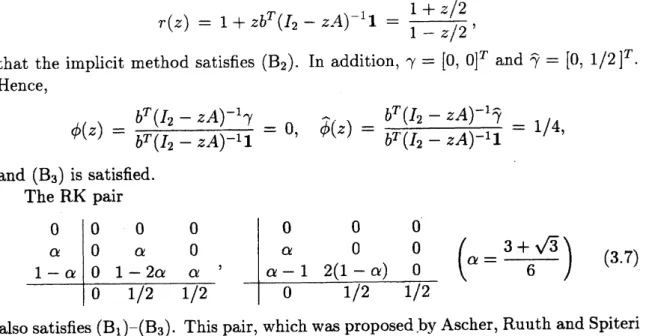
000000 11/2 1/2 , 110(3.6) 1/2 1/2 1/2 1/2 0 1 0 0 1/2 1/2 1/2 1/2 0 1 0 0 1 0 1/2 1/2
Clearly, $(\mathrm{B}_{1})$ is satisfied, and it follows from
$(I_{2}-zA)^{-1}= \frac{1}{1-z/2}$ $\{\begin{array}{lll}1- z/2 0z/2 1\end{array}\}$ , 2
$zb^{T}(I_{2}-zA)^{-1}= \frac{z}{1-z/2}[1/2,1/2]$,
$r(z)=1+zb^{T}(I_{2}-zA)^{-1}1= \frac{1+z/2}{1-z/2}$ ,
that the implicit method satisfies $(\mathrm{B}_{2})$. In addition, $\gamma=[0,0]^{T}$ and $\hat{\gamma}=[0,1/2]^{T}$.
Hence, $\phi(z)=\frac{b^{T}(I_{2}-zA)^{-1}\gamma}{b^{T}(I_{2}-zA)^{-1}1}=0$, $\hat{\phi}(z)=\frac{b^{T}(I_{2}-zA)^{-1}\hat{\gamma}}{b^{T}(I_{2}-zA)^{-1}1}=1/4$, and (B3) is satisfied. The RK pair
00000
0 0 $\alpha$ at 0 $\alpha$ 0 , $\alpha$ 0 0 $( \alpha=\frac{3+\sqrt{3}}{6})$ (3.7)1 –at 0 $1-2\alpha$ $\alpha$ $\alpha-1$ $2(1-\alpha)$ 0
01/2 1/2 01/2 1/2 0 $\alpha$ 1 – $\alpha$ 0 0 0 0 $\alpha$ 0 0 1 - $2\alpha$ $\alpha$ 0 1/2 1/2 0 0 0 $\alpha$ 0 0 $\alpha-1$ $2(1-\alpha)$ 0 0 1/2 1/2
also satisfies $(\mathrm{B}_{1})$-(B3). This pair, whichwasproposed.byAscher, Ruuth and Spiteri
[2], determines athird order partitioned RK method for ODEs. In particular, $(\mathrm{B}_{1})$
is satisfied. The conditions $(\mathrm{B}_{2})$ and (B3) follow from
$(I_{3}-zA)^{-1}=[100$ $- \frac{()z}{(1-\alpha z)^{2}}\frac{01}{1-\alpha z,2\alpha-1}$, $\frac{001}{1-\alpha z}]$ ,
$zb^{T}(I_{3}-zA)^{-1}= \frac{z}{2}[0,$ $\frac{1-(3\alpha-1)z}{(1-\alpha z)^{2}}$, $\frac{1}{1-\alpha z}]$ ,
$r(z)= \frac{1-(2\alpha-1)z-(\alpha-1/3)z^{2}}{(1-\alpha z)^{2}}$,
$\phi(z)=(\frac{\alpha^{2}}{\underline{9}})\frac{(2\alpha-1)z}{2+(1-4\alpha)z}$ , $\hat{\phi}(z)=-\frac{\alpha^{2}(2\alpha-1)z}{2+(1-4\alpha)z}$
.
We apply the RK pairs (3.6) and (3.7) to the MOL approximation (3.4), and
integrate it from $t=0$ to $t=1$, with various gridsizes and stepsizes of the form
$\triangle t=h=\frac{1}{M}$ . (3.8)
Table 1shows the values
$-\log_{2}\epsilon_{M}$, $\epsilon_{M}=1\leq n\leq M\mathrm{m}\mathrm{a}\mathrm{x}(1\leq j\mathrm{m}\mathrm{a}\mathrm{x}\leq M|u(t_{n’ j}x)-u_{j}^{n}|)$ .
It is
observed
that $\epsilon_{M}$ is of$O(\Delta t^{2})$ for each method. Noting (3.5) and (3.8),we
canconsider the result for (3.7) presents
an
order reduction phenomenon, i.e., theerror
ofa“third order” method behaves
as
$O(\Delta t^{2})$.
Table 1. Numerical results for the model problem (3.1) (3.3) $\lambda l$ 20 40 80 160 320 640 Method (3.6) Method (3.7) 3.63 5.09 6.79 8.64 10.56 12.52 5.60 7.42 9.32 11.25 13.19 15.16
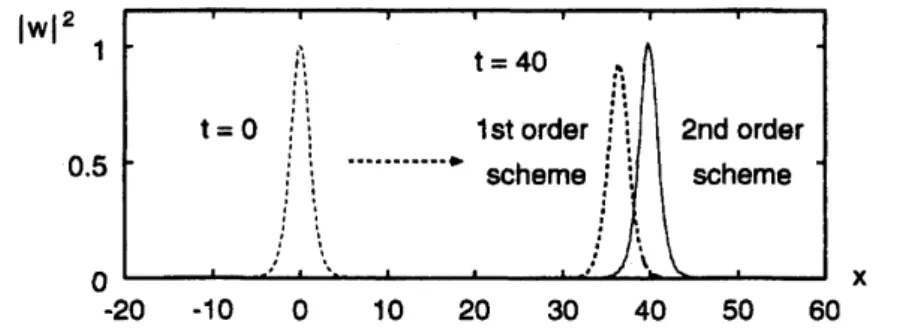
Fig. 1shows anumerical result concerning the “soliton solution”
$w(t,x)= \sqrt{2\alpha}\exp[\mathrm{i}\{\frac{c}{2}x-(\frac{c^{2}}{4}-\alpha)t\}]$ sech$[\alpha(x-ct)]$ (3.9)
to the simple nonlinear Schrodinger equation
$\frac{\partial w}{\partial t}=$ . $\frac{\partial^{2}w}{\partial x^{2}}+\cdot|w|^{2}w$
.
(3.10)The ”1st order scheme” indicates the method (1.5), and the ”2nd order schem\"e’’
indicates the method (3.6). The values $\alpha=0.5$, $c=1$, $\Delta x=0.2$, $\Delta t=0.005$
are
used for the computation.
$|\mathrm{w}|^{2}$ 1 $\mathrm{t}\mathrm{t}|||||_{1}|_{1}^{\backslash }$ $\mathrm{t}=40$ $\dot{\mathrm{i}}_{}^{}$ $\mathrm{t}\iota\iota^{\mathfrak{l}\mathrm{l}}\iota$
$\mathrm{t}=0$ $\mathrm{i}11$ 1storder $ii$ 2nd order
0.5 $|||||1||1|||!||-\cdot$ scheme $i_{1}^{1}\dot{\mathrm{i}}$ scheme $\prime\prime\prime \mathrm{l}.\iota^{t}1‘||\backslash .\backslash$
$\prime ^{\dot{}}$ $\dot{}_{1}$
0 $\mathrm{x}$ -20 -10 0 10 20 30 40 50 60 $\mathrm{t}\mathrm{t}|||||_{1}|_{1}^{\backslash }$ $\mathrm{t}=40$ $\dot{\mathrm{i}}_{}^{}$ $|\iota^{1}$ $\mathrm{l}\iota_{1}$
..
$\mathrm{t}=0$ $||\mathrm{i}$$\mathrm{I}|1|-$
–\sim lst
order$\mathrm{i}$ $i_{}$ 2nd order $\iota^{t}|||||1$ $1|!||1$ $-arrow$ scheme $i$ $\overline{\mathrm{i}}$ scheme $\prime\prime\prime 1^{\cdot}$
$‘||\backslash .\backslash$ $’^{^{}}$ $\dot{}_{1}$
Fig. 1. Numerical solutions of the nonlinear Schrodinger equation (3.10).
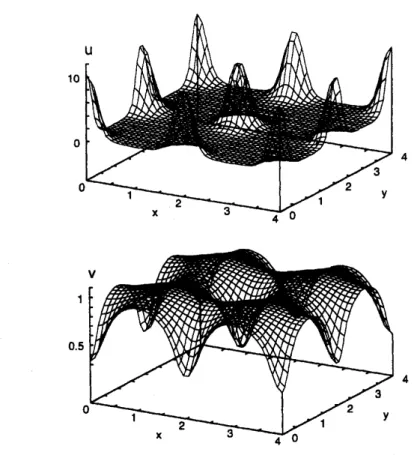
Fig. 2shows astationary solution to the equation (Brusselator)
$\{$
$\frac{\partial u}{\partial t}=D_{U}(\frac{\partial^{2}u}{\partial x^{2}}+\frac{\partial^{2}u}{\partial y^{2}})+\alpha-(\beta+1)u+u^{2}v$
$\frac{\partial v}{\partial t}=D_{V}(\frac{\partial^{2}v}{\partial x^{2}}+\frac{\partial^{2}v}{\partial y^{2}})+\beta u-u^{2}v$
(3.11)
$0\leq x\leq 4,0\leq y\leq 4$,
Du
$=0.02$,Dv
$=1$,cr
$=1$, $\beta=1.8$,under the Neumann boundary condition, obtained by the method (3.6). These
figures suggest that the method (3.6) is useful for
some
problemsFig. 2. Stationary solution to the equation (3.11).
References
[1] G. Akrivis, M. Crouzeix, C. Makridakis, Implicit-explicit multistep methods
for quasilinear parabolic equations, Numer. Math. 82 (1999), 521-541.
[2] U. M. Ascher, S. J. Ruuth, R. J. Spiteri, Implicit-explicit Runge-Kutta
meth-ods for time-dependent partial differential equations, Appl. Numer. Math. 25
(1997), 151-167.
[3] U. M. Ascher, S. J. Ruuth, B. T. R. Wetton, Implicit-explicit methods for
time-dependent partialdifferential equations, SIAM J. Numer. Anal. 32 (1995),
797-823.
[4] W. Bao,D. Jaksch, P. A. Markowich,
Numerical
solution of theGross-Pitaevskii
equation for Bose-Einstein condensation $(\mathrm{h}\mathrm{t}\mathrm{t}\mathrm{p}://\mathrm{b}\mathrm{o}\mathrm{z}\mathrm{o}\mathrm{n}.\mathrm{u}\mathrm{i}\mathrm{b}\mathrm{k}.\mathrm{a}\mathrm{c}.\mathrm{a}\mathrm{t}/\sim \mathrm{d}\mathrm{j}\mathrm{a}\mathrm{k}\mathrm{s}\mathrm{c}\mathrm{h})$ .
[5] K. Burrage, W. H. Hundsdorfer, J. G. Verwer, Astudy of $\mathrm{B}$
-convergence
ofRunge-Kutta methods, Computing, 36 (1986), 17-34.
[6] M. P. Calvo, J. de Frutos, J. Novo, Linearly implicit Runge-Kutta methods for
advection-reaction-diffusion
equations, Appl. Numer. Math. 37(2001), 535-549[7] R. Frank, J. Schneid, C. W. Ueberhuber, The concept ofB convergence SIAM
J. Numer. Anal. 18 (1981), 753-780.
[8] D. F. Griffiths, A. R. Mitchell, J. $\mathrm{L}\mathrm{I}$. Morris, Anumericalstudy
of the nonlinear
Schrodinger equation, Comput. Methods Appl. Mech. Engrg. 45 (1984),
177-215.
[9] E. Hairer, S. P. NOrsett, G. Wanner, Solving Ordinary
Differential
Equations $I$,Nonstiff
Problems (2nd rev. ed.), Springer-Verlag, 1993.[10] E. Hairer, G. Wanner, Solving Ordinary
Differential
EquationsIf
Stiff
andDifferential-Algebraic Problems (2nd rev. ed.), Springer-Verlag, 1996.
[11] D. Hoff, Stability and convergence of finite difference methods for systems of
nonlinear reaction-diffusionequations, SIAM J. Numer. Anal. 15 (1978), 1161
1177.
[12] K. J. in ’$\mathrm{t}$ Hout, On thecontractivityof implicit-explicit linear multistep
meth-ods Appl. Numer. Math. 42 (2002), 201-212.
[13] T. Koto, Explicit Runge-Kutta schemes for evolutionary problems in partial
differential equations, Ann. Numer. Math. 1(1994), 335-346.
[14] J. M. Sanz-Serna, J. G. Verwer, W. H. Hundsdorfer, Convergence and order
reduction of Runge-Kutta schemes applied to evolutional problems in partial
differential equations, Numer. Math. 50 (1986), 405-418.
[15] J. G. Verwer, Convergence and order reduction of diagonally implicit
Runge-Kutta schemes in the method of lines, in D. F. Griffiths, G. A. Watson (eds),
“Numerical analysis (Dundee, 1985)”, Pitman ${\rm Res}$
.
Notes Math. Ser. 140,220-237, Longman