Basic
properties
of definable
isomorphisms
of
quantum 2-tori
$T_{q}^{2}(\mathbb{C})$Masanori ITAI
Department
of
Mathematical
Sciences
Tokai
University, Hiratsuka,
Japan
Abstract
In [5] we constructed quantum 2-tori and studied their first-order
theories. Here we discuss basic properties of the definable
isomor-phisms between quantum 2-tori $T_{q}^{2}(\mathbb{C})$ and show that $SL_{2}(\mathbb{Z})$ is the
set of definable isomorphisms of them.
1
Definable isomorphisms
Let $\theta\in \mathbb{R}$ be
a
transcendental element and put $q=\exp(2\pi i\theta)$ where$i=\sqrt{-1}$. Let also $\Gamma_{\theta}$ be an infinite multiplicative group generated
by $q$. We denote $\mathcal{A}_{\theta}$ the non-commutative algebra $\mathcal{O}_{q}((\mathbb{C}^{\cross})^{2})$ with
generators written
as
$U,$ $U^{-1},$ $V,$ $V^{-1}$ satisfying $VU=qUV.$For each pair $(u, v)\in \mathbb{C}^{*}\cross \mathbb{C}^{*}/\Gamma_{\theta}$ ,
we
construct two $\mathcal{A}_{\theta}$-modules$M_{|u,v\rangle}$ and $M_{\langle v,u|}.$
The module $M_{|u,v\rangle}$ generated by elements labeled $\{u(\gamma u, v)$ : $\gamma\in$
$\Gamma_{\theta}\}$ satisfies
$U$ : $u(\gamma u, v)\mapsto\gamma uu(\gamma u, v)$,
(1)
$V$ : $u(\gamma u, v)\mapsto vu(q^{-1}\gamma u, v)$
.
We also define the module $M_{\langle v,u|}$ generated by elements labeled
$\{v(\gamma v, u) : \gamma\in\Gamma_{\theta}\}$ satisfying
$U$ : $v(\gamma v, u)\mapsto uv(q\gamma v, u)$,
(2)
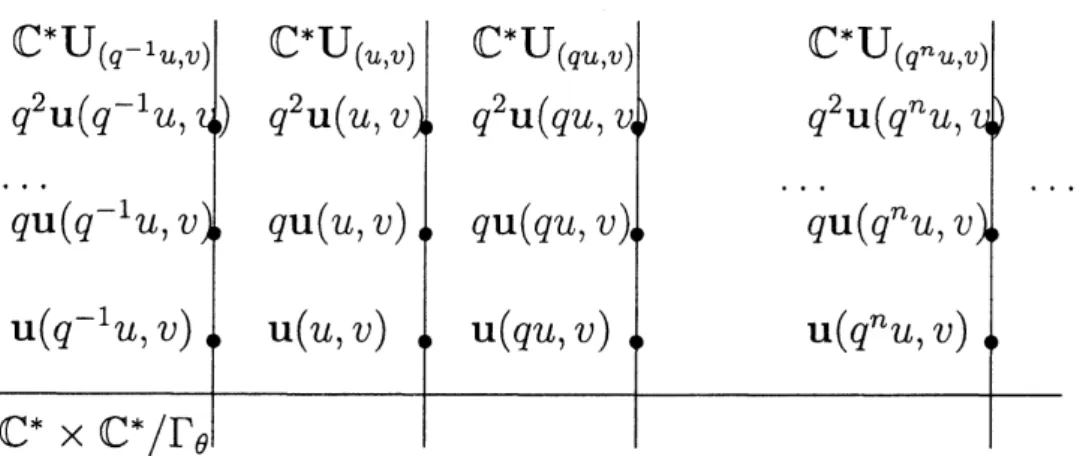
Figure
1: $\Gamma_{\theta}$-bundle
over
$\mathbb{C}\cross \mathbb{C}/\Gamma_{\theta}$ insidean
ambient $\mathbb{C}$-module
Notice that we have
$U^{-1}$ : $u(\gamma u, v)\mapsto\gamma^{-1}u^{-1}u(\gamma u, v)$,
$V^{-1}$ : $u(\gamma u, v)\mapsto v^{-1}u(q\gamma u, v)$, (3)
and
$U^{-1}$ : $v(\gamma v, u)\mapsto u^{-1}v(q^{-1}\gamma v, u)$,
$V^{-1}$ : $v(\gamma v, u)\mapsto\gamma^{-1}v^{-1}v(\gamma v, u)$
.
(4)Now let $\phi$ : $\mathbb{C}^{*}/\Gamma_{\theta}arrow \mathbb{C}^{*}$ Put $\Phi=$ ran$(\phi)$. Set $\Gamma_{\theta}\cdot u(u, v)$ $:=$ $\{\gamma u(u, v) : \gamma\in\Gamma_{\theta}\},$
$U_{\langle u,v\rangle}$ $:=$ $\bigcup_{\gamma\in\Gamma_{\theta}}\Gamma_{\theta}\cdot u(\gamma u, v)=\{\gamma_{1}\cdot u(\gamma_{2}u, v):\gamma_{1}, \gamma_{2}\in\Gamma_{\theta}\},$ $U_{\phi}$ $;=$ $\bigcup_{\langle u,v\rangle\in\Phi^{2}}U_{\langle u,v\rangle}$
$= \{\gamma_{1}\cdot u(\gamma_{2}u, v):\langle u, v\rangle\in\Phi^{2}, \gamma_{1}.\gamma_{2}\in\Gamma_{\theta}\}.$
(5)
We call $\Gamma_{\theta}\cdot u(u, v)$ a $\Gamma_{\theta}$-set over $u(u, v)$, and $U_{\phi}$ a $\Gamma_{\theta}$-bundle over
$\mathbb{C}^{*}\cross \mathbb{C}^{*}/\Gamma_{\theta}$. Notice that $U_{\phi}$ is a subset of the $\mathcal{A}_{\theta}$-module
$\bigcup_{\langle u,v\rangle}M_{|u,v\rangle}.$
Similarly a $\Gamma_{\theta}$-set $\Gamma_{\theta}\cdot v(v, u)$ over $v(v, u)$, and a
$\Gamma_{\theta}$-bundle $V_{\phi}$
over
$\mathbb{C}^{*}/\Gamma_{\theta}\cross \mathbb{C}^{*}$ is defined. As before the $\Gamma_{\theta}$-bundle $V_{\phi}$ is
a
subset of the$\mathcal{A}_{\theta}$-module
Definition
1Given
$\theta$ and $q=\exp(2\pi i\theta)$.
Let
$\phi$ : $\mathbb{C}^{*}/\Gamma_{\theta}arrow \mathbb{C}^{*}$We
call the structure $(U_{\phi},V_{\phi},\mathbb{C})$ with actions $U$ and $V$ satisfying (1) and
(2) $a$ quantum 2-torus $T_{q}^{2}(\mathbb{C})$ over the
field of
complex numbers $\mathbb{C}.$We denote $T_{q}^{2}(\mathbb{C})$ as $T_{\theta}$ in this note.
Notice that the structure of the quantum 2-torus $T_{\theta}$ is essentially
decided by $\theta$ (in fact $q=e^{2\pi i\theta}$). More precisely $\Gamma_{q}=q^{\mathbb{Z}}=\Gamma_{\theta}=$
$e^{2\pi i\theta \mathbb{Z}}=\langle e^{2\pi i\theta}\rangle$ is the key ingredient of $\Gamma$-bundles.
Remark 2 It is clear that we have $\Gamma_{\theta\pm 1}=\Gamma_{\theta}$, hence
for
any $n\in \mathbb{Z}$we
have $\Gamma_{\theta+n}=\Gamma_{\theta}$.
It is also clear that $\Gamma_{-\theta}=\Gamma_{\theta}$.
For $n\in \mathbb{Z}$, itis easy to
see
that $\Gamma_{n\theta}$ and $\Gamma_{\theta}$ are bothinfinite
multiplicative groupsgenerated by single elements hence isomorphic as such groups.
Definition 3 Given $\theta_{1},$$\theta_{2}\in \mathbb{R}$, both transcendental. We say that the
quantum 2-tori $T_{\theta_{1}}$ and $T_{\theta_{2}}$ are definably isomorphic in the structure
$(\mathbb{C}, +, \cdot, x^{\theta})$
if
there is andefinable
$f$ : $\mathbb{R}arrow \mathbb{R}$ such that $f(\theta_{1})=\theta_{2}$and
1. $f$ induces a
definable
isomorphism between$\mathbb{C}^{*}\cross \mathbb{C}^{*}/\Gamma_{\theta_{1}}$ and$\mathbb{C}^{*}\cross$$\mathbb{C}^{*}/\Gamma_{\theta_{2}},$
2.
$f$ inducesa
definable
isomorphism between $\Gamma_{\theta_{1}}$-bundleover
$\mathbb{C}^{*}\cross$$\mathbb{C}^{*}/\Gamma_{\theta_{1}}$ and $\Gamma_{\theta_{2}}$-bundle
over
$\mathbb{C}^{*}\cross \mathbb{C}^{*}/\Gamma_{\theta_{2}}$Proposition 4 From the
definition of
definable
isomorphismof
quan-tum 2-torus, we see that there are threecases
for
quantum 2-tori to be definably isomorphic:1. $\Gamma_{\theta_{1}}=\Gamma_{\theta_{2}}$ ,
or
2. $\Gamma_{\theta_{1}}$ and $\Gamma_{\theta_{2}}$ are isomorphic, $or$
3. $\mathbb{C}/\Gamma_{\theta_{1}}$ is definably isomorphic to $\mathbb{C}/\Gamma_{\theta_{2}}$, more precisely there is
a
definable
one-to-one correspondence between the cosetsof
$\Gamma_{\theta_{1}}$and the cesets
of
$\Gamma_{\theta_{2}}.$Remark 5 Our
defintion of
two quantum 2-tori being isomorphic isessentialy the same as the notion
of
Morita equivarence. The ideaof
using the Morita equivalence as the
definiton of
isomorphimof
quan-tum tori
comes
from
Manin’s argument.We investigate here the structure of the set Deflso$(T_{\theta_{1}}, T_{\theta_{2}})$ of all
Proposition 6 It is clear that
from
Remark 2, we have (1) $T_{-\theta}$ and$T_{\theta}$ are definably isomorphic and (2) $T_{\theta+n}$ and $T_{\theta}$ are definably
iso-morphic
for
$n\in \mathbb{Z}$.
It is not hard to see that$T_{n\theta}$ and$T_{\theta}$ are definablyisomorphic since $\Gamma_{n\theta}$ and $\Gamma_{\theta}$
are
isomorphic.1.1
$x^{\theta}$is
a
definable
isomorphism
between
$T_{\frac{1}{\theta}}$and
$T_{\theta}$Herewe show that the function $x^{\theta}$ gives
rise to adefinable isomorphim
in the sense of Definition 3 between quantum tori $T_{\frac{1}{\theta}}$ and
$T_{\theta}.$
Recall that $\Gamma_{\theta}$ is an infinite multipicative group generated by
$q=$
$\exp(2\pi i\theta)$.
Recall that
over
the complex numbers we have$x^{\theta}=e^{\theta{\rm Log} x},$
where Logx $=\ln x+2\pi i\mathbb{Z}.$
Remark
7
$x^{\theta}$is not
a
function
buta
multivalued operation.First observation to make is the following:
Claim Suppose $\Gamma_{\theta^{-1}}=\{q_{1}^{k} : q_{1}=\exp(2\pi i\theta^{-1}), k\in \mathbb{Z}\}$, and $\Gamma_{\theta}=$
$\{q_{2}^{m} : q_{2}=\exp(2\pi i\theta), m\in \mathbb{Z}\}$. Then $x^{\theta}$ sends a coset of $\Gamma_{\frac{1}{\theta}}$ to a coset
of $\Gamma_{\theta}$
as
follows;$x^{\theta}:a\cdot\exp(2\pi i\theta^{-1}k)$
$\mapsto==$
$\exp\exp\exp\{\begin{array}{l}\theta(\ln(a \exp(2\pi i\theta^{-1}k))+2\pi im))\theta(\ln a+2\pi i\theta^{-1}k+2\pi im))\theta(\ln a+2\pi im)+2\pi ik))\end{array}$
$= \exp(\theta(\ln a+2\pi im))\cdot\exp(2\pi ik)$
$= \exp(\theta\ln a)\cdot\exp(2\pi i\theta m)$
$= a^{\theta}\cdot\exp(2\pi i\theta m)$
$\in a^{\theta}\Gamma_{\theta}$
On the other hand, for given $a^{\theta}\cdot\exp(2\pi i\theta m)\in a^{\theta}\cdot\Gamma_{\theta}$ we have $a.$ $\exp(2\pi i\theta^{-1}m)\in a\cdot\Gamma_{\frac{1}{\theta}}$ and
$x^{\theta}$ :
$a\cdot\exp(2\pi i\theta^{-1}m)$ $\mapsto$ $\exp(\theta(\ln(a \exp(2\pi i\theta^{-1}m))+2\pi il))$
$= a^{\theta}\cdot\exp(2\pi i\theta l)$
These computations show that $x^{\theta}$ gives
a
one-t$0$
-one
correspondencebetween a coset of $\Gamma_{\frac{1}{\theta}}$ and a coset of
$\Gamma_{\theta}$
.
From this wesee
that $x^{\theta}$defines a definable bijection between $\mathbb{C}^{*}\cross \mathbb{C}^{*}/\Gamma_{\frac{1}{\theta}}$ and $\mathbb{C}^{*}\cross \mathbb{C}^{*}/\Gamma_{\theta_{1}}.$
Recall that the module $M_{|u,v\rangle,\frac{1}{\theta}}$ is generated by elements labeled
$\{u(\gamma^{\frac{1}{\theta}}u^{\frac{1}{\theta}}, v^{\frac{1}{\theta}}) : \gamma\in\Gamma_{\theta}\}$. Set first
$x^{\theta}$
: $u(\gamma^{\frac{1}{\theta}}u^{\frac{1}{\theta}}, v^{\frac{1}{\theta}})\mapsto u(\gamma u, v)$
Then the operators $U,$ $V$ act
as
follows:$U$ : $u(\gamma^{\frac{1}{\theta}}u^{\frac{1}{\theta}}, v^{\frac{1}{\theta}})\mapsto\gamma^{\frac{1}{\theta}}u^{\frac{1}{\theta}}u(\gamma^{\frac{1}{\theta}}u^{\frac{1}{\theta}}, v^{\frac{1}{\theta}})$ ,
(6)
$V$ : $u(\gamma^{\frac{1}{\theta}}u^{\frac{1}{\theta}}, v^{\frac{1}{\theta}})\mapsto v^{\frac{1}{\theta}}u(q^{-1}\gamma^{\frac{1}{\theta}}u^{\frac{1}{\theta}}, v^{\frac{1}{\theta}})$,
where $q=e^{2\pi i\theta}.$
Hence we have the following diagrams:
$u(\gamma^{\frac{1}{\theta}}u^{\frac{1}{\theta}}, v^{\frac{1}{\theta}})arrow^{x^{\theta}} u(\gamma u, v)$
$\downarrow U c\grave{)} u\downarrow$
$\gamma^{\frac{1}{\theta}}u^{\frac{1}{\theta}}u(\gamma^{\frac{1}{\theta}}u^{\frac{1}{\theta}}, v^{\frac{1}{\theta}})^{x^{\theta}}arrow\gamma uu(\gamma u,v)$
and
$u(\gamma^{\frac{1}{\theta}}u^{\frac{1}{\theta}}, v^{\frac{1}{\theta}})\underline{x^{\theta}} u(\gamma u, v)$
$\downarrow V 0 v\downarrow$
$v^{\frac{1}{\theta}}u(q^{-1}\gamma^{\frac{1}{\theta}}u^{\frac{1}{\theta}}, v^{\frac{1}{\theta}})^{\underline{x^{\theta}}}vu(q^{-1}\gamma u, v)$
These diagrams tell us that we have a definable correpondence of
vectors in $\Gamma_{\frac{1}{\theta}}$-set and
$\Gamma_{\theta}$-set and vectors in
$\Gamma_{\frac{1}{\theta}}$-bundle and
$\Gamma_{\theta}$-and,
eventually vectors in line-bundles of both sides. Observe that $x^{\theta}$
pre-serves actions of $U,$ $V.$
Proposition 8 In the structure $(\mathbb{C}, +, \cdot, x^{\theta})$, by sending $\frac{1}{\theta}$ to $\theta$, we
construct a
definable
isomorphism $f$ between $\Gamma_{\frac{1}{\theta}}$ and$\Gamma_{\theta}$ which give
rise to the
definable
$f:\mathbb{C}^{*}/\Gamma_{\frac{1}{\theta}}\simeq \mathbb{C}/\Gamma_{\theta}x^{\theta}.$
Therefore
the quantum 2-tori $T_{\frac{1}{\theta}}$ and1.2
$SL_{2}(\mathbb{Z})$is the
group
of
definable
isomor-phisms
We have shown that $\Gamma_{\theta}$ and
$\Gamma_{\frac{1}{\theta}}$ define isomorphic quantum 2-tori.
Since $\Gamma_{\theta+1}=\Gamma_{\theta}$, it is reasonable to have the following statement.
Proposition 9 $SL_{2}(\mathbb{Z})$ is the set
of
alldefinable
isomorphisms. Moreprecisely,
for
any$f\in SL_{2}(\mathbb{Z}),$ $\Gamma_{\theta}$ and$\Gamma_{f(\theta)}$
define
isomorphic quantum2-tori.
Proof: 1) first show that for any $f\in SL_{2}(\mathbb{Z}),$ $\Gamma_{\theta}$ and
$\Gamma_{f(\theta)}$ give rise
to isomorphic quantum 2-tori. Consider two functions
$f_{S}$ : $\theta$
$\mapsto$ $- \frac{1}{\theta},$
$f_{T}$ : $\theta$
$\mapsto$ $\theta+1.$
View both $f_{S}$ and $f_{T}$
as
M\"obius transformations; $\theta\mapsto\underline{a\theta+b}$$c\theta+d$’
which is identified with
$(\begin{array}{ll}a bc d\end{array})$
Then $f_{S}$ corresponds to $(\begin{array}{ll}0 -11 0\end{array})=S$, and $f_{T}$ corresponds to $(\begin{array}{ll}1 10 1\end{array})=T$
.
Then $S,$$T\in SL_{2}(\mathbb{Z})$ and $S$ and $T$ generate $SL_{2}(\mathbb{Z})$, i.e., $\langle S,$$T\rangle=SL_{2}(\mathbb{Z})$. From the argument in the previous subsectionwe have that $SL_{2}(\mathbb{Z})$ is a subgroup of the group of definable ismor-phisms.
We still need to show that any definable isomorphism in fact be-longs to $SL_{2}(\mathbb{Z})$. For this we have
Lemma
10 Suppose $T_{\theta}$ and $T_{\theta_{1}}$ are definably isomorphic quantumtori in $(\mathbb{C}, +, \cdot, x^{\theta})$
.
Then there is a $f\in\langle S,$$T\rangle$ such that $\theta_{1}=f(\theta)$.
Proof: Recall Propositon 4, From the fact that $\theta_{1}$ being
definable
inthe structure $(\mathbb{C}, +, \cdot, x^{\theta})$, there are three
cases
to consider;1. $\Gamma_{\theta}=\Gamma_{\theta_{1}}$ , or
2. $\Gamma_{\theta}$ and
3.
$\mathbb{C}/\Gamma_{\theta}$ is definably isomorphic to $\mathbb{C}/\Gamma_{\theta_{1}}$,more
precisely there isa definable one-to-one correspondence between the cosets of $\Gamma_{\theta}$
and the cesets of $\Gamma_{\theta_{1}}.$
Hence we may assume there are $a,$$b,$ $c,$$d\in \mathbb{Z}$ such that
$\theta_{1}=\frac{a\theta+b}{c\theta+d},$
thus there is
an
$f\in SL_{2}(\mathbb{Z})$ such that $\theta_{1}=f(\theta)$.References
[1] John Baldwin, Fundamentals of Stability Theory, Springer,
1988
[2] Henrique Bursztyn, A Survey on Morita equivalence
of
Quantum Tori, preprint[3] David Marker, Model Theory: An Introduction, Springer
2002
[4] Katrin Tent, Martin Ziegler, $A$
course
in Model Theory,Lec-ture Notes in Logic, Cambridge, 2012
[5] Masanori Itai, Boris Zilber, Notes on a model theory
of
a quantum2-torus, submitted 2012
[6] Boris Zilber, $A$ note on the model theory
of
the complexfield
withroots
of
unity, preprint, 1990[7] Boris Zilber, Structural approximation, preprint,
2010
[8] Boris Zilber, Zariski Geometries Geometry from the Logi-cian’s Point of View, Cambridge University Press, 2010
[9] Boris Zilber, $A$ class
of
quantum Zariski geometries in ModelTheory with Applications to Algebra and Analysis,
Lon-don Math. Soc. Lecture Note Series, Vol. 349, 293-326, 2008
[10] Boris Zilber, Pseudo-analytic structures, quantum tori and
non-commutative geometry, preprint, 2005
[11] Boris Zilber,Pseudo-exponentiation on algebraically closed
fields
of
characteristiczero.
Ann. Pure Appl. Logic, $132(1):pp.$ $67-95,$2005
[12] Boris Zilber, The noncommutative torus and Dirac calculus,
[13] Boris Zilber, Raising to powers in algebraically closed fields,
Jour-nal of Mathematical Logic, Vol. 3, No. 2, 217-238,
2003
[14] Boris Zilber, The theory
of
exponential sums, preprintDEPARTMENT OF MATHEMATICAL SCIENCES, TOKAI
UNI-VERSITY, HIRATSUKA, JAPAN