John B. Collins
Abstract
This study took place at Ritsumeikan Asia Pacific University (APU) and investigated the predictive value of Willingness to Communicate (WTC) and International Posture (IP) questionnaires in relation to observed instances of communication by Japanese L1 university students. The investigation also aimed to identify factors that influenced participants’ situational WTC through the use of stimulated recall interviews. Moderately strong correlations were found on two of the three observations between WTC questionnaire data and incidences of observed communication. Correlational statistics could not identify a relationship between IP questionnaire results and students’ incidences of observed communication. Data gathered through stimulated recall interviews identified six factors that influence participants’ situational WTC: perceived self ability, group size and member familiarity, ability of other group members, group leadership, nature of the task, and nature of the teaching. Of the factors identified in this paper, “group leadership” is explored as a possible avenue for future research into WTC in the small group context. The relationship between IP and WTC is explored through the framework of Dörnyei’s L2 Self System.
Key terms: Willingness to Communicate, International Posture, Japanese university students, situational motivation, group conversational tasks
1. Review of the literature Willingness to Communicate (WTC)
Second language (L2) Willingness to Communicate (WTC) is defined by MacIntyre et al. (1998) as “the intention to initiate communication, given a choice” (p.369). WTC is seen as the “most immediate determinant” (Clement et al., 2003) of a student’s decision to engage in communication. Borrowing from Dörnyei (2005), MacIntyre (2007) uses the metaphor “crossing the Rubicon” to describe the “point of no return” at which an individual makes the decision whether or not to raise their hand in class, initiate a conversation with a native speaker, or engage in some form of communicative activity. WTC is a complex construct (Ellis 2008) as we can see from the model (figure 1) proposed by MacIntyre et al. (1998).
The MacIntyre et al. (1998) model assumes that WTC is comprised of both trait-like and situational features. Situated in the lower layers of the pyramid, trait-like features include influences that are hypothesized to “endure over time and across situations” (ibid. p.565) such as personality and communicative competence. Located in layer III of the pyramid are the situational influences proposed by MacIntyre et al. as the immediate precursors of WTC, namely, the desire to communicate with a specific person and state self-confidence. State self-confidence, as opposed to trait self-confidence (which appears in layer IV), is hypothesized to vary moment to moment depending on the individual’s levels of anxiety and perceived competence at that particular moment (MacIntyre et. al. 1998).
Considerable research has been undertaken to explore the variables that influence WTC including the “Big Five” personality traits (extroversion/introversion, agreeableness, conscientiousness, emotional stability, and intellect), the social context, perceived competence in the L2, and language learning motivation (MacIntyre and Charos, 1996); introversion and extroversion (Dewaele and Furnham, 1999). Further factors investigated include motivation (Hashimoto, 2002); the influence of social support and language-learning orientations (MacIntyre et al., 2001); subjective social norms and the relative ethnolinguistic status of the learners’ first language (Clement et al., 2003); students’ perceptions of their speaking ability and attitudes towards classroom tasks (Leger and Storch, 2008); and International Posture (Yashima et al., 2002, 2004).
A common feature of these studies, and therefore a major limitation of their findings, is the reliance on self-report data. In all cases, the relationship between the specific variables under investigation and WTC and/or frequency of communication was established with self-report questionnaire data and not observations of actual incidences of communication. MacIntyre and Charos (1996) attempted to address this limitation by referring to the results of Zakahi & McCroskey (1989) as empirical evidence that “willingness to communicate is significantly correlated with observed communicative behavior” (p.21). Upon closer inspection of Zakahi & McCroskey’s study, however, we find that the “communicative behavior” MacIntyre and Charos refer to was in fact the display of a willingness to participate in a communicative research project and interviews. In other words, if the student agreed to participate and actually showed up to the interview, this was interpreted as observed communicative behavior.
In order to address this methodological gap, Cao and Philp (2006) investigated to what extent self-report WTC data corresponded with actual incidences of WTC in the classroom based on observations across whole class, group and didactic interaction. Their results displayed no significant relationship between the learners’ self-report WTC data and actual incidences of observed WTC. In a similar investigation into the role of individual and social variables on oral task performance in a group of 46 Hungarian EFL students, Dörnyei and Kormos (2000) found a significant positive relationship between WTC self-report questionnaire data and the number of communicative turns students produced, but not with the number of words participants produced (p. 286).
Unlike the lower layer trait-like variables, situational variables are context-specific, that is to say, they are not enduring and may “change moment to moment” (Kang, 2004). Located in layer III, state self-confidence is itself comprised of two constructs, namely, perceived communicative competence, and communication anxiety. Previous research has shown these two constructs to be the strongest predictors of WTC (Macintyre et al., 2001, McCroskey & Richmond, 1991).
A number of studies have investigated the situated nature of WTC including Yashima (2002), Yashima et al. (2004), Cao and Philp (2006), and Kang (2005). Kang identified excitement, responsibility and security as mitigating and stimulating factors of WTC (p.289). In addition to attempting to identify a positive relationship between self-report WTC and incidences of observed communication, Cao and Philp (2006) also attempted to identify the situational factors that influenced students’ WTC. As with Kang (2005), Cao and Philp employed stimulated recall interviews and, based on their findings, concluded that factors including the topic under discussion, familiarity with interlocutors, and self-confidence influenced students’ WTC. A major concern with their
International posture
Developed in the Japanese EFL context, International Posture (IP) is a construct advocated by Yashima and her colleagues (2002, 2004, 2009) that attempts to capture “a tendency to relate oneself to the international community rather than any specific L2 group” (2009:145).
In order to understand the motivation behind the appearance of international posture as a construct, one must first revisit the issue of integrativeness and its hypothesized impact on L2 acquisition. Since Gardner’s (1985) motivational research in the Canadian setting and the subsequent development of the concept of integrativeness, the construct has come under considerable criticism (including Dörnyei 1990; 1994; 2005; 2009) for its apparent inability to account for language learning motivation where there is no obvious L2 community, such as in Japan. It has been argued that Japanese EFL learners find it difficult to identify English with any specific L2 group (Yashima 2009). Indeed, anyone who has lived and taught English in Japan will tell you of the chronic shortage of interaction Japanese students have with native speakers. Thus, the absence of a clear L2 community with which students could communicate and interact with ensures that the application of Garner’s integrative orientation to explain Japanese EFL students’ motivation to learn English is problematic, if not counterintuitive.
The origins of the International Posture construct can be traced back to Yashima’s (2000) exploratory investigation into Japanese university students’ motivation to study English. Employing a 37-item questionnaire, students were asked to identify the three most important reasons why they were studying English. Her results showed that identification and/or interest with a specific L2 community, in this case American/British Anglophones, was amongst the least important motivational factors identified by her respondents. At the other end of the scale, “instrumental and international friendship” orientations were perceived as the most important. The latter of these two (international friendship orientation) reflected the students’ “tendency to learn English to have interaction with different cultural groups” (Yashima, 2009:146). The international friendship orientation is therefore fundamentally different to Gardner’s integrative orientation because, as Yashima points out, “it reflect(s) the role of English as a lingua franca, with the target community not clearly defined” (p.57). The international friendship orientation was consequentially labeled “international posture” by Yashima (2002) and is thus theorized to represent the favorable attitudes that Japanese EFL learners have towards English and what English symbolizes. International Posture, therefore, attempts to capture the degree to which Japanese EFL learners perceive themselves as “connected to the international community, have concerns for international affairs” and have a “readiness to interact with people other than Japanese” (2009:146).
International posture has been described as a rather “vague concept” (Yashima 2002:59) and is hypothesized to consist of at least the four following orientations: international friendship orientation, interest in international affairs, approach-avoidance tendency, and interest in international vocation and activities. Based on these four orientations and building on the results of her earlier (2000) study, Yashima (2002, 2004) investigated the relationship between international posture and L2 communication. Her results showed international posture to be a strong predictor of students’ WTC and also the amount of English communication students engaged in both within and outside the classroom. Yashima’s (2004) L2 communication model (figure 2) shows the hypothesized relationships between international posture, WTC and frequency of communication in the L2.
A major drawback of Yashima’s 2002 and 2004 investigations was the reliance on self-report questionnaires to measure WTC and frequency of communication. Indeed Yashima et al. (2002) recognized the need to explore alternative methods for addressing frequency of communication, including classroom observations.
As Yashima’s (2004) L2 model (figure 2) shows, a relationship is hypothesized to exist between international posture, WTC and frequency of communication. A possible explanation was explored by Yashima (2009) who hypothesized a relationship between international posture and the “L2 Ideal Selves” framework proposed by Dörnyei (2005).
Drawing on the concept of Possible L2 Selves, Yashima and her colleagues (2004, 2009) suggested that students who have a higher level of international posture “are more conscious of how they relate themselves to the world” and are therefore more likely to be able to visualize “English-using selves” (2004:143) as competent and confident English users “pursuing an international career, working in a foreign country, or conducting business negotiations in English” (2009:148). Thus, via the creation of ideal possible L2 selves, international posture is hypothesized to influence motivation, which in turn leads to greater proficiency, which leads to greater confidence and, ultimately, a raised WTC. Figure 3 (below) shows the interaction between international posture, proficiency, frequency of communication and WTC as proposed by Yashima (2009).
data as a measure of communicative behavior. Additionally, this research aims to build on the existing literature by identifying factors that contribute to students’ situational WTC in the small group context. The study involves both qualitative and quantitative methods in an attempt to answer the following three research questions:
1. What relationship is there between self-reported WTC and observed incidences of WTC in a classroom context?
2. What relationship is there between self-reported International Posture and observed incidences of WTC in a classroom context?
3. What are the situational variables that account for WTC in Japanese EFL students?
Participants and context:
The participants were 38 undergraduate students studying intermediate English at APU. All students were majoring in international business or Asia-Pacific studies and had completed at least six years’ English study at junior and senior high school.
This research involved two questionnaires, classroom observations and follow-up interviews. Participants’ informed consent was sought for all aspects of the research. A total of 38 participants were approached across two classes (group A and group B: 18 and 20 students respectively). Twenty-one participants agreed to take part in all stages of the research, namely, the two questionnaires, classroom observations, and follow-up interviews (10 and 11 students from group A and B respectively). These twenty-one participants were considered as candidates for classroom observations and follow-up interviews.
Instruments:
A number of WTC questionnaires have been used in previous studies and are primarily based on the WTC instruments developed by McCroskey and his colleagues (McCroskey & Baer, 1985; McCroskey & Richmond, 1991; McCroskey, 1992). The questionnaire used in the current investigation (appendix 1) is taken from Cao and Philp (2006) which is based on the McCroskey (1992) WTC scale. The scale has been shown to produce reliable results in previous studies (McCroskey, 1992; Asker, 1998). The 25-item questionnaire requires respondents to indicate how willing they would be to communicate in a range of communicative situations on a percentage scale. Participants completed the questionnaire in their L1, Japanese.
Yashima’s (2002) International Posture questionnaire was employed (appendix 2). The questionnaire was translated into Japanese by a native speaker and back-translated into English to ensure accuracy of meaning. Participants completed the questionnaire in their L1, Japanese. The questionnaire consisted of 19 statements on seven-point Likert scales. Using the Yashima questionnaire item weightings, a total score is calculated by averaging the scores of the 19 questions (possible range = 1-7). The questions aimed to measure students’ Intercultural Friendship Orientation in English Learning (4 items), Intergroup Approach-Avoidance Tendency (7 items), Interest in International Vocation or Activities (6 items), and Interest in Foreign Affairs (2 items).
Of the 38 participants invited to take part in this research, twenty-three completed the two questionnaires. The highest, lowest and mean scores for the two questionnaires were as follows:
Questionnaire 1 (WTC): High=94, Low=8, mean=42.04 Questionnaire 2 (IP): High= 6.21, Low=3.84, mean=5.24
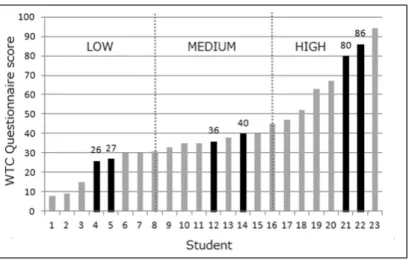
Figure 4 shows the distribution of scores produced in the WTC questionnaire (scores of participants selected for observations are shown in black).
Figure 5 shows the distribution of scores produced in the international posture questionnaire (scores of participants selected for observations are shown in black).
The six participants who were chosen to take part in follow-up interviews represented a sample of high, medium and low scores in the WTC questionnaire. Figures 4 and 5 (above) display the respective scores of each participant (shaded in black) and their position among the scores produced by other questionnaire respondents.
Classroom observation procedure:
Observations took place over three days. On any given observation day, the students were split into two groups: Intermediate English A and Intermediate English B. Both groups were taught by the same teacher who employed an identical lesson plan for both groups of students, ensuring that students covered the same content and had generally the same time allocation for tasks.
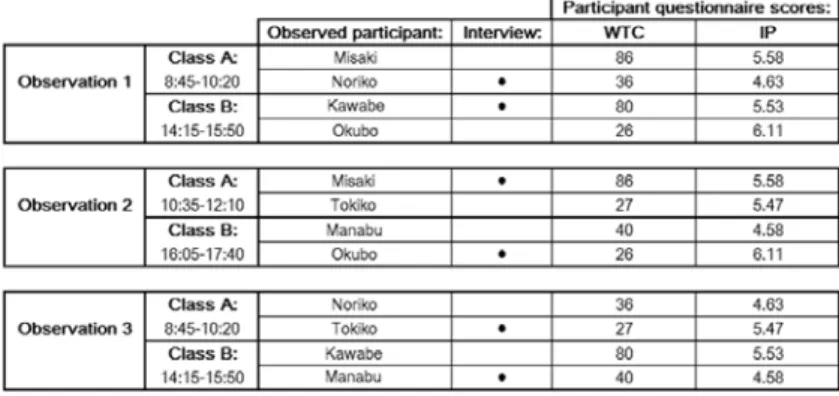
On any given observation day, two participants from group A and B group (four in total) were observed throughout the lesson. Figure 6 shows the participants observed during each of the three classes and their respective questionnaire scores (names are pseudonyms).
The lessons focused on teacher-led communicative group work. Groups consisted of four or five members and were arranged around the classroom furniture and computers. Students worked from the prescribed textbook and completed a range of communicative tasks following instruction from the teacher. Such tasks included discussing vacation activities, favorite TV programs, and the meaning of TV commercials. Observations were carried out using an observation schedule available in Cao and Philp (2006) (appendix 3).
As with the Cao and Philp (2006) study, this investigation employed stimulated recall interviews (Gass & Mackey, 2000). Over the course of the three 90 minute observed classes, each of the six participants selected for observation were observed twice but interviewed only once (see figure 6, above, for the interview schedule). The interviews took place immediately following each class in a library self-study room. During the interviews, the interviewee and the researcher viewed the video footage of the lesson and the researcher asked the student to comment on the lesson and answer a number of questions (appendix 4) related to motivation, anxiety and confidence, their opinions of the task, and their WTC and international posture questionnaire results. The interviews were conducted in the students’ L1, Japanese.
3. Results
In order to answer the first two research questions, Pearson product-moment correlations were calculated to establish the extent to which the WTC and International Posture (IP) questionnaire data corresponded with the results of each observation. Correlations were also calculated to establish the extent to which the WTC and IP questionnaire results corresponded with the participants’ semester participation grades. The “Pearson product-moment correlation” is a standard measurement used to establish the degree of correlation between two continuous variables.
Figure 7 shows the WTC and IP questionnaire scores for each particpant, and their respective data from each of the three observations.
Question 1: What relationship is there between self-reported WTC and observed incidences of WTC in a classroom context? In order to answer this question, the results of participants’ WTC questionnaires were compared with the situational WTC data gathered during the three classroom observations. Pearson’s correlations were calculated for the WTC questionnaire data and situational WTC data (represented as the total number of utterances produced by each student during each observation). The results are presented in Figure 8. No significant correlations were found between the WTC questionnaire results and the participants’ observed situational WTC. However, it should be noted that observations one and two did produce moderately strong positive correlations (r=0.689 and r=0.739 respectively). Observation three, however, produced a strong negative correlation (r=-0.823) suggesting that the relationship between trait and situational WTC is subject to situational variables (to be discussed below).
Question 2: What relationship is there between self-reported International Posture and observed incidences of WTC in a classroom
context?
To answer this question, the results of participants’ IP questionnaires were compared with the results of the classroom observations. Pearson’s correlations were calculated for the IP questionnaire data and the situational WTC data. The results are presented in Figure 9 (below). Correlations found between the IP questionnaire results and participants’ situational WTC data were minimal and non significant for all three observations (r=-0.103, r=0.041, r=0.167).
margin of each transcript to identify each general theme. Factors identified in previous research (see literature review) provided a starting point for the codes employed. An identical or similar coding term was employed for factors that appeared similar to those identified in previous research. For factors that appeared unique to the current study, such as “group leadership”, a new coding term was employed.
Such themes included factors such as self confidence, perceived self ability, nature of the task, and friendliness with other group members. Figure 10 shows the six factors that were identified and the number of participants who made comments relating to each of them.
Perceived self ability
All six participants mentioned the influence of their perceived English proficiency on their level of participation in the tasks. Three students remarked that although they wished to contribute to the task by saying something, they literally did not have the level of vocabulary needed to get their views across. Tokiko noted that “Sometimes the topic gets difficult and I just don’t have the vocabulary to explain my opinion even if I wanted to”. However, she also mentioned that the content covered at the intermediate level (the level of this class) was “comparatively simple” and that “even if the content gets a bit difficult, I can express my opinion because the content is usually such that we can get by with the limited vocabulary that we have”. The effect of a limited vocabulary was also mentioned by Okubo: “…others in my group were talking quite a bit. But I wasn’t talking as much as them…I guess it’s because I just don’t have the level of vocabulary”. This view was also reflected in Noriko’s statement:
“I can’t put into words what it is that I want to say. So it often ends up a fairly one-sided conversation. I really try to get my view across but the message just doesn’t get through.…”
Noriko also stated that her level of English was preventing her from initiating a topic because of a fear that she would be unable to maintain it:
“…if I start to speak but can’t understand what the other person is saying, then our teacher might say it back to me. But then I might not be able to understand what he is saying and I’d be afraid that the whole English lesson might come to a stop…”
For Noriko, it appears that her perceived lack of proficiency was contributing to her reserved stance. Indeed she spoke of how she becomes “rather nervous” when asked a question by the teacher and that “…if there is someone else already speaking, then I would just leave it to them”.
participants’ perceived English ability, therefore, appears to have a restricting, though not universal, influence on their situational WTC.
Group size and member familiarity
Five of the six interviewees mentioned their preference for group work and familiar group members. These five participants sighted reasons related to enjoyment, security and sources of assistance which, in turn, appear to have positively influenced their situational WTC. Noriko spoke of how being in a group with a close friend, who understands her level of English and makes adjustments for her, makes it easier for her to speak:
“…If I’m in a situation with a very close friend, then I can speak. If they are my friend then they know that I’m not a very good speaker and they will use easier grammar and vocabulary. I’m not so friendly with some people in class so I can tend to hush up”.
Okubo, like Kawabe, mentioned how working in a small group allows him to ask questions and get help from fellow group members. For Okubo, working in small groups appeared to give him a greater sense of security and also the opportunity to employ non-verbal modes of communication to compliment what he was trying to say:
“…English is not a language that comes naturally to me so I can feel a bit intimidated when it’s a whole class situation. But when we are in small groups we can look into each others’ eyes when we say things and even if our grammar is incorrect we can still get across the message that we are trying to say something”.
Working in small groups, then, provided the participants with a sense of security and a source of linguistic and non-verbal support which appeared to contribute to their situational WTC.
Ability of other group members
As described above, participants’ perceptions of their own English proficiency appeared to affect their situational WTC. However, it also appears that this can be mitigated by the level of English ability of their fellow group members. For example, although Tokiko described how her limited vocabulary restricts her ability to express her opinion, she also said that the amount she speaks depends on the level of the students around her:
“I have a pretty good idea of where my English level is. So if I’m in a class where the level is above mine, then the amount I will speak goes right down. If I think the level is about where I am, then I’ll speak out more actively”. Thus, how Tokiko situated herself amongst the ability levels of the other students had a direct impact on her situational WTC. In contrast to Noriko and Tokiko, Kawabe acknowledged that his level of English was lower than the students around him but that he was comfortable with that: “If I make a mistake, I’ll just need to fix it next time – that’s what study is about”.
The way that the participants’ perceive their own ability relative to their peers, therefore, does not have a universal negative impact – some students are comfortable with it and others are not. Of these three participants, Kawabe scored considerably higher in the WTC questionnaire (80) compared to Noriko (36) and Tokiko (27) which could indicate that his situational WTC is less susceptible to the impact of a perceived comparatively lower level of ability.
The nature of the task
Knowledge about the task topic, therefore, appears to have influenced Okubo’s motivation to speak. It appears, then, that the nature of the task in terms of how well it lends itself to a conversation has influenced the situational WTC of these four participants. Group leadership
Group leadership was a factor referred to by three of the interviewees: Noriko, Misaki and Tokiko. Throughout the interviews these three participants made a number of references to this factor through the use of words such as “lead”, “leading role” or “keep the task going”. Both Noriko and Tokiko expressed how having a group member that would lead the task or conversation helped them, while Misaki spoke of how the absence of any leader led to frustration and resulted in her having to take the lead. Noriko stated that:
“…with her (Misaki) I feel safe because she really keeps the task going. She really takes the lead of the group. But if I was just with him (the other group member), then one of us would probably have to lead. If I could, I would, but… she (Misaki) speaks English really well – better than me or him (the other group member)…If it were just him (the other member) and I, then I think I’d speak up. So I guess it really depends on the situation whether I speak or not”
Thus, Noriko feels safer when someone else takes the lead and keeps the task moving. Interestingly, however, she also indicated that she would take the lead and speak more in the absence of a group leader.
The necessity to take the lead was also influenced by the time restraints put on the task. As Misaki stated, their task had to be completed but they were running out of time. Misaki felt compelled to take the lead:
“One of the reasons I spoke today was because we had to pick a topic for our upcoming group presentations. We had to make a decision but we were running out of time. I had to ask ‘What shall we do? What shall we do?’ They couldn’t seem to make up their minds so I got a bit impatient”.
We can see, then, that there are at least two sides to the leadership issue. On the one hand we have students who appreciate others taking the lead in the conversation and, on the other hand, students who get annoyed when others do not take the lead and therefore feel compelled to take the lead themselves. The issue of group leadership and the roles assumed by group members is, the data suggests, an important dimension of situational WTC.
Nature of the teaching
Misaki stated that she found the lesson “boring” and contrasted this lesson with classes taught by another teacher:
“…the way the teacher gives us a topic for discussion is amazing. It’s like he wants the students to think deeper and deeper and to analyze the issues. He doesn’t just throw us a topic and get us to say what we think about it. He gets us to talk about why we think the way we do and I really enjoy that kind of structure”.
It can be said, then, that the topic and the way in which participants in this study were expected to interact with it have influenced their motivation to engage with the task. Tokiko stated that whatever the task is – speaking or writing – that it should have a “hook” that the students can latch on to and express their opinion. It appears that for these two participants, how the topic is presented by the teacher, and the way in which students are required to approach the task, influences their situational WTC.
4. Discussion
r=0.739 respectively). The data suggests, then, that there is a definite relationship between trait and situational WTC, but that participants’ decisions to actually take up an opportunity to engage in communication is also influenced by immediate proximal factors, including those identified in the current research, namely: perceived self ability, group size and member familiarity, ability of other group members, group leadership, nature of the task, and nature of the teaching. A similar conclusion was reached by Cao and Philp (2006) who suggested that participants’ observed WTC behavior in the classroom setting was influenced by both trait and situational WTC factors.
Figure 11 shows a tentative model that was constructed based on the above findings and illustrates how situational WTC, in the context of small classroom groups, is the result of both trait and situational factors. It assumes a starting point of a potential 100% WTC. As figure 11 illustrates, an individual’s trait-level WTC is influenced by trait-level factors, including those described at the lower layers of the MacIntyre et al. WTC pyramid model (figure 1), which bring an individual’s WTC to a level that we would interpret as trait-level WTC. Then, in a small group situation where the opportunity for communication is presented, an individual’s trait-level WTC is then influenced further by at least the six situational factors identified in the current and previous research. The model also assumes that situational factors may have a negative and positive effect on an individual’s situational WTC as was seen in the case of Tokiko who produced a comparatively low WTC questionnaire score of 27, but did in fact produce the highest number of utterances of all four participants in observation number three. The model shows, then, that the results of self-report WTC questionnaires can only provide a starting point for a range of potential levels of situational WTC that a student may display depending on the interplay of situational WTC factors.
their own ideal or possible selves as “speaking with international students, helping foreigners lost on the street, (and) reading English newspapers” (p.142). Five of the six interviewees made comments which could be interpreted as reference to their L2 Motivational Self System, that is to say, their Ought to L2 and Ideal L2 Selves. Tokiko, who produced a “mid range” IP score of 5.47, spoke of how she will need English in her future career in the hotel industry. Kawabe (IP = 5.53 “mid range”) spoke of how he will need English when he takes over his father’s international trading company. Noriko, who produced the lowest IP score (IP=4.63), made no such reference.
On the surface of it, these results provide tentative substance to Yashima’s (2009) hypothesis and model (see figure 3), namely, that students with a higher level of international posture visualize positive Ideal and Ought to L2 Selves using English, leading to increased levels of motivation.
The link between the IP questionnaire data and observed instances of WTC, however, was not found. One potential reason lies in the nature of the university and the type of students it attracts. APU, the venue of the current research, has a highly international student body and operates a dual-language curriculum. It could be said, then, that students coming to APU are motivated to enter an international environment and therefore have a higher level of international posture than the general Japanese student population for whom Yashima’s international posture construct was intended. Indeed the results of the IP questionnaire produced a comparatively high mean score of 5.2 and even the lowest score (3.84) was above 50% (on a 7 point scale). Thus, it could be said that by having such a narrow range of IP scores, there was not a sufficient range of high, medium and low scores for any relationship to be clearly identified.
Question 3: What are the situational variables that account for WTC in Japanese EFL students?
The results of the stimulated recall interviews produced the following six themes: perceived self ability, group size and member familiarity, ability of other group members, group leadership, nature of the task, and nature of the teaching. Of all these, the factor most frequently mentioned during the interviews was perceived self ability. Tokiko, Noriko and Okubo all mentioned how their perceived lack of vocabulary affected their WTC and this is consistent with the findings of Leger and Storch (2009) who concluded that a lack of vocabulary or linguistic knowledge was a hindrance to small group activities. The perceived ability of other group members was also a prominent factor that appeared to influence WTC and was aptly illustrated in Noriko’s following statement,
“…if I’m with someone who speaks really well … then I feel a lot of pressure. I know I have to speak but the fact that this person can speak so well only reminds me of how inferior my English is”.
The nature of the task and teaching were also identified as factors that influenced the participants’ situational WTC. The results of the current research suggest that an engaging topic that is conducive to communicative behavior promotes students’ WTC. Because the topic for group tasks and the nature in which it is presented to students can be influenced by the teacher, one conclusion that can be drawn from this research is the importance of appropriate task planning; as Misaki stated during her interview, it is important for teachers not to “…just throw us a topic and get us to say what we think about it”.
One variable identified in the current research is not widely addressed in the literature and thus presents a potentially fruitful avenue for discussion and further investigation, namely, the relationship between WTC, task leadership and group roles. The classroom, and more specifically the small group situation, is very different to the conditions under which students would normally have to make a volitional decision whether or not to initiate communication. Firstly, they are under an obligation to complete the task and therefore must speak. Secondly, the group-task context gives rise to an added dimension that must, the results suggest, be properly addressed if we are to fully understand the nature of WTC in the small group context – group dynamics and task leadership.
Opinion seeker/giver: who elicits the members’ feelings and reactions and also provides their own. (p.144)
The nature of these two roles, it could be said, requires students who assume such a role to take the initiative, speak up, and therefore use English. The interplay of responses provided by Noriko and Misaki provides a clear illustration of the importance of who takes the role of task leader and, as a result, the impact of group roles on each student’s verbal contribution to the task. As described above, Noriko spoke of how Misaki, “…really keeps the task going. She really takes the lead of the group”. This description fits that of the initiator role as described above. This is reflected in Misaki’s own comment:
“One of the reasons I spoke today was because we had to pick a topic for our upcoming group presentations. We had to make a decision but we were running out of time”.
Noriko also spoke of how, “after she speaks, she (Misaki) always asks for and listens to our opinion”. Misaki, it would appear, also plays the role of the opinion seeker/giver. We can see, then, that students’ verbal contributions to the task, and therefore the amount of verbal input we would observe as situational WTC, is influenced by the roles that students assume as group members. Observed instances of WTC in a group context such as this, it can therefore be said, cannot be understood without properly addressing this dimension of group dynamics. Cao and Philp (2006) identified an affective variable called “interlocutor participation” and hypothesized that WTC in pair work situations was co-constructed. I suggest that in addition to pair work, the hypothesized influence of interlocutor participation be extended to encompass the small group context. Cao and Philp also noted that gauging the degree to which WTC differed according to partners was not possible because dyads and group members were assigned randomly. The same must be said for the current study. I suggest that group roles offer a possible framework for analyzing WTC in small groups and/or pairs. Following this line of research, one could, for instance, investigate to what extent students with higher levels of trait WTC are more likely to assume certain roles within the group. Indeed it is interesting to note that Misaki, who was identified by her peers as the initiator/contributor and opinion seeker/giver, produced the highest trait WTC score (86) of all the interviewees. 5. Implications and conclusion
There are a number of limitations to the current research which the author acknowledges including the size of the sample, anxiety aroused by the presence of the video camera during the observations and follow-up interviews. Potentially the most important limitation, however, is the process of gaining the students’ informed consent. Indeed Dörnyei (2007) suggests that students should not be made aware of their participation in follow-up interviews prior to the conclusion of the classroom task in order to ensure that foreknowledge of the interview does not affect the students’ performance. The author recognizes the resulting potential threat on the validity of the current findings.
Data gathered through the current research suggested that perceived self ability greatly influenced participants’ situational WTC, which supports the results of previous studies. It would seem, then, that improving students’ views about their English proficiency remains an important goal of EFL instruction.
Looking forward, the issue of task and group leadership offers a potentially fruitful area of research that could improve our understanding of the mechanics of WTC in small groups. By understanding how this aspect operates, practitioners could then set about developing ways to encourage students to take more active roles in groups and ultimately enjoy greater levels of success as English language learners.
References
Asker, B. (1998), Student reticence and oral testing: a Hong Kong study of willingness to communicate, Communication Research
Reports, Vol.15, No.2, 162-169.
Cao, Y., Philp, J. (2006), Interactional context and willingness to communicate: A comparison of behavior in whole class, group and dyadic interaction, System 34, 480–493.
Clement, R., Baker, S.C., MacIntyre, P.D. (2003), Willingness to communicate in a second language: the effects of context, norms and vitality, Journal of Language and Social Psychology, Vol.22, No.2, 190-209.
Dewaele, J., Furnham, A. (1999), Extraversion: the unloved variable in applied linguistic research, Language Learning, 49:3, 509-544.
Dörnyei, Z. (1990), Conceptualizing motivation in foreign language learning, Language Learning, 40, 46-78.
Dörnyei, Z. (1994), Understanding second language motivation: on with the challenge!, Modern Language Journal, 78, 515-523. Dörnyei, Z. (2005), The Psychology of the Language Learner: Individual Differences in Second Language Acquisition. Routledge,
New York
Dörnyei, Z. (2007), Research Methods in Applied Linguistics, Oxford/New York, Oxford University Press.
Dörnyei, Z. (2009), Motivation, language identities and the L2 Self: a theoretical overview, in Z. Dörnyei & E. Ushioda (Eds.),
Motivation, Language Identity and the L2 Self (pp. 1-8). UK: Multilingual Matters
Dörnyei, Z., Murphey, T. (2003), Group Dynamics in the Language Classroom, Cambridge language learning library, Cambridge university press, UK
Dörnyei, Z., Kormos, J. (2000), The role of individual and social variables in oral task performance, Language Teaching Research, 4.3, 275-300.
Ellis, R. (2008), The Study of Second Language Acquisition. Second Edition. Oxford/New York, Oxford University Press. Ellis, R., Barkhuizen, G. (2005), Analysing Learner Language, Oxford/New York, Oxford University Press.
Gardner, R. C. (1985), Social Psychology and Second Language Learning: The role of attitudes and motivation. London: Edward Arnold.
Gass, S. M., Mackey, A. (2000), Stimulated Recall Methodology in Second Language Research, Mahwah, N.J.: L. Erlbaum Associates
Hashimoto, Y. (2002), Motivation and willingness to communicate as predictors of reported L2 use: the Japanese context, Second
Language Studies, 20(2), 29-70.
Kang, S. (2005), Dynamic emergence of situational willingness to communicate in a second language, System 33, 277–292. Léger D., Storch, N. (2009), Learners’ perceptions and attitudes: Implications for willingness to communicate in an L2 classroom,
System 37, 269–285.
MacIntyre, P. (1994), Variables underlying willingness to communicate: a casual analysis, Communication Research Reports, Vol. 11, No. 2, 135-142.
MacIntyre, P. (1999), Language anxiety: A review of the research for language teachers, in D. Young (Ed.), Affect in Foreign
Language and Second Language Learning (pp. 24-46). Boston: MacGraw-Hill College
MacIntyre, P. (2007), Willingness to Communicate in the Second Language: Understanding the Decision to Speak as a Volitional Process, The Modern Language Journal, Vol. 91, 564-576.
Language and Social Psychology 15, 3–16.
MacIntyre, P., Clément, R., Dörnyei, Z., Noels, K.A. (1998), Conceptualizing willingness to communicate in a L2: a situational model of L2 confidence and affiliation. Modern Language Journal, Vol. 82, 545-562.
McCroskey, J. C. (1992), Reliability and validity of the willingness to communicate scale, Communication Quarterly, 40, 16-25. McCroskey, J. C., Baer, J. E. (1985), Willingness to communicate: the construct and its measurement. Paper presented at the annual
convention of the speech communication association, Denver, CO.
McCroskey, J. C., Richmond, V. P. (1991), Willingness to Communicate: A cognitive view, in M. Booth-Butterfield (Ed).
Communication, Cognition, and Anxiety. Sage, Newbury Park, CA, 19-37
Yashima, T. (2000), Orientations and motivation in foreign language learning: A study of Japanese college students. JACET Bulletin, 31, 121-133.
Yashima, T. (2002), Willingness to communicate in a second language: the Japanese EFL context. The Modern Language Journal, 86, 54-66.
Yashima, T. (2009), International posture and the ideal L2 self in the Japanese EFL context, in Dörnyei, Z. & Ushioda, E. (Eds.),
Motivation, Language Identity and the L2 Self (pp. 144-163).UK: Multilingual Matters
Yashima, T., Zenuk-Nishide, L., Shimizu, K. (2004), The influence of attitude and affect on willingness to communicate and second language communication. Language Learning 54, 119–152.
Zakahi, W.R., & McCroskey, J.C. (1989), Willingness to communicate: a potential confounding variable in communication research,
Appendix 1: Willingness to Communicate Questionnaire
DIRECTIONS: Below are 25 situations in which a person might choose to communicate or not to communicate in English. Presume that you have completely free choice. Please indicate the percentage of time you would choose to communicate in each type of situation. Indicate in the space at the left what percent of time you would choose to communicate.
0% = never, 100% = always.
1. Talk with an acquaintance in an elevator. ( %)
2. Talk with a stranger on the bus. ( %)
3. Speak in public to a group (about 30 people) of strangers. ( %)
4. Talk with an acquaintance while standing in line. ( %)
5. Talk with a salesperson in a store. ( %)
6. Volunteer an answer when the teacher asks a question in class. ( %)
7. Talk in a large meeting (about 10 people) of friends. ( %)
8. Talk to your teacher after class. ( %)
9. Ask a question in class. ( %)
10. Talk in a small group (about five people) of strangers. ( %)
11. Talk with a friend while standing in line. ( %)
12. Talk with a waiter/waitress in a restaurant. ( %)
13. Talk in a large meeting (about 10 people) of acquaintances. ( %)
14. Talk with a stranger while standing in line. ( %)
15. Present your own opinions in class. ( %)
16. Talk with a shop clerk. ( %)
17. Speak in public to a group (about 30 people) of friends. ( %)
18. Talk in a small group (about five people) of acquaintances. ( %)
19. Participate in group discussion in class. ( %)
20. Talk with a garbage collector. ( %)
21. Talk in a large meeting (about 10 people) of strangers. ( %)
22. Talk with a librarian. ( %)
23. Help others answer a question. ( %)
24. Talk in a small group (about five people) of friends. ( %)
Appendix 2: International Posture Questionnaire
DIRECTIONS: Following are a number of statements with which some people agree and others disagree. I would like you to indicate your opinion by putting a number in the space in front of each statement which best indicates the extent to which you agree or disagree with the statement. Thank you very much for your help. Please use the following scale to help you:
1 2 3 4 5 6 7
No, not at all Somewhat Yes, a great deal
Part 1
As a reason to study English:
1. ___ It will allow me to meet and converse with more and varied people.
2. ___ It will allow me to get to know various cultures and peoples.
3. ___ I will be able to participate more freely in the activities of other cultural groups.
4. ___ I’d like to make friends with foreigners.
Part 2
5. ___ I want to make friends with international students or employees in Japan.
6. ___ I try to avoid talking with foreigners if I can.
7. ___ I would talk to a non-Japanese employee if there is one at my workplace.
8. ___ I wouldn’t mind sharing an office with a non-Japanese employee.
9. ___ I want to participate in a volunteer activity to help foreigners living in the neighboring community.
10. ___ I would feel somewhat uncomfortable if a foreigner moved in next door.
11. ___ I would help a foreigner who is in trouble communicating in a restaurant or at a station.
Part 3
12. ___ I would rather stay in my hometown.
13. ___ I want to live in a foreign country.
14. ___ I want to be transferred to an overseas position within my company if there is a possibility.
15. ___ I’m interested in volunteer activities in developing countries such as participating in Youth International Development
Assistance.
16. ___ I don’t think what’s happening overseas has much to do with my daily life.
17. ___ I’d rather avoid the kind of work that sends me overseas frequently.
Part 4
18. ___ I often read and watch news about foreign countries.
Appendix 3: Classroom observation schedule
Incidences recorded with a tally system
WTC behavior categories
1. Volunteer an answer (including raising a hand). 2. Give an answer to the teacher’s question.
(a) Provide information – general solicit. (b) Learner-responding.
(c) Non-public response. 3. Ask the teacher a question.
4. Guess the meaning of an unknown word. 5. Try out a difficult form in the target language. 6. Present own opinions in class.
7. Volunteer to participate in class activities.
Additional categories for group work in the absence of the teacher 1. Guess the meaning of an unknown word.
2. Ask group member a question. 3. Give an answer to the question.
4. Try out a difficult form in the target language (lexical/grammatical/syntactical). 5. Present own opinions in group.
Appendix 4: Follow-up interview questions: Part I: general questions
1. How important is it for you to learn English?
2. How good are you at learning English?
3. What do you think your English level is like? What about your speaking skill in particular?
4. How motivated were you during this language course?
5. How much did you like learning together with your classmates in this course?
6. How would you describe your personality (quiet or talkative, relaxed or tense)?
7. How competent do you think you were to communicate in English during this course?
8. Did you feel very sure and relaxed in this class?
9. Did you feel confident when you were speaking English in class?
10. Did it embarrass you to volunteer answers in class?
11. Did you feel that the other students speak English better than you did?
12. Were you afraid that other students would laugh at you when you were speaking English?
13. Did you get nervous when your English teacher asked you a question?
14. Were you afraid that your English teacher was ready to correct every mistake you made?
15. In what situation did you feel most comfortable (most willing) to communicate: in small groups, with the teacher in a
whole class? Why? Part II: stimulated recall questions
(This section will employ the video-recordings of the observation)
16. Did you like this task? Why? Why not?
17. How useful for your learning do you think this task was? Why? Why not?
18. Did you think you did this task well? Why? Why not?
19. Did you enjoy doing this task? Why? Why not?
20. Did you feel happy to work in this group? What did you feel happy/not happy with?
21. Comparing the two situations you did, which task did you prefer? Why?
Part III: individual questions