Abstract
Indonesia s security sector reform (SSR) effort has produced some fruitful outcomes, namely the abolishment of the Indonesian military s direct participation in politics, separation of the police force from the armed forces and the revocation of the dual-function doctrine, to name a few. Yet, since the ratification of Law on Indonesian Military (TNI) in 2004, additional efforts of SSR have been thrown into the backburner. Since 2004, attempts to professionalise the military have been focusing on arms modernisation and improvement of military personnel s welfare – such as increased training and educational opportunities, as well as housing allocation for military personnel – instead of addressing several unfinished reform agendas, namely the subordination of the TNI under the Ministry of Defence, territorial command reform and military secondment to non-military affairs/posts, among others. This article attempts to analyse how western-developed SSR policy initiatives were introduced in Indonesia and how the SSR agendas were eventually neglected. Finally, this article will reflect on the lessons learned from the introduction of SSR concept in Indonesia to understand its trajectory.
Picking up Where We Left Off:
The Indonesian Military and Prospects for Reviving of
Security Sector Reform
M
ARZUKI, Keoni Indrabayu
*RITSUMEIKAN INTERNATIONAL AFFAIRS Vol.16, pp.27-56 (2019).
* Senior Analyst, Indonesia Programme, Institute of Defence and Strategic Studies, S. Rajaratnam School of International Studies, Nanyang Technological University, Singapore
Keywords:
Indonesian Military, Military Reform, Security Sector Reform
I
NTRODUCTIONThe prolonged economic crisis and political instability that engulfed Indonesia – brought about by the 1997 Asian financial crisis, the ensuing riots and incessant student protests, and diminishing political support from both the political elites and the military – led to the resignation of President Soeharto after ruling the country for 32 years in May 1998. This critical juncture in Indonesia s history ushered in significant political change including proliferation of political parties, devolution of power and authority from the central government to local government at the regency and municipality level, greater freedom of the press, flourishing civil societies and, later, introduction of free, fair and direct elections at both the national and local level. The reform in the political dimension was accompanied by changes in the security sector which fundamentally transformed the role of Indonesia s security institutions, particularly the Indonesian military (TNI), in post-Soeharto Indonesia.
This article examines security sector reform progress in Indonesia twenty years since it was initially introduced, particularly on the military and issues surrounding civilian oversight. Security sector reform in Indonesia involves many institutions, but this paper will only focus on some of them for parsimony. While reforms in the security sector have shown some impressive progress, albeit imperfectly, during the early days of Reformasi, contemporary progress in security sector reform is slow, and some reform agendas designated in the past had never truly found the light of day. This reverberates with the more general assessments in the existing literature and discussion regarding Indonesia s security sector, which notes that security sector reform has been thrown in the backburner due to various factors (Baker, 2015; Beeson & Bellamy, 2008; Lowry, 2016; Mietzner, 2018). Recent research further shows some degree of backsliding in terms of the Indonesian military involvement in what is traditionally civilian affairs (Institute for Policy Analysis of Conflict, 2015; Sebastian, Syailendra, & Marzuki, 2018).
security sector reform, particularly post-2004, is caused by multiple factors and changes in Indonesia s political domain. This article identifies several key factors that held up the progress of reform, namely the waning self-motivation to pursue additional reform initiatives, declining support base for reform, declining support from international donors, the lack of political will to support reform, as well as shifting priorities in reform agendas. Most consequential of the inhibitor to reform, however, was the waning willingness from the military leadership to pursue further reform. This article is structured as follows. The first section outlines a broad introduction to security sector reform policy initiatives and how they were introduced to non-Western countries. The second section outlines some of the reform agendas that Indonesia had undertaken and discuss its imperfection, as well as some agendas that were forgotten. The third section discusses factors that lead to the neglect of SSR. The final section summarises the analysis of the paper.
L
ITERATURER
EVIEWSecurity Sector Reform – A Snapshot
The concept of security sector reform (SSR), emerging in the late 1990s, is different than Cold War-era military assistance programmes such as training and military equipment grants that is primarily aimed to enhance of the operational capacity of security institutions without much concern for democratic governance (Ball, 2004). The concept s origin was founded upon the growing recognition within the Western development community and donors that security and development are inextricably linked and should be delivered conjointly to sustain long-term development and democratisation (Duffield, 2001, p. 16). Changes in global geopolitics such as the end of the Cold War, the broadening concept of security (Bellamy, 2003; Cooper & Pugh, 2002), the sweeping wave of democratisation across different parts of the world (Gindarsah, 2015, pp. 3-4) and the emergence of transitional and post-conflict societies (Hä nggi & Scherrer, 2007) helped foster the so-called new aid paradigm.
While there is no single definition what the concept means and entails, one of the more widely accepted working definitions – conceived by the Development Assistance Committee of the Organisation for Economic Cooperation and Development – broadly refer SSR as the transformation
of the entire security system, which includes all of its actors (and other relevant stakeholders), their roles, responsibilities and actions, so that it is managed and operated in accordance with democratic norms and principles of good governance and thus contributes to a well-functioning security framework. A responsible and accountable security forces minimise the risk of conflict, provide adequate security for citizens and foster conducive environment for development (Wulf, 2004). In essence, security sector comprises of two core elements: groups with the mandates to use force – such as the military, police and intelligence – and institutions responsible for managing and oversight over matters of defence and internal security – such as defence ministries and legislative institutions (Huxley, 2001). However, the scope and target of SSR are not exclusive to these elements, but also encompassing civil societies and non-statutory security forces – e.g. private security companies, militias and guerrilla armies (Wulf, 2011, pp. 339-340).
SSR-related activities can be classified into five broad categories, namely (i) agenda setting and strategic planning in the security sector; (ii) r e b u i l d i n g, r e s t r u c t u r i n g a n d r e f o r m o f t h e n a t i o n a l s e c u r i t y establishment; (iii) strengthening civilian control and democratic oversight of security institutions; (iv) post-conflict settlement; and (v) activities related to cross-cutting concerns such as gender issues and child protection. In practice, these activities are translated to a wide array of programmes, ranging from disarmament, demobilisation and reintegration initiatives, small arms and light weapons control, defence reform, enhancing parliamentary oversight, and review of the security sector, to name a few (Hä nggi & Scherrer, 2008). In practice, the categories above may not be necessarily applied simultaneously as SSR activities depend on the context and settings in which is applied helps determines the type of programmes, focus and emphasis of reform initiatives, as well as actors that could deliver effective reform (Bryden & Hä nggi, 2005).
As an illustration of the difference in reform settings, post-conflict security sector reform generally involves international actors that play a more prominent role in initiating, designing and implementing reform, whereas reform in transitional authoritarian context is more likely to be self-initiated and therefore less dependent on international largesse (Donais, 2009). Reform in post-conflict states may prioritise re-integration of former combatants and controlling small arms distribution, whereas
post-authoritarian states emphasise more on streamlining the oversized military structure and strengthening civilian oversight. Additionally, no two SSR, even in the same context, are ever truly the same given the unique nature and specific settings that shape the security sector in each country. Fundamentally, however, principal key objective of these initiatives is to enhance the efficacy and effectiveness of security institutions in undertaking their role and function through improvements in professionalism and democratic control, as well as the minimisation of the potential threat to human security that they pose. In other words, security sector reform is primarily concerned to transform the practices, doctrines and management structures of the security sector towards Western norms of behaviour and liberal democratic values (Beeson & Bellamy, 2008, p. 19).
Experiences of SSR implementation around the globe yields mixed results. In Eastern Europe, SSR implementation is relatively successful primarily due to pressure exerted by NATO and EU enlargements and the collective approach to induce reform as a prerequisite for post-Soviet states to obtain membership in both groupings. Other factors, such as c o n t i n u o u s d i a l o g u e s t h a t h e l p f o s t e r r e f o r m s ; s t r o n g m u t u a l understanding between donors and receiving countries; as well as political and economic stability, enables the Baltic states and Poland to embrace SSR (Stålvant, 2011). Meanwhile, records of security sector reform in the Western Balkans and the Caucasus have proven to be less conclusive (Dursun-Ozkanca & Vandemoortele, 2012). Several factors, such as the lack of trust between national and ethnic communities, ethnic plurality, local stakeholders with narrow self-interests, absence of coherent long-term reform strategy and inter-states historical grievances that hinders common reform objective to form, are some impediments to produce a democratic security forces in countries such as Kosovo, Bosnia and Georgia (Ekengren & Simons, 2011).
While security sector reform is increasingly recognised as significant contribution to promote peace and development in the setting of post-conflict states of Africa, it yields mixed results. Significant and sustained improvement in security conditions among post-conflict African states such as South Africa, Ethiopia and Sierra Leone in one side is met with mixed or negative results in Liberia, Congo and Sudan. The relative success of security sector reform in post-Apartheid South Africa (Nathan,
2007), Sierra Leone and Ethiopia are primarily driven by popular political demand and strong mandate for the government, which was met with an equally strong interest to change then-existing institutions radically. While some gaps – such as inadequate functional oversight mechanism and inadequate embeddedness of the security sector as part of a democratic governance framework – remain, reform of Sierra Leone s security sector has enhanced the restoration of public safety in the country (Ebo, 2006). Although the context and setting for all cases of relative success is arguably different from one another, they all commonly feature popular consultations resulting in a governmental decision to focus on human security – which emphasises on economic development and improvement in police capacity – over traditional security goals that place emphasis on national militaries (Detzner, 2017). Cases of SSR failure is often multifaceted, ranging from issues regarding local ownership of SSR processes, coordination issues, omission of essential elements within the security sector, and neglects of peripheral and non-state actors. In Liberia, for example, the RAND Corporation-driven security sector reform process failed to respect the principle of local ownership and minimally involved the government and relevant security agencies (Bendix & Stanley, 2008, p. 24). In Mali (Caparini, 2015) , Libya, the Democratic Republic of Congo and, to some extent, Sierra Leone (Detzner, 2017, p. 122), disarmament, demobilisation and reintegration initiatives were inadequately funded.
Although security sector reform in Latin America is not featured prominently in the mainstream security sector reform literature, some key lessons can nevertheless be gleaned from them. The case of Costa Rica for example, presents a unique case study on reform initiatives that focus on the police force and security sector reform in non-military countries as it does not have a proper military force in the security sector (Dursun-Ozkanca, 2017). In the case of Haiti, the UN-led multilateral initiatives to demobilise the army, create an accountable police force and implement reform as part of the broader agenda to rebuild the state in the 1990s experienced major hurdles such as the lack of unified support from the elites, insufficient judicial sector capacity and deeply ingrained corruption (Mendelson-Forman, 2006).
For Southeast Asia, security sector reform only gained interest in the late 1990s and early 2000s, mainly due to democratisation in the region and the lack of ideal preconditions that facilitated reform in the past.
Firstly, Southeast Asian countries did not receive much external support for reform. Cold War-era military assistance primarily focused on enhancing the effectiveness of the region s security institution with little to no regard for democratic accountability. Second of all, unlike security sector reform in European countries, regional organisation in the Southeast Asian region (ASEAN) adopted principal core values, namely interference, consultation and consensus, use of force and non-confrontation, that fundamentally constrained the possibilities of the transmission of liberal democratic values and attention towards human rights. Third, security sector reform in the region is mostly focussed on the military instead of a whole-of-government approach given the prominent position of the military organisation in the majority of Southeast Asian states, its relation with the society, and subsequent political influence they hold (Heiduk, 2014).
There are variations as to how reform was implemented in the region. In the case of East Timor, reform initiatives were led by the UN between 1999-2004 as part of post-conflict reconstruction and democratisation, to a less than stellar result as efforts to build professional security sector institutions with effective civilian oversight practically failed due to the UN s misguided approach to reform the police institution and local government s unwillingness to assume responsibility for defence force development, which were compounded by politicisation of security institutions and escalating intra-sector tensions (Croissant, 2018, p. 47; Hood, 2006). While the case of East Timor demonstrated externally-driven reform, much of the reform initiatives undertaken in other Southeast Asian countries were mostly internally-driven, given that American and European military assistance became increasingly tied to fulfilment of security sector reform goals and that reform could potentially improve the effectiveness of the sector in undertaking its core tasks, political leaders of the region have a vested interest in pursuing security sector reform (Beeson & Bellamy, 2008, p. 29).
Experiences of security sector reform across the globe generate many criticisms towards security sector reform. Most prominently, critics have argued that one-size-fits-all Western democratic values to other countries – without taking into account the nuances of local security culture, state-society relations, historical settings and the compatibility of these values to local settings – limit the effectiveness of security sector reform,
democratisation process and development. In countries that evolved from colonialization, imposition of Western liberal democratic values could easily be seen as illegitimate (Beeson & Bellamy, 2008, p. 26; Krempel, 2014, pp. 75-78). A second set of criticism towards security sector reform, and related to the first one, is that the promotion of reform and security sector reform may breed insecurity and violence by compromising and dissolving pre-existing socio-political order that had maintained some degree of stability in the past, regardless of how precarious it was. Other criticism towards security sector reforms refer to the issue of local ownership – or the ability of local actors to commit to and play an active role in the reform process instead of having it driven by external actors. Reform programmes that are too externally driven can be seen as an external imposition and subsequently raises local resistance towards reform, especially if the country in question ha as deep colonial history. Others argued that security sector reform could be excessively focused on core security actors while neglecting others (Beeson & Bellamy, 2008, pp. 25-27).
O
VERVIEW OFI
NDONESIA’
SSSR A
GENDAS: I
MPERFECTR
EFORMS ANDF
ORGETTENA
GENDASBefore delving into Indonesia s experience of SSR, it is essential to first understand the context in which the military became such an overwhelmingly dominant agent in the security sector that propped up Soeharto s authoritarian rule for more than three decades. A brief discussion on the military s genesis of power would be instructive to understand the background of SSR. The Indonesian military, specifically the Army, played a central role in the founding of the modern Indonesian state through violent and arduous guerrilla struggle against colonial power – with some military officers arguing that the genesis of the putative Indonesian military to precede the formation of the state – which many military leaders believe earned them the right to play a central role in the society and politics (Said, 1987). Much of the distinctive structure and doctrines developed during the revolutionary period continue to influence the military s contemporary strategic thinking. The territorial command structure adopted by the military, a sprawling network of military structure which primary function is to detect and responds to
military threats is an example (Haseman, 2006). Beyond military purposes, it is significant source of influence for the military, an instrument to exercise societal control and political surveillance, as well as a means to keep the New Order regime in power (Sebastian & Gindarsah, 2013, p. 31).
The military would become more prominent over time. During the Soekarno era, it supported the declaration of martial law and imposition of guided democracy that ended the topsy-turvy parliamentary democracy, which the military viewed as a source of weakness that incentivised various rebellion and secessionist movement across the archipelago (Crouch, 2007, pp. 31-34). Martial law also allows the military the authority to assume effective ownership of Dutch and other foreign-owned properties after they were expropriated by the state in the late 1950s, thus granting the military with substantial economic resources while subsequently allowing them to extend their links with the state (Robinson, 2001). The military s power was further consolidated following the political upheaval in 19665 that saw the ouster of Soekarno and Soeharto s ascension as president. In the following year, General Nasution articulated the middle-way doctrine (jalan tengah), which proposed that the military is not an overwhelming force that dominates the government nor a tool of civilian government (Rabasa & Haseman, 2002, p. 10). This doctrine would later evolve into dual-function doctrine (dwifungsi), which prescribed and legitimised that the military has a socio-political function to promote national development and maintain political stability apart from its traditional defence role.
SSR in Indonesia s context is best illustrated by Mietzner (2006), who adopted the two-generational reform model proposed by Cottey, Edmunds and Forster (2002), as a two-phase process. The first phase of reform concentrates on dismantling the old power structures of an authoritarian regime by demolishing the coercive institutions associated with said regime, the establishment of civilian bodies with oversight role over the military, changes to the command system and empowerment of the parliament. Many of the changes instituted under the first phase have been implemented at the onset of reformasi, including the military s disengagement from politics and enhancing oversight functions of the legislature through the adoption of various legal frameworks. The second phase, on the other hand, focuses on the capacity building of both state
institutions and civil society in exercising democratic civilian control over the military (Mietzner, 2006).
Indeed, Indonesia has achieved significant milestones in its effort to reform the security sector. The most important reform agenda during the Habbie interregnum, i.e. from 1998 to early 1999, was to redefine the military s role in post-Soeharto Indonesia, primarily articulated as the military disengagement and extraction from politics. In the immediate aftermath of Soeharto s abdication from the presidency, General Wiranto, then-Commander of the Indonesian Armed Forces (ABRI), initiated internal reforms of the armed forces through the introduction of New Paradigm (Paradigma Baru) at ABRI Seminar in 1998, with the assistance from reformist senior military officers – namely Agus Widjojo, Agus Wirahadikusumah and Susilo Bambang Yudhoyono – who had extensive experience and military training education overseas. The New Paradigm posited four points, namely (1) the military does not necessarily have to be at the forefront of politics; (2) the military no longer seek to occupy positions in the state but would only influence policies; (3) changing the method of influence from directly influencing day-to-day politics to indirectly influencing politics; and (4) recognition of the necessity for role-sharing with other elements (Honna, 2003, pp. 164-167; Lee, 2000, pp. 699-700; Rinakit, 2005, pp. 105-106).
Three reasons drove the development of New Paradigm (Rinakit, 2005). The first reason was that the military needs to cope with the changing global strategic environment following the collapse of the Soviet Union and the growing prominence of human rights and democratisation. Secondly, the New Paradigm was essential to empower civilian technocrats capacities and managerial ability to ensure that Indonesia is competitive in a globalised free-market world. The third reason relates to the increasing awareness of the Indonesians who view that the military s socio-political role contravened democratic values. These reasons were compounded by Wiranto s acute sense towards the military s poor public image, which reached its nadir in 1999 (Yuniarto, 2018) and constant public antagonism that the military had to endure. The deteriorating public image of the military was primarily attributed to surfacing media reports regarding its complicity in human rights violation in Aceh and East Timor (Emmerson, 1999; Sukma, 2013, p. 123), the violent repression against student protestors and its role as the New Order s tool to
perpetuate the regime and defend its political and economic interests (Azca, 2004). Although the military has indeed distanced themselves from Soeharto at the demise of the New Order regime, the general public at the time considered the military as an accessory to Soeharto s authoritarian and thus military reform was an essential step to ensure the progress of democratisation.
The New Paradigm also signals the end of the military s dual function. The doctrinal change was manifested through a series of measures. First and foremost, the office of Social and Political Affairs (Kassospol) within the military structure was liquidated (Sukma, 2013, p. 124). The armed forces accepted partial reduction of the military s fraction reserved seats at both the local and national parliament in January 1999, before relinquishing all of their seats in the legislatures later in 2004. The military leadership at the time also moved to disassociate the military with Golkar, Soeharto s ruling party, and pledged neutrality in the 1999 elections (Mietzner, 2009). Furthermore to New Paradigm, active military personnel were prohibited from holding a public office without submitting their resignation from military duty. Moreover, there is some degree, while limited, of change in the military s curriculum that now emphasised on the military s withdrawal and non-involvement in politics, albeit they still include coursework with socio-political theme (Bradford, 2005). The separation of the police force from the military proper was another major reform initiative that Indonesia had successfully undertaken. The split was complemented with the delineation of the military s and police s core function and duties, whereby the military focus on its role from safeguarding the country from external threats while the police focus more on internal security and maintenance of order. These milestones are enshrined within the MPR Decree VI/2000 and VII/2000 respectively. Accompanying the separation of the police from the military was the rechristening of ABRI as TNI (Tentara Nasional Indonesia) (Sebastian, 2006, p. 218).
Considering the military s omnipresence in all aspects of life, it is unsurprising that much of the reform measures on the first phase centred around the military. So much so that the term military reform was used interchangeably with SSR (Muna, 2008), even though the two are distinctly different term. Characterising Indonesia s SSR experience as military reform, however, overlook other reform processes – particularly
on the empowerment, albeit limited, of civilian oversight – that Indonesia had undertaken over and above reforming the military by extracting it from day-to-day politics. The term military reform is deficient as a framework to understand SSR process in Indonesia, which also involves other security agencies such as the police.
A second set of reform undertaken during the Abdurrahman Wahid and Megawati presidencies did remedy, to a moderate extent, the shortfall of reform in establishing civilian control over the military, which was lacking under Habibie presidency. Soon after Wahid was elected, President Wahid asserted his authority as the Commander in Chief of the Indonesian Military by appointing a naval officer, Admiral Widodo AS, as TNI Commander – a position that has been traditionally occupied by Army generals during the New Order (Al Araf, 2007). Likewise, Wahid appointed a civilian defence minister, Juwono Sudarsono, a position that was previously reserved for military officers. These tradition-breaking appointments signify not only Wahid assertiveness, but also his commitment to further reform, especially in exercising civilian control over the security institutions (Mietzner, 2006, p. 20; Sukma & Prasetyono, 2003, p. 18). Three sets of legislations, namely Law No.3/2002 on State Defence, Law No. 2/2002 on the Indonesian National Police and Law No.34/2004 on the TNI were passed under Megawati s presidency. In addition to institutionalising previous reform measures as a formal legal framework, the legislations empower civilian institutions, particularly the legislature, with oversight capacities over the core security actors. For example, the national parliament is authorised, under the laws, to vet candidates that are proposed by the President to head security institutions.
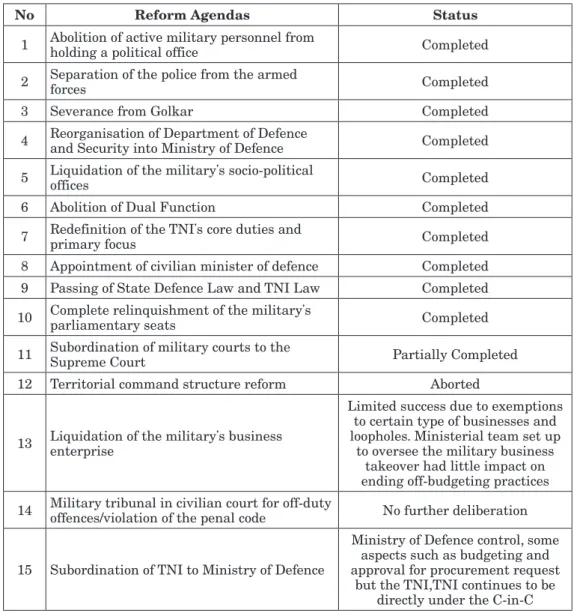
Indeed, Indonesia s SSR progress is by no means perfect, nor did it live up to the lofty ideals of SSR. Even some reform initiatives that fall under the category of first generation reforms were either aborted or forgotten entirely. As noted by some scholars (Honna, 2003, p. 167; Mietzner, 2009, pp. 203-204), the military reform agendas of the first phase of reform were not substantive to ensure democratic civilian control over the military for various reasons. The reform measures adopted by the military had political underpinnings and they were instruments to side-line certain faction within the military and hence were not implemented to establish democratic civilian control. Additionally, over and above the
reform measures above, there was a strong apprehension for further reform, particularly in aspects that relate to the military s socio-political role (Sukma, 2013, p. 124). Chrisnandi (2007), for example, noted that the New Paradigm and the abolition of dual-function doctrine did not immediately change the military s organisational culture given the long period of indoctrination and internalisation in the mindset of officers which perhaps lasted until this very day. Reform of the territorial command system is a classic example of an initiative that was deliberated but was eventually dropped from discussion within the parliament. The reason is that the structure was an integral part of Indonesia s defence strategy and thus considered to be sacrosanct. Reform on the military justice law, which proposed a military personnel that committed felony outside of their military duty to stand trial in civilian courts (Mietzner, 2009), was also deliberated but eventually canned. Other agendas to empower civilian control over the security institutions, such as providing more space for civilian to be involved in the Ministry of Defence was also unsuccessful as the institution continues to be dominated by military officers (Gunawan, 2017).
Meanwhile, the liquidation of the military s business enterprises and foundations has shown some progress. Reform in the military s business is especially important to ensure the military s subordination to civilian authority and prevent it from being overly independent and diverge from the objective that the government had set. Secondly, it allows senior military officers to focus on the task at hand – defending the nation against external threats. Third, the military s businesses create distortions in the nation s economy and potentially impede growth by means, such as, preferential access to bank credit (Rieffel & Pramodhawardani, 2007, pp. 3-6). The World Bank proposed that the issue of military s budget deficit could be addressed through government appropriation of the enterprises and foundations, whose revenues and profits could be utilised to finance the military (Lachica, 2003, p. 21). Upon closer inspect, on however, the agenda was emasculated. The failure to swiftly establish a hierarchical relationship between the Ministry of Defence and the TNI Headquarters allowed the military to create loopholes – such as defining some of its enterprises as cooperatives and thus exempted from the category of business – that prevent complete transfer of its enterprises to the government. Even in some enterprises that the military had agreed to
divest to the private sector, the money accrued from the sale went he its own pocket with little to no accountability (Mietzner, 2006, p. 55). In the end, reform on the military s business was only partially successful in transferring some of the enterprises to the government or private sector while some enterprises remain, although often in a vague manner, within the military s control because the Yudhoyono government was reluctant to fulfil the agenda (Mietzner & Misol, 2013, pp. 116-119), even though he issued a presidential regulation concerning the takeover of the military business by the government (Sebastian & Gindarsah, 2013, p. 35).
Table 1 List of First Generation Reform Agendas and Their Status
No Reform Agendas Status
1 Abolition of active military personnel from
holding a political office Completed
2 Separation of the police from the armed
forces Completed
3 Severance from Golkar Completed
4 Reorganisation of Department of Defence
and Security into Ministry of Defence Completed
5 Liquidation of the military s socio-political
offices Completed
6 Abolition of Dual Function Completed
7 Redefinition of the TNI s core duties and
primary focus Completed
8 Appointment of civilian minister of defence Completed 9 Passing of State Defence Law and TNI Law Completed
10 Complete relinquishment of the military s
parliamentary seats Completed
11 Subordination of military courts to the
Supreme Court Partially Completed
12 Territorial command structure reform Aborted
13 Liquidation of the military s business enterprise
Limited success due to exemptions to certain type of businesses and loopholes. Ministerial team set up
to oversee the military business takeover had little impact on ending off-budgeting practices
14 Military tribunal in civilian court for off-duty
offences/violation of the penal code No further deliberation
15 Subordination of TNI to Ministry of Defence
Ministry of Defence control, some aspects such as budgeting and approval for procurement request
but the TNI,TNI continues to be directly under the C-in-C
16 Civilianisation of Ministry of Defence Military officers continue to predominate the ministry
17
Regulatory framework concerning reserve component, military secondment, and operations other than war
Some discussions, but such regulations were never deliberated
in detail
18 Establishment a of national security council Discussed since 2002, no further concrete steps were taken
Source: Adapted from (Mietzner, 2006) and (Widjajanto, 2007)
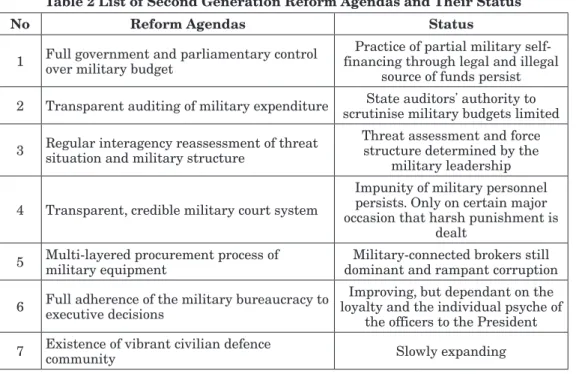
Given the partial success and deficiencies of the first phase of reform, the second-generation reform in empowering state institutions and civil society to exercise democratic civilian control over the military is also limited. For instance, given that the relations between the Ministry of Defence and the TNI Headquarter is coordinating and not subordination of the latter, the TNI has a leeway to determine operational policies and threat assessment without having to seek approval from the Ministry. In late 2017, for example, Indonesia s Corruption Eradication Commission investigation over the alleged corruption practices in the military s procurement of a transport helicopter intended for VIP transport (Suroyo & Reinard, 2017) – which later resulted in the historic life sentencing of a one-star general in a military court – not only illustrates that officers enjoy some degree of impunity from the civilian penal code, but also the enduring corruption practices in arms procurement process. The presence of the so-called civilian defence community consisting of donor-supported NGOs, activists and academia, as evident in their role in assisting several legislations concerning the security sector (Sukma, 2012), is perhaps one of the silver lining in the deficient second-phase reform, but sustainability of the majority of the community largely dependent on foreign donor to finance their activities and operations (Scarpello, 2014).
Table 2 List of Second Generation Reform Agendas and Their Status
No Reform Agendas Status
1 Full government and parliamentary control over military budget
Practice of partial military self-financing through legal and illegal
source of funds persist
2 Transparent auditing of military expenditure State auditors authority to scrutinise military budgets limited
3 Regular interagency reassessment of threat situation and military structure
Threat assessment and force structure determined by the
military leadership
4 Transparent, credible military court system
Impunity of military personnel persists. Only on certain major occasion that harsh punishment is
dealt
5 Multi-layered procurement process of military equipment
Military-connected brokers still dominant and rampant corruption
6 Full adherence of the military bureaucracy to executive decisions
Improving, but dependant on the loyalty and the individual psyche of
the officers to the President
7 Existence of vibrant civilian defence
community Slowly expanding
Source: Adapted from (Mietzner, 2006)
R
EFORMI
NHIBITORSSeveral scholars have analysed the progress of SSR and its limited scope, as well as its sluggish progress. Arguably, however, no single factor single-handedly inhibits SSR progress in Indonesia to the point of stagnation, but rather a flurry of complex inter-related factors. Some scholars argue that SSR in the Indonesian context is a process that was internally driven by the military, without much intervention and specific directives from civilian authority. The drawback of such a process, however, was that the pace and scope of reform were slow and limited because the military did not see the necessity for additional reform initiatives that were not related to extracting the military from politics (Muna, 2008, p. 237; Sukma, 2013, p. 124). Moreover, because of the internally driven nature of reform and the absence of clear guidance from the civilian authority allows them to selectively undertake reform, while at the same time undermine several agendas that pose a threat to its interest. Honna (2003), on the other hand, noted that intra-military
fragmentation and factional rivalry at the onset of reformasi influenced the pace of reform. The need to purge the legacy left by Prabowo Subianto and his supporters, arguably the most prominent threat to Wiranto s grip over the military, was a significant driver that compelled military leadership at the time to adopt reform.
Some scholars attributed the lacklustre progress of reform to the absence of adequate pressure to adopt sweeping reform from Indonesia s external environment. Unlike security sector reform in post-Soviet states which received some degree of external pressure and inducements from NATO and EU to reform their security sector to obtain membership in the two organisations, the Southeast Asian region lacks the institutional mechanism to promote democratic civilian control and security sector reform. Given that ASEAN adheres to a set of principle called the ASEAN-way, which includes principles of non-interference, consultation and consensus and non-confrontation, there is virtually no pressure for Indonesia to commit to reform the security sector (Heiduk, 2014, p. 10).
Other compelling explanation on why SSR lost its steam was the diminishing support base of SSR, both within the core security actors and relevant civilian institution. SSR support base in the military, particularly during the Abdurrahman Wahid s administration, was dismantled due stiff resistance towards reform from the status quo camp. Agus Wirahadikusumah, a proponent for sweeping reforms (Bourchier & Hadiz, 2003, p. 280), alongside his reformist associates such as such as Saurip Kadi, Mahidin Simbolon and Baktiman (Kingsbury, 2003, pp. 177-178), were eventually sidelined by President Wahid in a move to appease the military even though he was initially grooming Wirahadikusumah to helm the military. Other progressive officers that were previously involved in the formulation of New Paradigm, such as Susilo Bambang Yudhoyono and Agus Widjojo, were no longer a part of the military or did not hold leadership position that could help drive reform. Yudhoyono was one of the few military officers that Wahid forced to retire by appointing them as cabinet ministers. In line with the principles espoused by the New Paradigm, active military officers are required to tender their resignation before holding a public office. Widjojo, on the other hand, remained in the military but his position as the Chief of Staff for Territorial Affairs was not as influential as it was in the past as the post had been downgraded into an assistant post under the Chief of Staff for General Affairs in 2001
(Rabasa & Haseman, 2002, p. 28), a position that is less consequential to drive reform. Moreover, he was soon reassigned from his post to become the Deputy Speaker of the People s Consultative Assembly before he could make impactful reform in the territorial command structure.
Similar to the declining support base in the military, SSR support base from the civil society organisations and NGOs was also faltering. International donors such as the United States Agency for International Development (USAID) and the Department for International Development (DFID) initially provided invaluable financial assistance to the International Working Group for Security Sector Reform – a coalition of civil society organisations comprising of various entities ranging from academics, think tanks and human rights activities such as Centre for Strategic and International Studies (CSIS) Jakarta, ELSAM, Imparsial, PACIVIS – University of Indonesia, KontraS, INFID, the RIDEP Institute and Yayasan Lembaga Bantuan Hukum Indonesia (YLBHI) among others (Lorenz, 2015; Widjajanto, 2007) – to sustain their activities in shaping and drive SSR process (Scarpello, 2014). In the early 2000s, however, the donor s priorities shifted from establishing adequate civilian democratic control over the security sector in favour of supporting the security actors capacity to fight terrorism.
As far as Washington is concerned, the priority to combat terrorism in a global scale means that it was willing to ignore past human rights abuses that have yet to be fully resolved and were more inclined to return to Cold-War era practices to provide military assistance with little regard to democratic control (Beeson, Bellamy, & Hughes, 2006). Post 9/11, Secretary of Defence Donald Rumsfeld and Secretary of State Colin Powell certified, perhaps hastily, that Indonesia has taken satisfactory measures to reform its security sector to urge Congress to resume military partnership with Indonesia (Mietzner, 2006, pp. 40-41), which seemed to be successful given that the US have resumed full cooperation with the Indonesian military, including funding and arms sales (Beeson & Bellamy, 2008, p. 148), and concluded an anti-terrorism cooperation with the Army Special Forces (Kopassus), an elite special forces group that has gained notorious reputation of human rights violation (Beeson et al., 2006, pp. 466-477) . T h e s h i f t i n g p r i o r i t i e s h av e s e r i o u s i m p l i c a t i o n s f o r democratisation and reform in Indonesia, not only because this gave some breathing space for security actors to resume the repressive roles they
had, but also because it diminished a substantial amount of precious resources necessary to maintain the capacity of the CSOs and epistemic communities to continue advocating reform.
The lack of financial support was compounded by the internal weaknesses of CSOs. After the end of the working group, there is no similar vehicle with similar potency that could act as a viable framework to continue SSR advocacy. Distrust among the members of the now-defunct working group, especially human rights NGOs towards the reform credentials of organisations headed by former military officers. Moreover, some of the key individuals associated with the working group have moved on to other works, thus creating a void that is difficult to fill as their proficiency and credentials could not be easily matched. NGOs and think tanks remain partly professional of managing their administrative requirement and often lacking in transparency in their funding sources and how they spent the funds (Scarpello, 2014, pp. 143-144).
Declining popular support for further reform also plays a role in inhibiting reform. Recent polls by Kompas (Yuniarto, 2018) and other polling institutions consistently listed the Indonesian military as one of the most trustworthy institutions. Possible reasons for the improvement of TNI s image in the eyes of the public varies may include successful reform initiatives and decreasing friction between the TNI and the public due to TNI s disengagement in socio-political affairs, to name a few, but they might not be easily determined. That said, the polls illustrates that the military is highly popular in the public s views. Hence, unlike the circumstances of early reformasi where popular support are against the military and strong demands for reform was the zeitgeist of the era, there is less pressure and incentive now for the military to adopt further reform process as the public generally approved of the military.
SSR s sustainability also hinges on the political will of the civilian authorities to endorse and encourage SSR. President Wahid initially showed his eagerness to pursue sweeping reform by adopting measures that unsettled the conservative elements within the military, namely grooming Wirahadikusumah as the next Chief of Staff of the Army. Wirahadikusumah launched a probe to the military s foundations for embezzlement and announced his plan to dismantle the territorial command structure, policies that did not sit well with most officers at the time – including the progressives (Kingsbury, 2003, p. 179). At the same
time, Wahid was battling political pressure from his coalition and he needed the support from the military to counterbalance his waning political support. Consequently, Wahid removed Wirahadikusumah out of pragmatism as an appeasement to the majority of the officer corps who were up in arms about Wirahadikusumah s radical reform plan and to rally support from the military (Bourchier & Hadiz, 2003). Perhaps having observed first hand at how the military was instrumental in deposing her father and her predecessor, Megawati had taken great lengths to forge relations with conservative military officers, such as Ryamizard Ryacudu, to ensure the longevity of her administration. Similar to presidents preceding him, President Yudhoyono also relied on the Indonesian military to offset his limited authority to pass and enforce policy programme (Beeson & Bellamy, 2008, p. 150) by dragging his feet in pursuing reform initiatives such as complete government takeover of the military s business and opening the avenue for civilian court to tried military personnel for criminal offences
Another factor that hinders SSR progress is the shifting priorities of the Indonesian government in pursuing reform. Under President Yudhoyono, the focus on reform shifted towards enhancing military professionalism through arms modernisation under the ambitious Minimum Essential Force programme (Schreer, 2013), which according to Schreer would be the next logical phase in Indonesia s security sector reform (Baker, 2015). But more importantly, the aspiration to strengthen Indonesia s defence capability signals the shifting priorities from security sector reform, which focuses on entrenching civilian control over the military, towards a military modernisation agenda (Gunawan, 2017, p. 129). This results in the neglect of, even if inadvertently, continued efforts to fulfil remaining security sector reform agenda that has yet to be undertaken (Baker, 2015, pp. 147-151; Beeson & Bellamy, 2008) such as issues regarding military s assistance in civilian sector, questions regarding the rules of engagement of military operations other than war and most importantly the territorial command structure.
Finally, all relevant stakeholders in the security sector, as well as the majority of the public increasingly share the viewpoint that SSR has primarily been accomplished and thus it is more pertinent to shift resources and priority towards strengthening and professionalise the military (Rüland & Manea, 2013, p. 143). But as argued by Baker (2015),
this extension to Indonesia s security sector reform might come prematurely. The shifting focus to prioritise modernisation programme leap-frog some substantive reform agendas necessary to strengthen civilian control over the military and the MEF programme elegantly allowed the Yudhoyono regime to avoid the discussion on the issue of civilian control.
Most consequential of the factors inhibiting reform, however, was the waning inclination for further reform from the military leadership. The emphasis on the military leadership could not be underlined further given the unique culture within the Indonesian military where any leadership position presented an individual significant influence and ability to shape the organisation. Reflecting on the period where SSR adoption was at its most successful in the onset of reformasi underscore the instrumental role of Wiranto and his position as the Commander of the Armed Forces opening the floodgate to adopt SSR. His position at the peak of the military leadership allows him with the ability to endorse reform as an important process that the military needed to undertake in post-Soeharto Indonesia. Furthermore, his influential position as the Commander of the Armed Forces enables him to elevate reform-minded officers to a position of prominence where they can accelerate the process of reform and designate critical reform agendas. Indeed, Wiranto may not embrace reform out of recognition towards the importance of civilian control and democratic values. As briefly outlined above, Wiranto was driven to eradicate any threats towards his leadership of the military and embracing reform was a part of his pragmatic strategy to rally support from officers that had been concerned about the excess of dual function (Honna, 2003, pp. 69-88). Furthermore, embracing reform was also essential in the eyes of Wiranto to restore the military s credibility. The struggle for military consolidation in post-Habibie presidencies and the eventual ascension of the conservative and status quo leaning military officers into senior leadership gradually erode the willingness to adopt further reform, almost to a point where they resisted the idea of civilian control over the military and arguing for the reversion of some reform initiatives that had been adopted (Azca, 2004; Honna, 2013, p. 193). In the context of Indonesia where the military has a prevalent self-perception as the progenitor of the state, self-motivation is essential because high degree of intervention to foster reform, especially if they are perceived to
be disruptive, would only garner strong resistance which could jeopardise reform efforts entirely – as seen during the Wahid presidency.
C
ONCLUSIONIndonesia has shown substantial, albeit imperfect, progress in adopting SSR by extracting the military from politics and transforming its role as a defence force that is primarily responsible for defending the state and maintaining territorial integrity. As demonstrated in previous sections, Indonesia has made substantial SSR progress, particularly in terms of extracting the military from politics, defining the roles of the military in democratic Indonesia and establishing the foundation of democratic civilian control through the adoption of various legislation frameworks. Indeed, Indonesia s SSR endeavour is imperfect. Some reform agenda, notably the acquisition of the military s business enterprises by the government, was carried out but much of its key aspects were emasculated. Others, such as the Army s territorial structure and the provision of tribunal for military personnel committing off-duty criminal offences to be tried in civilian court, was abandoned entirely. Given the imperfect foundational reforms, however Indonesia has had significant predicament in establishing greater capacity of exercising civilian control and oversight over the security institution.
This article identifies several factors inhibiting SSR progress in Indonesia. Arguably there is no single factor that best explains why reforms stagnate as the sluggish pace of reform is a result of interactions between multiple factors. First of all, the nature of SSR in Indonesia as an internally-driven reform propped up primarily by the military ensures that some aspects of reform is undertaken, but the scope and pace of reform is eventually at the mercy of its whim. In certain aspects in which reform threatens to jeopardise the military s broader corporate interest, they could decide to put a break on the pace of reform or severely limit its scope. Secondly, the ebb and flow of reform have been affected by the political will of the civilian authority. As pragmatism to ensure that the regime sustainability is not compromised creeps into the civilian authority s calculus, they readily cast reform to side-line in order to sway the military s support into their direction. Third, and in relation to civilian authorities pragmatism, support base for reform, particularly in the
military, had been decimated due to an internal struggle within the military between military conservatives who preferred the status quo and Wirahadikusumah-led pro-reform camp. This eventually resulted in the consolidation of the military conservatives and the pro-reform camp side-lined, which then hampered the military s drive for reform.
The political and societal circumstances and context surrounding reform that previously stimulated reform have also changed over time. Popular demands for reform were notably high during the onset of reformasi, but recent polls suggested that the public approved of the military and listed it as one of the most trustworthy state institutions. The polls are indicative that the public is satisfied with the military and demand for further reform is low. In recent decades, Indonesia has been focusing more on modernising its military on the belief that much of the SSR agenda discussed at the onset of reformasi has been completed. While efforts to enhance military effectiveness and defence capabilities is a trajectory that Indonesia must consider, the shifting priorities undercut the focus on SSR, particularly on unaddressed agendas that are essential to keep the would-be modernised military in line with democratic principles. The most significant factor that underpinned reform at the beginning of reformasi, i.e. the military leadership s sensitivity to adopt reform and ultimately their willingness to embrace reform, no longer exist. Given the extremely hierarchical culture of the Indonesian military and, thus the ability of an individual at the top of the leadership in setting the agenda of the military, the role of these individuals are critical in driving reform.
External factors also play a part in the progress of SSR in Indonesia, albeit to a lesser extent. Unlike SSR in Europe where external pressure in the form of EU and NATO enlargement help countries to adopt SSR, Indonesia was not pressurised to adopt reform by its immediate regional groupings. On the other hand, support from international donors towards local CSOs and epistemic communities had declined in favour of new priorities in equipping security institutions with better counter-terrorism capacities. Additionally, local SSR-advocating CSOs also had managerial issues and accountability. Exacerbated by the shrinking financial assistance, their capacity to advocate SSR was undermined.
Many have argued that SSR in Indonesia had been completed. But in reality, SSR is a continuous process that has no clear indication as to why
it ends. Furthermore, in the case of Indonesia there are some reform agendas critical to improve civilian control over the military and, on the other side of the spectrum, to enhance the professionalism of the Indonesian military as a state institution. The Indonesian military takes pride of their history as an integral part in the founding of the state and thus it is in their interest, also as one of the state institutions that the public trust the most and in the endeavour to professionalise the military, to ensure that reform process continues. In addition, reform is ally critical to assure the balance of civil-military relations and to ensure that what happened in other countries, namely Thailand, whereby the military had frequent intervention in politics, would not happen, or at least making such a trend a difficult undertaking. This is of course not to say that Indonesia should adopt a fully-fledged Western liberal democratic values, but rather to say that the military has its reputation and public trust to maintain.
A
CKNOWLEDGEMENTThe author would like to thank Professor Jun Honna, Muhamad Haripin and Adhi Priamarizki for organising the 20 Years after Reformasi: Reflecting Indonesia s Military Reform workshop held at the Centre for Political Studies–Indonesian Institute of Sciences (P2P–LIPI), Jakarta, on 2 November 2018, as well as all of the participants of the workshop for their comments and feedbacks.
B
IBLIOGRAPHYAl Araf. (2007). Indonesian National Armed Forces, in Beni Sukadis (Ed.), Almanac on
Indonesian Security Sector Reform, Geneva: Geneva Centre for the Democratic
Control of Armed Forces.
Azca, Muhammad Najib. (2004). Security Sector Reform, Democratic Transition and Social Violence: The Case of Ambon, Indonesia, in Clem McCartney, Martina Fischer, & Oliver Wils (eds), Security Sector Reform: Potentials and Challenges for
Conflict Transformation, Berlin: Berghof Research Center for Constructive and
Conflict Management, pp. 35-44.
Baker, Jacqui. (2015). Professionalism without Reform: The Security Sector under Yudhoyono, in Edward Aspinall, Marcus Mietzner, & Dirk Tomsa (eds), The
Institute of Southeast Asian Studies, pp. 114-135.
Ball, Nicole. (2004). Dilemmas of Security Sector Reform: Response to Security Sector Reform in Developing and Transitional Countries , in Clem McCartney, Martina Fischer, & Oliver Wils (eds), Security Sector Reform: Potentials and Challenges for
Conflict Transformation, Berlin: Berghof Research Centre for Constructive
Conflict Management, pp. 45-51.
Beeson, Mark, & Alex Bellamy. (2008). Securing Southeast Asia: The Politics of
Security Sector Reform. Abingdon: Routledge.
Beeson, Mark, Alex Bellamy, & Bryn Hughes. (2006). Taming the Tigers: Reforming the Security Sector in Southeast Asia. The Pacific Review, 19(4), 449-472.
Bellamy, Alex. (2003). Security Sector Reform: Prospects and Problems. Global
Change, Peace and Security, 15(2), 101-109.
Bendix, Daniel, & Ruth Stanley. (2008). Security Sector Reform in Africa: The Promise and the Practice of a New Donor Approach. ACCORD Occasional Paper Series,
3(2).
Bourchier, David, & Vedi Hadiz (Eds.). (2003). Indonesian Politics and Society: A
Reader. New York: RoutledgeCurzon.
Bradford, John. (2005). The Indonesian Military as a Professional Organization:
Criteria and Ramifications for Reform (IDSS Working Paper No 73). Singapore:
Institute of Defence and Strategic Studies. Retrieved from Institute of Defence and Strategic Studies: https://www.rsis.edu.sg/wp-content/uploads/rsis-pubs/ WP73.pdf
Bryden, Alan, & Heiner Hä nggi. (2005). Reforming and Reconstructing the Security Sector, in Alan Bryden & Heiner Hä nggi (eds), Security Governance in
Post-Conflict Peacebuilding, Geneva: Geneva Centre for the Democratic Control of
Armed Forces, pp. 23-44.
Caparini, Marina. (2015). DDR and SSR Challenges in Mali (NUPI Working Paper 853). Oslo: Norwegian Institute of International Affairs. Retrieved from Norwegian Institute of International Affairs: https://www.nupi.no/en/Publications/ CRIStin-Pub/DDR-and-SSR-Challenges-in-Mali
Chrisnandi, Yuddy. (2007). Post-Suharto Civil-Military Relations in Indonesia. Singapore: S. Rajaratnam School of International Studies.
Cooper, Neil, & Michael Pugh. (2002). Security-Sector Transformation in Post-Conflict
Societies (CDS Working Paper No. 5). London: Centre for Defence Studies.
Retrieved from Centre for Defence Studies: http://gsdrc.org/docs/open/ssaj150.pdf Cottey, Andrew, Timothy Edmunds, & Anthony Forster (Eds.). (2002). Democratic
Control of the Military in Post-Communist Europe: Guarding the Guards. New
York: Palgrave.
Croissant, Aurel. (2018). Civil-Military Relations in Southeast Asia. Cambridge: Cambridge University Press.
Crouch, Harold. (2007). The Army and Politics in Indonesia. Singapore: Equinox Publishing (Asia) Pte Ltd.
Detzner, Sarah. (2017). Modern Post-Conflict Security Sector Reform in Africa: Patterns of Success and Failure. African Security Review, 26(2), 116-142.
Donais, Timothy. (2009). Inclusion or Exclusion? Local Ownership and Security Sector Reform. Studies in Social Justice, 3(1), 117-131.
Duffield, Mark. (2001). Global Governance and the New Wars: The Merging of
Development and Security. London: Zed Books.
Dursun-Ozkanca, Oya. (2017). Pitfalls of Police Reform in Costa Rica: Insights into Security Sector Reform in Non-military Countries. Peacebuilding, 5(3), 320-338. Dursun-Ozkanca, Oya, & Antoine Vandemoortele. (2012). The European Union and
Security Sector Reform: Current Practices and Challenges of Implementation.
European Security, 21(2), 139-160.
Ebo, Adedeji. (2006). The Challenges and Lessons of Security Sector in Post-Conflict Sierra Leone. Conflict, Security and Development, 6(4), 481-501.
Ekengren, Magnus, & Greg Simons. (2011). Conclusion: Challenges and Opportunities - Towards a Comprehensive EU SSR Policy and Practice, in Magnus Ekengren & Greg Simons (eds), The Politics of Security Sector Reform: Challenges and
Opportunities for the European Union s Global Role, Farnham: Taylor & Francis
Group, pp. 305-320.
Emmerson, Donald. (1999). Voting and Violence: Indonesia and East TImor in 1999, in Donald Emmerson (Ed.), Indonesia Beyond Suharto: Polity, Economy, Society,
Transition, New York: M.E. Sharpe, pp. 344-364.
Gindarsah, Iis. (2015). Security Sector Reform: A Literature Review. Oslo: Norwegian Institute of International Affairs. Retrieved from Norwegian Institute of I n t e r n a t i o n a l A f f a i r s : h t t p s : / / b r a g e . b i b s y s . n o / x m l u i / b i t s t r e a m / h a n d l e / 1 1 2 5 0 / 2 4 5 7 0 7 0 / G i n d a r s a h _ S e c u r i t y % 2 b S e c t o r % 2 b R e f o r m . pdf?sequence=1&isAllowed=y
Gunawan, Aditya Batara. (2017). Civilian Control and Defense Policy in Indonesia s Nascent Democracy, in Ariel Croissant & David Kuehn (eds), Reforming
Civil-Military Relations in New Democracies: Democratic Control and Civil-Military Effectiveness in Comparative Perspectives, Cham: Springer International
Publishing AG, pp. 129-150.
Hä nggi, Heiner, & Vincenza Scherrer. (2007). Towards a Common UN Approach to
Security Sector Reform: Lessons Learned from Integrated Missions (Policy Paper
No 25). Geneva: Geneva Centre for the Democratic Control of Armed Forces. Retrieved from Geneva Centre for the Democratic Control of Armed Forces: https://www.dcaf.ch/sites/default/files/publications/documents/PP25.pdf
---. (2008). Recent Experience of UN Integrated Missions in Security Sector Reform, in Heiner Hä nggi & Vincenza Scherrer (eds), Security Sector Reform and UN
Integrated Missions: Experience from Burundi, the Democratic Republic of Congo, Haiti, and Kosovo, Munster: LIT Verlag, pp. 3-25.
Haseman, John. (2006). Indonesian Military Reform: More than A Human Rights Issue. Southeast Asian Affairs, 2006, 111-125.
Heiduk, Felix. (2014). Introduction: Security Sector Reform in Southeast Asia, in Felix Heiduk (Ed.), Security Sector Reform in Southeast Asia: From Policy to Practice, New York: Palgrave Macmillan, pp. 1-22.
Honna, Jun. (2003). Military Politics and Democratization in Indonesia. Abingdon: RoutledgeCurzon.
---. (2013). Security Challenges and Military Reform in Post-authoritarian Indonesia: The Impact of Separatism, Terrorism, and Communal Violence, in Jürgen Rüland, Maria-Gabriela Manea, & Hans Born (eds), The Politics of Military Reform:
Experiences from Indonesia and Nigeria, Heidelberg: Springer, pp. 185-200.
Hood, Ludovic. (2006). Security Sector Reform in East Timor, 1999-2004. International
Peacekeeping, 13(1), 60-77.
Huxley, Tim. (2001). Reforming Southeast Asia Security Sector. The Conflict, Security
and Development Group Working Papers(4).
Institute for Policy Analysis of Conflict. (2015). The Expanding Role of the Indonesian
Military (IPAC Report No. 19). Retrieved from http://file.understandingconflict.
org/file/2015/05/IPAC_19_Expanding_Role_of_TNI.pdf
Kingsbury, Damien. (2003). Power Politics and the Indonesian Military. London: RoutledgeCurzon.
Krempel, Jörg. (2014). Eurocentric and Ahistorical? The Concept of SSR and Its Limits, in Felix Heiduk (Ed.), Security Sector Reform in Southeast Asia: From
Policy to Practice, New York: Palgrave Macmillan, pp. 54-82.
Lachica, Eduardo. (2003). Examining the Role of Foreign Assistance in Security Sector
Reforms: The Indonesian Case (RSIS Working Paper No 47). Singapore: S.
Rajaratnam School of International Studies. Retrieved from S. Rajaratnam School of International Studies:
Lee, Terrence. (2000). The Nature and Future of Civil-Military Relations in Indonesia.
Asian Survey, 40(4), 692-706.
Lorenz, Philip. (2015). Principals, Partners and Pawns: Indonesian Civil Society
Organizations and Civilian Control of the Military. (PhD PhD Thesis), Heidelberg
University, Heidelberg.
Lowry, Bob. (2016). The Puzzle of Security Sector Reform in Indonesia. ASPI The
Strategist. Retrieved from
https://www.aspistrategist.org.au/puzzle-security-sector-reform-indonesia/
Mendelson-Forman, Johanna. (2006). Security Sector Reform in Haiti. International
Peacekeeping, 13(1), 14-27.
Mietzner, Marcus. (2006). The Politics of Military Reform in Post-Suharto Indonesia:
Elite Conflict, Nationalism and Institutional Resistance. Washington, D.C:
East-West Center.
---. (2009). Military Politics, Islam and the State in Indonesia: From Turbulent
Transition to Democratic Consolidation. Singapore: Institute of Southeast Asian
Studies.
Democratization, in Robert Hefner (Ed.), Routledge Handbook of Contemporary
Indonesia, New York: Routledge, pp. 140-150.
Mietzner, Marcus, & Lisa Misol. (2013). Military Businesses in Post-Suharto Indonesia: Decline, Reform and Persistence, in Jürgen Rüland, Maria-Gabriela Manea, & Hans Born (eds), The Politics of Military Reform: Experiences from
Indonesia and Nigeria, Heidelberg: Springer, pp. 101-120.
Muna, Riefqi. (2008). Local Ownership and the Experience of SSR in Indonesia, in Timothy Donais (Ed.), Local Ownership and Security Sector Reform, Geneva: Geneva Centre for the Democratic Control of Armed Forces, pp. 233-252.
Nathan, Laurie. (2007). No Ownership, No Commitment: A Guide to Local Ownership
of Security Sector Reform. Birmingham: University of Birmingham.
Rabasa, Angel, & John Haseman. (2002). The Military and Democracy in Indonesia:
Challenges, Politics, and Power. Santa Monica: RAND.
Rieffel, Lex, & Jaleswari Pramodhawardani. (2007). Out of Business and On Budget:
The Challenge of Military Financing in Indonesia. Washington, D.C.: Brookings
Intitution Press.
Rinakit, Sukardi. (2005). The Indonesian Military After the New Order. Copenhagen: NIAS Press.
Robinson, Geoffrey. (2001). Indonesia: On a New Course?, in Muthiah Alagappa (Ed.),
Coercion and Governance: The Declining Political Role of the Military in Asia,
Stanford: Stanford University Press, pp. 226-256.
Rüland, Jürgen, & Maria-Gabriela Manea. (2013). The Legislature and Military Reform in Indonesia, in Jürgen Rüland, Maria-Gabriela Manea, & Hans Born (eds), The Politics of Military Reform: Experiences from Indonesia and Nigeria, Heidelberg: Springer, pp. 123-146.
Said, Salim. (1987). The Political Role of the Indonesian Military: Past, Present and Future. Asian Journal of Social Science, 15(1), 16-34.
Scarpello, Fabio. (2014). Stifled Development: The SSR-Civil Society Organizations Community in Post-authoritarian Indonesia, in Felix Heiduk (Ed.), Security
Sector Reform in Southeast Asia: From Policy to Practice, New York: Palgrave
Macmillan, pp. 131-158.
Schreer, Benjamin. (2013). Moving Beyond Ambitions? Indonesia s Military
Modernisation. Canberra: Australian Strategic Policy Institute.
Sebastian, Leonard. (2006). Realpolitik Ideology: Indonesia s Use of Military Force. Singapore: Institute of Southeast Asian Studies.
Sebastian, Leonard, & Iis Gindarsah. (2013). Taking Stock of Military Reform in Indonesia, in Jürgen Rüland, Maria-Gabriela Manea, & Hans Born (eds), The
Politics of Military Reform: Experiences from Indonesia and Nigeria, Heidelberg:
Springer, pp. 29-56.
Sebastian, Leonard, Emirza Syailendra, & Keoni Marzuki. (2018). Civil-Military Relations in Indonesia after the Reform Period. Asia Policy, 13(3), 49-78.
Transformations and Three Agents of Change, in Magnus Ekengren & Greg Simons (eds), The Politics of Security Sector Reform: Challenges and Opportunities
for the European Union s Global Role, Farnham: Taylor & Francis Group, pp.
15-22.
Sukma, Rizal. (2012). The Role of Civil Society in Indonesia s Military Reform, in Jürgen Rüland, Maria-Gabriela Manea, & Hans Born (eds), The Politics of
Military Reform: Experiences from Indonesia and Nigeria, Heidelberg: Springer,
pp. 147-160.
---. (2013). The Military and Democratic Reform in Indonesia, in Dennis Blair (Ed.),
Military Engagement: Influencing Armed Forces Worldwide to Support Democratic Transitions, Washington, D.C.: Brookings Institution Press, pp. 113-138.
Sukma, Rizal, & Edy Prasetyono. (2003). Security Sector Reform in Indonesia: The
Military and the Police (Working Paper 9). The Hague: Netherlands Institute of
International Relations Clingendael . Retrieved from Netherlands Institute of International Relations Clingendael : https://www.clingendael.org/publication/ security-sector-reform-indonesia-military-and-police
Suroyo, Gayatri, & Stefanno Reinard. (2017). TNI and KPK Announce Three Graft Suspects in Presidential Chopper Scandal. The Jakarta Globe. Retrieved from https://jakartaglobe.id/news/tni-kpk-announce-three-graft-suspects-presidential-chopper-scandal/
Widjajanto, Andi. (2007). Transforming Indonesia s Armed Forces (UNISCI Discussion Papers No 15). Madrid: UNISCI - Research Unit on International Security and Cooperation. Retrieved from UNISCI - Research Unit on International Security and Cooperation: https://www.ucm.es/data/cont/media/www/pag-72514/ UNISCI15_Widjajanto.pdf
Wulf, Herbert. (2004). Security Sector Reform in Developing and Transitional Countries, in Clem McCartney, Martina Fischer, & Oliver Wils (eds), Security
Sector Reform: Potentials and Challenges for Conflict Transformation, Berlin:
Berghof Research Centre for Constructive Conflict Management, pp. 9-27.
---. (2011). Security Sector Reform in Developing and Transitional Countries Revisited, in Beatrix Austin, Martina Fischer, & Hans Giessmann (eds), Advancing Conflict
Transformation, Opladen/Framington Hills: Barbara Budrich Publishers, pp.
338-356.