RITSUMEIKAN ASIA PACIFIC UNIVERSITY (APU)
GRADUATE SCHOOL OF ASIA PACIFIC STUDIES
DISSERTATION ON
ANGKOR HERITAGE TOURISM AND THE ISSUES OF SUSTAINABILITY: A TRIANGULAR PERCEPTIONS PERSPECTIVE
BY
CHHEANG VANNARITH (61106605)
SUPERVISOR: JEREMY S. EADES
AS PARTIAL REQUIREMENT FOR THE DOCTORAL DEGREE IN ASIA PACIFIC STUDIES
DEDICATION
Writing a thesis is a long journey which one can not travel alone. It requires patience, encouragement, and support from many people, especially one’s supervisor. I would like to take this opportunity to extend my sincere respect and gratitude to my supervisor Jeremy S. Eades for his intellectual inspiration, patience, guidance and encouragement. Without him, this thesis could not have been completed. I would like to thank Professor Yamagami Susumu, Professor Malcom Cooper, Professor A. Mani, Professor Antti Haahti, Professor Sasagawa Hideo, and Mr. Duncan Marshall for their guiding comments throughout my research and writing process.
I am very indebted to the Ministry of Education of Japan for providing me with a scholarship to further my study in Japan from the Masters to Doctoral level. Without the scholarship, I would not have been able to study here in Japan.
I would like to thank all the staffs and faculty members of the Ritsumeikan Asia Pacific University (APU) for assisting me in various ways. With their support and friendship, my academic life here has been very smooth. Special apprecitation goes to Ms. Oonk Emiko Tachikawa for the excellent coordination job and friendship.
Thank you to all my friends and colleagues with whom I have been struggling with throughout my academic and social life here. Their encouragement and friendship are very much appreciated.
My appreciation goes to all my informants for supporting and sharing their information and thoughts regarding heritage tourism in Angkor Park during my field work in Cambodia.
ABSTRACT
Designated as the World Heritage Site in 1992, Angkor has become new destination for heritage tourists from the region and the world. The dramatic increase in tourist arrivals poses many questions regarding the issues of sustainability. The objectives of this thesis are to understand the perceptions of tourists, local people and experts in regard to tourism in Angkor Park. Through the analysis of these three sets of perceptions, an assessment of the impact of tourism and their relevance to sustainable heritage tourism is possible. The case study research method used in this study integrates structured questionnaires with interviews and participant observation. Angkor Park and Siem Reap town were used as the research site. The study argues that triangulating tourist, local residents and experts’ perceptions is important in understanding the meanings and implications of tourism, especially heritage tourism. The findings indicate that tourists are generally satisfied with their experiences during their visits to Angkor Park and Siem Reap town. Their perceptions are influenced by their motivations before coming to Angkor and their actual experiences at the destination. The local people are marginally benefiting from the tourism industry. In general, the poor and powerless are left behind in terms of tourism development. The benefits from the tourism industry are not well distributed. The gap between rich and poor is widening and food price inflation mainly driven by the tourism industry is causing more difficulties for those living in the rural areas in proximity to the tourist destinations. The power struggle and conflict between heritage conservationists and tourism developers (especially tourism related business groups) are quite serious, and in most cases tourism developers are given special privileges. Poverty and lack of participation, the imbalance between heritage site management and heritage site commercialization, the lack of collaboration among the key stakeholders, and the lack of proper management of urbanization in Siem Reap town are the main challenges for sustainable heritage tourism in the Angkor region.
In order to have sustainable heritage tourism, at least three conditions must be met: positive tourist experiences, positive local participation in the tourism industry, and win-win collaboration between conservationists and tourism developers. Three pillars (place/environment conservation, cultural and social assets conservation and development, and fair economic interests’ distribution) are the fundamental foundation for sustainable heritage tourism.
TABLE OF CONTENTS DEDICATION...1 ABSTRACT ...2 List of Figures ...6 List of Maps...6 List of Tables...6 CHAPTER 1: INTRODUCTION...8
1.1. Heritage tourism and sustainability: Theoretical issues 9 1.1.1. Definitions of heritage tourism...9
1.1.2. Heritage tourism and the issue of sustainability...11
1.2. Research problems 18 1.2.1. Tourism and its impacts: Empirical investigation required ...18
1.2.2. Sustainable heritage tourism: An adaptive paradigm...19
1.2.3. Pressures for sustainable management of Angkor heritage tourism ...20
1.3. Research objectives and questions 28 1.3.1.Tourist perceptions ...29
1.3.2. Local perceptions...29
1.3.3. Expert perceptions and heritage management ...30
1.4. Research methods and data collection 30 1.4.1. Data sampling ...32
1.4.2. Data collection approach...40
1.5. Data analysis 45 1.6. Theoretical construction 45 1.7. Limitations of the study 45 1.8. The outline of the thesis 46 CHAPTER 2: HERITAGE TOURISM IN SOUTHEAST ASIA: A REVIEW OF THE LITERATURE ...49
Introduction ...49
2.1. General literature on tourism in Southeast Asia 49 2.1.1. Public-private partnership and tourism development...52
2.1.2. Tourism planning...53
2.1.3. Politics of tourism...54
2.1.4. Tourism and culture...55
2.1.5. Regional cooperation and tourism...57
2.1.6. The effects of tourism ...58
2.1.7. Tourism management...61
2.2. Heritage tourism in Southeast Asia 63 2.2.1. Indonesia ...63
2.2.2. Malaysia ...66
2.2.3. Singapore ...68
2.2.4. Thailand ...69
2.2.5. Laos, Myanmar/Burma, Vietnam...70
Conclusion ...72
CHAPTER 3: RESEARCH SITE ...74
Introduction ...74
3.1. Historical background to Angkor Park 74 3.2. Park resources 84 3.2.1. Angkor heritage site ...84
3.2.2. The local natural landscape...88
3.2.3. Local communities ...90
3.2.4. Physical infrastructure...92
3.3. Preservation and conservation of heritages 93 Conclusion ...98
CHAPTER 4: TOURISM DEVELOPMENT IN CAMBODIA ...100
Introduction ...100
4.1. The Modern political and economic development of Cambodia: An Overview 100 4.2. State, tourism and Cambodian identity 107 4.3. Tourism products and infrastructure 110 4.4. Tourism promotion policies 115 4.5. Tourist arrivals in Cambodia...127
4.6. Economic impact of tourism in Cambodia 129 4.7. Social impact of tourism in Cambodia 132 4.8. Tourism and cultural development 133 Conclusion ...134
CHAPTER 5: TOURIST PERCEPTIONS...135
Introduction ...135
5.1. Tourist perceptions and motivations 135 5.2. Research method 137 5.3. Profile of respondents 138 5.4. Research findings 140 5.4.1. Tourist motivations...140
5.4.2. Tourist motivations and region 142 5.4. 3. Tourist motivations and its correlations with age and education ...145
5.4.4. Accommodation and duration of stay ...147
5.4.5. Trip arrangement ...148
5.4.6. Mode of traveling ...149
5.4.7. Tourist perceptions ...150
5.4.8. Tourist motivations and perceptions ...156
5.4.9. Tourist satisfaction ...163
Conclusion ...164
CHAPTER 6: LOCAL PERCEPTIONS...165
Introduction ...166
6.1. Research method 167 6.2. Research findings 168 6.2.1. Respondents profiles ...168
6.2.3. Perceived socio-economic costs ...177
6.2.4. Community Requests ...181
6.3. Factor analysis and component correlation 182 Conclusion ...188
CHAPTER 7: EXPERT PERCEPTIONS...190
Introduction ...190
7.1. Power conflict: A challenge to Angkor heritage management 191 7.2. Carrying capacity issue 193 7.3. Over-commercialization 195 7.4. Intangible heritage management 196 7.5. Economic management 198 7.5.1. Tourism products development ...198
7.5.2. Tourism infrastructure development ...199
7.5.3. Visitor amenities and services ...200
7.5.4. Business innovation...201
7.5.6. Foreign companies and imported products...203
7.6. Environmental management 205 7.7. Urban planning 208 7.8. Local participation 209 7.9. Stakeholders’ collaboration 210 7.10. Stakeholders’ perspective on sustainable tourism 212 Conclusion ...215 CHAPTER 8: CONCLUSION...216 8.1. Methodological contributions 220 8.2. Theoretical contributions 221 8.3. Empirical contributions 223 8.4. Policy options 225 8.4.1. Increasing tourist experiences...225
8.4.2. Increasing local participation...226
8.4.3. Diversification of tourism products...226
8.4.4. Key stakeholders collaboration ...227
8.5. Constructed theory on sustainable heritage tourism...228
APPENDIX 1: VISITOR QUESTIONNAIRE...231
APPENDIX 2: LOCAL RESIDENTS QUESTIONNAIRE ...235
APPENDIX 3: TEMPLES AND SITES ...240
APPENDIX 4: HUN SEN’S SPEECHES ...268
APPENDIX 5: FIELD WORK PHOTOS ...272
List of Figures
Figure 1: Angkor Wat (Glaize 1993: 58)...76
Figure 2: Bas Relief ...77
Figure 3: Damage from shooting at Angkor...83
Figure 4: Angkorean Water System...88
Figure 5: Local natural landscape ...89
Figure 6: Local community ...91
Figure 7: Local roads ...93
Figure 8: Financing of the budget deficit ...106
Figure 9: Construct of the power discourse...116
Figure 10: Scree Plot...157
Figure 11: Scree Plot...183
List of Maps Map 1: Cambodia and Siem Reap Province...21
Map 2: Angkor Archeological Site ...21
Map 3: Zones in Angkor Park ...37
Map 4: Khmer Empire ...78
List of Tables
Table 1: Country of Residence...34Table 2: Gender and Age of Tourists...35
Table 3: Number of villages and respondents ...38
Table 4: Gender and Age of Local People...39
Table 5: Chronology of Kings at Angkor ...80
Table 6: Timeline of modern Angkor Development...84
Table 7: Population estimates for Cambodia 1994 and 2004 by sex and age...104
Table 8: Number of Hotel and Guesthouse ...113
Table 9: Number of Restaurants, Massage Salons, and Sporting Clubs ...114
Table 10: Number of Travel Agencies and Tour Operators...114
Table 11: Number of trained tour guides comparing with licensed tour guides as in parentheses ...123
Table 12: Tourist arrivals to Cambodia from 1993-2007 ...128
Table 13: Have you been in the area before? ...139
Table 14: Gender...139
Table 16: Highest level of education ...140
Table 17: Is your current occupation or former occupation or your education background connected with culture? ...140
Table 18: Tourist motivations/purposes ...141
Table 19: Describe current holiday...142
Table 20: Learn new things * Region Crosstabulation...143
Table 21: To be entertained * Region Crosstabulation...143
Table 22: Learn Local Culture and History * Region Crosstabulation ...144
Table 23: Experience atmosphere * Region Crosstabulation...145
Table 24: Correlations: Tourist motivations with generation and age...146
Table 25: Accommodation ...148
Table 26: Duration of stay ...148
Table 27: Trip arrangement ...149
Table 28: Mode of traveling ...149
Table 29: Tourist perceptions...151
Table 30: KMO and Bartlett's Test ...156
Table 31: Total Variance Explained ...159
Table 32: Pattern Matrix(a) ...160
Table 33: Component Score Coefficient Matrix ...161
Table 34: Component Correlation Matrix ...163
Table 35: How satisfied are you with your visits to this area ...164
Table 36: Will you come back to visit Cambodia, Angkor ...164
Table 37: Will you recommend Cambodia, Angkor, to your family and friends ...164
Table 38: Village names and number of respondents ...168
Table 39: Education between urban and rural area...169
Table 40: Occupations in Urban and Rural Areas ...169
Table 41: Tourism related...170
Table 42: Perceived socio-economic interests ...175
Table 43: Tourism and local infrastructure development...176
Table 44: Perceived socio-economic costs...181
Table 45: Community requests...182
Table 46: KMO and Bartlett's Test ...182
Table 47: Total Variance Explained ...185
Table 48: Pattern Matrix(a) ...186
Table 49: Component Correlation Matrix ...188
CHAPTER 1: INTRODUCTION
A natural link exists between tourism and cultural heritage management, yet little discussion and debate occurs between them on the sustainability of heritage tourism. (du Cros, 2001:65)
Tourism is an emerging social and political economic phenomenon in almost all societies (see Apostolopoulos, 1996: 2; Godde, Price, and Zimmermann 2000: 1; Harrison, 1992: 2; Jafari, 1982: 253; Jafari, 2001: 29; Yamashita, Din, and Eades, 1997: 13; Theobald, 2005: 75; Wood, 1980: 561-2). Two main groups of views on the impacts of tourism currently exist, which we can call the “Advocacy Platform” and the “Cautionary Platform.” The “Advocacy Platform” emphasizes the beneficial influences of tourism, including both economic benefits (it is labor intensive, it earns foreign exchange, it promotes local products, it makes use of available resources, and it has spillover effects into other economic activities); and sociocultural benefits (promoting mutual understanding, education, revitalizing and preserving local cultural heritage, and creating a sense of pride on a global stage). On the other hand, the “Cautionary Platform” emphasizes the costs and potential negative impacts of tourism, consisting of economic costs (inflation, leakage, seasonal unemployment, spread of disease, economic fluctuations, widening development gap, dependency, demonstration effects, resource eradication, and pollution) and sociocultural costs (misunderstanding leading to conflict, xenophobia, “social pollution” as a result of westernization, over-commoditization of local culture and values, prostitution, crime, and other social conflicts) (Jafari, 2001: 30). It is, therefore, necessary to investigate the phenomenon of tourism and its impacts in a particular situation and environment. Since tourism has both positive and negative impacts on the local society, economy, culture, and environment, it presents a challenge for sustainable tourism advocates. The question of how to make tourism sustainable has been posed and answered in many ways.
1.1. Heritage tourism and sustainability: Theoretical issues
The focus of this research is the sustainability of heritage tourism to Angkor. The research attempts to synthesize competing perspectives on sustainable heritage tourism, and to determine policies for the development of heritage tourism to Angkor. First the relevant terms used are defined, and then I define and discuss the main perspectives concerning heritage tourism in the relevant literatures. Following this, an overview of the main views is presented, and this research is positioned in its theoretical context. The research problem and objectives will then be determined, and the basis on which the theoretical and methodological choices were made is reported.
1.1.1. Definitions of heritage tourism
Many definitions have been developed to define the word “heritage”. Heritage means different things to different people in different contexts. Heritage can be defined as “contemporary uses of the past” (Ashworth, 1997) while Millar (1995: 120) defines heritage as “a special sense of belonging and of continuity that is different for each person.” Smith equates heritage with “the analysis by the resident population of the traditional culture in terms of appropriateness for display and manner of display. Museums, folk villages, ceremonial events, and festivals are among the options.” (Smith, 2001a: 113). Heritage includes “historic buildings and monuments; the sites of important past events like battles; traditional landscapes and indigenous wildlife; language, literature, music, and art; traditional events and folklore practices; traditional lifestyles including food and drink and sport” (Sethi, 1999: 1). Heritage is classified into two groups as tangible immovable resources (e.g. buildings, rivers, natural areas); intangible movable resources (e.g. objects in museums, documents in archives); or intangibles such as values, customs, ceremonies, lifestyles, and including experiences such as festivals, arts and cultural events (Timothy and Boyd, 2003: 3). According to ICOMOS:
Heritage is a broad concept and includes the natural as well as the cultural environment. It encompasses landscapes, historic places, sites and built environments, as well as biodiversity, collections, past and continuing cultural practices, knowledge and living experiences. It records and expresses the long process of historic development, forming the essence of diverse national, regional, indigenous and local identities and is an integral part of modern particular heritage and collective memory of each locality or community is irreplaceable and an important foundation for development, both now and into the future.1
According to the Convention Concerning the Protection of the World Cultural and Natural Heritage of the United Nations Educational, Scientific and Cultural Organization (UNESCO) in 1972, heritage is divided into two categories namely cultural heritage and natural heritage.
Cultural heritage includes monuments (architectural works of monumental sculpture and painting, elements of structures of an archaeological nature, inscriptions, cave dwelling and combinations of features, which are of outstanding universal value from the point of view of history, art or science), groups of buildings (groups of separate or connected buildings which, because of their architecture, their homogeneity of their place in the landscape, are of outstanding universal value from the point of view of history, art or science, and sites (works of man of the combined works of nature and man, and areas including archeological sites which are of outstanding universal value from the historical, aesthetic, ethnological or anthropological point of view) (UNESCO 1972).
Natural heritage includes natural features consisting of physical and biological formations or groups of such formations, which are of outstanding universal value from the aesthetic or scientific point of view; geological and physiographical formations and precisely delineated areas which constitute the habitat of threatened species of animals and plants of outstanding universal value from the point of view of science or conservation; and natural sites or precisely delineated natural areas of outstanding universal value from the point of view of science, conservation or natural beauty (UNESCO 1972).
Heritage tourism started long time ago, about 2000 years ago. But it takes long time for the industry to get its popularity. The word “heritage” has been widely used at least in Europe
1 ICOMOS International Cultural Tourism Charter, Principles and Guidelines for Managing Tourism at Places of Heritage Significance, International Council on Monuments and Sites, ICOMOS International Cultural Tourism Committee, December 2002.
since the 1970s (Sethi, 1999: 1). But it is quite a new phenomenon in the field of social science research.
Several definitions have been suggested. Sethi defines heritage tourism as “tourism which is based on heritage where heritage is the core of the product that is offered and heritage is the main motivating factor for the consumer.” In addition, Silberberg describes heritage tourism as “visits by persons from outside the host community motivated wholly or in part by interest in historical, artistic, scientific or lifestyle/heritage offerings of a community, region, group or institution” (Silberberg, 1995: 361). Heritage tourism is “a subgroup of tourism, in which the main motivation for visiting a site is based on the place’s heritage characteristics according to the tourists’ perception of their own heritage” (Poria et al., 2001: 1048, original italics).
In this study the term “heritage tourism” is similarly defined as the motivation to visit archaeological sites, monuments, architecture, museums, religious sites, palaces and local cultural sites showing the local people’s way of living, arts, crafts, and cultural performances based on the tourists’ perception of the heritage destinations. Normally, heritage tourism links with the perceived authenticity of the destination’s attributes.
1.1.2. Heritage tourism and the issue of sustainability
Interest in heritage tourism has been growing strongly since the 1980s. The demand for heritage experiences has increased rapidly (Ashworth and Tunbridge, 2000: vii). The numbers of tourists, especially the middle and high class tourists, visiting heritage sites are rising dramatically (Prentice, 2003: 171-76). Much attention and many studies have been devoted to heritage tourism (Balcar and Pearce, 1996: 203). Heritage tourism is increasingly recognized as one of the main sectors in the tourism industry, given that modern tourists increasingly tend to focus on gaining experiences from participating in the culture, social life and natural environment of others (Cohen, 1996b: 93; Dickinson, 1996). Even though mass tourists often head for the established beach holiday resorts and heritage tourism is often a niche market with smaller numbers of generally more highly educated and higher income tourists, heritage tourism
is still one of the most important products of the tourism industry given it meets both the demands of the tourists who want to learn about the history, culture, and lifestyle of the destinations and of the local people, and heritage preservation through economic value added. It is argued that heritage tourism is a key to improving human security through economic security, economic growth, and development (Jasparo, 2003: 11-21 and 199).
The dramatic increase of heritage tourism in recent decades impacts many aspects of social life and the environment belonging to the heritage sites. The increase in heritage tourists and an increasingly sophisticated and discriminating market have meant that management and interpretation are now the key issues. On one hand, it requires adequate funding to enable and preserve heritage attractions (Cossons, 1989: 192) while on the other hand, it needs proper management and even sometimes it is necessary to limit the number of tourists to specific destinations due to the limited carrying capacity.
There is a mixed picture of the impacts of heritage tourism. Russo and Brog cautiously observe that incomes from heritage tourism can be used to fill in the gap of funding “whereas if ungoverned, the tourist use of the town costs more than it pays” (Russo and Borg, 2000: 94). Against such a background, there is need for exploratory studies on managing heritage tourism in a sustainable way.
The increase in heritage tourism necessitates sustainable heritage management. On the international administration level, a series of international charters, declarations and conventions on heritage management have been drafted by ICOMOS (International Council on Monuments and Sites), UNESCO (United Nations Educational, Scientific and Cultural Organization), ICCROM (International Center for the Study of the Preservation and Restoration of Cultural Property), ICOM (International Council of Museums), and WTO (World Tourism Organization). Most important is the Convention Concerning the Protection of the World Cultural and Natural Heritage adopted by the General Conference of the UNESCO in 1972. The convention aims at establishing an effective system of collective protection of the cultural and natural heritage of outstanding universal value, organized on a permanent basis and in accordance with modern scientific methods.
However, little academic discussion and debate occur between tourism and heritage management, particularly in the context of sustainable heritage tourism (Du Cros, 2001: 65). In this thesis, a cross cutting theories on sustainable tourism were integrated. The fields of sustainable development, host-guest negotiations, and management science can be applied to construct theories on sustainable heritage tourism.
a. Theories of sustainable development
Concepts of sustainable heritage tourism have been developed based on the theories of sustainable tourism which have in turn developed from the concepts of sustainable development. Sustainable tourism was basically defined by the World Commission on Environment and Development in the report entitled “Our Common Future” in 1987 as “development that meets the needs of the present generation without compromising the ability of future generations to meet their own needs” (World Commission on Environment and Development, 1987: 43)2. Within this general framework, many concepts relating to sustainable tourism have developed since the early 1990s. De Kadt (1992: 50) suggests that the development of sustainable tourism involves the following features: protection of the environment; small-scale production and consumption; recognition of essentials beyond material consumption; recognition of the necessity to take future generations into account as well; and decision making from the bottom up. Similarly, Griffin and Boele (1997) hold that sustainable tourism should include several key elements: maintaining the current resource base for future generations; maintaining the productivity of the resource base; maintaining biodiversity and avoiding irreversible environmental damage; and ensuring equity both within and between generations (Griffin and Boele, 1997: 322-23). Hall (2000a: 101) argues that “sustainable tourism means conserving the
2 There are four principles which emerged from the World Commision on Environment and Development: 1. Ecological sustainability: Development must be compatible with the maintenance of ecological processes, biological diversity and biological resources. 2. Economic sustainability: Development must be economically efficient and equitable within and between generations. 3. Social sustainability: Development must be designed to increase people’s control over their lives and maintain and strengthen community identity. 4. Cultural sustainability: Development must be compatible with the culture and the values of the people affected by it.
productive basis of the physical environment by preserving the integrity of the biota and ecological processes and producing tourism commodities without degrading other values, including socio-cultural and economic values.” Yamashita (2003: 107) posits that “Sustainable tourism can be defined as development which will benefit the people of today without harming the resources to be shared by future generations or their prosperity. In other words, it is promotion of development that maintains a balance between ecosystem, society and culture.” The above theories of sustainable tourism emphasize the balanced preservation and management of the natural, cultural, and other resources of tourism.
b. Host and guest perceptions
Other theories emphasize the relationship between the satisfaction of both local people and tourists and sustainable tourism. Wallace argues that:
Sustainable tourism depends as much on hosts’ and guests’ cultural definition of a tourist destination as it does on the desire to protect the environment. The negotiation over the definition of a tourist destination has an impact on the environment and on the host culture and society…the degree to which sustainable development through tourism is possible depends on the negotiation among hosts and guests as to which interpretation of the touristic value and meaning of the destination predominates (Wallace, 2001: 298).
Sustainable tourism should be consistent with the local community values and allow “both hosts and guests to enjoy positive and worthwhile interaction and shared experiences” (Eadington and Smith, 1992: 3). Sustainable tourism involves providing for the needs of current tourists and host regions while at the same time protecting and enhancing opportunities for the future (Low, 2001: 23).
Local perceptions towards, and participation in the tourism industry are important elements for sustainable tourism (see Bramwell et al., 1998; Gursoy and Rutherford, 2004: 495; Richards and Hall, 2000: 1; Tosun, 2002) or more broadly “local empowerment” which means the distribution of power and enabling the local people to be actively involved in decision
making processes, so that they can support the tourism development processes and benefit from the tourism cash cow (see Du Cros et al., 2005; Scheyvens, 2002; Sofield, 2003).
In order to enhance community benefits from tourism, the industry should promote empowerment, encourage active participation, identify both tangible and intangible benefits of tourism, share the benefits and costs of tourism, support diverse livelihood options, and develop positive relationships between communities and other tourism stakeholders (Scheyvens, 2002:238-345; Cochrane, 2000). Moreover, local needs must be addressed such as community education (Din, 1993). According to Hitcock et al. (1993), sustainable tourism should balance with the adaptive capacity of the local people, culture and environment.
In relation to the tourist experience and sustainable heritage tourism, Poria et al. (2006) emphasize the importance of the perception of the individuals in preserving sustainable heritage tourism. They argue that viewing the heritage site is the main motivation for the visit. This means that tourist behavior determines the nature of sustainable heritage tourism. Moreover, Millar suggests that “Heritage sites need to have their own unique attributes emphasized and the interpretation and presentation of the attraction must be such as to accommodate the needs of the visitor while at the same time management has a responsibility to the community to preserve the site for posterity” (Millar, 1989: 9, emphasis added).
To provide a quality tourist experiences, authenticity is one of the central elements. Eugenio Yunis, a representative of the WTO, noted that:
[b]alancing the objectives for tourism and conservation without harming the physical and spiritual value of the heritage is the key for managing tangible heritages, while that for managing intangible heritage is authenticity. Since authenticity is crucial to the attractiveness of a destination with intangible heritage, local authorities need to protect the sustainability of authenticity through continuous regeneration of skills and values. (cited in Tussyadiah, 2005:276, emphasis added).
To have sustainable heritage tourism from a host-guest perspective means that the quality of tourist experiences and positive perceptions of the local people towards tourists are necessary. Tourists should be satisfied with their visit and local residents should also be pleased with tourist arrivals. The encounter and negotiation between tourists and local residents must be based on mutual respect and interests.
Other studies on tourist perceptions, experiences, and motivations can be found in the works of Craik (1995), Graham et al. (2000), Ryan (1997), Cohen (1998, 2004), Crampton (2004), Urry (2002), Suvantola (2002), Boorsin (1972), MacCannel (1976), Swarbrooke and Horner (2007), and Gnot (1997). These studies will be discussed in Chapter 5 on tourist perceptions.
c. The planning and management perspective
Many theories on sustainable heritage tourism are also derived from the planning and management perspective. Jamieson lists several problems facing sustainable heritage tourism. Public financing for the preservation of heritage resources is declining, and tourism is increasingly considered as the main source for heritage preservation. There are therefore pressures to view heritage as a commodity rather than as a cultural and historical resource. To deal with these issues, “the community, as well as tourism interests, should have a long term view in planning and heritage resource protection if resources are to be conserved for future generations” (Jamieson, 1998: 66-67). Also from the planners and managers’ perspective, McKercher and Du Cros suggest that preserving cultural heritage tourism needs the involvement and responsibility of the relevant stakeholders including heritage assets managers, tourism industry and the tourists themselves. It is emphasized that “each of these has a strong social and moral contribution to make to ensure that the valuable cultural heritage assets are conserved for future generations” (McKercher and du Cros, 2006: 219). Sustainable tourism depends on “decision makers, educators, NGOs and especially local stakeholders who adopt the principles of sustainable development into their management philosophy and daily practice” (Liburd, 2007: 155).
The study by Laws and Le Pelley (2000) of sustainable heritage tourism in the English city of Canterbury suggests an “open, soft systems model.” This model comprises primary elements, the historic city and its attractions, and secondary elements. This latter category includes hotels, guest houses and the range of attractions, shopping and catering in the city centre, additional elements (information services available to visitors, catering, car parking), destination inputs (managerial and technical skills), external factors (e.g. changing competitive conditions and improvement of the transport network), the methods assessing the outcome of the system, and evaluation of the outcome in order to get feedback and make policy recommendations for the future.
Garrod and Fyall (2000) argue that sustainable heritage management must address four issues in order to assess whether heritage tourism can be sustainable. First, we need to analyze and evaluate the mission statements of heritage attractions. What are the unique points of heritage sites and the ways to express those points? Second, we need to examine the factors affecting the pricing of entrance ticket to the heritage sites. Third, we need to understand the ideology or thoughts of the heritage managers regarding the sustainability issue. Finally, we need to determine the roles played by the public sector that assists financially the management and conservation of the heritage attractions.
Du Cros (2000) suggests that there should be a combination of cultural heritage management and tourism development. Such a combination or integration should be maintained throughout the development and management of heritage attractions. Du Cros (2001) provides a matrix model which uses “the relationship between the continuums of robusticity and market appeal” to explain the linkage between tourism and cultural heritage management. It means that we should segment the heritage products by their appealing level to the tourists and then manage the heritage sites accordingly and appropriately. The segmentation is based on the market appeal of each heritage site (the indicator used to define the market appeal being the number of tourists visiting the site every day).
Markandya (2000) looks at sustainable heritage tourism from an economic management perspective. The study suggests that charges and permits at the sites need to be implemented
together with achievement of a “socially optimal solution”. The cost of congestion and other external costs need to be evaluated quantitatively in order to get the maximum benefits. It is suggested that to deal with congestion problem, a monopoly policy in managing the traffic and operating the tourist sites should be implemented.
Barré suggests that to have sustainable heritage tourism “depends, one the one hand, on preserving the authenticity and specificity of the sites but also, on the other hand, on meeting international standards in terms of quality of service, comfortable accommodation, staff professionalism, hygiene, and security” (Barré, 2002: 130).
The above theories demonstrate various approaches to sustainable heritage tourism, but it seems that there is no standard theory of sustainable heritage tourism. We must rely on a case by case approach and different perspectives provide different approaches and different theoretical frameworks.
In this study, I combine all the above approaches to sustainable heritage management by specifically looking at three dimensions: host, guests, and local experts. These are the main stakeholders contributing to heritage tourism development and management. Contextualized sustainable tourism management by including and analyzing the perceptions and views of the main stakeholders is the most appropriate way to address the issue.
1.2. Research problems
1.2.1. Tourism and its impacts: Empirical investigation required
The literatures on tourism and development in developing countries suggest that the impacts of tourism can be positive and negative. It is different from one case to another, making it difficult to form an overall picture which can be generalized. Hitchcock et al. (1993: 5) generally observe that research on tourism development “has focused on whether its effects are beneficial or negative and whether they are developmental or anti-developmental”. It is
necessary to go beyond this through examining closely the interactions and relations of elements and actors involving in tourism industry which is a highly social, political, and economic complex.
Due to the complicated picture of the tourism impacts, we are required to examine empirically the phenomenon and analyze the integrated impacts of tourism on the socioeconomic, political and cultural structure (Apostolopoulos, 1996: 8). The importance of tourism development and the different impacts it brings about emphasize the importance of “sustainable tourism management.”
1.2.2. Sustainable heritage tourism: An adaptive paradigm
Sustainability is one of the most prominent issues faced by the tourism industry. However, there are different views on the management issues. The problem is that heritage tourism always implies some kind of balance. On one hand, tourism justifies politically and economically the conservation of heritage sites. On the other hand, uncontrolled increased visitation to the heritage sites without due respect to their cultural and historical values can lead to the damage of the integrity and authenticity of local culture and historical monuments. Theories of sustainable heritage tourism differ in their focus on these key elements. Sustainable heritage tourism is a subdivision of sustainable development which “means different things for different people, depending on their positions and perspectives” (Bramwell and Lane, 2005:52).
These different theories of sustainable heritage tourism create a theoretical puzzle. It seems that there is no absolute standard for managing sustainable heritage tourism: it all depends on specific circumstances. Hunter (1997:851) rightly notes that “sustainable tourism should not be regarded as a rigid framework, but rather as an adaptive paradigm which legitimizes a variety of approaches according to specific circumstances.” This study, therefore, attempts to integrate these various theoretical frameworks to examine the case of Angkor heritage tourism in order to determine the problems facing sustainable heritage tourism management and their appropriate solutions.
The main question in this study therefore is how to combine these approaches in order to provide a more comprehensive and holistic model for the analysis of Angkor heritage tourism and the related issues of its sustainability.
An adaptive paradigm which brings together the approaches used to deal with a particular situation, therefore, is applicable in examining the case of Angkor heritage tourism, through combining general theories and practices at the local level to determine the issues of sustainability which Angkor tourism is facing. Based on these analyses of the issues, theories can be constructed and policy recommendations can be made.
Based on the principle of an adaptive paradigm, three sets of perceptions are examined and analyzed in this study, which can be called a triangular perceptions perspective. This provides a broad-based approach to sustainable heritage tourism. It helps us to identify the issues in a particular context and from that we could design a proper and effective sustainable tourism policy. The triangular perceptions model includes tourist perceptions, local perceptions, and expert perceptions.
1.2.3. Challenges for the management of Angkor heritage tourism
Angkor, located in Siem Reap province in the north-western part of Cambodia, is one of the major world heritage tourist destinations. Siem Reap provincial city or town is about five kilometers away from the Angkor heritage site complex. Visitors to Angkor need to stay in Siem Reap town since it is the only closest urban city to the Angkor Park. Visitors also could enjoy the Khmer culture and food in the town after visiting the Angkor temple complex. There is a necessary link between Siem Reap town and Angkor heritage site as an integrated single heritage tourist destination.
Map 1: Cambodia and Siem Reap Province (Source: http://www.canbypublications.com/maps/provsr.htm)
Siem Reap is located in the north of Cambodia, bordering on the Tonle Sap (Great Lake) floodplain. Siem Reap, particularly the inner city, is one of the fastest changing regions in Cambodia, given its proximity to the Angkor complex.
The town of Siem Reap is the administrative seat of the Province and the only important urban center. With approximately 50,000 inhabitants in the urban core and 84,000 in the surrounding villages, Siem Reap is the focus for the region’s economy and a major station for inter-regional transport and exchange. The immediate proximity of the Angkor archeological site makes it the most important pole for tourism in the country. The town thus serves administrative, commercial and tourist functions, which strongly mark the urban landscape and the organization of space (APSARA, 1998: 139).
The Angkor civilization, which lasted mainly between the ninth and fourteenth centuries, resulted in the construction of the Angkor cities with their temples and monasteries, together with a strong administrative and political system. Agriculture was the main economic engine of the times, thanks to the ancient and sophisticated irrigation system called baray3 which still exists today, and the floating rice cultivation on Tonle Sap Lake. After the collapse of the Khmer Empire in the fifteenth century, the city still accommodated an agrarian society.
In spite of the richness of the local cultural and social system, studies of the daily lives of the Angkor people at the time were very limited. The only observations were made by the Chinese traveler and diplomatic envoy, Tcheou Ta-Kuan, who visited Angkor at the end of the thirteenth century. His personal account showed that the city was populous and wealthy. Modern studies on the people living in Angkor Park have been conducted by several scholars such as Keiko Miura who examined life in Angkor Park through the eyes of the local villagers (Miura, 2004) and Tim Winter who investigated postcolonial Cambodian identity reconstruction within the context of tourism (Winter, 2007). The studies recognized and emphasized the significant linkages between local practices and beliefs with the Angkor heritage site.
Four hundred years after the demise of Angkor as a city, the small market village of Siem Reap was developed along the banks of the Siem Reap River. European explorers to the region
3 The Western and Eastern Baray are part of the Angkor complex and argued by some scholars to religious
structures rather than agricultural infrastructure. However, it is strongly believed by the local people that it was used for agricultural purpose.
in the 19th century described the town as an “unimportant” and “sleepy” place. In 1863, Cambodia, like most other countries in Asia, came under the influence of European colonial expansion. The Angkor region was added to the French colony of Indochina in 1907. Having already commenced research at Angkor, the French strengthened their involvement in the region by establishing a headquarters in the market town of Siem Reap.
With the opening of the Angkor Archaeological Park in 1925, containing at least 60 sites of tourist attraction within its four hundred square kilometer area, the region became the most important tourist attraction in Cambodia (Wager, 1995: 516). In the same year, the road from Siem Reap to Phnom Penh was made passable, providing increased access all year (Rooney 2001: 83). The development of tourism gave rise to changes in the Siem Reap townscape, with guest bungalows and hotels being opened (Rooney 2001: 70). The largest of these was the Grand Hotel d’Angkor (opened in 1929), described as “an immense and dazzling white concrete palace that looked more at home on the Cote d’Azur” (Rooney 2001: 70).
Following the Japanese occupation during World War II, the French granted independence to Cambodia in 1953. Cambodia prospered in the 1950s and 1960s. The Siem Reap townscape remained relatively unchanged during these years (AusHeritage and ASEAN-COCI 2003:4). Over a thousand people were employed by the Angkor Conservation Office, involved in various restoration, conservation and research activities (Wager 1995: 522). Added to this, there are many people employed in the tourism and related businesses.
The spread of the Vietnam War to Cambodia in the 1970s led to the abandonment of the maintenance of the Angkor site. The Khmer Rouge took control over the country in 1975, renaming it Democratic Kampuchea. The Khmer Rouge regime evacuated the inhabitants of all the urban areas, including Siem Reap, to the rural areas and even within the rural areas there was forced people movement from place to place. Around two million people died countrywide due to executions, starvation and deprivation by the regime.4
After the collapse of the Khmer Rouge regime in 1979, the people in Siem Reap could return home and cultivate their land as before. But some were unable to return home, given that
the civil war was still going on. Some residents fled to the Thai border and joined the Khmer Rouge forces. After the Paris peace agreement in 1991 which brought an end to the Cambodian conflict, the refugees in the Cambodia-Thai border could return home and resettle in their home-towns, but some could not get enough land to cultivate. Their entitlements to land rights were also limited and some were prevented from owning and cultivating their land, given the cultivated land had long been abandoned. Most importantly, after the Khmer Rouge regime, the People’s Republic of Kampuchea introduced a system of state owned property, including land, and instituted krom samaki (solidarity groups) consisting of several families as collective units to cultivate the land (Chandler,1992: 230). Reforms under the State of Cambodia from 1989 to 1992 introduced a free market economy and the privatization of land, with new laws promulgated to allow farmers to own and transfer land title. According to Article 74 of the 1989 Land Law Sub-Degree No.25, people must publicly announce that a certain piece of land is theirs with witnesses; however, if the land has not been cultivated for five consecutive years, it can be taken away by other people (Miura, 2004: 145). These changes result in unclear land entitlement.
The lack of access to natural resources, especially land entitlement and cultivation, has adversely impacted the local livelihood and economy. Poverty and the lack of education led to wide-spread looting of archeological sites such as Angkor Wat, as statues, art works, and relics from the monuments were stolen for commercial purpose.
After the restoration of peace from the 1990s, tourism emerged as the main driving force for socio-economic development in the region. Given the national and historical significance of the Angkor site; efforts to preserve and restore the buildings gained momentum. In 1992, the Angkor site with four hundred square kilometers containing many of the monuments was included in the World Heritage List by the World Heritage Committee.
With the end of Cambodia’s isolation, tourists started to return almost immediately in the early 1990s. In Siem Reap, following 20 years of destruction and neglect, there were just two or three guesthouses near Angkor, and transport from Phnom Penh was in the form of old Soviet Union’s planes (Durand 2002: 132). Amongst the early visitors were UNTAC (United Nations
Transnational Authority in Cambodia) personnel who stayed in the two remaining hotels, the Grand Hotel d’Angkor and the Ta Prohm. Independent foreign travelers attracted to Cambodia by Angkor stayed in smaller guesthouses, or at the temples. These first tourists were attracted by a “new” destination that was emerging out of the jungle and was still full of mystery (Wager 1995: 516).
For the purpose of environmental preservation, promoting the tourist experience, and managing the heritage site of Angkor, the government instructed the local authority to relocate three villages geographically proximate to Angkor Wat, namely Trapeang Sre, Veal, and Teaksen Khang Tbong in 1991. The villagers from these villages were resettled in Phum Thmey. However, because many villagers had rice fields and fruit trees remaining in their old villages, and because they found it difficult to live in a new place, they came back secretly to their old places and some of them even sold their new land in Phum Thmey. Because of this, those who returned have become illegal residents in their native villages. Some of them have no other places to go to and are living in fear of dislocation by the government. Besides traditional land cultivation, the returning villagers in these three villages can earn extra income from selling souvenirs, food, and drinks to tourists (Miura, 2004: 146-7).
Poverty pushed some local villagers and children to become beggars. In 1999, the APSARA Authority5 ordered beggars to move out of the Angkor Wat compound and arranged for them to resettle in Banteay Srei district. In addition, APSARA Authority which is a public institution highly responsible for the management of Angkor Park, banned children and itinerant vendors of souvenirs from harassing tourists (Miura, 2004: 149).
5
APSARA was created by Royal Decree in 1995. A second additional Royal Decree reinforced its authority in January 1999. Today, APSARA is placed under the double supervision of the Presidency of the Council of Ministers (technical supervision) and the Ministry of Economy and Finance (financial supervision). APSARA's Director General is President of the Administrative Board, assisted by several Deputy Directors General(Retrieved on May 2009 from
Angkor attracts power and authority. The authorities in charge at various times have attempted to manage its space and justify their control over the local population in disregard of subsistence security. The marginalization threatens the very existence of impoverished local villagers, whose moral, social, economic and cultural integrity is at stake. Their sense of belonging has been seriously challenged, and they have constantly been under pressure from the authorities. Heritage sites have become advantageous sites for those who seek power, control, and authority (Miura, 2004: 152).
Tourists have been coming to Angkor for hundreds of years. In spite of the fact that tourist development was never a first priority either under the French Protectorate after Independence, over the last century, Siem Reap developed as a center for the many thousands of tourists who visited the Angkor Archeological Park each year. As one of the greatest tourist attractions in Southeast Asia, Angkor is rapidly establishing its preeminence on the tourist circuits of the region (APSARA, 1998: 155).
The new era of Angkor Park therefore presents a mixed picture. On one hand, the local residents are happy with tourism booming because they can get income. But on the other hand, there are marginalized villagers who are deprived of customary ownership and management of socio-economic resources, especially in the case of villagers from three dislocated villages.
Tourists coming to Angkor have increased remarkably since the early 1990s, after the civil war in Cambodia ended and stability was restored. The Angkor site “is currently one of Asia’s fastest growing destinations” (Winter, 2003: 58). “Cultural tourism” was heralded as “a potent money-spinner” for Cambodia following a conference hosted by the World Tourism Organization and the Cambodian government in Siem Reap in year 2000.6 Angkor was described as the “foremost jewel of Southeast Asian tourism,” and a cultural magnet, attracting visitors from around the world. It is said that “By 2020, Siem Reap will become a ‘beautiful and unique tourist city based on a harmony of history, arts and Khmer culture.”7
Tourist arrivals to Cambodia have increased dramatically from 118,183 in 1993 to 2,015,128 in 2007. There are about one million tourists visiting Angkor annually and this figure is increasing at about 30 percent per year. This increasing number of tourists has impacted
6Phnom Penh Post, Issue 9/26, December 22, 2000 - January 4, 2001 7Phnom Penh Post, Issue 15 / 05, March 10 - 23, 2006
heritage and economic management, the environment, and local community development. There are two conflicting views on Angkor heritage tourism: the international community (trying to preserve the heritage sites) prefers to limit the number of tourists coming to visit Angkor sites in order to provide quality tourist experiences, but domestic interest groups want to welcome more tourists in order to provide jobs and incomes for the local people. So how can we have sustainable tourism development which can satisfy local government, interest groups and international institutions? Can we find a balance between the two? Candelaria observes that:
A decade of successful preservation efforts of the Angkor sites by Cambodia and the international community has yielded a dilemma between competing tourist policies. Seeking to continue protection of the sites, the international community expects Cambodia to adopt high-quality, sustainable tourism. Meanwhile, domestic pressures exist for the government to encourage mass tourism. In light of extenuating economic conditions, the government’s responsibilities to its people should remain paramount over protectionist ideals and the community’s voice should not be disregarded in the international community’s quest to protect world heritage (Candelaria, 2005: 288).
Tim Winter further sharpens the issue by stating that:
Fearful of rampant and uncontrolled development, Angkor’s international heritage community have viewed tourism as a threat, an imminent danger, and a destructive force to be repelled. In contrast, for the Royal Government of Cambodia, tourism promises vast flows of capital and state wealth. Working in combination, these two discourses have framed the site as a bounded touristscape where people, capital and modern construction need to be spatially managed. It is a situation however, which has led to a number of important voids in knowledge and discursive exchange (Winter, 2007: 78).
Research problems in sustainable heritage tourism in general and Angkor heritage tourism in particular reflect the complexity of the tourism related issues. Tourism study opens of different approach and understanding depending on different realities and perceptions on the ground. The common problems are the lack collaboration among key stakeholders in providing high quality tourist experiences and the unfair distribution of the income generated from the tourism industry in poverty reduction.
1.3. Research objectives and questions
Specifically, the objectives of the study are therefore as follows:
1. To examine and analyze the perceptions of tourists, to understand the tourists´ views on Angkor heritage tourism;
2. To examine and analyze the perceptions of local residents, to understand the economic and social effects of the tourism industry on the local people;
3. To examine and analyze the perceptions of local experts in respect to Angkor heritage tourism and management, in order to understand the management and governance issues of Angkor Park and tourism development;
4. To build a theoretical framework of sustainable heritage tourism based on these perceptions.
In order to realize the objectives of the research, it requires asking more specific questions covering the broad picture of tourism development in Cambodia in general and the perceptions of the key players (tourists, locals, and experts) in particular.
1.3.1. Tourism development in Cambodia
Tourism has grown very fast in Cambodia since the early 1990s, thanks to the restoration of political stability and security in the country and the government’s open sky policy of promoting tourism in Cambodia to earn foreign currency and provide jobs for the local people. Tourism is regarded by Cambodians in both the public and private sectors as a tool for economic development and poverty reduction.
Therefore, we need to ask:
1. What are the current developments in tourism in Cambodia, and particularly Angkor tourism?
2. Why is tourism so important to Cambodian economic development? How is the government developing tourism?
3. What are the advantages and disadvantages of developing tourism in Cambodia?
1.3.2. Tourist perceptions
After conducting a pilot research project in February 2007, I found out that most of the tourists perceived Angkor as ruins through the image they had before coming to the place, they thought Cambodia as a dangerous place to visit, some tourists complained about the kids disturbing them around Angkor Park, the visitor overcrowding at the temples, and the lack of garbage bins in some places. However, generally the tourists were satisfied with their visits to Angkor. It is, thus, necessary to study the tourist perceptions of Angkor tourism scientifically.
4. What is the image of Angkor as a tourism destination? 5. What are the problems facing tourists?
6. How do these problems affect their experiences? 7. Are they really satisfied?
1.3.3. Local perceptions
Research results on local perceptions towards tourists are mixed. Generally, it is argued that the local people view tourism as another way to earn their incomes but they have some reservations concerning other social and cultural costs. Several questions should be addressed in order to examine the impacts of tourism on the local community:
8. How does tourism affect their livelihood in terms of income and living expenses? What are the cultural impacts of tourism on their community?
9. How do they view tourists coming to their community? 10. Can they participate in tourism development planning?
11. Are local people really satisfied with tourism development in their community and region?
1.3.4. Expert perceptions and heritage management
Decades of civil war and neglect resulted in serious degradation and damage to Angkor monuments. Looting of artifacts from the area was notorious in the 1970s, 80s, and 90s. These issues attracted the attention of the international community and donor countries. They came quickly to help restore Angkor from the early 1990s, after the Cambodian conflict was resolved under the Paris Peace Accord in 1991. Now the influx of tourists to the site is creating new issues for site management. The study attempts to explore these concerns and solutions taken in managing the site, the key questions are:
12. What are the perceptions of local experts of policy planning and implementation in regard to Angkor heritage tourism management?
13. Are the current management policies efficient?
14. What are the main challenges or issues facing heritage tourism managing stakeholders?
15. Can the managers of the site respond to the expectations of tourists and local people? 16. How can they develop sustainable heritage tourism?
1.4. Research methods and data collection
Studies of tourism have developed through several stages. In the 1960s, studies tended to focus on the economic impact of tourism in both developed and developing countries. Their findings were generally positive. From the 1970s, anthropologists and sociologists started to study the impacts of tourism on local culture and society. Their findings were cautionary. From the 1980s, an adaptation approach has been developed to introduce and study the alternative forms of tourism or sustainable tourism. From the 1990s, a “knowledge based platform” started emerging to determine ways to maximize the benefits generated from tourism and the final stage of tourism studies is how to bring theories into practices (Jafari, 2003, 2005).
This study examines tourism in Siem Reap and Angkor from multiple perspectives in order to understand the social, political and economic aspects of tourism, from which we can assess its impact, together with the perceptions of the key stakeholders within the framework of sustainable heritage tourism.
Tourism studies and research are very interdisciplinary in nature, resulting in a variety of methods. Tourism research is still in the exploratory stage of developing theories in its own right. There has been scant attention to developing new theories in the tourism field. Hobson points out that “the emphasis of too much tourism research is on theory testing, as opposed to theory development and building. It questions on what theoretical basis so many of these hypotheses are formed. Given that tourism is a field of study that is still in the formative stages…there remains a need for more exploratory research” (Hobson, 2003: 73). Against this background, it is necessary to conduct field work to collect the primary data to develop concepts contributing to the existing theories and/or constructing a new theory. In such a situation, the case study method is one of the best ways to generate theory from specific observations.
Sofield observes that “there is a need for more research into tourism in Asia, undertaken from the knowledge-base platform with greater objectivity and incorporating local perspectives on leisure and travel and the place of tourism within the social space of receiving communities” (Sofield, 2000: 55). This implies that case studies and field research are required to examine the impacts of tourism and the responses of the local community. Theories of tourism can be developed based on local perceptions and experiences. For instance, Haahti developed a model of the economy of identity, in other words how to sell local cultural identity as a tourist product, by examining closely the case of peripheral villages in the Lapland arctic wilderness in Finland (Haahti, 2007).
Tourism research, like other kinds of social research, attempts to answer rather focused questions. “For tourism researchers analyzing the process of question asking, it is important to consider the level and depth of the question, the focus of the question, and its relevance for diverse audiences” (Pearce and Moscardo, 1999:34). How to ask questions is the main issue here and it also determines what kind of methods should be applied to answer the questions
concerned. Since the research questions in this study attempt to examine the specific phenomenon of heritage tourism and the issues of sustainability in Angkor Park, it is suitable to use the case study method.
The case study method has been used to create a general theory or concept from a specific observation of social interactions in a particular context. The case study is one of the tools available to conduct research on tourism. After reviewing the research articles from four top ranking tourism journals (Annals of Tourism Research, Journal of Travel Research, Tourism Analysis, and Tourism Management) over a period of five years (2000-2005), Xiao and Smith found that case study methodology is valid, justifiable, and reliable for theory-building in tourism studies (Xiao and Smith, 2006). Heritage tourism theories, in particular, have been developed from various assumptions but they lack empirical data (Richter, 1999: 124). Case studies are closely linked to grounded theory which means theory that has been derived from “the study of a phenomenon situated in one particular context” (Strauss and Corbin, 1999: 174) or the studies that “examine events or experiences in context from the perspective of the individuals experiencing the phenomena” (Thomson and Panacek, 1998:121). The case study method is an all-encompassing method, covering the logic of design, data collection techniques, and specific approaches to data analysis (Yin, 2003: 14).
The aim of the study is to explore the perceptions of tourist, local community, and experts within the framework of sustainable heritage tourism and management in Angkor Park, Cambodia. It is, therefore, appropriate to use the case study method to explain and analyze the phenomenon. Case study research method is interdisciplinary in nature. It uses multidimensional aspects of analysis and data collection of one specific issue. In this study, Angkor heritage tourism will be the focal point of the research and exploration.
1.4.1. Data sampling
Miles and Huberman (1994: 34) suggest that six criteria can be used for sampling strategies: the sampling strategy should be relevant to the conceptual framework and the research questions addressed by the research; the sample should be likely to generate rich information on the type of phenomena which need to be studied; the sample should enhance the generality of the
findings; the sample should produce believable descriptions or explanations; the sample strategy should be ethical; and the sampling plan should be feasible in terms of resource cost and time. With these principles in mind, three groups of respondents were selected: tourists, local residents, and expert groups, including government officials, and representatives of the tourism related businesses and NGOs.
Tourism cannot take place without the presence of the tourists. It is, therefore, necessary to examine the tourists’ experiences regarding their visit to a destination: the tourist consumption of cultural heritage products “generated in the tourist’s origin culture rather than by the cultural offerings of the destination” (Craik, 2004: 33, original emphasis). Since tourist experiences are dependable on class, gender and ethnicity (Urry, 2002: 137, emphasis added), the structured English questionnaire was translated into Japanese and Korean languages in order to provide a better picture of the international tourist perceptions. International tourists are the main target of the research project given they outnumber and have more local impacts than the local tourists. Only those tourists who finished or are in the middle of their trip were chosen for the survey.
Based on the distribution of the questionnaires to the international tourists, an exploration and analysis of the tourist perceptions can be made. In this study, 500 questionnaires (English 300, Korean 100, and Japanese 100) were distributed to the tourists at the Siem Reap international airport, the only international airport close to Angkor Heritage Site. As a result, surprisingly 219 completed questionnaires were gathered from international tourists from different countries of residence. Another 23 questionnaires were collected through face to face interviews with Cambodian tourists visiting Angkor during their Chinese New Year holiday on 12 and 13 of February 2008. It must be noted that most of the local tourists come to visit Angkor to pay religious respect and pray in the temples. They can be both tourists and worshippers.
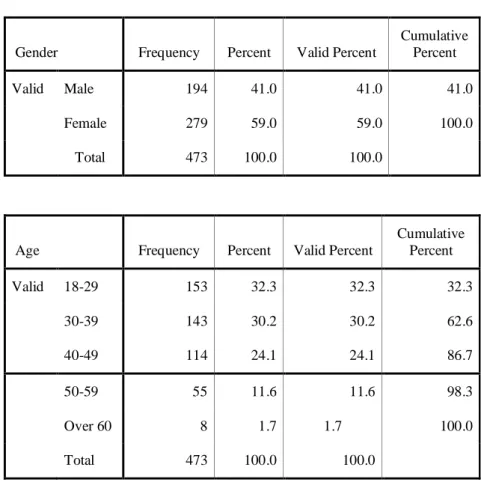
More than ninety percent of the respondents were aged from 20 to 59 years old. Male respondents were more numerous than females, with a ratio of around 60:40. It is quite contradictory to the conventional argument that most of the cultural tourists are middle age or older which means more than 45 years old. Whether there is any difference in terms of