The Japanese Psychonomic Society
NII-Electronic Library Service
The JapanesePsychonomic Society
TheltzpanesefournelofRs'ychonomic Science
2009,VoL 28,No. 1,l77-178
Summary
ofAwarded
Presentation2P44
Effectsof
auditory
information
persistence
of
moving
change
on
the
visiblevisual
objects
Souta
HmAKA*,
Wataru
TERAMoTo*2,
Jiro
GyoBA*,
andY6iti
SuzuKi*2
Graduate Schooi
of
Arts and Letters,Tohohu Uitiversity*,Research instituteof
Electn'cal
Communicatien,
Tohoku
[iniversit],*2
In
avisual apparent motiondisplay,
an abrupt changein
theattributes of an object, such asits
size, extends the time the changed object isvisible{visible
persistence)even after itsphysica]
termination.
The
aim ofthisstudy was toinvestigate
whether an abrupt change inan attribute ofcontingent auditory stimuli can also alter the visible persistenceof an object. and how
it
mightdo
this.The results indicated that a visible persistence occurred
for
]onger time when an abruptchange of tone was
introduced
intoa sequence ef constant tones presented synchronously withvisual stimuli. This
persistence
was alsolonger
than when no abrupt change wasintroduced
orwhen auditory
information
"ias absent(Experiment
1},However, the effect was attenuated whenit
wasdillicult
to
attribute theauditoryinformation
to
the
meving visual objects(Experiment
2),
These
results suggest that the object representations underlying the visiblepersistence
mightbe
formed
by multisensory integrati,onof auditory and visual information.Key words: visible persistence, auditory
'
representat]onfrequency, audio-visual interaction,moving objecVs
Recentiy, Mordkoff, & Enus
{2007)
demonstratedthat an abrupt change
in
the attributes of an object,such as its size, in an apparent motion sequence
extends the time in which the changed object is
visible
(visible
persistence) eyen afterits
physicalterrnination
{Fig,
1),
They
also confirmed that analteration of the visible persistence did not occur when thevisual stimu]us moved
behind
an occluder containing a small hole,so that there was a reason-able size change of thevisual stimuli. These findingsindicate
that the perception of multipLe objectsoc-curs
because
an object-level change, and not aretinaNevel change, triggers a discontinuity of
ob-iect
identification
in
motiondisplays,
Considering
that
ourinternal
representations areestablished by multimodal iniormation, itcould be
argued thatthe
discontinuity
of objectidenttfication
occurs across sensory modalities. The present
re-search exarnined the effect of auditory
information
(frequency)
changes on the visible persistence ofap-parently moving visual stimuli by using a method
adopted
by
Moore
et, al,(2007),
Experiment
1Methods. A white disc
(O.6'
in diameter, 49.11cd/m2) was sequentially presented against a gray
background
<7.28cd/m3)
as an apparent metionstimulus
{Figure
1).
The
disc
location
movedby
150
inevery frame of 80 rns, following a circular motion
*
Department
ofPsychology,
Graduate
School
ofArts
andLetters,
Tohoku
University:
27-1
Kawauchi,
Aoba-ku,Sendai
980-8576
Physical
nme
Percept
Figure
1.Sehematic
illustrations
of the visualstirnuli inExperiment 1,
path which was centered around a b]ue
fixation
point
(5.31
cd/m2).The
radius of theimaginary
circleof the motion path was 30.In the
t'Visua!
change" condition, thedisc
became
smaller(O.45e
in
diameter)
at the penultimate
frame
and returned toits
originalsize in the lastframe. The size of the discs was
constant during visual motion inthe"XNrithout visua] change" condition. One disc was presented at the
finaL
position of themotion trajectoryinthe "Single"trials,whereas two
discs
were presented atthepenul-timate, and
the
last,positionsof the motiontrajec-tery
in
the "Double" trials.For theauditory stimuli,
two types of pure tone were used: 600
Hz
{L
tone;83dB
SPL)
and 3000Hz
(H
tone;75dBSPL).
Each
tonewas 80ms long with an 8ms cosine ramp at the
onset and offset, and was presented synchronously
with each disc.During the "Without
auditory tran-sient" trials,a sequence of either L or
H
tones were constantLy presented, In contrast, on the '[Auditorytransient"trials,the type of the tone was abruptly
changed from L to }I,or frornH toL,inthe penulti-mate
frame,
and returned tothe original tene atthelast
frame.
The control trialswere composed ofThe Japanese Psychonomic Society
NII-Electronic Library Service
The JapanesePsychonomic Society
178
The
Japanese
Journal
of PsychonornicScicnce
VeL 28,No. 1frames without an auditory stimulus
("Without
sound").
Ten
participants were asked to report howmany
discs
they
observed(one
ortwo)
in
theIast
frame.
Results
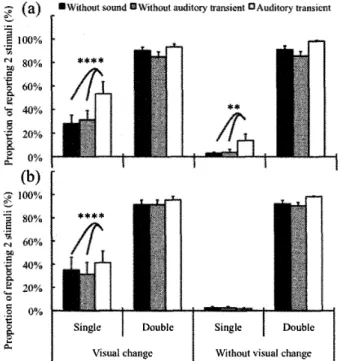
and Discussion.We
averaged thcpropor-tions
of reporting twodisc$
in
each condttion(Fig.
2).
A three-way repeated ANOVA revealed thatan
inter-action effect
between
all thefactors
was significantF(2,
18)=8.96,
p<.O05>.
In the "Double"condition,
the participants correctly perceived two discs
in
alarge
percentage of trials.However, inthe "Single"condition, theparticipants mistakenly perceived two
discsinseveral trialsinwhich thesize of the discwas
changed and!or the auditory
frequency
changed,Both
in
the "Visualchange" and the "Without
vi$ual
changei' conditions, theproportions of reporting
two
discs
were significantly higher when the auditoryfrequency
was abruptly changed thanin
any othersound conditi,ons
{P<.OO1).
The
results clearty revealed that not only the sizechanges of the visual stimuli, but also auditory
fre-quency changes, induced the perception of two
stim-ulj
in
the "Single'' condition.This
indicates
that thechanges of auditory attributes prolong the visible
persistence ef the apparently moving visual stimu]i.
Experiment
2
The aim of Experiment
2
wasto
investigatewhether the effect of auditory
frequency
change onthe
visible persistence ofthe
moving visual stimuliwas attenuated when the auditory information was
difficulttoassoeiate with the stimulL Thus, we
intro-duced
a situation where the tones were morelikely
to be associated with the fixation,but not to the
moving disc,We considered tbat
if
the auditoryfre-quency ehange
had
a selective effect on the visua]object a$sociated with the auditory stimuli, the
yisi-ble persistence of the rnoving
discs
would not beattered.
Methods. At the beginning of each trialthe color
of the fixationaLternated between red
(13.29
cdlmt)and
blue
(5.31cd!m2)
at the centcr of the display,while itwas synchronized with a sequencc of tones
in
the"Without
auditory change" and `tAuditorytransienti'
conditions,The
duration
of each color wasgradually
decreased
from280
ms to80
ms.A
disc
then appeared on the display, and imrnediately
started tomove.
The
color of the fixattoncontinuedto alternate during the visual rnetion sequence.
Results
andDiscussion.
A
three-way repeatedANOVA revealed an significant
interaction
between
all of thefactorsF(2, l8)== 5.97,P<D5). This revealed
that,in the
"Single"
trtalsof the'`Vi'sual
change"condition.
the
proportions of seeing twodisc$
were significantly higher when the auditoryfrequency
was abruptly changed than wben the Irequency was
constant or whcn there was no sound
(Fig.
2b).
For
the "Single" trials
of the "Without Visua] change"
condition, there was no significant
difference
(P=
ge....-fi'gptna='goautsE・=-g2q
ge-cr.E-ti.ptTge'f.a.ets8'eogac(a)IOO%gG%ec%4G%2e%
o%(b)lee%80%60%4e%2e% ea/. SWithoulseuntieW{theutaedltoryironsienLeAudlterytraisientFigure 2. Results of
{a)
Experiment 1 and(b)
Experiment
2,
Error
bar
denotes
the standarderror of the mean,
.92).
The
cffect of auditoryfrequency
change was ob-served only inthe"Visual
change" condition, and the sizeof theeffect was smaller than thatofExperiment
1.
Moreover,
theeffect oi auditoryfrequency
changewas not apparent in the
"Without
visual change"condition. These
findings
indicate
that changes ofauditory
frequency
infiuence
the visible persistence of apparently rnoving stimuli inan object-selective manner.
General
Discussion
The present study revealed thatan abrupt change
in
an auditory attributeCtrequency)
prolongs thevisible persistence of moving visual stimulL ln
addi-tion,thiseffect was attenuated when the auditory
information was difficultto associate with the
mov-ing visual objects. These results suggest that the
object representations unde'r]ying thevisible
persis-tence
of moving objects mightbe
formed bymu]tisensory
integration
of visual and auditoryin-formation.
Acknowledgments
This
research was supported byJSPS
ResearchFellowship
for
Young
Scientjsts
(No.
19004400) andby Grant-in-Aid for Specially Promoted Rescarch
{No.
19001004).,
References
Moore, C.M, Mordkoff,
J.
T,,& Enns,J,
T.(2007).
Thepath of
least
persistence:Object
status mediatesvisual updating. VisionResearch,47, l624-1630,