鳥取大学研究成果リポジトリ
Tottori University research result repository
タイトル
Title
The Acquisition of a New Self-image in Patients with
Type 1 Diabetes : A Qualitative Study
著者
Auther(s)
Nishio, Ikuko; Chujo, Masami
掲載誌・巻号・ページ
Citation
Yonago Acta Medica , 61 (3) : 160 - 165
刊行日
Issue Date
2018
資源タイプ
Resource Type
学術雑誌論文 / Journal Article
版区分
Resource Version
出版社版 / Publisher
権利
Rights
注があるものを除き、この著作物は日本国著作権法により保
護されています。
DOI
Corresponding author: Ikuko Nishio, RN, PhD [email protected]
Received 2018 May 25 Accepted 2018 July 12
Abbreviations: CSII, continuous subcutaneous insulin infusion; MDI, multiple daily injection; NGSP, National Glycohemoglobin Standardization Program
The Acquisition of a New Self-image in Patients with Type 1 Diabetes:
A Qualitative Study
Ikuko Nishio* and Masami Chujo
†
*Faculty of Nursing, Soka University, Hachioji, Tokyo 192-8577, Japan, and †Department of Adult and Elderly Nursing, School of Health Science, Tottori University Faculty of Medicine, Yonago 683-8503, Japan
ABSTRACT
Background In this study, we aim to highlight the transformation of self-image in patients with type 1 diabetes after diagnosis. Our objective in examining the self-image of these patients is to provide practical insights for nursing, as well as a basic reference for un-derstanding patients.
Methods The participants were 15 patients (2 men and 13 women) over 20 years of age who visited an outpatient setting to treat type 1 diabetes and had no serious complications, and who agreed to participate in the study. Semi-structured interviews were conducted 1–2 times, with a duration of 60–75 minutes per per-son, from February 2016 to March 2017. We drew on Krippendorff’s (1999) content analysis to carry out our analysis.
Results We identified a total of 107 codes. The self-image of patients with type 1 diabetes was catego-rized into 8 subcategories and 4 categories. The 4 cate-gories were ‘the wavering of a self-image that is distinct from the past,’ ‘loss of former self-image,’ ‘discovery of a new self-image,’ and ‘developing a new self-image.’ Ultimately, we were able to extract a fifth core category, ‘acquisition of a new self-image.’
Conclusion The self-image of patients with type 1 diabetes transformed from a negative to a positive one; ultimately, patients acquired a new self-image that was congruent with their ideal self-image. Our results showed that the new self-image that patients acquired through various experiences influenced motivation for treatment and continuation of self-care. When caring for patients with type 1 diabetes, it is crucial for healthcare professionals be aware of the meaning that patients de-rive from their disease and related difficulties, as well as to provide care while considering patients’ self-image.
Key words adults; self-concept; self-image; type 1 diabetes
Patients with type 1 diabetes experience considerable psychological impact from sudden diagnosis and the continuous insulin treatments they must face throughout their lives. The insulin treatment process also affects patients physically and socially. In recent years, the use of insulin pumps that detect fluctuations in blood glucose levels has become widespread in type 1 diabetes treatment, making this method of detection simpler and safer.1 However, even with advances in treatment
methods, the reality that patients must continue long-term insulin injections and glycemic control, a difficult treatment experience for many, remains unchanged. Given these realities of a type 1 diabetes diagnosis, a nurse’s awareness of the patient’s self-concept becomes critical when providing empathic care for patients with type 1 diabetes.
Self-concept is a term used in clinical psychology
that refers to an individual’s thoughts and assessments about him or herself is relevant to the social adjustment of individuals and is thought to influence perception of living environments and way of life. Studies on the self-concept of patients with type 1 diabetes appear to be absent in the literature; however, studies have been conducted on illness self-concept, illness identity, and self-esteem. In a study of illness self-concept,2-3
self-esteem in patients decreased as a result of a type 1 diabetes diagnosis, threatening the patients’ physical, psychological, and social well-being.
Nursing research on self-concepts has shed light on changes in, and the formation process of, self-concept following disease onset. However, self-concept involves not only an individual’s perception of self but also how they perceive interpersonal relationships as well as their living environments. Patients have difficulty noticing changes in their own physical functions and appearanc-es; thus, gaining insight about the self-concept of pa-tients with type 1 diabetes based on subjective reporting of experiences would be challenging. These factors relat-ed to self-concept suggest that changes in the self-image of patients with type 1 diabetes, rather than self-concept, may be of greater significance. We define self-image as the feeling, perception, and image that patients have of themselves after being diagnosed with type 1 diabetes. Additionally, self-image changes through various
expe-A new self-image of patients with type 1 diabetes riences. To date, self-image has been studied in patients
with psychological disorders, cancer, and AIDS, among others. Regarding diabetes, studies have been conducted on patients who underwent leg amputations and those who could not adhere to dietary restrictions.4 However,
no studies were found that focus on self-image in pa-tients with type 1 diabetes.
In the present study, we aim to shed light on the transformation of self-image in patients with type 1 diabetes as a result of diagnosis. Our objective in ex-amining the self-image of these patients is to provide practical insights for nursing, as well as a basic reference for understanding patients.
The purpose of this study is to describe the self-image of patients who developed type 1 diabetes, and gain insights for new nursing methods that take the patient’s self-image into consideration.
MATERIALS AND METHODS Subjects
The subjects were 15 patients (2 men and 13 women) over 20 years of age who were seen in an outpatient setting to treat type 1 diabetes and had no serious com-plications. The time since diagnosis was typically less than 5 years. We included those patients who understood the research content and provided consent.
Data collection
We conducted semi-structured interviews with the 15 patients who agreed to participate in the study (Table 1). After each patient completed the outpatient visits, an interview was conducted in a section of the outpatient waiting room where privacy could be ensured. We asked patients to speak freely about notable events, their image of self, and what they thought of themselves during the following three chronological periods: (i) the period in which the patient was healthy prior to disease onset, (ii) the period following disease onset, and (iii) the present. Interviews were recorded with the subjects’ consent. Interviews were conducted 1–2 times, with a duration of 60–75 minutes per person, from February 2016 to March 2017.
Analysis
We drew on Krippendorff’s (1999)5 content analysis to
carry out our analysis, because this method can analyze the contents of the interviews objectively and can extract categories efficiently.
The procedure was organized as follows: (i) inter-view transcripts were read repeatedly, and sections of the interview in which the subject’s self-image was ex-pressed (e.g., a single sentence or related sentences) were
regarded as 1 unit of data. The meaning of the data was then inferred and coded (first cycle coding); (ii) Similar codes were organized and conceptualized accordingly (second cycle coding); (iii) After merging and cate-gorizing similar concepts, we expressed the subjects’ self-image. In the analysis, we determined concepts and categories with supervision from experts on qualitative research; therefore, credibility and transferability were established.
This study was conducted using the following anal-ysis procedure. An example is shown below.
Researchers analyzed what the codes mean and derived themes from them. Codes < Acceptance of changes by insulin> < decide to live positively> < show others about my sickness > established subcategory “Decision to live on with a new self-image.” Further, the subcategory “Decision to live on with a new self-image” established “Developing a new self-image.”
Ethical considerations
This study was approved by the ethics committee of Tottori University (Record Number 2307, January 2013). Informed consent was obtained from all patients using the procedure approved by the ethics committee, and the confidentiality of the participants’ information was pro-tected. Furthermore, they were told that they could stop the interview at any time they wished and could refuse to answer any unwanted questions. Pseudonyms were allocated to all the patients to ensure confidentiality and all data were stored securely during the research pro-cess. This study received consent from the participants after they were provided with sufficient explanations including the study’s significance, purpose, method, expected result, and burden on the participants from this study.
RESULTS
Self-image of patients with type 1 diabetes
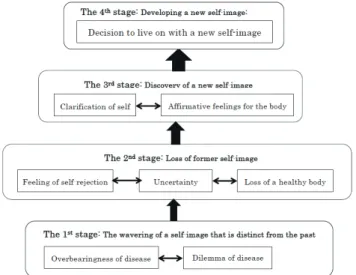
We identified a total of 107 codes. The self-image of patients with type 1 diabetes was categorized into 8 subcategories and 4 categories (Table 2). Ultimately, we were able to extract the core category, «acquisition of a new self-image». We developed a storyline to explain the relevance of each category, which is schematized in Fig. 1. In the results, we reported category, subcategory, and data, with « » indicating core category, ‘ ’ indicating category, and “ ” indicating subcategory.
Acquisition of self-image storyline
Patients initially had a negative self-image, due to negative emotions associated with a type 1 diabetes diagnosis. This negative self-image eventually changed
to a positive experience, and patients were able to express this process as «acquisition of a new self-image». The fi rst self-image phase, involved loss of health, as reported by the patients, due to “overbearingness of disease,” resulting in “dilemma of disease onset.” In this phase, patients had a self-image related to type 1 diabetes that was distinct from their past health-related self-images; this difference could be expressed as the ‘wavering of a self-image that is distinct from the past’. The wavering self-images of patients were comprised of the negative self-images of “loss of a healthy body” and “feeling of self-rejection.” In addition, the disease experience of patients resulted in perceived “uncertainty,” in which there was diffi culty in fi nding a clear meaning of their self-images. This phase could be expressed as the ‘loss of former self-image’. Once blood glucose levels stabilized
through treatment, patients felt “affi rmative feelings for the body” and gradually overcame negative emotions re-garding type 1 diabetes. Furthermore, patients were able to think of themselves in a positive light and were ready to come to terms with type 1 diabetes. This change developed into the “clarifi cation of self.” Patients in this phase were able to express the experience as ‘discovery of a new self-image,’ as they developed a new self-image that previously did not exist. Finally, patients reached the phase of ‘developing a new self-image,’ as they were able to make the “decision to live on with a new self-image” (Fig. 1).
Table 1. Demographic characteristic of the 15 study participant’s with type 1 diabetes
Participant characteristics n Gender Male 2
Female 13 Age (years old) 32–66 (43.6 ± 10.5) Time living with type 1 diabetes (years) 6–17 (9.7 ± 4.0) Insulin therapy MDI 10, CSII 5 HbA1c† (NGSP) (%) 6.5–9.8% (7.51 ± 1.23%) Employment Full time or Part time 11
Unemployed 4 † Glycated hemoglobin.
CSII, continuous subcutaneous insulin infusion; MDI, multiple daily injection; NGSP, National Glycohemoglobin Standardization Program.
Table 2. A new self-image of Patients with Type 1 Dia-betes
Core
category Category Subcategory
Acquisition of a new self-image
The wavering of a self-image that is distinct from the past
Overbearingness of disease
Dilemma of disease onset
Loss of former self-image
Loss of a healthy body Uncertainty
Feeling of self-rejection Discovery of a
newself-image
Clarifi cation of self Affi rmative feelings for the body
Developing a new
self-image Decision to live on with a new self-image
I. Nishio and M. Chujo
38
Fig. 1. Acquisition of a new self-image with type 1 diabetes patients.Fig. 1. Acquisition of a new self-image with type 1 diabetes pa-tients.
The wavering of a self-image that is distinct from the past
This category was comprised of the 2 subcategories “overbearingness of disease” and “dilemma of disease onset.” In this category, patients felt that developing type 1 diabetes resulted in the disease dictating every aspect of their lives. Further, patients perceived a dilemma in which they lost their former sense of self. Self-image in this phase is characterized by the perception of both the former self-image and a new one that is distinct from the past, as demonstrated in the following excerpts from the semi-structured interviews:
“Overbearingness of disease”
I don’t think much has changed since I got type 1 diabetes. Realistically speaking, it’s not like something could’ve helped. I think I’m probably going to be living with this sort of feeling until the day I die. (Case A – Female, 40 years old)
A new self-image of patients with type 1 diabetes
“Dilemma of disease onset”
You need long-term treatment for this disease, but it’s not curable…I always get this feeling that, I just wish I didn’t get this disease… (Case J – Female, 44 years old)
Loss of former self-image
This category was comprised of the 3 subcategories “loss of a healthy body,” “uncertainty,” and “feeling of self-rejection.” Patients in this category were negatively affected by the loss of their true healthy selves of the past, uncertainty about what will become of them, and a self-image that is different from the past. This phase was characterized by a strong perception of a negative self-image as indicated in the patients’ statements below:
I thought that illness was not related to me. I am frus-trated that I cannot return to my former self. (Case K – Female, 55 years old)
“Uncertainty”
Until I got type 1 diabetes, I didn’t think about the life ahead. Now, I think pessimistically, that I won’t be able to live very long. (Case E – Male, 35 years old)
“Feeling of self-rejection”
I got type 1 diabetes at a stage of life where I was just getting started, so I felt devastated. I’d still like to be a hair stylist if I can manage. (Case C – Female, 32 years old)
Discovery of a new self-image
This category was comprised of the 2 subcategories “clarification of self” and “affirmative feelings for the body.” With blood glucose levels stabilizing through insulin treatment, patients in this category experienced a change in their feelings toward type 1 diabetes and insulin treatment. As a result, they were able to restruc-ture negative psychological states into positive ones. This phase was characterized by the acceptance of a new self-image, which differs from that of the past as revealed through the following patient statements:
“Clarifi cation of self”
I don’t get that feeling anymore of my life being dictated by type 1 diabetes. I want to say that, even if you have an illness, you can still have a normal life. I can eat and drink normally like other healthy people. (Case H – Female, 38 years old)
“Affi rmative feelings for the body”
I have stable blood sugar, thanks to insulin. There is no discomfort in my body.
(Case K – Female, 55 years old)
Developing a new self-image
This category was comprised of the subcategory “de-cision to live on with a new self-image.” Patients were less frequently governed by the disease, and felt a desire to work toward hope. Patients were transitioning into a new, positive self-image from the negative self-image. In the fi nal phase, they had established a new self-image, as witnessed through their interview statements:
“Decision to live on with a new self-image”
I want to quit insulin treatment if I can afford to, but I feel unwell if I don’t. I feel grateful that I’m alive today because of insulin. (Case M – Female, 59 years old) These days I’m able to go public about my disease. I don’t mind talking about it. (Case B – Female, 38 years old)
DISCUSSION
Our results illustrate the process through which pa-tients with type 1 diabetes transitioned from a negative self-image to a positive one. Our research yielded results that were congruent with past research on the self-image of cancer patients,6 which reported that
pa-tients have both a negative and positive self-image. Roy (2010)7 claims that self-concepts are developed from
internal perception (perception of self) and external per-ception (perper-ception of reaction by others). Simons (2012),8
on the other hand, defines self-concept as the holistic perception of the self. In the present study, we showed that the observed self-image differed from the defini-tions of self-concept offered by Roy and Simons. The results suggest that the development of a patient’s inter-nal perception consisting of self-image, which was based on the patient’s experience, was influenced by their external perceptions, such as their misunderstanding and prejudice of sickness in people, and that self-concept and self-image differ.
In our analysis, in the “wavering of a self-image that differs from the past” category, we extracted the sub-categories “overbearingness of disease” and “dilemma of disease onset.” Patients who expressed that they were [unable to ignore the disease], appeared to be negatively affected emotionally by having to face the disease, and asked themselves about the meaning of their existence, way of life, and self-ideals as a patient with type 1 dia-betes. From the subcategories, we inferred that negative and positive self-images were simultaneously present. Patients trying to find a healthy part of themselves despite having type 1 diabetes led to the “dilemma of disease onset”; thus, we infer that the early phase self-image includes polar self-images comprising both ill and healthy aspects of self. A characteristic of type 1
diabetes, however, is that there are no overt changes in appearance, and patients do not have obvious symptoms from which they suffer, as compared to a disease like cancer. Though patients were already ill, they may have experienced ‘wavering of a self-image that differs from the past’, as their perceived differences in self-image were relative to their perception of a disease such as cancer. Wavering appears to occur precisely because the disease is type 1 diabetes.
Furthermore, in the ‘loss of former self-image’ category, patients appeared to perceive their healthy self before disease onset with a positive self-image, and their self after onset of type 1 diabetes with a negative self-image. From this category, we extracted the subcate-gories “loss of a healthy body,” “uncertainty,” and “feel-ing of self-rejection.” In the interviews, patients spoke of having an unstable physical state due to type 1 diabetes, experiencing a loss of social roles as a consequence, and watching their life plans collapse. In addition, uncer-tainty about consequences for their bodies and feelings of regret about developing the disease also appeared to contribute to anxiety about the future.
The uncertainty of disease has been defined as a cognitive state that occurs when one cannot find mean-ing in illness and cannot obtain insights about relevant events that happen from illness.9 In this study, we found
that “uncertainty” especially involves the uncertainty of physical image, which patients lose with type 1 diabetes. In addition, we found that a [healthy body] was not nec-essarily related to physical health, but the physical state and perception of not being able to perform activities that were previously possible when healthy. From the ‘discovery of a new self-image’ category, we extracted the subcategories “clarification of self ” and “affirmative feelings for the physical body.” Patients were able to feel grateful for being able to lead a normal life, find value in living, and obtain new perspectives about the disease or about themselves as a patient with type 1 diabetes. Patients also developed a feeling of autonomy about the disease after difficult experiences with insulin injections and the occurrence of high blood glucose levels. Patients were able to accept the self that differed from the past and realized that disease could improve or worsen at times. Patients told interviewers that [disease doesn’t dictate life] and that they [want to say that it’s possible to live normally]. Additionally, patients realized that they overcame difficult experiences and appeared to have been able to acquire [the self which found new ways of living]. In this phase, patients discovered a new self-image that is not governed by type 1 diabetes as a result of having found new ways of living.
Finally, in the ‘developing a new self-image’
cate-gory, patients were satisfied with their self-image and accepted it.
From this category, we extracted the codes “ac-cepting changes from insulin,” “decision to live on positively,” and “being open about disease.” Patients were determined to live with type 1 diabetes. In the “ac-cepting changes from insulin” subcategory, patients said that they [would rather not have to do insulin injections, but would feel unwell without it]. In the “decision to live on positively” subcategory, patients said that [they have to accept all of it and move on]. Through these difficult disease-related experiences, patients appeared to be liberated from the burden of having type 1 dia-betes by adopting a positive self-image; meeting other people with the same disease or those who understand the disease, as well as people who are willing to offer support, contributed to patients’ self-confidence. In the “being open about disease” subcategory, patients said that they [don’t mind talking about everything (about the disease)]. Building self-confidence appeared to have positively contributed to the acceptance of disease and insulin treatments.
In a study of the illness experience that patients undergo in type 1 diabetes (Nishio, Chujo, 2014),10
patients attempted to derive meaning from their illness through self-reflection when they faced negative illness experiences; specifically, patients initially derived only negative meaning, but were able to derive positive meaning over time. In doing so, they were able to see or understand themselves and others in a positive light. Further, this shift in meaning from negative to positive appeared to have led patients to the decision to contin-ue living with a new self-image. This determination may have contributed to the ‘development of a new self-image.’ Harter (1983)11 suggested that positive
at-titudes of the self may assist recovery; our study results support this claim. Thus, positive self-image appears to provide support and hope as patients with type 1 diabe-tes cope with disease throughout their lives.
According to a past study of self-image,12 negative
self-images are associated with “low self-protection,” and lead to a higher likelihood of developing suicidal thoughts. It is, therefore, appropriate to discuss nursing support that can foster the development of a positive self-image in patients with type 1 diabetes.
In this study, the self-image of patients with type 1 diabetes transformed from a negative to a positive one; ultimately, patients acquired a new self-image that was congruent with their ideal self-image. Our results showed that the new self-image that patients acquired through various experiences influenced motivation for treatment and continuation of self-care. Travelbee’s
A new self-image of patients with type 1 diabetes (1963)13 finding that nursing helps individuals find
meaning through the experience of illness and suffering, strongly applies in accepting disease and is important in adopting a positive self-image. When caring for patients with type 1 diabetes, it is crucial to be aware of the different meanings that patients derive from their self-image, as well as to provide care while considering their self-image. In order to achieve this level of care, the development of programs that foster a positive self-image and offer continued care for patients, would be instrumental. A necessary first step would involve developing an assessment tool for self-image and provid-ing assessment-based nursprovid-ing support that aligns with self-image. In addition, a diagnosis of type 1 diabetes leads to a perceived negative self-image; thus, patients require nursing support that prompts recovery of phys-ical senses, as well as psychologphys-ical and social support. It is important to help patients develop positive feelings, that is, for them to believe that they can control their own psychological states in any circumstance.
Additionally, patients are prone to the influence of negative self-image, especially when their self-image is wavering. It is important for nurses to communicate to patients that the wavering of self-image is normal, and to show acceptance when interacting with them. Nurses should set aside time to thoroughly listen to the patients’ feelings during the process through which self-image is developed. Further, nurses should create opportu-nities for patients to interact with others who have the same disease or establish a system in which patients may request individual consultations with healthcare professionals (e.g., nurses, doctors, pharmacists). We suggest that the task of developing, implementing, and communicating about programs in the near future would be most effective if undertaken by outpatient nurses who interact with patients during visits. A suggested next step to help set forth this plan, would be the development of a nursing program aimed at improving the quality of care for patients with type 1 diabetes, as well as to conduct intervention studies that could verify its effectiveness.
Limitations of this study
In this study, the acquisition of a new self-image was derived from 15 participants, using a qualitative data analysis method. Although it was difficult to general-ize the results, we were able to reduce sampling bias. Additionally, as this was a qualitative study with 15 participants, there was a limit in terms of examining the relationship between categories.
However, we did not have an opportunity to observe nursing support for patients with a new self-image. Therefore, there may be other acquisitions of a new self-image that are not covered in this study. Future studies should take a more refined approach, including the analysis of observational studies.
The authors declare no conflict of interest. REFERENCES
1 American Diabetes Association. Standard of Medical Care in Diabetes-2017. Diabetes Care. 2017;1:S11-4.
2 Luyckx K, Rassart J, Weets I. Illness self-concept in Type 1 diabetes: A cross-sectional view on clinical, demographic, and psychosocial correlates. Psychol Health Med. 2015;20:77-86. PMID: 24666256.
3 Luyckx K, Rassart J, Aujoulat I, Goubert L, Weets I. Self-esteem and illness self-concept in emerging adults with Type 1 diabetes: Long-term associations with problem areas in diabetes. J Health Psychol. 2016;21:540-9. DOI: 10.1177/1359105314531467. PMID: 24776688.
4 Salomé M, Masako G, F Lydia. Locus of health Control, body image and self-image in diabetic individuals with ulcerated feet. Journal of Nursing UFPE / Revista de Enfermagem UFPE. 2017;11:3419-28. DOI: 10.5205/reuol.11088-99027-5-ED.1109201713.
5 Krippendorff K, Mikami T, Shino N, Hashimoto Y. Content Analysis: An Introduction to Its Methodology by Klaus Krippendolf. Tokyo: Keisyo Syobou; 1999. p. 103-111. 6 Nayak GS, Shivananda PM, Sara L. Self-image of the Patients
with Head and Neck Cancer: A Mixed Method Research. Indian J Palliat Care. 2016;22:331-4. DOI: 10.4103/0973-1075.185050.
7 Roy C. The Roy adaptation model, 3rd ed. Upper Saddle River, NJ: Prentice Hall Health; 2009. p. 2-10.
8 Simons J, Capio CM, Adriaenssens P, Delbroek H, Vandenbussche I. Self-concept and physical self-concept in psychiatric children and adolescents. Research in Developmental Disabilities. 2012;33;874-81. DOI: 10.1016/ j.ridd.2011.12.012.
9 Mishel M H. Reconceptualization of the uncertainty in illness theory. Image J Nurs Sch. 1990;22:256-63. PMID: 2292449. 10 Nishio I, Chujo M. The suffering illness experience of young
adult with type 1 diabetes. J Yonago Med Ass. 2014;65:49-56. Japanese.
11 Harter S. Developmental differences in the nature of self-representations: Implications for the understanding, assessment, and treatment of maladaptive behavior. Cognitive Therapy and Research. 1990;14:113-42. DOI: 10.1007/ BF01176205.
12 Mikael A, Andreas. Diagnosis-specific self-image predicts longitudinal suicidal ideation in adult eating disorders. NT J EAT DISORD. 2017;50:970-8. DOI: 10.1002/eat.22730. 13 Travelbee J. Interpersonal Aspects of Nursing. 2nd ed.