
Energy-on-Demand System Based on Combinatorial Optimization of Appliance Power Consumptions
8
0
0
全文
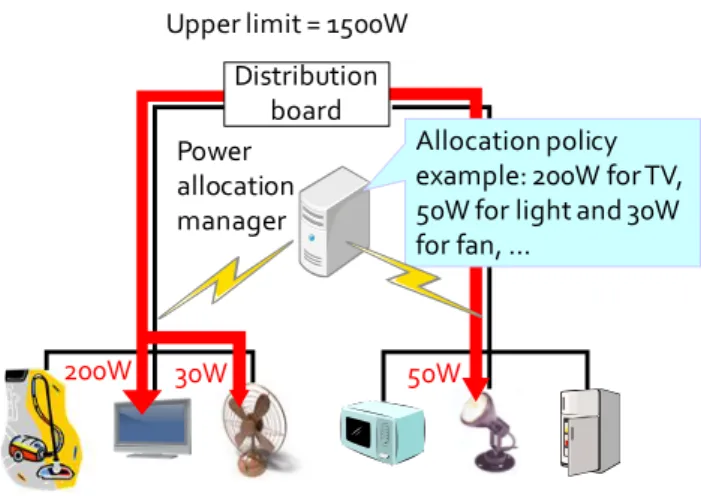
(2) Vol.2016-CDS-16 No.12 2016/6/2. IPSJ SIG Technical Report. as users lifestyles etc., and controls the amount of power supplied to the appliances in a way that minimizes undesired effect on quality-of-life (QoL) of users. Therefore, one of the most crucial factors in an EoD system is the strategy for deciding the optimal power allocation to appliances [7]. For optimizing power allocation, the power management system optimizes power allocation (e.g. up to 200W for a TV, 30W for a fan) considering user’s QoL, and when total power consumption exceeds a threshold value the system automatically controls power allocation based on control policies suited for users, assuming situations that total usable power is limited in demand-response scheme or for reducing peak load. Fig. 1 shows the concept of optimal power allocation. From a mathematical viewpoint, the power allocation management in an EoD system can be considered as an optimization problem; the problem where the goal is to choose the power allocation to appliances optimized for users from various possible combinations of appliance statuses, keeping total consumed power under the limitation. In real environments, many appliances have various operational modes in addition to simple on/off states, and it is not easy to find the most optimized combination of operation modes from many possible candidates. Also, the problem cannot be easily solved by linear programming methods since the importance of an appliance for users is not in proportion to the amount of power consumption, and since the amount of power consumption of many appliances varies in a step-wise manner with the change of operation modes. Moreover, for realizing the decided power allocation, the system should be able to flexibly and properly change operational modes of appliances, since most appliances do not work properly if the system simply reduces the amount of power supplied to them. In this research work, we propose power allocation management is considered as combinatorial optimization of appliance power consumptions as an alternative approach than the priority-based ones, and discuss the design, implementation and evaluation of an EoD system based on the combinatorial optimization. Power allocation schemes in existing EoD systems are priority-based, not based on the combinatorial optimization, where priority parameter is associated with each appliance, and the power allocation manager reduces the amount of power allocated to the appliance with lowest priority among the appliances [6], [8], [9], [10]. We formulate the power allocation as the multiple-choice knapsack problem (MCKP) [11], a kind of combinatorial optimization problem. The MCKP is an extended version of the simple knapsack problem; in the MCKP, class (an appliance) is a set of items (operation modes). Each item has parameters of size (power consumption) and profit (the importance to user’s life). A knapsack corresponds to a power source, and its capacity is the limit of available power resource. The objective of the problem is to find the optimal set of items packed into the knapsack that maximizes total obtained profit. Here exactly one item should be chosen from a class and should be packed into the knapsack in a way that the total size of packed items does not exceed capacity of the knapsack. The system is implemented utilizing a smart outlet network, where the power consumption of all the appliances is frequently (every one second) measured by power sensors. When the total amount of consumed power ex-. c 2016 Information Processing Society of Japan ⃝. ceeds the upper limit, the power allocation manager deployed in the system computes the new optimal allocation using an algorithm for the MCKP, and sends control messages to appliances. To control ordinary IR-controllable appliances with various operation modes other than simple on/off states, we have adopted a programmable IR control unit controllable from the manager via Wi-Fi, which enables the system to flexibly control the operation modes of IR-controllable appliances by sending pre-recorded IR signal patterns. Through experiments, the developed system is confirmed to work properly as an EoD system by observing system behaviors when the total power consumption exceeds the upper limit of the available power resource. This paper is consisted as follows; Section 2 refers related work. Section 3 presents a basic concept of Energy-on-Demand and formulation of power allocation as a combinatorial optimization problem. In Section 4, we discuss our implementation of the developed power allocation system. Section 5 describes experiments and considerations. Section 6 concludes this paper.. 2. Related Work As described in the previous section, power allocation schemes in existing EoD systems are priority-based, not based on the combinatorial optimization, where priority parameter is associated with each appliance, and the power allocation manager reduces the amount of power allocated to the appliance with lowest priority among the appliances [6], [8], [9], [10]. The major difference between the combinatorial optimization based approach and the priority-based approach lays in their power reduction schemes, especially when the total amount of power consumption exceeds an upper limit; a basic scheme of the priority-based algorithms is to repeatedly reduce the amount of supplied power for an appliance with lowest priority until total power consumption becomes less than the limit. The beneficial aspect of the combinatorial optimization based algorithm is that the power allocation can be done based on specific measures by setting an appropriate objective function, and the decision of the optimal modes of multiple appliances is completed by a single calculation. On the other hand, in the priority-based approach, configuring parameters might be relatively simple since only one appliance is controlled in a single operation. In general schemes of power management in Automated Demand Response or Home Energy Management System, priority-based methods are commonly used [12]. There have been other research work where optimization problems are considered in diverse formulation, and various simulational and theoretical studies have been conducted [13]. There have been noteworthy studies on optimizing power consumption in homes by quantifying the relationship between the importance of an appliance and the amount of power consumption. Sianaki et al. formulated the optimal power allocation as the knapsack problem (in a different approach compared to our formulation), proposed a method for parameterizing the importance of each appliance by applying the analytic hierarchy process, and presented results obtained by numerical simulations [14]. Kempton and Montgomery proposed a “folk quantification” method [15] to quantify the importance of appliance use in homes. Kumaraguruparan et al. formulated a scheduling problem based on 2.
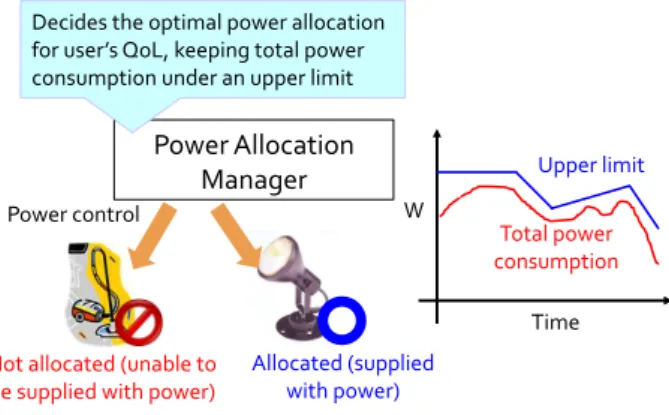
(3) Vol.2016-CDS-16 No.12 2016/6/2. IPSJ SIG Technical Report. Decides the optimal power allocation for user’s QoL, keeping total power consumption under an upper limit . Power Allocation Manager Power control . Upper limit W . Total power consumption Time . Not allocated (unable to be supplied with power) . Fig. 2. Allocated (supplied with power) . Energy-on-Demand concept.. the multiple knapsack problem, in which daily power-consuming tasks are allocated to time slots with different electricity bills to minimize total electricity bills, and made a simulation-based evaluation [16].. 3. Concept and Formulation This section describes the EoD concept and problem formulation of power allocation in EoD. 3.1 EoD Concept In a conventional power network in homes, power consuming devices (appliances) can be supplied with power if only they are connected to power sockets and are turned on. Therefore, to achieve power-saving goals, users are required to have sufficient knowledge on how much power is consumed by each appliance, and should take careful and manual work to save electricity. Energy-on-Demand (EoD) [17] is a novel power network architecture for automated power-saving with minimum undesired effect to users’ QoL, targeting ordinary homes and offices as well as plants or buildings. In an EoD system, the importance of each appliance is explicitly parameterized, which corresponds to the strength of “power demand” from each appliance, and the amount of power consumption of appliances are measured by power sensors; then, if the total amount of power consumption exceeds the limitation of power resource, a power allocation manager deployed in the system makes a decision on power allocation for appliances based on the parameters, the amount of power consumption, varying capacity of the power source and various factors such as users lifestyles etc., and controls the amount of power supplied to the appliances in a way that causes minimum undesired effect to QoL of users and total power consumption does not exceed the limit. Fig. 2 presents an overview of an EoD concept. In this example, there are two power-requiring appliances (cleaner and light). The power allocation manager decides the power allocation optimized to users life, based on parameters (power consumption, profit, upper limit of available power), and controls the amount of power supplied to the appliances (in this example, the light is supplied with power, while the cleaner is not). 3.2 Formulation as a Combinatorial Optimization Problem Setting an objective function is a crucial factor in the formulation of an optimization problem, and there are many reasonable. c 2016 Information Processing Society of Japan ⃝. candidates of the objective function in modeling power allocation in an EoD system. In this research work, we set the objective function as maximization of user’s benefit, which is gained by use of appliances with various operation modes; Fig. 3 shows an example situation where each appliance has its operational modes such as “high”, “mid” or “low”, associated with parameters of profit and power consumption. The task of the power allocation manager is to decide the optimal combination of the operational modes of the appliances, which maximizes total profit gained by selected modes. In the simple knapsack problem, we are given a knapsack with capacity and set of items with profit and size, and our objective is to find a subset of items that maximizes total profit of items and total size does not exceed the capacity of the knapsack. The multiple-choice knapsack problem (MCKP) [11] is a natural extension of the knapsack problem; the items are classified into class, and the constraint is added that exactly one item must be packed into the knapsack from each class. The objective is the same as the simple knapsack problem. Here we define some mathematical symbols for problem formulation; the number of classes (appliances) is denoted by m, and a class i (1 ≤ i ≤ m) is a set consisted of ni items (operational modes) j (1 ≤ j ≤ ni ). For each item j, profit (importance for its user) pi j and size (power consumption) wi j are associated. A knapsack (a power source) has capacity (upper limit of total power usage) c. Exactly one item must be packed into the knapsack, which means that an appliance cannot work with multiple modes at the same time (here operational modes contain the “off” status). A decision variable xi j ∈ {0, 1} means whether item j is chosen from class i; namely, if xi j = 1, appliance i works with operational mode j, and xi j = 0 means i works with some other mode than j. The formulation of the MCKP is presented below (here Ni is a set of items in class i). The first constraint means that the total size of packed items should not exceed capacity of the knapsack. The second and third constraints mean that exactly one item should be chosen from each class and packed into the knapsack.. max. m ∑ ∑. pi j xi j. (1). wi j xi j ≤ c,. (2). xi j = 1, i = 1, ..., m,. (3). xi j ∈ {0, 1}, i = 1, ..., m, j ∈ Ni .. (4). i=1 j∈Ni. subject to ∑. m ∑ ∑ i=1 j∈Ni. j∈Ni. 4. System Design and Implementation The design of the system is an extension of the former prototype system [18], which was based on an algorithm for the simple knapsack problem and was capable of on/off control utilizing smart outlets, which are the power strips with functions of power measurement, communications and power control with mechanical relays. Fig. 4 presents the overview of the developed system, which we assume is suitable for ordinary homes. The system ar3.
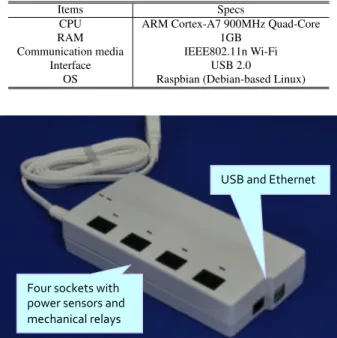
(4) Vol.2016-CDS-16 No.12 2016/6/2. IPSJ SIG Technical Report. Table 1 Data stored and maintained by the manager. Computes the optimal combination of operation modes and controls appliances . Upper limit of total power consumption = 200W . High (profit=40, power=500) Low (profit=10, power=100) Off (profit=0, power=0) . Fig. 3. Items Appliance IDs Operational modes Available control methods IR control messages Relay control messages Parameters of each operation mode Current power consumption Capacity of the power source Current modes of appliances. An appliance has operational modes with parameters of profit and power consumption. Power Allocation Manager. High (profit=80, High (profit=60, power=40) power=150) Mid (profit=60, Low (profit=20, power=10) power=100) Low (profit=40, Off (profit=0, power=0) power=70) Off (profit=0, power=0) . High (profit=70, power=100) Low (profit=20, power=40) Off (profit=0, power=0) . Table 2 Specifications of the power allocation manager. Items CPU RAM Communication media Interface OS. Combinatorial optimization of appliance operation modes in an EoD system.. Decides&the&optimal& combination&of& appliance&modes&by& solving&the&MCKP&. Power&allocation& manager& (Raspberry&Pi&2)&. WiAFi&Network. Remarks Name of appliances Possible operational modes IR-controllable or relay-only For IR-controllable appliances For relay-only appliances Profit and power consumption Measured by smart outlets Current upper limit For proper control of the system. Power& consumption& data. Specs ARM Cortex-A7 900MHz Quad-Core 1GB IEEE802.11n Wi-Fi USB 2.0 Raspbian (Debian-based Linux). Relay&control& message. On/off& relay& control&. Smart&outlet&. Control& operation& Non&IRAcontrollable& IRAcontrollable& modes& appliance appliance. Fig. 4. USB and Ethernet . IR&remote& control& (IRKit)&. Smart&outlet&. IR&control& message IR&signal. IRAcontrollable& appliance. Four sockets with power sensors and mechanical relays . System overview.. chitecture is designed in a centralized manner, where the power allocation manager takes all the crucial decisions. The manager stores data of possible operational modes of each appliance, values of parameters (profit and size) of each mode, control methods available for each appliance (IR-controllable or relay-only). The manager also collects real-time data of power consumption of each appliance (every one second), and when the total amount exceeds the upper limit it calculates optimal power allocation utilizing a dynamic-programming algorithm for the MCKP. Finally, the manager sends control messages to realize calculated power allocation; if the appliance to be controlled is IR-controllable, the manager first sends the corresponding control message to the WiFi capable IR remote control, then the control sends IR signals to the appliance. Otherwise i.e. the appliance is not IR-controllable hence no direct mode control method is available, the manager sends a control message to the smart outlet to which the appliance is connected, and the outlet turns on or off the corresponding socket. Table 1 shows the list of data stored and maintained by the manager. 4.1 Design and Implementation of Hardware and Software 4.1.1 Power Allocation manager In hardware aspects, the system consists of the power allocation manager, the smart outlets and the IR remote control, all of which are deployed in an IEEE802.11n Wi-Fi network. We assumed that, in realistic environments, the power allocation manager is not expected to have rich computational resources compared with personal computers such as laptop/desktop PCs, and it. c 2016 Information Processing Society of Japan ⃝. Fig. 5. An outward appearance of the smart outlet.. likely has similar specifications as embedded computers such as home controllers. Therefore, we adopted Raspberry Pi 2 model B *1 , a microcomputer with sufficient specifications and programmability, as the hardware of the power allocation manager. Table 2 shows its specifications. 4.1.2 Smart Outlet The smart outlet used on the developed system is the extended version of the one formerly developed [19]; we have improved the outlet to be more compact and practically designed, and have extended computational resources. Fig. 5 is an outward appearance of the smart outlet, and Table 3 shows its specifications. It has four sockets, and has functions of power sensing (voltage, current and power) and controlling relays for each socket. The Raspberry Pi Model B is used as the application board; an ARMbased microcomputer with CPU (ARM1176JZF-S 700MHz) and RAM (256MB or 512MB), enabling implementation of various software and control policies on the outlet. It has a built-in Ethernet interface and a Wi-Fi interface installed via USB. It communicates power consumption data and control messages via Wi-Fi and TCP/IP communications with outer devices such as a controller, a server or other smart outlets. Rated voltage and current is 100V and 15A, respectively. A/D conversion of measured amount of power is done with 20kHz sampling frequency and 12bit resolution. *1. http://www.raspberrypi.org. 4.
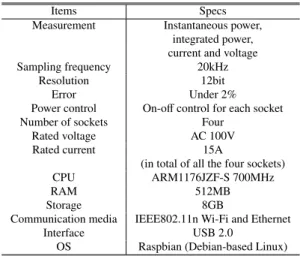
(5) IPSJ SIG Technical Report. Table 3 Specifications of the smart outlet. Items Measurement. Sampling frequency Resolution Error Power control Number of sockets Rated voltage Rated current CPU RAM Storage Communication media Interface OS. Specs Instantaneous power, integrated power, current and voltage 20kHz 12bit Under 2% On-off control for each socket Four AC 100V 15A (in total of all the four sockets) ARM1176JZF-S 700MHz 512MB 8GB IEEE802.11n Wi-Fi and Ethernet USB 2.0 Raspbian (Debian-based Linux). We adopted IRKit *2 to control IR-controllable appliances from the power allocation manager, which is a Wi-Fi-capable IR remote control. We can record IR signals of ordinary appliances using a receiver equipped in the IRKit and though its HTTPbased API, and the recorded signal data is able to be stored in the allocation manager. When the manager takes control of an IR-controllable appliance as a result of calculation, the manager first sends a text-based control message to the IRKit via Wi-Fi, then the IRKit transforms the message into IR signals and sends it to the appliance, realizing the decision made by the manager. 4.1.3 Software The software in the system has been developed using the standard C language. Since there is no straightforward method to grasp current operation modes and statuses of ordinary appliances from outer devices, the system has to keep the current operation modes of appliances by tracking the variation of modes from the initial state. The manager also stores data of IR control messages for changing modes of IR-controllable appliances, relay-control messages for controlling non IR-controllable appliances, and values of (pre-measured) power consumption and profit parameters associated to each operation mode of appliances. The communication in the Wi-Fi network among the manager, smart outlets and the IR control is done via standard TCP/IP socket protocols. 4.2 Network The Wi-Fi used in the network is IEEE 802.11n with maximum bandwidth of 300Mbps using 2.4GHz of frequency and is protected with WPA encryption for easier coordination with ordinary information devices such as PC, tablets or smartphones. As a transport layer protocol, we have chosen TCP for reliability, dependability and safety, because the system does control electricity actively, not only gathering data on power consumption. 4.3 Data Formats Measured power consumption data and relay control messages are formatted in XML-like manners as follows, considering the extendibility, versatility and easier handling [19]. • Measured Power Consumption Data: The below is an example of notice wattmeter, which is *2. http://getirkit.com/en/. c 2016 Information Processing Society of Japan ⃝. Vol.2016-CDS-16 No.12 2016/6/2. used for sending measured power consumption data (approximately 540 bytes). This example means that integrated power on socket #2 is 64Wh, instantaneous voltage is 100.585V, current is 0.831A, instantaneous effective power is 48.8W, and the relay at the socket has been turned on. <root><info> <kind>notice_wattmeter</kind> <time>20160509213008175</time> </info><data> <socket1><wh>0</wh><volt>100.519</volt>< current>0.002</current><watt>0.8</watt>< state>OFF</state></socket1> <socket2><wh>64</wh><volt>100.585</volt>< current>0.831</current><watt>48.8</watt>< state>ON</state></socket2> <socket3><wh>4</wh><volt>100.561</volt>< current>0.005</current><watt>2.0</watt>< state>OFF</state></socket3> <socket4><wh>57</wh><volt>100.568</volt>< current>0.511</current><watt>33.7</watt>< state>ON</state></socket4> </data></root> • Relay Control Message: The below is an example of command socket, a message for controlling relays (approximately 250 bytes). In this example, relay #1 and #4 should be turned on and #2 and #3 should be off. <root><info> <kind>command_socket</kind> </info><data> <socket1><state>ON</state></socket1> <socket2><state>OFF</state></socket2> <socket3><state>OFF</state></socket3> <socket4><state>ON</state></socket4> </data></root> 4.4 Dynamic-programming Algorithm for MCKP When all the classes have only one item, the MCKP corresponds to simple knapsack problem. Therefore the MCKP is NP-hard, since it includes the knapsack problem as a special case and the knapsack problem is NP-hard [20]. However, it has been shown that there is a dynamic-programming algorithm for the MCKP that obtains an optimal solution in pseudo-polynomial time [21]. Hereafter, we treat the power capacity and the amount of power consumption as integers (note that the smart outlet is able to measure the power consumptions to one decimal place and the algorithm is able to handle real numbers by increasing the number of digits, though there is trade-off between accuracy and computational time). We have implemented the dynamic-programming algorithm in the system. Algorithm 1 presents its formal description. As defined before, the number of appliances is denoted by m, and the number of operation modes of appliance i is denoted by ni . P(i, d) denotes an optimal solution of the subproblem with classes of 1, ..., i (1 ≤ i ≤ m) and a knapsack with capacity of d (1 ≤ d ≤ c). Generally, a dynamic-programming algorithm is based on principle of optimality; the algorithm first obtains the optimal solution of an instance with smaller size, then constructs the optimal solution for a larger instance in a step-by-step manner. In the case 5.
(6) Vol.2016-CDS-16 No.12 2016/6/2. IPSJ SIG Technical Report. Laptop . IR control . Power allocation manager . Battery charger . Light (IR-‐controllable) . Algorithm 1 Dynamic-programming Algorithm for the MultipleChoice Knapsack Problem [21]. Smart outlet . Fig. 6. Example configuration.. Power Consumption 100. Limit: 100W->80W. 90 Power Consumption (Watt). for d = 0 to c do P(0, d) = 0 end for for d = 1 to c do for i = 1 to m do for j = 1 to ni do if d ≥ wi j then P j (i, d) = P(i − 1, d − wi j ) + pi j else P j (i, d) = P(i − 1, d) end if end for P(i, d) = max j {P j (i, d) | j = 1, ..., ni } end for end for. Smart outlet . Fan (IR-‐controllable) . 80 70 60. 80W->60W. 50. 40W->20W. 40. 60W->40W. 30 20 10 0. 20W->10W. 10W->100W. 1 13 25 37 49 61 73 85 97 109 121 133 145 157 169 181 193 205 217 229 241 253 265 277 289 301 313 325 337 349 361 373. of the MCKP, the dynamic-programming based algorithm first treats the instance with limited capacity and a subset of items. Then, by using solutions for smaller instances and the recursions P j (i, d) = P(i − 1, d − wi j ) + pi j or P j (i, d) = P(i − 1, d), we can obtain the optimal solution of the instance with classes 1, ..., i and the knapsack with capacity d, based on the optimal solutions of the smaller instance with limited classes 1, ..., i − 1 and the knapsack with capacity smaller than d. Through the algorithm execution, the system records the set of selected appliance modes that achieves the optimal profit P(i, d) for each subproblem so that it is able to control the modes in a way that realizes the final optimal solution.. Time (second). 5. Experiments and Considerations This section descibes observations of the system behavior when the upper limit of an available power resource is periodically changed, shows required time for communication/calculation of power allocation/power control, and presents some considerations. 5.1 Experiments For presenting the result clearly, here we describe behavior of the system with a small number of appliances. Fig. 6 presents an example configuration of the developed system, which includes an IR-controllable fan (with modes of “off”, “low” and “high”, an IR-controllable light (with modes of “off” and “on”), a laptop (not IR-controllable) and a battery charger (not IR-controllable). In this example configuration, the profit parameters of appliances are manually set based on user’s preference. The power consumption parameters of the appliances are set as 50W for the laptop, 18W for the fan with “low mode” and 35W for “high” mode, 3W for the light and 5W for the battery charger, based on premeasured power consumption of each appliance. The power allocation manager checks whether the total power consumption exceeds the limit every one second, and when exceeding the limit it calculates the new power allocation based on the pre-measured power consumption values. We have observed how the developed system controls appli-. c 2016 Information Processing Society of Japan ⃝. Laptop. Fig. 7. Fan. Light. Battery Charger. Total. Power consumption of each appliance and their summation.. ance operation modes by recalculating the optimal power allocation, with the upper limit being changed over time. Fig. 7 shows the variations of total power consumption and power consumption by each appliance over time, where the X axis represents time (second), and the Y axis represents power consumption (W). The experiment was conducted in the following scenario; ( 1 ) From the zeroth second to around 150th seconds, the upper limit is set to be 100W; therefore, the fan works with its “high” mode and the other appliances are turned on with no limitation. ( 2 ) The first power control taken by the system can be observed around 150th seconds when the upper limit is set as 80W. Since the total power consumption exceeds the limit, the power allocation manager computes the new optimal power allocation. As a result, the fan is set to be “low” mode by a control message sent by the manager, and total power consumption became less than the limit. Hereafter, the upper limit changes periodically (every 30 seconds). ( 3 ) The second power control is observed around 180th seconds when the upper limit is set as 60W. A the result of the new optimal power allocation, the fan is turned off, while the allocation to other appliances are unchanged. Note that, 6.
(7) Vol.2016-CDS-16 No.12 2016/6/2. IPSJ SIG Technical Report. at around the 180th seconds, the power consumption of the fan temporarily increased and immediately dropped, because the manager should control it to be turned off via temporal “high” mode due to the specification of the fan. ( 4 ) Next, we set a new upper limit of 40W around 210th seconds. The decision by the manager is that the laptop and the battery charger should be turned off since 40W of available power is not sufficient to supply power to them, instead the fan is controlled to be “high” mode. ( 5 ) Similarly, when the limit is changed to 20W at the 240th seconds and 10W at the 270th seconds, the new power allocation is recalculated as optimized for each new setting. ( 6 ) When the limit is recovered to 100W around 300th seconds, the power resource is sufficient and all the appliances are fully allocated with power, i.e. the fan works with “high” mode and all the other appliances are turned on. These observations through the experiment indicate that the system works properly as an EoD system. By deploying the system in a real-life environment and changing the upper limit, we also have confirmed that the system is able to handle other ordinary appliances such as an IR-controllable air conditioner, a TV, audio systems, a coffee maker or a hair dryer, etc., some of which consume the larger amount of power than the appliances used in the example configuration. We have measured time required to compute the optimal power allocation by using the algorithm for the MCKP. The calculation of the optimal allocation is completed less than one second on the power allocation manager (Raspberry Pi 2), when example instances have 24 appliances with five modes and the upper limit is set as 3000W (and less than 100 milliseconds when four appliances with three modes). Therefore, the time needed for the calculation is sufficiently short. In the experimental environment, to control an appliance required at most around six seconds when multiple IR signals should be sent to an IR-controlable fan. It is shown that relay control by the smart outlet can be done in averagely 29.3 milliseconds after receiving a relay control message, using Wi-Fi 802.11n as a communication media and the standard TCP/IP socket communication [18]. Hence, in a real-world environment, the implemented system is also expected to work as a circuit breaker and is beneficial for avoiding damage caused by overcurrent, overload or short circuit, though the main purpose of the system is optimizing power allocation. 5.2 Considerations In the experiments, sending IR-control messages requires marginal time, since IR-controllable appliances sometimes failed to receive the control signals if they are sent fast and continuously. Also, since the calculation of power allocation is done using premeasured power consumption of each appliance, sometimes there appears some unintentional deference between assumed power consumption and actual power consumption, which causes inefficiency in utilizing available power resources. In addition to that, as long as the power allocation and control is done in periodically, it should be inevitable that sometimes total power consumption temporally exceeds the upper limit, which is a common issue in EoD systems [6]. Frequency of data collection and power control. c 2016 Information Processing Society of Japan ⃝. should be optimized for real-life situations, considering various factors such as the variation of appliances’ power consumption, trade-off between control precision and computational load, etc. Some of the limitations of the developed system depend on functional restrictions of today’s ordinary appliances; there is no straightforward method to grasp their current operation modes or internal statuses from outer devices such as the power allocation manager. Therefore, the system should properly manage statuses of all the appliances, which is not always possible in a real-life environment since the appliance operation modes can be manually changed by users and it is not easy for the system to precisely detect or handle manual mode changes. After the system fails to detect the manual operation, the control by the system does not work properly since the actual modes differ from the modes assumed in the system. Though the estimation methods for recognizing operation modes of appliances from power consumption [22] should be useful, the complete solution for these technical problems can be achieved only by utilizing so-called smart appliances, which are capable of communicating the internal statuses with other devices based on communication standards for smart appliances such as ZigBee Smart Energy Profile *3 , Apple HomeKit *4 or ECHONET Lite *5 . Therefore, we are considering to extend the developed system being capable of handling these protocols, and conduct real-life experiments. In this context, the noteworthy feature of USB Power Delivery (USB PD) *6 is its smart power supplying scheme; a USB PD ready power consuming device communicates with the power source, negotiates about the amount of power it is allowed to consume, and is able to adapt its mode best suited for available power amount. For developing a more sophisticated and flexible EoD system, it is strongly desired that the appliances have similar smart functions.. 6. Conclusion and Future Work In this paper, we have considered the power allocation management in an EoD system as a combinatorial optimization of appliance power consumptions, and have discussed the design and implementation of an EoD system using the dynamic-programming algorithm for the multiple-choice knapsack problem. The system finds the optimal combination of appliance operation modes under the limitation of available amount of power, and controls the amount of power supplied to appliances using the IR control and mechanical relays in smart outlets. Time required for calculating the optimal allocation is sufficiently short when we consider instances with realistic size (24 appliances with five modes, upper limit set as 3000W). We have confirmed that the developed system works properly as an EoD system by observing system behaviors when the total power consumption exceeds the upper limit of the available power resource. In the developed system we focused on keeping restrictions on instantaneous power, however there are other reasonable factors to be considered as well; for example, assuming the Time*3 *4 *5 *6. http://www.zigbee.org/ http://www.apple.com/ios/homekit/ http://www.echonet.gr.jp/english/index.htm http://www.usb.org/developers/powerdelivery/. 7.
(8) Vol.2016-CDS-16 No.12 2016/6/2. IPSJ SIG Technical Report. of-Use pricing in demand response systems, it is reasonable to control power consumption to minimize the electricity cost, not only considering restrictions of instantaneous power. Since the combinatorial-based approach we have taken can be extended to other objective functions (the total energy consumption, electricity cost, CO2 emission, etc.), we are planning to additionally implement a scheduling scheme in the developed system, where the parameter setting is based on real-life power consumption data and patterns measured over one year [19]. In developing scheduling strategies, it should be of importance and interesting to consider uncertain factors such as price uncertainty [23]. Another future research direction is to make experimental comparisons of two power allocation approaches (the combinatorial optimization based approach and the priority-based approach) in real-life environments, since they have different characteristics; the combinatorial optimization based algorithm decides all the operation modes in a single calculation, while the priority-based algorithm repeats to select an appliance based on its priority parameter and reduce the amount of supplied power for it until total power consumption decreases to be less than the upper limit. One of the important future work topics for applying the developed system in real-life situations is to pursue a method to decide the profit parameters of appliances. The methods for systematically parameterize the importance of appliances are the common challenging problem in EoD systems (e.g. [24]). The profit parameters of appliance modes should dynamically change over time, depending on various factors such as temperature value. We are considering to apply the methods for quantifying user’s preference such as analytic hierarchy process [14] or folk quantification [15], based on patterns of user’s behavior and power consumption data in a real-life environment, which can be grasped by the smart outlet network for energy-aware services utilizing various sensor information (motion, temperature, humidity, etc.) [19]. We expect the developed system works as a test-bed for reallife application of the other optimization methods which have been studied in theoretical or simulational manners. Also we are considering to pursue more sophisticated system with a smart rule-based scheme which realizes EoD by determining the power requests from policies and the appliances specification [9], since the computational resource of the smart outlet and the power allocation manager is sufficient for the rule-based power management system [19].. [3] [4] [5] [6] [7]. [8]. [9] [10]. [11] [12]. [13]. [14]. [15] [16]. [17]. [18]. [19]. [20]. Acknowledgment The author would like to thank Enegate Co., Ltd. for their cooperation in developing the smart outlet. This work was supported by JSPS KAKENHI Grant Number 15K15979, JST Super Cluster Program, and NICT Advanced Telecommunication Research Fund.. [21] [22]. [23]. References [1] [2]. Ueno, T., Inada, R., Saeki, O. and Tsuji, K.: Effectiveness of an energy-consumption information system for residential buildings, Applied Energy, Vol. 83, No. 8, pp. 868–883 (2006). Sanstad, A. H. and Howarth, R. B.: ‘ Normal ’markets, market imperfections and energy efficiency, Energy policy, Vol. 22, No. 10, pp. 811–818 (1994).. c 2016 Information Processing Society of Japan ⃝. [24]. Weber, L.: Some reflections on barriers to the efficient use of energy, Energy Policy, Vol. 25, No. 10, pp. 833–835 (1997). Yamamoto, Y., Suzuki, A., Fuwa, Y. and Sato, T.: Decision-making in electrical appliance use in the home, Energy Policy, Vol. 36, No. 5, pp. 1679–1686 (2008). Kempton, W. and Layne, L. L.: The consumer’s energy analysis environment, Energy Policy, Vol. 22, No. 10, pp. 857–866 (1994). Kato, T., Yuasa, K. and Matsuyama, T.: Energy on demand (in Japanese), IPSJ Journal, Vol. 54, No. 3, pp. 1185–1198 (2013). Sakai, K. and Okabe, Y.: Quality-aware energy routing toward ondemand home energy networking, Proceeding of the 2011 IEEE Consumer Communications and Networking Conference (CCNC), pp. 1041–1044 (2011). Yokohata, M., Maeda, T. and Okabe, Y.: Power Allocation Algorithms of PoE for On-Demand Power Supply, Proceedings of the the 37th IEEE International Conference on Computers, Software and Applications Workshops (COMPSACW), IEEE, pp. 517–522 (2013). Fujita, N., Yoshihisa, T. and Tsukamoto, M.: A Rule-based Energyon-Demand System for Reducing Energy Consumption (in Japanese), IPSJ Journal, Vol. 55, No. 2, pp. 1–9 (2014). Maeda, T., Nakano, H., Morimoto, N., Sakai, K. and Okabe, Y.: Design and Implementation of an On-Demand Home Power Management System based on a Hierarchical Protocol, Proceedings of 2015 IEEE 39th Annual Computer Software and Applications Conference Workshops (COMPSACW), IEEE, pp. 188–193 (2015). Kellerer, H., Pferschy, U. and Pisinger, D.: Knapsack Problems, Springer (2004). Umer, S., Kaneko, M., Tan, Y. and Lim, A. O.: Priority based maximum consuming power control in smart homes, Proceedings of 2014 IEEE PES Innovative Smart Grid Technologies Conference (ISGT), IEEE, pp. 1–5 (2014). Vardakas, J. S., Zorba, N. and Verikoukis, C. V.: A Survey on Demand Response Programs in Smart Grids: Pricing Methods and Optimization Algorithms, Communications Surveys & Tutorials, IEEE, Vol. 17, No. 1, pp. 152–178 (2015). Sianaki, O. A., Hussain, O. and Tabesh, A. R.: A Knapsack problem approach for achieving efficient energy consumption in smart grid for endusers’ life style, Proceedings of 2010 IEEE Conference on Innovative Technologies for an Efficient and Reliable Electricity Supply (CITRES), IEEE, pp. 159–164 (2010). Kempton, W. and Montgomery, L.: Folk quantification of energy, Energy, Vol. 7, No. 10, pp. 817–827 (1982). Kumaraguruparan, N., Sivaramakrishnan, H. and Sapatnekar, S. S.: Residential task scheduling under dynamic pricing using the multiple knapsack method, Proceedings of the 2012 IEEE PES Innovative Smart Grid Technologies (ISGT), IEEE, pp. 1–6 (2012). Kato, T., Yuasa, K. and Matsuyama, T.: Energy on demand: Efficient and versatile energy control system for home energy management, Proceedings of the 2011 IEEE Second International Conference on Smart Grid Communications (SmartGridComm), IEEE, pp. 392–397 (2011). Morimoto, N., Fujita, Y., Yoshida, M., Yoshimizu, H., Takiyamada, M., Akehi, T. and Tanaka, M.: A Power Allocation Management System Using an Algorithm for the Knapsack Problem, Proceedings of the IEEE 38th International Conference on Computer Software and Applications Workshops (COMPSACW), pp. 590–595 (2014). Morimoto, N., Fujita, Y., Yoshida, M., Yoshimizu, H., Takiyamada, M., Akehi, T. and Tanaka, M.: The design and implementation of a smart outlet for policy-based power management (in Japanese), IPSJ Transactions on Consumer Devices & Systems, Vol. 3, No. 4, pp. 1–11 (2013). Garey, M. R. and Johnson, D. S.: Computers and Intractability; A Guide to the Theory of NP-Completeness, W. H. Freeman & Co., New York, NY, USA (1990). Dudzi´nski, K. and Walukiewicz, S.: Exact methods for the knapsack problem and its generalizations, European Journal of Operational Research, Vol. 28, No. 1, pp. 3–21 (1987). Kato, T., Cho, H. S., Lee, D., Toyomura, T. and Yamazaki, T.: Appliance Recognition from Electric Current Signals for InformationEnergy Integrated Network in Home Environments, International Journal of Assistive Robotics and Systems, Vol. 10, No. 4, pp. 51–60 (2009). Kim, T. T. and Poor, H. V.: Scheduling power consumption with price uncertainty, IEEE Transactions on Smart Grid, Vol. 2, No. 3, pp. 519– 527 (2011). Zhang, X., Yamada, Y. and Matsuyama, T.: A Novel Method for the Bi-directional Transformation between Human Living Activities and Appliance Power Consumption Patterns, IEICE TRANSACTIONS on Information and Systems, Vol. 97, No. 2, pp. 275–284 (2014).. 8.
(9)
図
+2

関連したドキュメント
The main idea of computing approximate, rational Krylov subspaces without inversion is to start with a large Krylov subspace and then apply special similarity transformations to H
Applications of msets in Logic Programming languages is found to over- come “computational inefficiency” inherent in otherwise situation, especially in solving a sweep of
In order to be able to apply the Cartan–K¨ ahler theorem to prove existence of solutions in the real-analytic category, one needs a stronger result than Proposition 2.3; one needs
Classical definitions of locally complete intersection (l.c.i.) homomor- phisms of commutative rings are limited to maps that are essentially of finite type, or flat.. The
Shi, “The essential norm of a composition operator on the Bloch space in polydiscs,” Chinese Journal of Contemporary Mathematics, vol. Chen, “Weighted composition operators from Fp,
Yin, “Global existence and blow-up phenomena for an integrable two-component Camassa-Holm shallow water system,” Journal of Differential Equations, vol.. Yin, “Global weak
This paper presents an investigation into the mechanics of this specific problem and develops an analytical approach that accounts for the effects of geometrical and material data on
We study the classical invariant theory of the B´ ezoutiant R(A, B) of a pair of binary forms A, B.. We also describe a ‘generic reduc- tion formula’ which recovers B from R(A, B)
