◇論 文◇
Achievement and Motivation in English Learning
MARCHESSEAU Gerard
1 . Introduction
This study investigates the link between motivation and English achievement in pre-service teachers in their first and second years of undergraduate study. To assess motivation, a questionnaire was given to first and second-year students of this university. The questionnaire consisted of ten items, each addressing different aspects of motivation. The next section will elaborate on the questionnaire, item by item, with reference to prominent theories of motivation. This analysis will show the construct of motivation in this study. English achievement was measured by students' scores on the grade2/3 EIKEN Institution Based Assessment (IBA).
The purpose of this study is firstly, to show which aspects of motivation are the most closely related to success in learning. For example, being interested in English music and movies shows that learners are open to the foreign language (L2) culture, reflecting Gardner's (1985) overarching variable, "integrativeness". Likewise, formulating concrete study goals indicates learner autonomy, another aspect of motivation (Dornyei, 2001). Each of these examples are represented in the questionnaire. This study investigates the correlation between positive answers from the questionnaire and students' performance on the EIKEN test. If the correlation coefficient is higher for the latter questionnaire item than the former, we could further hypothesize that learner autonomy is more important than simply being interested in the L2 culture (although we wouldn't want to imply cause and
effect, merely from the correlation coefficient).
The second purpose of this study is to show which aspects of motivation our students seem to possess, and which they may be lacking. Here, the results are interesting because a negative correlation is seen to emerge between motivational aspects which are highly correlated to success and motivational aspects which our students seem to possess. In other words, the type of motivation that our students have does not seem to highly correlate with successful learning. The implication is that motivation is important for
successful learning, but also that the type of motivation makes a difference. There is probably a lot that we can do as teachers to encourage the more effective aspects of motivation.
2. The questionnaire
Students were given a Japanese translation of the questionnaire which can be found in the appendix. The questionnaire required students to rank the following ten items on a five-point Likert scale, from strongly agree to strongly disagree:
I am interested in 'Western' music and movies I am interested in traveling to other countries English is important for Japan
English is important for me, personally I am good at English
I like English
I wish to be fluent in English
I set goals for myself to improve my English I am highly motivated to learn English
I can imagine being an English user in the future
The first two items, showing interest in 'Western'music and movies as well as travel, reflect "integrativeness", Gardner's (1985) first overarching variable. According to Gardner, feeling close to the L2 and L2 culture is seen to be an aspect of motivation and might improve learning outcomes.
The adjective, "Western" was used instead of "English" for three reasons. First, practically speaking, most Western foreign media comes from native-English speaking countries, lead by the U .S., so in this context, a distinction does not seem necessary. Furthermore, other media, such as public German television and documentaries available on the internet often appear in English. Finally, with globalization and English as an International Language in mind, Japanese are increasingly studying English as a tool for international communication, rather than communication with native-English speakers, specifically. The choice of words reflects this reality.
The third item, "English is important for Japan" represents an external motivational factor (Williams and Burden, 1997) and is related to extrinsic
74-motivation (Noels, 2001; Van Lier, 1996). The Japanese government has long stressed the importance of English education for Japan on a macro level, and future teachers and society at large are keenly aware of this. However, it is questionable whether students see the importance of Englishing personally in their own future. Many may not enjoy the very process of communicating and improving their English, ideas which are linked to intrinsic motivation (Noels, 2001; Van Lier, 1996). Regardless of students' personal affection for English, everyone has heard the rhetoric about the importance of English for Japan in the context of globalization.
The fourth item contrasts with the previous one. Answering positively on "English is important for me, personally" indicates a personal connection with English and is associated with intrinsic motivation. Envision English as being important in your future also may lead to developing a more concrete image of yourself as an English user. Dornyei (2005) pointed out the importance of a well-defined "ideal L2 self". "Ideal" does not necessarily mean "expert" or "native-speaker-like", but one who is able to use the language effectively for the functions which are required of them. Having this future self-image is seen as being an important factor of motivation. Furthermore, intrinsic motivation is generally seen as being more effective than extrinsic motivation (Tanaka, 2009; Noels, 2001; Van Lier, 1996).
Feeling that one is good at English, the fifth item, shows linguistic self-confidence, another aspect of motivation pointed out by Dornyei (2005). Students who feel that they are good at English also likely feel less language anxiety, which is another of Garder's (1985) variables. It should be noted that this question could be somewhat problematic since Japanese are generally reluctant to propose that they are good at activities and language learning can certainly be daunting. Nonetheless, the item was included since it is linked to the construct of motivation.
T.he sixth item, liking English, reflects affective factors relating to Gardner (1995), and Williams and Burden (1997). Ushioda (2003), likewise addressed this aspect in "attribution theory". Essentially, we tend to be good at things which we find enjoyable. Not to minimalize Ushioda (2003), attribution theory seeks to tease out the learner-perceived factors which lead to success or failure. These internal mechanisms, in turn have different effects on motivation. A more focused examination of attribution theory would be a different study.
The seventh item, wishing to be fluent, stands in contrast to the two items which follow. Gardner (1985) identified "intensity" and "desire to learn" as submeasures of motivation. Having a general "wish" to become "fluent", likely an unrealistic goal to begin with, indicates motivation to some extent, but not necessarily the motivational intensity that will lead to action or results. The next item, "I set goals for myself to improve my English", on the other hand, indicates motivational intensity. This also relates to Dornyei and Otto's (1998) process model. In their "preactional stage", learners set goals and expectations for their language learning, which are then carried out in the "actional stage". The previous item indicates a general, somewhat fanciful desire to excel at L2, whereas setting goals to improve indicates both learner autonomy, and probably a higher intensity of motivation.
The ninth item, "I am highケmotivated to learn English", investigates motivational intensity. Motivation, indicating intensity and desire to learn, was identified as a subconstruct of motivation (Gardner, 1995), which includes self-confidence, learner autonomy, and other aspects which are represented in the questionnaire. While the larger construct requires precise definition, the meaning of "motivation" as it appears in this questionnaire item should be clear to the participants.
Finally, the tenth item, "I can imagine being an English user in the future", is derived directly from Dornyei's (2005) notion of "The ideal L2 self'. Having a clear and realistic image of being an L2 user in a specific capacity in the future is said to promote instrumental, integrative and internalized motivation. It can inspire the present self to become the ideal self.
3. This study
3.1 Purpose
As stated in the introduction, there were two purposes of this study; firstly, to show which aspects of motivation are the most closely related to success in learning, and secondly, to show which aspects of motivation our students seem to possess, and which they may be lacking. For the purpose of this study, English achievement is measured by students' scores on the grade 2/3 EIKEN Institution Based Assessment. Our construct of motivation is reflected in the questionnaire items, which were derived from the main
theories of motivation in L2 learning.
3.2 Participants
The participants in the study were all of the first and second-year undergraduate students in Naruto University of Education who were enrolled in mandatory English Communication classes. Initially, 230 students took the test. On the day that the questionnaire was given, a number of students were absent for their teaching practicum or other reasons. The number of students who answered the questionnaire was 206. The 24 absentees were not a part of this study.
The students come from all subject areas (English, Japanese, science and so on) and most will go on to teach in elementary, junior or senior high schools. Those aiming for elementary and junior high school are required to obtain an elementary school teaching license. English is currently one of the required subjects in elementary school, so even students who are not majoring in English may be required to teach it in the future and hopefully envision themselves as being English users in some capacity.
3.3 Method
Students were given the questionnaire at the beginning of class. There were two reasons to develop this questionnaire rather than relying on an existing motivation assessment tool. First, many well-known motivation surveys tend to be created for very general use. It was felt that specifically tailoring the questions for our pre-service teacher participants would be more appropriate than using a more general questionnaire. Second, due to issues of practicality, it was felt that the questionnaire should be limited to around ten items. Existing surveys tend to be much longer.
SPSS was used to investigate the correlation between students' individual scores on the EIKEN test, and their answers on each of the questionnaire items. Since the data was ordinal, Spearman's rho was used to show correlation. When presenting the results, I used the terms "slight indicator of English achievement" where r was less than 0.2; "moderate indicator of English achievement" where r was between 0.3 and 0.4; and stronger indicator of English achievement" where r was greater than 0.4. The item-by-item results of the Likert-scale questionnaire are also presented to show which aspects students possess and which they may be lacking.
4. Results
Figure one presents the students' scores on the EIKEN IBA.
加 > り に の n b の 」 」 Jロ e 叩 叩o 1e叩 Scores on EIKEN IBA Figure 1 . Results from the EIKEN IBA
Table one shows the correlation between positive answers on each questionnaire item and the EIKEN IBA scores. The items are ordered from the smallest correlation coefficient, indicating the weakest correlation, to the highest coefficient, indicating the highest correlation.
Table 1: Correlation between questionnaire items and EIKEN scores Questionnaire item
I am interested in western music and movies 0.121
English is important for Japan 0.135
I wish to be fluent in English 0.155 *
I am interest in travelling to other countries 0.185 ** I can imagine being an English user in the future 0.302 **
I am good at English 0.326 **
I set goals for myself to improve my English 0.342 ** I am highly motivated to learn English 0.383 ** English is important for me, personally 0.427 **
I like English 0.510 **
*p<.05 **p<.ol
-Showing an interest in western media and believing that English is important for Japan show very weak correlation to English achievement, having the lowest correlation coefficient. In fact, while there may be a slight correlation, the significance threshold of 0.05 was not achieved (p>O.OS). Wishing to be ガuent and having an interest in foreign travel showed a statistically significant correlation with achievement at (p<O.05) and (p<O.Ol) respectively. Still, the correlation coefficient was less than 0.2 so these items are deemed to be only slight indicators of English achievement.
All items below achieved a significance threshold of 0.01. Having an image げ being an English user, believing oneseゲto be good at English, setting goals for improvement, and ルeling highかmotivated were all moderate indicators of English achievement. Believing English is important to "me ",
and liking English had the highest correlation coefficients and are seen as being stronger indicators of English achievement.
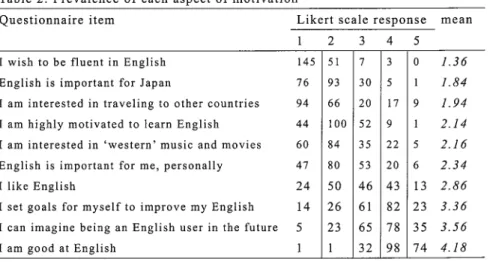
Table 2 shows the aggregate results of the questionnaire, item by item. Here, the items are ordered from the most prevalent among our students (having the highest number agreeable responses on the Likert scale) to the least prevalent (indicated by disagreement). The mean score of each item was calculated for comparison between items. 1 is "strongly agree" while 5 is "strongly disagree". Thus, a mean of 5 .0, for example, would indicate that every participant responded "strongly disagree" on the item.
Table 2: Prevalence of each aspect of motivation
Questionnaire item Likert scale response mean
1 2 3 4 5 I wish to be fluent in English
English is important for Japan
I am interested in traveling to other countries
145 76 94 51 93 66 7 3 2 5 3 5 4 6 6 3 0 0 2 5 3 6 1 5 2 3 5 l 9 2 2 4 8 【 ノ 9 7 2 0 3 2 8 8 0 1 9 1.36 1.84 1.94 I am highly motivated to learn English 44 100 1 2.14 I am interested in 'western' music and movies 60 84 5 2.16 English is important for me, personally
I like English
I set goals for myself to improve my English
47 24 14 80 50 26 6 13 23 2.34 2.86 3.36 I can imagine being an English user in the future 5 23 35 3.56
I am good at English 1 74 4.18
1=strongly agree, 2=agree, 3=neither agree nor disagree, 4=disagree, 5=strongly disagree -79 ー
We can see that items which indicate a general desire to be good at English, such as "I wish to be fluent in English", are largely agreed upon, whereas items which indicate that students are taking action, such as "I set goals for myself to improve my English" do not seem prevalent. These issues
will be addressed in the discussion below.
5. Discussion
The results of this study support ideas put forth by Dornyei, Gardner and others. Intrinsic motivation is widely seen to be more instrumental than extrinsic motivation and this is supported when looking at the results on items like "English is important pr Japan" and "English is important pr me, personally". The Japanese government mentions the importance of English for Japanese people in the context of globalization (MEXT, 2018) and has used the coming Tokyo Olympics to stress the necessity of English on the global stage. Everyone has heard the rhetoric, but the corresponding questionnaire item is only very tacitly connected to achievement, if at all. (Statistical significance was not achieved.) External pressure seems to have a much lesser effect than when learners have a more personal connection to English. Believing that English is important on a personal level on the other hand, had the second highest correlation to achievement. Other, very personal affective factors are also highly connected to achievement. Feeling highly motivated, which indicates motivational intensity was the third most important factor, while simply liking English correlated the most strongly with achievement. Of course, it is difficult to establish cause and effect. Everybody likes things that they are good at, but to be certain, MEXT has stressed the importance of affective factors in English education (MEXT, 2008). Efforts to make children like English, or at least to stem the tide of discontent that seems to arise in the latter half of junior high school, are probably a good idea.
Setting goals for improvement is also moderately correlated to success. This item draws on Dornyei's notion of the "ought to self" and learner autonomy. The pattern that seems to emerge is that having a personal connection to English and taking charge of one's own learning process is strongly correlated to success. Active learners seem to be the most successful. The motivational factors occurring at the bottom of the list, in contrast, are all comparatively passive and not directly connected to the learning process.
Wishing to be fluent in English, with a correlation coefficient of only 1.55, does not entail any specific action and the goal of being "fluent" sounds nice, but is ultimately vague, compared to an item like "I can imagine myself being an English user in the future ", which is personal, and therefore, more specific.
The notion of integrativeness does not seem to be particularly important in this study. Being interested in traveling to other countries as well as being interested in Western movies and music were weakly correlated to achievement. In both cases, the correlation coefficient was under 0.2 and showing interest in Western media did not meet a significance threshold of .05. Again, these interests are not directly related to learner autonomy or language learning in an active capacity. While it can be expected that active, autonomous learners might seek out authentic material such as Western media, anyone can show an interest in Western culture. When we look at the results in a little more detail, it can be seen that the vast majority of students agreed with these statements, though these qualities are less associated with successful learning. This pattern becomes clearer when we look at other results also.
:'I
薫ngIi
h
I need English, personally. 'lam'hi lミ‘線為麟lf! 'ted
I set goaIsforimprovement. Ii§荒」す「’→三“ ' 芦m go
~can see theEn8」‘・」1"ME' 敏
I wish Iwer-efluentin English.
[wish I were fluent in English. Japan needs English.
I want tb travel abroad.
I like western movies and music. ham highly mativat起,
I need English, personally. I like English. 、一
I set goals for improvement. ー些白h=see the En柳ish 叩ME". 一 ・ 葺
Ilike western move.,and music. lam good at En:Iish.
Figure 2: Indicators of success vs. beliefs and actions regarding learning.
Among the ten questionnaire items, Liking English, believing English to be personally important, setting goals for improvement and reporting to be good at English represent four of the top five items which are most closely
related to achievement in English. However, these statements were among the bottom five when we look at student agreement. Having an image of being an English user, also, showed a correlation coefficient of 0.302, yet only a very small minority of students, around 14%, agreed with this statement.
Meanwhile, the four items that correlate the least with achievement represent the top four items which students agree with. Figure 2 shows this apparent inverse relationship.
This study does not claim that students are necessarily lacking in motivation, but that their motivation might not be in the right direction. Envisioning English as being connected to the learner, personally, seems to have a more positive impact on learning, but students do not feel this connection. Aside from those who go on to teach English in junior and senior high school, many more students will be required to teach English in elementary school, working with native-English speaking teachers ("ALTs", presumably). Almost all students who go on to become teachers will likely have ALTs as coworkers, occasionally visiting their classroom to eat lunch or perhaps sitting next to them in the teacher's room. As a faculty member at Naruto University of Education, I believe that students' perception of English as being not particularly important on a personal level is mistaken, and I hope that they realize that developing functional ability in English can enrich their own lives and the lives of those around them. The other point that should be made is that language learning is hard. Merely wishing to be "fluent" or showing interest in Western culture are nice, but becoming autonomous, hardworking learners will yield far better results. By way of a conclusion, two pedagogic suggestions or implications are drawn from this study.
6. Conclusion
The present study investigated various aspects of motivation and their relationship to L2 achievement. Consistent with theory and research, intrinsic, internal and personal motivational factors are more closely related with success than extrinsic factors such as the belief that English is important on a more macro level. Likewise, the study indicates that having a clear image of oneself as an L2 user in the future and setting concrete goals are more important qualities than simply wishing to be good at English or being interested in L2 culture. When these motivational aspects are then ranked by
their prevalence among students, the aspects that were the most prevalent were the least correlated to successful learning, and vis versa. In effect, students' motivation seems to be misdirected.
The first pedagogic implications of this research is that as teachers, we should spend more time showing students that globalization is not just an impersonal force exerted on the nation, and that English can be a valuable tool for personal, individual growth. Recasting English in this way may improve English achievement. One way to do this is to provide more role models that students can relate to. There are many elementary school teachers in our immediate community, for example, who were very anxious when they learned that they would be required to teach English. When they overcome their initial shock and got down to the .business of teaching, working with ALTs and using English in class, they were very successful, which transformed their attitude towards English. Presenting specific, realistic role models like this to our students will hopefully give them a deeper, personal connection to English.
The second pedagogic implication is that we should spend more time discussing learning strategies with students. Learning a language is probably a life-long task and class time is very limited. Most learning likely occurs outside the classroom and it is very important that students take charge of their own learning. They should be able to set realistic goals and create a plan to reach those goals. They should also be able to take pause and reflect on their learning, adjusting their goals and strategies appropriately. Whereas the first implication is about Dornyei's (2005) "ideal L2 self", this second implication is about the "ought-to self". Autonomous learners are successful learners. In the spirit of "active learning" we should give students practical advice about how to become independent, autonomous learners.
References
Dornyei, Z. and Otto, I. (1998) Motivation in Action: A Process Model of L2 Motivation. Working Papers in Applied Linguistics, 4, 43-69.
Dornyei, Z . (2005). The Psychology of the Language Learner: Individual Differences in Second Language Acquisition. New York: Routledge. MEXT (2008) MEXT. (2008). Shogakkou gakushuu shidou youryou:
Gaikokugo katsudou 伍lementary school curriculum guidelines: Foreign language activities). Retrieved 8/26/10 from: http://www.mext.go.jp/
component/a~ menu/education/micro~ detail/icsFiles/afieldfile/2009/ 06/ 16/1234931_012.pdf.
MEXT Official Website. Retrieved October 19th, 2018 from http ://www.mext.go .jp/en/policy/ education/index.htm.
Noels, K ., Pelletier, L., Clement, R. and Vallerand, R. (2000). Why are you learning a second language? Motivational orientations and
self-determination theory. Language Learning 50:57-85.
Gardner, R. C. (1985). Social Psychology and Second Language Learning: The Role afAttitudes and Motivation. London: Edward Arnold.
Tanaka, H. (2009). Enhancing intrinsic motivation at three levels: the effects of motivational strategies. JALT Journal, 31, (2), 227-250.
Ushioda, E. (1996). Learner Autonomy 5: The Role of Motivation. Dublin: Authentik.
Ushioda, E. (2003). 'Motivation as a socially mediated process' in Little, D., 斑dley, J. and Ushioda, E . (eds) Learner Autonomy in the Foreign Language Classroom: Teacher, Learner, Curriculum and Assessment. Dublin: Authentik.
Van Lier, L . (1996). Interaction in the Language Curriculum: Awareness, Autonomy and Authenticity. London: Longman.
Williams, M . and Burden, R . L . (1997). Psychology for Language Teachers. Cambridge: Cambridge University Press
Appendix: Questionnaire given to students (Japanese translation)
'Short English Motivation Questionnaire
Name: Student ID アンケートで知り得た個人情報を第三者に漏らしたり、授業の評価に反映させたりすることはありませんので、 氏名を記入してください。 自分と英語(この場合の「英語」とは国語、数学、英語など学校の教科としての英語ではなく、英語、スペイン語、中国 語など言語としての「英語」である) の関わりについてのアンケートにお答えください。骸当する番号ュ~5のいずれかを【】に記入してください。 ュとても当てはまる 2 当てはまる 3 どちらとも言えない 4 当てはまらない S 全く当てはまらない。 欧米の音楽や映固に興昧がある【】 海外旅行に興味がある【】 英語が上手だ【】 英語が好きだ【】 英語は私にとって重要だ【】 英語は日本にとつて重要だ【】 英語が流暢に話せたらなと思う【】 英語を習得する意欲がある【】 英語の上達のために目標を設定している【】 将来自分カ《英語を使っているところを想像できる(英語を使っている自分をイメージできる】【】