Title Pathogenesis of Chlamydial Infections( 本文(FULLTEXT) )
Author(s) RAJESH, CHAHOTA
Report No.(Doctoral Degree) 博士(獣医学) 甲第226号 Issue Date 2007-03-13 Type 博士論文 Version author URL http://hdl.handle.net/20.500.12099/21409 ※この資料の著作権は、各資料の著者・学協会・出版社等に帰属します。
Pathogenesis of Chlamydial Infections
!"#$%&'()*+%,-./0
2006
The United Graduate School of Veterinary Sciences, Gifu University,
(Gifu University)
Pathogenesis of Chlamydial Infections
!"#$%&'()*+%,-./0
CONTENTS
PREFACE……… 1
PART I
Molecular Epidemiology, Genetic Diversity, Phylogeny and Virulence Analysis
of Chlamydophila psittaci
CHAPTER I: Study of molecular epizootiology of Chlamydophila psittaci among captive and feral avian species on the basis of VD2 region of ompA gene Introduction……… 7Materials and Methods………... 9
Results……… 16
Discussion……….. 31
Summary……….... 35
CHAPTER II: Analysis of genetic diversity and molecular phylogeny of the Chlamydophila psittaci strains prevalent among avian fauna and those associated with human psittacosis Introduction……… 36
Materials and Methods………... 38
Results……… 42
Discussion……….. 55
Summary……… 59
CHAPTER III: Examination of virulence patterns of the Chlamydophila psittaci strains predominantly associated with avian chlamydiosis and human psittacosis using BALB/c mice Introduction……… 60
Materials and Methods………... 63
Results……… 66
Discussion……….. 74
PART II
Investigation of the Emergence of Chlamydial Infection in Animals and Human
Disease Conditions
CHAPTER IV: Involvement of multiple Chlamydia suis genotypes in porcine conjunctivitis in commercial farms of Japan
Introduction……… 79
Materials and Methods………... 80
Results……… 86
Discussion……….. 92
Summary……… 98
CHAPTER V: Molecular characterization of the Chlamydophila caviae strain OK135, isolated from human genital tract infection, by analysis of some structural and functional genes Introduction………. 99
Materials and Methods……… 100
Results………. 103 Discussion………... 108 Summary………. 110 CONCLUSION……… 112 REFERENCES………. 116 ACKNOWLEDGMENTS……… 140
Chlamydiae are the obligate intracellular bacterial pathogens of animals and human beings (185, 188). They replicate within the cytoplasm of host cells, forming characteristic intracellular inclusion bodies. The chlamydiae undergo a unique biphasic developmental cycle characterized by two morphologically distinct forms, the elementary body (EB) and the reticulate body (RB). EBs are small (0.2–0.3 µm in diameter) infectious forms that are either endocytosed or phagocytosed by host cells. The EB within an intracytoplasmic inclusion, transforms into the larger (0.5–1.6 µm in diameter) intracellular non-infectious, metabolically active, RB. The RB multiplies by binary fission and fills the inclusion, which expands in size. RBs re-condense back into EBs via intermediate bodies towards the end of the cycle (24–48 hr, depending on species and strains) and are then released from the host cell by lysis or exocytosis to initiate another cycle of infection (75, 119, 131, 216).
The EB, in contrast to the RB, is structurally rigid, resulting from the formation of extensive disulphide linkages between various cysteine-rich proteins in or associated with the outer membrane. The chlamydial outer membrane consists of lipopolysaccharide (LPS), polymorphic outer membrane proteins (POMPs), peptidoglycan and cysteine-rich proteins like major outer membrane protein (MOMP), OmcA and OmcB. The most important of these is the MOMP, which makes up 60% of the weight of the outer membrane. MOMP is about 40- to 45-Kda in mass and contains serovar- and species-specific epitopes. MOMP acts as porins, channels to allow exchange of molecules including nutrients. The high rigidity results in EBs being resistant to both chemical and physical factors and therefore, adapted for prolonged extracellular survival, an important factor in terms of chlamydial pathogenesis and control or treatment of chlamydial infections (75, 176).
Earlier all chlamydiae were placed in order Chlamydiales, family Chlamydiaceae and one genus Chlamydia that included 4 species: C. trachomatis, C. psittaci, C.
pneumoniae and C. pecorum (52, 64, 132). Following reclassification of the order Chlamydiales in 1999, the family Chlamydiacaeae is now divided into two genera, Chlamydia and Chlamydophila (43). The genus Chlamydia comprises of Chlamydia trachomatis, Chlamydia suis and Chlamydia muridarum species. The genus Chlamydophila contains the species Chlamydophila pneumoniae, Chlamydophila psittaci, Chlamydophila abortus, Chlamydophila pecorum, Chlamydophila felis and Chlamydophila caviae.
Chlamydiae are responsible for a diverse range of diseases in birds and mammals including humans. Among human chlamydial infections, C. trachomatis causes blindness (trachoma), sexually transmitted disease and infertility. C. pneumoniae is a cause of acute respiratory infection, coronary heart disease and chronic inflammatory lung diseases viz. chronic obstructive pulmonary disease and asthma (71, 105, 177).
Animal chlamydial infections are caused by many chlamydial species. In genus
Chlamydia, C. suis is associated with either asymptomatic infections or cause
conjunctivitis, enteritis, pneumonia and genital tract infections in domesticated and wild porcine (99, 165, 183). C. muridarum causes either no disease or asymptomatic pneumonitis among mice and hamsters (40, 48). In genus Chlamydophila, C. pecorum is associated with chronic conditions viz. pneumonia, polyarthritis, conjunctivitis, enteritis, encephalomyelitis, metritis and mastitis among ruminants, swine and marsupials (40, 52).
C. felis is responsible for “feline chlamydiosis”, which is characterized by rhinitis and
conjunctivitis in cats, particularly kittens (192). Studies conducted in Japan have shown C.
felis to be more widespread in stray cats than in pet cats (26, 57, 222). C. abortus is a cause
of abortion in sheep, goats and responsible for reproductive failure in bovine, equine and porcine (40, 113, 160). C. psittaci causes “avian chlamydiosis ” among many avian species (reported 460 avian species) and can also infect mammalian species (8, 94, 210). Avian
and conjunctivitis (8, 188). C. caviae is a host specific pathogen of guinea pigs and causes either self-limiting or asymptomatic inclusion conjunctivitis among young (4-8 weeks old) guinea pigs (63, 101, 135). C. pneumoniae is also reported from marsupials and equines (62, 218).
Animal chlamydial infections also have public health hazard significance. Among all chlamydial species infecting animals, C. psittaci, C. abortus and C. felis are potential zoonotic pathogens (113). C. abortus can cause severe, life-threatening disease in pregnant women. Infection in women during pregnancy can result in spontaneous abortion or stillbirths, which are typically preceded by several days of acute influenza-like illness, as well as renal failure, hepatic dysfunction, disseminated intravascular coagulation, and possibly death (25, 87). Cases of C. felis infection associated with conjunctivitis and atypical pneumonia in humans have been reported over the years (19, 113), but it is only recently that compelling evidence of transmission from cats to humans has been provided by way of molecular classification techniques (74). In Japan serological evidence of human C. felis infection has been reported (222).
The zoonotic infection by C. psittaci, is particularly a significant occupational health hazard to the workers in poultry industry, aviaries, zoos and also pet shop owners, farmers and veterinarians. Infection in humans can vary in severity but is usually associated with respiratory disease. But multiple organs may become infected resulting in endocarditis, myocarditis, hepatitis, encephalitis or meningitis and result in deaths (113, 181, 210). The financial losses resulting from this disease, particularly those incurred in the poultry and pet industries, combined with the fact that this is the most common animal chlamydiosis transmissible to man, highlights the economic importance and public health significance of avian chlamydiosis. The incidences of zoonotic infection by C. caviae, C. pecorum, C. suis and C. muridarum are unknown (113).
Defining the distribution of natural chlamydial infections in animals and human and its relationship to pathogenesis provides the fundamental basis for management and control
of chlamydial diseases. The final outcome of chlamydial infection in animals and human depends on large numbers of host and organism specific factors (217). Genetic and biological differences among various chlamydial species/strains are well known. Different pathobiotypes of C. trachomatis strains have been recognized, which include trachoma, urogenital and lymphogranuloma venereum (LGV) biovars. These biovars varies in tissue tropism and host specific cellular response which indicates variation in disease causation mechanism (128, 137, 214). In C. pneumoniae also, human, equine and koala biovars are known. The virulence and genetic distinction of C. abortus strains causing abortion in ewes from non abortifacient strains has also been established (38, 159, 162). However, in
C. psittaci no such relationship has been explored among various genetically diverse
strains even though it has been detected from diverse host rage and disease conditions. On the other hand, some studies have found varied virulence of C. psittaci strain to avian species (212). Therefore, detailed molecular epidemiological studies of animal chlamydial species by screening variety of host species and disease conditions is important to identify association of particular species/strain with specific disease syndrome.
The diagnosis of chlamydial infections and analysis of chlamydial diversity are done by isolation, serological and biotyping studies (175, 184, 220). But these procedures are time consuming and high technical skills are required for testing samples. Therefore, the recent epidemiological studies are mostly contemplated by detecting species/strain specific gene (DNA) by nucleic acid amplification using polymerase chain reaction (PCR). By this technique even a very small amount of EBs can be detected. The genetic diversity among the prevalent chlamydial species/strains can be studied by sequencing and genetically analyzing the amplified DNA fragment (59, 80, 83, 96, 97, 148).
The differentiation at the species level among various chlamydiae is usually done by genetic analysis of highly conserved genes like 16S ribosomal RNA, 16S-23S
ribosomal RNA intergenic spacer region, rnpB and groEL-1 genes (24, 41, 54, 79, 149, 193, 205). However, for the identification at strain level, ompA gene coding MOMP has been targeted in many studies (38, 47, 50, 60, 173, 191).
For identification and differentiation of C. psittaci isolates especially of avian origin, ompA gene was analyzed by many researchers (50, 98, 174, 191, 207). Depending on serovar specific monoclonal antibody typing, 8 serotypes named A to H have been identified in C. psittaci (4, 56, 206, 207). Based on AluI restriction fragment length polymorphism (RFLP) pattern of ompA gene, C. psittaci strains are also divided into 7 genotypes from A to F and E/B (60, 174, 207), but serotyping and RFLP studies do not reflect the actual genetic diversity (60).
Therefore, the detailed investigations about natural distribution, molecular identification, genetic diversity and virulence of various chlamydial species/strains of animal origin are necessary to understand disease pathogenesis. Hence, to elucidate some of these questions the present study was undertaken with the following objectives:
1) Study of molecular epizootiology of Chlamydophila psittaci among captive and feral avian species on the basis of VD2 region of ompA gene.
2) Analysis of genetic diversity and molecular phylogeny of Chlamydophila psittaci strains prevalent among avian fauna and those associated with human psittacosis. 3) Examination of virulence patterns of Chlamydophila psittaci strains predominantly
associated with avian chlamydiosis and human psittacosis using BALB/c mice. 4) Investigation of the emergence of chlamydial infection among animals and human
disease conditions.
These findings will help to identify predominant/emergent chlamydial genotypes prevalent among domesticated and wild fauna, with/without disease symptoms and also those with high zoonotic potential for better understanding of disease pathogenesis.
PART I
Molecular Epidemiology, Genetic Diversity, Phylogeny and Virulence
Analysis of Chlamydophila psittaci
f
Study of molecular epizootiology of Chlamydophila psittaci among captive
and feral avian species on the basis of VD2 region of ompA gene
INTRODUCTION
Chlamydiae are obligate intracellular pathogens and widely prevalent among avian species, animals and human beings (7, 51, 132, 188). According to the recent classification based upon 16S rRNA gene sequences, all the chlamydiae are divided into four families (43). Chlamydophila species belonging to the family Chlamydiaceae are often involved in the infection of avian species and domestic animals (43, 53).
The avian chlamydiosis is caused by Chlamydophila psittaci. The disease is characterized by clinical and/or subclinical infection. The clinical signs vary in severity and disease is usually systemic with up to 30% mortality (8, 188). C. psittaci has been reported in more than 400 avian species and occasionally in non-avian hosts (8, 94, 143, 182, 209). C. psittaci is usually transmitted horizontally to in-contact animals and human beings by diseased or subclinically infected birds (35, 112, 113, 115, 181). People are frequently exposed to diverse type of domestic and/or feral avian fauna in daily life either incidentally or occupationally. Furthermore, the feral birds congregated in urban public habitations also contaminate the environment with C. psittaci laced aerosols and droppings (30, 55, 70, 202). In Japan, 45 cases of human psittacosis in 2002, 44 in 2003 and 36 in 2004 were reported (136) and in USA 935 cases were reported from 1988 to 2003 (181). Many more cases may have occurred but are neither correctly diagnosed nor reported due to confusing symptoms.
Immunodiagnostic and biotyping studies (31, 184, 220) were reported to identify various avian species harboring C. psittaci and to detect chlamydial diversity. Depending on serovar specific monoclonal antibody typing, 8 serotypes named A to H have been identified in C. psittaci (4, 56, 206, 207). In the last decade, for identification and differentiation of C. psittaci isolates especially of avian origin, ompA gene coding major outer membrane protein (MOMP) was analyzed by many researchers (50, 98, 174, 191, 207). On the basis of AluI restriction fragment length polymorphism (RFLP) pattern of
ompA gene, C. psittaci strains are also divided into 7 genotypes from A to F and E/B (60,
174, 207), but serotyping and RFLP studies do not reflect the actual genetic diversity (60). The ompA gene consists of genetically conserved fragments called conserved/constant domains (CD) flanking 4 genetically variable domains (VD). The VDs of ompA gene are reported to have species/strain specific sequences and thus can be analyzed for identification of chlamydial species/strains and also to study the genetic diversity directly from field samples after PCR amplification (12, 86, 96, 148, 225).
The detailed epizootiological study of avian chlamydiosis is essential to know the prevalence of different chlamydial strains/species among various avian species and to ascertain the possibility of health hazard risk to in-contact animals and human beings. Moreover, limited information is available in literature on the current molecular epizootiology and genetic diversity of C. psittaci after reclassification of avian and mammalian isolates of the previous Chlamydia psittaci group (43). Therefore, the present research was planned to investigate the molecular epizootiology and genetic diversity among C. psittaci strains and/or other chlamydial species prevalent in diverse avian fauna. It appears that various genetically diverse chlamydial species and strains may cause avian chlamydiosis but some strains of C. psittaci are highly prevalent and are frequently associated with clinical/subclinical infections.
MATERIALS AND METHODS
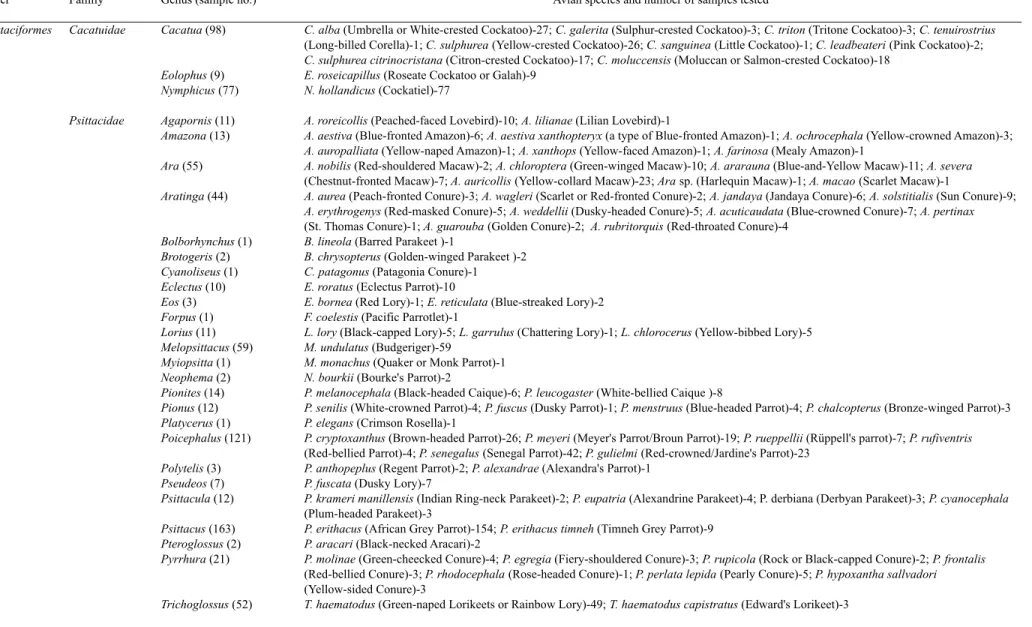
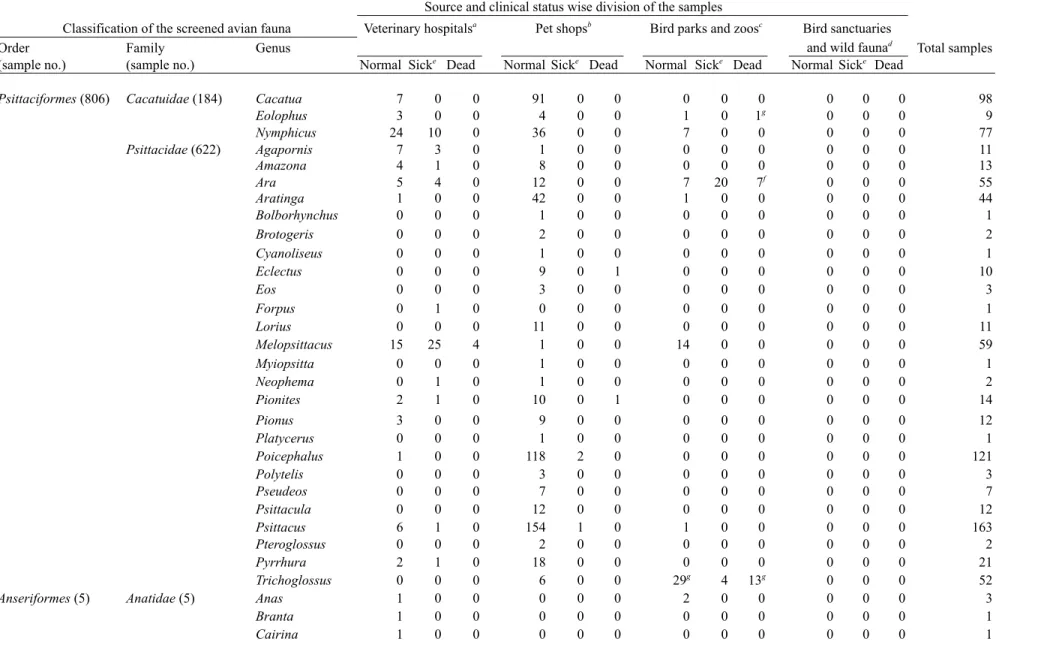
Samples examined: A total of 1,147 samples from 11 avian orders were collected from 4 avian pet shops, 3 bird sanctuaries/wild animal rehabilitation centers, 3 bird parks/zoos and 14 veterinary hospitals located in 11 prefectures of Japan from January 2003 to December 2004. The collected samples included the cloacal swabs or freshly voided feces and/or whole blood in heparin and/or pieces of visceral organs (1-2 g) including lung, liver, spleen, heart and posterior intestinal loop from dead birds. The avian fauna screened in the study is shown in Table 1. The distribution of tested samples according to clinical history and sources are shown in Table 2. In total, 11 avian orders include 28 genera and 81 species from psittacine birds and 25 genera comprising of 32 species from non-psittacine birds.
DNA extraction: SepaGene DNA extraction Kit (Sanko Junyaku, Tokyo, Japan) was used to extract DNA from samples according to the manufacturer’s instructions. In brief, about 200 mg of fecal/tissue material or 50 µl of blood or cloacal swabs suspended in 700 µl of phosphate-buffered saline (PBS), pH 7.4 were processed for DNA extraction. DNA was finally dissolved in 30 µl Tris-EDTA (TE) buffer, pH 7.4 (100 mM Tris-HCl, pH 7.4 and 10 mM EDTA, pH 8.0) and stored at –30°C. DNA extracted from purified elementary bodies of GPIC strain of Chlamydophila caviae (ATCC VR-813) was used as a positive control in the test.
Nested PCR: Two sets of consensus oligonucleotide primers based on ompA gene were used in a two-steps procedure. An outer pair of primers CMGP-1F (5'-CCTTGTGATCCTTGCGCTACTTG-3'; nucleotide (nt) 138 to 160 in ompA gene sequence of 6BC strain of C. psittaci with accession number X56980) and CMGP-1R (5'- GTGAGCAGCTCTTTCGTTGAT-3'; nt 1184 to 1164) and an inner pair of primers
Table 1. Details of the avian species screened in the study.
Order Family Genus (sample no.) Avian species and number of samples testeda
Psittaciformes Cacatuidae Cacatua (98) C. alba (Umbrella or White-crested Cockatoo)-27; C. galerita (Sulphur-crested Cockatoo)-3; C. triton (Tritone Cockatoo)-3; C. tenuirostrius
(Long-billed Corella)-1; C. sulphurea (Yellow-crested Cockatoo)-26; C. sanguinea (Little Cockatoo)-1; C. leadbeateri (Pink Cockatoo)-2;
C. sulphurea citrinocristana (Citron-crested Cockatoo)-17; C. moluccensis (Moluccan or Salmon-crested Cockatoo)-18 Eolophus (9) E. roseicapillus (Roseate Cockatoo or Galah)-9
Nymphicus (77) N. hollandicus (Cockatiel)-77
Psittacidae Agapornis (11) A. roreicollis (Peached-faced Lovebird)-10; A. lilianae (Lilian Lovebird)-1
Amazona (13) A. aestiva (Blue-fronted Amazon)-6; A. aestiva xanthopteryx (a type of Blue-fronted Amazon)-1; A. ochrocephala (Yellow-crowned Amazon)-3; A. auropalliata (Yellow-naped Amazon)-1; A. xanthops (Yellow-faced Amazon)-1; A. farinosa (Mealy Amazon)-1
Ara (55) A. nobilis (Red-shouldered Macaw)-2; A. chloroptera (Green-winged Macaw)-10; A. ararauna (Blue-and-Yellow Macaw)-11; A. severa
(Chestnut-fronted Macaw)-7; A. auricollis (Yellow-collard Macaw)-23; Ara sp. (Harlequin Macaw)-1; A. macao (Scarlet Macaw)-1
Aratinga (44) A. aurea (Peach-fronted Conure)-3; A. wagleri (Scarlet or Red-fronted Conure)-2; A. jandaya (Jandaya Conure)-6; A. solstitialis (Sun Conure)-9; A. erythrogenys (Red-masked Conure)-5; A. weddellii (Dusky-headed Conure)-5; A. acuticaudata (Blue-crowned Conure)-7; A. pertinax
(St. Thomas Conure)-1; A. guarouba (Golden Conure)-2; A. rubritorquis (Red-throated Conure)-4
Bolborhynchus (1) B. lineola (Barred Parakeet )-1
Brotogeris (2) B. chrysopterus (Golden-winged Parakeet )-2 Cyanoliseus (1) C. patagonus (Patagonia Conure)-1 Eclectus (10) E. roratus (Eclectus Parrot)-10
Eos (3) E. bornea (Red Lory)-1; E. reticulata (Blue-streaked Lory)-2 Forpus (1) F. coelestis (Pacific Parrotlet)-1
Lorius (11) L. lory (Black-capped Lory)-5; L. garrulus (Chattering Lory)-1; L. chlorocerus (Yellow-bibbed Lory)-5 Melopsittacus (59) M. undulatus (Budgeriger)-59
Myiopsitta (1) M. monachus (Quaker or Monk Parrot)-1 Neophema (2) N. bourkii (Bourke's Parrot)-2
Pionites (14) P. melanocephala (Black-headed Caique)-6; P. leucogaster (White-bellied Caique )-8
Pionus (12) P. senilis (White-crowned Parrot)-4; P. fuscus (Dusky Parrot)-1; P. menstruus (Blue-headed Parrot)-4; P. chalcopterus (Bronze-winged Parrot)-3 Platycerus (1) P. elegans (Crimson Rosella)-1
Poicephalus (121) P. cryptoxanthus (Brown-headed Parrot)-26; P. meyeri (Meyer's Parrot/Broun Parrot)-19; P. rueppellii (Rüppell's parrot)-7; P. rufiventris
(Red-bellied Parrot)-4; P. senegalus (Senegal Parrot)-42; P. gulielmi (Red-crowned/Jardine's Parrot)-23
Polytelis (3) P. anthopeplus (Regent Parrot)-2; P. alexandrae (Alexandra's Parrot)-1 Pseudeos (7) P. fuscata (Dusky Lory)-7
Psittacula (12) P. krameri manillensis (Indian Ring-neck Parakeet)-2; P. eupatria (Alexandrine Parakeet)-4; P. derbiana (Derbyan Parakeet)-3; P. cyanocephala
(Plum-headed Parakeet)-3
Psittacus (163) P. erithacus (African Grey Parrot)-154; P. erithacus timneh (Timneh Grey Parrot)-9 Pteroglossus (2) P. aracari (Black-necked Aracari)-2
Pyrrhura (21) P. molinae (Green-cheecked Conure)-4; P. egregia (Fiery-shouldered Conure)-3; P. rupicola (Rock or Black-capped Conure)-2; P. frontalis
(Red-bellied Conure)-3; P. rhodocephala (Rose-headed Conure)-1; P. perlata lepida (Pearly Conure)-5; P. hypoxantha sallvadori (Yellow-sided Conure)-3
Anseriformes Anatidae Anas (3) Anas sp. (Duck)-3
Branta (1) B. sandvicensis (Hawaiian Goose)-1 Cairina (1) C. moschata (Muscovy Duck)-1
Ciconiiformes Ardeidae Nycticorax (1) N. nycticorax (Black-crowned Night Heron)-1 Ciconiidae Ciconia (256) C. ciconia (White Stork)-256
Columbiformes Columbidae Columba (2) Columba livia (Pigeon)-2
Cuculiformes Musophagidae Tauraco (10) T. persa (Guinea Turaco)-4; T. livingstonii (Livingstone's Turaco)-5; T. hartlaubi (Hartlaub's Turaco)-1 Musophaga (7) M. violacea (Violet Turaco)-7
Galliformes Phasianidae Lophura (1) L. nycthemera (Silver Pheasent)-1
Gallus (5) G. domesticus (Chicken and Chicken Silkie Bantom)-5 Coturnix (3) C. japonica (Japanese Quail )-3
Pavo (2) P. cristatus (Common Pea Fowl)-2 Gruiformes Gruidae Grus (14) G. japonensis (Red Crowned Crane)-14 Passeriformes Estrildidae Padda (5) P. oryzivora (Java Sparrow)-5
Fringillidae Coccothraustes (1) C. coccothraustes (Hawfinch)-1 Lagopus (1) L. mutus (Rock Ptarmigan)-1 Hirundinidae Hirundo (1) H. rustica (Barn Swallow)-1
Ploceidae Passer (1) P. montanus (Eurasian Tree Sparrow)-1 Pycnonoyidae Hypsipetes (1) H. amaurotis (Brown-eared Bulbul )-1 Sturnidae Gracula (2) G. religiosa (Southern Grackle or Hill Mynah)-2
Sturnus (1) S. cineraceus (Grey Starling)-1
Piciformes Ramphastidae Ramphastos (11) R. toco (Toco Toucan)-3; R. tucanus (Red-billed Toucan)-3; R. sulfuratus (Keel-billed Toucan)-1; R. vitellinus (Channel-billed Toucan)-3; R. swainsonii (Chestnut-mendibled Toucan)-1
Sphenisciformes Sphaniscidae Spheniscus (5) S. demersus (Cape Penguin)-5
Strigiformes Strigidae Bubo (5) B. bengalensis (Bengal Eagle Owl)-3; B. virginianus (Horned Owl)-2 Tytonidae Tyto (1) T. alba (Barn Owl)-1
Table 2. Type of avian fauna screened and distribution according to clinical history and sources of sampling.
Order Family Genus Total samples
(sample no.) (sample no.) Normal Sicke Dead Normal Sicke Dead Normal Sicke Dead Normal Sicke Dead
Psittaciformes (806) Cacatuidae (184) Cacatua 7 0 0 91 0 0 0 0 0 0 0 0 98
Eolophus 3 0 0 4 0 0 1 0 1g 0 0 0 9 Nymphicus 24 10 0 36 0 0 7 0 0 0 0 0 77 Psittacidae (622) Agapornis 7 3 0 1 0 0 0 0 0 0 0 0 11 Amazona 4 1 0 8 0 0 0 0 0 0 0 0 13 Ara 5 4 0 12 0 0 7 20 7f 0 0 0 55 Aratinga 1 0 0 42 0 0 1 0 0 0 0 0 44 Bolborhynchus 0 0 0 1 0 0 0 0 0 0 0 0 1 Brotogeris 0 0 0 2 0 0 0 0 0 0 0 0 2 Cyanoliseus 0 0 0 1 0 0 0 0 0 0 0 0 1 Eclectus 0 0 0 9 0 1 0 0 0 0 0 0 10 Eos 0 0 0 3 0 0 0 0 0 0 0 0 3 Forpus 0 1 0 0 0 0 0 0 0 0 0 0 1 Lorius 0 0 0 11 0 0 0 0 0 0 0 0 11 Melopsittacus 15 25 4 1 0 0 14 0 0 0 0 0 59 Myiopsitta 0 0 0 1 0 0 0 0 0 0 0 0 1 Neophema 0 1 0 1 0 0 0 0 0 0 0 0 2 Pionites 2 1 0 10 0 1 0 0 0 0 0 0 14 Pionus 3 0 0 9 0 0 0 0 0 0 0 0 12 Platycerus 0 0 0 1 0 0 0 0 0 0 0 0 1 Poicephalus 1 0 0 118 2 0 0 0 0 0 0 0 121 Polytelis 0 0 0 3 0 0 0 0 0 0 0 0 3 Pseudeos 0 0 0 7 0 0 0 0 0 0 0 0 7 Psittacula 0 0 0 12 0 0 0 0 0 0 0 0 12 Psittacus 6 1 0 154 1 0 1 0 0 0 0 0 163 Pteroglossus 0 0 0 2 0 0 0 0 0 0 0 0 2 Pyrrhura 2 1 0 18 0 0 0 0 0 0 0 0 21 Trichoglossus 0 0 0 6 0 0 29g 4 13g 0 0 0 52
Anseriformes (5) Anatidae (5) Anas 1 0 0 0 0 0 2 0 0 0 0 0 3
and wild faunad
Bird sanctuaries Source and clinical status wise division of the samples
Ciconiiformes (257) Ardeidae (1) Nycticorax 0 0 0 0 0 0 0 0 0 0 1 0 1
Ciconiidae (256) Ciconia 0 0 0 0 0 0 0 0 0 254 0 2 256
Columbiformes (2) Columbidae (2) Columba 0 0 0 0 0 0 2 0 0 0 0 0 2
Cuculiformes (17) Musophagidae (17) Tauraco 0 0 0 0 0 0 10 0 0 0 0 0 10
Musophaga 0 0 0 0 0 0 7 0 0 0 0 0 7
Galliformes (11) Phasianidae (11) Lophura 0 0 0 0 0 0 1 0 0 0 0 0 1
Gallus 3 0 0 0 0 0 2 0 0 0 0 0 5
Coturnix 0 0 0 0 0 0 3 0 0 0 0 0 3
Pavo 0 0 0 0 0 0 2 0 0 0 0 0 2
Gruiformes (14) Gruidae (14) Grus 0 0 0 0 0 0 14 0 0 0 0 0 14
Passeriformes (13) Estrildidae (5) Padda 4 0 0 0 0 0 1 0 0 0 0 0 5
Fringillidae (2) Coccothraustes 0 0 0 0 0 0 0 0 0 0 1 0 1 Lagopus 0 0 0 0 0 0 0 0 0 0 0 1 1 Hirundinidae (1) Hirundo 0 0 0 0 0 0 1 0 0 0 0 0 1 Ploceidae (1) Passer 1 0 0 0 0 0 0 0 0 0 0 0 1 Pycnonoyidae (1) Hypsipetes 1 0 0 0 0 0 0 0 0 0 0 0 1 Sturnidae (3) Gracula 1 0 1 0 0 0 0 0 0 0 0 0 2 Sturnus 0 0 0 0 0 0 0 0 0 0 1 0 1
Piciformes (11) Ramphastidae (11) Ramphastos 0 0 0 0 0 0 11 0 0 0 0 0 11
Sphenisciformes (5) Sphaniscidae (5) Spheniscus 0 0 0 0 0 0 5 0 0 0 0 0 5
Strigiformes (6) Strigidae (5) Bubo 0 0 0 0 0 0 5 0 0 0 0 0 5
Tytonidae (1) Tyto 0 0 0 0 0 0 1 0 0 0 0 0 1
Total 93 48 5 564 3 2 127 24 21 254 3 3 1147
a Include samples from hospitals located in Nara, Tokyo, Gifu, Aichi, Saitama, Okinawa, Kanagawa, Kyoto and Fukuoka prefectures of Japan and represents birds those were
individually or pair wise caged and kept as pets in households.
b Mostly birds were imported from South Africa, Singapore, Thailand and USA or in house bred by pet shops (located at Tokyo, Aichi, Osaka and Hyogo prefectures) and sold to
various clients.
c Include birds kept in large enclosures as colonies in artificial habitats and are exposed to human contact continuously. These bird parks or zoos are located in Okinawa, Hokkaido
(Kushiro), Hyogo and Shimane prefectures of Japan.
d The samples represent birds living in natural or near natural habitats and also includes oriental white storks imported from Russia. Samples were collected from Hokkaido and Gifu
prefectures.
e The birds showing the chlamydia specific or unrelated clinical signs and are not clinically normal. f Include samples from outbreak-I in a bird park at Shimane prefecture.
CMGP-2F GCCTTAAACATCTGGGATCG-3'; nt 384 to 403), CMPG-2R (5'-GCACAACCACATTCCCATAAAG-3'; nt 634 to 613) was used for the first and second steps, respectively. Five µl of the first step PCR product was used for the second step PCR. This test is able to detect 2 to 10 copies of genomic DNA of diverse types of
Chlamydophila sp. in a 50 µl reaction mixture (data not shown). The primers were
synthesized by the Rikaken Co., Nagoya, Japan. In both steps, reaction was performed in 50 µl reaction mixture containing 0.15 µM of each forward and reverse primer, 250 µM of each dATP, dTTP, dGTP, dCTP, 100 µM of Mg2+ in buffer and 2.5 units of TaKaRa
Ex-Taq (Takara Bio Inc., Otsu, Shiga, Japan) and 2.0 to 5.0 µg of template DNA of each
sample. The thermo cycling conditions used were initial denaturation at 94°C for 3 min, then 35 cycles of denaturation at 94°C for 30 sec, annealing at 55°C for 30 sec and extension at 72°C for 60 sec, then final extension for 5 min at 72°C and soaking at 4°C. In the second step PCR; the same thermal cycle conditions were used except shorter extension period of 30 sec. The DNA of C. caviae was used as positive control and PBS (pH 7.4) and water were used as negative controls.
Cloning of PCR product and sequencing: The PCR products after second step were purified by gel electrophoresis using low melting agarose gel in Tris-acetate-EDTA (TAE) buffer, pH 7.4 followed by QIAquick Gel Extraction kit (Qiagen, Hilden, Germany). The DNA fragment was cloned in pGEM-T vector (Promega, Madison, Wisconsin) and DH5! strain of E. coli (Tyobo Co., Osaka, Japan) was used for transformation by heat shock method (171). DNA insert containing clones were selected on Luria-Bertani (LB) medium plates containing isopropyl-"-D-thiogalactopyranoside (IPTG) (23.8 µg/ml), ampicillin (50 µg/ml) and 5-Bromo-4-Chloro-"-D-Galactoside (X-gal) (40 µg/ml) (171). From each sample, 3 to 5 clones with expected size DNA insert were taken for sequencing. We preferred cloning and sequencing over direct sequencing
because DNA of normal intestinal flora (fecal samples) interfered with direct sequencing. The sequencing was done using the dye-terminator method and performed by a commercial resource (Dragon Genomics Co., Yokkaichi, Mia, Japan). Both strands were read. The sequences were assembled and edited using Genetyx-Mac/ATSQ 4.2.3 and Genetyx-Mac, version 13.0.6 (SDC, Tokyo, Japan).
Analysis of sequences and construction of phylogenetic trees: The chlamydia species and strains were identified by NCBI-BLAST (http://www.ncbi.nlm.nih.gov) search of nucleotide and deduced amino acids sequences. For phylogenetic analysis, the ompA gene sequences of C. psittaci strains and each representative species of genus
Chlamydophila as well as Chlamydia trachomatis were retrieved from the DNA Data Bank
of Japan (DDBJ). Multiple alignments of the trimmed sequences were done using ClustalX, version 1.83 (198).
Phylogenetic analysis was done with programs in the Phylogeny Inference Package software (PHYLIP) (version 3.6a3; [http://evolution.genetics.washington.edu /phylip.html]). The distance matrix between species was computed by DNADIST using F84 model (46, 102) and clustering of lineages was done by NEIGHBOR using neighbor-joining method (170). The phylogenetic tree of inferred amino acid sequences was also constructed by neighbor-joining method with the distance matrix calculated using PROTDIST by Jones-Taylor-Thornton model (91). The bootstrap values were calculated to evaluate the branching reliability of trees from a consensus tree constructed by generating 1,000 random data sets using SEQBOOT (45). C. trachomatis strain D/IC-Cal-8 (accession no. X62920) was used as out-group.
RESULTS
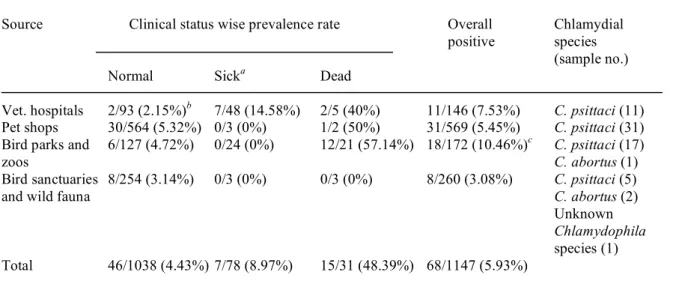
The epizootiological and genetic data were analyzed to identify the chlamydial genotypes prevalent among different avian species kept or living in different habitats and having variable disease manifestations. Out of 1,147 samples screened, 68 (5.93%) were found positive by the nested PCR among clinically normal, sick and dead birds of all avian species (Table 3). By sequencing and analyzing the genetic composition of VD2 region of
ompA gene, genetic diversity and phylogenetic relationship among detected strains of
chlamydiae was examined.
Genetic variation and relative prevalence of chlamydial species and strains: The genetic analysis of VD2 region of ompA genes from 68 samples showed prevalence of 64 C. psittaci (94.12%), 3 C. abortus (4.41%) and 1 unknown type of Chlamydophila sp. (1.47%) among all avian species (Table 3).
Table 3. Prevalence of chlamydiae according to the sampling sources and clinical status of the host avian species.
Source Clinical status wise prevalence rate Overall Chlamydial
positive species (sample no.)
Normal Sicka Dead
Vet. hospitals 2/93 (2.15%)b 7/48 (14.58%) 2/5 (40%) 11/146 (7.53%) C. psittaci (11)
Pet shops 30/564 (5.32%) 0/3 (0%) 1/2 (50%) 31/569 (5.45%) C. psittaci (31)
Bird parks and 6/127 (4.72%) 0/24 (0%) 12/21 (57.14%) 18/172 (10.46%)c C. psittaci (17)
zoos C. abortus (1)
Bird sanctuaries 8/254 (3.14%) 0/3 (0%) 0/3 (0%) 8/260 (3.08%) C. psittaci (5)
and wild fauna C. abortus (2)
Unknown
Chlamydophila
species (1) Total 46/1038 (4.43%) 7/78 (8.97%) 15/31 (48.39%) 68/1147 (5.93%)
a Indicate the birds showing the chlamydia specific or unrelated clinical signs.
b The figures are positive samples/total tested samples. The positive percentage is shown in parentheses. c Includes samples of two outbreaks of avian chlamydiosis.
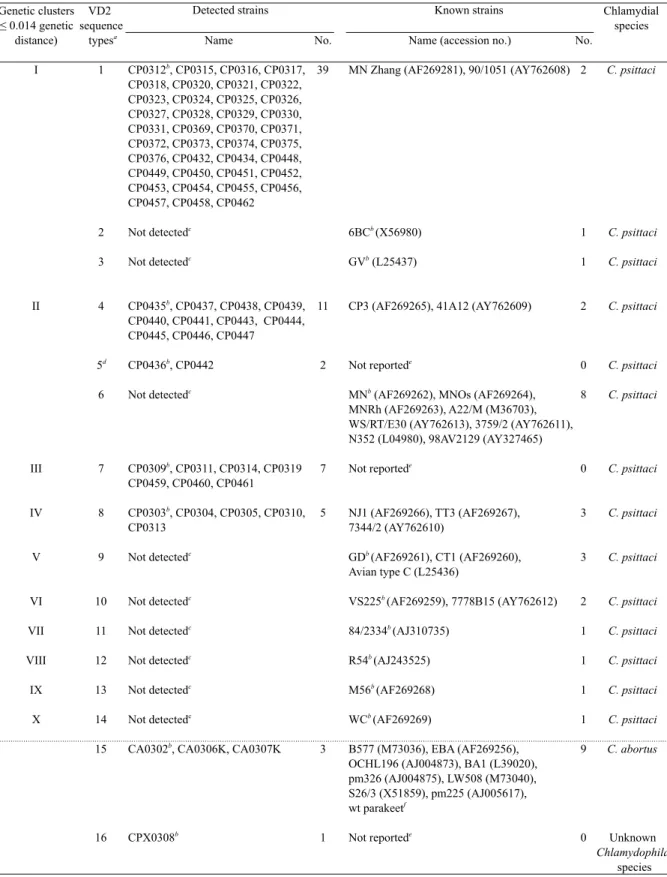
Among sequenced samples, 5 kinds of nucleotide sequences (designated as VD2 sequence types) were detected in VD2 region of C. psittaci ompA gene (Fig. 1 and 2; VD2 sequence types 1, 4, 5, 7 and 8 in Table 4). All detected sequence types of C. psittaci were grouped into 4 genetic clusters, named from I to IV, based on the genetic distance ! 0.014 (Table 4). The genetic distance was calculated by PHYLIP. The majority of detected strains belong only to clusters I (57.35%) and II (19.12%) and these strains were detected mainly among psittacine species and only 2 oriental white storks (Fig. 3). On the basis of phylogenetic and genetic distance analysis, all the known (from data bank) and detected strains of C. psittaci were divided into 10 genetic clusters (named I to X) (Table 4 and Fig. 4).
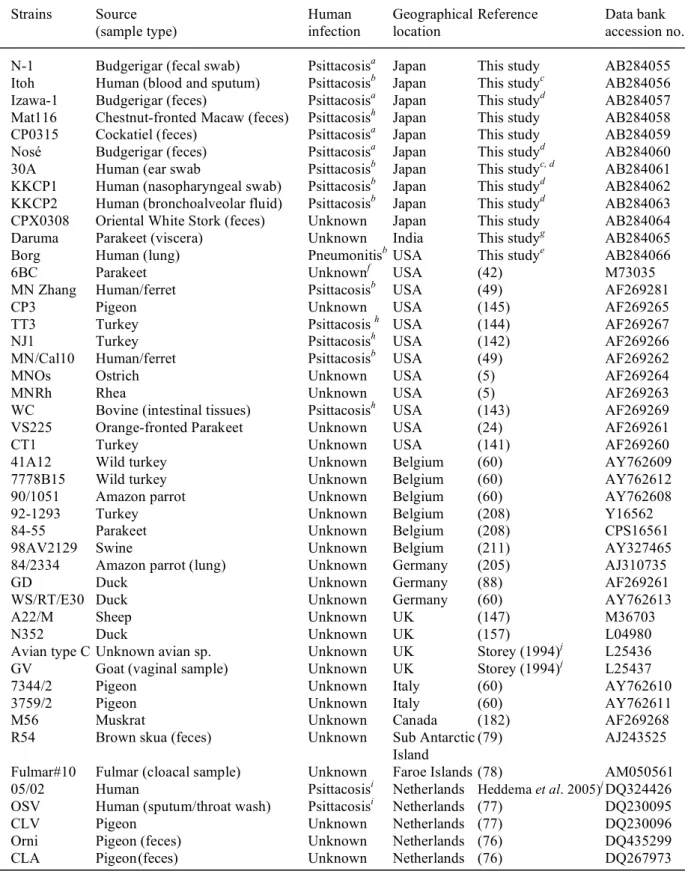
The nucleotide and amino acid sequence based percent identity matrix (Table 5) showed that all the detected and known strains of C. psittaci can be broadly divide into two large groups. The first group is represented by the strains of clusters I to III and IX (Table 4). The second group is represented by the strains of clusters IV, V, VI, VII, VIII and X and also CPX0308 strain (Table 4), those are genetically close to C. abortus (Fig. 4). The WC and CPX0308 strains appeared to be genetically close to the second group of strains. WC strain showed 88% amino acid homology with GD strain, whereas, CPX0308 showed 79% nucleotide and amino acid homology with C. caviae-GPIC and C. felis-FP baker strains, respectively.
Phylogenetic analysis: Nucleotide sequence based neighbor-joining (NJ) phylogenetic tree showed distinct genetic clustering of C. psittaci strains (Fig. 4). CA0302, CA0306, CA0307 (Table 4) strains form a cluster along with various strains of C. abortus. The newly detected strains of clusters III and unknown type of Chlamydophila sp., form significantly distinct diverging clusters from other strains.
Fig. 1. Comparative nucleotide sequence alignment of representative variant strains of C.
psittaci, C. abortus and CPX0308 (detected strains in bold letters) in the VD2 region
(within box) and flanking constant domain region of ompA gene. The representative strains correspond to each group of strains having 100% nucleotide homology in VD2 region (designated as VD2 sequence types) as shown in Table 4. The alignment was done by Genetyx-Mac, version. 13.0.6.
CP0312 1 CTTCGACATTTTCTGCACCTTAGGGGCATCCAATGGATACTTCAAAGCAAGTTCGGCTGCATTCAACTTGGTTGGGTTAATAGGGTTTTCAGCTGCAAGCTCA 103 GV 1 ...A... 103 6BC 1 ... 103 CP0435 1 ...T...A.C.A.... 103 CP0436 1 ...T...A.C.A.... 103 MN 1 ...T...A.C... 103 CP0309 1 ...A...A...C.... 103 M56 1 ...T...A...T..C...T...G.. 103 CP0303 1 ...T..T...A...C..T..T...G...T...T..G...C.C...T..G..T..TC..AA..GAA.TGAT.TC 101 CA0302 1 ...T..T...A...C..T..T...G...T...T..G...C.C...T..G..T..TG..AA..GAT.CTC.AT. 103 VS225 1 ...T..T...A...T..T...G...T...T...C.C...T..G..T..TG..AA..GAA.CTC.GT. 103 R54 1 ...T..T...A...C..T..T...G...T...C..G...C.C..C..A..G..T..TG..AA..GA..CTCT.T. 103 84/2334 1 ...T...A...C..T..T...C...T...C..G...TC.C..C..T..G..T..TA..AA..GAAAC.C..T. 103 GD 1 T..T..T...A...C..T..T...G...T...T..G...TC.C...T..G..T..TG..AA..GA---...C 100 WC 1 ...T..T...A...T..T..T...C...G.G...C...T...TC.T...C..GT.C..AA..G.T.GA---..TAGC 100 CPX0308 1 T...TG....T...T...T..TA.T...C..T..T...T.T.A...T..A..T..T.GTC.T...C...T..AG..G.T.GA.G.TC..T. 103 CP0312 103 ATCTCTACCGATCTTCCAACGCAACTTCCTAACGTAGGCATTACCCAAGGTGTTGTGGAATTTTATACAGACACATCATTTTCTTGGAGCGTAGGTGCACGTGGAG 209 GV 103 ... 209 6BC 103 ...T... 209 CP0435 103 .C...T... 209 CP0436 103 .C...C...T... 209 MN 103 .C...G...T... 209 CP0309 103 .C... 209 M56 103 G.TAG...A...C...C... 209 CP0303 101 .AT---.ATC.A...---...C...C...C...T..G...C...A....C...G... 194 CA0302 103 GCAG..GATC.G...C---..T...C..T...AA.C..T...T...A....C...T...C.... 197 V225 103 GCAG..GATC.A...---...C..T...A....T..G...C...T...A....C...T. 197 R54 103 TCA---GAGC.A...---...C..T...T..G...C...T...A...C...C.... 194 84/2334 103 .CAAA.GA.CGA...C---...C..T...C...T..G...C...T...A....C...C.... 197
Variable domain 2 Constant domain
Constant domain Variable domain 2 Constant domain CP0312 1 FDIFCTLGASNGYFKASSAAFNLVGLIGFSAASSISTDLPTQLPNVGITQGVVEFYTDTSFSWSVGARG 69 GV 1 ...Y... 69 6BC 1 ...M... 69 CP0435 1 ...S...TN.T...M... 69 CP0436 1 ...S...TN.T...M... 69 MN 1 ...S...T..T..E..M... 69 CP0309 1 ...TT.T... 69 M56 1 ...S.AV...K...A... 69 CP0303 1 ...LKGTDFN-NQ..----..A...T... 64 CA0302 1 ...VKGS.IAADQ..----...I...T... 65 VS225 1 ...VKGT.VAADQ..----...I...T... 65 R54 1 ...VKG..LS-EQ..----...T... 64 84/2334 1 ...IKGNTLTNDR..----...T... 65 GD 1 ...VKGS.LTND----...A...T... 65 WC 1 ...G...F.IAGN.E-.NA.ND...A....I...T... 68 CPX0308 1 ..V...T...SN....S...VAGG.LNANE..----..FM...I..L....T... 65
Fig. 2. Amino acid homology among representative variant strains of C. psittaci, C. abortus and CPX0308 (detected strains in bold letters) in the VD2 region of ompA gene. The portion within the box represents the genetically variable domain 2 (VD2) flanked by the constant
reg-Table 4. Clusters of detected and known strains of C. psittaci based on nucleotide sequence similarity in the VD2 region of the ompA gene.
Genetic clusters VD2 Chlamydial
(! 0.014 genetic sequence species
distance) typesa Name No. Name (accession no.) No.
I 1 CP0312b, CP0315, CP0316, CP0317, 39 MN Zhang (AF269281), 90/1051 (AY762608) 2 C. psittaci
CP0318, CP0320, CP0321, CP0322, CP0323, CP0324, CP0325, CP0326, CP0327, CP0328, CP0329, CP0330, CP0331, CP0369, CP0370, CP0371, CP0372, CP0373, CP0374, CP0375, CP0376, CP0432, CP0434, CP0448, CP0449, CP0450, CP0451, CP0452, CP0453, CP0454, CP0455, CP0456, CP0457, CP0458, CP0462
2 Not detectedc 6BCb (X56980) 1 C. psittaci
3 Not detectedc GVb (L25437) 1 C. psittaci
II 4 CP0435b, CP0437, CP0438, CP0439, 11 CP3 (AF269265), 41A12 (AY762609) 2 C. psittaci
CP0440, CP0441, CP0443, CP0444, CP0445, CP0446, CP0447
5d CP0436b, CP0442 2 Not reportede 0 C. psittaci
6 Not detectedc MNb (AF269262), MNOs (AF269264), 8 C. psittaci
MNRh (AF269263), A22/M (M36703), WS/RT/E30 (AY762613), 3759/2 (AY762611), N352 (L04980), 98AV2129 (AY327465)
III 7 CP0309b, CP0311, CP0314, CP0319 7 Not reportede 0 C. psittaci
CP0459, CP0460, CP0461
IV 8 CP0303b, CP0304, CP0305, CP0310, 5 NJ1 (AF269266), TT3 (AF269267), 3 C. psittaci
CP0313 7344/2 (AY762610)
V 9 Not detectedc GDb (AF269261), CT1 (AF269260), 3 C. psittaci
Avian type C (L25436)
VI 10 Not detectedc VS225b (AF269259), 7778B15 (AY762612) 2 C. psittaci
VII 11 Not detectedc 84/2334b (AJ310735) 1 C. psittaci
VIII 12 Not detectedc R54b (AJ243525) 1 C. psittaci
IX 13 Not detectedc M56b (AF269268) 1 C. psittaci
X 14 Not detectedc WCb (AF269269) 1 C. psittaci
15 CA0302b, CA0306K, CA0307K 3 B577 (M73036), EBA (AF269256), 9 C. abortus
OCHL196 (AJ004873), BA1 (L39020), pm326 (AJ004875), LW508 (M73040), S26/3 (X51859), pm225 (AJ005617), wt parakeetf
16 CPX0308b 1 Not reportede 0 Unknown
Chlamydophila
species
a Detected or known strains having 100% nucleotide homology in VD2 region of ompA gene are designated as VD2 sequence type. b The representative strains used for analysis in Fig. 1, Fig. 2 and Table 5.
c Strains not detected in our study.
d Having 1 nucleotide difference in the VD2 as compared to VD2 type 4 sequences but no change in amino acid residue. e Strains not reported in DNA data banks.
f The ompA gene of the strain isolated from a diseased parakeet was found 100% homologous to B577 strain (98).
Table 5. Percentage identity matrix (PIM) of detected strains (representative strains only) and known strains of C. psittaci and C. abortus in VD2 region of ompA gene. VD2 Genetic types clusters 1 2 3 4 5 6 7 8 9 10 11 12 13 14 15 16 17 18 19 20 21 1: C. psittaci-CP0312 1 100 100 100 97 97 97 98 94 79 80 79 77 78 77 73 72 70 72 69 68 60 2: C. psittaci-GV 3 99 100 99 97 96 97 98 93 79 79 79 77 78 77 72 72 70 72 68 68 60 3: C. psittaci-6BC 2 99 97 100 98 97 98 98 94 79 80 79 77 78 77 73 72 70 72 69 68 60 4: C. psittaci-CP0435 4 93 91 94 100 100 99 98 92 80 80 79 78 79 77 72 72 70 73 69 67 61 5: C. psittaci-CP0436 5 93 91 94 100 100 99 97 91 80 80 79 78 79 77 72 72 70 73 69 67 61 6: C. psittaci-MN 6 93 91 94 97 97 100 97 92 79 80 79 78 79 77 72 71 69 72 68 66 60 7: C. psittaci-CP0309 7 III 96 94 94 96 96 94 100 93 88 81 79 78 79 78 73 72 70 73 70 69 61 8: C. psittaci-M56 13 IX 93 91 93 90 90 90 91 100 88 80 77 77 75 78 74 72 72 73 71 70 60 9: C. psittaci-CP0303 8 IV 86 83 86 86 86 84 80 79 100 91 91 92 90 88 81 76 78 80 75 71 64 10: C. psittaci-VS225 10 VI 85 83 85 85 85 85 86 83 92 100 92 91 89 97 81 77 75 78 74 69 65 11: C. psittaci-R54 12 VIII 91 89 91 88 88 88 89 86 93 92 100 91 91 92 79 74 74 79 72 69 66 12: C. psittaci-GD 9 V 85 83 85 83 83 83 85 86 95 91 94 100 92 92 81 77 75 76 73 72 64 13: C. psittaci-84/2334 11 VII 83 82 83 82 82 82 83 82 92 88 91 92 100 88 83 73 73 75 71 70 63 14: C. abortus-CA0302 15 - 86 83 86 83 83 83 85 83 90 97 92 92 88 100 79 73 73 76 71 70 63 15: C. psittaci-WC 14 X 79 76 79 79 79 79 79 79 86 86 86 88 86 86 100 76 70 74 73 69 63 16: Unknown type-CPX0308 16 - 71 69 71 72 72 72 71 69 77 78 78 77 74 78 75 100 79 73 71 72 62 17: C. caviae-GPICa - - 73 70 73 73 73 72 75 75 78 79 79 79 74 77 75 74 100 77 70 72 65 18: C. felis-FP Bakera - - 77 73 77 77 77 75 78 77 84 84 80 79 77 82 77 79 78 100 70 70 64 19: C. pneumoniae-CSFa - - 69 65 69 69 69 69 69 70 70 71 72 76 76 73 73 69 66 66 100 70 67 20: C. pecorum-1710Sa - - 66 67 66 68 68 68 68 68 74 72 70 69 69 69 68 74 74 76 69 100 65 21: C. trachomatis-Da - - 57 54 57 57 57 57 57 57 59 59 62 59 61 59 60 64 62 59 64 64 100
a The accession no. of sequences are: C. caviae-GPIC (AF269282), C. felis-FP Baker (AF269257), C. pneumoniae-CSF (AF131889), C. pecorum-1710S (AF269279) and C. trachomatis-D (X62920). For C. psittaci strains accession no. are shown in Table 4.
The upper right triangular half of the matrix is nucleotide based and lower left triangular half is amino acid based. The bold figures separating two triangular halves indicate the 100% identity based on nucleotide and amino acid sequences. The strains having !90% identity are boxed together in the solid line. The numbers (1 to 21) in the top row correspond to the respective species/strains listed in the first column. The matrix was constructed by ClustalX (version 1.83). The comparative PIM of C. psittaci strains with other Chlamydophila species and C. trachomatis infecting mammals and human (non-avian hosts) is also shown.
I
Fig. 3. Diagram showing the comparative prevalence of chlamydial strains detected in this study. The types of avian species (psittacine species are members of Cacatuidae and Psittacidae families) tested chlamydia positive are shown in boxed text near each cluster of strains. Two largest clusters of C. psittaci strains are cluster I (57.35%) and cluster II (19.12%) respectively.
Epizootiological analysis: The cases of avian chlamydiosis were mainly due to C. psittaci strains and detected among 58 samples from Psittaciformes birds, 5 from oriental
white storks and 1 from Java sparrow. The C. abortus was detected in 1 budgerigar and 2 oriental white storks samples. One unknown species, CPX0308 was also found in an oriental white stork imported from Russia to a bird sanctuary in Japan (Table 6). The strains of cluster I were mainly detected in chlamydiosis cases including 2 outbreaks (Fig.
10 psittacine species, 1 oriental white stork
5 psittacine species, 1 oriental white stork 2 oriental white storks, 2 budgerigars, 1 Java sparrow
2 oriental white storks, 1 budgerigar
1 oriental white stork
15 psittacine species, 1 oriental white stork
5). However, other genotypes were also detected occasionally including an outbreak with strains of cluster III (mixed infection with cluster I strains). The month wise incidence rate of chlamydiosis due to various genotypes during 2003 and 2004 is shown in Fig. 5. The chlamydiosis cases were detected throughout year but slight rise was observed in chlamydiosis incidences in the beginning of winter and spring seasons including 2 outbreaks.
The prevalence rate according to clinical status, sources of sampling, avian species, sex, age and geographical locations is as follow:
(i) Clinical status wise prevalence. Among 4.43% (46/1038) clinically normal birds
all 6 types of C. psittaci genotypes (genetic clusters) were detected in the feces including one case (CP0432) in which only blood sample gave positive PCR result. The strains of clusters I and II were detected from 8.97% (7 out of 78) sick birds showing chlamydia specific and non-specific symptoms. 48.39% (15 out of 31) dead birds, those showed typical clinical symptoms of chlamydiosis before death and histopathological lesions, were found to carry chlamydial strains of clusters I, II and III (Tables 3 and 6).
(ii) Avian habitat wise prevalence. According to the habitats of avian hosts
(represented by the sources of sampling) that also epitomize managemental conditions and avian-human interactions, the highest 10.46% cases were detected from bird parks/zoos (including 2 outbreaks by strains of clusters I and III), followed by 7.53% from individually/pair wise caged birds, mostly kept as pets in households. However, 5.45% and 3.08% cases were detected respectively from pet shops and bird sanctuaries (Table 3). The cluster II strains were detected mostly from one pet shop. The strains of cluster I and II were detected most often among samples from veterinary hospitals and pet shops. The chlamydial infection in the bird parks and zoos were mostly due to strains of clusters I, III, and IV of C. psittaci and C. abortus strains, whereas, among samples from bird sanctuaries
Fig. 4. Neighbor-joining (NJ) phylogenetic tree, based on nucleotide sequences of VD2 region of ompA gene of different strains of C. psittaci, C. abortus and other
Chlamydophila species. The strains detected in this study are shown in bold letters and
vertical lines mark genetic clusters of C. psittaci strains from I to X. The genetic distance is indicated in 0.05 unit bar. Bootstrap values are shown at respective nodes. The C. trachomatis is used as out-group.
WC (AF269269) B577 (M73036) pmSH1 (AJ005618) pm234 (AJ004874) pmd623 (AJ005615) pm112 (AJ005613) EBA (AF269256) BA1 (L39020) S26/3 (X51859) LW508 (M73040) pm225 (AJ005617) pm326 (AJ004875) OCHL196 (AJ004873) CA0302 CA0306 CA0307 VS225 (AF269259) 7778B15 (AY762612) GD (AF269261) CT1 (AF269260) Avian type C (L25436) 84/2334 (AJ310735) NJ1 (AF269266) TT3 (AF269267) 7344/2 (AY762610) CP0303 CP0304 CP0305 CP0310 CP0313 R54 (AJ243525)
C. felis-FP Baker (AF269257)
M56 (AF269268) CP0309 CP0311 CP0314 CP0319 CP3 (AF269265) CP0436 CP0442 41A12 (AY762609) CP0435 CP0437 CP0438 CP0439 CP0440 CP0441 CP0443 CP0444 CP0445 CP0446 CP0447 MN (AF269262) MNOs (AF269264) MNRh (AF269263) GV (L25437) A22/M (M36703) N352 (L04980) 3759/2 (AY762611) WS/RT/E30 (AY762613) 98AV2129 (AY327465) 6BC (X56980) CP0359 CP0360 CP0361 CP0312 CP0315 CP0316 CP0317 CP0318 CP0320 CP0321 CP0322 CP0323 CP0324 CP0325 CP0326 CP0327 CP0328 CP0329 CP0330 CP0331 CP0369 CP0370 CP0371 CP0372 CP0373 CP0374 CP0375 CP0376 CP0432 CP0434 CP0448 CP0449 CP0450 CP0452 CP0453 CP0454 CP0455 CP0456 CP0457 CP0458 C. abortus I II III IV 100% 100% 99.9% 100% 95.5% 90.5% 79.4% 0.05 units CP0451 V VI VII VIII IX X
Fig. 5. Month wise incidences of avian chlamydiosis cases detected by PCR during 2003 and 2004 among all avian species. The numerical figures shown inside and above the bars are actu--al numbers of chlamydiae positive and negative cases. The numbers shown in columns below each bar indicatethe distribution of samples and detected strain type in each month. Outbreak-I and outbreak-II took place at two different bird parks and boxes mark the types of C. psittaci strains involved. I. 0 0 1 0 0 1 3 1 6 7 8 8 1 1 0 0 0 0 1 0 0 0 1 0 II. 0 0 0 0 0 0 0 0 0 0 0 0 0 2 11 0 0 0 0 0 0 0 0 0 III. 0 0 3 0 0 0 0 0 0 0 1 0 0 0 0 0 0 0 0 0 0 0 3 0 IV. 0 3 1 0 1 0 0 0 0 0 0 0 0 0 0 0 0 0 0 0 0 0 0 0 0 3 0 0 0 0 0 0 0 0 0 0 0 0 0 0 0 0 0 0 0 0 0 0 0 0 1 0 0 0 0 0 0 0 0 0 0 0 0 0 0 0 0 0 0 0 0 0 Genetic clusters (2003) (2004) outbreak-I outbreak-II Sample number 0 62 40 59 51 27 60 36 65 74 37 140 41 36 151 32 18 47 9 12 17 54 0 0 1 1 1 1 0 0 0 1 0 0 0 4 7 4 11 8 3 9 7 6 3 6 6 0 0 20 40 60 80 100 120 140 160 180
Jan Feb Mar Apr May Jun Jul Aug Sep Oct Nov Dec Jan Feb Mar Apr May Jun Jul Aug Sep Oct Nov Dec Sample numbers Positive Negative Number of samples C. psittaci C. abortus Unknown Chlamydophila sp.
strains of clusters I, III, IV and unknown type of the Chlamydophila sp. were detected (Table 6).
(iii) Avian species wise prevalence. The incidences of chlamydiosis were
predominantly detected among Psittaciformes birds (detected among 28 psittacine avian species). It includes chlamydia positive rates of 7.61% (14 out of 184) in family
Cacatuidae and 7.23% (45 out of 622) in family Psittacidae. However, some psittacine
bird species such as Trichoglossus haematodus 12 out of 52 (23.08%), Nymphicus
hollandicus 11 out of 77 (14.28%), Aratinga sp. 5 out of 44 (11.36%), Ara sp. 5 out of 55
(9.09%) and Mesopsittacus undulates 5 out of 59 (8.47%) showed high incidences (Tables 1, 2 and 6). In the Cacatuidae family mainly the cluster I strains were detected; however, in Psittacidae, strains of clusters I, II, III, IV and C. abortus were detected. Whereas, among non-psittacine species, 3.12% (8 out of 256) samples from oriental white storks (Ciconia boyciana) belonging to Ciconiidae family of order Ciconiiformes, were found having strains of clusters I, II, III, IV, C. abortus and unknown type of Chlamydophila sp. A single case of chlamydiosis due to a strain of cluster IV was also detected in a Java sparrow (Padda oryzivora) belonging to Estrildidae family of Passeriformes order (Table 6).
(iv) Avian sex and age wise prevalence. The incidences of chlamydiosis were found
higher among birds around the age group of 3 months due to different genotypes, irrespective of their sexes (Table 6).
(v) Worldwide locations wise prevalence. All type of genotypes were detected
among the avian species imported to Japan from Singapore, Indonesia, USA, South Africa and Russia as well as from different places in Japan, indicating ubiquitous presence of various chlamydia genotypes infecting different avian fauna (Table 6).
Table 6. Types of chlamydial species/strains detected in relation to the zoological position, sampling source, clinical status, sex, age and import source of avian host species
Gen-Order, family and scientific name (common name) Species wise Strains etic Accession no.
of the host avian species positive/tested No. Type Clinical history Source Age:sex of the hosta Source of Chlamydial designated
clust-(no. of positive/tested samples) samples (M: male, F: female) importb species ters
Order-Psittaciformes (59/806) Family-Cacatuidae (14/184)
Cacatua moluccensis (Salmon-crested Cockatoo) 1/18 1 Clotted blood Normal Pet shop 6 months Singapore C. psittaci CP0432 I AB239867
C. sulphurea (Yellow-crested Cockatoo) 1/26 1 Cloacal swab Normal Pet shop Indonesia C. psittaci CP0457 I AB239878
Eolophus roseicapillus (Roseate Cockatoo or Galah) 1/9 1 Pooled visc. orgn.cDead (outbreak-I)d Bird park/zoo C. psittaci CP0312 I AB239842
Nymphicus hollandicus (Cockatiel) 11/77 2 Feces Normal Vet. Hospital 3 months C. psittaci CP0315 I AB239843
C. psittaci CP0316 I AB239844 4 Feces Sicke Vet. Hospital 6 months C. psittaci CP0322 I AB239848
2 years 10 months C. psittaci CP0460 III AB239897
C. psittaci CP0448, CP0449 I AB239869, AB239870 5 Cloacal swabs Normal Pet shop Domestically C. psittaci CP0451, CP0452 I AB239872, AB239873 bred (Japan) CP0453, CP0454 AB239874, AB239875
CP0455 AB239876 Family-Psittacidae (45/622)
Amazona aestiva (Blue-fronted Amazon) 1/6 1 Feces Sicke Vet. hospital 1 year C. psittaci CP0462 I AB239880
Ara ararauna (Blue-and-yellow Macaw) 1/11 1 Cloacal swab Normal Pet shop C. psittaci CP0444 II AB239888
A. auricollis (Yellow-collard Macaw)* 2/23 2 Cloacal swabs Normal Pet shop 2 years Singapore C. psittaci CP0445, CP0446 II AB239889, AB239890
A. severa (Chestnut-fronted Macaw)* 2/7 2 Pooled visc.orgn.c Dead (outbreak-I)d Bird park/zoo C. psittaci CP0311, CP0314 III AB239893, AB239894
Aratinga aurea (Peach-fronted Conure) 1/3 1 Cloacal swab Normal Pet shop 1 year:F South Africa C. psittaci CP0328 I AB239855
A. pertinax (St. Thomas/Brown-throated Conure)* 1/1 1 Cloacal swab Normal Pet shop 1 year:M South Africa C. psittaci CP0329 I AB239856
A. acuticaudata (Blue-crowned Conure) 1/7 1 Cloacal swab Normal Pet shop South Africa C. psittaci CP0330 I AB239857
A. wagleri (Scarlet or Red-fronted Conure)* 1/2 1 Cloacal swab Normal Pet shop M South Africa C. psittaci CP0439 II AB239884
A. jandaya (Jandaya Conure)* 1/6 1 Cloacal swab Normal Pet shop 3 months South Africa C. psittaci CP0442 II AB239908
Lorius lory (Black-capped Lory)* 1/5 1 Cloacal swab Normal Pet shop 1 year Singapore C. psittaci CP0441 II AB239886
Melopsittacus undulatus (Budgerigar) 5/59 1 Feces Normal Bird park/zoo C. abortus CA0302 - AB239904
2 Feces Normal Bird park/zoo C. psittaci CP0303, CP0304 IV AB239899, AB239900 1 Spleen Dead Vet. hospital 4 months C. psittaci CP0447 II AB239891
1 Liver Dead Vet. hospital C. psittaci CP0438 II AB239883
Neophema bourkii (Bourke's Parrot) 1/2 1 Feces Sicke Vet. hospital 6 months:M C. psittaci CP0458 I AB239879
Poicephalus rueppellii (Rüppell's Parrot)* 2/7 2 Cloacal swabs Normal Pet shop M South Africa C. psittaci CP0326 I AB239853 South Africa C. psittaci CP0450 I AB239871
P. senegalus (Senegal Parrot) 1/42 1 Cloacal swab Normal Pet shop 3 months South Africa C. psittaci CP0319 III AB239895
P. cryptoxanthus (Brown-headed Parrot)* 2/26 1 Cloacal swab Normal Pet shop 3 months:M South Africa C. psittaci CP0323 I AB239850 1 Cloacal swab Normal Pet shop 3 months:M South Africa C. psittaci CP0436 II AB239907
P. gulielmi (Red-crowned/Jardine's Parrot) 1/23 1 Cloacal swab Normal Pet shop South Africa C. psittaci CP0443 II AB239887
Pionites leucogaster (White-bellied Caique) 1/8 1 Pooled visc.orgn.c Dead f Pet shop 3 months:M USA C. psittaci CP0461 III AB239898
P. melanocephala (Black-headed Caique) 1/6 1 Cloacal swab Normal Pet shop C. psittaci CP0456 I AB239877
Psittacula derbiana (Derbyan Parakeet) 1/3 1 Cloacal swab Normal Pet shop Domestically C. psittaci CP0327 I AB239854 bred (Japan)
Psittacus erithacus (African Grey Parrot) 3/154 3 Cloacal swabs Normal Pet shop 3 months:M South Africa C. psittaci CP0317, CP0318 I AB239845, AB239846 3 months South Africa C. psittaci CP0434 I AB239868
Pyrrhura hypoxantha sallvadori (Yellow-sided Conure)* 1/3 1 Cloacal swab Normal Pet shop 5 months C. psittaci CP0440 II AB239885
P. perlata lepida (Pearly Conure)* 1/5 1 Feces Sickg Vet. hospital 1 year 9 months:M C. psittaci CP0459 III AB239896
Trichoglossus haematodus (Green-napped Lorikeet) 1+11h/49 8 Pooled visc. Orgn.cDead (outbreak-II)h Bird park/zoo C. psittaci CP0320, CP0369 I AB239847, AB239859
CP0370, CP0371 AB239860, AB239861 CP0373, CP0374 AB239863, AB239864 CP0375, CP0376 AB239865, AB239866 1 Feces Dead (outbreak-II)h Bird park/zoo C. psittaci CP0324 I AB239851
2 Feces Normal (outbreak-II)hBird park/zoo C. psittaci CP0321, CP0372 I AB239849, AB239862
1 Cloacal swab Normal Pet shop M C. psittaci CP0325 I AB239852
Order-Ciconiiformes (8/257) Family-Ciconiidae (8/256)
Ciconia boyciana (Oriental White Stork)* 8/256 2 Feces Normal Bird sanctuary Russia C. abortus CA0306, CA0307 - AB239905, AB239906 1 Feces Normal Bird sanctuary Russia Unknown CPX0308 - AB239931
Chlamydo- phila sp.
3 Feces Normal Bird sanctuary Russia C. psittaci CP0309 III AB239892 Russia C. psittaci CP0331 I AB239858 Russia C. psittaci CP0437 II AB239882
2 Cloacal swabs Normal Bird sanctuary Russia C. psittaci CP0310, CP0313 IV AB239902, AB239903 Order-Passeriformes (1/13)
Family-Estrildidae(1/5)
Padda oryzivora (Java Sparrow) 1/5 1 Feces Normal Bird park/zoo C. psittaci CP0305 IV AB239901
a Only the available data about age and sex of avian species are shown.
b Only the confirmed records about the source of importation and breeding place of host species are shown. c Pooled visceral organs includes pieces lung, liver, spleen and heart.
d Samples are from outbreak-I.
e Include those birds showing chronic weight loss, yellowish-green diarrhea, anorexia, cachexia and rise in body temperature. f Died with acute symptoms and also found positive for avian polyoma virus by PCR.
g Had crop inflammation due to yeast infection along with clinical symptoms of chlamydiosis. h Samples from outbreak-II.
DISCUSSION
C. psittaci mainly infects avian species and also has potential zoonotic importance
(8, 181, 188). In this chapter, we investigated the strain level prevalence of various chlamydiae among diverse avian fauna and examined various situations those contribute to the maintenance, precipitation and/or horizontal transmission of infection. Further genetic and phylogenetic relationships among prevalent species/strains were also examined.
We analyzed partial ompA gene (VD2 region) for identification of chlamydial species and strains. This locus has been reported to be associated with the phylogenetic divergence of Chlamydophila spp. and Chlamydia spp. and has been used in other phylogenetic studies. Although the phylogenetic analyses of conserved 16S rRNA, ompA and rnpB genes of chlamydiae group are often used to classify and differentiate C. psittaci strains from other species of family Chlamydiaceae (60, 79, 149, 191, 193, 205), the analysis of ompA gene is advantageous in epizootiological strain typing due to presence of strain/serovar/genotype specific motifs in 4 genetically variable domains (12, 86, 148, 225). Sequence analysis of highly conserved 16S rRNA gene may not detect minor strain variations. Direct sequencing of 16S rRNA gene was also not suited in our study due to the interference by normal intestinal microflora DNA as we tested many samples of fecal/fecal swab or intestinal loops origin. By our approach, small DNA fragment of ompA gene can be conveniently amplified from clinical samples by nested PCR and sequenced even in lower EB concentration in samples (2 to 10 EBs). This approach of direct strain typing from clinical samples particularly in large-scale epizootiological/epidemiological studies is less cumbersome as serotyping and isolation is time consuming.
To survey the host range of C. psittaci, total 113 avian species from 11 avian orders examined. The chlamydiae were detected among 28 species of psittacine birds and 2 species of non-psittacine birds (oriental white stork and Java sparrow). Out of total 28