Demotivation: Interviews with Japanese university EFL students
Yoko Igarashi and Michael Radcliffe
While the Practical English Program at Yokohama City University is considered a success, it is known that a number of students are discontented with the program. These demotivated students are concentrated in classes with repeating students. Drawing on research in the field, this exploratory study investigates demotivation through six in-depth interviews with demotivated repeating students. The results show that demotivated students at YCU, as well as resenting being forced to study English, have specific complaints about the P.
E. program. In particular, they are dissatisfied with the assessment system, resent being forced to repeat until they fulfill the program s requirements, and are often unhappy with class content. In addition, some also report negative experiences with teachers. While acknowledging that a teaching program should not be based solely on the complaints of demotivated learners, the authors present a suggested new model for the Practical English program that addresses several of the concerns raised in the interviews.
YCUɁʡʳɹʐɭɵʵˁɮʽɺʴʍʁʯᴥPEᴦʡʷɺʳʪɂˢްɁӎɥ ȝȨɔȹȗɞˢǾး٣ɁʡʷɺʳʪȾ˪ɥધȷޙႆȟ۹ୣȗɞ̜ɕɑ
Ȳ̜ȺȕɞǿȦɟɜɁޙඕɥ܅ȪȲޙႆᤎɂ˿ȾPEʡʷɺʳʪɁ ѓࠚεᐐȺȕɞǿటᆅሱɂǾޙᐐɁޙඕɁນᣝǾ܅ᴥDemotivationᴦ ɁᛵىȾȷȗȹǾȦɟɑȺɁᆅሱȾᅔᄻȪȽȟɜPEʡʷɺʳʪɁѓࠚεᐐ ջɁɮʽʉʝʯ˂ɥᣮȪȹᚐȶȲ̙϶ᄑᆅሱȺȕɞǿ
ɮʽʉʝʯ˂ɁፀȻȪȹǾYCUɁޙඕɁນᣝȪȲޙႆᤎɂǾɑȭ॒
εᇼᄻȻȪȹᔐɥࠚεȪȽȤɟɃȽɜȽȗȻȗșཟȻцȾǾʡʷɺʳʪ ȾߦȬɞ࿑ްɁ˪ɕધȶȹȗɞȦȻȟțȹȠȲǿ࿑ȾΙศǾԨͱ
ीɁ॒ᛵᛵ͔ɥᤎȬɞɑȺѓࠚεȪፖȤȽȤɟɃȽɜȽȗʁʃʐʪǾ
ૌഈɁю߁ȾᩜȪȹɁ˪ȟમȥɜɟȲǿɑȲଡ଼࢙ȟՁىȻȽɞքްᄑȽ ޙጽ᮷ɥમȥȲɕɁɕȗȲǿ
छུɁȦȻȽȟɜࠚεʡʷɺʳʪɂޙඕɥ܅ȪȲޙႆᤎɁ˪ɥЫ ȾͽȨɟɞɌȠȺɂȽȗȟǾటሟȺɂȦɁɮʽʉʝʯ˂ɥᣮȪȹțȹ ȠȲཟɥᐎਁȾоɟǾȪȗʬʑʵɁʡʷɺʳʪɁ૬ಘɥᝁɒȲǿ
INTRODUCTION
The importance of motivation for successful second language learning has long been recognized. It is realized intuitively by teachers in classrooms, and the centrality of motivation is both supported by and reflected in voluminous academic research. Indeed, motivation is considered by many to be the most important factor of all, without which language acquisition will simply not occur.
An examination of classroom issues of motivation, however, will reveal that it is demotivation, the
̈
Dark Sidẻ
of motivation, that is often the real concern for teachers, students and administrators. This realization, so obvious in retrospect, has only recently started to engender research specific to the issues involved.So what exactly is demotivation? Dörnyei (2001
㧕
provided a working definition, stating that it concerneď
specific external forces that reduce or diminish the motivational basis of a behavioral intention or an ongoing action.̍
Although Dörnyei at this time argued that demotivation was specifically external, most literature published since then has included internal factors, such as self-confidence or dislike of the subject. We view demotivation in a very broad sense, as anything that reduces motivation. A broad conception of the idea allows the inclusion of̈
amotivation̉
as conceptualized by Deci and Ryan (1985).Demotivation as a phenomenon is of especial relevance in the Japanese context, where low motivation is often thought to be a common problem (Benson 1991, Berwick and Ross 1989, Hasegawa 2004). Teachers at the university level often have the impression that Japanese students are passive and unresponsive, as well as having low levels of communicative English, a curious phenomenon given the difficulty of university entrance exams and the number of years of
English study students have had. Some of the reported passivity may be due to cultural restraints on displaying enthusiasm in the classroom, while low interest in university study in general is often explained by the
̈
exam burnout̉
theory, where students are exhausted after years of preparation for university exams and are willing only tö
have a good timẻ
for several years before graduation and entering the workforce. Nevertheless, low levels of motivation are a significant barrier to achievement in Japanese universities, and are therefore of considerable interest to language teachers and researchers, who have a duty to minimize demotivation and endeavor to instill in their students both a love of English and an interest in foreign culture.Demotivation is an issue at Yokohama City University (YCU). While on the whole the English program (Practical English) is a success, with approximately 90 per cent of students fulfilling the program s requirements within two years, there are some recurring demotivation issues. Specifically, it has been found that motivation levels drop significantly after the first year, and that male students have lower motivation than female students (Physick et al in press).
Furthermore, the compulsory nature of the program, together with what by some standards are challenging passing requirements, has generated some resentment, especially in students who have been forced to repeat the program several times. This has resulted in an atmosphere in repeating classes that is not always conducive to positive learning. In these classes some students seem to be unresponsive to efforts to involve them in lessons, uninterested in achieving communicative competence in English, and motivated only by the need to fulfill attendance requirements.
In taking on this research we decided to grab the bull by the horns, as it were, and specifically seek out demotivated students and interview them. It was
felt that by listening to and then presenting their concerns we could most directly provide an opportunity for grievances to be aired and if possible, addressed. Although interviewing only the most demotivated students can hardly provide an unbiased view of the program, it certainly allows a thorough exploration of its problems, and thus, it is felt, makes possible a more honest appraisal of its success.
The following questions are addressed in this study:
1. What demotivates YCU P.E. Program repeating students?
2. Are these concerns specific to YCU or shared by Japanese university students in general?
3. What suggestions can be made to address these concerns?
LITERATURE REVIEW
Compared to the topic of motivation as a whole, there has been relatively little research published specifically on demotivation in second language learning, although it is a growing field. Dörnyei (2001), as well as providing a working definition of demotivation, reviewed the existing literature. Various factors, or
̈
demotives̉
were uncovered, and contributed in different ways in different studies. The most commonly-reported demotive was dissatisfaction with the teacher, including teaching style, personality, and classroom behavior.Other demotives included reduced self-confidence, inappropriate or boring
teaching methodology and materials, or the compulsory nature of the subject.
A number of recent studies have focused on the issue of demotivation in Japan. Falout and Falout (2004) published one of the first studies in the country, finding again that teachers can often be held responsible, and that
̌
Every study on L2 learner demotivation indicts teachers as a major source of demotivation.̍
Teacher behavior that was said to induce demotivation included favoritism, nitpicking, autocracy, anger at questions, humiliating students, or being belligerent, incompetent or ill-prepared. They also detailed some of the negative effects of demotivation, noting that not only is there an immediate reduction in self-confidence, but that demotivation created an affective cycle: a downward spiral where the more students blame themselves, the worse they perform, and the worse they perform the more they blame themselves.Hasegawa (2004 : 134) surveyed 223 junior and senior high students and her findings represent even more bad news for teachers, reporting that
̌
inadequate teacher behaviors led to students demotivation̍
. On the other hand, Sakai and Kikuchi surveyed high school students (2009a) and university students asking them to reflect on experiences in high school (2009b), reporting in both instances that while teachers could be a demotive, a major demotivating factor in high school was the exam-focused, grammar-translation teaching methodology that is commonly used in Japan, and concluding thať
such emphasis on grammar and examinations may function as a demotivating factor for Japanese students of English.̍
(2009b: 198).While it is true that delving into the study of demotivation, the
̌
Dark Side̍
of motivation, leads to a depressingly large number of descriptions of bad teacher behavior, the situation is a little brighter at the tertiary level. A number of studies have directly addressed the concerns of students studying EFL inJapanese universities, and the results have been mixed. Maruyama and Falout (2004) surveyed 164 Japanese freshmen, dividing them along proficiency lines.
They found that low proficiency students attributed their failures to internal causes, while high proficiency students were more likely to blame external and specific causes for their demotivation. Four main demotives were found: self- confidence; attitude to the L2; course content (e.g. lists of dry vocabulary to be learned); and teachers. And in a major recent study, Falout et al (2009) surveyed 900 EFL university learners about their past and present experiences. Factor analysis unearthed 9 different positive and negative motivational factors.
Refreshingly, for teachers at least, it was found that most respondents had positive perceptions of past teachers, and that the single largest demotive was the dominant teaching methodology in secondary school the grammar- translation method. Finally, two smaller case studies demonstrate once again the importance of teacher behavior and misbehavior. Meehan (2009) found yet again that teachers, specifically teacher energy levels and personality, accounted for the most demotivation, while Arai (2004) gives an account of a study of 33 students who experienced many examples of demotivating teacher behavior, such as laughing at students, getting angry or even smacking students.
At the university level students are no longer forced to study for debilitative grammar and translation based exams, and teachers often have more leeway in developing communication-based lessons or curricula. However, this freedom has not resulted in a corresponding increase in reported levels of motivation. This apparent demotivation has traditionally been explained by the
̈
exam burnout̉
theory, where students are in shock from the strain of university entrance exams (see for example Berwick and Ross 1989) ; but research has also shown that even jaded students still often have positive
attitudes to the target culture and language (e.g. Da Silva and M. McInerney 2008). In any case, regardless of the reasons behind low levels of motivation, universities still have an obligation to their students and a duty to provide the best and most inspiring English education they possibly can.
DATA COLLECTION
At Yokohama City University all students are required to satisfy the university s English requirements before graduating. Although several different types of language assessment are accepted, the bulk of students fulfill these requirements through either the paper-based ITP-TOEFL exam, where they must achieve a score of at least 500, or the TOEIC exam, with a required minimum score of 600 or more. Students who are unable to achieve one of these scores before entering university are placed in the Practical English Program, a thrice-weekly course of study intended to both improve communicative ability (specifically to
̈
function effectively in English in college level liberal arts classes at YCỦ
) and prepare students for the TOEFL exams which are held several times a year. Those students who are still unable to fulfill the requirements of Practical English after two years must repeat each semester until they do, being unable to enter third year. In addition, as well as the exam requirements for Practical English, an 80% attendance rate is required.This combination of strict attendance requirements, exam pressure, and the compulsory nature of the program is thought to be demotivating for some students, especially those who are being forced to repeat. We thought it appropriate, then, to confine our search for demotivated students to repeating
classes. A preliminary survey was distributed to five classes containing approximately 70 students in total. The survey consisted of five Likert-scale questions designed to identify demotivated students, specifically those who claimed to have initially liked studying English but now felt demotivated and hated the Program (Appendix). According to the completed surveys, there was no shortage of students who disliked or hated the study of English, and six students were selected for interview. Prospective students were chosen on the basis of disparity between initial and present levels of motivation, the desire for representation from different years of entry into university, and the goal of gender balance. Consequently, 2 students from each year of entry 2005, 2006, and 2007 were selected. In the event, no appropriate female student was identified from the 2006 entry group (repeating classes are overwhelmingly male), so in total four men and two women were chosen. All of the prospective subjects readily agreed to be interviewed.
Interviews were structured and took from 40-50 minutes and were conducted in English and Japanese. However, as students were given every opportunity to present their ideas without struggling for words, the most useful data was in Japanese. Both authors were present at the interviews, which were digitally recorded. Students names have been changed for the purposes of this study. Interviews covered the following topics:
Background: Age, place of birth etc.
English education background, especially exposure to different teaching methodology.
Past exposure to or interest in foreign or English language culture.
Perceptions of need for English in the future.
Opinions of the Practical English program at Yokohama City University.
Suggested ways to improve the program.
BACKGROUND OF STUDENTS
Five of the students had an English education background that is typical for Japan, consisting of classes that began in junior high school and continued until the end of high school. One male student, Toshiki, lived in Hong Kong from the ages of 4 to 8 and seems to have been fluent in English when he returned to Japan. However, he claimed that his English has since deteriorated completely from disuse and indeed his communicative ability did not seem noticeably different to other students in his class. In any case, all students reported that classes in junior high and high school were taught primarily using the grammar- translation method that is usual for Japan, focusing on exam preparation and not on communicative competence. Occasionally, classes involved Assistant Language Teachers, from English-speaking countries, who typically used games, songs and other communicative activities. In general the foreign- teacher classes were said to be quite enjoyable, although several students also reported positive experiences with classes led by Japanese teachers who taught classes using non-traditional teaching styles.
Asked why they had a positive attitude to English prior to entering university, answers varied. In Toshiki s case, even though he claimed his stay in Hong Kong had little lasting effect upon him, he enjoyed high school oral English classes. He is also the member of a rock band and as a consequence of his involvement in the music scene is exposed to foreign music, and
communicates in English to an Austrian friend who was in his band. He likes foreign culture and is open to the possibility of living overseas in the future.
Shigeru s case represents another positive experience with the target culture.
His classes at junior high school included positive experiences with memorable Japanese and foreign teachers; and as a consequence, he developed a liking for English and at the age of 16 travelled to America for a one-month home stay organized by his school. He harbors fond memories of his experience and keeps in touch with his former home stay family via email. Masashi liked studying English in junior high school and felt he was good at it; he also felt that studying English at an exam prep school improved his ability and contributed to positive feelings about the language. The other three students, Hiroya, Chizuru and Mariko, all reported enjoyable experiences in junior high school, followed by lessening interest in high school. In Hiroya s and Chizuru s cases this developed into an actual hatred of English. Asked why this was the case, Hiroya said that high school English classes were difficult and he couldn t understand what the teachers were saying, while Chizuru said that she couldn t see any use for the English she was learning and her motivation level subsequently crashed.
In most cases, the students expected their need for English in the future to be limited. Only Toshiki expected to be using English regularly, citing his involvement in the music scene, the internet, and increasing globalization. The others in general asserted that English would be useful but not essential. As Hiroya said:
̌
I think it s useful, but if you ask me if English is necessary, I ll saÿ
No, it s not̉̍
.
THE PRACTICAL ENGLISH CONTEXT
Some of the demotives uncovered in the interviews are common to the literature in the field. Comments about individual teachers were common; in particular several students complained that teaching methodology, teaching style, and class content differed greatly from teacher to teacher. For example, some teachers were too strict, didn t use the textbook at all, did not focus on exams, or only focused on the TOEIC exam and neglected the TOEFL.
Understandably, given their status as unhappy students, there were specific complaints about the Practical English program. One common source of resentment is the compulsory nature of the program, in that students are required to attend even if they have no interest in English. As they feel they will have little or no need for English in the future it is difficult for them to see a justification in compulsory study, particularly with rigorously-enforced attendance requirements. Furthermore, being unable to achieve the required score they are unable to progress to the third year of study. Consequently, not only are they unable to focus on their own major, they are not permitted to study other foreign languages and they then have to repeat a subject they did not choose to take in the first place. As Mariko put it, when asked what her biggest complaint was:
̌
I can t get the score! I don t like the fact that I can t go up just because I can t pass P.E.̍
These students feel that Practical English has been reduced merely to the effort required to get through it. The desire for class content to directly reflect
this goal is expressed by Shigeru:
̌
We need more TOEFL-focused contents and test practice both in class and for homework.̍
These students are no longer focusing on improving their English skill, but rather on fulfilling attendance requirements and achieving the all-important score of 500 or 600. This has unfortunate consequences, as one of our findings is that demotivated students fail to see the connection between class content and the exams. Indeed, one common complaint was that the goal of Practical English in unclear: is the focus communicative ability or the paper-based, reading and grammar-intensive TOEFL? According to Hiroya:
̌
Attending class may help us to improve our English, but is it directly helping to get the TOEFL or TOEIC score? I can t see it. We want that score. But speaking is not necessary for TOEIC and TOEFL. Well, it s OK to do speaking practice, but we feel,̈
Then what?̉
Does the university want us to get that score, or to become fluent speakers? This point is not clear.̍
The frustration felt by students who would like to be preparing for the TOEFL exam but in fact are doing speaking activities is expressed by Chizuru:
̌
We have no time to be doing non-test-related activities! Let us do test preparation!̍
The program is viewed as coercive by these demotivated students. The pressure to get the needed exam score, the perceived mismatch between class
content and exams, the loss of confidence resulting from repeated failed attempts to achieve the needed score, the question mark over the need for English in the first place, the great teacher variability in terms of materials and teaching methodology ; these factors together add up to demotivation and resentment towards the program. Toshiki expressed his concerns in this way:
̌
Well, the attendance system and the score give me pressure. And about classes, students can t choose teachers...I feel we are focusing on P.E. itself, I mean getting the TOEFL score. It s not like becoming an̈
international person̉
, the focus is rather just getting the score of 500. Then, are the students who actually get 500 competitive speakers? I doubt it. It s a question.̍
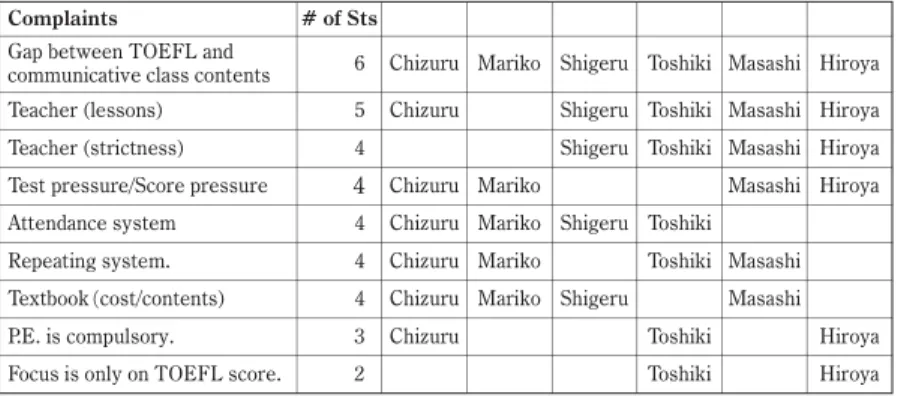
Complaints are summarized in the following table. It is not definitive; the students were generally unhappy about all of the following points; nevertheless the most salient are presented.
Table 1: Summary of Student Complaints.
Complaints # of Sts
Gap between TOEFL and
communicative class contents 6 Chizuru Mariko Shigeru Toshiki Masashi Hiroya
Teacher (lessons) 5 Chizuru Shigeru Toshiki Masashi Hiroya
Teacher (strictness) 4 Shigeru Toshiki Masashi Hiroya
Test pressure/Score pressure 4 Chizuru Mariko Masashi Hiroya Attendance system 4 Chizuru Mariko Shigeru Toshiki
Repeating system. 4 Chizuru Mariko Toshiki Masashi
Textbook㧔cost/contents) 4 Chizuru Mariko Shigeru Masashi
P.E. is compulsory. 3 Chizuru Toshiki Hiroya
Focus is only on TOEFL score. 2 Toshiki Hiroya
IMPLICATIONS
The Practical English program at YCU, while a success, is not perfect.
Some students, who dislike compulsory English study and are unable to achieve required test scores despite repeated attempts, will always be unhappy. On the other hand it is a tragedy that there are students who like English and have contact with the target culture outside of class, but have become discontent with specific aspects of the program at YCU.
One issue is that the exams used to assess students, the TOEFL-ITP and TOEIC, do not test productive skills. In terms of positive backwash in communicative classes, a speaking component in the exams would be a marked improvement. In lieu of that, the indirect connection between communicative competence and exam performance should be stressed to students before classes begin. This is especially important as many students, as products of the Japanese education system, may only have experience of dry exam-focused grammar-translation teaching methodology.
Demotivated students also believe the program should contain more content that directly addresses exam skills. Starting from first semester 2010 this issue is being addressed with a TOEFL preparatory class text that is intended especially for homework.
Naturally, it should not be supposed that language courses should be designed solely on the basis of students preferences, let alone the preferences of demotivated students. Nevertheless, as stake-holders in the system demotivated students have a right to be heard, particularly if their opinions have validity and are reflected in the literature. Taking this into consideration, a modification of the Practical English Program is suggested.
A NEW PRACTICAL ENGLISH
A demotive shared by all the interviewees was the mismatch between communication-focused class content and the requirements of the TOEFL paper-based exam. Ideally, an emphasis on communicative competence will eventually lead to exam prowess. While this is certainly the case under long- term ideal conditions, there is some question over how feasible this approach is for all students given the constraints of the university classroom. The TOEFL exam includes vocabulary that is specific to academic fields, and that is unlikely to be encountered in general conversation. It is believed by some teachers that to learn such vocabulary in a short period of time, to become accustomed to academic reading passages, and to prepare for quiz-like
̈
machigaisagashỉ
(spot the mistake) grammar multiple choice questions, specific test-focused practice strategy is effective.Our suggested revision of the Practical English program recognizes this and aims to achieve a balance between the TOEFL-focused and communication- focused approaches to teaching. It also aims to address some of the other shortcomings in the present system.
In the suggested system the first two years of Practical English remain compulsory unless the TOEFL/TOEIC score requirements is achieved.
However, rather than three separate skills classes, there are two communication-focused classes and one TOEFL-focused class. This helps to address the
̈
balancẻ
issue the program currently experiences. It also helps to alleviate the common student complaints of textbook cost and underuse, as there would now be one TOEFL-focused text and one four-skills text for the communication classes, in lieu of the three underused texts currently required.Finally, assessment at this level consists of participation, class tests, assignments and attendance.
In the current system students are required to achieve a score of 500 on the TOEFL or 600 on the TOEIC before progressing to third year. In the suggested system the time limit for achieving this goal is extended to graduation. To assist with achieving this goal optional P.E. classes are available in 3rd and 4th year. These classes consist of TOEFL-focused classes and Communication-focused classes, both of which are streamlined according to required score. The new system empowers learners in that they can decide which learning methodology is suitable for them; they can even decide not to attend P.E. classes at all and rely on self-study.
Conclusion
This study suffers from an obvious limitation: the students interviewed are not representative of the student body as a whole. On the contrary, they were interviewed specifically because they were highly demotivated, and the findings of this study cannot be extrapolated to the student population in general.
Nevertheless, some useful conclusions can be drawn.
Student demotivation at Yokohama City University is to an extent similar to demotivation experienced by university students elsewhere in Japan.
Specifically, demotivated students are unhappy with compulsory English and have had negative experiences with teachers.
In other respects demotives are specific to the program at YCU. The students interviewed are unhappy with the assessment system of the P. E.
program. They resent the fact that they cannot progress to third year without the required TOEFL or TOEIC score, when in their eyes these tests have questionable value. They are also dissatisfied with the content of classes, and especially perceive a mismatch between the content of lessons and the exams.
Finally, they are concerned with what they see as very strict attendance requirements.
In order to improve the program in general and address the concerns of demotivated students in particular, a revision is proposed by the authors. It includes the postponement of the required attainment of P.E. exam scores until graduation, the provision of both communication-focused and exam-focused classes for compulsory P.E., and the offer of a variety of optional classes after the second year of study.
Although the results of this study were obtained only from interviews with six students, we believe that our research has provided a useful glimpse into the
̈
underworld̉
of demotivation for English language university students in Japan.We further hope that if teachers are informed about demotivation issues, practical classroom implications can be the final result.
REFERENCES
Arai, K. (2004). What
̌
demotives̍
language learners? Qualitative Study on demotivational factors and learner s reactions. Bulletin of Toyo Gakuin University, 12,39-47.Benson, M.J. (1991). Attitudes and motivation towards English : A survey of Japanese freshmen.RELC Journal, 22 (1), 34-48.
Berwick, R., and Ross, S. (1989). Motivation after matriculation: are Japanese learners of English still alive after exam hell?JALT Journal, 2 (2), 193-210.
Da Silva, D., and McInerney, M. (2008). Motivational and self-goals of female students in contemporary Japan. In O. S. Tan., D. M. McInerney., A. D.
Liem., & A. Tan (Eds.),What the West can learn from the East: Asian perspectives on the psychology of learning and motivation (pp. 191-216).
Charlotte, North Carolina: Information Age Publishing.
Deci, E. L., and Ryan, R. M. (1985).Intrinsic motivation and self-determination in human behavior. New York: Plenum.
Dörnyei, Z. (2001).Teaching and researching motivation. Harlow: Longman Falout , J., Elwood, J., & Hood, M. (2009). Demotivation: Affective states and
learning outcomes.System, 37, 403-417.
Falout, J., & and Falout, M. (2005). The other side of motivation : learner demotivation. In K. Bradford-Watts, C. Ikeguchi, & M. Swanson (Eds.) JALT2004 Conference Proceedings. Tokyo: JALT.
Falout, J., & Maruyama, M. (2004). A comparative study of proficiency and learner demotivation:The Language Teacher, 28 (8), 3-9.
Hasegawa, A. (2004). Student demotivation in the foreign language classroom.
Takushoku Language Studies, 107, 119-136.
Meehan, K. (2009). A case study of demotivation. Jissen Women s University FL Journal, 4, 33-40.
Physick, M., Radcliffe, M., & Kubo, M. (in press). An examination of students motivation in the Practical English program at Yokohama City Unversity.
The Bulletin of Yokohama City University, Humanities.
Sakai, H., & Kikuchi, K. (2009). An analysis of demotivators in the EFL classroom.System, 37, 57-69.
Appendix
Motivation Survey
ᴥޙඕȾȷȗȹɁᝩ౼ᴦThis survey is intended for students who have been in the P.E. Program for a while. Feel free to be as
honest as possible. ᴥȦɁץᇝɂ 2' ʡʷɺʳʪȾȝȤɞޙඕȾȷȗȹɁᝩ౼ɥᄻᄑȻȪȹ
ȝɝǾး٣PEࠚε˹ɁႡࢳᐐɥᝩ౼ߦ៎ȻȪȹȗɑȬǿȕȽȲɁɥඩᄽȾȝኌț˩Ȩȗǿᴦ Name: (English)__________________ Student Number: ________
Male: ǫ Female: ǫ Class number: _________ Date: ____________
ᴥ႒ॴᴦ ᴥܤॴᴦ ᴥɹʳʃႭհᴦ ᴥᜤоஓᴦ Question 1. How I feel about studying English in general:
ᴥᔐɁޙȾȷȗȹȼș९ȗɑȬȞǿᴦ
Hate Love
۾ݲȗ ȼȴɜȞȻȗțɃݲȗ ܧȠȺɕݲȗȺɕȽȗ ȼȴɜȞȻȗțɃܧȠ ۾ܧȠ
Question 2. How I feel about the P.E. Program:
ᴥPEʡʷɺʳʪȾȷȗȹȼș९ȗɑȬȞǿᴦ
Hate Love
۾ݲȗ ȼȴɜȞȻȗțɃݲȗ ܧȠȺɕݲȗȺɕȽȗ ȼȴɜȞȻȗțɃܧȠ ۾ܧȠ
Question 3. Before I entered the P.E. Program, I liked English:
ᴥʡʷɺʳʪɥܿɔɞҰȾɂᔐɂܧȠȳȶȲǿᴦ
Agree Disagree
ऐȢȰș९ș Ȱș९ș ȼȴɜȻɕțȽȗ Ȱșɂ९ɢȽȗ пȢȰșɂ९ɢȽȗ
Question 4. The P.E. Program is a failure:
ᴥPEʡʷɺʳʪɂ܅ȳȻ९șǿᴦ
Agree Disagree
ऐȢȰș९ș Ȱș९ș ȼȴɜȻɕțȽȗ Ȱșɂ९ɢȽȗ пȢȰșɂ९ɢȽȗ
Question 5. I feel motivated to study English:
ᴥᔐɁӣऐȾȷȗȹɗɞȟȕɞǿᴦ
Agree Disagree
ऐȢȰș९ș Ȱș९ș ȼȴɜȻɕțȽȗ Ȱșɂ९ɢȽȗ пȢȰșɂ९ɢȽȗ Can we have your permission to use your answers and TOEFL scores in our research? Of course, your real name will never be published.˨ᜤץȾߦȬɞȕȽȲɁوኌю߁ȻTOEFLɁʃɽɬɥȦɁ ᝩ౼ȾΈႊȬɞȦȻɥȧ̘੪ȗȲȳȤɑȬȞᴼȕȽȲɁջɂу᚜ȨɟɑȮɦ
Yes ᴥ̘੪Ȭɞᴦ ǫ ̘੪ȬɞکնɂǫȾ ɥᜤоȪȹȢȳȨȗǿ Thank you for your time. ȧԦӌȕɝȟȻșȧȩȗɑȪȲǿ