in Cameroon and the Urban‑Rural Relationship
著者(英) Haruka Wazaki
journal or
publication title
Senri Ethnological Studies
volume 31
page range 303‑371
year 1992‑03‑31
URL http://doi.org/10.15021/00003122
The and
Political Structure of the Bamoun Kingdom in the Urban‑Rural Relationship
Cameroon
HARUKA WAZAKI
.1opan va'bmehls ulrziversity
.This paper's basic aim is an analysis of the political system of the Bamoun kingdom and its dynamic process of state and capital fOrmation, combined with an analysis of the urban‑rural relationship in the particular perspective of the anthropology of complex societies.
The diachronic process of kingdom's development, integrating many chiefdoms and villages, will be synchronically analyzed by means of a comparison of the capital and village political systems. In the process of state formation, the Bamoun society with many chiefdoms coming under its rule could be vertically structured by reproducing in the roles of the village and lineage chiefs in the villages the very same functions attaching to the role of the kingdom's chief in the royal capital. This will be shown here. Thus, a single, continuous line of multi‑layered ruler‑ruled relationships has been formed, encompassing everyone from the king in the royal capital at the top to ordinary Bamoun people in rural societies at the bottom. In this paper, it will be made clear that the Bamoun・state has been formed with economic, legal, political and military consistency from its summit to the base.
The Barnoun use raphia palm and oil palm in a variety of ways in daily life, creating the raphia palm culture complex which extends from e'conomic functions to religious meanings. The Bamoun kingdom utilizes this raphia palm culture complex to reinforce its political system. The way in which the raphia and oil palm culture are combined with the social and political system will be made apparent.
As well, the relationship between the political structure of the Bamoun kingdom and its Islamization will be analyzed. Faced with the new civilization of Islam, the Bamoun kingdom adapted the Islamic network into a political organization, using the network to its own .advantage to reinforce its own political foundation.
Through these analyses, the writer intends to form a dynamic anthropology of complex societies, states and cities, combining their structure and history.
INTRODUCTION
The Bamoun'(Bamoum or Bamum) kingdom in Cameroon, in Central Africa, is a composite multi‑layered society of complex organization. Starting as a mere chiefdom, it established a multi‑layered political structure, of the ruler and the 303
ruled, through repeated conquest, subjugation, and peace agreements. State formation can be recognized in.this process. The political process of the state formation represented the maturation of the kingdom's political apparatus and involved the formation of a close‑knit relationship between the royal capital and village communities, as the state was formed out of the integration of villages by the royal capital, the center of power. Therefore, it is significant to contemplate the structure of the royal capital, the center of power per se, along with the process of the absorption and rule of villages.
In this paper, therefore, the author shall attempt to examine the political structure of the Bamoun kingdom‑which succeeded in establishing a complex chieftainship society‑in terms of the Bamoun's unique political organization and the process of its improvement and consolidation through Islamization. The author shall do so by focusing, in particular, on how the traditional Bamoun political structure is affk)cted by the raphia;palm culture complex and on how this political structure, in turn, affects the urban structure and the city‑village community relationship.
/
1. THE BAMOUN KINGDOM AND RAPHIA‑PALM CULTURE
1) The Top‑down Political System and the Grass Roots Kinship System
The political system of any ethnic group or state, if it is a ruling apparatus imposed "from the top" only, is unlikely to last for long due to the lack of popular identification and support. Likewise, people identify with neither values nor a culture which support a particular political system without engaging popular viewpoints "from the grass roots."
Thus, it becomes necessary for a top‑down political system to adapt to and combine itself with the daily rounds and customary system of the people. In the Bamoun kingdom, it is the system of nji that serves this purpose. IY7i is an honorific title granted by the king. A person with this title is positioned at the juncture between the political system of kingdom and the popular kinship system.
A nji is a sort of prince, as well as a lineage chief or a clan chief, with many family chiefs under him. In other words, one nji has many nganjuh, or family chiefs, within his own lineage. Such family chiefs, and their polygamous families, usually live in houses or on land which their nji rents to them within his territory.
Although a nji may "give," a piece of land to a nganjuh, the nji's decisions and commands, which cannot be rejected, can change ownership at anytime. A nji's absolute authority and political power within his lineage are guaranteed by the vertical line of descent and rule of king‑nji‑nganjuh: a nganjuh's father is a nji, whose father is in turn the king or wfon, by both the multi‑layered parent‑child relationship and the ancestral‑temporal relationship. The authority of the successive Bamoun kings, who are the ethnic group's. chiefs, gods, and ancestors all at the same time, along with the life force of the king (wfon), which embodies the entire ancestry of the Bamoun ethnic group, position a nji as "the king's child,"
empowering and deifying him.
A nji exercises absolute authority over all agricultural produce and other products generated within his territory,' including oil palms and raphia palms planted there. In not only the traditional but also the present‑day economic system, the economic value of palm wine, which is generated naturally by and extracted from raphia palms, is high as it sells well on the market.
For example, one nji named Njikumunjua of Njimom Village, 24 km northeast of Foumban, owns a vast stretch of land comprising mountains, hills, rivers, forests, farms, and fields. The majority of Fonga, one of the seven sections constituting the village of Njimom, belongs to him. Those living nearby and not belonging to his lineage group may ask the nji for permission to use raphia palms, which are left untended due to the lack df labor within the clan. Such a request and negotiation took place on August 23, 1984 at nji Njikumunjua's residence, in Njimom Village. Following the negotiation, the following written contract was signed by the nji, i.e. the owner of the raphia palms, and the user:
Njimom Village, August 23, 1984
I, Njikumunjua, hereby sign and permit Mr. Mumben Tathio to extract palm wine from the raphia palm fields which I privately own in Njimom Village. In return, Mr. Mumben agrees to pay (return) me 3,OOO CFA per month. The payments shall commence on the last day of October.
In determining Mr. Mumben's ability for the aforementioned payment, a delay in payment of up to six months shall not be held against him.
(Signed) Owner ' (Signed) Mumben
(Signed) ACii's witness (Signed) User's witness
As shown above, four persons, including the witnesses of the raphia palm owner and user, signed the contract approving the right to use raphia palms to distill palm wine. On the nji's side, raphia palms may be described as a hen that lays golden eggs; he can receive 3,OOO CFA without any effbrt on his part. In such a negotiation, it is always the nji that determines the lease of the raphia palms. Even' when the raphia palms in question are located on a piece of land already rented to a nganjuh, the nji alone can make decisions and freely take advantage of the economic value of the palms. Moreover, nji have the symbol of raphia palms conferred upon them by the king, as a guarantee of their new or continuing status as nji'
What are nji's role and authority in the traditional Bamoun society like? Let us consider this in the context of the political structure of the Bamoun kingship
!society and examine how the cultural symbol of raphia palms is related to and supports the Bamoun political structure. ・
2) Political Structure of the Bamoun Kingdom
The Bamoun king, (wfon), is the sole and paramount chief of the Bamoun
state. The paramount chief has subordinate chiefs (wfontuo) and rural village chiefs working under him. The king gives his collateral relatives royalty regions within the state to rule and develop, where they act as founders and develop their respective lineages and clans. The royal family and princes who thus become the founders of・lineages and then lineage's chiefs are al1 given the title of nji by the king. Basically, the term nji means "the king's child." However, not all nji who have become village chiefs and regional leaders were originally princes: court ministers, those awarded land, a wife (or wives), and the labor force of the king employed for their services in war, those recognized as "kings" for their special skills despite their descent from the conquered, and those among the leaders of the conquered recognized as "children" of the Bamoun king for their allegiance to the king'(or for appointment as regional chiefS) also become nji and‑as village chiefs and regional chiefs, are assigned to several parts of the Bamoun state, ngu. Those recognized as village chiefs by the king have had their own clans develop in several regions across the Bamoun state. A nji, as a village chief, is also a lineage chief.
Thus, since the 1lth King Bouombouo, the Barnoun kings have successively given birth to hundreds of lineage groups within the state through regional conquest and developmenti).
The king in the royal capital reigns over hundreds of lineage groups developed in villages throughout his kingdom and, as the "parent," distributes land, labor force, and women (as wives) to his "children," i.e. village chiefs, so that these lineage groups and village communities prosper. The king solves problems in
‑accordance with the ancestral rules and customs of the Bamoun and mediates between villages to settle conflicts and disputes; he summons up soldiers from villages to fight other chiefdoms and rewards them with slaves (labor) and women (wives) as trophies of war; and he oMciates sacred rites for the ancestral kings and the whole ethnic group to pray for and maintain peace in all villages and the prosperity of the kingdom.
On the other hand, a village chief, a nji, who rules a village community within the kingdom, divides the usu‑fruct of hiS land granted by the king among family chiefs in his village or lineage group. In doing this, a nji, who is the lineage chief and the village chief, acts as "parent" to his "children," the family chiefs. The allotment of not only land, but also labor and spouses, to family chiefs is carried out solely according to the judgement and decision of a nji, "the king's child"
empowered by the divine king. In this sense, it can be said that a nji has absolute authority, approved by the king and ethnic ancestors, over his family chiefs. A nji mediates between families and lineage groups to settle condicts and disputes;
summons up soldiers from families in his village to fight for the Bamoun king and kingdom; distributes trophies of war, including slaves and women rewarded by the king, among the families; and oMciates sacred rites for all the lineage chiefs who have ever existed, i.e. ancestral nji, to protect the village and lineage from evil magic 1) King Bouombouo created 112 villages, King Nsangu 165 villages, and King Njoya 169 villages [TARDiTs 1973: 486].
SLi,abVoe
ur
Service to the court
War
Consentration
@Ritual Priest
Food products
@Ritual Priest
Clothes
([3Iiii])i Arml)!)
arbitlali,gk ( i)
arbitla::t("rmil)i)
Family Chief arbitla::k([l) Ar‑)
(l?fTdiO,P,hieS oLand
[P/TwraOrPhieS (DLand
Parent・child . Horn cup Materials ralationship ritual
Village chief, Lineage chief
Land tt
PrOdlCetaiOn"sw..,.¥gi',etlt'.Cshhil'gilrHitOura"iC"P,
Family chief
@Ritual Priest
Family Members
[P/T.raO,PhieS OLand S!aves
Redistribution
Chief of the Royal capital.
II
eg,r,ep,s,c,hfiis1l,",g.'s,cup
Members, Villagers
Royal capital
Village
Fig. 1
and to pray for peace in all families of the village and for the prosperity of the entire
.reglon.
It is clear, therefore, that the role of the kingdom's chief in the royal capital, wfon (king), toward regional village chiefs, nji, is identical to and linked with that of nji, village and lineage chiefs toward their villagers and family chiefs in the village, although the scale of their power differs (Fig. 1). The role and authority of nji is the same wherever nji are posted, whether in a rural village or a ward (quarter) of the royal capital. The fact that authority granted to a person who has become a nji is enormous is deeply connected to the present‑day meaning of sfi nji, the ritual for producing new nji, which will be described later. Either a biological or a nominal parent‑child relationship is constituted by each of the following pairs: the king and any given nji, who are lineage chiefs scattered throughout the capital and villages; a lineage chief and any given family chief; and a family chief and any given family member. Therefore, a single, continuous line of multi‑layered ruler‑ruled relationships is formed, encompassing everyone from the king in the royal capital at the top to・ordinary Bamoun people in rural villages at the bottom. The political structure of the Bamoun state is thus formed and supported by economic, legal and political, military, and religious consistency from top to bottom2).
3) Political System of the Bamoun Kingdom and Raphia Palm Culture
As mentioned above, the political system of the Bamoun state is basicaliy structured so as to constitute economic, political, military, and religious consistency and continuity. This consistency and continuity characterize the roles and 2) This political hierarchy is analyzed in' the writer's urban theory on chiefdom's or kingdom's, with special emphasis on the spatial development of the urban‑rural relationship [WAzAKi 1984].
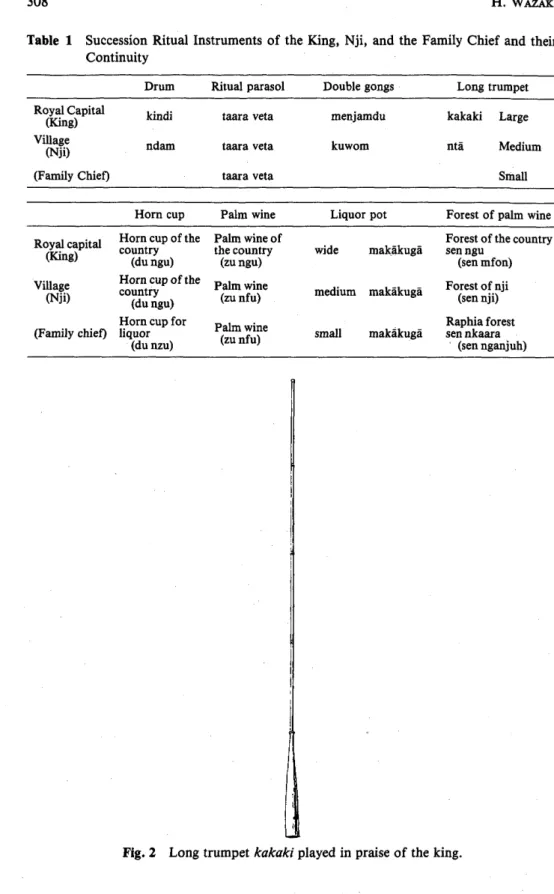
Table 1 Succession Ritual Instruments Continuity
of the King, Nji, and the Family Chief and their
Drum Ritual parasol Double gongs Long trumpet
Royal Capital (king)
Village (Nji) (Farnily Chief)
kindi
ndam
taara veta
taara veta
taara veta
menjamdu kuwom
kakaki nta
Large
Medium
Stnall
Horn cup Palm wine Liquor pot Forest of palm wine Royal capital
(king)
Village (Nji)
(Family chief)
Horn cup of the country (du ngu) Horn cup of the country (du ngu) Horn cup for
liq(UdOur nzu)
Palm wine of the country (zu ngu) Palm wine (zunfu) . Palm wine (zu nfu)
wide maka‑kuga medium makakuga smal1 makakuga
Forest of the country sen ngu
(sen mfon) Forest of nji (sen nji) Raphia forest se?,2ka.a,',a.j.h)
Fig. 2 Long trumpet kakaki played in praise of the king.
meanings underlying the actions of the king, i.e. the supreme ruler, village chiefs (njD, and family chiefs, ranging from the center of the kingdom, the royal capital, to individual families in rural villages. It should be noted that this political mechanism also has the function of symbolic and cultural intensification, realized through cultural symbols existing both in the royal capital and village communities to which raphia palm culture is closely related.
Let us study Table 1. It shows the political mechanism of the Bamoun kingdom as comprising the three levels of the king, nji, and the family; as well as the corresponding levels of royal capital, village community, and family. At the same time, it compares religious ritual instruments and cultural symbols used on each level. First, let us take as an example the long trumpet, a ritual instrument called a kakaki (Fig. 2). It is played in front of the king for benediction, praise, and purification when the chief of the kingdom marcheS. Similarly, on the village level, the long trumpet called a ntd, which iS of the same shape but slightly smaller than a kakaki, is played in praise of the village chief when a nji marches. The function and the form of these ritual instruments ' are identical on both the level of the king (royal capital) and of the nji (village), but their size and the sphere of their political influence clearly differ.
Next, let us consider a U‑shaped pair of bells generally called double gongs.
There is a pair of double gongs called menjamdu for the king in the palace (Photo.
1). The menjamdu bells are rung at the time of a king's death. At the king's funeral, the bells are placed on the left side of the king's head when he is laid on his deathbed. At the same time, aparasol called a taara veta is placed at the top of the head of the bed. The king's double gongs and parasol remain with the king's deathbed for seven days in this manner. The king's large drum, kindi, is beat to announce approaching enemies or to summon people into the square in front of the palace (ku‑yenv'a), whereas the king's double gongs are rung when his soldiers are about to go to war. The drumstick used with the double gongs, which convey
Photo. 1 Thekingplaysmenjamdudouble‑gong,inspiringhisBamounchildrento JJ"go to war
L
zt(rXs,
"
:・i' }'1;J
ifr・.・.
e"'ta ';:,v
'ei
+/.
b. 4・ty
Efa ‑l' ti
l ;':'et l'"' tt'f"'f'
e4.S;.1
E
illii)l
!
g
li'o';,'‑
E
'
.. ')';"k 4zi .・;..‑.'i ‑tt ZZ
'
¥・
Fig. 3
t;.te ‑ Xs
・ ・. i・;
S iV
,i ,.:':';!sY b:r.・.h・‑i
Double gongs: Nji's kuwom and family chief's small kuwom.
highly important meanings, is made from the scraped surface of the trunk of a raphia palm tree (kam zu). When sfi nji is performed in the royal capital to produce a new nji, the king attends the ritual in war costume and inspires the new nji to "go to war," beating his menjamdu (Photo. 1), as "the king's child" is expected to fight for the Bamoun king.
In village communities, on the other hand, at a nji's residence, there are double gongs called kuwom (Fig. 3). Smaller than the king's menjamdu, kuwom are of exactly the same shape as the king's bell. A kuwom is rung at the time of a village and lineage chief's death. As with the king's double gongs, a nji's double gongs are placed on the left side of the nji's head when he is laid on his deathbed at his funeral. At the same time, aparasol called by the same name as the king's, taara
Photo. 2 7hara veta, raphia palm‑made ritual parasol
N /Y,
tws
‑,.:
g}kgl#t
‑tt‑‑‑・・‑34gkf
‑ 7ik :'=, . '>iv' ::
‑.:' ÷. 4
‑{z‑k/
‑r‑.
='.'‑・r''t'‑.'' }
tt"
.,s
Fig.4 Horn Cup du nzu
veta, and made of raphia palm is also placed at the same location of the bed in the same manner as for the king. A nji's taara veta and the king's differ in size, but their shape and name are identical (Photo. 2). Mor.eover, a nji's double gongs and parasol also remain with the nji's deathbed for seven days, as for the king's funeral.
A nji's large drum, a ndum, like the king's, is beat to announce approaching .enemies or to summon people into the village square, and a nji's double gongs are also rung to inspire villagers and lineage members. Furthermore, the drumstick for a nji's double gongs is also made from kam zu of a raphia palm tree, like the king's.
Both the king's and a nji's parasols are made by braiding hard‑surfaced long strings of scraped raphia‑palm kam zu, which shine like the trunk of a bamboo tree.
It is clear, then, that almost all important ritual instruments in village communities used for nji correspond to those in the royal capital used for the king.
In other words, ri.tgal instruments used at the village level, i.e. a nji's ritual mstruments, are miniatures of those used in the capital or at the king's level and have an identical role, usage, and form. This fact secures the political hierarchy of the royal capital and villages, and the continuity and identity of the line of rule connecting the king to nji and to the people. It should also be noted that cultural symbols of raphia palms and their symbolic meahings are used in the form of the double gongs and the parasols.
Let us compare rituals in the royal capital and a village for the exchange or succession of a chief. In this case, in accordance with the political system of the Bamoun state, the three levels of the kingdom chief in the capital (wfon), a village and lineage chief (njD, and a family chief in a village (nganjuh) are involved (Fig. 1, Tab. 1).
First, for the succession ritual at the level of family chiefs who rule Bamoun villagers in rural communities, du nzu, a cup made from a wild ox's horn (Fig. 4, Photo. 2) and meaning "a cup for liquor"; zu nLfu, palm wine extracted from raphia palms3); and makaakugaa, a pot for holding liquor (Fig. 5, Photo. 3) are prepared.
For the succession of a new family chief, the rite is attended by the nji who rules him in the village and secures the legitimacy of his authority. The nji pours palm 3) Palm wine always accompanies rituals of propitious natur.e such as liberation and benediction. A marriage vow is complet'ed when a woman and a man drink palm wine together.'It is also raphia palm that is used to celebrate birth and to protect a new mother's body after delivery. Lamare gives an example of such use: a belt made of raphia palm is wrapped around a new mother's abdomen fpr protection ILAMARJ: 1975:
181].
r' ,a ttt
1‑
ilNl ..":‑..
exL' tt
x kt,L '
t"
,w ‑‑
1・NNS", l‑.
NKNN,' Il,,
tt ‑‑
tl t N
t N Nits' ss
・'xx .XN.
'v'.zee'
x '
;)yt
N s
' ' t
s..
iil ・N
t h
'z‑ ' =
zrt ‑.
iii, ・i・t
Fig. 5 Bag (Pwa kpetkambum Pamom) containing makaakugaa (right)
Photo. 3 Palm wine pot makaakugaa and enemy teeth
wine from the pot (makaakugaa) into the cup (du nzu) and gives it to the new family chief. Receiving the approval of the king, who is god himself, and the nji, the god's child, the new family chief in turn gives palm wine to his family members over whom he is now to exercise his authority. The family members take off their hats and squat down ih front of their new chief, who is seated with a horn cup in his hands. Then they receive palm wine from the horn cup in both of their bare hands and drink up the wine. By doing this, they express their complete acceptance of the new family chief's authority and rule. The manner, which expresses solemn respect, is derived from the notion that Bamoun people clearly see the king's
ancestral gods at the extension of the line of patrilineal lineage through this succession ritual..
For the succession ritual of a nji, a chief at the level of lineage, village, or quartier (quarter or ward), a cup made from a wild ox's horn (du ngu), which means "the horn cup of the ancient land" or "the horn cup of the country"; zu nLtru (palm wine); and makaakugaa, (liquor pot) are prepared. These three ritual instruments for a new nji are identical to those for a family chief succession ritual,.
except for the horn cup and makaakugaa, which are larger than for a family chief.
As well, the horn cup is called by a different name: at the level of the family chief, it is called "a horn cup for liquor," a generic name with little marking; whereas at the nji level, it is called by a specific name suggestive of clear‑cut political and territorial definition and expanse, "the cup of the ancient land" or "the cup of the country."
A person who is to become a new village chief, a nji, visits the king's palace in the royal capital to receive palm wine poured out of the king's horn cup by the king himself, and to receive the king's recognition that he has become a new nji, i.e. "the king's child." With this recognition and secured legitimacy of his new status, the new nji returns to his village, where he gives palm wine in the horn cup (du ngu) to the many family chiefs whom he is to rule and protect and whose prosperity he is supposed to secure. At this time, the family chiefs, who have been in power longer, take off their hats and squat before the seated new nji to receive and drink palm wine in both of their bare hands (Photo. 4). By doing this, the family chiefs express their complete acceptance of the new nji's authority and rule.
Finally, at the top of the kingdom's power structure, for the succession ritual of a king, a cup made from a wild ox (du ngu or "the horn cup of the country");
palm wine called zu ngu; and the makaakugaa pot are also used. This means that the basic material compositions of instruments used for the succession ritual of the state's supreme chief, the king, are precisely identical to the composition of the instruments used in the succession ritual of a lineage chief nji or a family chief in a
Photo. 4 Palm wine ritual by a new IY7i
village community, although the instruments used differ in size, terminology (for the horn cup and palm wine), and the range ofterritory indicated. In this example, a cultural structure corresponding to and inseparable from the continuity of political rule is found. For the, king's succession ritual, the horn cup is called "the cup of the country," while the palm wine is called "the liquor of the country." This is the largest scale of political territory in the Bamoun state. As well, the word
"ngu," which means "of the country," indicates metaphorically the chronological depth and traditional legitimacy of the rule・ of the Bamoun state by the successive '
The three levels of names for the horn cup can be compared. The horn cup for a family chief is called "a horn cup for palm wine" or "a horn cup for liquor." The ctip has no spec'ific distinction su'ggesting the family chief's rule over the Bamoun people at large. Rather, the most commonplace, small‑scale political sphere of the daily‑life of the Bamoun people is indicated. For both nji and the king, the horn cup is called "du ngu." The Bamoun explanation is that in the case of a nji's horn cup, the word ngu means "the country," but more accurately "ancient land" or
"ancient homeland." This means that, the horn cup is suggestive of the origin of the Bamoun. Why, then, is the name suggesting the largest domain of the Bamoun, their origin, or the country, given to the horn cup for nji? The ansWer to
New king's
River Nishi
Raphia.."
palm
.・・" forest Sac'red "・・・"
"palm wine
...." of the coun!ry"
Njimom village
origin of the holy kingdom
bathing ritual "・""
Royal capital
Purification ritual (palm wine)
Ordinary Bamoun people
Strangers
Harem
Palace@Palace
Ivory Origin of foreigners
Castle wall
Fig. 6
Ordinary Banloun people
Treason Execution site '
pure impure
this question can be found in a Bamoun proverb. The Bamoun people think as follows: "the Bamoun country and the king are likened to a wild ox, and the nji are its horns; they charge at enemies to protect the country." IY7i i's the "horn" which supports "the country" itself. Therefore, the same horn (cup) overlaps the two levels of the king and nji, meaning "the country" for the king, and "the ancient land and the country" for nji. Wh.en the king is considered as a wild ox (i.e. the.
country), nji become its part, "the horn of the country." A family chief, on the other hand, is never likened to any part of a wild ox. In this sense, the king and nji become one as "the parent and children," figuratively forming a wild ox, i.e. the country. Therefore, the king and nji are inseparable. This is how the name; "the horn cup of the country," emerged.
As part of the succession ritual, the new king bathes in a river called Nshi, "the ancestral river" (Fig. 6), which flows near the royal capital from the direction of Njimom, the origin of the Bamoun. He does this in order to be purified and approved by his ancestors, i.e. the successive kings, and the land of o'rigin. Then, he returns to the palace and gives "palm wine of the kingdom" in the horn cup (du ngu) to selected people among those he rules and who thus directly receive the king's sacred power, the accompaniment of his authority. These people, selected for the honor of receiving liquor from the divine king in person, are the king's children and "the king's children." This means that nji, who are village and lineage chiefs, receive palm wine from the new king, along with princes, the king's blood relatives. First, nji, who have been in their rcspective positions longer than the new king, take off their hats and squat in front of the seated new king, and they receive palm wine from the horn cup in both of their bare hands to drink. By doing this, nji express their complete acceptance of the new king's authority and rule.
One should notice, in comparing the religious rituals of the Bamoun kingdom on the three levels, and specifically those of the succession ritual for the king, nji, and family chiefs, the existence of consistency and continuity in the ritual instruments, the name of the palm forest where palm wine is distilledi the ritual forms and manners, and the meaning behind them. It should also be noted that it is always the "power" and sacredness of the Bamoun palm culture that give birth to a "chief" on all levels from the king to the people. In Bamoun society, the ritual of the royal capital is transplanted to a village community exactly as it is. In other words, the ritual in a village community is a carbon copy or a miniature of the ritual in the royal capital. Therefore, it is quite natural that the order of the royal capital is adopted entirely in a village.community and, as a result, a village community in a substantive sense succeeds in becoming a royal capital. One sees a village community and finds a royal capital there.
Because of this continuity of the palm wine ritual, supported by political and economic continuity between the king and the people or between the center of sovereign power, the royal capital, and rural villages, the Bamoun king's rule over remote villages in regions far removed from the capital beeomes easier and stronger.
Conversely, the Bamoun people can find the essence of the royal capital, and feel
316 H. WAzAKI
the presence of the king in the palm wine rituals carried out for nji and family ,chiefs in their village, without having seen their divine king in person, or however far away they live from the center of the state. Thus, the people can confirm their link with the king, the very presence of their god and ancestors, and find peace there, acquiring the wholeness of their Bamoun identity. Moreover, raphia palm trees have an extremely close presence for individual villagers, who enjoy palm wine on a daily basis. Therefore, the fact that such raphia palm trees serve the role of securing the kingdom and giving birth to the king, nji, and chiefs of families, to which the people personally belong, completes the establishment of the political structure of the Bamoun kingdom, which extends even to little corners of rural villages. At the same time, it also gives the people individual psychological ・securlty.
Amid the continuity.found between the rituals in the capital and yillage communities, the only different points are the size of ritual instruments and the extent which their respective names suggest (Tab. 1). The folk names for the horn ' cup and palm wine plainly mean: "a horn cup for liquor" and "palm wine" on the level of the village family chief; "the horn cup of the country" and "palm wine" on the village nji level; and "the horn cup of the country" and "the liquor of the country" on the level of the・king in the royal capita!, with "the country" indicating the largest unit of political territory in the Bamoun kingdom.
These points of difference indicate the absolute difference between the king and the other chiefs as well as the difference between the capital and village communities. In other words, they suggest the absoluteness and supremacy of the king and the preeminence and centrality of the royal capital in a chieftainship society of kingdom. In this sense, the capital and village coMmunities are continuous in some areas while, at the same time, they are separation in others.
Junzo Kawada, in his study of the characteristics of the royal capital of the Mosi, whose society is based on kingship, also compares the capital, central cities ruled by regional chiefs, and rural villages, pointing out continuity and separation among them [KAwADA 1980]. It is thus believed that, in the case of a chiefdom or kingdom, it is significant to study a city by contemplating the relationship between the capital and village communities.
Raphia palm‑based rqligious symbols correspond to and correlate with the continuity of political rule extending from the top to the bottom, forming an indivisible link and intensifying the political structure. This compound structure of religious symbols underlies Bamoun society and its cultur,e. With palm wine made from raphia palm trees at the center, the compound structure comprising valuable instruments, cultural symbols, and rituals and faith is linked organically with the corresponding political, economic, and social structures of the Bamoun kingdom, thereby ensuring for the Bamoun people, ancestral power, and the legitimacy and the source of life.
As mentioned before, in the succession ritual, the new king bathes in the River Nshi, "the ancestral river,'i to purify himself before entering the palace as the
qpproved new king. As shown in Fig. 6, the sacredness and purity of the river come from the raphia palm forest called sen ngab, or "the forest of the country," on the upper reaches of the river, which can be considered the origin of the Bamoun as well as of the palm wine extracted from this forest. The founder of the Bamoun state, King Nchare, is buried in the forest, from where the river fiows. Palm wine is also transported on ‑the river. From these facts, it can be said that purification with pa!ms is also involved in the new king's entry into the palace.
In this regard, the royal capital should be seen, in terms of its structure, as a symbolic space. The inside of the royal capital is protected by palm wine and the palm culture in contrast to its outside. Based on the distinction between the
"inside" and the "outside," the structure of royal power and of the community in which this power culminates, i.e. the royal capital itself, will be analyzed in the following chapter.
2. THE "INSIDE" AND THE "OUTSIDE" OF THE ROYAL CAPITAL
1) The "Inside‑Outside" Boundary of the Royal Capital and the Purification Ritual: the Symbolism of Palm Wine
For the Bamoun the royal capital Foumban is the center of the political domain, and of the greatest sacredness. Therefore, a strict control system was established to prevent invasion of the capital by other ethnic groups and enemies.
Since the reign of the 1 lth King Bouombouo, the capital has been protected by the mound wall surrounding it. In those days,,the wall had 8 gates, each of which was guarded by a group of 15 young men organized by a quarter chief, wfayom. The eight gates corresponded to the eight traditional quarters (quartier; nju) which comprised the royal capital Foumban. This means that each of the quarters of the Capital was responsible for one gate. Each group guarded a gate day and night, questioning all passengers coming in and out of the capital, and checking their belongings or passes if they were exiting the capital. For a person of another ethnic group about to enter the royal capital, the traditional Bamoun liquor, i.e. raphia palm wine, was poured around the person's feet to purify him or her and the boundary, before entry was permitted. In Bamoun・sdciety, palm wine is a basic and important ritual symbol. It was therefore used in the purification ritual before the entrance into the center of the sacred land, particularly for people of other ethnic groups because of the notion that Bamoun land was pure and the outside world was impure. Moreover, the pUrification ritual for meMbers of other ethnic groups, using palm wine, secured their freedom in Bamoun society. Therefore, it can be said that the purification of members of other ethnic groups at the wall gate also had the purpose of granting them "citizenship" inside the Bamoun royal capital. Likewise, when a person desired to liberate a slave from slavery or poverty, he did so by pouring palm wine over both the slave's feet.
There is another example of the ritual of admitting people of other ethnic groups into the Bamoun. When the Bamoun constantly fought・ against other
ethnic groups, especially during the reign of King Bouombouo, it was customary that only the Bamoun king had the authority to punish or murder the chief of a defeated chiefdom, when one was brought to the royal capital. It was customary that a defeated chief enter the capital enclosed in oil palm leaves for his purification
and protected by Bamoun warriors. Once inside, he stood before the Bamoun chief and then knelt down to scoop up and drink palm wine of subordination and submission with both his hands. After this, he was a subject of the Bamoun king.
If he refused to undergo this ritual, however, he was killed before the onlookjng crowd [Sultanat Bamoun 1985: 19‑21].. Thus, the palm wine in the royal capital had the function of recognizing a conquered chief as a subordinate chief in the Bamoun kingdom. While this is part of the process of defining the conqueror‑
conquered relationship, it is also regarded as a ritual of purification and liberation‑.
The sacredness of the royal capital must be protected and maintained not only by chiefs of other ethnic groups, but also by' the Bamoun king himself. For
example, when the king returns after having been away from his political territory, the kingdom (ngu) or the royal capital (ku‑nju), he must cleanse himself of the impurity of the outside world. For another example, it is a traditional custom for the king to pour palm wine before crossing the River Noun at the southern edge of
the kingdom, forming the boundary between Bamoun and the Bamileke
Chiefdoms, and when entering the capital through a castle wall gate. In recent years, siqr, the words of blessing by nga maasa mfon, the admirer of an Islamic sultan, are often used in lieu of palm wine to break through the boundaries and to return to purity from impurity. Itcan also be replaced by benediction greetings by kom, the king's immediate adviser and minister. In either case, it is clear that great importance is attached to benediction or purification upon entry to the royal capital. Thus the inside and the outside of the capital are symbolically distinguished. The king purifies himself with palm wine upon entering the royal capital while at the same time purifying his subjects and the capjtal itself, which have been deprived of their central sacredness due to his absence, with his own words of benediction to the Bamoun people and the capital on the ritual site of his return.
Another example of symbolic distinction of the inside and the outside of the capital can be found in its relation to war. According to Joseph Mfochive's description, in 1894, a civil war broke out between Prince Njoya and Chief Retainer Gbetkom over the right to succeed the 16th King Nsangfi. In‑.1896, Prince Njoya returned to the capital as the victor, but had to wait outside of the royal capital Foumban for seven days to purify himself. Moreover, the trophies. of war and prisoners were exposed to smoke at the wall gate entrance as a purification rite.
The game was also smoked and purified before it was offered to the gods and spirits of the Bamoun kingdom. Warriors returning to the capital had to step over their ancestral graves to purify themselves [MFocHivE 1983: 106‑107]. The game and prisoners from the outside of the capital were considered impure, and could exist inside the capit'al only after purification. This is another indication of the
symbolism of the inside and the outside of the capital.
In this last example given, palm wine was involved in the purification ritual as well: palm wine was poured over the ancestral graves. Traditionally, when the king returns to his capital after a visit away or a war, his body, i.e. the symbol of the state, is purified with palm wine both at the entrance gate, which defines the boundary between the outside and the inside of the capital, and at the River Noun, the boundary between the Bamoun kingdom and other countries4).
2) The Concept of the Royal Capital and the Symbolism of Urban Space (1) The Concept of the Royal Capital
In their concept of community,, how do the Bamoun people distinguish urban and rural communities from‑each other in the domain of the daily round? In the Bamoun language, a country and a town are called "ngu"; and a village "nju" or
"nsa‑ngu'," but basically "ngu." "IVSa‑ngu'"'actually means a small (nsa) ngu. At least from this folk terminology for the'different forms of community, it is clear that the Bamoun people do not necessarily differentiate between urban and rural comrnunities.
However, they have a special term for their royal capital Foumban. It is called by its proper name per se, Foumban, or more closely to its Bamoun pronunciation, Fomben. Foumban or Fomben means "the Mben'sfom," the word fom meaning ruins. Thus, Foumban means the ruins of the Mben people. This name comes from the historical fact'that the Pamom, the founding group of the Bamoun kingdom from the northeastern land of the Tikar ethnic group, conquered the Mben, the aborigines. Bamoun is also derived from the name "Pamom."
Therefore, Foumban, the name for a city, refers to the origin of the powerful conqueror kingdom, in which the Bamoun take pride.
Another aspect of the concept of the Bamoun royal capital Foumban, height
sensit'ivity of the Bamoun people, should be noted. In general, a Bamoun person attaches the prefix ku when referring to a place located higher than his or her vantage point; ma when referring to a lower place; and for a place at roughly the same height as his or her vantage point, ju, if close, and nji if slightly distant or very
remote (Fig. 7). For example, the word for school, ndalewa, changes to
"kundalewa" when one looks up at the school from a lower place and "mandalewa"
when looking down from a higher ,place, even though it is the same school.
It is obvious that the height sensitivity of the Bamoun people is subject to geographical, environmental, and topographical conditions. Moreover, it actually 4) Raphia palm is involved in almost all aspects of Bamoun daily life including food, clothing, and shelter. It is also believed to realize sacred‑profane interchange, to bring "ancestral power" to life, and・to invoke strong feelings and a sense of identity. Such,a sacred symbol deserves dintinction from other symbols for its special role of realizing a cultural complex. Ortner terms such a sacred symbol a "summarizing symbol" [ORTNER 1973: 1338‑1346]. ・
/
ku : high, up
n7'i : far Origin
fot : near ma : low, down Fig. 7
transcends simple consciousness of such outward conditions; it includes, among others, religious piety which is reflected in their social and psychological consciousness. The differentiation of the royal capital from rural villages among the Bamoun people reflects this point. Even though their villages are located in mountainous and undulating areas, the vil!age dwellers, in many cases, call the royal capital Foumban, ・not Ma‑nju,' but Kuinju. ' The Bamoun people do so out of their respect for the place of their supreme chief, the king. The Bamoun people are aware of the loftiness of this particular place because it is the king's residence.
Thus, it can be said that while the people's general distinction between a city and a village is not well defined, they have in their consciousness a clear‑cut distinction between the sUpreme city where the king lives and the rest of the kingdom.
In this context, it is important to note the fact that the royal capital Foumban is called Ku‑nju, ot Nju without the prefix, since "nju" means one's hometown or native place. Generally, when Bamoun people wish to say "return to one's hometown or ancestral land," they use the expression, "njupua," which means "my hometown (or ancestral land)." "The village you come from" is ̀'rij・upugn." All the Bamoun people use the generic noun "hometown" (nju) in reference to Foumban. Thus, for all Bamoun people, no matter in which villages they live within the kingdom, as 'well as other Bamoun Who live in other areas away from the Bamoun province, Foumban is their hometown, the land of the kingdom's origin.
The consciousness of the royal capital as the place where all things begin and are generated is reflected in the name for Foumban.
The height sensitivity is also related to the rigid distinction.between the "inside"
and the "outside" of the royal capital, which can be found in honorific titles given to people connected with the king.
(2) The Symbolism of the Royal Capital as Seen through Honorific Titles One traditional rule of the Bamoun state is that only three generations of the king's lineal descendants are allowed to live in the royal capital, and those of the fourth and following generations must live outside the capital. The same applied for collateral royalty. This rule was originally established for two main reasons.
One was the need for a 1arger number of people outside the capital, to develop the
territory which was being expanded by the Foumban‑based 11th King, Bouombouo, who repeated the pattern of war and conquest. It was then necessary to decrease the number of people living in the capital, and develop rural villages to increase food production in'order to support the population in the capital. The other reason concerned the royalty's attribute of ambivalence, in that they were
basically friends.and foes at・the same' time. In other words, for the kingg the royalty could be both his supporter and potential rival for the throne. For this reason, stability in the capital was maintained by keeping bnly three generations of the king's descendants inside the capital and dispatching those of the fourth and following generations to villages, thereby keeping some potential threats out of the capital.
Let us examine the honorific titles and names given to royalty in the Bamoun kingship system. First, the king is called Mfon, and the king's children are all given the title nji. Only one of the all the existing nji succeeds to the throne. In other words, when Mfon is in the first generation, those Qf princedom, nji, are in the second generation, and nganjuh the third. No title exists for those in the fourth and succeeding generations. This indicates the significance of the third‑generation title nganjuh in that it forms the dividing line. The word nganjuh may be analyzed in detail to examine its meaning: it consists of nga, which means "people," and nju,
"hometown." IY7u or "hometown" can also be interpreted as the original land or territory, or the land of origin. While the title nganjuh is more commonly used these days to mean a "master" or "head of a family," it is clear that it originally meant "people ofthe original territory" or "people in the land of origin." Needless to say, "the original territory" here refers to Foumban, the capital. This in turn means that nganjuh refers to people'in the royal capita15). As already meritioned, the king's descendants up to the third generation from himself, i.e. the generation of nganjuh, are allowed to live in the capital. ,Nganjuh themselves can be residents of Foumban. Therefore, the nganjuh title indicates that its bearer is a' rightful resident of Foumban, proving that the title nganjuh serves as the symbol of division between the inside and the outside bf the city (the royal capital). The continuity and scope of the titles, Mfon for the king, nji for princes, and nganjuh, form a
Royal capital, nju, homeland
Palace Village community
development
Aiganjuh ・‑‑ Aiji
3rd 2nd
generatlon generatlon
King
2wflon
lst
Aiji
2nd . generatlon
.A{iganjuh ‑
3rd
generatlon
no title
4th
generatlon generatlon
s
Castle wall
Fig. 8
5) In the Bamoun language, the palace is usually "nshut," but it can be replaced by nju, i.e. "hometown." This suggests that the hometown of the Bamoun at large is nju as the royal capital and nju as the palace. Tardits argues that the king's nju is the premier hometown in Bamoun society [TARDiTs 1980: 572].