グリーンランド北西氷床(SIGMA-D)アイスコアの解析速報
的場澄人1、本山秀明2、藤田耕史3、山崎哲秀4、大沼友貴彦5、箕輪昌紘1、6、小室悠紀7、門田萌1、6、山口悟8、 青木輝夫9
1北海道大学低温科学研究所、2国立極地研究所、3名古屋大学、4アバンナット、5千葉大学、6北海道大学、
7山形大学、8防災科学研究所、9気象研究所
Preliminary results of an ice core obtained from Northwestern Greenland Ice Sheet (SIGMA-D).
Sumito Matoba1, Hideaki Motoyama2, Koji Fujita3, Tetsuhide Yamasaki4, Yukihiko Onuma5, Masahiro Minowa1,6, Yuki Komuro7, Moe Kadota1,6, Satoru Yamaguchi8 and Teruo Aoki9
1Institute of Low Temperature Science, Hokkaido Univ., 2National Institute of Polar Research, 3Nagoya Univ., 4AVANGNAQ,
5Chiba Univ., 6Hokkaido Univ., 7Yamagata Univ., 8National Institute for Earth Science and Disaster Prevention,
9Mereorological Reserach Institute
1. INTRODUCTION
To elucidate the snow/ice albedo feedback effect caused by snow grain growth and light-absorbing snow/ ice impurities, including glacial microbes, for the recent abrupt snow/ice melting in the Arctic, the Snow Impurity and Glacial Microbe effects on abrupt warming in the Arctic (SIGMA) Project was launched in 2011 (Aoki et al., 2014). In this project, we conducted ice core drilling and snow observations in the northwestern Greenland Ice Sheet (GrIS) in 2004 to reconstruct temporal variations of snow albedo and climate changes in GrIS, We also established an auto weather station at the drilling site.
2. FIELD OBSERVATIONS AND CHEMICAL ANALYSES
We frew seven personnels and equipment (3000 kg) from Qaanaaq, which was mail settlement in northwestern Greenland area, to drilling site (SIGMA-D site; N77°38', W59º07', 2100m a.s.l.) by three flight of Twin Otter airplane on 5 May. We conducted 222m ice coring with an electro-mechanical drill developed by Geotech Co. Lid. Ice cores were measured stratigraphy, density and analyzed by near infrared photometry in whole depth. The ice cores from surface to 112m depth were cut vertically, and half portion (40%) was used for preparation of liquid samples for chemical analysis in 5cm interval and the other portion was packed in insulation boxes. The ice cores from 112m to 175m were cut vertically, and half portion was removed and discarded to reduce volume of ice core samples. After three weeks for observation and one week for waiting owing to bad weather, we frew back 7 personnels and equipment (2500 kg) to Qaanaaq by two flight of Twin Otter, and two peronnels and ice core samples (1000kg) from Qaanaaq to Resolute by one flight of Twin Otter on 3 June. In Resolute, the ice core samples were kept in cold rooms of Polar Continental Shelf Program Resolute Facility, and transported to National Institute of Polar Research by commercial flight in frozen. We also conducted a bore hall logging, snow pit observations for snow collection and near infrared photometric observation, measured surface flow velocity and surface elevation around the drilling site by GPS system. We established an auto weather station near drilling site. The measurement parameters were air temperature, relative humidity, air pressure, wind speed and direction, snow height change, down and upward solar radiation, down and upward longwave radiation, snow temperature, and tilt angle of AWS main pole. The ten-minute average data are stored on a data logger, and are tranported to us via Argos satellite. These date are prepared to open on the Arctic Data archive System (ADS) in National Institute of Polar Research.
Liquid samples were transported to Institute of Low Temperature Science, Hokkaido University after research expedition, and were kept frozen until chemical analyses were done. Chemical species were determined with an ion chromatography (Thermoscientific, ICS-2100), and stable isotope ratios of water were measured with a cavity ring-down spectroscopy (Picarro, L-2130i). We analyzed the samples from surface to 11.2m.
3. RESULTS
Figure 1 shows a profile of density of the ice cores. The pore close-off depth, where density of ice core reached to 830 kg m-3, was approximately 60m, which was comparable to that (68m) in Camp Century 70km south from SIMGA-D (Gow, 1971).
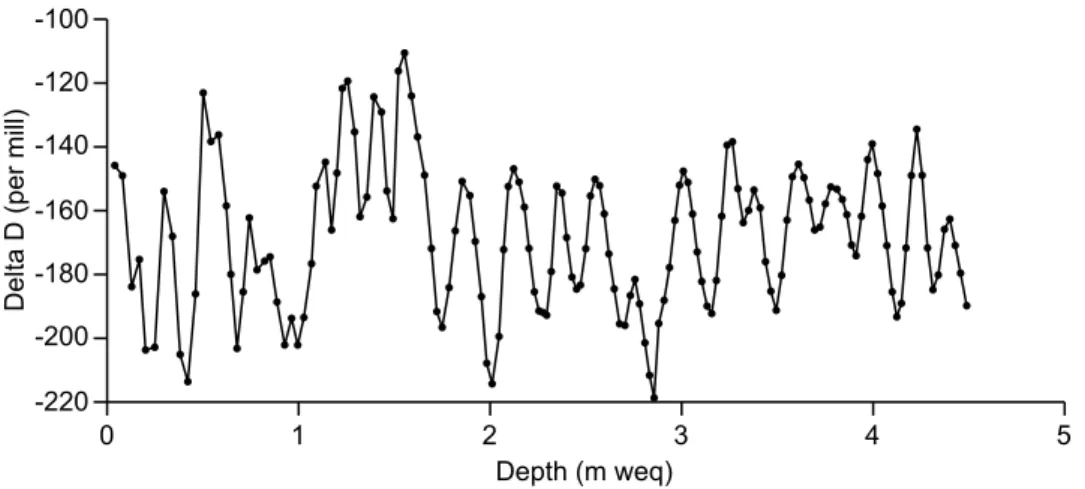
Figure 2 shows the profile of δD in ice cores from surface to 11.2m, which corresponds to 4.5m water eq. The profile of δD showed obvious seasonal variations. We calculated annual thickness which was determined by the distance of δD negative peaks. The depth of 11.2m corresponded to AD 1995, and average accumulation rate from 1996 to 2013 was 0.21 m water eq.
yr-1, which was also comparable to those reported in previous studies (Bales et al., 2009)
References
Aoki, T. and 4 others, Field activities of the "Snow Impurity and Glacier Microbe effects on abrupt warming in the Arctic"
(SIGMA) Project in Greenland in 2011-2013, Bullet. Glaciolog. Res., 32, 3-20, doi: 10.5331/bgr32.3, 2014.
Bales and 8 others, Annual accumulation for Greenland updated using ice core data developed during 2000-2006 and analysis of daily coastal meteorological data, J. Geophys. Res., 114(D06116), doi:10.1029/2008JD011208, 2009.
Gow, A. J., Depth-time-temperature relationships of ice crystal growth in polar glaciers, CREEL Res. Report, 300, 1971.
0 200 400 600 800 1000
0 50 100 150 200
Density (kg m-3)
Depth (m)
Figure 1. Density profile of ice cores obtained from SIGMA-D
-220 -200 -180 -160 -140 -120 -100
0 1 2 3 4 5
Delta D (per mill)
Depth (m weq)
Figure 2. Profile of δD from surface to 4.5m water eq. depth at SIGMA-D