A phylogeny of Japanese dwarf bamboos, the Sasa‑group based on RAPD‑ and morphological data analyses
著者 Kobayashi Mikio, Furumoto Ryo journal or
publication title
植物地理・分類研究 = The journal of phytogeography and toxonomy
volume 52
number 1
page range 1‑24
year 2004‑07‑25
URL http://hdl.handle.net/2297/48641
Introduction
Muroi(1937)was the first who divided the Japanese bamboos into three main groups ; the
“Take”, the “Sasa” and the “Bamboo”. These are defined by the culm-sheath deciduous, culm- sheath persistent and sympodial rhizome system without considering the culm height, respec- tively. Recently they have been most acceptably revised by Suzuki(1996), who recognized 6 gen- era in the Take-group, Phyllostachys, Hibano- bambusa,Semiarundinaria,Sinobambusa,Tetragono- calamus andShibataea; 8 genera in the Sasa- group,Sasa,Neosasamorpha,Sasamorpha,Sasaella, Pseudosasa,Indocalamus,Pleioblastus and Chi- monobambusa; and two genera of Bambusa and Dendrocalamus in the Bamboo-group. The Take-and Sasa-group are distributed naturally in the temperate region, while the Bamboo- group was introduced from tropical Asia(Suzuki
1978)which is laid aside in the present study.
Among the Sasa-group, genera Sasa and Sasamorpha are representative floristic ele- ments that characterize the plant community in Japan. GenusSasais almost endemic to the Ja- pan Islands with 32 species, whereas the only two species ofSasamorphaare distributed in the Pacific side of the Japan Islands and Korea
(Suzuki 1996). Suzuki(1961)established the
‘Crassinodi-line’ as a distribution limit which lies longitudinally parallel to the Pacific coast line from north to south of the northeastern dis- trict of the Japan Islands(Fig. 1). The line is based on an approximate 50 cm of mean annual maximum snow depth and defines the geo- graphical distribution limits ofSasa sect.Crassi- nodi on the Pacific side, while Sasa sects.Sasa andMacrochlamysare distributed in the exceed- ingly snowy area on Japan Sea side. Monilicla-
1Department of Forest Science, Faculty of Agriculture, Utsunomiya University, Utsunomiya 321―8505, Japan;
2Oversea Cooperation Department, Forest Tree Breeding Center, 3809―1 Ishi, Juo 319―1301, Ibaraki, Japan
!The Society for the Study of Phytogeography and Taxonomy 2004
Mikio Kobayashi
1and Ryo Furumoto
2: A phylogeny of Japanese dwarf bamboos, the Sasa-group based on RAPD- and morphological data analyses
Abstract
A phylogenetic relationship of 30 Japanese bamboo taxa was analyzed includingPhyllostachys bambusoides, Shibataea kumasasa, Sinobambusa tootsik, and the species of four most common genera of the Sasa-group ; Sasa,Sasamorpha,PleioblastusandPseudosasabased on 327 RAPD data by Wagner parsimony rooted atStrep- tochaeta spicata. Phyllostachys/Shibataea positioned as the earliest divergent clade, Pseudosasa was the next most basal, andSasamorpha/Sasasect.LasiodermaandPleioblastus/SasaexcludingLasiodermaformed a sister clade at the terminals. Within genusSasaclade, sect.MacrochlamysincludingSasa jotanii was the most basal, Monilicladae was the next most basal, followed by the sister clades of sects.Sasa andCrassinodi at the termi- nals. Clusters of a UPGMA dendrogram coincided with the topology of the RAPD tree except for the position of Pseudosasa. Differencies between another RAPD tree with representative 20 species and a variety of the Sasa- group and a morphological tree with 14 species and a variety based on 35 characters both rooted at Phyl- lostachys bambusoides were discussed. Section Lasioderma was in the Sasamorpha clade in the RAPD trees, while the morphological tree showed it as a component of the genusSasa. These results compelled us to exclude the section from the genus Sasa and to conserve the genusNeosasamorpha Tatew. Character states between culm-sheaths persistent and deciduous, branching pleioclade and monoclade, culm erect and ascending were dis- cussed on the former as the plesiomorphic and the latter as the apomorphic to consider the evolutionary trend among the Japanese bamboos and divergence of genusSasain accordance with the snowy environment.
Key words: Japanese bamboos,Neosasamorpha, phylogeny,Sasa, Sasa-group.
1
dae of other section is distributed in a Pacific Ocean environment, whereas sect. Lasioderma mostly within the distribution range of the sect.
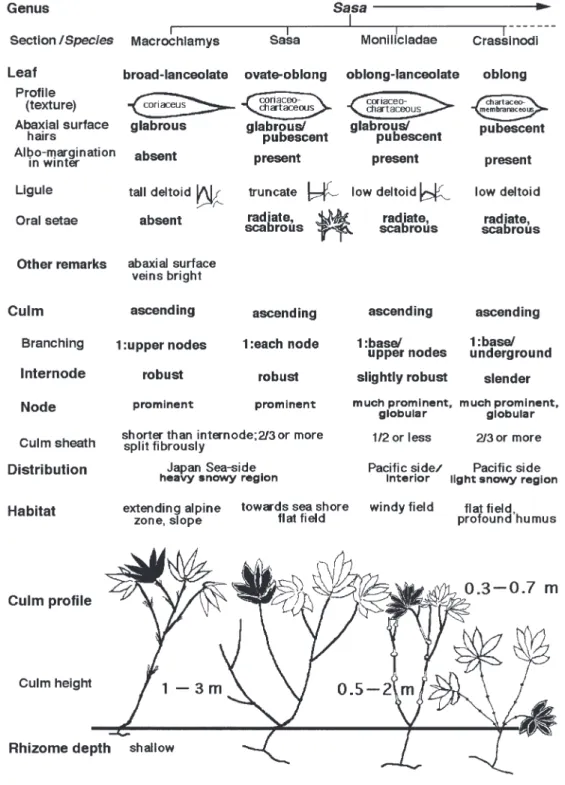
Crassinodi(Fig. 1, Suzuki 1978). Key characters of vegetative organs, habitat property and geo- graphical distribution of these dwarf bamboos are schematically summarized in Fig. 2.
Tanimoto(1984)discovered the distribution of a plant like Sasa kurilensis of sect. Macrochla- mys in Isls. Hachijojima and Mikurajima, Izu Is- lands, even though these islands are located in the Pacific Ocean far south of the Izu Peninsula
(Fig. 1). His discovery was so sensational from a phytogeographical viewpoint that controversy Fig. 1. Map showing the distribution range of genusSasa sect.Crassinodi(screened area), theCrassinodi-line
(bold line), locations of sect.Lasiodermaplants(open dots), and main locations of sampling site in the Japan Islands.
2
aroused over which taxon the plant should be ascribed to : Sasa kurilensis var.jotanii(Inoue and Tanimoto 1985),S.kurilensis var.kurilen- sis(Kobayashi 1985), or S. tsuboiana(Suzuki 1996). Recently, Kobayashi(2000)treated it as a new species, S. jotanii, after an intensive study on its flower morphology.
Nakai describedSasasect.Lasioderma(Nakai 1931)and sect.Acrocladula(Nakai 1934). Tate- waki(1940)recognized these groups as having putative hybrid origin between Sasa and Sasamorpha and revised them into a new genus Neosasamorpha. Koidzumi described two new sections of genus Sasa, i.e., Pseudosasamorpha
(Koidzumi 1939)and Nanopseudosasamorpha
(Koidzumi 1942), and decided that, contrary to Tatewaki’s treatment, the two intercalary sec- tions form continuous intermediaries between Sasa and Sasamorpha. Suzuki(1978)initially treated those four sections as one,Sasasect.La- sioderma Nakai sensu lato. However, Suzuki
(1996)later adopted Tatewaki’sNeosasamorpha while excluding the possibility of hybridity.
Using allozyme evidence on hybridization in the genus Sasa and its related genera, Taka- hashi et al.(1994)decided that these confusing taxonomic treatments were mainly due to inter- sectional and intergeneric hybridization not only on the F1hybrid level but also at the underlying genetic recombination level, in which phyloge- netic analysis was laid aside. Thus, distribution patterns and putative hybridity of various Sasa- group require explicit analytical methods to re- solve the phylogenetic relationships of each sec- tion and position.
In 1990, Williams et al. developed a method of RAPD (random amplified polymorphic DNA)
analysis examining the relation between RAPD data with RFLPs. Before that, Nei and Li(1979)
proposed the transformation of shared restriction -site data of mitochondorial DNA fragments into genetic distance for RFLPs analysis. Many stud- ies suggest that RAPD banding patterns are good predictors of homology among various sub- ordinate taxa as follows. Dos Santos et al.(1994)
compared the modes of genetic similarity among 45 Brassica oleracea genotypes between RAPD and RFLPs methods and found that there is high relationship between them ; effective classi-
fication of Japonica rice cultivars(Mackill 1995); good correlation with RAPD,rbcLsequences and RFLPs data for phylogenetic analysis among lo- cal populations ofLarix(Shiraishi et al. 1996);
among three species of Helianthus as deter- mined by Southern hybridization or correlation with restriction sites of endonucleases, and/or homologous genetic loci(Rieseberg 1996); and high consistency index between most parsimoni- ous trees based on RAPD-dataset and supranu- clear dataset of morphological, pollen epidermis texture, chromosomal and chemical variation among sections of genusAllium(van Raamsdonk et al. 1997). Thus, applications for various sub- ordinate taxa from cultivars through congeneric species or sections show that RAPD data are ef- fective in analyzing their phylogenetic relation- ships.
The Japanese dwarf bamboos have a uniform- ity in genomic size among related genera such that all are tetraploid with 2n=48(Tateoka 1955). These taxa have self-compatibility and few crossing barriers to forming hybrids even be- tween distantly related genera(Muramatsu 1981)suggesting an underlying homology in chromosomal morphology. These findings sug- gest that Japanese bamboos are close enough for effective RAPD analysis, considering segregation of a single RAPD marker links well with the configuration of chromosome-specific DNA frag- ments(Williams et al. 1990). Therefore, we con- sidered that RAPD analysis will be sensitive enough to resolve the phylogenetic relationships among Japanese dwarf bamboos.
As mentioned above, phylogenetic positions of Sasa jotanii and Sasa sect. Lasioderma Nakai sensu lato are ones of the most interesting ques- tions concerning the Japanese dwarf bamboos.
In the present study, we at first, tried to analyze a phylogenetic relationship within the dwarf bamboos based on the morphological characters by Wagner parsimony method because no cladis- tic analysis using the morphological characters of Japanese bamboos has been reported yet since the description of the genusSasaby Makino and Shibata(1901). Next, a UPGMA analysis with RAPD data was carried out to clarify principal clusters among Japanese bamboo taxa. Third, phylogenetic relationship was investigated by 3
Fig. 2. Index of vegetative organs to Japanese dwarf, culm-sheath persistent bamboos, the Sasa-group
4
excluding genusSasaella.
5
means of Wagner parsimony with RAPD data.
Lastly, a combined data set with the morphologi- cal and RAPD was analyzed, since the method does not require any assumption of evolutionary change or the kind of input data(Nei 1990).
Materials and methods Plant materials
Table 1 shows 40 samples of bamboo speci- mens used for UPGMA and parsimony analyses with RAPD data. The taxa included 7 genera and 24 species of Japanese bamboos. One of the most primitive herbaceous bambusoid grasses, Streptochaeta spicata was selected for compari- son of the genetic distances in UPGMA and as an outgroup for a parsimony analysis to role out the most basal clade among the Japanese bam- boos. Streptochaeta and Anomochloa are the most ancestral clade of the Poaceae, as indicated byndhF sequence data(Clark et al. 1995)and combined sequence data of ndhF, rbcL, and PHYB (Clark et al. 2000). The taxonomic treatment of the bamboos was principally based on the system of Suzuki(1978). Among the col- lected specimens, two undescribed taxa were in- cluded as an intermediate plant between Sasa kurilensis and Sasamorpha borealis, and as re- lated allies of Sasamorpha borealis having an extremely fragile culm, narrowly divaricate branching, and concaved leaves.
Another common genus Sasaella was laid aside for the further study for its intergeneric hybridity betweenSasaandPleioblastus(Taka- hashi et al. 1994). The first objective of the pre- sent study was high-lighted on the position of Sasa section Lasioderma, a putative hybrid taxon between genera Sasa and Sasamorpha, avoiding more complicated analytical conditions.
Majority of the specimens were collected from native stands. Some were obtained from the cul- ture collections of the Fuji Bamboo Garden and Utsunomiya University(Fig. 1, Table 1). Voucher specimens were maintained in the herbarium of Department of Forest Science, Faculty of Agri- culture, Utsunomiya University.
Morphological data collection
Four most common genera of Sasa-group ; Sasa,Sasamorpha,Pseudosasa andPleioblastus
were listed up their key characters of vegetative organs of leaf, branch, culm, culm profile, even more the distribution pattern and habitat char- acteristics(Fig. 2).
Due to limited records on bamboo flowers it was possible to collect the overall complete data of only 16 taxa, as shown in Table 2, which were based on the literatures of Takagi(1963), Suzuki
(1978), Kobayashi(2000)and a direct measure- ment on herbarium specimens as follows ; the first flower and/or caryopses records ofSasa pu- biculmis subsp. sugimotoi(RF 573, MK 1668, Aug. 3, 1998)from Mt. Amamaki, Tochigi Prefec- ture and Sasamorpha borealis var. viridescens
(MK 131, May 6, 1985, Mt. Miharayama, Isl.
Hachijojima ; MK 1669, Aug. 10, 2001, Ebine Park, Isl. Mikurajima). Additional specimens ex- amined for flower measurements were as fol- lows : Sasa tsukubensis(MK 149, Jun. 3, 1985, Senjogahara), Sasamorpha borealis(MK 198, May 20, 1986, Senjogahara),Sasa shimidzuana
(MK 191, May 10, 1986, Mt. Nekko),Pseudosasa japonica(MK 121, Feb 10, 1985, Hachioji, To- kyo),Pleioblastus simonii(MK 132, May 6, 1985, Isl. Hachijojima). Each value listed on Table 2 shows a mean value of three to 35 measure- ments of floral organs.
Among these 16 taxa, a total of 35 characters were scored as seen in Table 3 and being com- posed of the 19 characters of vegetative organs from the index shown in Fig. 2 and the 16 char- acters of floral organs registered in Table 2. Cod- ing method was the reductive coding(Forey and Kitching 2000)such as all characters were scored as bistate with 1/0 whether it occurs and/or pres- ence or does not occur and/or absence. We took both characters of non-overlapping variations and continuous quantitative variations, though the latter is found to contain less phylogenetic signal(Stevens 2000). When a variation was considered as overlapping one by visual inspec- tion, we used the character only when discrete ranges are recognized among the values. For ex- ample, in Table 2, caryopsis length ranged from 5.6 to 18.5 mm, in which two discrete ranges are recognized, i.e., one is 5.8 to 8.0 and another is 11.8 to 18.5. Then we scored them as “ caryopsis less than 10 mm” in Table 3.
Phyllostachys bambusoides, one of the Take- 6
7
8
group, was selected as an outgroup for parsi- mony analysis of 35 morphological characters in 15 ingroup taxa. This choice seemed appropriate since RFLP analysis had suggested that Phyl- lostachys bambusoides was positioned more ba- sal in the East Asiatic bamboo clade than the Sasa-group(Kobayashi 1997).
RAPD analysis
Samples were taken as rolled or immediately after unrolled leaves to avoid any epiphytic fun- gal contaminations(Zhang et al. 1997). Total DNA was extracted from fresh or silica gel-dried
(Chase and Hills 1991)leaves using a modified CTAB method(Hasebe and Iwatsuki 1990).
Sample DNA in a TE buffer was used as tem- plate DNA for RAPD analysis after Williams et al.(1990). Forty primers of the Operon’s 10―mer kits(Kit-A and Kit-C)were used as the random primers for amplification. Amplification reac- tions were performed in volumes of 10 μl con- taining 15 to 60 ng template DNA, 0.25 U Taq DNA polymerase(GeneTaq, Nippon Gene), 0.3 mM primer, 0.25 mM of each dNTP, 1.65 mM MgCl2, 11 mM Tris-HCl(pH 8.8), 0.1 mM EDTA, 55 mM KCl, 0.11% Triton X 100, 0.25% glycerol, and 5 mM DTT. Polymerase chain reaction
(PCR)was performed in a Perkin Elmer Gene Amp PCR System 2400 programmed for an in- itial denaturation of 45 sec at 94℃followed by 43 cycles of denaturation for 30 sec at 92℃, an- nealing for 1 min at 48℃, extension for 2 min at 72℃, and post-elongation for 5 min at 72℃. Am- plification products were analyzed by electropho- resis in 2% agarose gels in 0.5×TBE buffer(45 mM Tris-base, 45 mM borate, 1.0 mM EDTA, pH 8.3)by pulse-field electrophoresis(CHEF DRII ; BioRad)and detected by staining with ethidium bromide. To confirm that the bands were stable and amplified genomic DNA, any sample DNA was omitted from the control lane for each primer and confirmed to be insensitive to DNA template concentrations varying from 10 to 100 ng/ml. Segregating polymorphic banding pat- terns were scored for presence/absence as 1/0 data matrices only when reproducible markers between 2 or 3 replicate PCRs for each random primers were detected.
Genetic distance between each samples was
calculated according to a formula introduced by Mackill(1995)based on Nei and Li’s(1979)es- timator F in which the shared DNA fragment F transforms restriction-site data into genetic dis- tances.
GD = 1−F = 1−{2 N/(Ni+ Nj)} In which Ni and Nj are the number of bands for samples i and j, respectively. N is the num- ber of shared bands between the two samples. A program software written in N 88 BASIC pro- duced by ourselves for calculating these genetic distances from PHYLIP data file as in the Ap- pendix is available for corresponding to the author. The genetic distance data were used to construct a cluster dendrogram by UPGMA us- ing NEIGHBOR in PHYLIP(Felsenstein, J. 1995.
PHYLIP(Phylogeny Inference Package)version 3.57 c. Seattle : University of Washington, URL : http : evolution.genetics.washington.edu/phylip/). An optional mode of Neighbor-Joining method in the NEIGHBOR program gave no systematically meaningful result such that majority of each clusters were composed of different generic taxa.
Phylogenetic analysis was carried out by Wag- ner parsimony with a 1,000―replicate bootstrap confidence using SEQBOOT, MIX and CON- SENSE in the program package PHYLIP version 3.57 provided by Felsenstein(1995). In using each program, data input was made with ran- domizing input order by three times of jumbling, without any character weighting. Calculating en- semble consistency and retention indices, CI and RI was referred to Maddison and Maddison
(1992)and ambiguous states at all nodes were omitted to avoid overestimation of those tree sta- tistics.
Results Morphological phylogeny
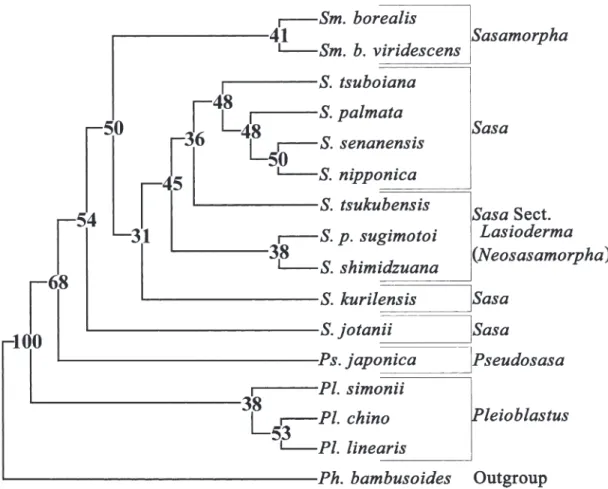
Wagner parsimony analysis of 35 morphologi- cal characters produced a single tree, with a length of 82 steps, a CI of 0.72, and an RI of 0.47(Fig. 3).Genus Pleioblastus was the most basal clade, the next most basal wasPseudosasa japonicawith 68% bootstrap confidence.Sasa jo- taniipositioned outside the clade ofSasamorpha andSasa including sect.Lasioderma.Sasa sect.
Lasioderma was monophyletic with Sasa tsuboiana S.nipponica group with 45% boot- 9
10
strap confidence.
RAPD analysis
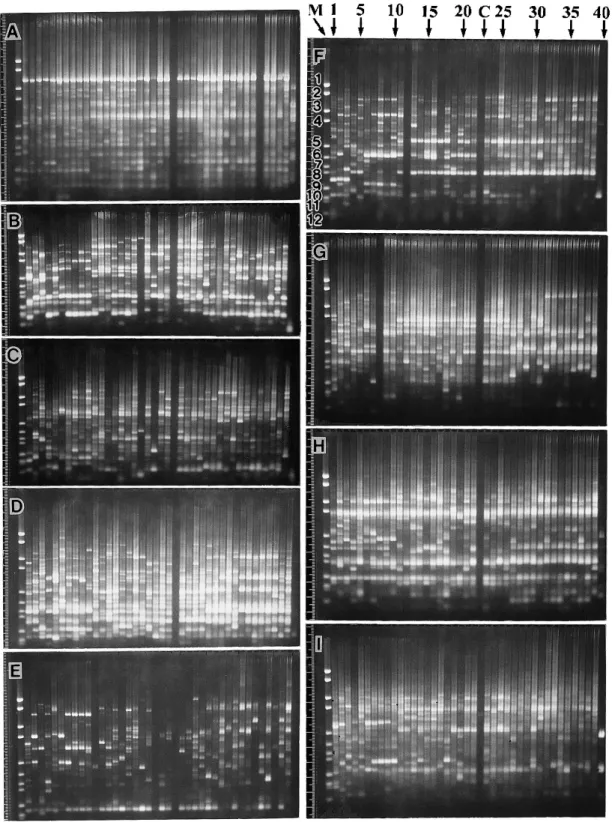
Nine out of 40 primers were selected to give stable electrophoretic banding patterns(Table 4). A total of 327 polymorphic bands were detected and scored as 1/0 data matrices as shown in Ap- pendix. Identification of RAPD bands was made by visual inspection of the original pictures of the gels(Fig. 4). In evaluating each banding pat- terns, the criteria for informative band was re- ferred to the bands within the size range of the DNA Molecular Weight Marker VI between 2,176 bp and 154 bp. Among them, the 11 th band of 220 bp was the finest, to which band with the same or stronger intensity were scored as significant. In the Appendix, data matrix of the whole RAPD bands was shown in order as
scored for 1/0 from top(well side)to bottom(front side)for each primer in each gel of A through I in Fig. 4.
The average band number for each Japanese bamboo specimen was 62 ; while the band of Streptochaeta spicata was 11, which fewer band number probably dues to ploidy level that the taxon is diploid, while the Japanese bamboos are tetraploid(Tateoka 1955 ; Soderstrom 1981).
UPGMA
A UPGMA dendrogram(Fig. 5)of genetic dis- tances between 40 specimens showed four princi- pal clusters within the Japanese bamboos ;(1)
PhyllostachysandShibataea;(2)Pseudosasa ja- ponica,Sinobambusa andPleioblastus;(3)Sasa excluding sect.Lasioderma; and(4)Pseudosasa owatarii and theSasamorpha-Lasiodermagroup.
Fig. 3. A single most parsimonious tree of 35 morphological characters in 16 taxa rooted atPhyllostachys bam- busoideswith CI, RI, and tree length of 0.72, 0.47, and 82 steps, respectively. The numbers on each node indi- cate a 1,000 replicate-bootstrap confidence(%).
11
The third cluster consisted of two main groups, Sasa sect. Macrochlamys and three sections of Monilicladae, Sasa and Crassinodi. Two speci- mens of S. tokugawana; one from Batou and the other from Hakone were placed in different groups.
Phylogenetic analysis based on RAPD data Wagner parsimony analysis of 327 RAPD bands from 40 samples yielded 8 equally parsi- monious trees in which the number of steps, CI, and RI of each tree were 1200, 0.86, and 0.44, respectively. In a majority rule consensus tree
(Fig. 6), four major clades were resolved. The basal clade consisted ofPhyllostachys bambusoi- desandShibataea kumasasa. The next most ba- sal clade contained both species of Pseudosasa, showing the most distinct point with the topol- ogy of the UPGMA dendrogram(Fig. 5). The re- mainder of the Sasa-group was strongly sup- ported in 90% of the bootstrap confidence.Sasa sect.Lasiodermawas placed in the same lineage as the genusSasamorpha, though this was sup- ported weakly in not more than 7% of the boot- strap confidence. Another group was subdivided into two principal clades, one that included the genera Pleioblastus and Sinobambusa, and an- other that was formed by the genusSasaexclud- ing sect. Lasioderma(hereafter called as the Sasa clade). Within theSasa clade, the species of sect. Macrochlamys together with two other taxa formed the most basal group, followed by those of sect.Monilicladae at the next most ba-
sal position. The species ofSasa sect. Sasa was sister to sect.Crassinodiat the terminal.
In general, hybrid taxa render a phylogenetic tree analysis ambiguous(McDade 1995 ; Riese- beg and Morefield 1995). Ambiguous polymor- phisms in RAPD analysis may result from poor discrimination by a primer against alternative priming sites of slightly different nucleotide se- quences(Williams et al. 1990). Hybrid taxa prob- ably caused many ambiguous banding patterns in RAPD-PCR products. Thus we removed sus- pected hybrid taxa from the 40 specimens with respect to the system of Suzuki(1978). This pro- cedure led to a reduced set of 22 taxa, including two to three representative species of each genus or section of the Sasa-group and an outgroup.
A Wagner parsimony analysis of 289 RAPD data rooted at Phyllostachys bambusoides pro- duced a single most parsimonious tree(Fig. 7 ; tree length=723 steps, CI=0.87, RI=0.57). In this tree, two main clades were resolved. One com- prised the generaPseudosasa,Sasamorpha and SasasectLasioderma, the other consisted of the genusPleioblastus which was sister to theSasa clade. Within the Sasa clade, sect. Macrochla- mys was the most basal, followed by theMonili- cladae and the sects. Sasa and Crassinodi as sister clades at the terminal.
RAPD and morphological data set
Analysis of combined RAPD and morphological data sets of 298 characters in 16 taxa rooted at Phyllostachys bambusoides produced five equally parsimonious trees(length 639 steps, CI=0.83, RI=0.59). The majority rule consensus tree(Fig.
8)resolved three major clades. Sasa clade and Sasamorpha/sect. Lasioderma may appear as sister to each other with that clade sister to the Pseudosasa/Pleioblastusclade. In each clade, sis- ter relationship ofPseudosasa japonica to genus Pleioblastus, genus Sasamorpha to Sasa sect.
Lasioderma, and sect. Macrochlamys to other sections of Sasa clade is supported with 62%, 54% and 25% of bootstrap confidence, respec- tively.
Discussion
Evolutionary trends in Japanese bamboos Naturally distributed Japanese bamboos are 12
Fig. 4. RAPD banding patterns for primers of A, OPA―01 ; B, OPA―06 ; C, OPA―08 ; D, OPA―17 ; E, OPC―03 ; F, OPC―06 ; G, OPC―14 ; H, OPC―16 ; I, OPC―18 in the Japanese bamboos. The numbers indicated in the row of photograph F refer to the sample number as shown in Table 1. Two lanes containing control mixture
(C),and a DNA size marker, Boehringer Mannheim’s DNA Molecular Weight Marker VI(M),in which numbers 1 through 12 in the column designate 2176, 1766, 1230, 1033, 653, 517, 453, 394, 298, 234, 220 and 154 bp, re- spectively.
13
all temperate species with the somatic chromo- some number of 2n=4x=48(Tateoka 1955 ; Soderstrom 1981)which are resolved as mono-
phyletic with a chloroplast DNA analysis(Koba- yashi 1997). Diagnostic characters of Japanese bamboos are mainly based on the external mor- Fig. 5. UPGMA dendrogram of 40 samples based on Nei and Li’s genetic distances with RAPD data listed in
Appendix.
14
phology of vegetative organs due to the rarity of flowering, e.g., the culm-sheath deciduous or persistence and other vegetative organs as shown in Fig. 2. Both a RAPD based tree(Fig. 6)
and the chloroplast DNA-tree(Kobayashi 1997)
show Phyllostachys and Shibataea, the Take-
group are more basal than the Sasa-group sug- gests the deciduous culm-sheath is a plesiomo- phic character, while persistent is an apomor- phic one.
Pleioblastus-Sinobambusa clade is relatively basal in tree topology than theSasa-clade(Fig.
Fig. 6. Majority rule consensus tree of eight equally parsimonious trees based on 327 RAPD data in 39 Japanese bamboo samples and an outgroup rooted at Streptochaeta spicata with CI, RI, and tree length of 0.86, 0.44, and 1,200 steps, respecttively. Numbers on each node show a 1,000 replicate-bootstrap confidence(%).
15
6). Genus Pleioblastus is more basal than the other Sasa-group in the morphological and RAPD-morphological combined trees(Figs. 3 and 8). The species of the Take-group ; Phyl- lostachys bambusoides,Shibataea kumasasa and Sinobambusa tootsik bear two, five and more than three branches per node, respectively, whereas genus Pleioblastus bears more than three. While genusSasa clade as well as Pseu- dosasaandSasamorpha are monoclade(Fig. 2).
Thus, those species which are relatively basal than the Sasa clade all have the multiple branching habit suggesting that the character state of multiple branching per node or pleio- clade is plesiomorphic, while one branch per node or monoclade is apomorphic.
The branch number per each node is origi- nated from the primordial axis number per each mid-culm bud. In this respect, Usui(1957) re- ported four types of mid-culm branch buds and Fig. 7. A single most parsimonious tree of 289 RAPD data in 21 taxa of Sasa-group and an outgroup ofPhyl- lostachys bambusoideswith CI, RI, and tree length of 0.87, 0.57, and 723 steps, respectively. Numbers on each node show a 1,000 replicate-bootstrap confidence(%).
16
corresponding branch complements among the Japanese bamboos as genusSasa-,Pleioblastus-, Shibataea- and Phyllostachys-types. Each type is characterized by one- or two-keeled prophyl- lum that enclosed a primordial branch axis and subsidiary buds developed before and/or after a rupture of the prophyllum in the bud stage. Phy- logenic transformation was supposed to have
taken place with a fusion of a one-keeled pro- phyllum and a foliage leaf primordium to pro- duce a two-keeled prophyllum, accompanying with a reduction of the branch numbers from many to one. Considering on the evolutionary trend, Usui speculated that the earliest diversi- fied was the Shibataea-type, next was the Phyllostachys-type, followed by the Pleioblastus- Fig. 8. Majority rule consensus tree produced from five equally parsimonious trees of 298 combined RAPD/mor- phological data in which CI, RI, and tree length are 0.83, 0.59, and 639 steps, respectively. Numbers on each node show a 1,000 replicate-bootstrap confidence(%).
17
type, and the most advanced was theSasa-type.
In the present phylogenetic analyses, it was shown that the Take-group was the most ances- tral,Pleioblastusfollowed them, and genusSasa was the most advanced. These results suggest that the Usui’s scheme is adequate.
Phylogenetic position ofSasa jotanii
Suzuki(1996)persisted that theSasa kurilensis -like plant distributed in the Southern Izu Is- lands should be referred toSasa tsuboianaMaki- no of the sect.Monilicladae and even a variety ofSasa kurilensis was not believed to distribute in the Izu Islands far from the heavy snowy re- gion of the Japan Sea side. On the contrary, Maekawa(1971)pointed out thatSasa jotaniiis a remarkable example of a vicarious species with Sasa kurilensiswhich shows a disjunctive distri- bution over the Pacific side of the Japan Islands, discussing the phytogeographical differentiation inPlatanthera ophrydioides F.Schmidt. He gave some other examples of vicarious taxa such as Carex doenitziiBoeck. var.okuboi(Franch.)Kük., Patrinia triloba(Miq.)Miq. var. kozushimensis Honda, and other Orchidaceous plants to show the Izu Islands is a general vicarious area with the Japan Sea side. Kobayashi(2000)placedS.
jotanii within the genusSasa, and considered it most closely related to S. kurilensis of the sect.
Macrochlamys, based on a morphological com- parison of S. jotanii, S. kurilensis and S.
tsuboiana. RAPD-based and RAPD-morphological combined trees(Figs. 6 and 8)includedS.jotanii in the sect. Macrochlamys which supported Maekawa’s phytogeographical viewpoint and suggested that the taxonomic treatment ofS.jo- tanii as a distinct species of sect.Macrochlamys
(Kobayashi 2000)is adequate.
However, the morphological tree(Fig. 3)sepa- rated S. jotanii from the Sasa clade. Sasa jo- tanii has unicellular long hairs at the margin of prophyllum that embraces a bud borne on the node near the apex of monopodial rhizome(Ko- bayashi and Yachimori 2000). Takenouchi
(1932)clarified that the rhizomatous prophyllum hairs in the Take-group,Phyllostachys,Tetragono- calamus and Chimonobambusa which is occa- sionally included in the Sasa-group though, have unicellular long ones, while in the genera of
Sasa-group, they have a mixed type of unicellu- lar and multicellular hairs. Thus, S. jotanii shares a common character with Take-group in other morphological traits than the analyzed characters as in Table 3. Those characteristics imply that S. jotanii has a possibility in posi- tioning the more basal clade as in the morpho- logical tree than in the RAPD trees. The decision is laid aside for the further phylogenetic study with other molecular markers, because the boot- strap confidences of many clades of RAPD trees in the present study are generally low.
Divergence of genusSasa
Not concerning with the branch numbers, the Take-group, Pleioblastus, and even Pseudosasa are relatively basal in tree topology than genus Sasa(Figs. 3, 6, 7 and 8). This signifies that erect culm is the more ancestral state than an ascending one. Ascending culms as well as culm height in the genus Sasa plants have been con- sidered as an adaptation to the snow depth envi- ronment(Suzuki 1961 ; Kobayashi 1985). Figure 2 shows the morphological aspect of vegetative organs, habitat, and the distribution patterns on the horizontal view of the Japan Islands from the Japan Sea side through the Pacific side.
Genera Pseudosasa and Pleioblastus are situ- ated on the snow-less area on the right end, which are distributed both sides of the Japan Is- lands other than Hokkaido, though only two spe- cies of Pleioblastus are sporadically distributed around the Oshima Peninsula in Hokkaido
(Suzuki 1978).
Suzuki(1961)considered the mean annual snow depth of snow-cover is one of the most im- portant limiting factors for the distribution of ge- nus Sasaplants. In the regions where the snow depth is more than 75 cm, the sect.Sasahabit is predominant. Species of sect. Macrochlamys are always distributed sympatrically with sect.Sasa, but occur generally more inland and in higher elevation. While in the regions of less than 50 cm snow depth, species of sect. Crassinodi are dominant. In the regions of least snow, e.g. in the southern parts of the Kanto district, they be- come rare and usually genus Pleioblastus ap- pears in dense thickets.
RAPD trees showed the intergeneric relation- 18
ships as the genus Sasa excluding sect. La- sioderma was more advanced than the genera Sasamorpha and Pleioblastus, while as for the intrageneric relationships of genus Sasa, sect.
Macrochlamys was the most basal,Monilicladae was the next most basal, and sects. Sasa and Crassinodiwere the most advanced(Figs. 6 and 7). Coincidence of these phylogenetic relation- ships with the habitat segregation and the dis- tribution patterns as shown in Fig. 2 supports the Suzuki’s consideration above cited. The dis- tribution patterns suggest that the Japanese dwarf bamboos extended their distribution ranges northwards, diversifying genus Sasa plants from warm region towards the snowy area around the Japan Sea region.
At the first time of diversification, the species of the most basal clade in genusSasa, the sect.
Macrochlamys show wide range of distribution, thus S. jotanii inhabits in a mild climate of Southern Izu Islands on one hand, while S.
kurilensisin heavy snowy areas surrounding the Sea of Japan on the other hand, though S. jo- tanii is considered as the vicarious species as discussed earlier.
In all trees, the sects.Sasa andCrassinodi or parts of them are sister to each other at termi- nal nodes, suggesting that the two taxa are the closest and most advanced lineages in the genus Sasa. The sister relationship with a small ge- netic distance between them corresponds to the geographical distribution pattern in the Japan Islands such that occurred side by side around the Crassinodi-line. In addition, Suzuki(1961)
reported an occurrence of intermediate plants between both sections alongside the Crassinodi- line in Northern Japan. Niimiya and Ito(1983)
also reported the occurrence of the intermediate plants in Hokkaido and studied their morpho- logical characteristics in special reference to the portions of winter buds. Kobayashi and Hama- michi(2001)studied the intermediate plants dis- tributed around the Senjogahara as the clonal complex ofSasa nipponica S.palmata which was selectively predated by Sika-deer, Cervus nippon Temminck. Moreover, the present find- ings confirm the results of the allozyme polymor- phism analysis by Takahashi et al.(1994). They showed that genetic differences of allozyme phe-
notypes on 10 enzyme systems between the two sections were small and the sections formed a
“composite type”. These findings suggest that sects. Sasa and Crassinodi differentiated most lately in accordance with the habitat segregation appeared contrastively side by side the Crassinodi-line located on the Pacific side inte- rior.
Taxonomic position of sect.Lasioderma
In all trees(Figs. 3, 6, 7 and 8), the two gen- era Sasa excluding sect. Lasioderma and Sasamorpha were located in distinct clades, sug- gesting that the two taxa have a distinct generic limit each other and the taxonomic treatment of Sasasect.Sasamorpha(Nakai)Muroi annotated by Ohrnberger(1999)was inaccurate.
On the contrary, a discrepancy between mor- phological and RAPD trees ; morphological tree placed the sect. Lasioderma into the same line- age as the genusSasa(Fig. 3), while in RAPD trees it fell into the Sasamorpha clade(Figs. 6, 7 and 8), gives us insight into the generic limit problem amongSasa,Sasamorpha and sect.La- sioderma.
Diagnostic morphological characters of sect.
Lasioderma are :(1)several foliage leaves per branch complement,(2)developing radiate- scabrous oral setae,(3)leaf blades usually asym- metrically oblong-lanceolate,(4)slightly ascend- ing culm,(5)culm-sheath slightly shorter than internode, and(6)culm-sheath wraps branch base with main culm separately(Fig. 2 ; Suzuki 1978). Among them, the former two,(1)and(2)
are limited to genusSasa, while the last one,(6)
is to Sasamorpha, whereas other three,(3)〜(5)
are the intermediate characters characteristi- cally seen in sect.Lasioderma.
Tatewaki(1940)was the first to recognize that Sasasects.LasiodermaandAcrocladulahad pu- tative hybrid origins as Sasamorpha×Sasa and revised them into a new genus Neosasamorpha.
Takahashi et al.(1994)pointed out that Sasa sect. Lasioderma Nakai s.l. had distinctive ge- netic characters caused by successive recombina- tion which were not present in the parental taxa.
For a long time, sect. Lasioderma has been treated as a component of genus Sasa(Suzuki 1978)which was supported by our morphological 19
tree. However, RAPD trees separated it from the genus and showed the more closed allies of the genus Sasamorpha on the genetic basis which makes us exclude it from the genusSasa. In ad- dition, the taxon has some distinctive genetic characteristics and intermediate morphology. Ac- cording to them, we at present conserve the ge- nus Neosasamorpha Tatew. instead of sect. La- sioderma.
Acknowledgements
We greatly appreciate anonymous reviewers for their critical comments and invaluable sug- gestions. We wish to thank Dr. K. Nakamura emeritus professor of Utsunomiya University for providing us the sample of Pseudosasa owatarii from Mt. Miyanoura, Isl. Yakushima. We also thank Mr. H. Kashiwagi of the Fuji Bamboo Garden for his help in providing their culture collections. We are indebted to Mr. H. Hirose, the chief of the general management section, and the personnel of the village office of Mikura- jima, Tokyo for providing us their facilities and various suggestions to bring out our field works in the Isl. Mikurajima. We thank Mrs. S. Kasai and M. Ishii of Isl. Hachijojima, Tokyo for their various helps in collecting bamboo specimens in the island.
References
Chase, M.W. and Hills, H.H. 1991. Silica gel : an ideal material for field preservation of leaf samples for DNA studies. Taxon40 : 215―220.
Clark, L.G., Kobayashi, M., Mathews, S., Span- gler, R.E. and Kellogg, E.A. 2000. The Puelioi- deae, a new subfamily of Poaceae. Syst. Bot.
25 : 181―187.
Clark, L.G., Zhang, W. and Wendel, J.F. 1995. A phylogeny of the grass family(Poaceae)based onndhF sequence data. Syst. Bot. 20 : 436―
460.
Dos Santos, J.B., Nienhuis, J., Skroch, P., Ti- vang, J. and Slocum, M.K. 1994. Comparison of RAPD and RFLP genetic markers in deter- mining genetic similarity amongBrassica oler- acea L. genotypes. Theor. Appl. Genet. 87 : 909―915.
Forey, P.L. and Kitching, I.J. 2000. Experiments in coding multistate characters. Scotland, R.
and Pennington, R.T.(eds.). Homology and systematics, pp.54―80. Taylor & Francis, Lon- don.
Hasebe, M. and Iwatsuki, K. 1990. Adiantum capillus-venerischloroplast DNA clone bank as useful heterologous probes in the systematics of the leptosporangiate ferns. Amer. Fern J.80 : 20―25.
Inoue, K. and Tanimoto, T. 1985. Sasa plants
“Mikura-zasa” on Izu Islands, Japan. J. Jpn.
Bot.60 : 249―250.(in Japanese)
Kobayashi, M. 1985. Sasa kurilensis and other Sasa plants on Hachijojima and Mikurajima, Izu Islands, Japan. J. Phytogeogr. Taxon.33 : 59―70.(in Japanese)
Kobayashi, M. 1997. Phylogeny of world bam- boos analysed by restriction fragment length polymorphisms of chloroplast DNA. Chapman, G.(ed.). The bamboos, pp.225―234. Academic Press, London.
Kobayashi, M. 2000. Flower morphology ofSasa jotanii(Poaceae : Bambusoideae); new taxo- nomic status. J. Jpn. Bot.75 : 241―247.
Kobayashi, M. and Hamamichi, T. 2001. Ecology of Japanese dwarf bamboos, the Sasa group and their selective predation by Sika deer, Cervus nippon Temminck occurred in the montane forest at southern vicinity of Odashi- rogahara, Okunikko, Japan. Bull. Utsunomiya Univ. For.37 : 187―198.(in Japanese)
Kobayashi, M. and Yachimori, S. 2000. Roof rat, Rattus rattus is a predator of bamboo shoot and monopodial rhizome apex ofSasa kurilen- sis var. jotanii in Mikurajima Island, Izu Is- lands, Japan. Bamboo Jour. 17 : 35―40.(in Japanese)
Koidzumi, G. 1939. Contributiones ad cognitio- nem florae Asiae Orientalis. Acta Phytotax.
Geobot.8 : 50―74.
Koidzumi, G. 1942. Sasa sect. Lasioderma et Nanopseudosasamorpha. Acta Phytotax. Geobot.
11 : 101―119.(in Japanese)
McDade, L.A. 1995. Hybridizaion and phyloge- netics. Hoch, P.C. and Stephenson, A.G.(eds.). Experimental and molecular approaches to plant biosystematics, pp.305―331. Missouri Bo- tanical Garden, St.Louis.
Mackill, D.J. 1995. Classifying Japonica rice cul- tivars with RAPD markers. Crop Sci.35 : 889 20
―894.
Maddison, W.P. and Maddison, D.R. 1992. Mac- Clade Version 3. 398 pp. Sinauer Associates, Inc., Sunderland.
Maekawa, F. 1971. The wild orchids of Japan in colour. 495 pp. Seibundo-Shinkosha.(in Japa- nese)
Makino, T. and Shibata, K. 1901. On Sasa, a new genus of Bambuseae, and its affinities.
Bot. Mag. Tokyo15 : 18―27.
Muramatsu, M. 1981. Hybridization among Bambuseae species. Higuchi, T.(ed.). Bamboo production and utilization ; Proceedings of the Congress Group 5.3 A, pp.65―69. XVII IUFRO World Congress, Kyoto.
Muroi, H. 1937. Nouringaku jou kara mita Ni- hon kyudo no Take to Sasa. Hyogo Seibut- sugaku Kaishi (13): 68―91.(in Japanese)
Nakai, T. 1931. Graminiae-Bambuseae. Miyabe, K. and Kudo, Y.(eds.). Flora of Hokkaido and Saghalien II. J. Fac. Agr. Hokkaido Imp. Univ.
26 : 180―195.
Nakai, T. 1934. Novitates Bambusacearum in Imperio Japonico recentissime detectae(1). J.
Jpn. Bot.10 : 547―581.
Nei, M. 1990. Molecular evolutionary genetics.
Japanese edition translated by Gojobori, T.
and Saito, N. 433 pp. Baifukan, Tokyo.(in Japanese)
Nei, M. and Li, W. 1979. Mathematical modal for studying genetic variation in terms of re- striction endonuclease. Proc. Natl. Acad. Sci.
U.S.A.76 : 5269―5273.
Niimiya, H. and Ito, K. 1983. Studies on the variation pattern of morphological characteris- tics in the genusSasa, Graminiae(1). The En- vironmental Science, Hokkaido 6 : 117―150.
(in Japanese)
Ohrnberger, D. 1999. The bamboos of the world.
585 pp. Elsevier, Amsterdam.
Rieseberg, L.H. 1996. Homology among RAPD fragments in interspecific comparisons. Molec.
Ecol.5 : 99―103.
Rieseberg, L.H. and Morefield, J.D. 1995. Char- acter expression, phylogenetic reconstruction, and the detection of reticulate evolution. Hoch, P.C. and Stephenson, A.G.(eds.). Experimen- tal and molecular approaches to plant biosys- tematics, pp.333―353. Missouri Botanical Gar-
den, St. Louis.
Shiraishi, S., Isoda, K., Watanabe, A. and Kawasaki, H. 1996. DNA systematical study on the Larix relicted at Mt. Manokami, the Zao Mountains. J. Jpn. For. Soc.78 : 175―182.
(in Japanese)
Soderstrom, T.R. 1981. Some evolutionary trends in the Bambusoideae(Poaceae). Ann. Missouri Bot. Gard.68 : 15―47.
Stevens, P.F. 2000. On characters and character states : do overlapping and non-overlapping variation, morphology and molecules all yield data of the same value? Scotland, R. and Pen- nington, R.T.(eds.). Homology and systematics, pp.81―105. Taylor & Francis, London.
Suzuki, S. 1961. Ecology of the bambusaceous genera Sasa and Sasamorpha in the Kanto and Tohoku Districts of Japan, with special refernce to their geographical distributions.
Ecol. Res.15 : 131―147.
Suzuki, S. 1978. Index to Japanese Bam- busaceae. 384 pp. Gakushukenkyusha, Tokyo.
(in Japanese)
Suzuki, S. 1996. Illustrations of Japanese Bam- busaceae(Revised edition). 271 pp. Shu- kaishorin, Funabashi.(in Japanese)
Takagi, T. 1963. On the spikelets of Sasa, Pleioblastus and Sasaella. Reports of Fuji Bamboo Garden8 : 58―68.(in Japanese)
Takahashi, K., Watano, Y. and Shimizu, T. 1994.
Allozyme evidence for intersectional and inter- generic hybridization in the genus Sasa and its related genera(Poaceae : Bambusoideae). J. Phytogeogr. Taxon.42 : 49―60.
Takenouchi, Y. 1932. Take no kenkyu(Bamboo studies). 291 pp. Youkendo, Tokyo.(in Japa- nese)
Tanimoto, T. 1984. Distribution research ofSasa and an unexpected result during the biomass study. Sanrin(1197): 53―60.(in Japanese)
Tateoka, T. 1955. Karyotaxonomy in Poaceae III.
Further studies of somatic chromosomes. Cy- tologia20 : 296―306.
Tatewaki, M. 1940. Hokkaido sasarui no bunrui
(2). Hokkaido Ringyo Kaiho38 : 45―53.(in Japanese)
Usui, H. 1957. Morphological studies on the pro- phyll of Japanese bamboos. Bot. Mag. Tokyo 70 : 223―227.
21
Van Raamsdonk, L.W.D., Smiech, M.P. and Sandbrink, J.M. 1997. Introgression explains incongruence between nuclear and chloroplast DNA-based phylogenies in Allium section Cepa. Bot. J. Linn. Soc.123 : 91―108.
Williams, J.G.K., Kubelik, A.R., Livak, K.J., Ra- falski, J.A. and Tingey, S.V. 1990. DNA poly- morphisms amplified by arbitrary primers are useful as genetic markers. Nucl. Acids Res.18 : 6531―6535.
Zhang, W., Wendel, J.F. and Clark, L.G. 1997.
Bamboozled again! Inadvertent isolation of fungal rDNA sequences from bamboos
(Poaceae : Bambusoideae). Molec. Phylogenet- ics Evol.8 : 205―217.
(Received July 31, 2002 ; accepted February 25, 2004)
小 林 幹 夫1・古 本 良2:日 本 産 サ サ 類 に お け る RAPD および形態形質データに基づく最節約法によ る系統類縁関係の解析
マダケ,オカメザサ,トウチク,ならびにアズマ ザサ属を除く日本産ササ類を含む30分類群につい て,327個のRAPDデータに基づきStreptochaeta
spicataを外群としたワグナーの最節約法によって
系統類縁関係の解析を行った。マダケ・オカメザサ 群が最も祖先的な位置を占め,ヤダケ属がそれに続
き,スズダケ属・ササ属ナンブスズ節群とメダケ属
・トウチク・ナンブスズ節を除くササ属群の2大 系統群が末端に位置した。ナンブスズ節を除くササ 属内部では,ミクラザサを含むチシマザサ節が最も 早い分岐群となり,次いでアマギザサ節,末端にチ マキザサ節とミヤコザサ節が姉妹分岐群を形成して 位置した。UPGMA樹状図もヤダケ属を除いて同 様なクラスター配置を示した。次に,マダケを外群 とし,主なササ類の20種・1変種についてRAPD の,また,14種・1変種について35個の形態形質 データに基づき解析した。ナンブスズ節はRAPD 系統樹ではスズダケ属と同一の分岐群を形成するの に対して,形態系統樹ではササ属と同一の系統に属 した。
本研究では,ナンブスズ節に対して,以上の検討 結果と中間的形質ならびに遺伝的形質の存在を考慮 し,ササ属,スズダケ属のいずれからも独立したス ズザサ属として扱う見解を採った。また,日本産タ ケ類の系統分岐に関する,稈鞘の脱落性と宿存性,
1節多分枝と単一分枝,稈の直立性と斜上性につい て前者を原始的,後者を派生的とみなす形質の論証 を行い,積雪深に依存したササ属の系統分岐につい て考察した。
(1〒321―8505 宇都宮市峰町350 宇都 宮 大 学 農 学 部 森 林 科 学 科;2〒319―1301 茨 城 県 十 王 町
3809―1 林木育種センター海外協力課)
22
23
24