• 検索結果がありません。

Effects of Chronic Heat or Cold Exposure on Growth and Blood Pressure in Rats

N/A
N/A
Protected

Academic year: 2021

シェア "Effects of Chronic Heat or Cold Exposure on Growth and Blood Pressure in Rats"

Copied!
7
0
0

読み込み中.... (全文を見る)

全文

(1)

Effects of Chronic Heat or Cold Exposure on Growth and Blood Pressure in Rats

Katsuhiko TSUCHIYA* and Akihiro TAlMURA*

Abstract: We studied the effects of various environmental temperatures on growth and blood pressure in rats. Spontaneously hypertensive rats (SHR) and their mother strain, normotensive Wistar-Kyoto rats (WKY) were used as the experimental animal. Rats of the two strains, SHR and WKY of 1 month old were divided into three groups randomly and they were housed in three rooms, of which temperatures were controlled at a constant, 30°C (H-group), 22-24°C (N-group) and 10°C (C-group), respectively.

Effects of environmental temperature on body weight gain were studied. Growth retardation was observed in the H-group of both strains. Maximal body weight gains were higher and reduced more quickly in SHR compared to those in WKY In both SHR and WKY, at approximately 4 months old, the ratio of the tail to body surface areas was in the order ofH-group > N-group > C-group in both strains.

Systolic blood pressure (BP) was measured by the tail cuff method at approximately 4 months old.

In WK~ BP in the C-group was significantly higher than that in H-group. In SHR, the BPs ofthe three groups were high compared to those in WKY groups, to which rats were exposed since 1 month old.

And the BPs ofC-group and H-group were significantly high compared to that in N-group.

These facts indicate that effects of environmental temperature, to which rats were exposed since 1 month old, on growth were similar in WKY and SHR, and that the effects of the environmental temperature on systemic BP are clear in normotensive WK~ whereas in SHR, genetic expression of the hypertensive phenotype is consistent at various environmental temperatures.

Key Words: Environmental temperature, Wistar-Kyoto-rats (WKY), Spontaneously hypertensive rats (SHR), Growth

INTRODUCTION

There are many studies on the effects of environmental stress on growth and physiological conditions. The effects of chronic exposure to various environmental temperatures on the physiological conditions in rats have been reported.

Cold-induced hypertension in rats was reported by Fregly et al. (1989).

* Department of Natural Environmental Conserveation, Faculty of Environmental Studies, Nagasaki University, Nagasaki 852-8521, Japan

Received 26 April 2006 Accepted 8 August 2006

Global warming is increasing, mainly due to industrial activities. A high environmental temper- ature may have severe effects in various fields including human health.

This study investigated animal models to indicate the

effect of increased environmental temperature on the

health of humans and other species. Experimental

animal models for genetic hypertension, spontane-

ously hypertensive rats (SHR) and the mother strain,

normotensive Wistar-Kyoto rats (WKY) were

introduced (Okamoto & Aoki, 1963). These SHR

rats were known as a genetically hypertensive rats,

the hypertension is consistently developed with

aging. It is interesting whether a development of

genetic hypertension is modified or not by the

(2)

4 0 0 - r - - - , 4 0 0 - . - - - ,

4 5

(months old)

4 5

(months old)

3 3

2 2

O~-_.._-____,r__-_.__-__r-___I

o

O~-__._-___.--_r__-~-___I

o

§

1::OJ .~ 200

>.

"C

dl

300

100

B----fr-

N-group: 22-24·C (n=8)

SHR

~ C-group: 10·C (n=7) 100

§

1::OJ

·iii 3= 200

~

lD 300

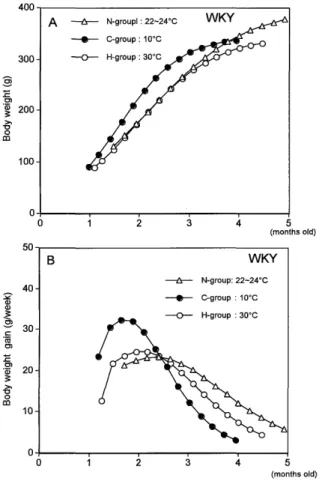
N-group and the C-group. In WK~ mean BW at near 4 months (M) old was 343±28 g in the C-group (n=10; 3.9M), 338±9g in the N-group (n=5; 4.0M) and 319±8 g in the H-group (n=5; 4.0M). There were no significant differences among these values.

In SHR, the mean value ofBW at 4 months old was 335±25 g in the C-group (n=7: 4.0 M), 346±21 gin the N-group (n=8; 4.0 M) and 310±16 g in the H-group (n=8; 4.0 M). The value of the H-group was significantly lower than those of the Nand C groups (P < 0.05).

Fig. 1. Mean body weight ofWKY (A) and SHR (B) exposed to the three different environmental temperatures, C-group (solid circles, WKY;n=lO, SHR;n=7), N-group (open triangles, WKY;n=5, SHR;n=8 ), and H-group (open circles WKY;n=5, SHR;n=8).

A

--t:r- N-group: 22-24·C (n=5)

exposure to the various environmental temperatures.

The effects of chronic exposure to various temperatures on growth and the development of hypertension were studied in WKY and SHR.

METHOD

Male WKY and SHR were introduced from the breeding company (Charles River, Japan). Rats ofthe two strains, SHR and WKY of 1 month old were divided into three groups randomly and they were housed in three rooms, of which temperatures were controlled at a constant, 30°C (H-group), 22-24°C (N-group) and 10°C (C-group), respectively.

In one plastic cage, 3 or 4 rats were kept with wood shavings under a 12/12-hour light-dark cycle (light on 7:00-19:00) with food (F-2, Funahashi, Japan) and water ad libitum. The body weights (BW) of rats were measured using a balance every week.

The predicted growth curves were obtained by fitting values of BW to the logistic function (Y=a1{I +b exp(-cX)}, where Y is predicted BW, X is months from birth. a, band c are constant). From these fitting curves, mean weight gain per week was calculated.

At approximately 4 months old, the systolic blood pressure (BP) of rats was measured by the tail cuff method (PE-300, NARCO, USA) after the general warming, which induced tail vasodilation. In order to evaluate the tail surface area by calculation, assuming that the cross section of any portion of the rat tail is an exact circle, the entire length of the tail, from the anus to the tip of the tail, and the diameter at every 3 cm of the tail were measured using a slide caliper. Calculated body surface area was obtained by the equation, S = 8.62 x BW 0.67 (S: total surface area (cm 2 ), BW: body weight(g), Lyzak & Hunter, 1987).

Values were expressed as Mean±S.D.. Statistical significance of change in parameters was determined Kruskal-Wallis test (Stat View 5.0, SAS Institute Inc.).

RESULTS

Body weight and body weight gain

The mean body weights (BW) of the three groups in WKY and SHR were plotted against time (month) after birth in Fig. I-A, B. One-group was composed of 5-10 rats. As shown in Fig. 1, growth curves of SHR were steeper in comparison with those ofWKY.

And in both strains, WKY and SHR, the growth curves of the H-groups were under than those of the

Fitting curves of BW to the logistic equation in WKYare shown Fig.2-A. From these fitting curves, the mean weight gain per week was calculated (Fig.

2-B). In WK~ maximal values of weight gain are

within the range of 1.5-2.5 months old. Maximal

values of weight gain were 32.4 g/week in the

C-group, 23.3 g/week in the N-group and 24.7

g/week in the H-group. Figure 3-A and B shows the

fitting curves of BW and weight gain of SHR,

(3)

4 0 0 - . - - - .

respectively. In SHR, maximal values of weight gain are in the range of I.S-2 months old, the value of weight gain at the peak was 39.7 g/week in the C-group, 42.3 g/week in the N-group, and 32.0 g/week in the H-group.

Curves ofthe weight gain in SHR were higher in the maximal zone, and thereafter those curves reduced more quickly than those ofthe WKY groups.

300 :§

E

Cl 'iii

;: 200

>-

"0 IIIo

100

A

----t::r- N-groupl :22-24'C

SHR

Fig. 2. Fitting curves of mean body weight to the logistic equation (A) and weight gains of the three rats groups ofWKY (B).

2

3 4

5

(months old)

WKY

----t::r- N-group:22-24'C

-e-

e-group :10'C

4 5

(months old)

3 2

2

3 4

5

(months old)

SHR

---ft- N-group :22-24'C

-e-

e-group:10'C

---0-- H-group :30'C

0

0 50

B 40 2'

<ll

<ll

~

c:

30

'ro

Cl

E

Cl

20

~

10

0 0

Tail growth

The body surface area of the rats was calculated by means of the equation, and the tail surface was also calculated by the diameter measured in each 3 cm of the tail from the anus to the tip of the tail.

In WKY, the ratio of the tail surface to the body surface area was 7.9 +0.3 % in the C-group (n=10), 8.S+0.4% in the N-group (n=10), and 8.9+0.2% in the H-group (n=S), (Fig. 4-A). In SHR, the ratio was 7.0+0.1% in the C-group (n=7), 8.1 +0.4 % in the N-group (n=8), and 9.0+0.3% in the H-group (n=8), (Fig. 4-B). In both strains, these values were significantly different (P < 0.01, or P < O.OS only between N-group and H-group in WKY) from each other. Both in WKY and SHR, mean values of the ratio ofthe tail surface to the body surface areas were in the order ofH-group > N-group > C- group.

Fig. 3. Fitting curves of mean body weight to the logistic equation (A) and weight gains (B) of the three rats groups of SHR.

5 (months old)

4

3 2

0

0 50

B 2' 40

Q) Q)

~

-9

c:

30 'ro

Cl

E

Cl

20

'iii

;:

>-

"0 0 III

10

0 0 400

A

300 :§

ECl 'iii;:

200

>-

"0 III0

100

(4)

T

WKY

n=4

4.1M

* *

" ' - 1

~---'I

" ' - 1- - - . ,

SH R

T

o-L..J... L.--

B

A

200

~ E 150 ,S

~ ~ 100

!/)

~0-

"0

ii5 o 50

200

~

~100

!/)

~

0-

"0

ii5 o 50

o-L....I... L--

three groups of SHR, hypertension developed. Mean values of BP in both C-group and H-group were significantly (P<0.05) higher than that in the N-group.

n=5

4.0M

n=8

4.0M

* ,J WKY

T

II

T

**

**

**

** ,..-...*... *---, I SHR

1--"";";;";';;---'11 +

B

~ 10.0

lU~ lU

~ 7.5

::J

!/)

>-

"0

~ 5.0

-

lU~

lU

~ 2.5

~

::J

!/)

~ O.O..L-II... --I---

~ 10.0

lU

~lU

~ 7.5

::J

!/)

>-

"0

~ 5.0

-

lU~

lU

~ 2.5

~

::J

!/)

~ 0.0...- ..

Fig. 4. Ratio of the tail surface area to body surface area in WKY (A) and SHR (B) at approximately 4 months old. Rats were chronically exposed to the three different environmental temperatures from 1 month old. Values are Mean ± SD, ** P <

0.01, * P < 0.05.

A

Systemic bloodpressure

Systolic blood pressure (BP) was measured by the tail cuff method in rats of approximately 4 months old in both strains, which were reared exposed to the three different temperatures from 1 month old. In WK~ the BP was 134+8 mmHg in the C-group (n=6), 127 + 11 mmHg in the N-group (n=6) and 117+9 mmHg in the H-group (n=7). In

WK~ the BP of the C-group was significantly (P<0.05) higher than that of the H-group (Fig. 5-A).

In SHR, the BP was 179 + 12 mmHg in the C-group (n=7), 163 + 10 mmHg in the N-group (n=5) and 180 +6 mmHg in the H-group (n=4) (Fig. 5-B). In the

Fig. 5. Systolic blood pressure of WKY (A) and SHR (B) at approximately 4 months old. Rats were chronically exposed to the three different temperatures from 1 month old. Values are Mean ± SD, * P < 0.05.

DISCUSSION Growth (Body weight)

Brobeck (1945) has already reported on body

weight growth in albino rats, weight gain was greater

at 86 OF (30°C) than 70°F (21.1 °C) when food intake

and activity were constant. On the other hand, it was

reported that growth of the rat is prominent in the

(5)

neutral temperature, and growth was retarded in the hot and cold environments (MacFarlane et al.,1959, Yamauchi et al., 1981; Peeters et al., 1989; Gordon 1990). In this study, both WKY and SHR, there was an inclination of growth retardation in chronic heat-exposure. Growth retardation of the hot environment was remarkable in the SHR (Fig.

1-A,B). These findings suggest that the growth of SHR is more susceptible to hot environmental stress than WKY.

Schork et al. (1994) studied the relationship between the growth and the development of hypertension in SHR, stroke-prone SHR (SHRSP) and WKY. They indicated that the growth is phasic and that there is a growth spurt peak at 50 days of age in each strain.

In this study, body weight gains (g/week) were calculated from the fitting curve of the experimental growth curve. In both WKYand SHR, maximal body weight gains were observed between 1.5 month and 2.5 months. The values of weight gain reduced more quickly in SHR compared to those in WKY. These results show the special features of body weight gain of SHR, and support the findings of Shork et al.

(1994).

Growth (tail)

The effect of chronic exposure to various ambient temperatures on rat tail growth has been studied by Thorington (1966). Rat tails are short in a cold environment, whereas those are long in a hot environment. In this study, in both WKY and SHR, the ratio ofthe tail surface to body surface areas were significantly different depending on the exposed temperatures. These ratios were in the order of H-group > N-group > C-group. These results suggest that the effects of environmental temperatures were similar on the growth of rat tails in both WKY and SHR.

Growth and Hypertension

In this study, SHR and WKY were used as

experimental animals, and the effect of chronic exposure on growth and development of hyper- tension were investigated. Schork et al. (1994) studied the relationship between growth and the development of hypertension in SHR, stroke-prone SHR (SHRSP) and WKY. They indicate that the time of maxiaml weight gain corresponds to the onset of a blood pressure spurt. These results support the idea that growth and rising blood pressure are intimately linked. In this study, the peak value ofweight gain of C-group was the highest among the three groups of WKY. And the peak values of weight gain of three groups of SHR were higher than those of the corresponding groups in WKY. It is interesting fact that development of hypertension was definite in C-group of WKY and in the three groups of SHR, in which four groups the high peak values of weight gain were observed.

Reasons for cold-induced hypertension

In this study, mild hypertension was shown in cold-exposed WKY as reported by Feregly et al.

(1989). The BP of the H-group of WKY was lower than that of the control, N-group. This suggests that chronic heat-exposure might have a reverse effect of the cold exposure on such a system in normotensive WKY.

During chronic exposure to cold, it was reported that B-adrenergic responsiveness increased in the cardiovascular system, both in the heart and the blood vessels in the tail skin in the rat (Barney et aI.,

1980). And plasma noradrenaline concentration increased and remained elevated, whereas that of adrenaline increased and then gradually reduced during the cold exposure (Papanek et al., 1991).

In this study, severe hypertension developed in

SHR groups exposed to both heat and cold

environments. And the BPs of C-group and H-group

in SHR were significantly high compared to that in

N-group. In WK~ the exposure to cold environment

induced the development of the hypertension, and

that to hot reduced the BP. Therefore, the

(6)

retardation of the development of genetic hypertension of SHR is expected after the exposure to hot environment. But, as shown in Fig. 5, the hypertension development was observed in the three groups of SHR. These results suggest that the development of hypertension in SHR is considerably tolerant to thermal environment influences and is somewhat different from WKY

Susceptibility to the environmental stress in SHR To investigate growth and the development of hypertension in SHR, Cierpial and McCarty (1987) studied maternal influences in SHR. The maternal environment before weaning affects growth and the development of hypertension in .SHR. Cross fostering of SHR pups to WKY mothers resulted in reduction of BP and BW in adulthood compared to those in control SHR.

These facts suggest that the preweanling period is important for susceptibility of environmental influences.

In this study, before, the chronic exposure to various environmental temperatures at 1 month old, WKY and SHR rats used in this experiments were reared in the thermoneutral temperature. Though environmental stress were avoided in the preweanling period, clear different effects of environmental stress on the growth and the development ofthe hypertension were shown in this experiment. In next step, effects of environmental stress during the preweanling period should be studied.

CONCLUSION

In this study, chronic exposure to various environment temperatures began at 1 month old.

The results of this study suggest that although environmental temperature has similar affects on growth, an increase in body weight and tail in both SHR and WKY, it has different affects on the development of hypertension in these two strains.

Furthermore, it scarcely affects the development of genetic hypertension in SHR. Hypertension developed in the three groups of SHR.

REFERENCES

1) Barney C.C., Katovich M.J., Fregly M.J., Tyler P.E., Changes in B-adrenergic responsiveness of rats during chronic cold exposure, J. Appl. Physiol.

49, 923-929 (1980).

2) Brobeck J.R., Effects ofvariations in activity, food intake and environmental temperature on weight gain in the albino rat. Am J. Physiol. 143, 1-5 (1945).

3) Cierpial M.A., McCarty R., Hypertension in SHR rats: contribution of maternal environment. Am J.

Physiol. 253, H980-H984 (1987).

4) Fregly M.J., Kikta D.C., Threatte R. M., Torres J.L., Barney C.C., Development of hypertension in rats during chronic exposure to cold. J. Appl.

Physiol. 66, 741-749 (1989).

5) Gordon C.J., Thermal biology ofthe laboratory rat.

Physiol. Behav. 47,963-991 (1990).

6) Lovenberg W., Techniques for the measurement of blood pressure. Hypertension 9, Supp1. I, 1-5 - 1-6, (1987).

7) Lyzak W.A., Hunter W.S., Regional surface areas of spontaneously hypertensive and Wistar-Kyoto rats. J. Appl. Physiol. 62, 752-755 (1987).

8) MacFarlane W.V., Ostwald M., Pennycuik P., The effects of season, and of life at 33°C, on fluid distribution, reproduction and behaviour of albino rats. J. Physiol. 146, 6P-7P (1959).

9) McMurtry J.P., Wexler B.C., Hypersensitivity of spontaneously hypertensive rats (SHR) to heat, ether, and immobilization. Endocrinol 108,1730-1736(1981).

10) Okamoto K. Aoki K., Development of a strain of spontaneously hypertensive rats. Jpn. Circ. J.

27,282-293 (1963).

11) Ozaki M. et al., StatView Official Guide Book( in Japanesae), Nankodo, Tokyo(1995).

12) Papanek P.E~, Wood C.E., Fregly M.J., Role of

(7)

the sympathetic nervous system in cold-induced hypertension in rats. J Appl. Physiol. 71, 300-306 (1991).

13) Peeters R, Buys N, Kuhn E.R., A simultaneous stimulation of the peroxidase activity in the thyroid gland and the hepatic monodeiodination, associated with a decrease in hepatic thiol groups, during chronic cold exposure of rats. J Therm. BioI. 14,

103-107 (1989).

14) Schork N.J., Jokelainen P., Grant E.1., Schork M.A., Weder A.B., Relationship of growth and blood pressure in inbred rats. Am. J Physiol. 266, R702-R708 (1994).

15) Thorington Jr. R.W., The biology of rodent tails, A study of form and function. AAL.TR-65-8, Arctic Aeromed Lab, Fort Wainwright, Alaska, pp 1-137 (1966).

16) Yamauchi C., Fujita S., Obara T., Ueda T., Effects

of room temperature on reproduction, body and

organ weights, food and water intake, and

hematology in rats. Lab. Anim. Sci. 31, 251-258

(1981).

Fig. 1. Mean body weight ofWKY (A) and SHR (B) exposed to the three different environmental temperatures, C-group (solid circles, WKY;n=lO, SHR;n=7), N-group (open triangles, WKY;n=5, SHR;n=8 ), and H-group (open circles WKY;n=5, SHR;n=8).
Fig. 3. Fitting curves of mean body weight to the logistic equation (A) and weight gains (B) of the three rats groups of SHR
Fig. 5. Systolic blood pressure of WKY (A) and SHR (B) at approximately 4 months old. Rats were chronically exposed to the three different temperatures from 1 month old

参照

関連したドキュメント

Therefore, with the weak form of the positive mass theorem, the strict inequality of Theorem 2 is satisfied by locally conformally flat manifolds and by manifolds of dimensions 3, 4

Using the fact that there is no degeneracy on (α, 1) and using the classical result known for linear nondegenerate parabolic equations in bounded domain (see for example [16, 18]),

Analogs of this theorem were proved by Roitberg for nonregular elliptic boundary- value problems and for general elliptic systems of differential equations, the mod- ified scale of

Then it follows immediately from a suitable version of “Hensel’s Lemma” [cf., e.g., the argument of [4], Lemma 2.1] that S may be obtained, as the notation suggests, as the m A

Correspondingly, the limiting sequence of metric spaces has a surpris- ingly simple description as a collection of random real trees (given below) in which certain pairs of

[Mag3] , Painlev´ e-type differential equations for the recurrence coefficients of semi- classical orthogonal polynomials, J. Zaslavsky , Asymptotic expansions of ratios of

The important dynamical difference between the transient AIDS state in the acute infection stage and the chronic AIDS state that signals the end of the incubation period is the value

 Failing to provide return transportation or pay for the cost of return transportation upon the end of employment, for an employee who was not a national of the country in which