Acta Med. Nagasaki 30 : 75-92
Serial Fecal-oral Transmission of Hepatitis A Virus (HAV) in Marmosets (Saguinus labiatus) :
Establishment of an Experimental Model
for a Natural Transmission Pathway of HAV
Kouichi YAMANOUCHI Department of Bacteriology,
Nagasaki University School of Medicine, Nagasaki, Japan
Received for publication, March 9, 1985
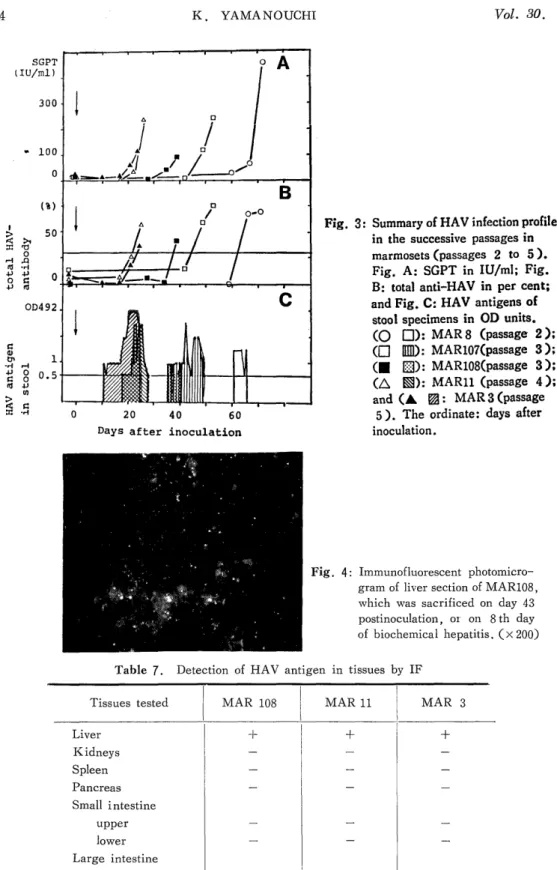
Hepatitis A virus (HAV) originally obtained from stool specimens of a human patient with an acute phase of hepatitis type A was successively passaged in marmosets, Saguinus labiatus, by oral administrations. The pattern of infection was as follows: after a certain incubation period, the appearance of HAV antigen in stools was the first sign of infection, followed by the simultaneous elevations of transaminases and anti-HAV antibody with ap- proximately 10-day intervals. This sequence was consistently observed throughout four successive passages. More passages resulted in less incubation time: the incubation period at passage 3 was 49 and 35 days in two animals, and those at passage 4 and 5 were 26 and 21 days, respectively. Because the inoculation dosis used beyond passage 2 was adjusted at 2,000 antigen units, the shorter incubation period in later passages suggested the adaptation of HAV in marmosets, Saguinus labiatus. Since the adapted virus showed reproducible incubation periods as well as clinical courses in marmosets, it is now possible to look for the primary target organs other than the liver of HAV, if any, and to use this system for the screening of vaccine candidates.
INTRODUCTION
Hepatitis type A, caused by hepatitis A virus (HAV), constitutes approximately 20 to 30 % of acute viral hepatitis a year in Japan.') HAV belongs to the enterovirus group of the family Picornaviridae.1) It has a single stranded RNA with a genome size of 2.3 X 10⁶ daltons,3>4> and the virion has a diameter of 27 nm with a density of 1.34 g/ml in CsCl.S> HAV is stable upon heating at 60°C for 1 hr. and by treatment with ether or acid at pH 3, but is inactivated by heating at 100°C for 5 min., or by treatment with chemicals or electromagnetic waves, such as formalin and ultraviolet irradiation.')
山之 内宏 一
HAV shows world-wide distributions but there are foci of highly endemic areas, especially in developing countries, such as New Guinea 7) and the Pacific Islands 8), Thai- land') and Africa10), where almost all of the population become anti-HAV positive by the age of 10. For example, the prevalence of anti-HAV positive population exceeds 90% in
11