E x e c u t i v e S u m m a r y
1 The Current State and Significance of p. 5 Small Hydropower and Institutional Issues
Concerning its Popularization
Since the accident at the Fukushima No. 1 nuclear power plant operated by Tokyo Electric Power Co. caused by the Great East Japan Earthquake, the spread and promotion of power generation via renewable energies and distributed energy resources have become more important policy issues than ever for Japan. Solar and wind power get most of the attention in discussions of generating power with renewable energies, but small hydropower certainly has an important role to play.
Small hydropower has less potential for development (i.e. scale of facility capacity) compared to solar and wind power, but compared to other means of power generation with renewable energy it enjoys many advantages such as an extremely high equipment utilization ratio, small load variation and fairly sound technology.
We could say that the development of this is type of renewable energy generation is one that Japan should also prioritize. The first step should be to build distributed energy resource (DER) systems, particularly in mountainous areas, to generate power for consumption in nearby areas. Furthermore, local communities depend on the water resources in their area, so it is essential to take another look at local resources in the development process and contribute to stimulating local economies.
While a variety of initiatives are underway across Japan, we may not have an adequate understanding of sites with the potential to generate small amounts of power through small hydropower. Thus, this warrants more detailed research.
But generally speaking, popularizing and promoting renewable energy, which has higher generating costs than existing power sources, needs policy means to support it. In August 2011, the Japanese government passed into law the Act on Special Measures Concerning Renewable Energy and the fixed-tariff system for renewable energy will come into effect in July 2012. This will impose a long-term obligation on electric utilities to buy power generated by renewable energy at a certain price for the purpose of spreading and encouraging the adoption of these power generation methods. The tariffs and other matters will be decided by the Minister of Economy, Trade and Industry, who will do so based on the deliberations of the Procurement Cost Estimation Committee. On April 27, 2012, the committee released its proposals concerning tariffs for each type of renewable energy generation, including small hydropower.
Traditionally, one reason why coordinating among “water rights” and other such matters has been a hindrance to the spread of small hydropower is the extremely complex administrative procedures. In recent years, Japan has seen a gradual relaxation of regulations and simplification of procedures while the direction the technology is heading in has become clearer since the Great East Japan Earthquake, but the government still has a number of matters under consideration. Although small hydropower still has room for technological development and cost reduction, it is a power-generating technology that could grow significantly with the relaxation of various systemic/institutional constraints, even without any technological breakthroughs. Considering the power situation in Japan today, the country needs further regulatory relaxation and procedural simplification.
(Original Japanese version: published in May/June 2012)
1
The Need to Change the Concept of Water-related Disaster Prevention
Yasushi Ito Visiting Fellow
Introduction
Since the 1990s, we have known of the grave necessity, in terms of combating global warming, for power generation by renewable energies that do not directly produce CO2 emissions. However, the spread of such technologies has been slow due to the high cost of using renewable energies; the fact that many of them have difficulty providing a stable energy supply because of how they generate it and fluctuations caused by the natural environment; as well as—particularly in Japan—the weak support these technologies receive from government. On the other hand, it is well known that the disaster at the Fukushima No. 1 nuclear power plant operated by Tokyo Electric Power Co. (TEPCO), which was caused by the tsunami spawned by the Great East Japan Earthquake, has made the rapid spread of renewable energy an extremely important policy issue in Japan.
One reason why we need to spread and expand our use of renewable energies is their small environmental impact. However, that is not all. Another big reason garnering attention is their compatibility with
“distributed” energy resource (DER) systems. Until now, Japan’s power supply systems have mainly focused on setting up large power stations in remote locations and transmitting the power to where it is consumed. This is the “large-scale, concentrated model.” But the Great East Japan Earthquake showed that with this approach, an accident at a large power station has a huge effect over a widespread area. A system that depends on a certain amount of distributed energy resources to generate power with relatively small facilities located near where it is consumed can mitigate these kinds of supply risks. In March 2012, the National Policy Unit’s Energy and Environmental Council released the Energy Regulation and Reform Action Plan: Implementation of 28 Important Points
1 for Green Growth (Draft), which also cites “the use
and expansion of distributed energy resources” as a part of power system reforms.[1] Of course, distributed energy resources also come with supply risks, so a balance between “concentrated” and “distributed” is needed.
Now when one mentions generating power with renewable energy, one often imagines doing so by conventional means such as solar, wind and biomass.
Meanwhile, small hydropower has received relatively little attention. This is because hydropower is a fully developed, mature technology that is not seen as so much of a new frontier like solar power and the like. It may also be due to the impact of criticism directed at hydropower for causing environmental destruction with large dams, which is accompanied by criticism of public works projects. However, small hydropower generates more electricity in Japan today than any other method defined as “renewable energy generation,” and it has yet to live up to its full potential to develop and expand. Furthermore, while solar and wind power planning is done on a large scale, by definition small hydropower is not so large, thus making it compatible with future DER systems.
Among all renewable energies, small hydropower fits the requirements for low environmental impact and compatibility with distributed systems extremely well.
This report will outline the state of small hydropower (primarily in Japan) and the significance of its expansion, followed by an examination focusing on the systemic/institutional issues related to further spreading and developing this technology. For information about the technical aspects of hydropower, please refer to the March 2010 issue of Science &
Technology Trends Quarterly Review, which took up this topic.[2]
The Current State of Small Hydropower and its Growth Potential
2-1 Definition of Small Hydropower
As is evident from its name, small hydropower is a form of hydroelectric power that generates small amounts of electricity output, but there is no precise definition regarding the exact scale. For example, the European Small Hydropower Association (ESHA) defines it as hydropower with an output of 10,000 kW or less.[3] In Japan, the New Energy and Industrial Technology Development Organization (NEDO) classifies hydropower according to output in the following manner : 1,000 to 10,000 kW is small hydropower, 100 to 1,000 kW is mini hydropower, and output below 100 kW is micro hydropower.[4] However, these definitions are not necessarily in general use.
As addressed later in this report, the Act on Special Measures Concerning New Energy Use by Operators of Electric Utilities that went into effect in 2003 to promote “new energy” supports hydropower with an output of less than 1,000 kW, while the Act on Special Measures Concerning Renewable Energy enacted in August 2011 aims to promote hydropower with an output of less than 30,000 kW, which it terms “small- to medium-sized hydropower.” This report examines small hydropower by defining it with the standard of 10,000 kW of output or less—which is often adopted internationally.
While hydropower generally makes use of hydraulic head, there are four forms in which the water is used:
flowing water, reservoirs, storage tanks and pumping.
As for ensuring hydraulic head used to generate power, there are three methods: conduits, dams, and a dam/conduit combination.[5] Since in many cases small hydropower uses relatively small flows and hydraulic head, it generally generates power by either using flowing water as is (instead of damming a river or employing storage tanks) or by placing a weir over a river upstream to collect water and direct it into a channel to create hydraulic head.[6] However, an extremely small-scale project may employ a dam.
2-2 Where Small Hydropower is Used
Until now, small hydropower has mainly been used on rivers and channels such as agricultural waterways, catering to power demand by local communities
(rural villages, etc.), with the surplus being sold off in many cases. In principle, small hydropower is possible anywhere there is hydraulic head, so it has also been used inside water utility facilities as well as buildings and other structures. We are gradually seeing more and more small hydropower inside water utility facilities and general buildings, where setup mostly requires no complicated procedures.
2-3 The State of Small Hydropower Thus Far and Future Growth Potential
According to estimates of “areas with long-lasting energy” by Chiba University’s Research Center on Public Affairs for a Sustainable Welfare Society and the Institute for Sustainable Energy Policies (ISEP), an NPO, hydropower with an output of 10,000 kW or less accounted for 61.05% of power generated by renewable energies in 2008, while hydropower with output of less than 1,000 kW accounted for 5.04%, more than the 4.17% share generated by biomass.[7]
However, this is not the result of a recent proactive push to develop small hydropower. Rather, the rate of growth for small hydropower has long been slower than that for solar and wind power. This shows that small-scale hydropower plants built in the past are still operating today.
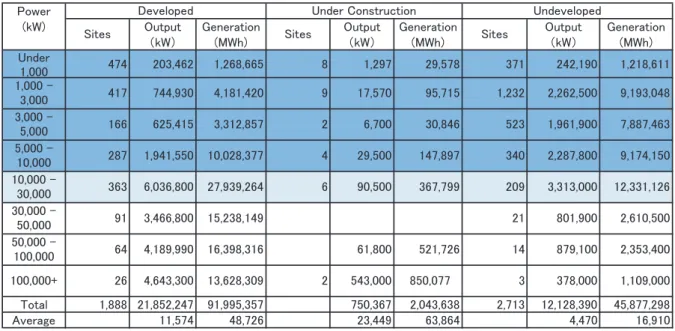
There are a number of estimates concerning small hydropower’s future growth potential. Table 1 shows the potential scope for development that hydropower has according to the Water Power Resource Survey (March 2004) conducted by the Agency for Natural Resources and Energy. According to this, there is still room to develop a total of 6 million kW or more from hydropower with an output of 10,000 kW or less per power generation facility.[8] On the other hand, there is little room for development of power generation facilities with an output of 1,000 kW or less. Generally, the smaller the output category, the more undeveloped sites, but only the output category of less than 1,000 kW has an extremely low estimated number of undeveloped sites. Normally, the smaller the output level, the easier it is to install equipment and the more sites are available. From its outset, the above-mentioned Water Power Resource Survey has not considered mountain streams and small rivers thought not to be very economical in its estimates,[9]
so the author believes it highly likely that the potential for small-scale sites has been underestimated.
The Survey on the Potential for Adding Renewable
2
Energy published by the Ministry of the Environment (MOE) in March 2011 contains estimates for small hydropower’s potential. Figure 1 compiles these estimates. Here, the potential for adding hydropower with an output of 10,000 kW or less per power generation facility (on rivers) is approximately 13 million kW.[10] Because the potential here is a theoretically estimated amount that does not consider the stricter constraints that would accompany it, the actual potential is that which subtracts unusable sites due to natural or social constraints. However, this figure does not subtract the portion that is already in use. According to the Water Power Resource Survey in Table 1, approximately 3.5 million kW of hydropower with an output of 10,000 kW or less per
power generation facility has already been developed, so some simple math (13 mil kW - 3.5 mil kW) would put the unused potential at around 9.5 million kW.
This amount produced by this simple subtraction is not precise since each survey employed different calculation methods, but it does allow us to understand the general situation.
The MOE estimates that there are 18,229 sites that could produce less than 1,000 kW each and that they have the potential to generate around 5.3 million kW of power hydropower. This is larger than the amount estimated by the Water Power Resource Survey in Table 1, but some experts have indicated that this is still an underestimate.[11] The ministry estimates that there are 593 locations conducive to small hydropower
Power
(kW) Output Generation Output Generation Output Generation
(kW) (MWh) (kW) (MWh) (kW) (MWh)
Under
1,000 474 203,462 1,268,665 8 1,297 29,578 371 242,190 1,218,611
Total 1,888 21,852,247 91,995,357 0.32 750,367 2,043,638 2,713 12,128,390 45,877,298
Average . 11,574 48,726 . 23,449 63,864 . 4,470 16,910
Sites Sites
744,930 4,181,420 9 17,570 95,715
Developed Under Construction Undeveloped
Sites
625,415 3,312,857 2 6,700 30,846 523
147,897 340 2,287,800 9,174,150 1,232 2,262,500 9,193,048
6,036,800 27,939,264 6 90,500
1,961,900 7,887,463 1,941,550 10,028,377 4 29,500
367,799 209 3,313,000 12,331,126
521,726 14
1 21 801,900 2,610,500
3,466,800 15,238,149 1 1
11 61,800 1,000 -
3,000 3,000 -
5,000 5,000 -
10,000 10,000 -
30,000 30,000 -
50,000 91
363 287 166 417
850,077 3 378,000 1,109,000
64 4,189,990 16,398,316 50,000 -
100,000 100,000+
879,100 2,353,400 26 4,643,300 13,628,309 2 543,000
Source: Compiled by the Science & Technology Foresight Center based on materials from the Agency for Natural Resources and Energy website (http://www.enecho.meti.go.jp/hydraulic/index.html).
Table 1 : Water Power Resource Estimates by the Agency for Natural Resources and Energy
1875.005 2480.741
6198.255
1577.265 925 372 4498 4386
5815
3530 3175
2000 3000 4000 5000 6000 7000
2000 3000 4000 5000 6000 7000
Sites
apacity (1,000 kW)
283.536 638.764 925.372
238 61 0
1000 0
Ca 1000
Capacity
Capacity(1,000kW) Sites less than
more than
Figure 1 : Small Hydropower Potential (MOE Survey)
Source: Compiled by the Science & Technology Foresight Center based on materials from Reference #10.
on agricultural waterways, with a potential output of roughly 258,000 kW. Kobayashi (2011) studied agricultural waterways on alluvial soil where small hydropower facilities have already been installed.
He calculated an estimate of the scope for potential development on a main waterway (approximately 18 km in length) and a lateral canal (12 km in length).
Considering that small hydropower is feasible where this is a certain amount of hydraulic head, he found 100 suitable locations along a total of roughly 30 km of agricultural waterways. Japan is said to have 40,000 km of lateral canals for agricultural water. Even if there are few agricultural waterways to be found that are suitable because their water flows over flat ground, Kobayashi argues that the MOE’s estimate of only 593 locations along 40,000 km is too low a figure.
More detailed research is warranted, especially on the potential to produce output of less than 1,000 kW per generating facility.
The Significance of Promoting Small Hydropower and Problems
3-1 Small Hydropower's Advantages[12]
Small hydropower’s advantages when compared to other forms of renewable energy are:
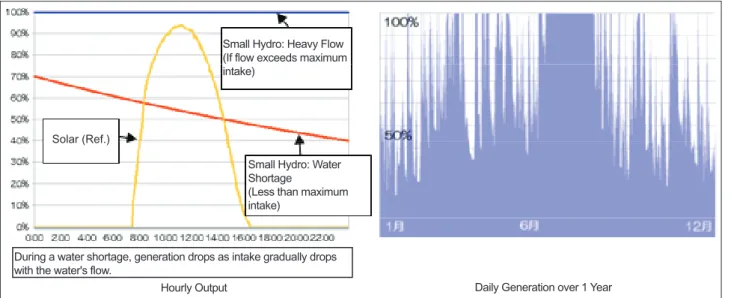
1. Equipment utilization is around 60% to 70%, much higher than generating power with other renewable energies.
2. Relatively small output fluctuation makes it unlikely to destabilize the power grid.
3. Preliminary surveys and construction are relatively simple.
4. The basic technology for hydropower has already matured, so the technology itself is fairly sound.
On the other hand, small hydropower experiences the following problems:
1. Other parties have interests in using water resources, and legal procedures to start up a new power station are complex.
2. In general, producing many of the same pieces
Type Small Hydro Solar Wind
Utilization approx. 70% approx. 12% approx. 20%
37-46 yen/kWh 10-14 yen/kWh (Residential) (Land, 4.5+ MW) Only generates
during the day.
Generation fluctuates according to amount of sunlight.
Cost 8-25 yen/kWh
Notes
Little temporal variation in generation.
Generation fluctuates according to wind strength.
Source: Compiled by the Science & Technology Foresight Center based on materials from the MOE website
(http://www.env.go.jp/earth/ondanka/shg/page02.html).
Table 2 : Characteristics of Major Renewable Energy Generation
Solar (Ref.)
Small Hydro: Heavy Flow (If flow exceeds maximum intake)
Small Hydro: Water Shortage
(Less than maximum intake)
During a water shortage, generation drops as intake gradually drops with the water's flow.
Hourly Output Daily Generation over 1 Year
Figure 2 : Small Hydropower Max Output and Output Ratio Change (Visualization)
Source: Cited from the MOE website (http://www.env.go.jp/earth/ondanka/shg/page02.html).
3
of equipment is best to keep down power generation costs, but because each site has its own characteristics (hydraulic head and discharge) that vary greatly, equipment specifications must accommodate, thus making mass production of equipment relatively ineffective compared to other power generation equipment.
3-2 What is the Significance of Promoting Small Hydropower?
When compared to solar, wind and other such forms of generating power with renewable energy, the potential to add small hydropower is small. This may be why some people question the significance of promoting the growth of this technology.
First, a look at small hydropower’s potential shows us that it cannot become Japan’s primary source of power. However, Japan has been forced to reduce its reliance on nuclear energy since the accident at the Fukushima No. 1 nuclear power plant caused by the Great East Japan Earthquake, but at the same time we need to cut down on carbon dioxide emissions in order to stop global warming. Under such circumstances, increasing power output by renewable energies even a little bit would be significant so long as the costs are not too great. For example, if the MOE’s estimate that there is a potential to add approximately 10.5 million kW of small hydropower generating capacity with facilities producing 10,000 kW of electricity or less is correct, then developing all of these sites would be equivalent to around 4% of the 237.15 million kW generated by all general electric utilities in 2009.[13] This is no small amount in a time when we are asked to maximize our energy conservation efforts. While some have said that the potential to add small hydropower is comparatively small, one could counter that its potential can be projected to a certain extent—more accurately than what we can project for solar and wind power. In other words, small hydropower is a renewable energy we could develop that has relatively low technical and economic risks and it is a renewable energy source that we should prioritize for development.
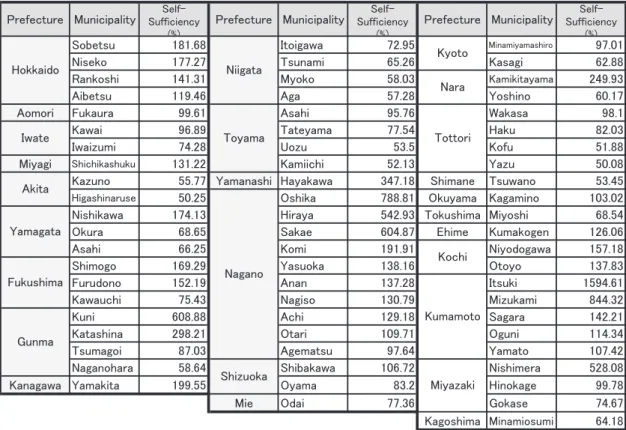
Additionally, the significance of promoting the growth of small hydropower is not only limited to increasing the overall amount of power supplied from renewable energy. The above-mentioned estimates for renewable energy power output in the Areas with Long-lasting Energy includes estimates for “natural energy power self-sufficiency,” which shows to what
extent renewable energy meets an area’s residential and farming/fisheries sector power demand. As of 2008, more than 30 municipalities had 100% “power self-sufficiency” and the number with 50% or better reached 67.
Most of these municipalities are small communities located in mountainous areas suitable for small hydropower. Even at present, small hydropower meets a hefty share of power demand in these municipalities (and nearby areas). If untapped small hydropower potential were developed, it would be a significant boost for communities with high amounts of latent
“energy (i.e. power) self-sufficiency.”
Providing power, which the Great East Japan Earthquake turned into a pressing issue, reconfirmed the importance of adopting systems based to a certain extent on distributed energy resources. However, transitioning a power supply system to a distributed model requires sufficient preparation and time.
Spreading the use of small hydropower, which has high equipment utilization and a relatively low load variation compared to other renewable energies, would be the first step to demonstrating the feasibility of a system based on distributed energy resources that generates power close to where it is consumed, especially in mountainous areas suitable for small hydropower and their surrounding areas.
Growing Small Hydropower as a Community Development Model
Small hydropower’s generating capacity is constrained by a site’s unique natural features (discharge, hydraulic head, etc.) as well as social constraints (water rights, etc.; discussed in further detail below). In order to generate small hydropower, one must look at the area’s water resources, coordinate with the local interests and engage in sufficient discussion, but this is also an essential process for stimulating local economies. In fact, there are places throughout Japan that are adopting and using small hydropower to try and create sustainable communities.
One could say that these small hydropower projects are
“community development models” for rural areas.[14]
Let us look at some examples below.
A local NPO in Omachi, Nagano Prefecture (population about 30,000) used small hydropower on some of the agricultural waterways running through
4
the city to produce energy for local use. The NPO also used the sites to reduce the environmental impact of tourist facilities and for producing local specialties, as well as to teach visitors about the environment, in an attempt to revitalize the community.[15] After the small hydropower facility took shape, the NPO encountered the systemic/institutional barrier posed by water rights (discussed in further detail below) and the technical issue of whether it was actually possible to generate power on agricultural waterways. The NPO secured three test sites, appended a consent form from each land improvement district (LID) and submitted water usage applications in accordance with the River Act.
Then, they started small hydropower performance testing while at the same time organizing events such as a symposium on natural energy and local history and a study group on mini hydropower. Later, after the small hydroelectric power stations began operating, the NPO has conducted eco tours of them (three locations with maximum output of 800 W, 300 W and 700 W) and used the sites for studying the environment.
In the Itoshiro district of Kujo, Gifu Prefecture, home to around 300 residents, another local NPO is working on a small hydropower project.[16] The NPO hoped to revitalize the local community as its
population has failed to halt its decline. The district had had a small hydroelectric power station until 1955, so the NPO began working on small hydropower as a way to “discover new things by studying the past.”
The project got underway in 2007. The local economy was stimulated in line with the small hydropower project’s progress and efforts were started up to encourage people from outside the district to settle there. There were some new residents who decided to move to Itoshiro after coming there to tour the small hydropower facilities. Recently, in June 2011, a 2.2 kW small hydropower facility began operating on an agricultural waterway, and there are plans to transmit the power generated to an adjacent agricultural produce processing facility.
Of course, in the future small hydropower will need to transform from a symbol of community development into a means of meeting a certain amount of local power demand.
Policy Means to Further Promote Small Hydropower
Because generating power with renewable energies is typically expensive at present—with some exceptions—it will be difficult to spread
Prefecture Municipality SufficiencySelf- (%)
Prefecture Municipality SufficiencySelf- (%)
Prefecture Municipality SufficiencySelf-
Sobetsu 181.68 Itoigawa 72.95 Minamiyamashiro (%)97.01
Niseko 177.27 Tsunami 65.26 Kasagi 62.88
Rankoshi 141.31 Myoko 58.03 Kamikitayama 249.93
Aibetsu 119.46 Aga 57.28 Yoshino 60.17
Aomori Fukaura 99.61 Asahi 95.76 Wakasa 98.1
Kawai 96.89 Tateyama 77.54 Haku 82.03
Iwaizumi 74.28 Uozu 53.5 Kofu 51.88
Miyagi Shichikashuku 131.22 Kamiichi 52.13 Yazu 50.08
Kazuno 55.77 Yamanashi Hayakawa 347.18 Shimane Tsuwano 53.45
Higashinaruse 50.25 Oshika 788.81 Okuyama Kagamino 103.02
Nishikawa 174.13 Hiraya 542.93 Tokushima Miyoshi 68.54
Okura 68.65 Sakae 604.87 Ehime Kumakogen 126.06
Asahi 66.25 Komi 191.91 Niyodogawa 157.18
Shimogo 169.29 Yasuoka 138.16 Otoyo 137.83
Furudono 152.19 Anan 137.28 Itsuki 1594.61
Kawauchi 75.43 Nagiso 130.79 Mizukami 844.32
Kuni 608.88 Achi 129.18 Sagara 142.21
Katashina 298.21 Otari 109.71 Oguni 114.34
Tsumagoi 87.03 Agematsu 97.64 Yamato 107.42
Naganohara 58.64 Shibakawa 106.72 Nishimera 528.08
Kanagawa Yamakita 199.55 Oyama 83.2 Hinokage 99.78
Mie Odai 77.36 Gokase 74.67
Kagoshima Minamiosumi 64.18 Nara
Tottori
Kochi
Kumamoto Iwate
Akita
Yamagata
Fukushima
Niigata
Toyama
Nagano
Shizuoka
Miyazaki Kyoto Hokkaido
Gunma
Source: Compiled by the Science & Technology Foresight Center based on "Areas with Long-Lasting Energy (2008)"
from the Institute for Sustainable Energy Policies, Chiba University.
Table 3 : Municipalities with 50%+ Small Hydro Self-Sufficiency (2008)
5
these technologies without some sort of supportive government policies, whether in Japan or other countries. Below is an outline of policy means to promote the spread of small hydropower in Japan.
5-1 Act on Special Measures Concerning New Energy Use by Operators of Electric Utilities (the Renewable Portfolio Standard [RPS]
Japan’s RPS law enacted in April 2003 obliges Law) electric utilities to use new energies and such to generate at least a certain percentage of their power.
As for hydropower,the law initially only applies to hydroelectric stations on waterways, with output of less than 1,000 kw, but an amendment to the law in April 2007 expands the scope to include waterways with small dams. The amount of renewable energy that each electric utility is required to use is determined according to the “Use Target for Electricity from New Energy, etc. by Electric Utilities” that are formulated every four years by the Minister of Economy, Trade and Industry (METI) for the forthcoming eight years.
The total use target for FY 2010 was set at 12.2 billion kWh (1.35% of electricity sold in Japan).
The most important feature of the RPS law is that it allows the trading of “New Energy Certificates.”
Thus, when a party produces electricity with renewable energy, the new energy certificates are issued. Utilities can also purchase certificates to fulfill their obligations. For example, an electric utility operating in an area with no sites suitable for small hydropower can fulfill its obligations relatively cheaply by purchasing New Energy Certificates from another party that has set up small hydroelectric power stations, instead of having to build its own such power stations at great cost.
5-2 Act on Special Measures Concerning Renewable Energy (the Feed-In Tariff Law) While the RPS law is a policy means that should soundly achieve the targets in the obligations it imposes on electric utilities, they will not generate more power with renewable energy than obliged to unless given an incentive to do so. This thus risks setting a veritable “ceiling” on the spread of renewable energies if the obligated amounts are low. Furthermore, the term “renewable energy”
encompasses a range of technologies at significantly varying stages of development, so of course the cost of
generating power with them varies as well. If electric utilities are only required to use a certain amount of renewable energy of any sort, then they will focus on the relatively cheaper power generation methods and the policy will not end up encouraging the spread of diverse types of power generation. In fact, according to research that used national panel data to quantitatively analyze the effect of policy means and such on patent applications concerning renewable energy-related technology, RPSs increase the number of patent applications for wind power technology, which at present is relatively lucrative cost-wise compared to other forms of renewable energy, but they do not result in more patent applications for solar power and other forms of renewable energy that are not as cost-efficient.[17]
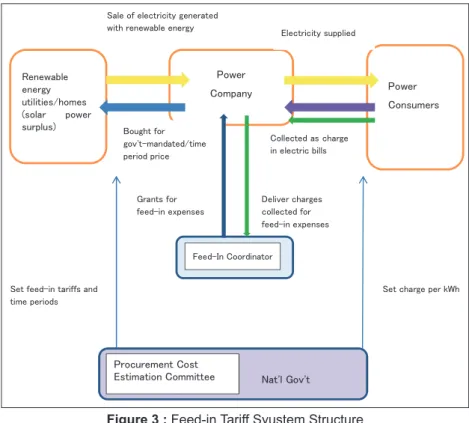
Europe, where renewable energy is spreading, is encouraging this by introducing “feed-in tariffs” that oblige electric utilities to buy electricity generated by renewable energy at a high enough price to allow the producers to recover their costs over the long term. More people are calling for the introduction of this system in Japan. By guaranteeing renewable energy producers long-term electricity sales at a price sufficient to recover the cost of their investment, feed- in tariffs provide renewable energy companies with a high level of predictability to create a system that promotes generation with renewable energy. Japan first introduced a feed-in tariff system in November 2009 that was limited to surplus energy generated with solar power. The initial purchase price was set at 48 yen/kWh for residences and 24 yen/kWh for non-residences over a period of 10 years. Thereafter, the system was expanded to include all renewable energies via the Act on Special Measures Concerning Renewable Energy that passed the Diet on August 26, 2011, but it only comes into effect on July 1, 2012. Specifically, the law requires electric utilities to purchase all power generated with solar, wind, hydro (small- to medium-sized hydropower with output of less than 30,000 kW), geothermal and biomass (though only surplus power in the case of residential solar power), the cost of which utilities incur will be transferred to entire customers as a “Surcharge for renewable energy” added to customers’ electricity bills that is proportionate to the power they consume.
In other words, power consumers will bear the burden in the form of higher electricity bills. The higher the tariffs, the greater the cost borne by power consumers.
Figure 3 : Feed-in Tariff Syustem Structure
Source : Compiled by the Science and Technology Foresight Center, based on materials from the Agency for Natural Resources and Energy
However, enterprises whose expenses from purchasing power exceed a certain proportion of their sales will be granted reduced surcharges. In addition, due to the possibility that the speed at which renewable energies spread may vary by area, the law will set up a body to coordinate the size of the cost burden for power consumers. This cost burden coordinator will temporarily collect the surcharges levied by electric utilities and then give each power company the money in the form of a grant according to the actual cost of tariffs (see Figure 3). It should be noted that the RPS law will be nullified when the feed-in tariff system goes into effect.
The degree to which renewable energy will spread
is determined by tariff rates, their expiration dates and the like. The METI, while respecting the opinion of the Procurement Cost Estimation Committee (an impartial third-party committee of five members formed by the upper and lower houses of the Diet), decides these matters for each type of renewable energy, installation, size and so forth. After the committee’s first meeting on March 6, 2012, it continued debate while hearing comments from many renewable energy-related enterprises, then announced its proposal on tariffs and expiration dates on April 27 (see Table 4). As for small hydropower, it was divided into three categories of generation facilities according to installed capacity: less than 200 kW; 200 to 999
Power Company Renewable
energy utilities/homes (solar power surplus)
Power Consumers Sale of electricity generated
with renewable energy
Bought for gov't-mandated/time period price
Electricity supplied
Collected as charge in electric bills
Feed-In Coordinator
Deliver charges collected for feed-in expenses Grants for
feed-in expenses
Procurement Cost Estimation Committee
Set charge per kWh
Nat'l Gov't Set feed-in tariffs and
time periods
Source: Compiled by the Science & Technology Foresight Center based on materials from the Agency for Natural Resources and Energy.
Power Company Renewable
energy utilities/homes (solar power surplus)
Power Consumers Sale of electricity generated
with renewable energy
Bought for gov't-mandated/time period price
Electricity supplied
Collected as charge in electric bills
Feed-In Coordinator
Deliver charges collected for feed-in expenses Grants for
feed-in expenses
Procurement Cost Estimation Committee
Set charge per kWh
Nat'l Gov't Set feed-in tariffs and
time periods
Source: Compiled by the Science & Technology Foresight Center based on materials from the Agency for Natural Resources and Energy.
incl. tax base
42.00 40 25
42.00 42 10
23.10 22 20
53.75 55 20
27.30 26 15
42.00 40 15
25.20 24 20
30.45 29 20
35.70 34 20
40.95 39 20
Unused Wood 33.60 32 20
Regular Wood 25.20 24 20
General Waste/Sewage 17.85 17 20
Recycled Wood 13.65 13 20
Small/
Medium Hydropowe
Direct Fuel Combustio n
Gasification Biomass
10+ kW
Under 10 kW (purchase of surplus) 20+ kW
Under 15,000 kW 1,000 kW - 29,999 kW 200 kW - 999 kW Under 200 kW Solar
Wind
Purchase Period
( )
Source Output
Under 20 kW 15,000+ kW Geothermal
Price (Yen)
Source: Compiled by the Science & Technology Foresight Center based on materials from the Procurement Cost Estimation Committee.
Table 4 : Procurement Cost Estimation Committee Proposal (as of April 27, 2012)
kW; and 1,000 to 29,999 kW. Tariffs were set at 35.70, 30.45 and 25.20 yen, respectively, while expiration dates were set at 20 years following commencement for all three categories.
For three years after the law takes effect, tariffs will be set with particular consideration given to the profits of parties that generate power with renewable energy, in order to expand the concentrated use of renewable energy, thus reflecting the committee’s proposal on this point. Tariffs and expiration dates will be revised every fiscal year, taking into consideration the cost of generating each kind of energy and other relevant matters.
5-3 Subsidies for Capital Investment
Subsidies for capital investments in renewable energy are a subsidization policy that has been carried out since a relatively early period. The METI, the Ministry of Agriculture, Forestry and Fisheries (MAFF) and other government agencies have set up subsidies for construction and other costs associated with hydroelectric power stations.
At present, the METI offers various subsidies for small- and medium-sized hydroelectric power stations: a subsidy for the construction costs other than the introduction of new technology (20% for power stations with an output of 1,000 to 4,999 kW, 10%
for an output of 5,000 to 29,999 kW) and a subsidy for the cost of introducing new technology (50% for an output of 1,000 to 29,999 kW). In FY 2011, the ministry granted subsidies to 14 small- and medium- sized hydroelectric power stations. Together with geothermal power utility subsidies, they amounted to approximately 2 billion yen.
MAFF subsidies are managed as part of land improvement projects (irrigation drainage, etc.), rural development projects and the like. It used to be that one-off maintenance confined only to power generation facilities was not covered by MAFF subsidies, but new installations and renovations to single pieces of generating equipment have been allowed for some projects since FY 2009. Many of the MAFF’s subsidies cover 50% of expenses, relatively high compared to the METI’s.
The Water Rights Problem
Water rights are an especially high hurdle to surmount when operating small hydropower. When
using river water for hydropower, one must obtain a “water usage permit.” Even if one were to use water for hydropower that is already permitted for agricultural, industrial or other use, a new permit is required because the purpose is different.
Furthermore, getting a permit even for small-scale hydropower generally requires going through the same procedures as those for large-scale hydropower produced by a dam. In the cases of the municipalities discussed earlier in this report, for its application to use the water, the organization generating the power (in this case a local NPO) had to obtain consent from the LID as well as from the organization permitted to use the water for agriculture. A water usage application takes a year-and-a-half from the prior consultations to obtaining the official permit. It has also been reported that when a single small hydroelectric power facility exceeded the scale of the initial plan that was originally discussed during the application process, it incurred a backlash from the local LID and the water wheel eventually had to be removed.[18] This is how operating even a small-scale generation project of less than 1,000 kW of output requires negotiating among various water rights.
However, the RPS law relaxed the procedural requirements for permits and water rights as they concern small hydropower by targeting the technology for promotion.[19] In 2005, the amount of paperwork for using water that is subordinate to other water usage was reduced. That has, for example, simplified the permit procedures if one were to take water already permitted for agricultural use and draw it from a field to generate small hydroelectric power (subordinate power generation). In the following year, 2006, it was made known that if one were to use water for small hydropower after it has already been completely used for its permitted purpose, then no new permit is required. As an example, no new permit is needed if one were to generate small hydroelectric power on a channel that is currently used only as a drainage ditch.
This is how government can simplify some of the many procedures required when water rights for agricultural and other use have already been assigned, but problems still remain. Regarding the use of water for agriculture, water can be drawn from waters for agricultural use during paddy cultivation, but only a limited amount can be drawn during winter, when no farming occurs. Thus, power generation that depends on agricultural water becomes impossible in winter.[20]
6
If one wants to secure access to an amount of water in winter as well in order to generate power, then the purpose of the water right becomes power generation, thus requiring the power producer to obtain another new permit.
A power producer that takes water directly from a river has to obtain a new water right for power generation. Furthermore, the procedures become incredibly complex because the consent of any persons or entities affected by taking the water is also required.
Even after obtaining a permit to use water for power generation, operation is still made difficult. The maximum amount of water that the power producer can take per second is prescribed by the water usage permit, so the electric utility must never take more than this amount of water. However, from the time the Great East Japan Earthquake struck until April 30, 2011, when power supplies had difficulty meeting demand, power producers were temporarily allowed to exceed the volume-per-second rule so long as their 24-hour average of water taken did not surpass the amount permitted. This measure allowed power producers to take less water from rivers at night while taking more during the day to help cope with peak daytime electricity demand by generating more power at that time.[21] Since it is extremely difficult for a power producer required to comply with a volume-per-second rule to manage operations while responding every second to a natural flow of water that is constantly changing, power producers typically take only around 95% of the permitted volume so that they do not exceed it due to some sort of disturbance.
However, a requirement to comply with a one-day average allows a power producer to adjust even if it takes a somewhat larger amount of water earlier in the day, thus reaching nearly 100% of the permitted amount and generating around 5% more power.[22] Although there have been urgent calls to make this measure more than temporary, the government did not do so. Instead, it relaxed the regulation only somewhat, requiring power producers not to take more than the permitted amount of water each hour.[23]
The labyrinthine procedures associated with obtaining water rights and other regulations that hinder the spread of small hydropower are gradually being relaxed and improved. For example, the Great East Japan Earthquake Special Reconstruction Zone Act and the General Special Zone Act that came into effect
in 2011 have simplified subordinate power generation- related procedures and shortened the standard amount of time for processing paperwork.[24] Furthermore, in March 2012 the government announced that environmental impact assessments for rivers and other requirements had been waived for certain small hydropower projects. The government also established a consultation desk for procedures relating to water rights for power generation. However, many matters concerning procedural simplification are still in the review phase.[25]
Conclusions: The Significance of Small Hydropower and Related Issues
Compared to solar and wind power, small hydropower does not have great growth potential in terms of quantitative power output. However, it does compare favorably to other means of generating power with renewable energies because of its high equipment utilization, low load fluctuation and the mature technologies it employs. Another advantage of small hydropower is its compatibility with a power supply system employing a “distributed model” that generates power for consumption in nearby areas. In addition, it is essential to examine the local area's resources and environment during the process of developing small hydropower because it depends on local water resources. Thus, it can contribute to stimulating the local economy. This is in fact happening in many places in Japan. While small hydropower receives less attention than other means of generating power with renewable energies, such as solar and wind power, it is very significant for us to encourage the growth of this technology.
With regards to quantitative estimates of the potential to add new small hydropower, especially for small- scale projects generating less than 1,000 kW, we may not have an adequate understanding. More detailed research is needed. While small hydropower still has room to develop cost-cutting techniques, it is a power generation technology that could expand greatly if various infrastructure restraints were relaxed, even without any technical breakthroughs. Although the complex procedures for water rights and other impediments to the technology’s spread are gradually being relaxed, we are not yet encouraging small hydropower enough. While it goes without saying
7
that there are historical reasons for the difficult water rights procedures and that we will need to thoroughly examine the effects of further regulatory relaxation, when we consider the state of the power supply in Japan today, we see that we need to urgently examine problems such as specific benefits as well as the costs and other problems associated with the spread of small hydropower, and also take another look at the various regulations, including an examination of the effect of
relaxing regulations such as water usage procedures that the government has required thus far.
Acknowledgements
Toshihiro Matsuo of the National Small Hydropower Promotion Association provided helpful information for this report, for which the author expresses his deepest gratitude.
[1] Energy and Environment Council [2012], Energy Regulation and Reform Action Plan: Implementation of 28 Important Points for Green Growth (Draft): http://www.npu.go.jp/policy/policy09/pdf/20120329/shiryo1.pdf [2] Motoyuki Inoue, Eiichi Shiraishi, “A New Age of Hydropower as a Renewable Energy,” “Science
& Technology Trends,” March 2010: http://www.nistep.go.jp/achiev/ftx/jpn/stfc/stt108j/1003_03_
featurearticles/1003fa02/201003_fa02.html
[3] The European Small Hydropower Association: http://www.esha.be/about/about-small-hydropower/in-the- world.html
[4] New Energy and Industrial Technology Development Organization (NEDO) [2010], “NEDO Renewable Energy Technology White Paper”
[5] Inoue, Ishihara [2010]
[6] National Small Hydropower Promotion Association [2006], “The Small Hydropower Energy Reader,”
Ohmsha
[7] Chiba University Research Center on Public Affairs for a Sustainable Welfare Society and the Institute for Sustainable Energy Policies (ISEP), “Areas with Long-Lasting Energy – 2008 Report”
[8] Agency for Natural Resources and Energy, “Water Power Resource Survey”: http://www.enecho.meti.go.jp/
hydraulic/index.html [9] Inoue, Ishihara [2010]
[10] Ministry of the Environment [2011], “FY 2012 Renewable Energy Introduction Potential Study Report”:
http://www.env.go.jp/earth/report/h23-03/index.html
[11] Hisashi Kobayashi [2011], “The Future of Small-Scale Distributed Energy in Terms of Rural Revival and Small Hydropower,” “Rural Culture Association” No. 7, 2011
[12] Hisashi Kobayashi, Hiroaki Togawa, Masayuki Horio, [2010], “Small Hydropower with Local Power,” Kojin no Tomo
[13] The Institute of Energy Economics, Japan, “Energy and Economic Statistics Overview 2011”
[14] Masaru Nakajima [2011], “Small Hydropower,” “Rivers,” May 2011
[15] Hiro Kasagi [2007], “Citizen Experiments to Build Sustainable Communities,” Vol. 43, No. 5, 2007
[16] Akihide Hirano [2011], “Generating Power with Small Water Wheels: Creating Jobs by Utilizing a Processing Center,” “Rural Culture Association” No. 7, 2011
[17] Johnstone, J., I. Hascic and D. Popp [2010], Renewable energy policies and technological innovation:
Evidence based on patent counts, Environmental and Resource Economics, Vol.45, 2010, 133-155 [18] Kasagi [2007]
[19] Yasushi Nagami [2007], “The Current State of and the Outlook for Policies to Spread Small Hydropower,”
Vol. 43, No. 5, 2007; Jun Miyazaki [2011] “A Systematic Look at Water Rights,” “Water Culture,” 39, November 2011
[20] Masaru Nakajima [2006], “For the Utilization of 400,000 Kilometers of Agricultural Waterways to Produce Energy,” “Solar Energy,” Vol. 32, No. 5
[21] Ministry of Land, Infrastructure, Transport and Tourism [2011], “Emergency Response to the Great East Japan Earthquake – Flexibility in Managing Water Taken for Use in Hydroelectric Power Generation”:
http://www.mlit.go.jp/common/000138097.pdf
[22] Hisashi Kobayashi [2011], “What is the Future of Small Hydropower?” [2011], “Water Culture,” 39, References
16
November 2011
[23] Cabinet Office Government Revitalization Unit [2011], “A Review of Regulations and Institutions Relating to Power Demand and Supply Measures,” June 7, 2011
[24] Energy and Environment Council [2012]
[25] Cabinet Office Government Revitalization Unit [2012], “Subcommittee Report on Regulatory and Institutional Reform (Energy)”: http://www.cac.go.jp/kisei-seido/publication/240326/item240326.pdf.
Yasushi ITo
Science and Technology Foresight Center, Visiting Fellow
Chiba University of Commerce, Faculty of Commerce and Economics, Professor http://www.cuc.ac.jp/index.html
Ito's specialties are environmental economics and regional economics. His research began with digging up Japan's pollution and environmental policies during its period of high-speed growth, and has now come to focus on the effects of environmental and energy policy on technological development and popularization. Ito has recently been devoting effort to studying the post-earthquake reconstruction and recovery as well.
(Original Japanese version: published in May/June 2012) Profiles
科 学 技 術 動 向 2012 年 5・6 月号
伊藤 康
科学技術動向研究センター 客員研究官 千葉商科大学商経学部 教授
http://www.cuc.ac.jp/index.html
専門は環境経済学・地域経済学。高度成長期の日本の公害対策・環境政策の掘り起こ しが研究の出発点。環境・エネルギー政策が技術開発・普及に与える影響を中心に研 究を行ってきた。最近は、震災復旧・復興に関する研究にも力を入れている。
執筆者プロフィール