4
Copyright@SPSD Press from 2010, SPSD Press, Kanazawa
Planning Review: Green City Design Approach for Global Warming Anticipatory
Surabaya’s Development Plan
Respati Wikantiyoso1 and Pindo Tutuko2*
1 Department of Architecture, Merdeka University Malang 2 School of Environment Design, Kanazawa University
* Corresponding Author, Email: [email protected] Received 15 December 2012; Accepted 25 April 2013
Key words: Eco-city, Global Warming, Urban Design, Spatial Structure and Spatial Pattern
Abstract: Environmentally, sustainable development will increase durability to any changes in the environment. Planning and urban design as a form of physical intervention in urban development should anticipate phenomenon of global warming through design decisions. A balanced development between the physical environment of development and environmental conservation should be done to achieve a healthy urban environment for present and future generations. The balance between green space and developed space with an integrated system of environmental infrastructure will increase the carrying capacity of an urban environment. Green city planning and design is one solution to global warming phenomenon. Green city concept was conceived as an answer that emphasizes aspects of environmental sustainability considerations in solving the urban problems (Murota and Ito, 1996). Green city planning implications in urban planning and design approach is the realization of the overall ecological city (Eco-city). This paper aims to discuss the concept of city planning and design approach that is able to eliminate global warming. Purpose of the discussion in this article was to determine whether the product of city planning has to anticipate problems of global warming became a major issue of urban development. The discussion in this article is the result of a review of the design of Long-Term Development Plan 0f 2005-2025 and Spatial Planning of Surabaya 2009-2029.
1. INTRODUCTION
This paper aims to review the planning practice in Surabaya from the concept of green city design approach, which is recognized as one of planning measures to anticipate problems of global warming that becomes a comment discussion in urbanization process across the cities in the world.
The study was conducted by analyzing the designs of Long-Term Development Plan of 2005-2025 and Spatial Planning of Surabaya 2009- 2029 (Hereafter Surabaya’s development plan). We are concerned with the aspects of urban planning and design related to the environmental preservation efforts, as well as consistency between development policies in urbanization process in Indonesia.
The increasing number of the world’s urban population will increase very significantly. According to Schell and Uljaszek (1999) about 67% of
the world's population is expected to live in cities by the year of 2025.
Urban development is a logical consequence of the urbanization process.
The following effect of urban population growth is the increasing number of physical facilities and rapid development of the city. Due to fast urbanization, natural ecosystems are increasingly replaced by urban land use. Urbanization increases the distance between people and natural space (Li and Wang, 2003a).
In general, economic growth has been contributed to the excessive exploitation of natural resources, which encourage the increase of environmental degradation in both urban and rural areas. The rapid development of the developing countries will fasten global warming and exacerbate resource problems (Murota and Ito, 1996). Increasing energy consumption is the consequence of the distribution and transport inefficient that encourages increasing carbon emissions, in which triggered the greenhouse effect, increasing geothermal and surface waters, which ultimately leads the climate changes. Based on the data from the International Energy Agency during 2002-2007, it is predicted there will be an increasing number in electric energy demand and carbon emissions in Asia and the world until the year of 2030.
Global warming is a phenomenon in which the global temperature increases from year to year due to the greenhouse effect caused by increasing emissions of gases like carbon dioxide (CO2), methane (CH4), Nitrous oxide (N2O) and so on. The phenomenon of global warming which leads to climate change has very serious effects toward human life.
Intergovernmental Panel on Climate Change (IPCC) states that the Earth's temperature has been rising up 0.15 - 0.13o C since 1990 to 2005. If the condition remains the same, it is predicted that the Earth's temperature will rise at around 4.2 º C by the year of 2050 to 2070. It will cause the rising of the sea levels to 90 cm higher than today. In addition, this condition will make around 2,000 small islands will sink. Global warming is a serious threat to coastal cities such as Jakarta, Semarang and Surabaya.
Urbanization leads the decreasing of the capacity; due to the decreasing numbers of open space area in the city, which has an ecological function.
Urbanization also leads to the increased number of vehicles that implies the increase of CO2 and CO gas into the air (Murota and Ito, 1996). Exhaust emissions released by vehicles causing major pollution and it is one of the causes of Global Warming.
On the other hand, the provision of green space in the city can be one of the planning measures for the realization of more human-urban environment, and capable of functioning ecological city. Republic of Indonesia mandated Act 26 year 2007 and concerns about the utilization of space that requires 30% green space from the total area of the city. Meanwhile, Indonesia as a maritime country with more than 70% of the territorial waters (coastal, river, and lake) has a challenge and a great potential to save the waterfront area as a buffer zone and conservation of natural environment. Institutions would need a handler to remain subdued conservation function along the waterfront area. The current condition that occurs is the utilization of an increasingly waterside area that is out of control, both in quality and quantity. Actually, the existence of the waterfront area can be optimized as a potential part of green city design through the concept of waterfront as well as substitution of Green Open Space area (Respati, 2004).
This paper is organized as the following; we firstly investigated literature regarding the influence of urbanization on global warming from a view of green city design. Secondly, reviews on Surabaya’s development plan have
been conducted with an emphasis on urban planning studies and environmental planning aspects of open space. Thirdly, we discuss about the concept of green design city in Surabaya's development plan as an ecological approach and some policy interventions in urban space utilization to ensure the ecological functions of the city. The last section is the conclusion.
2. LITERATURE REVIEW ON GREEN CITY DESIGN
Some research reports talk about green city design for global warming anticipatory basically from the concept of open space, green city, pollution, and sustainable city, such as Dyer (1994), Li, et al. (2005), Li and Wang (2003b), Bradley (1995), Shafer (1999), Diamantini and Zanon (2000), L’utz and Bastian (2002). Generally, city planning and design is an integrated form of physical intervention, which involves socio-cultural, economic and political unity of urban spaces. Thus, the city is a design product in which urban policies are set out in the framework of spatial arrangement of land use as a solution to urban problems in resource utilization (urban space), as well as the linkages between various urban functions in accordance with the necessary infrastructure capacity (Respati, 2004). Furthermore, the aspects of an effective utilization of an urban open space are a primary consideration, such as how aspects of city life (natural and socio-economic) can be accommodated in the spatial structure. The role of urban planning and design in anticipating the impact of global warming become extremely important in order to protect and create a comfortable living environment and healthy communities through green city design. The planning and management of urban green space development is significance to urban sustainable development (Miller, 1988; Grey, 1996). Urban planning and design decisions have a very strong impact on overall physical context, so that deciding the form of the plan must go through a comprehensive consideration.
As an integrated management tool of urban areas, urban design basically aims to promote the formation of urban regulation that is able to anticipate all aspects of urban development including the impact of global warming. It is also a solution for the constraints of natural and artificial environments.
According to Shirvani (1985), in his book The Urban Design Process, urban design is a part of the planning process relating to the physical design of urban space and an environment dedicated to the public interest. When viewed from the city-forming element, it’s essentially the substance of urban design that actually involves three main elements, they are:
1. Natural environmental factors; natural characteristic is the basic element that will provide the specific characteristics of a region / city. Control of utilization of the natural environment will be crucial in designing the urban environment while ensuring the ecological functions of urban neighborhood to remain alive. These natural factors include: climate, topography, seism city, geomorphology, humidity, air temperature, flora and fauna and so on.
2. Artificial environmental factors, the condition of artificial environment potency as a product of cultural communities that have formed a specific environment which should be a consideration as a whole activity product of society.
3. Non-physical environmental factors, socio-cultural, economic, political, and technological, as a background for the formation factor of human built environment.
Those three factors are a unity that influences each other. The natural environment will determine the structure and patterns of specific cities, as a reflection of patterns of behavior and socio-cultural values, economics and politics behind them (Shirvani, 1985).
The planning of green spaces is one of the significance towards sustainable urban development (Teal et al., 1998). Urban green space improves the urban environment, which contributes to the public health and improves the quality of urban life (Thompson, 2002). The concept of green city design as a form of micro-city neighborhood becomes a global issue now. Green City in the Environment World Days in 2005 is used as a central issue in an attempt to save the environment from global warming. Green City is a response towards urbanization in big cities of the world, which has led to the carrying capacity of an urban environment that is in very poor conditions. Green City is conceived as an answer which puts its’ emphasize on aspects of environmental sustainability considerations in solving urban problems. Urban green spaces are an important component of the complex urban ecosystem (Li, et al., 2005). Parks, forests and farmlands are three main types of urban green space, which have significant ecological, social, as well as economic functions (Bradley, 1995; Shafer, 1999; L’utz and Bastian, 2002).
Furthermore, green city design is closely associated with the presence of the urban landscape. The urban landscapes as the embodiment of a role entity is functioned to ensure the sustainability of ecological functions of the city. According to Li, et al. (2005), Landscape ecology is the study of interactions among landscape element. Landscape ecology generates understanding of how spatial pattern affects ecological processes. The main principle of green city design is essentially about urban design efforts by creating an environment that ensures ecological functions of the city. It is also shown by the experience of several cities in the world in an effort to rescue the city environment. Learning from the experience of several countries about the efforts to save the environment should not be done by extreme huge finance, where are successful in the quality improvement efforts in a sustainable environment by maintaining a balance among economic, social and environment in an integrated and sustainability. Here are several successful environmental rescue efforts:
1. In the spirit Mottai-Nai in Japan has successfully implemented the movement of 3Rs (Reducing, Reusing, and Recycling) in an attempt to preserve the environment. Mottai-Nai is a spirit of living habits or behavior that respects and maintains the product by recycling. Japanese Environment Minister in 2003-2005 periods applies that spirit through movement Nai Mottai-3R (Reducing, Reusing, and Recycling) by reducing the waste, reusing old items, and recycle materials that is recyclable.
2. In Switzerland, they have developed a roof garden. The roof of the house used as part of the environment. Make the roofs a green land by planting various crops. Additionally rooftops also developed to absorb solar energy, which is used as a power source, while still laid some green plants underneath.
3. Bogota mayor in 1998-2001 period, Enrique Penalosa implement the Transmilenio programs, high car taxes, tree planting, 1000 redevelopment of parking, bike lanes along the 374 km, and the
pedestrian along 17 km. People can congregate in public spaces such as streets and city parks where all people have equal rights.
To build a humanist or city ciudad Humana is appropriate if the users of bicycles and pedestrians should be pampered. For example, Bogota, before there is a special bike lane, cyclists are 4% only. But after there is a special line for bikes, within five years it has risen to 14 percent of total trips by using bicycles. If the available public transport is safe, convenient, punctual, provided a special bike track, safe pedestrian facilities and comfort, then people will choose the facility as a third mode of transportation rather than private car which can stuck in traffic for hours on the road and waste fuel.
Green city design can ensure the ongoing ecological functions of the city, because of the availability of urban adequate green open spaces or within a relatively large proportion. Formal regulations in Indonesia bring the proportion of urban green open space in the Law of the Republic of Indonesia on Act No 26 year 2007 on Spatial Planning, which sets a minimum of 30% green city open spaces of the total city area. Provision of open space that a city can do is through the utilization of demarcation along the river watersheds, beaches, reservoirs, utilization roof garden, as well as planning and design of open spaces other cities.
Implementation of green urban design in Indonesia is still facing very complex issues, including socio-cultural problems, economically and politically. Substantially, products of city planning and design in Indonesia have not fully made the issue of global warming become a strategic issue.
The main orientation of urban planning and design (Shirvani, 1985) of products is still dominated by the orientation of the economy (development orientation), in addition to the orientation on environmental sustainability (environmental orientation) and in the interests of the community (community orientation). In the following section, we review the Surabaya’s development plan for understanding how the concept of green city design can be put into planning practice in Indonesia.
3. SURABAYA’S DEVELOPMENT PLAN AND URBANIZATION
3.1 Case study city
This case study city is Surabaya as the second largest coastal city in Indonesia. In the National Long Term Development Plan, Surabaya is designated as the National Development Center of eastern Indonesia.
Therefore, it is very interesting to know how the planning and design of Surabaya in addressing the current global warming Issues.
As shown in Fig.1, Surabaya is the capital city of East Java province, which has a geographic position at 07 021 'south latitude and 112 036' to 112 054 'East longitude, with its boundaries described as follows:
Northern frontier: Madura Strait
Southern boundary: Sidoarjo regency
Western frontier: Gresik regency
Eastern Boundary: Madura Strait
The study was conducted by analyzing the designs of Long-Term Development Plan of 2005-2025 and Spatial Planning of Surabaya 2009-
2029, in which we are concerned with the aspects of urban planning and design related to the environmental preservation efforts, as well as consistency between development policies.
Figure 1. Geographical position of Surabaya city as Case
3.2 Urbanization in Surabaya
Regarding land use utilization and environmental conditions, indication of compliance on Surabaya's Development Plan looks at the suitability of different types of land uses and public facilities. Based on the data analysis of Surabaya long-term planning, extensive land is used for the settlement of
± 12184.71 Ha. The need for residential land in Surabaya will reach approximately 13553.36 hectares or 41.01% of the total land area of 33 048 hectares. The total housing land requirement is expected to accommodate about 556 542 housing units. So that the needs of residential land is estimated for the year 2029 about 1368.66 acres use of land for public facilities (educational, health, worship, government, culture and recreation) reaches ± 7.718% or 2550.58 Ha. Commercial activities (trade and services) are expected to reach approximately ± 7.721% 2551.76 Ha of the total area of Surabaya city. Industrial and warehousing activities are estimated at ± 3264.92 hectares or 9.879% of the region consisting of the Industrial and Warehouse industry and households scattered in the city of Surabaya.
Special area of activities (military) is expected to reach 771.13 Ha or ± 2.33% of the total area in Surabaya city. While the area is built, which was directed in the form of a green open space (protected areas, parks, sports facilities and grave yards) is estimated at ± 7481.35 hectares or 22.638% of the city. Wide roads of 2512.39 hectares or 7.602% and the river reached 362.51 hectares or 1.097%. This condition suggests that the city of Surabaya will experience rapid growth where land-use estimates for each designation tends to increase along with the population growth.
Uncontrolled numbers of migrants increased in Surabaya city which can lead to the emergence of solid areas and slums in the city center, near the coast, on the railroad and along the river border. Urbanization will have a negative impact if the development efforts can’t be controlled. Mobility of commuters each day to Surabaya has contributed in creating a point of
congestion in the streets of Surabaya during the work hours. The use of mass public transit systems and inter-mode system that connects the center of activity is expected to reduce both traffic density and congestion due to commuter mobility, and internal mobility of citizens of Surabaya city.
Utilization of the railway line to parse downtown congestion in the city center would be optimal.
Furthermore, the socio-cultural gaps as a result of urbanization will confront the government of Surabaya within the next 15 years associated with the demographic problem is the increasing number of population (Fig.2), mainly for the productive age (15-64 years), the implications of which require an increase in the fulfillment of educational facilities, health and expansion of employment and business opportunities. Increasing the number of migrants as a result of successful development, particularly in education will bring socio-cultural issues that must be anticipated to social vulnerabilities that always accompany the development of metropolitan cities.
Progress and development of the city of Surabaya will bring even higher attraction for the community in Surabaya. It is difficult to avoid urbanization so that unemployment will rise. If this is not anticipated by implementing various control measures of urbanization, population growth and expanding employment, the problems will be very complex.
Figure 2. Graph of Surabaya Population Prediction per Sub Region to 2029 (Source: Surabaya City Planning Board 2010)
3.3 Planning issues in urbanization process
Surabaya’s development plan attempts to find solutions of various planning issues in its urbanization process. Integrated spatial patterns between the city center (urban) and the suburbs (suburbs), between Surabaya with the surrounding area, supports the function as service centers in Surabaya Metropolitan Area context and Germakertasusila (Gresik, Madura, Mojokerto, Surabaya, and Sidoarjo Regency). As an indirect result of the high intensity of land use, the conversion of land can’t be avoided.
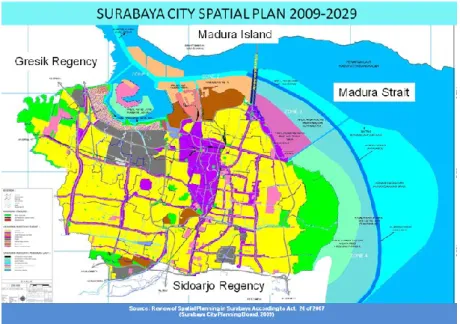
The challenge is the increasing conversion of agricultural land use or land change function of cultivated area. Zoning for urban green space is largely determined in the Eastern region city of Surabaya (Fig.3.).
Figure 3. Surabaya City Spatial Plan 2009-2029 (Source: Surabaya City Planning Board 2010)
The high dynamics of the city of Surabaya developments resulted in a high intensity of land use in Surabaya downtown. This led to the economic value of land that is increasing. The high economic value of the land encourages utilization of services trade both urban and regional scale (Fig.4.). Yet, the increase in the economic value is also an impact on the utilization of open spaces to green open space of diminishing returns.
Current percentage of green space compared to the overall size of the city is 20.84% according to Surabaya City Spatial Plan 2009. Average building density is high (more than 50 buildings / Ha).
Figure 4. Major Opportunity Development of Surabaya 2009-2029 (Source: Surabaya City Planning Board 2010)
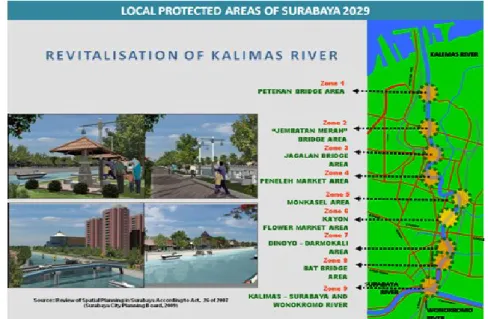
Several projects should be done is to protect the area along the riverbanks Kalimas. The river is very important to keep the city from the threat of flooding; it must have to be revitalized in order to function properly (Fig.5.). Surabaya is a coast city, so the waterfront area should be maintained properly. East Surabaya region needs to be developed for the
green barrier, mangrove reforestation, and keep the area from tidal waves (Fig.6.).
Figure 5. Local protected Areas of Surabaya 2029 (1) (Source: Surabaya City Planning Board 2010)
Figure 6. Local protected Areas of Surabaya 2029(2) (Source: Surabaya City Planning Board 2010)
Until 2025, the city of Surabaya faces the problem of life quality in its urbanization process. Quality of life of a region is influenced by complicated factors including health, education, security, economics and so on, which are multidimensional, not just about the size of income. Various measures of empowerment, care, rehabilitation, and social protection to vulnerable communities including the social welfare problem have been done, however, the number of social welfare problems are not diminishing in number. The problem of poverty in the city of Surabaya is still a threat that needs to be handled carefully and seriously.
Beside of those issues regarding land use pattern and life quality, statistics have a tendency to decrease the incidence of fire, because there are many sources of water that can be taken to extinguish the fire. Water
resources are one of the taken advantages of unused land that is not supervised and not be used, which is precisely also trigger the emergence of illegal settlement.
4. GREEN CITY DESIGN IN ECOLOGICAL SYSTEM OF SURABAYA
4.1 Ecological system
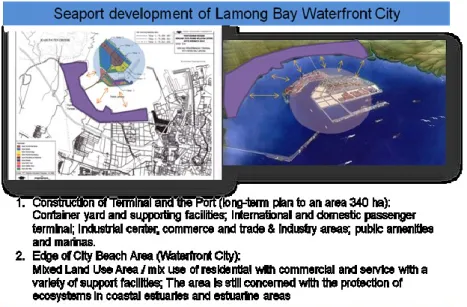
According to Diamantini and Zanon (2000), the new ecological indicators should be developed for urban planning for sustainable development. Comparison between the areas of green open space can assess the quality of urban planning, although it can’t reflect the quality of green open space. As the research conducted by Dyer (1994), the author mentioned that range limits of many plant species are expected to shift dramatically for climatic warming, driven by the release of greenhouse gases, occurs in the next century. In this case, Surabaya City is a center of the Eastern Indonesia development. As shown in Fig.7, development of Surabaya coastal areas became national scale port is a dilemma dealing with conservation of coastal areas. Areas of coastal water ecosystems are dynamic ecosystems and have a wealth of diverse habitats, both on land and at sea as well as interact with each other. Besides having great potential, coastal ecosystems are also vulnerable to the impact of human activities.
General construction activities are directly or indirectly, will adversely impact on coastal aquatic ecosystems. River Lamong project activities in the North Coast region Surabaya will create an international harbor and a waterfront city. However, this activity will threaten the existence of mangrove ecosystems that exist, although the region is only 10% of the sea, but holds nearly 90% of marine life.
Mangrove ecosystem damage also occurred in the East Coast of Surabaya. Triggered by events other than reclamation on river and coastal pollution levels, environmental declaration program protects the mangrove ecosystem in the region East Coast of Surabaya is very important to keep the environment sustainability. Conservation of East Coast of Surabaya will save the biodiversity and ecotourism potential of the region. A review of 2008 is known that the condition of 40% or about 400 acres mangrove forests in the region of East Coast of Surabaya is in damaged condition.
There was a 29.8 km long coastline of mangrove in the region of East Coast of Surabaya, now only 8.7 km of mangrove vegetation is overgrown with a thickness of not more than 50 meters. This is very different from the situation in the 1990s, where the thickness of the mangrove forest can be more than 50 meters and they grew up along the shoreline in the East Coast of Surabaya.
4.2 Toward green city design: spatial structure and patterns
In accordance with the laws of spatial No. 26 of 2007, the development of Surabaya city should refer to the long-term development plans of national, provincial and city of Surabaya for ensuring the proportion of green open space. In the design of long-term development plan of the town which contained 8 Surabaya’s development missions. One of the Surabaya’s
urban development missions is making environmentally spatial planning and put its orientation to the principles of equitable and sustainable way to achieve the eco-city Surabaya. Indication of the success of this mission is characterized by the preservation of green open space and increase the percentage of its range, decrease in the slums, the reduced extent of inundation/flooding, increasing the quality of the environment (land, water, air), the establishment of conservation of water catchments areas, the increase of natural resources can be utilized, and reduced marginal lands due to excessive water uptake, increasing the coverage status of basic infrastructure services settlement environment, the increasing coverage of water services, reduced levels of pollution in watersheds and coastal areas, the use of zones and areas of integrated coastal zone management and sustainable, less mangrove ecosystems and biological resources are damaged, increasing the contribution of the fisheries, the increasing role of the community, the increasing number of proposals for large-scale projects that use the concept of green city, green architecture, as well as the concept of sustainable development concept.
In the description of this mission there are 11 described the efforts in achieving this mission, namely:
1. Planning, utilization, control the intensity of land coverage, focused on efforts to control land uses that do not pay attention to the portion of green open space to built space.
2. Control of land conversion, control efforts directed at converting open spaces into green productive land up.
3. Slum reduction, aimed at reducing slum area, both in the city center, near the coast, along the border on the edge of the river and railroad tracks.
4. Reduction in disaster-prone areas, aimed at reducing disaster- prone areas, both flooded / inundation or fire.
5. Integrated Management and conservation of coastal areas.
6. Increased use of environmentally friendly energy is directed in an effort to diversify the sources of primary energy with renewable energy is more environmentally friendly.
7. Utilization of Natural Resources Renewable, aimed to increase the carrying capacity of nature and environmental preservation and welfare. Restrictions on the use of natural resources are directed to maintain stability and carrying capacity of nature to be done correctly.
8. Utilization of renewable natural resources is directed at meeting the interests of the carrying capacity of nature and environmental conservation and social welfare.
9. Water Resources Management, aimed to improve water resource management of surface water that provides justice for the community to meet the various needs of the conservation, utilization and control the water resources.
10. Housing and Settlement directed to fulfill the needs of the home as well as the formation of a healthy environment and appropriate allocation function. The project will also be directed to improve the distribution and dispersion of population and development.
11. Increase community participation in climate change mitigation and adaptation
In Surabaya’s development plan, the planning measures are suggested from the views of spatial structure and spatial pattern as the following:
1) Spatial structure: Establishment of service centers and sub centers in hierarchical service as national and international service centers, service centers and regional cities, Sub City Centre and the Centre for Development Unit (UP) and ocean zoning to be four zones to support the development of a knot trading activities and services based on the characteristics and potentials of marine areas as well as policy development is an integrated network system between the system of transportation networks, energy network system, telecommunication network systems, ecological network systems including green open space and water resources, urban infrastructure systems.
2) Spatial Pattern: the establishment of protected areas with the establishment of various protected functions of the city and the integrated conservation area covers the protection against the employee; local protected areas; nature reserves and cultural reserves; area of green open space; disaster-prone areas, and coastal areas marine areas as well as by improving the function of each area in the city of Surabaya, including residential areas;
areas of trade and services; office area; the industrial area; the area of tourism; non green open space areas; the evacuation chamber; the allotment of space for informal sector activities and the other designation.
Figure 7. Seaport development of Lamong Bay Waterfront City (Source: Surabaya City Planning Board, 2010)
Figure 8. Determination of Surabaya Strategic Plan Area 2029 (Source: Surabaya City Planning Board 2010)
Spatial strategic planning based on economic aspects, the functions and carrying capacity of the environment, social, cultural, and high technology;
and the development and/or limitation of function are shown as intended spatial structure and spatial pattern endorsed in Fig.8 strategic areas in urban and regional scale.
4.3 Discussion on Surabaya’s planning practice
In Surabaya’s development plan, an ecological approach to urban planning became a very important approach in anticipating global warming.
Approach to effective functioning of open space (ecological, social and economic) into new approaches was taken into account in Surabaya’s development plan. Effective use of urban space becomes a challenge in implementing the concept of green city design in this city. The city should be viewed as an ecosystem of dynamic interaction between social life community and nature environment, which becomes a major mindset in urban planning and design approach.
In the case of Surabaya’s development plan, it can actually be done with physical intervention through urban planning and design in order to anticipate global warming in urban development. Urban planning and design that puts the interests of environmental sustainability is recognized as a guarantee of sustainable development not only for the current generation but also for future generations. Some policy interventions in urban space utilization are considered to ensure setting the urban policy development and management from the following points in the case of Surabaya city:
1. Urban development should be continuing to be supported by the city's infrastructure (transportation, sanitation, drainage, etc.) that are environmentally friendly and adequately supporting the environmental sustainability efforts.
2. Efforts to use space should be done by reducing vulnerability environment, so that the environmental carrying capacity can be maintained to avoid the threat of rising sea levels, flooding, abrasion, and other natural hazards.
3. The design of urban areas should be able to sustain the ongoing ecological processes essential for life support systems and biodiversity, so that the ecological functions of the city remain stable.
4. The city government needs to apply the principles of good governance, so that the integration step between the public, investors and government can participate synergistically in creating a comfortable urban environment, and sustainable. Bottom-up approach emphasizes the role of the community (participatory planning process) in the implementation of urban development in a transparent and accountable to be more accommodating to the various inputs and aspirations of all stakeholders in the implementation of development, especially in conserving the natural environment.
5. Law enforcement is consistent and consistently – both government regulation, decree, or local regulations to avoid unilateral interests and for the implementation of role sharing a 'balanced' between the elements of stakeholders in creating a healthy environment and sustainable cities
As discussion above, a city is a very complex ecosystem consisting of natural, socio-cultural subsystems, and the economy. In addition to natural factors, socio-cultural aspects, and economics play an important role in planning and managing urban green open space, and wider urban environment. The success of urban planning and design is actually not located in a beautiful design outcome, but rather on how urban planning can be implemented. The city planners who have an important role to realize the product planning and urban design, with the involvement of all stakeholders, coordinate the city government. Increase the participation of all stakeholders, and better coordination of planning agencies are critical to the success of urban planning and design. Thus, it is still a long way to the goal of Surabaya’s development plan.
5. CONLUSION
This study is the result of reviewing the Long-Term Development Plan for 2005-2025 and Spatial Planning of Surabaya in the period of 2009-2029 from the view of green city design. In the Surabaya’s development plan, the phenomenon of global warming, which will give a direct impact on coastal cities such as Surabaya, underlies the importance of making anticipatory efforts through urban planning. Some planning works anticipate a solution designed to provide input to the Government of Surabaya city including the revitalization of the river Kalimas, mangrove reforestation, solution development of green areas in the east of the city, and port development projects. But it all depends on the local government through anticipatory planning.
Substantially, products of city planning and design have become the major objectives in spatial strategic plan in Indonesia. However, for the implementation of green city design, as described above, Indonesia still requires a long process and the role of urban planning and design has a very large role in the effort to realize or toward green city. Besides, implementation of green city design in Indonesia is still facing very complex issues, including socio-cultural problems, economically and politically. This research report is expected to assist policy makers in the planning and
design of the city of Surabaya, so as to anticipate global warming issue at this time.
6. ACKNOWLEDMENTS
As academicians that are concerned with the problems of urban environmental quality, we are involved in the preparation of the Long Term Development Plan for the city of Malang, Malang Regency, Surabaya and others. We did this study in conjunction with the preparation of the Surabaya Long Term Development Plan for 2005-2025 conducted jointly planning agency of Surabaya Urban Development. We are very grateful to the entire staff of Surabaya City Planning Board for giving information about the products of Surabaya city planning. Finally, we thank for Zhen- Jiang SHEN for his constructive suggestions.
REFERENCES
Bradley, G.A. (1995). Urban Forestry Landscapes: Integrating Multidisciplinary Perspectives. University of Washington Press, Seattle.
Diamantini, C., Zanon, B. (2000). “Planning the urban sustainable development the case of the plan for the province of Trento, Italy”. Environ. Impact Assess. Rev. 20, 299-310.
Dyer, J.M. (1994). “Land use pattern, forest migration, and global warming”, Journal of Landscape and Urban Planning, 29, 77-83.
Grey, G.W. (1996). The Urban Forest: Comprehensive Management, Wiley, New York.
Li, F., Wang, R. et.al (2003a). “Comprehensive concept planning of urban greening based on ecological principles: a case study in Beijing, China”, Journal of landscape and urban planning.
Li, F., Wang, R. (2003b). “Evaluation, planning and prediction of ecosystem services of urban green space: a case study of Yangzhou City”, Acta Ecol. Sin. 23 (9), 1929-1936.
Li, F., Wang, R., Paulussen, J., Liu, X. (2005). “Comprehensive concept planning of urban greening based on ecological principles: a case study in Beijing, China”, Journal of Landscape and Urban Planning, 72, 325–336.
Lutz, M., Bastian, O. (2002). “Implementation of landscape planning and nature conservation in the agricultural landscape a case study from Saxony”, Agric. Ecosyst. Environ, 92, 159- 170.
Miller, R.W. (1988). Urban Forestry: Planning and Managing Urban Green Spaces. Prentice- Hall, Englewood Cliffs, NJ.
Murota, Y., Ito, K. (1996). “Global warming and developing countries; The possibility of a solution by accelerating development”, Energy Policy, 24(12), 1061-1077.
Respati, W. (2004). “Pengelolaan Kawasan Pesisir Secara Berkelanjutan (suatu telaah terhadap pendekatan ekologis dan partisipasi masyarakat)”, Jurnal Diagonal Terakreditasi Volume: 5 Nomor 1/Februari 2004, Malang: Fakultas Teknik Unmer Malang (in Indonesian).
Schell, L.M., Ulijaszek, S.J. (1999). Urbanism, Health and Human Biology in Industrialized Countries, Cambridge University Press, Cambridge.
Shafer, C. (1999). “US National park buffer zones: historical, scientific, social, and legal aspects”, Environ. Manage, 23 (1), 49-73.
Shirvani, H. (1985). The Urban Design Process. New York: Van Nostrand Reinhold Co.
Teal, M., Huang, C.S., Rodiek, J. (1998). “Open space planning for Travis Country, Austin, Texas: a collaborative design”, Landscape Urban Plan, 42, 259-268.
Thompson, C.W. (2002). “Urban open space in the 21st century”, Landscape and Urban Planning, 60, 59-72.