1. Introduction
Starting from the particle-rotor model with triaxially deformed rigid-body moments of iner- tia by adopting the angular-momentum (I) de- pendent moments of inertia, we have obtained an algebraic solution, and obtained quite good fit to the experimental data both for the energy levels and the electromagnetic transitions [1,2,3]. Our model takes into account the invari- ance of the nuclear states under Bohr symmetry group [4] which reduces the diagonalization space to 1/4 of the full space. The precession of
→ → →
the core angular momentumR=I−j correlates
→
with the single-particle angular-momentum j, and so such an interplay between two tops with
→ →
R and j is called the “top-on-top mechanism”.
The angular-momentum dependent moments of inertia simulates the decrease of pairing effect by a gradual increase of the core moments of in- ertia as functions ofI.
The purpose of the present paper is to ex- tend this top-on-top model to the odd-odd nu- cleus, which is named as “tops-on-top model”.
As an example, we apply tops-on-top model to
164Lu where the spin and parity of three TSD bands are assigned [5,6]. The formalism is
The triaxial strongly deformed bands in odd-odd nuclei
Kazuko Sugawara-Tanabe*
Abstract
The particles-rotor model, where one proton and one neutron in each single-j orbital are coupled to the triaxial rotor with angular-momentum dependent moments of inertia, is successful in describing physical properties in odd-odd nucleus of164Lu. Both positive and negative parity TSD bands are well reproduced in a set of parameters with attenuation factors in the Coriolis interaction and the proton-neutron interaction in the recoil term.
One unit quantum number difference between the yrast and yrare TSD bands is con- firmed by estimating the alignment of rotational axis components of total and the rotor core angular momentaIxandRx.
Key Words : Triaxial strongly deformed band, Odd-odd nucleus, Particles-rotor model.
*
大妻女子大学
大妻女子大学紀要
―社会情報系―
社会情報学研究 202011 153
shown in Sect. 2, the numerical analysis in Sect. 3, and the conclusion in Sect. 4.
1 Formalism
The particles-rotor Hamiltonian is given by
→ →
H=Hrot+Hsp(j1)+Hsp(j2) (1) with
Hrot=k=x,y,z
Σ
Ak(Ik−j1k−j2k)2,→ →
Hsp(j)= V
j(j+1)[cosγ(3jz2−j2)
− 3 sinγ(jx2−jy2)], (2)
→ → →
whereAk=1/(2Jk), andj stands for eitherj1orj2. Similar to the odd-A case, we introduce the angular-momentum dependent rigid-body mo- ments of inertia :
Jk= J(I) 1+(165π)1/2β
[
2 1−
(
45π)
1/2β2cos(
γ+23πk)]
,J(I)=J0
I−c1
I+c2, (3)
wherek=1,2 and 3 correspond tox,yandz, and β2andγare the deformation parameters. Our formula is applicable to the high spin and highly excited region, i.e., TSD band region, and the parametersc1andc2are so chosen thatJ(I) increases monotonically with increasingI and goes toJ0asI→∞.
The maximum moment of inertia is about x-axis and the relation JxJyJz holds in the range of 0γπ/3. We choosex-axis as a quan- tization axis, and then a complete set of theD2- invariant basis [4] is given by
{
2I16+1π2 [DMKI (θi)φjΩ11φjΩ22+(−1)I−j1−j2DM−KI (θi)φj−Ω11φj−Ω22] ;
K−Ω1−Ω2=even,Ω1>0
}
, (4)whereK,Ω1andΩ2denote eigenvalues ofIx,j1x
and j2x, respectively. Number of independent bases is given by (2I+1)(2j1+1)(2j2+1)/4. The wave functionsφjΩ11andφjΩ22stand for spherical bases of the single-particle states, andDMKI (θi) is WignerD-function. The magnitude R of the ro-
→ → → →
tor angular momentum R=I−j1−j2is restricted toR=|I−j|, |I−j|+1,…,I+j−1,I+j withj=|j1
−j2|, |j1−j2|+1,…,j1+j2. If we defineR=I−j1−j2+ nβ+nγwith integersnβandnγ,nβandnγrange asnβ=0, 1, 2,…, 2j1−1, 2j1andnγ=0, 1, 2,…, 2j2
−1, 2j2, so thatR exhausts all the possible inte- gral values defined above. SinceRxruns fromR to −R, andRx=Ix−j1x−j2x=K−Ω1−Ω2=even, an inte- gernαdefined by the relationRx=R−nαranges as
nα=0,2,4, ..., 2R, forR=even,
nα=1,3,5,…, 2R−1, forR=odd. (5) We remark that the basis in Eq. (4) is the eigen- state ofH for the case ofV1=V2=0 andγ=π/3 (Ay
=Az).
We assume that two particles occupy differ- ent orbitals or different isospins, so that [j1k,j2k’]
=0 forkork’=x,y,z. Commutation relations sat-
→ → →
isfied among three angular momentaI,j1andj2
→ → → → → →
are [I,j1]=[I,j2]=[j1,j2]=0, and [Ik,Ik’]=−iIk×k’and
→ →
[jk,jk’]=ijk×k’ for both ofj1 andj2. These are real- ized in terms of three kinds of Holstein-
〈 〈 〈 〈
Primakoff (HP) boson operatorsa,a†,b,b†and
〈 〈
c,c†as follows :
〈 〈
I+=I_†=Iy+iIz=−a† 2I−na,
〈
Ix=I−na,
〈 〈
j1+=j1†−=j1y+ij1z= 2j1−nbb,
〈
j1x=j1−nb,
〈 〈
j2+=j2_†=j2y+ij2z= 2j2−ncc,
〈
j2x=j2−nc, (6)
〈 〈 〈 〈 〈 〈 〈 〈 〈
where na=a†a, nb=b†b and nc=c†c. In applying this HP transformation to Eq. (1), we expand
大妻女子大学紀要
―社会情報系―
社会情報学研究 202011
154
〈 〈 〈 〈
2I−na, 2j1−nband 2j2−ncinto series inna/(2
〈 〈
I),nb/(2j1) andnc/(2j2), and retain up to the next- to-leading order.
For the case of V1=V2=0, diagonalization of Hrotis achieved by the unitary transformation to quasibosons (α,β,γ) :
(
αβγ)
=K(
〈
a〈 b〈
c
)
+M(
〈
a〈 † b〈 †
c†
)
, (7)Two 3×3 matrices are given by
K
(
= f00Iη+−f−ffI14ηf3−−fff2ηI3f4−)
, (8)M
(
= −ff05Iη−f001η+f2η00+)
, (9)where fI=
I
I−j1−j2, f1=
j1
I−j1−j2
,
f2=
j2
I−j1−j2
, f3= j1
j1+j2, f4=
j2 j1+j2
, f5= j1+j2
I−j1−j2
, (10)
and
η±={1sgn(q−p)}
[
12(
2p+qpq±1) ]
1/2, (11)withp≡Ay−Ax,q≡Az−Ax. The eigenvalue ofHrot
for the case ofV1=V2=0 becomes Erot(I,nα,nβ,nγ)=AxR(R+1)−p+q
2 nα2
+(2R pq+
pq−p+q 2 )(nα+1
2), (12)
whereR=I−j1−j2+nβ+nγand nα,nβ andnγ are
〈
the eigenvalues of number operators nα=α†α,
〈 〈
nβ=β†βandnγ=γ†γ. In the symmetric limit of Ay=Azwhereη+=1 andη_=0,Erottakes the well- known form ofAzR(R+1)+(Ax−Az)(R−nα)2. Even
〈
in this limitαdoes not coincide witha, but the
〈 〈 〈 〈 〈 〈
relation nα−nβ−nγ=na−nb−nc holds. In compari- son with Eq. (4), nα, nβ and nγ are the same ones as defined in the symmetric limit ofAy=Az
withV1=V2=0. Therefore,nα describes the pre- cession of the rotor, in other words, wobbling quantum number [5], and nβ and nγ describe precession of j1 and j2, respectively. Thus, a physical state is labeled by a set of non-negative integers (nα, nβ, nγ), i.e., asymptotic quantum numbers in addition toI,j1,j2. The lowest TSD band level ofI has quantum number (nα=0,nβ= 0, nγ=0), while the second lowest TSD band level ofI+1 has (1,0,0). In odd-Acase we got an algebraic solution of total Hamiltonian even when single-particle potential exists. The alge- braic solution for the full Hamiltonian is de- scribed by two quantum numbers which satisfy D2-symmetry. However, in odd-odd case, it is very hard task to obtain the algebraic solution ofH with non-zeoV1andV2.
2 Application to164Lu
We perform the exact diagonalization ofH in Eq. (1) by using Lanczos method. Two TSD bands with positive parity (TSD3 and TSD2) and one negative parity TSD band (TSD1) are observed in164Lu [7]. In the beginning TSD2 was assumed to be of negative parity [6] after which its naming comes, but later was con- firmed to be of positive parity [7].
The proton single-particle orbital isi13/2the same as in the other odd-ALu isotopes, but the neutron single-particle orbital is not definite.
Ref. [6] suggests neutron orbital is also i13/2 for TSD3 band as TSD3 starts from 13+ state, and h9/2orbital for TSD1 band but TSD1 starts from 14−state. We adopt the same deformation ofγ=
17°and β=0.38 as in the neighbouring163Lu.
We want to use the same set of parameters both for positive and negative parity bands [3]. Thus,
Sugawara-Tanabe:The triaxial strongly deformed bands in odd-odd nuclei 155
we compare two cases, i.e., Case 1 whereνi13/2
for TSD3 andνj15/2for TSD1 bands, and Case 2 whereνg9/2for TSD3 andνh9/2for TSD1. The pa- rameter set is different from that in odd-A nu- cleus, as we need new extra parametersVkfork
=π(or 1) andν(or 2). In analysing the zigzag bands in odd-neutron nuclei based on the particle-rotor model, the attenuation factor should be introduced on the Coriolis interaction [8,9]. Based on the renormalization group method, we have shown that the effect of trun- cating the basic Fock space must be compen- sated by scaling the coupling constant, and the attenuation factor on the Coriolis interaction is such a typical example [10]. We adopt attenu- ation factor of 0.55 for the Case 1 and 0.65 for the Case 2 in Coriolis term of −Σk=x,y,zIk(j1k+j2k)/Jk. This attenuation factor compensates the effect of truncation of the single-particle space. There is an another problem in Case 1, as both proton
and neutron orbitals are the samei13/2. Then, the interaction between the proton and neutron be- comes important, while our model Hamiltonian has no such correlation as an additional inter- action. We introduce another attenuation 0.55 to the proton-neutron interactionΣk=x,y,zj1kj2k/Jkin the recoil term. Finally, the parameter set of Case 1 is V1=V2=2.3MeV, J0=82MeV−1, c1=−8, andc2=41 together with the attenuation factor of 0.55 both in −Σk=x,y,zIk(j1k+j2k)/JkandΣk=x,y,zj1kj2k/ Jk. The parameter set in Case 2 is J0=87.7 MeV−1, c1=−8.5, and c2=47.3 together with the attenuation factor of 0.65 only in −Σk=x,y,zIk(j1k+j2k) /Jk.
Employing parameter set of Case 1, we cal- culate energy eigenvalueE(I) and showE*−aI (I+1) witha=0.0075 in Fig. 1 for TSD3 and TSD 2, and Fig. 2 for TSD1. Only the bandhead en- ergy of TSD3 is adjusted to experimental value.
WhileE*−aI(I+1) atI around the starting and ending of TSD2 band are not in good agreement Figure 1 : Comparison between the experimental and
the theoretical energy levelsE*-aI(I+1) as functions of angular momentumI for TSD3 and TSD2 bands in
164Lu. The vertical axis is in unit of MeV. Theoretical values are shown as filled squares connected by solid lines, while experimental values as open triangles connected by solid lines. The proton orbital isi13/2and the neutron orbitali13/2. The parameter set is Case 1 (see the text). The experimental data are from Ref. [7].
Figure 2 : Comparison between the experimental and the theoretical energy levelsE*-aI(I+1) as functions of angular momentumI for TSD1 and X2 bands, to- gether with the predicted partner band TSD1-2 band in
164Lu. The proton orbital isi13/2and the neutron orbital is j15/2. The parameter set is Case 1. The meanings of the curves are as defined in Fig. 1. The experimental data are from Ref. [7].
大妻女子大学紀要
―社会情報系―
社会情報学研究 202011
156
with experimental data, theoretical values re- produce both TSD3 band with (nα=0,nβ=0,nγ=0) and TSD2 band with (1,0,0) quite well over all region. With the same set parameters we show theoretical results for the negative parity band of TSD1 with (0,0,0) and its partner band TSD1
−2 with (1,0,0) in Fig. 2. There is no experimen- tal data for TSD1−2 band levels with oddI and negative parity. Instead, Ref. [7] identifies the other sequence of levels along the band X2 which forks from 42−. The theoretical level scheme follows this yrast band X2.
Similarly, we show the theoretical level scheme with Case 2 in Fig. 3 (νg9/2) for TSD3 and TSD2, and Fig. 4 (νh9/2) for TSD1. Again, only the bandhead energy of TSD3 is adjusted to the experimental level of 13+. Agreement of theoretical levels in TSD3 and TSD2 bands with the experimental data seems to be better except for the starting and ending of the band.
However, as seen in Fig. 4, the odd spin se- quence 19, 21,…(TSD1-2) appears lower than even spin sequence 16, 18,…(TSD1). AsI−j1−j2
=I−11, odd spin sequence of TSD1−2 has pre- cession quantum numbers (0,0,0) and even spin sequence of TSD1 has (1,0,0) because of theD2- symmetry (see Eq. (5)). The experimental levels (open triangles) belong to TSD1. If the band- head energy of TSD1 is shifted to the experi- mental level ofI=16−in Fig. 4, theoretical curve for TSD1 agrees quite well with the experimen- tal level sequence continued to X2 band. If we calculatej15/2with the parameter set of Case 2, the gradient ofE*−aI(I+1) for the configuration πi13/2 νj15/2is much steeper than the experimen- tal curve. Since no lower band like TSD1−2 is observed experimentally, and as far as we want to explain both positive and negative parity bands with the same parameter set,νh9/2is not a good candidate for TSD1 band. From now on we concentrate on the theoretical results based
on Case 1.
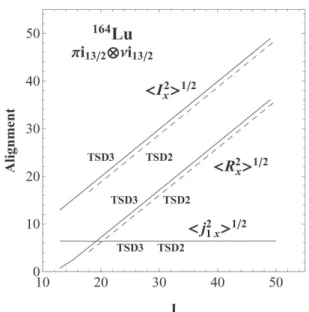
First, we investigate the alignment of spins in TSD bands. In Fig. 5 (positive parity TSD2 and TSD3 bands) and Fig. 6 (negative parity TSD1 and TSD1−2 bands), we show the align- ment of〈Ix2〉1/2,〈Rx2〉1/2, and〈jkx2〉1/2withk=1(π), 2 (ν). In Fig. 5, we show only〈j1x2〉1/2, as both pro- ton and neutron are in the same i13/2 orbital,
〈j1x2〉1/2=〈j2x2〉1/2. Here the state |〉stands for the eigenstate ofH belonging to the eigenvalue E (I). Comparing solid lines (TSD3) with dashed lines (TSD2) for〈Ix2〉1/2and〈Rx2〉1/2, we recognize almost one unit difference between TSD3 and TSD2 independent ofI. It confirms the one unit difference innαbetween (1,0,0) and (0,0,0), indi-
→ →
cating full alignment ofj1andj2tox-direction as a result of Coriolis interaction. This fact is di- rectly demonstrated by the fact that〈j1x2〉1/2=
〈j2x2〉1/2~ 13/2, as seen in Fig. 5. In Fig. 6, it is also seen almost one unit difference between TSD1 and TSD1−2 in〈Ix2〉1/2and〈Rx2〉1/2. The dif- ference between〈j2x2〉1/2and〈j1x2〉1/2is one unit due Figure 3 : Comparison between the experimental and the theoretical energy levelsE*-aI(I+1) as functions of angular momentumI for TSD3 and its partner band TSD2 bands in164Lu. The proton orbital isi13/2and the neutron orbital is g9/2. The parameter set is Case 2.
The meanings of the curves are as defined in Fig. 1.
The experimental data are from Ref. [7].
Sugawara-Tanabe:The triaxial strongly deformed bands in odd-odd nuclei 157
to the difference betweenj15/2andi13/2. Both Figs.
5 and 6 show the alignment ofj1xandj2x are al- most perfect, indicatingnβ=nγ=0 for both yrast and yrare TSD bands.
Kinematic and dynamic moments of iner- tia,J(1)andJ(2), which are developed for the nu- cleus with axially symmetric deformation [11], cannot be related to the inertial tensor for a tri- axially deformed nucleus. However, their de- tailed behavior assessed from experimental data can be available for the test of theoretical band levels E(I), since they are defined in terms of the first and the second differences ofE (I) with respect toI, i.e.,
J(1)= 2I−1 EI−EI−2
,J(2)= 4 EI−2+EI+2−2EI
. (13)
We showJ(1)andJ(2)for positive parity bands in Figs. 7 and 8, and for negative parity bands in Figs. 9 and 10. We compare theoretical and ex- perimentalJ(1)in Figs. 7 and 9, andJ(2)in Figs.
8 and 10. The solid lines correspond to theoreti- Figure 4 : Comparison between the experimental and the theoretical energy levelsE*-aI(I+1) as functions of angular momentumI for TSD1 and its partner band TSD-2 bands in164Lu. The proton orbital isi13/2and the neutron orbital ish9/2. The parameter set is Case 2.
The meanings of the curves are as defined in Fig. 1.
The experimental data are from Ref. [7].
Figure 5 : The alignments ofIx,Rxandj1x for two posi- tive parity TSD bands as functions ofI . Solid lines cor- respond to TSD3, while dashed lines to TSD2. The alignment ofj1x comes fromπi13/2orbital. As forj2x, see the text.
Figure 6 : The alignments ofIx,Rx,j1x andj2x for two negative parity TSD bands as functions of I . Solid lines correspond to TSD1, while dashed lines to TSD1 -2. The alignment ofj2x comes from
ν
j15/2orbital, and j1xfromπi13/2orbital.大妻女子大学紀要
―社会情報系―
社会情報学研究 202011
158
cal values and the dashed lines to the experi- mental ones. As is seen in Figs. 7 and 9, tops- on-top model reproduces the kinematic mo- ments of inertia J(1) quite well. As is seen in Figs. 8 and 10, this model is not enough to ex-
plain the detailed behavior of the dynamic mo- ment of inertiaJ(2), but reproduces the average value especially in the middle of the band. In Figure 7 : The comparison of kinematic moments of in-
ertia J(1) with experimental ones for positive parity TSD3 and TSD2 bands as function ofI. Solid lines correspond to theoretical values, while dashed lines to experimental ones. Both theoretical and experimental values are deduced from energyE(I).
Figure 8 : The comparison of dynamic moments of in- ertia J(2) with experimental ones for positive parity TSD3 and TSD2 bands as function ofI. Solid lines correspond to theoretical values, while dashed lines to experimental ones. Both theoretical and experimental values are deduced from energyE(I).
Figure 9 : The comparison of kinematic moments of in- ertia J(1) with experimental ones for negative parity TSD1 and TSD1-2 bands as function ofI. Solid lines correspond to theoretical values, while dashed lines to experimental ones which include X2 band from 42-.
Both theoretical and experimental values are deduced from energyE(I).
Figure 10 : The comparison of dynamic moments of inertia J(2)with experimental ones for negative parity TSD1 and TSD1-2 bands as function ofI. Solid lines correspond to theoretical values, while dashed lines to experimental ones which include X2 band from 42-.
Both theoretical and experimental values are deduced from energyE(I).
Sugawara-Tanabe:The triaxial strongly deformed bands in odd-odd nuclei 159
Fig. 10, the divergence of experimental value of J(2)around 42−comes from the band crossing be- tween TSD1 and X2. Such a bandcrossing is out of the scope of present tops-on-top model, but should be an object of a self-consistent micro- scopic many-j approach. Similarly, complicated behavior of experimentalJ(2)seen in Fig. 8 sug- gests strong correlations of TSD2 with other bands which are not yet observed.
3 Conclusion
Our attempt in the present paper is to fore- see properties of the TSD bands in an odd-odd nucleus164Lu based on the theoretical model as simple as possible. Calculation is carried out with the “tops-on-top” model, which is essen- tially the particle-rotor model with valence pro- ton and neutron each in a definite single-j or- bital coupled to the rotor with angular- momentum dependent rigid-body moments of inertia. The angular-momentum dependence simulates the collapse of pairing correlation in the rotating core. In order to explain both en- ergy level schemes for positive and negative parity TSD bands [7], we choose Case 1 parame- ter set. As for the positive parity bands, an as- sumption that a valence neutron occupies i13/2
orbital is favorable, while for the negative par- ity bands j15/2 orbital seems to be favorable in
164Lu.
We have confirmed that the calculated alignments〈Ix2〉1/2and〈Rx2〉1/2give stable differ- ence by one unit independent ofI between two TSD bands characterized by the precession (or wobbling) quantum number nα=1 and 0. The degeneracy of the calculated alignments〈j1x2〉1/2 and〈j2x2〉1/2between yrare and yrast TSD bands indicates precession quantum numbersnβ=nγ=
0 for both TSD bands.
From the energy eigenvalues E(I), kine- matic and dynamic moments of inertia are de- duced. Kinematic moment of inertia J(1)repro- duce experimental one, but the detailed behav- ior of dynamic moments of inertiaJ(2), for exam- ple divergence coming from the band crossing at 42−is out of our macroscopic model. In order to explain such a band crossing, our single- particle space is too small, and many-j calcula- tion is inevitable.
Refererences
[1] K. Tanabe and K. Sugawara-Tanabe, Phys.
Rev. C 73, 034305 (2006) ;75, 059903(E) (2007).
[2] K. Tanabe and K. Sugawara-Tanabe, Phys.
Rev. C77, 064318 (2008).
[3] K. Sugawara-Tanabe, and K. Tanabe, Phys.
Rev. C82, 051303(R) (2010).
[4] A. Bohr, Mat. Fys. Medd. K. Dan. Vidensk.
Selsk.26, no. 14 (1952).
[5] A. Bohr and B. R. Mottelson,Nuclear Struc- ture (Benjamin, Reading, MA, 1975), Vol.
II, Chap. 4.
[6] S. Törmänen et al, Phys. Lett. B 454, 8 (1999).
[7] P. Bringel et al, Phys. Rev. C 75, 044306 (2007).
[8] S. A. Hjorth et al, Nucl. Phys. A144, 513 (1970).
[9] Th. Lindblad, H. Ryde and D. Barneoud, Nucl. Phys.A144, 513 (1970).
[10] K. Sugawara-Tanabe and K. Tanabe, Phys.
Rev. C19, 545 (1979).
[11] J. M. Espino and J. D. Garrett, Nucl. Phys.
A492, 205 (1989).
大妻女子大学紀要
―社会情報系―