A SUTUTY OF PLAY IN PRESCHOOL CHILDREN :
An Examination of Changes in Children's Play
Behaviour during their First Year in a Kindergarten
―Comparison between the First Term and the Second Term―
Tomoko SHINNO*
1) 1 2
2)
1
2
3)
1 2 3
Abstract
Research was done to clarify the changes of three‑year‑old children's play behaviour in the first year of the kindergarten. The present report discusses the changes of play behaviour bet‑
ween the first term and the second term. The play was videotaped and analy$ed under three main headings; type of play, interpersonal behaviour and other behaviour.
Type of play
. t Solitary play' and tparallel play' decreased from the first term to the second term.
. C Group play'(including 'mixed sex group' and 'same sex group' play)increased from the first term to the second term both for children alone and for a group involving a teacher, and for both sexes.
Interpersonal Behaviour
. ' Imitating another child', tlooking at a child', tbody contact'(both with children alone and with a teacher and/or an adult) and tseeking contact with children' decreased from the first term to second term.
. t Proximity to other children' and tseeking attention'(both with children alone and with a teacher and/or an adult) increased from the first terrn to the second term.
Other Behaviour:
. " Wandering' decreased greatly from the first term to the second term.
. t Object conflict' increased from the first term to the second term.
, C Rough and tumble play' and taggressive behaviour' were observed in boys more often than girls during the two terms.
* Department of Educational Psychology, Nagasaki University.
Introduction
It is natural that the newcomers to a kindergarten will change greatly in their first year. Shinno (1990) reported the play behaviour of three‑year‑old children in a Japanese kindergarten during the first term. Hold‑Cavell, Attili and Schleidt(1986) reported the change during the first year in a cross‑sectional study. They analysed eight children in West Germany and eight in Italy with regard to certain play and behaviour categories; but there were host children in their classes. In Japan, children enter kindergarten from the age of three. Iijima(1986, 1989) studied the change of the three year‑old preschooler's behaviour longitudinally for three years, i. e. nine terms. Children were observed only once a term, for 20 minutes at the beginning of the term, not continuously through the term.
Thus, the present research was intended to clarify the change of play behaviour, in the first year, in three‑year‑old children, in the absence of host children. Observation was done twice a week for .nine of the sixteen weeks, during each term. The collected data were analysed under the same categories as employed in Shinno(1990) .
Method
1) Subjects:
The subjects were the same children whose behaviour during the first term of kindergarten was studied in Shinno (1990) . The average age of the children was 42. 8 months at the beginning of the study.
2) Setting:
The setting was the same as in Shinno(1990) . 3 ) Data collection:
The method employed was the same as in Shinno(1990) . The observation of the second term took place from 12 September to 14 December. The children's attendance level was between 88 per cent and 100 per cent.
The same two teachers were still involved in the youngest class during the second term as in the first term but the other adults, such as parents, were rarely involved. Even though the children still spoke to the observer, the frequency decreased.
The behaviour of the children was classified in the same way as in Shinno (1990) .
Results 1. Type of Play
Table 1 shows the frequency of each type of play in the first term and the second term.
Loglinear analysis was done to compare the types of play. 'Solitary play' decreased
significantly (O==‑6.104, sE= O.033) at the one per cent level of significance from the
first term to the second term. Interaction between gender and term was shown at the one
per cent level of significance(O =3. 295, sE=O. 033);boys did tsoiitary play' more in the first term and girls did it more in the second term, and the degree of the change was bigger in boys than in girls.
Table 1. The Frequency of the Type of Play in Term I and Term ll
term I g
gender
.categorles
boys girls boys girls
solitaryplay 276 306 148 254
parallelplay 339 295 152 140
socialplaymixedpair 99 91 36 25
373 321 324 387
<pairplay> 472 412 360 412
mixedsexgroup 190 156 370 399
same‑sexgroup 87 219 574 308
<groupplaywithCalone> 277 375 944 707
mixedgroupplaywithT 69 111 217 230
same‑sexgroupwithT 30 133 38 200
<groupplaywithT> 99 244 255 430
<groupplaywithCorT> 376 619 1,199 1,137
tParallel play' decreased at the one per cent level of significance from the first term to the second term (O=10. 925, sE=O. 035) .
tPair play' (including mixed pairs and same sex pairs) decreased at the one per cent level of significance from the first term to the second term (O ==2. 74 sE= O. 025) . There was interaction at the one per cent level of significance(O=2. 743 sE =O.025) between gender and・ term; boys did "pair play' more frequently in the first term and girls did so in the second term. "Mixed pair' play decreased at the one per cent level of significance (O=
7. 727 sE==O. 0757) . 'Same sex pair', play showed a significant difference in interaction between gender and term (O=3.061, sE==O.027); boys played in a tsame sex pair' in the first term more frequently and girls did so more frequently in the second term.
Group play (both children alone and involving a teacher and/or an adult) increased from the first term to the second term at the one per cent level of significance (e == 23. 720, sE=O. 020) . Interaction between gender and terrn was also shown; boys did tgroup play' more frequently at the one per cent level of significance(e= 8. 427, sE=O. 020) in the se‑
cond term, girls did so in the first term.
As for 'group play' with children alone, the total of the categories tmixed sex' and
* In the tables, T=teacher and/or an adult and C=child or children.
'same sex' group play increased from the first term to the second term at the one per cent level of significance(O= 19.886, sE==O.148). There was interaction at the one per cent level of significance between gender and term(O=6.329, sE=O.023); boys did tgroup play' more frequentiy with children alone in the second term than in the first term, and girls did so more frequently in the first term than in the second term.
tSame sex group'(with children alone), increased at the one per cent level of significance from the first term to the second term(O==15.355, sE=O.036). There was also interaction between gender and term at the one per cent level of significance(O=
10.654, sE=O.036); boys played in a tsame‑sex group' more frequently in the second term than in the first term, while girls did so more frequently in the first term than in the second term.
tMixed sex group' play increased from the first term to the second term at the one per cent level of significance(O =12. 357, sE ==O. 032). Interaction between gender and term at the five per cent level of significance (O == 2. 098, sE=O. 032)was also shown; boys played in a tmixed sex group' more often in the first term than in the second term while the girls played in a tmixed sex group' more in the second term than in the first term.
tGroup play with a teacher' increased at the one per cent level of significance(O : 10. 579, sE=O. 036) . There was interaction between gender and term at the one per cent level of significance(O=2.654, sE==O.036); boys did {group play with a teacher' more often in the second term than in the first term, while girls did so more in the first term than in the second term.
tSame sex group play with a teacher' increased at the five per cent level of significance from the first term to the second term (O=2. 399, sE=O. 067) .
tMixed sex group play with a teacher' increased at the one per cent level of significance from the first term to the second term(O=10. 404, sE= O.045). Interaction between gender and term was shown; boys played in a tmixed sex group with a teacher' more often in the second term than in the first term, while girls did so more frequently in the first term than in the second term.
2. Interpersonal Behaviour
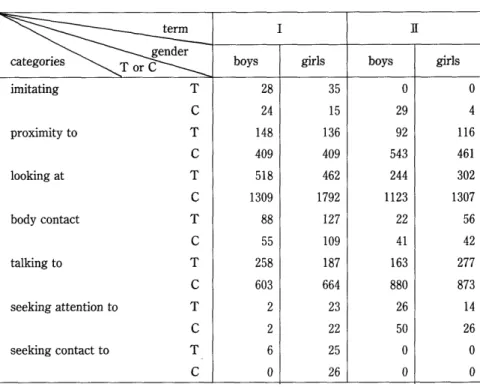
Table 2 shows the frequencies of the categories of interpersonal behaviour of the children during the two terms. tlmitating teacher', tproximity to a teacher', tlooking at a teacher', tlooking at children', tbody contact teacher', tbody contact with children' and tseeking contact to teacher' decreased in frequency significantly from the first term to the
second term(O =4.840, sE=O.359; O==3.461, sE=O.046; O=3.461, sE=O.046; O==
1O. 982, SE ==O. 027; O ==8. 592, SE ==O. O14; O=:7. 675, SE=:O. 072; O ==4. 538, sE ==O. 069; O ==
3. 524, sE=O. 0369 respectively).
Significant interactions between gender and term at the one per cent level were shown
for the categories, tlooking at teacher'(O=3.055, sE=O.027), tlooking at
Table 2. The Frequency of Interpersonal Behaviour in Term I and Term ll
term I II
.gender
categorieSTorC boys girls boys girls
imitatingT C 28 24 35 15 29 o o 4
proximitytoT 148 136 92 116
C 409 409 543 461
lookingatT c 1309 518 1792 462 1123 244 1307 302
bodycontactT 88 127 22 56
C 55 109 41 42
talkingtoT C 258 603 664 187 163 880 277 873
seekingattentiontoT 2 23 26 14
C 2 22 50 26
seekingcontacttoT
'6 25 o o
C o 26 o o
children'(O=2.975, sE=O.O14), tseekingattentiontoteacher'(O=3.787, sE==O.202) and tseeking attention to children'(O==3.927, sE==O.194); and at the five per cent level for 'imitatingchildren'. tSeekingattentiontoteacher'(O==3.787, sE==O.202) and tseek‑
ing attention to children'(O =3.927, sE=:O.194) increased in frequency from the first term to the second term at the one per cent level of significance.
Table 3. The Frequency of the Other Categories in Term I and Term I
term I II
categories gender
boys girls boys girls
objectconflict
rough&tumbieplay
aggressivebehaviour automanipulation wandering
'
36
162313