Applicability of the OVOP Movement in rural tourism development : The Case of Craft
tourism in Vietnam
journal or
publication title
International Journal of Social and Cultural Studies
volume 2
page range 93‑112
year 2009‑03
URL http://hdl.handle.net/2298/28784
Applicability of the OVOP Movement in rural tourism development
The Case of Craft tourism in Vietnam -
Vu Norn
Abstract
The paper looks at the experience of the One Village One Product (OVOP) movement in Japan and its effectiveness as a tool for regional and rural community development in developing a country like Vietnam.
The adoption of the movement may not be the same in every country and depends on the social, economic and political situation of each country.
In South East Asia, some countries such as Thailand, Malaysia and the Philippines have got success from the application of OVOP movement in regional development but it has not been widely applied to Vietnam. This paper examines the applicability of the OVOP movement in Vietnam and conditions for combining it with the development of craft tourism in the rural areas. The paper also looks at the experiences of craft tourism in
Thailand.
1. Introduction
Together with globalization and international economic integration, regional economic development is one of the important issues of many developed and developing countries. In developing countries in Asia like China, Thailand and Vietnam, industrialization and modernization is accelerating national economies but also making the gap in economic development between urban and rural areas bigger. Many governments in developing countries are trying to find ways to control and harmonize development between cities and rural areas. In this situation, assistance, in both financial support and development experiences from other countries in the region or from developed countries, plays a significant role in regional economic development. In Asia, since the 1990s, the relative openness of political authorities in many countries has promoted the establishment of many international cooperation agreements such as the Association of South East Asia Nations (ASEAN), Asia-Pacific Economic Cooperation (APEC), the ASEAN Free Trade Area (APIA) etc. The cooperation is not only at national level but also at local level.
93
The One Village One Product (OVOP) movement originated in Oita prefecture in Japan in 1979 and spread out to Asia and Africa in the 1990s due to the support of the Japan International Cooperation Agency (JICA).
Many countries in Asia and Africa found it an effective tool in regional development, especially in rural economic development. OVOP is thus now becoming an international movement and being widely applied in many developing countries.
In Vietnam, regional and rural development is one of the biggest issues in economic development because nearly 80% of the population is still living in rural areas and around 70% of the population is involved in agriculture. Traditional handcraft is also important, besides cultivation, and the economic value of the traditional handicrafts is higher than agricultural products. The income from handicrafts is said to be triple or quadruple that of farmers. Since the beginning of the 1990s, recognizing the importance of traditional handicraft in rural economic development, the Vietnam government has enacted many policies to encourage traditional handicraft production both for domestic consumption and for export. However, these policies were not implemented all over the country but mainly in some villages near big cities or economic centers, because of inadequate financial and technical support from the government. In recent years, many handicraft villages have been facing difficulties in exporting their products due to limitations in marketing, product quality and design and the world financial crisis. In 2008, according to the statistics of the Association of Vietnam Traditional Handicraft Villages, 60% of traditional handicraft villages that depended on export had to cease production and 20% more are in danger of bankruptcy". In this context, it is necessary for the Government to apply OVOP nationally for developing and promoting traditional handicraft villages, developing
tourism and services in rural areas. The combination of traditional handicraft and tourism has been applied in some countries such as Thailand, Malaysia and India. Traditional handicraft based tourism or craft tourism are now considered a development factor in many rural
areas.
2. The principles of OVOP in Japan
One Village One Product was originally developed in Oyama district in
Oita prefecture around 1960 when the local people promoted change from
traditional cultivation, to increase productivity. Their promotion slogan
was 'Cultivating plums for Hawaii*. After that, at the start of the 1970s,
Applicability of the OVOP Movement in rural tourism development 95 the success of Yufuin town in exploiting hot springs as a tourism resource and becoming a famous tourism attraction was a major achievement for
OVOP.
In 1979, Mr. Hiramatsu, the governor of Oita prefecture, officially took the initiative in promoting OVOP. The main idea of the movement is encouraging villages or local areas to concentrate on one product that they did very well and then work to market that product abroad. The One Village One Product concept grew out of this.
The "One village-One product" movement had two objectives. The
first objective was to increase the per capita income of the citizens. At that time, the income of Oita' s citizens was low and the disparity with Tokyo, for example, was very great. The second objective of the movement was to create a society where all citizens could be proud and feel satisfied with their lifestyles in each of their respective communities; the creation of a society where people could live in affluence both materially and spiritually. The elderly could live with peace of mind and the young could fully express their vitality and people could produce their own specialties including cultural and tourism events in the rural areas. GNS (Gross National Satisfaction) through regional vitalization could be developed.
The "One Village-One Product" movement will improve both the GNP
and GNS (Hiramatsu, 2007).
The activities of the "One Village-One Product" movement include, not only the production of goods, but also tourism and regional arts and cultures. The movement has three basic principles (Figure 1).
The first principle is "Local yet Global". This concept means that the
local people should not make products sold in the local area only; but should aim at developing high-quality products that can be marketable locally, regionally or event internationally.
Local yet Global
Self-Rcliance and
Creativity
Human Resource
Development
Source: www.ovop.jp
Figure 1: Three basic principles of OVOP
The second principle is "Self-reliance and Creativity' . This concept
means the driving force of the movement should be the citizens. It is not the government, but the locals, who should decide their specialty and improve it with original ideas and creativity. One village can produce more than one product or two or more villages can produce one product.
Local people should take the risks and be accountable. If they have to take the responsibility, they will work hard to be successful. The government helps by providing technical guidance, financial support, sale promotion, export assistance, etc.
The third principle of the movement is Human Resource Development, which is the most important of this campaign. If the people are challenged to create new things in agriculture, trading, tourism and many other fields, then the human resource base is developed (Hiramatsu, 2007).
OVOP was initiated autonomously in 58 cities, towns and villages of Oita prefecture. In the year of its introduction, the number of OVOP communities was 143, but 20 years later, the figure had increased to 329.
OVOP in Oita prefecture provides an important model of success in regional development policies. The movement encouraged and empowered local citizens to unearth opportunities for economic growth and develop local industry with a global outlook. The principles behind this movement, and the efforts of the local citizens which sustained it, have attracted attention from across Japan and from many other Asian countries, and the movement is now often presented as a new paradigm for regional development.
Now, the ideas of OVOP have spread out and are being applied in many countries in Asia such as China, South Korea, Thailand, Malaysia, and Laos etc. From the "One village - One product' concept, each country has created its own slogan. For instance, "One hamlet one product"
movement in Shanghai and "One village one treasure in Wuhan - China;
"One Tambon - One product in Thailand; "One Barangay, One Product' in Philippine; "Satu Kampung Satu Produk" and "One district One product" in Malaysia (Table 1).
The success of OVOP in Japan and other Asian countries has played a
significant role in craft tourism development in many countries. Thank to
this movement, a lot of traditional crafts and craft villages have been
renovated and developed in traditional styles. A lot of craft products have
been produced, for exporting and the local market. The renovation of craft
villages not only contributes to economic development in the rural areas
but also to tourism development in the region. Thailand is a typical
Applicability of the OVOP Movement in rural tourism development 97 Table 1: The OVOP movement in Asia
China
(1) One Hamlet One Product Movement (Shanghai) (2) One Town, One Product Movement (Shanghai) (3) One Region, One Vista Movement (Shanghai) (4) One Village, One Treasure Movement (Wuhan)
(5) One Community, One Product Movement (Jiangsu province) (6) One Product Movement (Jiangsu province)
(7) One Village, One Product Movement (Shaanxi province) (8) One Village, One Product Movement (Jianxi province) Philippines (9) One Barangay, One Product Movement
(10) One Region, One Vision Movement Malaysia (11) Satu Kampung, Satu Produk Movement
Indonesia (12) Back to Village (East Java)
Thailand (13) One Tambon, One Product Movement Cambodia (14) One Village, One Product Movement
Laos (15) Neuang Muang, Neuang Phalittaphan Movement Mongolia (16) Neg Baag, Neg Shildcg Butccdgckhuun Source: Oita Prefecture International Center
example, in South East Asia, that has achieved success from the combination of OVOP and craft tourism in the rural areas.
In Vietnam, although OVOP has not been set up, the government has recognized the importance of this movement and hopes to implement its ideas in near future in combination with the development of craft tourism
activities.
3. The applicability of OVOP movement in craft tourism in Vietnam 3.1 The current situation of traditional handicraft in Vietnam
In Vietnam, the traditional rural economic structure combines
agriculture and the traditional handicraft industry. Consequently, the
handicraft industry plays an important role in the rural economy. The
formation and development of handicraft in Vietnam goes hand in hand
with the development of agriculture. The formation of handicrafts
originated from the creation and production of primary and simple tools
for agriculture and hunting. Gradually, along with the growth of the
population and emergence of new demands, the tools were further improved. Families got to know how to create simple productive tools for themselves. In the early days, handicraft was mixed with farming activities within farming families. Later on, it developed into producing specialized tools and goods such as knifes, soil picks, beds, bamboo and ceramic goods, etc. It became an independent sector (Pham Van Dinh,
2003).
In Vietnam, there are different definitions of traditional craft villages.
Bui Van Vuong (1997) has defined traditional craft villages as follows: A traditional craft village is the centre of craft production, with master artisans and lots of households of traditional craft. Artisans and craft households in the village have the same craft progenitor, have rules in production management, in keeping and inheriting professional secrecy, cooperate in producing and selling their products in thestyle of small and
medium enterprises.
The Ministry of Agriculture and Rural Development (MARD) of Vietnam has defined: A traditional craft village is the village where 20%
percent of households are involved in traditional handicraft with more than 100 years of history and at least 20% percent of their income is derived from handicraft production.
In general, the term Traditional handicraft in Vietnam combines some following features (Bui Van Vuong. 1997):
1. Takes shape, exists and has a long-standing development in the
country.
2. Assembly production, forming craft villages or streets.
3. Having generations of skillful workers and craftsmen.
4. Having the stable technique of the Vietnamese nation.
5. Using the nation' s materials.
6. Being a typical and original product of Vietnam with high value and quality, being an artistic and cultural product and even the nation' s cultural heritage with a Vietnamese identity.
Such features of traditional handicrafts are not only unique to Vietnam'
s traditional handicrafts but also to other countries. For instance,
according to the Law of Development of Traditional Handicraft Industry of Japan, the concept of traditional handicraft products includes the following 5 conditions:
1. Almost all traditional handicraft products are for daily life.
2. Main processes of production are by hand.
3. Products made by traditional techniques and methods (have
history of more than 100 years).
Applicability of the OVOPMovement in rural tourism development 99 4. The materials for production are traditional and natural
materials.
5. The characteristic of products is unique and symbol of a specific region.
In both definitions, the common characteristics of traditional handicrafts are: a long history of development, made by hand, using traditional technology and domestic materials.
Table 2: List of traditional handicrafts in Vietnam
1
Ceramic 2 Stone carving
3 Copper casting 4 Iron forging
5 Fabric weaving 6 Ship building
7 Silver and gold jewellery 8 Sedge mat weaving
9 Garment 10 Embroidering
11 Wood carving 12 Conical hat making
13 Shoe and slipper making 14 Carpet making
15 'Do' paper making 16 Folk painting
17 Wood printing 18 Mother-of-pearl Inlaying
19 Lacquer 20 Glass - ware
21 Pearl making 22 Paper - fan making
23 Drum making 24 Umbrella and parasol making
25 Toy making 26 Puppetry making
27 Bamboo and rattan weaving 28 Music instrument making
29 Drama clothes making 30 Carpentry
31 Architect and building 32 Wood lathing
33 Comb making 34 Joss slick and candle making
35 Plough and rake making 36 Bow and cross-bow making
37 Oriental medicine 38 Traditional medicine (based medicinal herbs)
on
39 Alcohol making 40 Soya sauce making
41 Fish sauce making 42 Preserving vegetables in salt
43 Candy and honey making 44 Green rice flakes 45 Soft noodle making 46 Sausage making
47 Soya curd 48 Vegetable oil making
49 Salt making 50 Swallow nest making
Source: Bui Van Vuong. 1997. Traditional Handicraft villages in Vietnam
According to the statistics of MARD, at present, Vietnam has 2017 villages where about 50 kinds of traditional handicrafts (Tabic 2) have been practiced for more than 100 years. There are 1594 villages in the North (3/> of the total), 312 villages in the South and 111 villages in the central region.
Before the "Doi moi policy in 1986, Vietnam had suffered a long period of wars and was unsuccessful in economic development, concentrating only in heavy industries like the Union of Soviet Socialist Republics. Thus, handicraft industries in the rural areas had fallen into
oblivion.
In December 1986, the sixth Congress of the Vietnam Communist Party enacted the renovation policy known as "Doimoi. Priority was given to economic reforms to shift from a central economy, creating a multi-sector market economy regulated by the government while renovating Party and State structures, balancing the budget, and opening the market to the world. Since the Doimoi policy was implemented, Vietnam government has paid much attention to the renovation and development of the traditional handicraft industry and considered it an important component in rural economic development. Currently, there are approximately 2017 traditional handicraft villages in Vietnam, where 1.5 million craftspeople and about 5 million seasonal laborers are employed, with annual sales of 3 billion USD (Pham Tiling Luong, 2006).
Handicraft and fine arts products (like ceramic, wood carving products, embroidery ••• ) are also strong export items for Vietnam and traditional handicrafts have raised the country' s export value. According to the Ministry of Trade, the export value of those items in 2005 was 650 million USD, account for 2% of the total export value (Figure 2) and expected to exceed 1 billion USD by the year 2010.
Arts and handicrafts are still a small export sector but they are important in a socioeconomic perspective. To a large extent, the goods are produced by poor people in rural areas and by minority tribes.
Development of this sector is therefore important for poverty reduction
and to reduce the economic difference between rural and urban areas. The
potential is high, thanks to unique designs and low prices (Johan, Erik, 2008).
Problems for potential development include bad infrastructure, bad
standardization, and low product quality (Freudenberg&PauImier,
2005:1 I). The income from handicraft-associated work is said to be triple
or quadruple that of farmers. Handicraft workers have an average income
Applicability of the OVOP Movement in rural tourism development 101
Export Structure 2005
19%
15% 2%
Crude oil Rice
Other agriculture
Seafood• Coai Garments
• Footwear Electronics Handicrafts
Wood products
OtherSource: Ministry ofTrade and Industry 2005 Figure 2: Export structure of Vietnam in 2005
of around 800,000 to 1,000,000 VND a month, higher than the country' s average of 750,000 VND and the rural average of 300,000 VND (around 20USD).
3.2. The main issues of traditional handicraft villages in Vietnam Handicraft development in Vietnam is not yet stable. Before 1975, owing to contracts signed with the former Soviet and East European countries, handicraft grew substantially. Unfortunately, it decreased because of the political crisis in these countries after 1986. The mass decline of handicraft teams in cooperatives led to the emergence of private enterprises and market issues became more difficult (Pham Van Dinh.
2003). Handicrafts of fine art production were recovered and substantially developed after "Doimoi (1986). The expansion of production in craft villages and the spread to hinterlands has increased substantially the quantity and variety of products. Mass production without guidelines has split producers and the market and has produced large amounts of goods, especially low quality products, while expansion to international markets is still limited. Although, the rural economic structure has changed a lot after "Assignment 10" (1988) with a high rate of employment, higher income for villagers (especially in traditional craft villages), resource degradation, limited markets and environmental pollution are current hot topics.
Two main problems, for selling products made by traditional villages,
are: (1) increasing production scale (supply exceeds demand), while the market is not expanding and (2) massive increases of low quality products, especially from the new villages. Some traditional products have disappeared because of the emergence of low priced industrial versions. Craft villages are facing many challenges and problems to reach the world market due to inadequate management, lack of funds, technology and equipment, lack of market data or marketing skills, insufficient basic infrastructure in the villages and lack standardization of products. Due to their lack of marketing skills, most of the villagers depend on middlemen for their sales, and therefore receive less profit for their products. Besides that, there are problems of women and child labour and environmental pollution that need be solved.
3.3. Traditional handicraft-based Tourism (Craft Tourism)
In recent years, due to the difficulties in producing and selling traditional handicraft products, especially export markets, many countries are promoting traditional handicrafts by developing craft tourism. The term Traditional Handicraft-based Tourism or Craft Tourism is used to describe tourism activities that operate mainly in traditional handicraft villages. The villages and their cultures are considered tourism resources.
There is still no specific definition of craft tourism but it can be defined as
a kind of rural tourism, in which tourists come to traditional handicraft villages to view craft products, to learn how the artisans make them and the stories or history behind them and hopefully they will also buy the products. Besides that, tourists can also experience the life and cultural values of the village as well as enjoy traditional foods.
Craft tourism is seen to be a popular tourism activity, especially in
developing countries. MacCannell (1976) describes tourism as a quest for
an authentic experience, an escape from the alienation caused by
modernization, and a desire for the exotic. Lee and Crompton (1992) also
point the search for novelty as an important motivation for tourism. Craft
tourism can encompass all of these. The pressure of modern life and work
in the big cities is making people feel stressed and they demand to refresh
themselves in quiet rural settings and return to traditional values. In
Japan, tourism to remote areas, such as mountain villages is thus
projected as the link reuniting modern, westernized Japanese urbanites
with their imagined village heritage, traditional past, and traditional
Japanese values. Most of the tourists are women, urban dwellers who
form part of the modern exodus to representative areas of 'lost Japan'
during their vacation periods (Millie R.Creighton. 1995). Craft tourism, in
Applicability of the OVOP Movement in rural tourism development 103 combination with other rural tourism types, can satisfy this demand. One
of the most remarkable characteristics of craft tourism is that it is not affected by the seasonal characteristics of tourism like beach tourism.
Tourists can visit craft villages all year round.
From an economic perspective, the development of craft tourism can create more employment, increasing the income of local communities and contribute to poverty alleviation in rural and remote areas. This is essential for local communities facing difficulties in marketing their products as they can sell their products to tourists who visit their villages.
For instance, more than 40% of the products of Vanphuc silk village in Vietnam were sold to tourists and the profits were much higher than exporting these products (Ngo Anh Due, 2005). The products can be sold directly to customers and are not distributed by middlemen. Both villagers
and tourists can benefit from this business.
Development of craft village tourism contributes actively to the rehabilitation of traditional craft villages and increases exports of craft products - a perspective economic trend of a nation's socio-economic development (Pham Trung Luong, 2006). Craft tourism is considered an effective channel for marketing. If tourists know about a product, they will be able to buy the products even in their home countries.
In addition, the role of craft tourism is also manifested in ceasing the population outflow from these remote areas through the social and economic development (Suzuki, 2006). Nowadays, because of low income and shortage of employment, a lot of young people in rural and remote areas are moving to the big cities to find jobs and better incomes.
This movement has caused many serious social problems. The development of craft tourism as well as other kinds of rural tourism will bring tourists to the countryside, create more jobs, increase income for the local communities and narrow the gap between cities and the countryside.
A research in Chiangmai-Thailand showed that craft tourism can create jobs and employment opportunities for women and as a result, reduce
their involvement in sex tourism activities.
Craft tourism facilitates and promotes the development of the gift and souvenir industry. Shopping is one of the activities that tourists are associated with and one of the most common undertakings during travel.
For most tourists, in fact, a vacation experience would become in
complete without opportunities to shop (Keown, 1989; Turner and
Reisinger, 2001). Most tourists do shopping and buy souvenirs, artworks,
etc, during their travel, not only for reminding them of their visit but also
for their relatives and friends. The products tourists buy most for gifts and
souvenirs arc local handicrafts even if the purpose of their travel is not craft tourism. One of the reasons that tourists buy local handicrafts is that locally made handicrafts and souvenirs designed as tourist products may reflect elements of indigenous cultures or symbols of local culture (Cevat Tosun and S.Pinar, 2007). Therefore, the development of the tourism industry without promoting traditional handicraft will be a loss to the national economy. A research in the Dominica Republic showed that more than 85% of the souvenir merchandise sold to tourists are imported from outside the country, contributing to an estimated loss to the economy of more than one billion dollars (Davit O' Connor.2006).
Although the volume of handicraft sales to tourists cannot compare to the export market, handicraft plays an integral role in support of the performance arts which are of primary importance to tourism. Working together, the crafts become important catalysts in building ethnic pride and maintaining or reviving cultural practices which otherwise might become extinct (K.Kerr. 1995). For tourists, spending money on locally made craft products is also considered as leisure tourism. In addition, the effect of craft tourism may not be limited to economic gains for the local, regional and national economies. The craft products purchased by tourists for different reasons may help a destination develop a favorable image in the mind of tourists and their friends and relatives, because people in general, and tourists in particular, tend to share their experiences through photos, videos and items they purchased while away (Kim and Littrell, 2001). For this reason, craft tourism also has functions of culture and tourism promotion of the host countries.
3.4. OVOP and craft tourism in rural areas.
Vietnam has much potential of craft tourism, as mentioned above, but the development of craft tourism mainly depends on the development and promotion of traditional handicraft villages. Therefore, OVOP should be promoted and targeted at the traditional handicrafts thought-out the country. In Vietnam, the movement of revitalization of traditional handicraft villages has been spearheaded by the MARD with the support of international organizations. The villagers have also had many chances to access the skills of managing an organization, marketing, and branding.
However, the movement was only implemented in villages near big cities such as Hanoi and Hochiminh city and the products are mainly for domestic consumption. The handicraft products for export and tourist
souvenirs are still limited.
The purpose of OVOP would be to improve and heighten the awareness
Applicability of the OVOPMovement in rural tourism development 105 of the villagers and craftsmen about the value of their products and targeting them for export or for selling to tourists. There are some recommendations, for the application of OVOP in the promotion of traditional handicrafts and craft tourism, as follows:
(1) The intervention of the government: OVOP should be led and guided by the government at national level. In many countries, more active involvement by the higher levels of the state is needed to coordinate tourism with other economic sectors. In some cases, coordination may be necessary to ensure that valuable tourism assets are not irreparably damaged by other economic activities (John Brohman.1996). Without state intervention, tourism development will likely lack the cohesion and direction necessary to sustain itself over the long term (John Brohman, 1996). Government involvement is necessary, in areas such as the formulation of the master plan for the OVOP movement; assisting lower levels of government to develop their own OVOP development strategies; developing and formulating regulations relating to OVOP and tourism activities;
giving management and technical consultancy to craftsmen and tourism stakeholders, investing in important national tourism projects, etc.
(2) At the local level: Local communities should be encouraged and guided to participate in the OVOP movement and craft tourism development. The principle Local yet Global should be acknowledged by the villagers and craftsmen and they should be supported with finance and technology to be able to produce high quality products, not only for domestic consumption, but also for export and selling to international tourists. In terms of tourism development, the participation of the local community in craft tourism planning and management is also an important factor for the success of the national tourism strategy. John Brohman (1996) emphasized that the success of a strategy of tourism development ought not to be measured just in terms of increasing tourist' s numbers or revenues. Tourism should also be assessed according to how it has been integrated into the broader development goals of existing local communities, as well as the ways in which tourism-
related investments and revenues have been used to benefit those
communities. Therefore, the local communities need to be
empowered with both knowledge and confidence so that they can
control the tourism activities in their villages. The technical guidance
should be given to the communities by the government, university
and travel agencies and the communities which choose to be involved in tourism need the opportunity to participate in an active and equitable manner (Regina Schcyvens, 2002). The current situation in Vietnam shows that the participation of local communities is still sporadic and mainly depends on the relationship with travel agencies. The local communities and craft villagers have recognized the role of craft tourism but they do not know where to start their business and how to become involved. Besides that, the shortage of infrastructure in rural areas is also a big issue for the development of tourism and the distribution of craft products.
(3) Human resource development policies: Human resource development is the third principle of OVOP and is considered the most important factor for both traditional handicraft revitalizalion and craft tourism development. At present, there are some difficulties in human resource development in traditional handicraft such as: the young people are not interested in working in rural areas and traditional handicraft because of low incomes and working conditions; the custom of keeping traditional technology among the craftsmen and the shortage of investment from the state. The adoption of the tourism and service sector will solve these issues and encourage the revitalization of traditional handicraft. Human resource development policies should be carried out in both directions: Training craftsmen for traditional handicraft production and staff and managers for tourism. In some cases, the craftsmen are also the tourism managers in the villages. Therefore, they should be trained in tourism and management skills. Supports from the state, research and travel agencies are necessary.
3.5. Craft tourism villages - The combination of OVOP, traditional handicraft villages and rural tourism
Tourism villages have now developed as tourist attractions in rural
areas and are becoming a model of community-based tourism. A tourism
village is a village which offers the natural atmosphere of a village, from
social, cultural life, customs, etc and offers attractions, accommodation,
food and beverages, and other tourist needs. The development of a
tourism village is not meant to alter the life which already exists in the
village and cannot be separated from the village itself. In general, a
village which can be developed into a tourism village is one which
already has good conditions in terms of the economy, social, cultural,
physical, natural surroundings, is non-urban, and possesses uniqueness in
Applicability of the OVOP Movement in rural tourism development 107 tradition (Ahmad SHUHERMAN, 2005). Among the tourism villages developed, most are based on traditional handcraft products which are considered as the main attraction of the village and are the cultural identity of the village. In Vietnam, some traditional handicraft villages are now becoming famous, such as Lac village (in Hoa Binh province) which is famous for traditional textiles of the Thai ethnic minority, Cat Cat village (in Sapa, Lao Cai province) which is famous for textiles of the H' Mong ethnic minority or Battrang village (in Hanoi) which is famous for
its traditional ceramics.
The effectiveness of OVOP lies in the fact that it can encourage the revitalization of traditional handicraft and the development of rural tourism. This is important in the formation of craft tourism villages.
The model of OTOP Tourism Villages in Thailand: Craft tourism villages in Thailand were developed from 2001 due to the success of the
"One Tambon One Product" (OTOP) movement (another name of OVOP in Thailand). From the success of OTOP , Thailand' s government assigned the Ministry of Tourism and Sport (MTS) to develop craft tourism in Thailand based on the OTOP movement. Therefore, the OTOP Tourism Villages Project was created and it was considered a measure of maintaining and upgrading the quality of Thai tourism and local products.
In practical working terms, the MTS is responsible for setting policies and strategic action plans as well as working with the public and the private sector to ensure the effective implementation of projects. The MTS is also responsible for training programs, information technology, the administration and management of tourism, and working with other government ministries as well as local administrative organizations, private and community groups, to ensure the development of sustainable
tourism.
The Ministry of Tourism and Sport in Thailand has selected eight villages, among 50.000 villages of the OTOP movement, as the models of craft tourism in Thailand and called them OTOP Tourism Villages since January 2004. These initial eight villages have been selected for the variety of craft products manufactured and for their geographical location.
Each of these villages also has a number of houses serviced as home-stay accommodation for both Thai and foreign visitors, and qualified guides can be arranged for the inspection of the OTOP manufacturing process and for tours around the locality.
The selection of the villages was undertaken by the Product Selection
Committee of the MTS. The first stage of the selection process was to
choose the craft products not the villages. The craft products were ranked
in star levels (from 1 star to 5 stars). Only the villages that had 5-star status were chosen to become OTOP Tourism Villages. Other criteria in selection process included accessible locations close to popular tourist routes, an attractive geographic character and environment, residents' friendly attitude, an interesting history, and most of all, an interesting production process that can be demonstrated to visitors. Residents of chosen villages maintained their normal way of life and preserved their
customs and traditions.
To ensure that all this is easily accessible to visitors and that they are assured of a comfortable stay, the MTS has developed certificate standards based on the management and success of the tourism programs.
The standards are applied to accommodation, food and nutrition, safely, management, tourism services, environment, added value and marketing.
Consequently, visitors to the OTOP tourism villages are able to experience a way of life that may have remained unchanged in its essence for centuries. Families warmly welcome guests to their homes and are happy to share their lifestyle with visitors, offering insights into their ways and traditions, sharing their meals, and arranging guided rambles or drives around the locality. Sampling the local foods, attending local festivals, visiting historic temples and monuments, and exploring the natural beauties are all part of this home-stay experience. Besides that, visitors will see how these leading OTOP products, now on sale in international markets, are manufactured. A guide will explain the history of the craftsmanship that goes into the manufacturing process, and the visitors will be able to talk with craftsmen and community leaders.
Together with the initial success of OTOP Tourism Villages, the MTS
launched the "Long Stay-Home Stay" project in December, 2005 to
encourage overseas visitors to stay longer in Thailand. In the first stage of the Government' s plan, 60 of 76,000 villages nationwide have been selected for this project. The villages selected have premium OTOP products and are involved in craft tourism. The MTS grant certification for the qualified villages.
Thailand has achieved success in building tourism villages by combining the ideals of OVOP and traditional handicrafts as well as famous agricultural products. This is a good model, not only for Vietnam, but other developing countries as well, in rural and regional development.
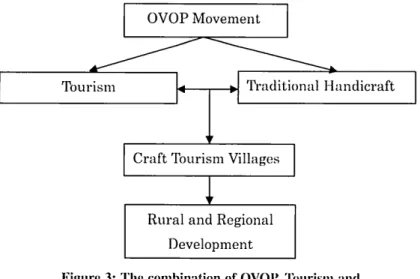
The combination of OVOP, traditional handicrafts and tourism and their
role in rural and regional development arc described in Figure 3 below:
Applicability of the OVOPMovement in rural tourism development 109
Rural and Regional Development
Figure 3: The combination of OVOP, Tourism and Traditional Handicraft in Rural and regional development In this combination, the local communities can actively develop tourism and preserve as well as promote their traditional handicrafts.
Vietnam has actually had these so-called craft tourism villages since the 1990s, when tourism was at the initial stages of development. However,
tourism and traditional handcraft have not had a direct correlation.
Traditional handicrafts were considered a tourism resource and exploited by the travel agencies. The local communities and craftsmen got little benefit from this. The identity of the traditional handcrafts was in danger of disappearing. In 2004, with the support of the Japan International Cooperation Agency (JICA), MARD surveyed traditional handcrafts all over the country, and in 2005, the Vietnam National Administration of Tourism did a feasibility study on Handicraft Villages-based tourism.
However, the results of that study are yet to be applied.
4. Conclusion
Rural and regional economic development is now one of the most talked
about issues in the macro- economic policies in Vietnam. The unbalanced
development between cities and rural areas is creating problems for the
government in economic development. The OVOP movement from Oita
Prefecture in Japan is emerging as an effective policy for regional
development. The purpose of OVOP is heightening the quality of local
products, building local brands, marketing and increasing the value of the products on the market. The combination of OVOP, traditional handicrafts and tourism, will bring rural and regional revitalization and development in Vietnam, where agricultural lands are being reduced by urbanization and agricultural activities are limited to just 4 - 6 months per year. The average income, per year, from agriculture is from 4 million to 6 million VND (equivalent to 230 to 340 USD)".
For craft tourism development, the principle of OVOP is to encourage Self-reliance and Creativity but the local communities will not able to improve their traditional handicrafts, a prerequisite for craft tourism, without the support of the government in terms of finance, technology and marketing. In addition, tourism is a general services sector and tourists always demand quality services. Therefore, the local communities also need to be trained in skills of the tourism business, business organization and marketing. The government should establish a national committee for the implementation of OVOP and craft tourism.
Craft tourism, as mentioned above, is playing an important role in rural and regional revitalization but if not managed well, tourism may also cause harm to the local communities. For instance, the traditional customs, lifestyles and the natural environment can easily be altered by the development of tourism activities in the villages. The lifestyle of villagers can be affected by new cultures brought by visitors. Some social evils can arise to meet the demands of tourists such as prostitution. The environment can also be degraded by waste and garbage from tourists. In terms of craft production, to meet the demands of tourists and to earn more profits, the craftsmen may produce low quality products that may badly affect the village' s traditional values and craft tourism activities in the future. Copying of foreign products and popular products is also still prevalent.
Note:
1) Financial Crisis Attacking Vietnam Traditional Handicraft Villages. Vietnam
F.conomic Times. December 2008.
2) According to Ngo Anh Due (2005), there are some types of rural tourism as follows:
(1) Natural tourism, which is mainly for recreation with little or no ecological impact.
(2) Cultural tourism, which is concerned with the culture, history, and archeology of local people.
(3) F.cotourism, which is a responsible type of tourism which preserves natural
resources as well as maintaining the well-being and social values of the local
Applicability of the OVOP Movement in rural tourism development 111
population.
(4) Village-based tourism, in which tourists share village life, and the rural villages gain economic and other benefits from tourist activities.
(5) Agro-tourism, in which tourists watch or take part in traditional agricultural practices, without disturbing the ecosystem or the productivity of host areas.
3) The statistics of CARE and the Association of Sciences and Technologies in
Vietnam 2006.
References
Ahmad AHUHERMAN, 2001. Tourism Village: A Conceptual Approach. Asia- Europe Seminar on Cultural Heritage, Man and Tourism in Hanoi - Vietnam.
May 2001.
Asia Seed Institute-Vietnam National Administration of Tourism (VNAT), 2005. The Final Report for Feasibility Study on Development of Tourism related Handicraft industries along the West- East Corridor.
Bui Van Vuong, 1996. Traditional Handicraft Villages in Vietnam (In Vietnamese:
Lang Nghc Thu Cong Truycn Thong o Vietnam).
Ccvat Tosun, S.Pinar Temizkan, Dallen J.Timothy and Allan Fyall, 2007. Tourist shopping Experiences and Satisfaction. International Journal of Tourism Research 9, 87-102.
Craig Thompson and Elizabeth Cutler, 1997. The Effect of Nationality on Tourists Arts: the case of the Gambia, West Africa.
Dimitrios Konstadakopukos.2007. Environmental and Resource Degradation Associated with Small-Scale Enterprise Cluster in the Red River Delta of Northern Vietnam.
David O' Connor, 2006. Artisans are also Your Treasures. World Tourism Organization Conference in Teheran-Iran, May 2006.
Erik Cohen, 2000. The Commercialized Crafts of Thailand: Hill Tribes and Lowland Villages.
JICA-MARD, 2004. The study on Artisan Craft Development Plan for Rural Industrialization in the Socialist Republic of Vietnam.
John Brohman. 1996. New Directions in Tourism for Third World Development.
Annals of tourism Research, Vol.23, No. I, pp.48-70, 1996.
Mai Thi Thanh Thai, 2002. Does tourism help local people? A Vietnam focus.
University of Hawai' i at Manoa.
Martin Oppermann. 1993. Tourism Space in Developing Countries. Annals of Tourism Research, Vol.20, pp.535-556, 1993.
Ministry of Tourism and Sport of Thailand. 2005. OTOP Tourism Villages.
Michael Hitchcock, 2001. Souvenirs, Culture Tourism and Development. Asia- Europe Seminar on Cultural Heritage, Man and Tourism in Hanoi - Vietnam.
May 2001.
Millie R.Creighton, 1995. Japanese Craft Tourism- Liberating the Crane Wife.
Annals of Tourism Research, Vol.22, No.2 pp.463-478, 1995.
Mori hi ko Hiramatsu, 2007. Circumstances behind the establishment of IOPA. 1st Annual Conference of International OVOP Policy Association: IOPA
Naoto Suzuki, 2006. Effective Tourism Development through Traditional Craft Promotion-Japanese Experiences. First International Congress on Tourism and Traditional Craft & Associated Activities. Riyadh, KSA November, 2006.
Ngo Anh Due, 2005. Blending Handicraft and Tourism Development the Good Way of Preservation of Tradition and Poverty Alleviation in the Rural Areas.
Nguyen Van Huy, 2001. Tourism and Culture Heritage: What Future to be expected for Handicraft. Asia- Europe Seminar on Cultural Heritage, Man and Tourism in Hanoi - Vietnam. May 2001.
Pham Trung Luong, 2006. Craft Village-based Tourism: Current Situation and Development Orientation in Vietnam. APEC/SME Seminar on 'Support for Local and Cottage Industries' in Hanoi Septemper, 2006.
Thailand Ministry of Tourism and Sports, 2005. OTOP Tourism Villages.
The Vietnam National Administration of Tourism (VNAT). 2002. The National Tourism Development Strategy from 2001 to 2010.
Hl$i'-*):&* 2005^-o 21 |!l;&«}tkJ$U-?*-^„
W3:j£\ 2006 % JlfeM I'l j"//^i&ift t '«<>
Yoshimitsu MIKI, KazumiYAMAGUCHI,Tatsuo MIYAHARA. 2007. IMftWM9L
^ «£ * jifeWft-Mb. ic&'km*mi$tv% $ is & i o-
Kaoru HAYASHI. 2007. II ^WJlkM»<^fM$ M&M±fl ~ YMfrtltzHki&\n\
& I ''j .
Fumio MORI.2003. fcMtfyWftMn&mti&M,'?? > Vfr'Aifr Ltz $ W<
9 o smk&mm-k^x,
http://www.laodong.com.vn/Home/moitruong/2007/8/51246.laodong.
Environment Pollution in Battrang Village: SOS (in Vietnamese). 5th August,
2007.