Finger Identification and Hand Gesture Recognition Techniques for Natural User Interface
Unseok Lee and Jiro Tanaka
Graduate School of Systems and Information Engineering, University of Tsukuba 1-1-1, Tennodai, Tsukuba, Ibaraki, Japan
{leeunseok, jiro}@iplab.cs.tsukuba.ac.jp
ABSTRACT
The natural user interface using hand gesture have been popular field in Human-Computer-Interaction(HCI). Many research papers have been proposed in this field. They proposed vision-based, glove-based and depth-based approach for hand gesture recognition. However, hand gesture itself is simple and not natural way to interact. In otherwise, hand gesture recognition using finger tracking and identification can be implemented more robust and subtle recognition. Recently, new horizons are open with the development of sensors and technology such as Kinect and Depth-Sense. This development has made possible robust recognition, like finger identification and hand gesture recognition in bad conditions such as dark light and rough background as well. In this paper, we proposed a new finger identification and hand gesture recognition techniques with kinect depth data. Our proposed finger identification and gesture recognition methods provide natural interactions and interface by using fingers. We implemented interfaces and designed hand gestures using this method. This paper explains finger identification method and hand gesture recognition in detail. We show the preliminary experiment for evaluating accuracy of finger identification and hand gesture recognition accuracy.
Finally, we discuss the result of evaluation and our contributions.
Author Keywords
Natural User Interface;Human Computer Interaction;Finger Tracking;Finger Identification;Hand Gesture Recognition;
Kinect.
ACM Classification Keywords
H.5.m. Information Interfaces and Presentation(e.g., HCI):
Miscellaneous.
General Terms Human Factors;Design.
INTRODUCTION
The interface using the hand gesture is popular field in Human Computer Interaction(HCI). Recently, a new possibility is provided to HCI field with the development of the sensors and technology [1]. This development has made possible robust recognition which is like to identify fingers and hand gesture recognition in bad condition such as dark light and rough background. At the same time, the interface for natural interaction was required from many users. How- ever, it doesn't reach to this requirement of users.
Some of researchers propose media player manipulation interaction using hand motion gesture [3] and glove-based hand gesture interaction. Vision-based hand gesture recognition system was proposed as well [5], [8]. However, the research approaches that propose the mounting of addition-al device on the body [6] are usually troublesome and not natural. The vision-based hand gesture recognition is not practical for robust hand gesture recognition because of much influence by light and background clutter.
Recently, new horizons are open to the HCI field with the development of sensors and technology [2] such as Kinect, Depth-Sense and Leap motion. This development has made possible robust recognition, like finger gesture recognition in bad conditions such as dark light and rough background.
This depth-based sensor and technology provide a robust recognition, but many research works using them do not provide proper natural interaction [1], [4]. They mostly provide simple hand gesture interactions or hand motion interactions. They do not provide a natural interface. On the other hand, Finger gesture recognition with finger identification can provide more practical experience and natural interaction than hand gesture and hand motion [2].
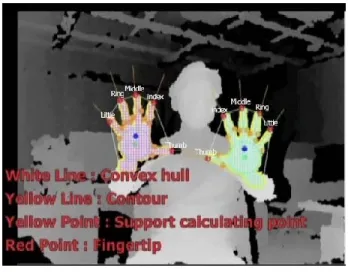
In this paper, we propose new hand gestures recognition and finger identification techniques for natural user interface. We implemented two types of interface such as finger painting, finger mouse using designed natural user interactions. They can provide intuitive and natural interaction for users. Our proposed interfaces are calculating finger identification basically. After calculating, the system recognizes hand gesture that is pre-defined by system. Figure 1 shows the finger identification result using our proposed method.
Permission to make digital or hard copies of all or part of this work for personal or classroom use is granted without fee provided that copies are not made or distributed for profit or commercial advantage and that copies bear this notice and the full citation on the first page. Copyrights for components of this work owned by others than ACM must be honored.
Abstracting with credit is permitted. To copy otherwise, or republish, to post on servers or to redistribute to lists, requires prior specific permission and/or a fee.
Request permissions from [email protected] APCHI '13, September 24 - 27 2013, Bangalore, India Copyright 2013 ACM 978-1-4503-2253-9/13/09…$15.00.
http://dx.doi.org/10.1145/2525194.2525296
Figure 1. Finger Identification Result RELATED WORK
Many hand gesture recognition techniques are proposed to interact with objects for natural user interface(NUI). They are implemented using various devices and techniques.
Vision based, glove based and depth based are widely used in hand gesture recognition [2].
Vision-based hand gesture recognition
Chu et al [5] presents self-portrait interface using vision based hand motion gesture. They provide interesting interaction to control camera by the user. However, the recognition is difficult in bad conditions, such as darkness, because they use skin color segmentation. In addition, system functions are limited when user moves far from the camera because they do not use depth data for recognition.
Glove-based hand gesture recognition
Kenn [6] presents an interface for wearable computing applications using glove based finger recognition. His paper implemented finger identification for hand gesture. The research provides rich user experience based on accurate recognition rate. However, it is not practical in all situations because the user cannot always carry a glove. The glove is both unnatural and heavy. This condition is not suitable for natural interaction.
Depth-based hand gesture recognition
Yang et al, [3] proposed a hand motion gesture recognition system using kinect depth data. They designed hand motion gestures like wave, forward/backward, move up/down, left/right in a media player application. This system shows the possibility of using kinect for hand motion gesture recognition in a contactless UI. However, the implemented system was not able to recognize fingertip. Therefore, they were not able to provide delicate and natural gestures, such as pinch gesture, spread gesture and flick finger. Raheja et al, [4] proposed a method to recognize and track fingertips and center of palm using kinect. They track the fingertip by calculating depth image segmentation of hand regions.
However, they don’t implement any interactions, gesture and finger identification. Thus, this approach is not suitable for NUI.
In short, most of the proposed hand gesture interaction techniques have limitation for natural interaction using finger gesture.
SYSTEM OVERVIEW Hardware
Our system is comprised of Microsoft Kinect for Xbox 360 sensor and large display. The kinect sensor is used with input data for capturing user gestures using CMOS camera(640x480 pixels) with 30 FPS and Depth camera(see figure 2). The system used 3D depth sensor of kinect for capturing user's finger data and gestures, RGB camera used for displaying feedback from implemented applications.
For improving system performance, we limit the distance from hands to sensor. We found the appropriate value of distance(0.5m to 0.8m) experimentally.
Figure 2. MS Kinect Architecture [16]
OpenNI Framework
Especially, there is enough open source framework which is developed for HCI the communication between physical device or motion sensor and UIs. OpenNI provides the API to the cross-platform due to NI application of the thing which is one and them many languages. Presently, they support three kinds of major platform: Windows 7, Mac and Linux. The application comprised at OpenNI is usually the portable and to be used in the other middleware easily. The framework webpage1 provides the components described in figure 3 such as 3d sensing technique, hand gesture recognition and motion recognition as libraries, middleware and applications. They provides many technical support for improving natural interaction as well.
Figure 3 describes three abstract layers of the OpenNI concept [14]. Each, the layer shows the integrated type element :
1 http://www.openni.org/openni-sdk
Figure 3.OpenNI framework layers
The top layer represents the applications implemented for natural interactions.
The middle layer represents the OpenNI framework, in which it not only interacts with physical sensing devices as well as applications, but also communicates with middleware components.
The bottom layer represents all kinds of sensing devices, including visual and audio sensors.
FINGER IDENTIFICATION METHOD
We describe a finger identification method for hand gesture recognition. Our system makes interaction based on pre- defined hand gestures such as mouse dragging gesture and mouse left/right click gesture, so that the finger identification is important for such delicate recognition. The method is mainly divided into three parts, described as follows.
Figure 4. Finger identification
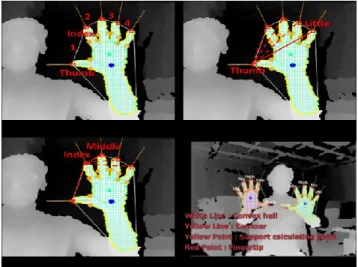
The first step is counting the number of fingers. According to this number, the system determines whether it will start to calculate or not. The algorithm starts to calculate when all fingers are extended. Second, we identify the thumb and the index finger. The system uses the distance from the device and shape bases matching for identifying the thumb.
In general, among all fingers the thumb has the shortest
distance from the device when all fingers are extended. We use hand shape matching for more accurate thumb identification. The thumb can be found more accurately by combining these results, and then we make pairs of all neighbor fingers. System calculates largest distance among one to four (see figure 4(a)). The set of thumb and index finger has the largest distance, so we can determine the index finger. Third, the little finger is determined as the farthest finger away from the thumb, and then the middle finger is deter-mined as the closest finger from index finger (see (b) and (c) of figure 4). The remaining finger is determined as ring finger. The same method is used for identifying the fingers of both hands (see figure 4(d)).
HAND GESTURE RECOGNITION About Gesture
Gestures are expressive, meaningful body motions, physical movements of the fingers, hands, arms, head, face, or body with the intent to convey information or interact with the environment. In the HCI literature the word gesture has been used to identify many types of hand movements for control of computer process. However, getting one's hand to the place to start creation or manipulation is not considered a gesture, because it is a necessity to move your hand, but it does not contribute to the final product as such. The way you move your hand to reach this point is not important According to McNeill [17] the dynamic gesture movement consists of three parts :
Approach: body begins to move Stroke: the gesture itself
Return: return to balanced posture
Gesture is widely divided into static and dynamic. But some gestures have both static and dynamic elements, where the pose is important in one or more of the gesture phases.
Hand Gesture Recognition
Depth-based hand gesture recognition is believed to be an effective technique and number of system has been proposed. There are following types of depth-based technique: clustered depth data detection, 3d sensing and depth motion detection techniques. A static gesture is a particular hand configuration and pose, represented by a single image. A dynamic gesture is a moving gesture, represented by a sequence of images. Picking up the most important features with controlling information from variant and complex hands movements is the key technique for gesture recognition system. A static hand postures can act as a special turning state of a dynamic gesture, and also a dynamic gestures can be captured and analyzed as a set of static gestures. Recognizing and extracting temporal gestures from movements are handled by the finite state machine technique with serial movements with start signals as inputs. We implemented dynamic hand gesture recognition for natural interaction. Proposed hand gesture
recognition system used depth-based data and RGB data together for robust hand gesture recognition accuracy.
Hand Gesture Recognition Method
After finger identification, our system is ready for gesture recognition. Gesture recognition is described as follows.
First, system calculates extended finger for classify captured hand. The extend fingers mean fingertips number.
The system determines database depend on fingertip number (e.g. one fingertip database set).
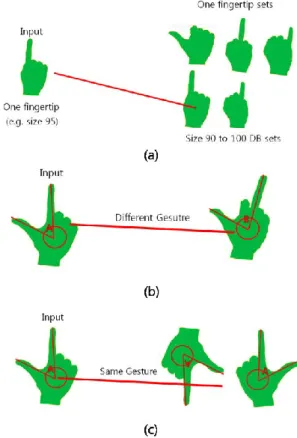
Second, gestures are recognized by sending captured hand size through a database set of classifiers. The system determines size of database set depend on captured hand size area(see (a) of figure 5). Because the captured size of hand is different by camera angle and distance from users.
After system determined appropriate hand size database set, they try to find same hand pose(see (a) of figure 5). We experimentally decided that over 90 percent matching is accurate enough between captured hand shape and hand shape in database.
Third, the system calculates degree and direction in captured fingertip. Even same gestures are captured, the direction of fingertips can be difference. Even different gesture are captured, the direction can be same. In result, our system is implemented direction and degree calculation in captured fingertips simultaneously for accurate gesture recognition(see (b) and (c) of figure 5 ).
Figure 5.Hand Gesture Recognition Method
NATURAL USER INTERFACE
We implemented applications for natural interactions using proposed hand gesture recognition method. The applications are based on open source project[7].
System Configuration
Our system is comprised of large display and Microsoft Kinect for Xbox 360 sensor. For robust recognition performance, we decide the certain distance from user to kinect sensors because of kinect's resolution limitation. The large display that we used has a size of 30 inches. The display shows interaction of system's feedback from the implemented application using user gesture input.
Figure 6. System Configuration
We implemented two type of sample application using designed gesture with hand gesture recognition and finger identification. We provided finger painting and mouse controlling with fingers. All of them used our proposed hand gesture recognition techniques.
Finger Painting Interface
Our interface implemented correctly finger painting interactions by using depth-based hand gestures. We designed painting and drawing line gesture for these interactions. First, painting gesture is recognized when user extends his/her index finger, then the line is drawn along the path of movement.
Second, drawing line gesture is recognized when user extends their thumb and index finger, then the line is drawn depending on the coordinates value of the thumb and index finger. The same interactions are made in the case of using both hands at simultaneously. Because of our system used proposed hand gesture recognition method, the system can recognize even user extend his/her hand any direction with gesture.
Finger Mouse Interface
The hand mouse interface is implemented well mapped with mouse click interactions. It provides mouse functions using hand gestures (i.e. drag, click, double click gesture) and mouse right button interaction with L gesture using thumb and index finger recognition. This interface provides natural interaction with computer.
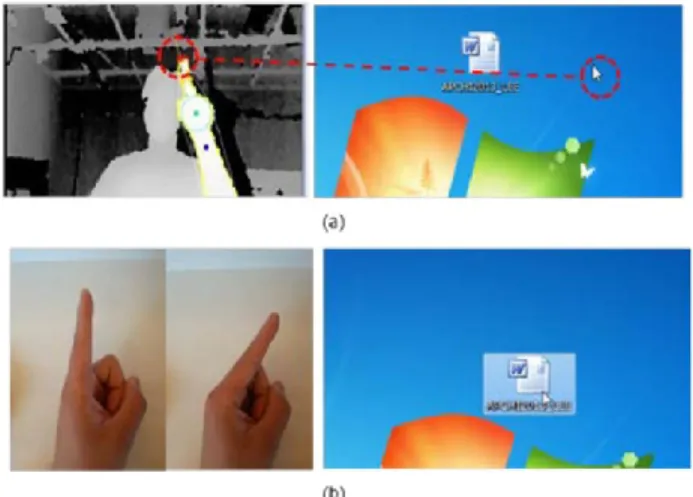
In order to drag the mouse cursor, the system tracks the number of fingertips. When system detects fingertip of index finger, it changes to dragging interaction mode (see (a) of figure 7). In dragging interaction mode, the system computes the coordination value of index fingertip. If the fingertips move to position, mouse cursor also moves to same direction.
In order to make click interaction, the system computes depth value of index fingertip. If the index finger is moved forward and backward one time(see (b) of figure 7), the mouse click interaction is made. For mouse double click, same process is needed with mouse click interaction.
However, double click interaction needs to make two times of click interaction quickly. It calculates the depth value of index fingertip as well.
The mouse right button interaction is made when the use when the system detects thumb and index fingertips(L shape gesture).
Figure 7.Finger Mouse Interface and Click Gesture EVALUATION
In this experiment, we evaluated hand gesture recognition accuracy with our proposed method. The experiments were performed on a computer with Intel Core i5 CPU 2.67GHz and 4.0 GB RAM, using Microsoft Kinect for Xbox 360.
We performed the experiments with ten volunteers. Our experiments are designed to evaluate six gestures, i.e.
extending all fingers for finger identification, drawing, mouse, six gesture(L, V and OK shape, Thumb-up, Thumb- down, Love shape using thumb and index finger of each hand).
After thoroughly explaining all our gestures, each volunteer performed a gesture 100 times, in each condition. We checked whether the system recognized the gesture or not.
Figure 8 shows the average of recognition for the ten volunteers.
Figure 8. The average result for ten volunteers CONCLUSION
Our proposed method for finger identification and finger gesture recognition with depth data has shown high accura- cy over 91 percentages for all gestures. Figure 8 shows almost the same accuracy with normal and dark conditions, and relatively low accuracy in rough conditions (e.g. many obstacles in background). However, the system was not influenced at all by dark and rough condition. We found that six gestures had a relatively low recognition rate.
In this paper, we proposed a new finger identification and hand gesture recognition techniques. We presented finger tracking and hand gesture recognition techniques using finger identification with depth data. We propose our own method to identify fingers. After identification, the system detects the designed hand gesture from users and feedback.
In future work, we intend to support more practical functionalities with interaction such as Games, Google Street View, Google Earth. We also want to implement a 3d interface using HMD with finger gesture. It will need to apply object tracking for marker-less interface. We expect that this interface can include practical functions and will be more natural to use.
REFERENCES
1. Z. Ren, J. Meng and Z. Zhang. “Robust Hand Gesture Recognition with Kinect Sensor”, MM’11, Proceedings of the 19th ACM international conference on Multime- dia, 2011.
2. D. Wigdor and D. Wixon. “BRAVE NUI WORLD”, Published by Morgan Kaufmann, pp.9-15, 2011.
3. Y. Cheoljong, J. Yujeong, B. Jounghoon, H. David and K. Hanseok. “Gesture recognition using depth-based hand tracking for contactless controller application”, Consumer Electronics (ICCE), 2012 IEEE International Conference on, pp. 297 -298, 2012
4. J. Raheja, C. Ankit and S. Singal. “Tracking of fingertips and centers of palm using KINECT”, 2011 Third International Conference on Computational Intelligence Model-ling Simulation, pp. 248-252, 2011.
5. S. Chu and J. Tanaka. “Hand Gesture for Taking Self Portrait”, Human-Computer Interaction, Part II, HCII 2011, LNCS 6762, pp. 238–247, 2011.
6. H. Kenn, F. Megan and R. Sugar. “A glove-based gesture interface for wearable computing applications”, Proceedings of the IFAWC 4th international forum on applied wearable computing 2007, pp. 169-177, 2007.
7. Hand and finger tracking with Kinect depth data.
http://candescentnui.codeplex.com.
8. S. Lenman, L. Bretzner and B. Thuresson. “Computer Vision Based Hand Gesture Inter-faces for Human- Computer Interaction”, Technical Report CID- 172,Center for User Oriented IT Design, pp.3-4, 2002.
9. J. Wachs, M. Kölsch, H. Stern, and Y. Edan. “Vision- based hand-gesture applications”, Communications of the ACM, Vol. 54 Issue 2, pp.60-70., 2011.
10. V. Frati and D. Prattichizzo. “Using Kinect for hand tracking and rendering in wearable haptics”, IEEE World Haptics Conference, pp. 317-321, 2011.
11.R. Graham. “An efficient algorithm for determining the convex hull of a finite planar set”, Information
Processing Letter, pp. 132-133, 1972.
12. M. Tang. “Hand Gesture Recognition Using Microsoft’s Kinect.” Paper written for CS228, Winter
2010.Technologies, UIST’11, ACM, pp.1-9, 2011.
13.G. He, S. Kang, W. Song and S. Jung. “Real time gesture recognition using 3D depth camera”, Software Engineering and Service Science (ICSESS), 2011 IEEE 2nd International Conference on, pp.187-190. 2011.
14. OpenNI organization. OpenNI User- Guide, 2012.
15. H. Nanda and K. Fujimura. “Visual tracking using depth data”, Conference on Computer Vision and Pattern Recognition Workshop, pp.37, 2004.
16. The teardown, Engineering & Technology, Vol.6, no.3, pp. 94-95, 2011.
17. D. McNeill. “So you think gestures are nonverbal?”, Psychological Review, vol92 (3), pp. 350-373, 1985.
18. A. Akl. “A Novel Accelerometer-based Gesture Recognition System”, Signal Processing, IEEE Transactions on, University of Toronto, pp. 2-3, 2010.