Journal of
International Cooperation for Agricultural Development
J Intl Cooper Agric Dev 2018; 16: 20–30
Original
Farmers’ Perceptions of, and Preferred Traits in, Rice Varieties in the Coastal Region of Kenya and Their Implications for Breeding
Ruth N. Musila1, 2), Julia Sibiya1), John Derera1), John M. Kimani2), Pangirayi Tongoona1) and Kengo Danda1)
1) African Centre for Crop Improvement, School of Agricultural, Earth and Environmental Sciences, University of KwaZulu-Natal, Scottsville, Pietermaritzburg, Republic of South Africa
2) Kenya Agricultural and Livestock Research Organisation, Kaptagat Road, Loresho, Nairobi, Kenya Received December 13, 2017 Accepted March 15, 2018
Abstract. The adoption rate of new rice varieties in the coastal region of Kenya has been negligible, possibly because the farmers’ special preferences are not taken into account during the breeding process. To bridge the gap between breeders and farmers, and to ensure the faster release and widespread adoption of new varieties, participatory research was undertaken in two major rain-fed rice-producing counties (Kwale and Kilifi) in coastal region of Kenya. The objectives were to determine what rice varieties were grown by the farmers and what their trait preferences were. Results showed that, over 90% of farmers grew landraces with preference differing between counties. The landrace Sigaye was preferred in Kilifi county while Kitumbo, Madevu and supa dominated in Kwale county. Preferred traits of new rice varieties were high-yield, short-duration, drought-tolerance, medium height, with white, long, bold grains of good baking quality. The good baking quality trait was found to be a unique requirement in the region, because rice is rarely bred for its baking properties especially in Sub-Saharan Africa. In this study, the role of farmers’ trait preferences were revealed in the adoption decisions when considering a new rice variety for the coastal region of Kenya. Future breeding programmes are encouraged to utilize farmer preferred landraces in their breeding programmes and incorporate farmer desired traits into new rice varieties for the region.
Key words: Rice, Oryza sativa, Farmers’ trait preferences, Landraces, Coastal region of Kenya
Corresponding author: Ruth N. Musila, e-mail: ruthmusila@
gmail.com
Introduction
Kenya’s coast is a net importer of food and its grain production barely meets 20% of its annual requirement1). Despite this, the region is endowed with untapped suitable land for rain-fed rice production and with irrigation water from the Tana, Galana and Umba Rivers. Coupled with the available traditional knowledge of the local communities, proper utilization of these resources may turn the region
into a new frontier in rice farming, significantly reducing the costly rice imports. However, rice production is still under the subsistence farming system that is practiced by smallholder farmers. Little progress has been made in addressing the farmers’ needs and it has been the practice to introduce accessions from international and regional rice breeding programs, many of which are never adopted.
Consequently, rice yields in the region have remained very low, ranging between 1.4 t ha–1 2) and 2.7 t ha–1 3), which is far below the optimum of about 5.0 t ha–1 4) and the world’s average of 4.0 t ha–1 5). The actual rice yields are similar to those reported for Sub-Saharan Africa (SSA), which
averages 1.5 t ha–1 6), and this constitutes one of the main challenges to rice production in SSA.
Although modern rice varieties have been developed and released in most of the countries in SSA including Ke- nya, small-scale farmers especially in marginal areas still rely on landraces for their planting7, 8). Though low yield- ing, rice landraces are invaluable inputs in local breeding programme because they are well adapted to the local environment and possess most of the attributes farmers want introgressed into new rice cultivars. To enhance the potential of adoption of new varieties in the marginal ar- eas, farmer preferences for rice varieties should clearly be identified6). This can be done using several methods such as participatory rural appraisal (PRA) approach or surveys either separately or in combination. Studies using these methods have shown that small scale farmers especially in marginal areas usually provide unique requirements on their preferred cultivars that are not so obvious to the breeder9).
Cultivar traits commonly targeted in conventional breed- ing system include high yield, early-maturity, fertilizer responsiveness and dwarfness10). However, some studies, especially in SSA, have revealed that farmers’ preferred traits rarely correlate with those of scientists7, 8). A study in Sikasso Region of Mali revealed that farmers in the rain-fed upland and lowland rice ecologies preferred tall varieties and were willing to trade-off yield for grain qual- ity and plant height. In contrast, farmers in the irrigated ecology preferred high-yielding, long-duration rice variet- ies7). In the Ashanti region of Ghana, farmers preferred not only high-yielding varieties, but also varieties that had specific grain quality attributes, such as white coloured, long, slender and translucent grains (low chalkiness), fra- grance and preferred cooking quality8). From these studies, it can be concluded that farmers are well aware of their cultivar needs and that they prioritize these traits depend- ing on the social-economic and environmental conditions prevailing in their specific niches. It is therefore important to determine from farmers their preferred traits in crop va- rieties. This enhances the potential for adoption of the new varieties in the target region where studies are conducted.
Participatory rural appraisal tools and household surveys have not been previously exploited to set rice breeding goals for rice breeding in the coastal region of Kenya.
Therefore, the objectives of this study were to determine, by means of a household survey and participatory rural appraisal tools, what rice varieties were grown by farmers and what the farmers’ trait perceptions in rice cultivars were, in the coastal region of Kenya.
Research Methodology Description of the study area
The study was conducted in the Kwale and Kilifi coun- ties of the coastal region of Kenya (Fig. 1) between Decem- ber, 2013 and March, 2014. The Kwale county (4.18° S, 39.46° E) is located in the south-eastern corner of Kenya.
It has three administrative sub-counties, namely, Matuga, Kinango, and Msambweni. The area has a mean monthly temperature of 22ºC. Rainfall is bi-modal with short rains being experienced from October to December, while the long rains are experienced from March/April to July. The annual rainfall ranges between 600 mm and 1200 mm11). The Kilifi county (3.22° S, 40.12° E) is located south-east of Nairobi and north of Mombasa. It has six administrative sub-counties i.e. Kilifi, Ganze, Malindi, Magarini, Rabai and Kaloleni. The area has a mean monthly temperature of 23ºC. Rainfall pattern is bi-modal similar to that experi- enced in Kwale county. The average annual rainfall ranges between 500 and 1000 mm11).
Sampling procedures
A multistage sampling procedure was used to select the sites for the study. Kwale and Kilifi counties were purpo- sively chosen because they are the leading producers of rain-fed lowland rice in coast region of Kenya3). In each county, sampling was done at several administrative lev- els. One sub-county was selected per county. In the Kwale county, the Msambweni sub-county was selected while in the Kilifi county, the Kaloleni sub-county was selected.
From each sub-county a list of 20 villages of potential rice growers was presented by the ministry of agriculture (MOA) extension officers from where four villages were randomly selected. Villages selected were Mwagwei, Bodo, Ganda and Bwiti in Msambweni sub-county and Kizurini, Garashi, Vikindani and Chilulu in Kaloleni sub-county. From the selected villages participants were randomly selected.
Data collection
Primary data were collected, using both a household survey (HHS) and participatory rural appraisal —a suit- able tool in the context of exploratory and discovery pur- poses12). The household survey was administered by using semi-structured questionnaire. After developing the ques- tionnaire, prior to the time of the exercise, the facilitators, including the principal investigator, local MOA extension officers from each sub-county, five trained enumerators and eight key informants, convened for a brain-storming session to review and improve on the questionnaire.
Adjustments on the questionnaire were made during this
meeting. Thereafter, the questionnaire was pre-tested on two farms in Mwangwei village in Msambweni sub-county and adjustments made accordingly. The HHS provided information on general background of the respondents, rice varieties grown by farmers and their use, the area under rice production, crop management and agronomic practices, seed sources, as well as the rice traits preferred by farmers and why. In total 224 farmers participated in the household survey with a gender composition of 76%
female and 24% male (Table 1). The participatory rural
appraisal methodologies involved focus group discussions (FGD) and pair-wise ranking. The FGD was administered using a checklist. Local agricultural extension staff and vil- lage headsmen mobilized farmers for FGD. Farmers listed the varieties that they grew, ranked them and identified the traits they would prefer in the rice varieties. In addition, pair-wise ranking was carried out to compare the pair-by- pair traits of interest, while the groups were asked which of the two they preferred, and why. One-hundred-and-two farmers (70% female and 30% male) participated in the Fig. 1. Administrative map of Kenya showing the study areas Kilifi and Kwale Counties (districts).
Table 1 Number of farmers’ interviewed in household survey and those who participated in focus group discussions in Msambweni and Kaloleni sub-counties of coastal region of Kenya Sub-county Village Focus groups Household survey Sub total
Male Female Male Female
Msambweni Mwagwei 3 11 7 20 41
Bodo 0 18 4 25 47
Ganda 8 6 10 20 44
Bwiti 9 4 11 11 35
Kaloleni Kizurini 0 9 4 26 39
Garashi 2 10 3 24 39
Vikindani 4 6 5 25 40
Chilulu 5 7 3 26 41
Sub total 31 71 47 177
Total 102 224 326
FGD (Table 1). Both formal and informal methodologies were employed in data collection to enhance precision.
Data analysis
Statistical analyses were performed using the Statistical Package for Social Scientists (Release 21) computer pack- age13), and in Genstat 14th edition14). Relationships were ex- plored through frequencies, descriptive statistics and cross tabulations for data collected in each sub-county, followed by mean comparisons between sub-counties. The ranking of the desired traits was evaluated, using the Kendall’s coefficient of concordance (W) to identify which were the most important. The Kendall’s coefficient of concordance (W)15) is a measure of degree of agreement/concordance among m set of n ranks. It is an index that measures the ratio of the observed variance of the sum of ranks to the maximum possible variance of sum of ranks. The essence of this index is to find the sum of the ranks for each at- tribute/factor being ranked and to examine the variability of this sum. If the rankings are in perfect agreement, the variability among these sums is said to be at minimum15). Results
General crop production of rice
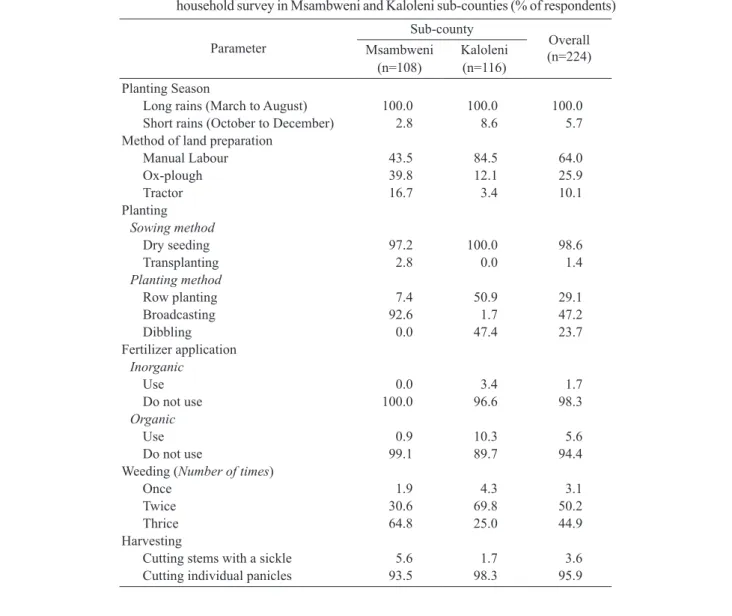
Although data is not shown, the study established that rice is a staple food in the area under study. In Msambweni sub-county, farmers have been growing rice for a longer period of time than in Kaloleni sub-county (Table 2). On average, the potential area for rice production owned by individual farmers was twice the actual area. The rice yield ranged from 0.4 to 2.5 t ha–1. About 95% of farm- ers interviewed in Kaloleni sub-county grew rice for consumption (Fig. 2). This may be linked to their small rice plots and low yields obtained from these plots. Only a small percentage of the respondents (8%) in Msambweni grew rice purely for cash. Farmers’ crop management and agronomic practices are shown in Table 3. In Msambweni, broadcasting was the most common planting method (Fig.
3a). They believed that the method was less labour inten- sive, less time-consuming and not tiresome. The majority of the farmers (98%) did not use inorganic fertilizer. The use of organic manure was practiced by less than 10% of the farmers. Different weeding times were reported for
Table 2 Average farm size, average actual and potential area, years growing rice and average yield for rain-fed lowland rice conditions in Msambweni and Kaloleni sub-counties
Sub-county Ave. farm size (ha) Ave. actual area under
rice production (ha) Ave. potential area under
rice production (ha) Years
growing rice Yield (t ha–1) Average Min Max
Msambweni 3.04 0.4 0.8 30 1.6 0.6 2.5
Kaloleni 2.82 0.2 0.4 20 0.95 0.4 1.5
Fig. 2. Proportion of farmers that grow rice for food, food and cash, and cash in Msambweni and Kaloleni sub- counties of coastal lowlands of Kenya.
the different counties. While majority of the farmers in Msambweni (64.8%) weeded their rice fields on average three times, those in Kaloleni (69.8%) weeded only twice.
The first weeding was done using hoes while the second and third weeding were done mainly by pulling out the weeds by hand. Rice harvesting was predominantly done by cutting individual panicles with a knife (Fig. 3b). A small percentage (3.6%) of the participating farmers used sickles for harvesting.
Rice varieties grown and sources of seed
The majority of the farmers, over 99% in Msambweni and 88% in Kaloleni, grew different rice landraces with over eleven landraces to choose from including Sigaye, Kitumbo, Madevu, Supa etc. (Table 4). The New Rice for Africa (NERICA) varieties6) were the only improved vari- eties grown in this region and were grown by one and 12%
of the participating farmers in Msambweni and Kaloleni sub-counties respectively. This shows that the region has negligible adoption of improved rice varieties. Preference for the most common landraces differed between the sub- counties. In Msambweni, Kitumbo (65%) was the most preferred followed by Madevu (56%) and Supa (52%).
In Kaloleni sub-county the majority of the farmers (90%) grew the landrace Sigaye. The names of these landraces
were indicative of the type of satisfaction farmers got from growing the variety or were descriptive as they referred to key identifiable characteristics. The name Sigaye means no problem. The variety had big panicles with white, long,
bold, and aromatic grains. Kitumbo means big stomach and the named was derived from its short and bold grains.
Though low yielding, the variety was preferred because it had a higher satiety value compared to other varieties thus Table 3 Farmers practising different crop management and agronomic practices during
household survey in Msambweni and Kaloleni sub-counties (% of respondents)
Parameter Sub-county
Overall (n=224) Msambweni Kaloleni
(n=108) (n=116) Planting Season
Long rains (March to August) 100.0 100.0 100.0
Short rains (October to December) 2.8 8.6 5.7
Method of land preparation
Manual Labour 43.5 84.5 64.0
Ox-plough 39.8 12.1 25.9
Tractor 16.7 3.4 10.1
Planting Sowing method
Dry seeding 97.2 100.0 98.6
Transplanting 2.8 0.0 1.4
Planting method
Row planting 7.4 50.9 29.1
Broadcasting 92.6 1.7 47.2
Dibbling 0.0 47.4 23.7
Fertilizer application Inorganic
Use 0.0 3.4 1.7
Do not use 100.0 96.6 98.3
Organic
Use 0.9 10.3 5.6
Do not use 99.1 89.7 94.4
Weeding (Number of times)
Once 1.9 4.3 3.1
Twice 30.6 69.8 50.2
Thrice 64.8 25.0 44.9
Harvesting
Cutting stems with a sickle 5.6 1.7 3.6
Cutting individual panicles 93.5 98.3 95.9
Fig. 3. Farmer practices a) broadcasting and b) harvested individual rice panicles.
grown for food. The name Madevu was derived from the physical characteristics of its paddy grain, which had long awns shielding the grain from bird damage. The variety had medium to late maturing cycle and was mostly grown for food. The name Supa means the best or excellent grain quality and was characterized by big panicles with white, longer, bold, tasty and aromatic kernels, and a good milling quality. This variety was mostly grown for market.
There were landraces that were grown specifically for confectionery purposes (Table 5). The landrace Pishori was the most preferred especially for traditional bread- making by 34 and 10% of the participating farmers in Msambweni and Kaloleni sub-counties respectively (Table 5). The variety was low yielding, highly aromatic, with white, long and slender kernels. Other rice confectionary products made by the farmers were Vitumbua, Kibibi, and Matobosho.
Sources of seed of the varieties grown by farmers are presented in Table 6. Farmers generally obtained rice seed from informal sources. Among the informal sources the main source of seed was farmers own harvest (recycled seed), followed by seed obtained from the local market.
Very few farmers received seed of the introduced NERICA varieties from MOA.
Preferred rice characteristics
Results from the household survey showed that there were significant differences in farmers’ preferences for rice traits between the sub-counties, since the computed chi-square value was larger than the corresponding tabular value with 16 degrees of freedom at a 5% and 1% level of significance (Table 7). However, ranking of the first six
traits was similar for the two sub-counties. A high-yield was considered to be the most important trait. This was followed by drought-tolerance, early-maturity, aroma, good weed competitor, and high-tillering-ability. Prefer- ence for any other trait differed among counties. A good baking quality was a unique trait mentioned by 66% of the farmers in Msambweni, compared to 22% in Kaloleni.
Farmers cited nine characteristics associated with good dough for making rice bread (Table 8). Important traits cited by over 25% of the respondents in Msambweni were that the dough should become porous, swell and rise up and has a soft texture as shown in Fig. 4
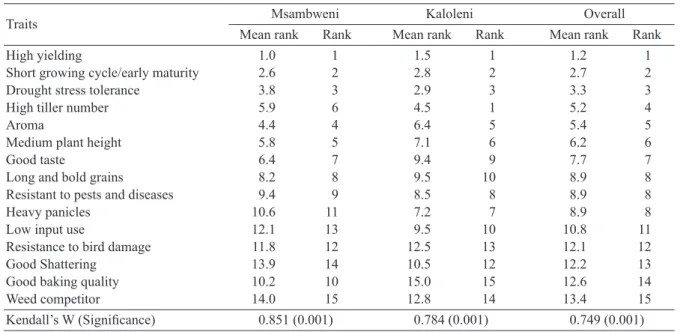
Results from the focus group discussions indicated that across the counties, the Kendall’s W of 0.749 was sig- nificant at a 1% level, suggesting that 75% of the farmers agreed on the outcome of the ranking (Table 9). The trait Table 4 Varieties mentioned and grown by farmers (% of
respondents) in Msambweni and Kaloleni sub- counties in coast Kenya
Variety
Msambweni
sub-county Kaloleni sub-county Number
of farmers % of
farmers Number of farmers % of
farmers
Ambale 0 0 20 19
Sigaye 0 0 97 90
Kitumbo 75 65 0 0
Madevu 65 56 0 0
Kibawa cha nzi 5 4 4 4
Niwahi 35 30 0 0
Ringa 3 3 0 0
Kimachomacho 0 0 1 1
Manyoya 2 2 0 0
Pishori 22 19 15 14
Supa 60 52 21 19
Other landraces 23 20 10 9
NERICA 1 1 13 12
Table 5 Landraces grown by farmers (number and % of re- spondents) for confectionary purposes in rain-fed lowland ecology in coast region of Kenya
Landrace
Msambweni
sub-county Kaloleni
sub-county Number
of farmers % of
farmers Number of farmers % of
farmers
Pishori 39 34 11 10
Madevu 18 16 0 0
Niwahi 16 14 0 0
Kivunga 10 9 0 0
Sigaye 0 0 6 6
Ringa 4 3 0 0
Kibawa cha inzi 3 3 2 2
Kimachomacho 3 3 0 0
Supa 3 3 0 0
Manyoya 2 2 0 0
Ambari 0 0 1 1
Riziki 1 1 0 0
Table 6 Percentage of farmers obtaining rice seeds from different sources in Msambweni and Kaloleni sub-counties
Source of seed Sub-county
Msambweni Kaloleni
Own (Farm Saved) 35.9 43.9
Neighbours 14.6 14.3
Local Market 31.1 21.4
Own + Neighbours 1.0 12.2
Own + Market 10.7 5.1
Neighbours + Market 1.9 1.0
Own + Neighbours + Market 3.9 0.0
MOA* 1.0 2.0
* Ministry of Agriculture
of being a good weed competitor scored poorly under the FGD compared to the scoring of individual farmers. This is because farmers in the FGD perceived that the problem of weed competition would partly be solved by practicing the recommended agronomic practices such as a good land preparation, row planting and use of quality seed for planting. Overall, results from both the HHS survey and the FGD indicated that most farmers would prefer to have high-yielding, early-maturing and drought-tolerant varieties. Aroma and good taste were the most preferred subjective traits.
Table 7 Preferred traits in rice cultivars as indicated by farmers during the household survey (% of respondents and ranking)
Traits
Sub-county
Across
Msambweni Kaloleni
% Rank % Rank % Rank
High yielding 100.0 1 100.0 1 100.0 1
Drought stress tolerance 96.3 2 100.0 1 98.2 2
Short growing cycle/early maturity 92.6 3 94.8 3 93.8 3
Aroma 91.7 4 91.4 4 91.5 4
Good weed competitor 76.9 5 86.2 5 81.7 5
High number of tillers 73.1 6 79.3 6 76.3 6
Good taste 68.5 8 67.2 9 67.9 7
White grain colour 60.2 10 75.9 7 67.4 8
Long and bold grains 71.3 7 57.8 10 64.3 9
Medium plant height 46.3 11 71.6 8 59.4 10
Good baking quality 66.7 9 22.4 12 43.8 11
Tolerant to low soil fertility 34.3 12 39.7 11 37.1 12
Tall plant height 27.8 13 3.4 14 15.2 13
Short plant height 5.6 14 7.8 13 6.7 14
Medium growing cycle 1.9 15 0.9 15 1.3 15
Long growing cycle 1.9 16 0.0 17 0.9 16
Feed for livestock 0.0 17 0.9 16 0.4 17
Chi-square computed value =61.82 and tabulated values with 16 d.f, at the 0.05 and 0.01 level of significance is 27.59 and 33.41
Table 8 Traits associated with good dough for making rice bread (Number and % of respondents)
Traits for bread types Msambweni sub-county Kaloleni sub county Number of
farmers % of
farmers Number of
farmers % of farmers
White flour 11 9.5 6 5.6
Porous (air spaces) 35 30.2 18 16.7
Swells and rises up 30 25.9 16 14.8
Soft texture 30 25.9 9 8.3
Low fat content 24 20.7 2 1.8
None sticky 7 6 1 0.9
Aroma 4 3.4 3 2.8
Tasty 24 20.7 2 1.9
Absorbs little water 6 5.2 0 0
Fig. 4. Sliced traditional rice bread showing air spaces (porous)
Discussion
In the current study female farmers (76%) predominated in the cultivation of rice in the rain-fed lowland ecology of coastal lowland Kenya. Another study also reported that women in coastal region of Kenya are responsible for producing food crops, while men tend to be responsible for growing and marketing tree crops such as coconut and cashew nuts16). Predominance of female farmers in produc- tion of rice in the rain-fed lowland ecosystem has also been reported in other regions7). However, gender dimensions of rice production in Kenya indicate that involvement of fe- male farmers in rice production adversely affects adoption and up-scaling of rice technologies because women hardly attend seminars and training workshops5). Efforts should therefore be made to deliberately engage female farmers in participatory plant breeding to determine their varietal needs and priorities.
Farmers used manual labour to prepare their rice fields.
This partly explains why the average actual area under rice production in the region was less by half the potential area.
Broadcasting was the common planting method because the farmers believed that the method was less labour intensive, less time-consuming and not tiresome. Broad- casting is a common practice among small scale farmers in rain-fed lowland and irrigated ecologies in Sub-Saharan Africa7). On average the seeding rate was about 70 kg ha–1 compared to 45 kg ha–1 if drilling or dribbling method were used17). Therefore farmers should be encouraged to explore other faster land preparation methods and adopt efficient planting method to cultivate more land. The majority of the farmers (97–100%) did not apply inorganic fertilizer
to their rice fields. Their perception was that rice is like a grass and therefore has the capacity to sustain itself under natural conditions. They believed that their soils were adequately fertile, and their lack of knowledge on how to apply inorganic fertilizers was among one of the reasons why they did not apply it. Similar beliefs were also displayed in the results of a survey on the adoption of maize production technologies in the coastal lowlands of Kenya16). Although soils in the rain-fed lowland ecolo- gies are believed to be richer in terms soil nutrients due to erosion of soil nutrient and debris from the upland fields7), this may not be so in the coastal region of Kenya. In this region the soils are mainly sandy with low nitrogen as a major limiting element as it is easily leached during heavy rains18). The water holding capacity and cation exchange capacity are extremely low resulting in poor efficiency of inorganic fertilizers and low crop production. Due to negligible usage of inorganic fertilizers by farmers, it is imperative that rice breeding programmes for the region develop rice varieties that respond to low nitrogen and other plant nutrients.
Farmers depended on informal seed sources which in- cluded farm saved, local market and neighbors. The disad- vantages of using farmers own seed was that the seed was of poor quality, and had seed admixtures resulting in poor crop establishment and low yields. The implications were that there was need for involving farmers in community seed programmes that includes training on seed cleaning, selection and storage. There was low usage of certified seed of improved varieties due to limited supply since it was sourced from Mwea, in Kirinyanga County, another rice growing region creating geographical inconveniences.
Table 9 Ranking from scores of pairwise ranking of the traits preferred by the farmers during focus group discussions
Traits Msambweni Kaloleni Overall
Mean rank Rank Mean rank Rank Mean rank Rank
High yielding 1.0 1 1.5 1 1.2 1
Short growing cycle/early maturity 2.6 2 2.8 2 2.7 2
Drought stress tolerance 3.8 3 2.9 3 3.3 3
High tiller number 5.9 6 4.5 1 5.2 4
Aroma 4.4 4 6.4 5 5.4 5
Medium plant height 5.8 5 7.1 6 6.2 6
Good taste 6.4 7 9.4 9 7.7 7
Long and bold grains 8.2 8 9.5 10 8.9 8
Resistant to pests and diseases 9.4 9 8.5 8 8.9 8
Heavy panicles 10.6 11 7.2 7 8.9 8
Low input use 12.1 13 9.5 10 10.8 11
Resistance to bird damage 11.8 12 12.5 13 12.1 12
Good Shattering 13.9 14 10.5 12 12.2 13
Good baking quality 10.2 10 15.0 15 12.6 14
Weed competitor 14.0 15 12.8 14 13.4 15
Kendall’s W (Significance) 0.851 (0.001) 0.784 (0.001) 0.749 (0.001)
One of the solution to availability of certified seed in the region could be identification and training of rice seed growers within the community.
Landraces were the dominant rice varieties grown by farmers (over 90%) with over eleven varieties to choose from. Farmers preferred growing their landraces mainly for taste, aroma, tolerance to drought, resistant to bird damage and other farmer specific attributes. For example farmers preferred growing Kitumbo for its drought toler- ance attribute. Research evaluations of some exotic and local landraces under water stress and no-water stress con- ditions confirmed that Kitumbo was moderately drought tolerant during the reproductive phase19). Supa was grown for sale and fetched a higher premium than the other vari- eties because of its good grain quality, fragrance and good milling quality. Apart from growing rice to be used as boiled rice grain, farmers also grew rice for confectionery purposes. About eight varieties were perceived suitable for production of rice based products such as bread, Vitum- bua, Kibibi, and Matobosho. Farmers had identified these varieties based on physical dough characteristics of the rice flour. However, based on chemical properties of the rice flour some landraces and improved rice varieties have been shown to be suitable for rice flour bread. For example in Japan, the Japanese rice cultivars Koshihikari and Nip- ponbare and in South Korea, Chenmaai and Gaomibyeo were found to be suitable for production of rice bread20,21). Chemical properties of the bread types in the region are yet to be elucidated. Farmers’ high preference for their land- races suggested that breeders would make impact by im- proving or breeding from these landraces because they are already adapted to the local environment and possess most of the grain quality traits preferred by farmers. Despite wide dissemination and adoption of NERICA varieties all over Africa, only a small percentage (1 to 12%) of farmers in the region were growing these varieties. Although farm- ers were willing to adopt these varieties, unavailability of seed was one of the major reasons farmers gave for not growing these varieties.
In terms of trait preference farmers generally preferred high yield as the first trait they would desire in new rice cultivars. Rice yields in the farmers’ fields were low and highly variable ranging from 0.4 to 2.5 t ha–1. The low yields observed in these communities were comparable to those reported for most of smallholder farmers growing rice in rain-fed lowlands in sub-Saharan Africa which average 2 t ha–1 against a potential of 5 t ha–1 6). The sig- nificant yield gap between farmers yield and the yield po- tential could be attributed to use of poor quality seed, high weed infestation, low-input farming due to lack of capital, limited knowledge on the best bet agronomic practices and overreliance of low yielding landraces among other
factors. Results from researcher managed trials using seed of Supa landrace collected from the region showed that the variety was low yielding with an average yield of 1.4 t ha–1 2). The yield potential of the other farmer preferred local varieties under research managed trials is yet to be confirmed. Efforts should therefore be made to address the rice production constraints contributing to low yields as well as develop new high yielding varieties for the region.
Next to high yield was desire for short growing cycle and drought tolerant varieties. Farmers’ preference for short duration and drought-tolerant varieties was compelled by their observation that most of their preferred varieties had long growing cycle and were severely affected if drought occurred during the flowering stage, resulting in low yields and, in some cases, complete crop failure. In another study it was confirmed that Kitumbo and Supa had a long growing cycle of about 150 days19). Farmers were quick to mention that the major cause of drought in the region was what was locally termed as “Upepo Mkali”, or “June winds”, emanating from the Indian Ocean between May and June, which coincides with the reproductive stage of the rice crop1).
Of the subjective traits, farmers preferred aroma, taste and long bold white rice. In contrast a PRA study conducted in Sikasso region of Mali showed that taste and aroma where least preferred while long red rice was preferred to long white rice7). This indicates that farmers differ in their trait preferences which should be taken into account in breeding programmes. One of the unique subjective traits preferred by farmers was good baking quality for rice bread. Use of rice flour for production of rice flour-based products such as bread is rare especially in Sub-Saharan Africa where rice has traditionally been used as boiled rice. However, in the coastal lowlands of Kenya rice bread is one of the cultural rice products common in most traditional ceremonies. It is also cheap and convenient for breakfast and the farmer could save on the limited financial resources. The criterion given by farmers for identifying and selecting suitable varieties for traditional rice bread were; white milled rice flour with a low fat content, the dough should be easy to work on, it should absorb little water, it should swell, rise up and become porous, and it should not stick onto the baking tin while baking. As mentioned earlier farmers predicted rice bread quality traits from the physical dough characteristics of the rice flour. However, chemical properties of rice flour give a better prediction of rice bread quality21). Thus an op- portunity does exist to assess the suitability of the rice flour of the farmer selected bread types for production of rice bread. Overall, the results showed that rice traits desired by farmers in new rice cultivars for the coastal lowlands of Kenya were varied indicating differential alleles of genes
controlling these traits. Different selection indices may be adopted to develop different farmer preferred high yield- ing, short growing cycle and drought tolerant varieties for boiled grain and rice flour. In developing such selection indices a participatory plant breeding approach involving the relevant rice stakeholders should be adopted.
Conclusions
The study established that predominantly farmers cultivated landraces with negligible cultivation of modern varieties such as NERICA and that rice was grown mainly for consumption as boiled grain rice and/or traditional rice bread. Farmers valued their landraces because they had certain key identifiable characteristics they treasured and which they wished would also to be introgressed in new rice cultivars. High grain yield was the most important trait preferred by farmers. Next to high yield were short growing cycle and drought tolerant varieties preferred by farmers as a mitigation strategy to cope with the unreliable rainfall. A rare farmer-desired trait observed in this study was preference for good bread quality traits. Overall, the results imply that there were unique requirements for rice improvement and adoption of new rice cultivars by small- holder farmers growing rice in the rain-fed lowland ecol- ogy in coastal lowlands of Kenya. Thus involving farmers in the breeding and selection process through participatory breeding will ensure that farmers’ priorities and needs are incorporated in the existing local varieties or in creation of new varieties.
Acknowledgements
This research was funded by the Alliance for Green Revolution in Africa (AGRA). The authors also acknowl- edge all the agricultural extension officers in the study areas for the enormous role they played in organizing farmers.
References
1. Muti SM, Kibe AM. (2009) The effects of east African low level jet on food security in horn of Africa: a case study of coastal region of Kenya. Journal of Food, Ag- riculture, Nutrition and Development 9, 1761-1777.
2. Kega VM. and Maingu AR. (2008). Evaluation of New Rice for Africa (NERICA) cultivars in coastal lowlands Kenya. In: Esilaba AO. et al., (eds) Proceed- ings of the 10th KARI biennial scientific conference.
Responding to demands and opportunities through innovative agricultural technologies, knowledge and approaches, KARI Headquarters. 12-17 November 2006. Kenya Agricultural Research Institute (KARI), Loresho, Nairobi, Kenya, pp. 1-5.
3. United States Agency for International Development (USAID). (2010). Staple foods value chain analysis.
Country report-Kenya. Chemonics International Inc.
4. Ministry of Agriculture (MOA). (2009). National Rice Development Strategy (NRDS), 2008-2018. pp. 5-8.
5. Ministry of Agriculture, Livestock and Fisheries (MoALF). (2014). National Rice Development Strat- egy (NRDS) implementation framework (2014-2018).
6. Africa Rice Center (AfricaRice). (2010). New Breed- ing Directions at AfricaRice: Beyond NERICA.
Cotonou, Benin: 24 pp.
7. Efisue A., Tongoona P, Derera J, Langyintuo A, Laing MD, Ubi B. (2008). Farmers’ perceptions on rice vari- eties in Sikasso region of Mali and their implications for rice breeding. Journal of Agronomy and Crop Science 194: 393-400. https://doi.org/10.1111/j.1439- 037X.2008.00324.x.
8. Asante MD, Asante BO, Acheampong GK, Wiredu AN, Offei SK., Gracen V, Adu- Dapaah H, Danquah EY. (2013). Grain quality and determinants of farm- ers’ preference for rice varietal traits in three districts of Ghana: Implications for research and policy. Jour- nal of Devevelopment and Agricultural Economics 5:
284-294.
9. Sperling L, Ashby JA., Smith ME., Weltzien E, McGuire S. (2001). A framework for analyzing participatory plant breeding approaches and results.
Euphytica 122: 439-450.
10. Morris, M.L and Bellon, M.R. (2004) Participatory plant breeding research: Opportunities and challenges for the international crop improvement system. Eu- phytica 136: 21-35.
11. Jaetzold R, Schmidt H. (1983). Farm management of Kenya. In: National conditions and farm manage- ment information. East Kenya (Eastern and Coast Provinces). Farm Management Branch, Ministry of Agriculture, Nairobi, Kenya, pp. 325-366.
12. Phillips BS. (1968). Social research; strategy and tactics, 4th printing. London
13. SPSS Inc. (2012) SPSS Statistics 21.0, SPSS INC., Chicago, IL.
14. Payne RW, Murray DA, Harding SA, Baird DB, Soutar DM. (2011). GenStat for Windows (14th Edition) In- troduction. VSN International, Hemel Hempstead.
15. Mattson DE. (1986). Statistics: Difficult concepts understandable explanations. Bolchazy-Carducci Pub.
Publisher, pp. 281-283.
16. Wekesa E, Mwangi W, Verkuijl H, Danda K, Groote HD. (2003). Adoption of maize production technolo- gies in the coastal lowlands of Kenya. International Maize and Wheat Improvement Center (CIMMYT) publisher, Mexico, D.F.
17. De Datta SK. (1981). Principles and practices of rice production. John Wiley and Sons, New York, p. 618.
18. Mureithi JG, Tayler RS, Thorpe W. (1995). Pro- ductivity of alley farming with leucaena (Leucaena leucocephala Lam. de Wit) and Napier grass (Pennis- etum purpureum K. Schum) in coastal lowland Kenya Agroforestry Systems 31: 59-78.
19. Musila RN. (2015) Genetic analysis for drought tol- erance and yield stability in interspecific and Oryza Sativa L. rice germplasm. PhD thesis, University of Kwazulu-Natal, Republic of South Africa.
20. Araki E, Ashida K, Aoki N, Takahashi M, Hamada S. (2016) Characteristics of rice flour suitable for the production of rice flour bread containing gluten and methods of reducing the cost of producing rice flour.
Japan Agricultural Research Quarterly 50: 23-31.
21. Han H, Cho JH, Kang HW, Koh BK. (2012). Rice varieties in relation to rice bread quality Journal of Science, Food and Agriculture 92: 1462-1467.