Chemoradiotherapy for Squamous Cell Carcinoma of the Anal Canal : A Case Report
Takahiro UMEMOTO, Yoshikuni HARADA, Makiko SAKATA, Kazuma SAKURABA, Hiroki MIZUKAMI, Saito MITSUO,
Gaku KIGAWA, Hiroshi NEMOTO and Kenji HIBI
Abstract : A 79-year-old woman presented to our hospital with frequent episodes of hematochezia. Colonoscopy revealed an apparent tumor with central ulcer- ation, and analysis of biopsy specimens confirmed the presence of non-invasive squamous cell carcinoma of the anal canal. No distant metastases were identified on enhanced computed tomography (CT). The cancer was classified as stage II
(T2N0M0), and chemoradiotherapy (CRT) was selected as the first-line treatment.
A continuous intravenous infusion of 5-fluorouracil with daily cisplatin was planned on days 1 to 5 of a 4-week cycle. After the first course, the drug administration was discontinued because the patient experienced diarrhea as an adverse event, and treatment with daily oral titanium silicate-1 (TS-1) was initiated. In addition, a total of 65 Gy of radiation was applied to the primary lesion, pelvis, and bilateral groin area. Four weeks after the completion of CRT, colonoscopy showed the dis- appearance of the tumor and analysis of biopsy specimens confirmed the absence of any viable cancer cells. CT showed no evidence of lymph node metastasis or distant metastases. At 10 months after the completion of CRT, the patient showed no recurrence and with complete response.
Key words : anal canal cancer, chemoradiotherapy, titanium silicate-1 (TS-1)
Introduction
Although squamous cell carcinoma of the anal canal (SCCA) is an uncommon malignancy, its incidence is currently increasing1, 2). Historically, anal cancer was managed surgically with abdominoperineal resection (APR), but since the landmark publication by Nigro et al, 1974, chemoradiotherapy (CRT) has been the mainstay of treatment3). CRT has superseded surgery because it affords equivalent survival with the benefit of a better functional outcome, because a colostomy is not required. We report a case of SCCA in which a complete response (CR) was achieved with CRT using titanium silvcare-1 (TS-1).
Case Report
A 79-year-old woman presented to our hospital with frequent episodes of hematochezia. The patient had no significant medical history of inflammatory bowel disease, did not drink alcohol, Case Report
Department of Gastroenterological and General Surgery, Showa University Fujigaoka Hospital, 1-30 Fujigaoka, Aoba-ku, Yokohama-shi, 227-8501, Japan.
and was a non-smoker. Digital rectal examination revealed an anal canal tumor in the anterior wall ; the bilateral inguinal lymph nodes were not swollen. At presentation, the patient had a body temperature of 36.6℃, blood pressure of 120 / 75 mmHg, a pulse rate of 70 beats / min, and a respiratory rate of 17 breaths / min. She was in good general condition, with normal vital signs. On physical examination, the abdomen was relatively soft. The white blood cell count was 11,100 cells /μl. Serum electrolyte levels were within normal ranges. The levels of carcinoembryonic antigen (CEA) and squamous cell carcinoma antigen(SCC-Ag) were within normal limits (Table 1).
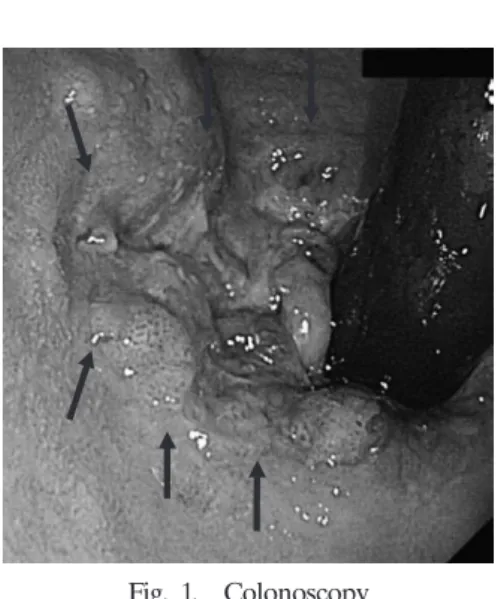
Colonoscopy showed an apparent tumor with central ulceration located in the anterior wall of the anal canal and lower rectum (Fig. 1). Analysis of biopsy specimens confirmed the presence of non-invasive SCCA. CT showed no evidence of lymph node or distant metastases (Fig. 2). The cancer was classified as stage II (T2N0M0), and CRT was selected as the first-line therapy.
After we obtained informed consent from the patient, continuous intravenous infusion of 5-fluorouracil (5-FU)(710 mg / day) with daily cisplatin (CDDP)(10 mg / day) was planned on days 1 to 5 of a 4-week cycle. However, administration was discontinued after the first course because the patient experienced diarrhea, and the chemotherapy regimen was changed to daily oral TS-1. Each course consisted of daily oral TS-1 (80 mg) for 4 weeks followed by 2 drug- free weeks. In addition, a total of 65 Gy of radiation was applied to the primary lesion, pelvis, and bilateral groin area. Drug-induced diarrhea (grade 2) developed after completion of the
Fig. 1. Colonoscopy
Colonoscopy showing an apparent tumor (arrows)
with central ulceration located in the anterior wall of the anal canal and lower rectum.
Table 1. Tumor marker of CEA and SCC Before CRT After CRT CEA (ng / ml) 1.1 0.9 SCC (ng / ml) 0.8 0.6
second cycle, and the TS-1 dose was reduced to 40 mg / body to allow improvement. Three cycles of chemotherapy were performed in total (total dose of TS-1, 4,480 mg as tegafur).
Four weeks after CRT completion, colonoscopy showed the disappearance of the tumor (Fig.
3) and analysis of biopsy specimens confirmed the absence of any viable cancer cells. CT showed no evidence of lymph node or distant metastases, as was the case on the initial CT
(Fig. 4). At 10 months after CRT completion, the patient showed no recurrence with complete
Fig. 3. Colonoscopy at 4 weeks after the completion of chemoradiotherapy Colonoscopy showing the disappearance of the tumor (A, arrows). Narrow band imaging showing only cicatricial tissue (B, arrows).
Fig. 4. Computed tomography at 4 weeks after the completion of chemoradiotherapy CT showing no evidence of lymph node or distant metastases, as was the case on the initial computed tomography.
Fig. 2. Computed tomography
CT showing no evidence of lymph node or distant metastases.
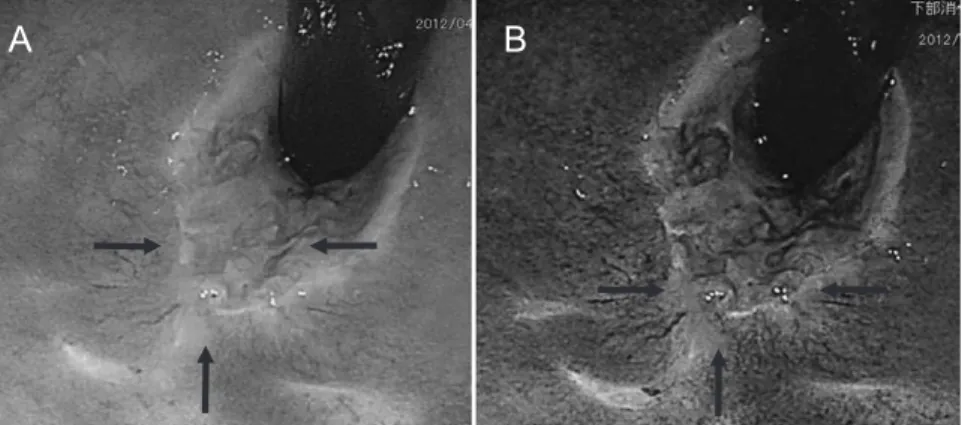
response (CR). Colonoscopy and narrow band imaging showed no recurrence of SCCA (Fig.
5). The patient continues to undergo outpatient treatment.
Discussion
SCCA is a relatively rare tumor, representing 2〜4% of all cancers of the colorectum and anus4), but its incidence is increasing1, 2). Up to 45% of patients with SCCA present with rectal bleeding. Other symptoms include rectal pain and / or a mass sensation, which occur in 30% of patients. The presentation of an anal canal tumor is often nonspecific, and 70〜80% of patients are initially diagnosed with a benign anorectal condition such as hemorrhoids. We recommend that a thorough clinical history and physical examination with careful rectal examination is mandatory for all patients with suspected anal canal cancer. Approximately 20% of patients have no symptoms at the time of diagnosis5, 6). Colonoscopy is required to rule out synchronous colorectal neoplasms7). In the case described here, the patient had frequent episodes of hematochezia and colonoscopy revealed an apparent tumor of the anal canal.
Endoscopic mucosal biopsy is a standard tool for histological diagnosis. The chemotherapy regimen comprising 5-FU and mitomycin-C is the most commonly used among patients with anal carcinoma but it causes well-documented toxicities. Hung et al8) reported that combined modality therapy with continuous infusion of CDDP and 5-FU was a well-tolerated regimen that results in high rates of local control, overall survival, and sphincter preservation. And these rates were comparable to the best results reported with mitomycin-C and 5-FU8, 9)(Table 2). In
Table 2. Impact of radiation therapy plus 5-FU / MMC vs radiation therapy plus 5-FU / CDDP n chemotherapy 5-year overall survival
(%) disease-free survival
(%)
Hung A et al8) 92 5-FU / CDDP 85 77
Bartelink et al9) 51 5-FU / MMC 56 58
Fig. 5. Colonoscopy at 10 months after completion of chemoradiotherapy Colonoscopy and narrow band imaging showing no recurrence of squamous cell carcinoma of the anal canal (A, B, arrows).
Japan, a Phase I / II trial of chemoradiotherapy concurrent with S-1 plus mitomycin C in patients with clinical Stage II / III squamous cell carcinoma of the anal canal (JCOG0903 : SMART-AC)
was undertaken10). After we obtained informed consent from the patient, continuous intravenous infusion of 5-FU and CDDP was started. After the first course of 5-FU and CDDP, the patient experienced diarrhea as an adverse event. The chemotherapy regimen had to be changed to daily oral TS-1 from 5-FU. TS-1 is an oral anticancer drug, which was developed based on the biochemical modulation of tegafur by gimeracil and oteracil. The antitumor effect of TS-1 has already been demonstrated in patients with a variety of solid tumors, including advanced gastric cancer11), colorectal cancer12), non-small cell lung cancer13), and head and neck cancer14). Because drug-induced diarrhea (grade 2) developed after completion of the second cycle, the TS-1 dose was reduced to 40 mg / body to allow improvement after an off-period of one month.
Three cycles of chemotherapy were administered in total.
We report a case of SCCA in which a complete response was achieved with CRT using TS-1 allowing preservation of the anal sphincter and avoidance of a permanent colostomy.
APR is now reserved as a salvage therapy for those individuals with persistent disease after combined CRT. At 10 months after CRT completion, the patient has had no recurrence and no complications. The findings of this case suggest that CRT with TS-1 may be effective for treating SCCA.
Conflict of interest
The authors have declared no conflict of interest.
References
1) Johnson LG, Madeleine MM, Newcomer LM, et al. Anal cancer incidence and survival: the surveillance, epidemiol- ogy, and end results experience, 1973-2000. Cancer. 2004;101:281-288.
2) Robinson D, Coupland V, Moller H. An analysis of temporal and generational trends in the incidence of anal and other HPV-related cancers in Southeast England. Br J Cancer. 2009;100:527-531.
3) Nigro ND, Vaitkevicius VK, Considine B Jr. Combined therapy for cancer of the anal canal: a preliminary report.
Dis Colon Rectum. 1974;17:354-356.
4) Rousseau DL Jr, Thomas CR Jr, Petrelli NJ, et al. Sqamous cell carcinoma of the anal canal. Surg Oncol.
2005;14:121-132.
5) Tanum G, Tveit K, Karlsen KO. Diagnosis of anal carcinoma--doctorʼs finger still the best? Oncology. 1991;48:383- 386.
6) Ryan DP, Compton CC, Mayer RJ. Carcinoma of the anal canal. N Engl J Med. 2000;342:792-800.
7) Fleshner PR, Chalasani S, Chang GJ, et al. Practice parameters for anal squamous neoplasms. Dis Colon Rectum.
2008;51:2-9.
8) Hung A, Crane C, Delclos M, et al. Cisplatin-based combined modality therapy for anal carcinoma: a wider thera- peutic index. Cancer. 2003;97:1195-1202.
9) Bartelink H, Roelofsen F, Eschwege F, et al. Concomitant radiotherapy and chemotherapy is superior to radio- therapy alone in the treatment of locally advanced anal cancer: results of a phase III randomized trial of the European Organization for Research and Treatment of Cancer Radiotherapy and Gastrointestinal Cooperative Groups. J Clin Oncol. 1997;15:2040-2049.
10) Takashima A, Shimada Y, Hamaguchi T, et al. A Phase I / II trial of chemoradiotherapy concurrent with S-1 plus mitomycin C in patients with clinical stage II / III squamous cell carcinoma of anal canal (JCOG0903: SMART- AC). Jpn J Clin Oncol. 2011;41:713-717.
11) Sakata Y, Ohtsu A, Horikoshi N, et al. Late phase II study of novel oral fluoropyrimidine anticancer drug S-1 (1 M tegafur-0.4 M gimestat-1 M otastat potassium) in advanced gastric cancer patients. Eur J Cancer. 1998;34:1715- 1720.
12) Ohtsu A, Baba H, Sakata Y, et al. Phase II study of S-1, a novel oral fluorophyrimidine derivative, in patients with metastatic colorectal carcinoma. Br J Cancer. 2000;83:141-145.
13) Kawahara M, Furuse K, Segawa Y, et al. Phase II study of S-1, a novel oral fluorouracil, in advanced non-small- cell lung cancer. Br J Cancer. 2001;85:939-943.
14) Inuyama Y, Kida A, Tsukuda M, et al. Late phase II study of S-1 in patients with advanced head and neck cancer. Jpn J Cancer Chemother. 2001;28:1381-1390. (in Japanese).
[Received April 4, 2013 : Accepted May 21, 2013]