• 検索結果がありません。

 The Beginning:

N/A
N/A
Protected

Academic year: 2021

シェア " The Beginning: "

Copied!
5
0
0

読み込み中.... (全文を見る)

全文

(1)

 The Beginning:

 Dr. Roseann Mulligan and Dr. Glenn Clark, elected to visit Showa University School of Dentistry during their 6 month sabbatical from the University of Southern California Herman Ostrow School of Dentistry. This visit was with the support and the blessing of the Dean, Dr. Takashi Miyazaki and Professor of Prosthodontics, Dr. Kazuyoshi Baba.

 Hybrid Lecture and PBL Activity:

 One of their activities at the School of Dentistry was to experiment with creating and delivering online lectures to those faculty and students who were interested in either Oral Medicine or Special Patient Care topics. All of these lectures were recorded using a desktop video camera and were stored on a streaming video server. A link was provided to each lecture using a Moodle-based course website where faculty and students who so desired, but could not attend the actual lecture, could view the lecture videos at their convenience. In addition, Dr. Clark and Mulligan experimented with integrating their problem based seminar (PBL) seminar sessions on the Moodle website also. Moodle is an open source, web-based learning management software system which allowed Dr. Clark and Dr. Mulligan to post all content they create, and all content created by the students on the website. The main purpose for this experimenting with teaching

methods is that they wanted to write and create new lectures and test-out new web-based educational methodologies (e.g. video conferencing, desktop recording streaming video systems (www.ViVu.tv), and web-based learning management systems: (www.

Moodle.com) which they hope to use back at USC.

 Oral Medicine Lectures (by Dr. Glenn Clark):

 This course involved 12 registered students, interns and faculty/staff from the Showa School of Dentistry who have successfully completed the course. We also had 19 guests registered in the course who are either auditing (not taking weekly quizzes) or are faculty from another University (Keio School of Medicine) who asked to have access to the online lectures. The course had 9 lectures and there were 4 online quizzes and a final examination. There was 55 page syllabus provided to study from and the lectures included:

 (#1) Other Oral Cancer Diagnostic methods  (#2) Diagnosis and Treatment of Burning Mouth

Syndrome

 (#3) Antibiotics and their Use as an Analgesic in Chronic Pain

 (#4) Endothelial Dysfunction in OSA and the Use of a Mandibular Advancement Device

 (#5) Diagnosis of Atypical Odontalgia and Phantom Tooth Pain

 (#6) Treatment of Atypical Odontalgia and Phantom

寄  稿

Our Showa Experience (July 2nd to Dec 22nd 2010)

Roseann M ulligan * and Glenn T. C lark **

*Charles M. Goldstein Professor of Community Dentistry, Associate Dean for Community Health Programs and Hospital Affairs, Herman Ostrow School of Dentistry

University of Southern California,Los Angeles, California

**Professor and Director, Orofacial Pain and Oral Medicine Center, Herman Ostrow School of Dentistry, University of Southern California, Los Angeles, California

*,**

Visiting Professors, Showa University School of Dentistry, Tokyo, Japan

(2)

Tooth Pain

 (#7) The Role of Complementary and Alternative Medicine used for Orofacial Pain

 (#8) Needle Based Therapy for the Control of Orofacial Pain

 (#9) Top Oral Medicine Medications Used in Dentistry

Oral Medicine PBL Seminar (by Dr. Glenn Clark):

 This PBL seminar series was provided over 9 sessions in the seminar. The course included 7 registered students/faculty/staff from Showa University.

At end of each PBL session, the participants were given a learning need assignment and at the beginning of the next session, each student gave 10 min PPT- style show to show what it was they had learned. The 3 cases covered in this course were:

 • Case 1: vesiculo-bullous disease

 • Case 2: oral dystonia case of jaw closers  • Case 3: neuropathic oral pain & Tx failures

  Special Patient Care Lectures (by Dr. Roseann Mulligan):

 This course involved 10 registered students, interns and faculty/staff from the Showa School of Dentistry who have successfully completed the course. We also had 38 guests registered in the course who were auditing (not taking weekly quizzes). The course had 9 lectures and there were 9 weekly online quizzes.

There was 110 page syllabus provided and the lectures included:

 (#1) Caring for the Intellectually Disabled

 (#2) Hearing Impairment and Visual Impairment Throughout the Lifespan

 (#3) The HIV/AIDS Trajectory: History, Current Status and New Directions

 (#4) Caring for Patients with Recurrent Convulsive Disorders

 (#5) Treating Geriatric Dental Patients: Is There a Tipping Point? Part 1

 (#6) Treating Geriatric Dental Patients: Tipping Points Revisited. Part 2

Table 1  For those curious what students thought of the hybrid-LMS-PBL course, the table below contains responses from the questionnaire we sent to the 13 students in the PBL courses we taught (n = 11).

Statements

Disagree (either moderately or strongly)

Neutral (or slightly

agree /disagree)

Agree (either moderately or strongly)

1 I found it easy to use the course web-site. 0.0% 0.0% 100.0%

2 I believe the website and supplemental materials created for this course greatly enhanced the PBL learning process. 9.1% 45.5% 45.5%

3 Using this hybrid approach (lectures and quizzes plus PBL cases) was very helpful to my understanding of the key concepts taught in this course. 27.3% 54.5% 18.2%

4 I found the PBL session presentations of my fellow students very helpful to my understanding of the key concepts taught in this course. 0.0% 27.3% 72.7%

5 I found the supplementary lecture videos provided by the faculty expert very helpful to my understanding of the key concepts taught in this course. 0.0% 27.3% 72.7%

6 I found the supplementary PDF handouts from the lectures very helpful to my understanding of the key concepts taught in this course. 0.0% 27.3% 72.7%

7 I found the weekly quizzes very helpful to my understanding of the key concepts taught in this course. 0.0% 36.4% 63.6%

8 The biggest problem I had with this course was my spoken English language ability. 0.0% 18.2% 81.8%

9 I would have liked this course better if it were offered in Japanese language. 0.0% 27.3% 72.7%

10

Based on my experience in this course I believe that all PBL cases should use a hybrid format (meaning they will be hosted on a website that also provides supplemental expert lectures and other materials to support the key case concepts).

27.3% 18.2% 54.5%

(3)

 (#7) Osteoporosis and Dental Treatment Implica- tions

 (#8) Uncharted Waters: Caring for the Aging Developmentally Disabled Patient

 (#9) Still the Best Medicine: 21st Century Preven- tion for the Elderly Patient

  Special Patient Care PBL Seminar (by Dr. Roseann Mulligan):

 This PBL seminar series was provided over 9 sessions in the seminar. The course included 6 registered students/faculty/staff from Showa University.

At end of each PBL session, the participants were given a learning need assignment and at the beginning of the next session, each student gave 10 min PPT- style show to show what it was they had learned. The 4 cases covered in this course were:

 • Case 1: Downs Patient with Toxic Shock  • Case 2: Geriatric Dentistry Case

 • Case 3: 2 Short Case Scenarios on Geriatric Oral Health Issues

Advanced Pharmacology Lecture Series (by Dr.

Glenn Clark):

 While, not a course at Showa or even in Japan, Dr. Clark used a portion of his time to teach a course back in the USA on advanced pharmacology to USC advanced dentistry students (Pedo, Perio, Prosth, Endo, and Oral Medicine) as part of the core curriculum given to these students. This lecture course was provided over 14 sessions and the activities included 31 registered students. They were provided with a 27 page syllabus, 13 streaming video-based lectures, 13 online quizzes and 1 final online exam. The students had to complete 2 detailed drug-drug interaction based written homework assignments and thankfully, all 31 students (100%) completed the course successfully.

 Virtual Patient:

 Dr. Glenn Clark, has had a long-time interest in computer based teaching with virtual patients

publishing his first article on this topic over 17 years ago. At USC he had developed a fully autonomous virtual patient system for training dental students how to interview patients and thereby test their clinical decision making skills. The development of this project was accomplished with the help of a young computer sciences student, Mr. Apar Suri, who at the time was obtaining his master’s degree in the prestigious game development program at the USC School of Engineering. (We should mention here that USC was just recently named the #1 University for Game Development in the US.) Last year Dr. Clark first demonstrated his autonomous virtual patient education system to Showa Dean Miyazaki and Professor Baba.

Subsequent collaborative activities have included hiring a company of linguistic programmers to translate Dr. Clark’s virtual patient system from an English language based system to a Japanese language based one. The work is ongoing and the system will soon be tested for utility with dental students at Showa under the guidance of Dr. Baba, Dr. Suganuma and Dr. Ono.

Dr. Clark had the honor of providing a special lecture at the 2010 meeting of the Japanese Association of Dental Education in Morioka, Japan, where he introduced this project to the members of the association. Dr. Baba and his faculty will present a report on the Japanese language version of the system in the near future.

 Special Lectures:

 Dr. Clark and Dr. Mulligan had the honor of providing 18 external (by invitation) lectures during their stay at Showa. A list of the various special lectures given by Dr.

Clark and Dr. Mulligan are listed on Table 2:

 Online Education in Clinical Research Design

 Dr. Glenn Clark and Dr. Roseann Mulligan have

been developing their online teaching skills by teaching

an entirely Online Course in Clinical Research Design

that involves 16 young Prosthodontic faculty from

13 different Japanese Universities. All meetings of

this course are held in the virtual world. In fact, two

(4)

of these faculty-students are currently on leave from their Universities doing research in Los Angeles (at USC and another is in New York City) where they are visiting research scholars this year. Both are still able to participate in the course activities because it

is online. The course is hosted on Moodle and it has 9 lectures, 9 weekly online quizzes and 7 separate homework assignments which involve writing a full detailed research protocol and writing critiques of several articles. There was also a weekly online video conference between the faculty and students in the course. Of the 16 students enrolled, 11 students (68%) completed all elements of the course on time and received a certificate of completion. Three students, Dr.

Aita from the Health Sciences University of Hokkaido, Dr. Ryota Takaoka from Osaka University, and Dr.

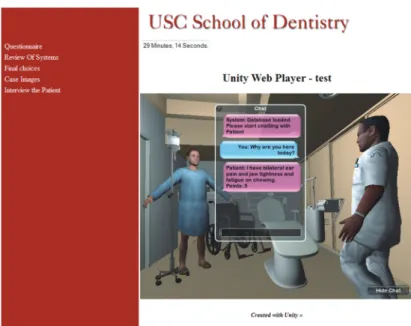
Eri Makihara (1st place winner) from Kitakyushu Fig. 1  This shows the virtual world based dental office where the patient avatar is being interviewed by a

doctor avatar. The back and forth discussion between the two avatars is displayed in the chat box.

Table 2a A list of invited lectures provided by Dr. Clark.

7/24―Japanese Dental Education Association―Morioka, Japan:

Autonomous Virtual Patients in a Virtual World.

8/6―Showa University School of Dentistry:

Advances in Educational Methodology!

9/21―Mekai Univ. School of Dentistry, Japan:

Reversing Endothelial Dysfunction caused by OSA with a MAD.

10/5―Japanese Academy of Orofacial Pain―Fukuoka:

Complimentary and Alternative Therapy in OFP/TMD!

10/16―Japanese Prosthodontic Society―Tokyo Branch:

Autonomous Virtual Patients!

10/29―Obstructive Sleep Apnea Course; UCSF, Calif. USA:

Obstructive Sleep Apnea for Dentists!

11/5―Hokkaido Univ. School of Dentistry, Japan:

Fifteen Common Mistakes in Clinical Research!

11/15―Korean Academy of TMD in Seoul, Korea:

Course on various topics in orofacial pain.

11/16―Seoul National Univ., School of Dentistry; Seoul, Korea:

Autonomous Virtual Patients in a Virtual World.

11/16―Hwang Kee Univ., School of Dentistry, Seoul Korea:

Reversing Endothelial Dysfunction with a MAD.

11-29―Univ. of Malaya, Kuala Lumpur, Malaysia:

Autonomous Virtual Patients in a Virtual World.

12/4―Showa Univ. School of Dentistry, Tokyo, Japan:

Progress with Online Teaching and Virtual Patients.

Table 2b A list of invited lectures provided by Dr. Mulligan.

8/6―Tokyo, Showa University School of Dentistry Great Expectations for My Sabbatical!

9/21―Mekai University School of Dentistry, Japan Tipping Points in Geriatric Dentistry, Part I

10/16―Japanese Prosthodontic Society meeting―Tokyo Branch Tipping Points in Geriatric Dentistry Part II

10/19―Japanese Society for Disability and Oral Health meeting    ―Tokyo Branch

Lecture: Aging of Disabled Patients

10/29―Geriatric Dentistry Symposium at USC, Los Angeles,     Calif. USA

Tipping Points in Geriatric Dentistry Part III

11/5―Hokkaido University School of Dentistry, Japan

My Journey Through the HIV Epidemic

(5)

(Kyushu Dental College) were judged as excellent and were selected to compete for an award at the Japanese Prosthodontic Meeting – Tokyo branch hosted this year by Showa University.

 Scholarship:

 Dr. Glenn Clark and Dr. Roseann Mulligan have submitted for publications during their time at Showa:

 1. Clark GT, Mulligan R: Fifteen common mistakes encountered in clinical research. J Prosthodont Res, 55:

e1⊖e6, 2010

 2. Clark GT: Burning Mouth Syndrome: Is it a neuropathic disease and does having this disease change your brain? Jpn J Orofac Pain, 3: 7⊖19, 2010  3. Clark GT, Suri A: Autonomous Virtual Patients used for Clinical Competency Assessment in Orofacial Pain and Oral Medicine: a preliminary report. The Journal of Japanese Dental Education Association, 26:

311⊖318, 2010

 4. Mulligan R, Seirawan H, Faust S, Barzaga H:

Dental Caries in Disadvantaged Children of Los Angeles. J Health Care Poor Underserved, 22: 648⊖

662, 2011

 5. Clark GT, Mulligan R, Baba K: Developing and Providing an Online (Web-Based) Clinical Research Design Course in Japan: Lessons Learned. J Prosthodont Res, 55: e61⊖e68, 2011

 Conclusion:

 Sabbatical are not vacations, but opportunities to focus on a specific area and learn new skills. As the above testifies to, Dr. Clark and Mulligan had a very busy and productive sabbatical period at Showa and close with a very sincere “thank you” to all our Japanese friends/students/staff but especially to Dean Miyazaki & Professor Baba for our Showa Experience!!

Table 3  For those who are curious what the students thought, the table below contains responses from the questionnaire we sent to the 16 students in the Clinical Research Design course (n=13).

Statements

Slightly, Moderately or Strongly Disagree

Neutral Opinion

Slightly, Moderately or Strongly

Agree

I very much enjoyed this form of teaching! 0.0% 15.4% 84.6%

I believe online teaching is as effective as live face-to-face teaching! 46.2% 7.7% 46.2%

I would have liked this course better if it were offered in Japanese language! 15.4% 7.7% 76.9%

I would like to try additional online courses in my field! 0.0% 0.0% 100%

I would recommend online courses to my colleagues! 0.0% 7.7% 92.3%

I found it easy to use the course web-site! 7.7% 30.8% 61.5%

I found the textbook very helpful in this course! 0.0% 7.7% 92.3%

I found the live video conferences very helpful! 15.4% 15.4% 69.2%

I found the videos of the lectures very helpful! 7.7% 7.7% 84.6%

I found the PDF handouts of the lectures very helpful! 7.7% 7.7% 84.6%

I found the weekly quizzes very helpful! 0.0% 7.7% 92.3%

I found the article reviews I had to write very helpful! 0.0% 15.4% 84.6%

I found the research protocol I had to write very helpful! 0.0% 7.7% 92.3%

The biggest problem I had with this course was my spoken English language ability! 30.8% 0.0% 69.2%

The biggest problem with this course was the lack of time necessary for me to complete

the work! 15.4% 15.4% 69.2%

Table 1  For those curious what students thought of the hybrid-LMS-PBL course, the table below contains responses from  the questionnaire we sent to the 13 students in the PBL courses we taught (n = 11).
Table 2a A list of invited lectures provided by Dr. Clark.
Table 3  For those who are curious what the students thought, the table below contains responses from the questionnaire we  sent to the 16 students in the Clinical Research Design course (n=13).

参照

関連したドキュメント

In this, the first ever in-depth study of the econometric practice of nonaca- demic economists, I analyse the way economists in business and government currently approach

The Mathematical Society of Japan (MSJ) inaugurated the Takagi Lectures as prestigious research survey lectures.. The Takagi Lectures are the first se- ries of the MSJ official

The Mathematical Society of Japan (MSJ) inaugurated the Takagi Lectures as prestigious research survey lectures.. The Takagi Lectures are the first series of the MSJ official

В данной работе приводится алгоритм решения обратной динамической задачи сейсмики в частотной области для горизонтально-слоистой среды

Compared to working adults, junior high school students, and high school students who have a 

Keywords: continuous time random walk, Brownian motion, collision time, skew Young tableaux, tandem queue.. AMS 2000 Subject Classification: Primary:

This paper presents an investigation into the mechanics of this specific problem and develops an analytical approach that accounts for the effects of geometrical and material data on

While conducting an experiment regarding fetal move- ments as a result of Pulsed Wave Doppler (PWD) ultrasound, [8] we encountered the severe artifacts in the acquired image2.