Abstract ID: 92 WCSMO-14, June 13-18, 2021
Numerical experiments for cavity shape identification analysis using hammering test data based on level-set type topology optimization
Takahiko Kurahashi1, Yuki Murakami2, Shigehiro Toyama3, Fujio Ikeda4, Tetsuro Iyama5 and Ikuo Ihara6
1, 6 Nagaoka University of Technology
2, 3, 4, 5, Nagaoka Institute of Technology, Nagaoka College
Presenting author: Takahiko Kurahashi
In this study, numerical experiments for cavity shape identification analysis using hammering test data are carried out based on level-set type topology optimization. The review of hammering test for concrete structures have been performed form the ceiling collapse accident at Sasago tunnel in 2012 in Japan, because the result by conventional hammering test depends on the inspector’s experience.
Therefore, in this study, we focused on the automatic identification system of cavity position and shape using the hammering test data. First of all, the oscillation equation in three dimensions is introduced as the governing equation in numerical simulation. The finite element and the Newmark’s beta methods are applied to discretize the governing equation. Even if multiple cavities exist in structures, the cavity shape can be identified by using the topology optimization. Especially, the cavity shape can be clearly identified by using the level-set topology optimization. The time history of observed displacement is employed as the measurement value used in the topology optimization. The performance function is defined by square value of difference between computed and observed displacements at observation points integrated in time. The performance function is extended by the discretized governing equation, initial and boundary conditions based on the adjoint variable method. In order to obtain the stationary condition of the extended performance function, the Lagrange function, the first variation of the extended performance function is calculated. Consequently, the adjoint equation which is the equation of the adjoint variable, and the gradient of the extended performance function with respect to level set function are obtained. The gradient value is used as the source term in the reaction diffusion equation, the cavity shape is gradually updated by the reaction diffusion equation. In this study, some numerical experiments are performed by changing the numerical parameters in the topology optimization analysis.
Abstract ID: 92 WCSMO-14, June 13-18, 2021
Numerical experiments for cavity shape identification analysis using hammering test data based on level-set type topology optimization
T. Kurahashi 1 | Y. Murakami 2 | S. Toyama 3 | F. Ikeda4 | T. Iyama 5 | I. Ihara 6
1, 6 Nagaoka University of Technology | 2, 3, 4, 5, Nagaoka Institute of Technology, Nagaoka College
Presenting author: T. Kurahashi
In this paper the authors carried out numerical experiments for cavity shape identification analysis using hammering test data based on level-set type topology optimization. The displacement response is obtained by the hammering test, and the performance function is defined by the time history of the displacement as Eq. (1)
𝐽 =1
2∫ (𝒖 − 𝒖𝑡𝑡𝑓 𝒐𝒃𝒔.)𝑇𝑸(𝒖 − 𝒖𝒐𝒃𝒔.)𝑑𝑡
0 (1)
The oscillation equation in three dimensions is introduced to simulate the displacement field, and the governing equation is discretized by the FEM [1] and the Newmark’s β method in space and time, respectively. The discretized equation is employed as the constraint condition of the performance function, and the Lagrange function J* is derived by the adjoint variable method. the first variation of the Lagrange function is calculated to obtain the stationary condition of the Lagrange function, i.e., δJ*=0 . In this calculation, the governing equation is expressed by the level-set function φ, and the gradient of the Lagrange function with respect to the level-set function, i.e., ∂J*/∂φ, is derived [2]. The gradient ∂J*/∂φ is employed as the source term of the reaction diffusion equation, and the shape of cavity expressed by the level-set function is updated.
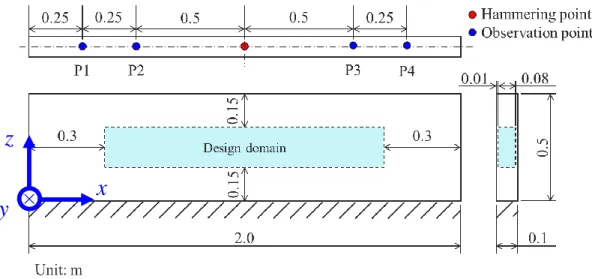
The computational model of the numerical experiments is shown in Fig.1, and the computational conditions are shown in Table 1. In this study, the striking force is give at the center point of the top surface, and the displacement response is evaluated at the observation points (See Fig.1.). As for the initial shape of the cavity is set as shown in the left hand side of Fig.2. The right hand side figure of Fig.2 represents the target shape of cavity. In this study, the regularization parameter τ was adjusted as τ=0.001 (Case-A), 0.005 (Case-B) and 0.010 (Case-C), and numerical experiments were carried out.
Consequently, the shape of cavity was identified as shown in Fig.3. From this result, it is found that the number of cavity is corresponding to exact solution shown in Fig.2, but the size of the cavity is small in comparison with the target shape.
Fig.1 Setup of design domain and size of computational domain.
Table 1 Numerical conditions.
Number of nodes 112761
Number of elements 100000
Number of time steps 256
Time increments Δt 39.0625
Young’s modulus E, GPa 35.096
Poisson’s ratio ν 0.16
Mass density ρ, kg/m3 2300
Damping coefficient cM, cK ( Reyleigh damping ) 90.0, 1.0×10⁻⁶ Weight parameters qu, qv, qw ( Diagonal component in matrix Q ) 0, 0, 1.0×10⁹
Virtual time increment Δ𝑡̃ 1.0×10⁻⁸
Convergence criterion ε 1.0×10⁻³
× x y
z
Fig.2 Initial and target shapes of cavity. (Left: Initial shape, Right: Target shape)
Case A : τ=0.001 Case B : τ=0.005 Case C : τ=0.010 Fig.3 Comparison of cavity shape for each regularization parameter τ.
Acknowledgements
This work was supported by grants from Japan Science and Technology Agency, “A-STEP tryout: Digital transformation of skill up process of hammering test technique by self-organized maps” and Nagaoka University of Technology. The computations were mainly carried out using the computer facilities at Kyushu University’s Research Institute for Information Technology. We wish to thank all the persons who assisted us with this study.
References
[1] N. Takeuchi, K. Kashiyama and K. Terada, “Computational mechanics – Basic of the FEM –“, Morikita Publishing Co., Ltd., (2003). (In Japanese)
[2] T. Yamada, S. Nishiwaki, K. Izui, M. Yoshimura and A. Takezawa, ”A Structural optimization method incorporating level set boundary expressions based on the concept of the phase field method”,
Transaction of Japan Society of Mechanical Engineering, Series A, Vol.75, No.753, pp.550-558 (2009). (In Japanese)
X Y
Z
X Y
Z
X Y
Z