Provenance Study of Pre-Neogene Sandstones in the Japanese Islands
Kazumi Yokoyama
Department of Geology, National Museum of Nature and Science, Tokyo, 169–0073, Japan E-mail: [email protected]
Abstract. Sandstone is one of the most common rock-types in the Japanese Islands. It occurs as a constituent of the accretionary complex and non-marine or shallow marine sequence. We ana- lyzed detrital monazites in the pre-Neogene sandstones to obtain their provenance. An electron probe micro analyzer (EPMA) has been used to measure the U–Th–Pb ages of more than 15,000 detrital monazites in the islands. The age data were compared with those from the recent river sands in East Asia that represent their probable provenance area. Although ages of the sandstones are various, major provenances are divided into three types; (1) bimodal type with peaks at 100–
300 Ma and 1850–1900 Ma; (2) major peak around 500 Ma or (3) at 400–450 Ma. Sandstones with a bimodal pattern (1) were derived mainly from the Korean Peninsula and coastal zone of China.
Sandstones with ages of (2) 500 Ma and (3) 400–450 Ma peaks were derived from the Russian side of Far East Asia and the South China Craton, respectively.
Most of the sandstones in the Jurassic to Cretaceous accretionary complexes have a bimodal pattern. Paleogene sandstones in the Shimanto Belt from Kyushu to Okinawa have a peak at 400–
450 Ma, whereas those from Kanto to Shikoku have a peak at 500 Ma. The former monazites were derived from the area including the South China Craton and the latter from the Russian side. Most non- and shallow-marine sandstones have a bimodal pattern. Sandstones with a peak at 500 Ma occur sporadically in the islands: northern Hokkaido (Yezo and Saroma groups, Cretaceous), the Hida area (Tetori Group: Cretaceous), and Maizuru (Nabae-Yakuno Group: Triassic). These classi- fications and provenances for the sandstones are important when we determine a tectonic recon- struction of the Japanese Islands.
Key words: monazite, age, sandstone, Japanese Islands
Introduction
The Japanese Islands are composed of com- plex geological units. Except for the granitic and volcanic rocks, basements consist mainly of an accretionary complex and its metamorphic equivalent with a subordinate amount of non- and shallow-marine sequence (Fig. 1). Strike-slip movement and the rotation of blocks are com- mon in the islands. Many tectonic reconstruction models have been presented for the islands. The most outstanding movements are the opening of the Sea of Japan at around 20 Ma (Otofuji &
Matsuda, 1983) and the strike-slip movement of the huge faults such as the Median Tectonic Line,
the Tanakura Tectonic Line and many other faults.
The present study examines pre-Neogene sandstones in the islands to obtain the prove- nances of detrital minerals on the basis of the age distribution of monazite. The result will contrib- ute to the tectonic reconstruction of the islands.
The age determination of individual mineral grains has provided a powerful tool for prove- nance studies. Many age dating methods have been applied to the provenance studies of zircon, for example the Sensitive High-Resolution Ion Microprobe (SHRIMP) (e.g. Ireland, 1991; Tsu- tsumi
et al., 2003), fission-track dating (e.g.Garver et al., 1999), inductively coupled plasma
mass spectrometry (ICP-MS) (e.g. Evans et al., 2001; Wyck & Norman, 2004), and by monazite age via the electron probe micro-analyzer (EPMA) (e.g. Suzuki et al., 1991; Fan et al.,
2004; Yokoyama et al., 2007).
Monazite is present in granitic rocks and high- grade metamorphic rocks such as gneiss and amphibolite. It also occurs as a detrital mineral in
Fig. 1. Geological division of the basement rocks in the Japanese Islands.
sandstone. Monazite is treated as an ultrastable mineral similar to zircon. However, it easily decomposes into rare earth element (REE)-bear- ing minerals under metamorphic conditions, even in weakly metamorphosed rocks. Even though there is a weakness for its decomposition, which is different from an ultrastable zircon, the age distribution of monazite is simpler than that of zircon due to restricted sources of monazite. As age data of monazites in the sands from the riv- ers cutting through the coastal provinces of Asia
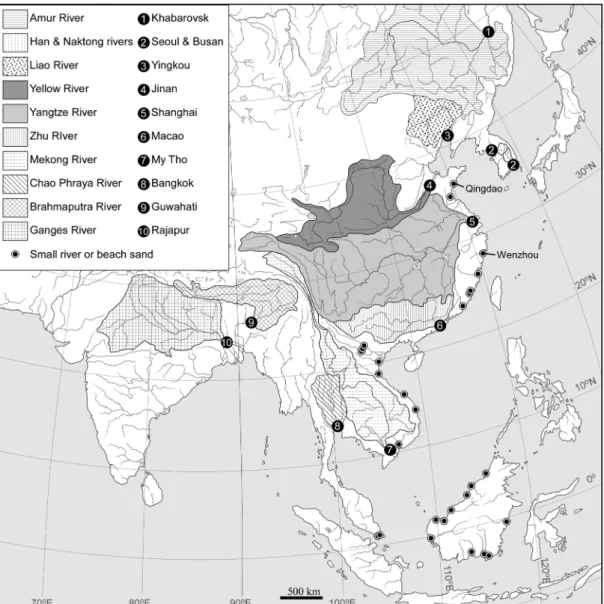
have already been reported (Fig. 2: Yokoyama et
al., 2007, 2010 & 2012), the monazite age datain the sandstones from the Japanese Islands will be a strong tool for provenance study.
Each river sample in East Asia has its distinct age distribution characteristics reflecting the dif- ferent rocks in their drainage basins. In the Korean Peninsula, monazite age shows a clear bimodal pattern with clusters at 100–300 Ma and 1800–1900 Ma and monazites with ages from 300 Ma to 1800 Ma are scarce. A similar bimodal
Fig. 2. Sampling localities of sands from the rivers in Asia. The age data of the sands were already published by Yokoyama et al., 2007, 2008, 2010a, 2010b, 2012 & 2015).
pattern is observed for the sands collected from coastal areas of China: Qingdao and Wenzhou (Fig. 2: Yokoyama et al., 2007 & 2012). Sands from the Yellow and Yangtze rivers have age peaks at 100–300 Ma, 410 Ma and ca.1900 Ma.
The strongest peak appears at 0~25 Ma for the Yangtze River. The youngest monazites were almost certainly derived from the Himalayan region that has been a part of the riverʼs drainage basin since the earliest Pleistocene (Fan et al., 2004). Such young data should therefore be excluded from consideration in provenance stud- ies in the pre-Neogene sandstones in the Japa- nese Islands. A cluster of ages between 700 and 1000 Ma in the age distribution pattern of the Yangtze River is relatively high and is represen- tative of the South China Craton (Wang, 1986).
The Pliocene and Early Pleistocene sandstones in the drill core from the mouth of the Yangtze River have similar peaks to those of the modern sands except for a shift of the 450 Ma peak in the Pliocene sands to 410 Ma in Recent sand (Fan et
al., 2004). Sand from the Amur River cuttingthrough Siberia and northern China has a strong peak at 500 Ma, which is different from the other rivers in East Asia.
Sandstone samples
A detailed geological map of the Japanese Islands is presented by the Geological Survey of Japan. Many authors used a simplified map for basement rocks of the islands except for the gra- nitic and volcanic rocks as shown in Fig. 1.
Sandstones are present as one of the major con- stituents in the accretionary complex and terres- trial sequences including shallow marine in ori- gin. Monazite is usually a rare mineral. It is easily decomposed into REE minerals even under low-grade metamorphism, but is well pre- served in non-metamorphosed sandstones. Tsu- tsumi
et al. (2003) completed the provenancestudy using an ultrastable mineral, zircon, even in the metamorphic rocks. In this study, we only analyzed detrital monazite in the non-metamor- phosed sandstones.
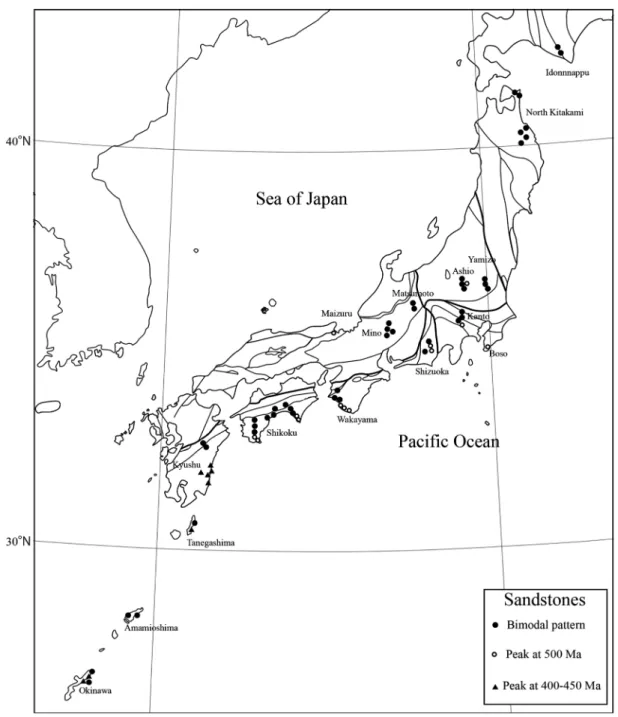
Accretionary complexes in the islands occur as a belt and range in age from the Early Paleozoic to the Paleogene. The sandstones studied in this paper are from the Mino-Ashio Belt (Jurassic), the Chichibu belt (Jurassic to Lower Cretaceous) the North Kitakami Belt (Jurassic to Lower Creta- ceous), the Iddonnappu Belt (Cretaceous) and the Shimanto Belt (Cretaceous to Paleogene) (Fig. 3).
The Shimanto Belt includes partly Early Miocene sediments and also includes locally shallow- marine sediments. Although the essential mem- bers are from the deep-sea in origin, the constitu- ents of the Shimanto Belt are tentatively treated here as a Cretaceous to Paleogene accretionary complex. Permian sandstones from the Maizuru Belt were studied and published by Yokoyama et
al. (2009). Many sandstone samples were col-lected from each belt and are stored in the National Museum of Nature and Science, Tokyo.
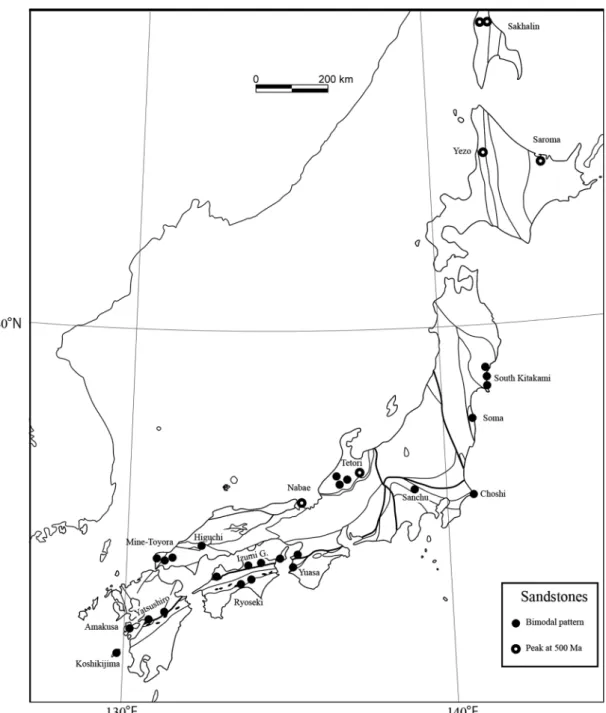
Non- or shallow-marine sandstones occur spo- radically in the islands. Among them, samples were collected mostly from South Kitakami (Jurassic to Lower Cretaceous), the Chichibu Belt (Jurassic and Cretaceous) and the Tetori Group (Cretaceous). A few samples were col- lected from the Yezo Group (Cretaceous), north- ern Hokkaido, and its northern extension (Sakha- lin) (Fig. 4). The sandstones were also collected from the Choshi Group in the Kanto Province (Cretaceous), the Higuchi Group in central Chu- goku Province (Early Jurassic), and the Himenoura Group in western Kyushu Province (Cretaceous).
There are many other non- and shallow- marine sandstones in the islands. Among them, the Trias- sic to Cretaceous sandstones (Mine Group, To yora Group and others) in western Chugoku Province, Triassic sandstones at Wakasa Bay (Nabae- Yakuno Group) and the Latest Cretaceous sand- stones (Izumi Group) along the Median Line were already reported by Yokoyama et al. (1998, 2000 & 2009).
Analytical Procedures
Procedures for the separation of heavy miner-
als including monazite are the same as have been
described by Yokoyama et al. (1990). The theo- retical basis for monazite age calculation is essentially the same as that developed by Suzuki
et al. (1991). Monazites were analyzed by elec-tron probe micro-analyzer, EPMA, fitted with a Wavelength Dispersive Spectrometer (WDS).
The EPMA, JXA-8800, is situated in the
National Museum of Nature and Science. Analyt- ical conditions have been described by Santosh
et al. (2006). Age calibrations were carefully per-formed by comparing data obtained by EPMA dating with those acquired by the SHRIMP tech- nique (e.g. Santosh et al., 2006). Apart from minor shifts due to machine drift and variations
Fig. 3. Sampling sites of sandstones in the accretionary complexes including previously studied sites.
in standard conditions, the ages obtained from the techniques were found to have good consis- tency. Monazites with ages of 3020 Ma and 64 Ma that were obtained by SHRIMP and K–Ar methods, respectively, have been used as internal standards for age calibration. The standard devia- tion of the age depends mostly on PbO content of
the monazite. The error for the age is within a few percent for most of the analyzed monazites that were rich in ThO
2. If the age error exceeded 25 Ma for Mesozoic to Cenozoic monazites and/
or 50 Ma for older monazites, these data were excluded from the figures and further discussion.
All the analytical positions were selected from
Fig. 4. Sampling sites of sandstones in the non- and shallow-marine sequences including previously studied sites.
back-scattered electron images and metamictised areas/zones were avoided. The standard devia- tion of ages within a single grain is mostly less than a few percent in old monazites (>ca.
100 Ma) or less than 25 Ma in younger monazites (<ca. 100 Ma). If a doubtful age was obtained, age analyses were repeated and one representa- tive age has been selected for each grain.
Age of Monazite
Sandstones in the accretionary complexes:
Among the various types of accretionary com- plexes in the Japanese Islands, one of the old accretionary complexes is the Maizuru belt from the Permian. The ages of monazites from the Maizuru Belt have a strong peak at 500 Ma.
Yokoyama et al. (2009) concluded that they were derived from the Khanka and Jiamusi blocks in Russia before the amalgamation of northern China Craton and the Khanka-Jiamusi Block dur- ing the Triassic. Permian or older accretionary complexes are the Akiyoshi Belt, the Nedamo Belt and the Sangun belt in the Japanese Islands, but detrital monazite has not been preserved.
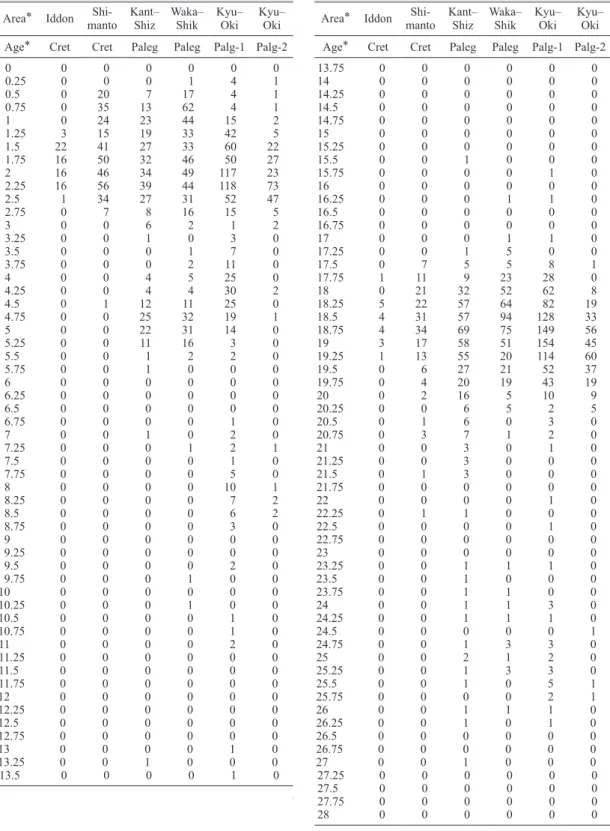
More than 7000 monazite grains in the sand- stones from the accretionary complex have been analyzed. All the age data are summarized in Table 1. Although many samples were collected from each belt, detrital monazite is not always preserved. The age data obtained from each belt are summarized in the same diagram as either suf- ficient age data was not obtained or the samples show a similar age distribution. Age distributions of monazites are presented as probability dia- grams in Figs. 5 and 6. Probability distributions for monazite ages were calculated with a multi- peak Gauss fitting method (Williams, 1998). Age patterns of the sands from the rivers in East Asia were reproduced for comparison in Fig. 7.
Detrital monazite is more or less preserved in the sandstones from the Jurassic to Lower Creta- ceous accretionary complexes. The studied sam- ples are from the Mino and Matsumoto areas in the Mino Belt, the Ashio–Yamizo Belt, the North Kitakami Belt and the Chichibu Belt. The age
distribution patterns are shown in Fig. 5. Most of them show a bimodal pattern with peaks at 200–
300 Ma and 1850–1900 Ma which is similar to those from the Korean Peninsula and/or present southern coast zone of the China Craton (Yokoyama et al., 2012).
Sandstones in the Chichibu Belt including part of a Lower Cretaceous formation are metamor- phosed weakly, and then monazite was not well preserved. Only restricted sandstones contain detrital monazite with a bimodal age distribution as well as the other Jurassic accretionary com- plex. A few samples from the Ashio Belt have a peak at 500 Ma in addition to 1850–1900 Ma and 200–300Ma peaks (Fig. 5). The monazite with 500 Ma is present in the Khanka or Jiamusi blocks and is common in the sand from the Amur River (Yokoyama et al. 2009). As discussed by Yokoyama et al. (2001), it is reasonable to con- clude that the provenance of a few sandstones in the Ashio Belt was both the Korean Peninsula and also the Khanka-Jiamusi Block.
The Shimanto Belt occurs from the Kanto Province to Okinawa through Shikoku and Kyushu (Fig. 1). The Cretaceous sandstones from Kanto to Okinawa have a bimodal pattern similar to those in the Jurassic and Lower Creta- ceous accretionary complexes (Fig. 6). On the other hand, Paleogene sandstones have three pat- terns in their monazite age distribution. The sandstones from Kanto to Shikoku have peaks at 500 Ma and 2500 Ma in addition to 200–300 Ma and 1850–1900 Ma (Fig. 6). The pattern is simi- lar to that of the present Amur River (Fig. 7). On the other hand, two patterns are recognized for the sandstones from Kyushu to Okinawa. One is a bimodal pattern, possibly derived from the Korean Peninsula. The other has a complex age pattern with peaks at 200–300 Ma, 400–450 Ma, 1800–1900 Ma and 2500 Ma. A weak cluster at 700–1100 Ma is also recognized. This kind of age pattern is similar to that of the Yangtze River.
The Cretaceous accretionary complex, the
Iddonnapu Belt in Hokkaido, occurs at the west-
ern margin of the Hidaka low-pressure type met-
amorphic belt. The sandstones in the belt have
Area* Iddon Shi- manto Kant–
Shiz Waka–
Shik Kyu–
Oki Kyu–
Oki Age* Cret Cret Paleg Paleg Palg-1 Palg-2
0 0 0 0 0 0 0
0.25 0 0 0 1 4 1
0.5 0 20 7 17 4 1
0.75 0 35 13 62 4 1
1 0 24 23 44 15 2
1.25 3 15 19 33 42 5
1.5 22 41 27 33 60 22
1.75 16 50 32 46 50 27
2 16 46 34 49 117 23
2.25 16 56 39 44 118 73
2.5 1 34 27 31 52 47
2.75 0 7 8 16 15 5
3 0 0 6 2 1 2
3.25 0 0 1 0 3 0
3.5 0 0 0 1 7 0
3.75 0 0 0 2 11 0
4 0 0 4 5 25 0
4.25 0 0 4 4 30 2
4.5 0 1 12 11 25 0
4.75 0 0 25 32 19 1
5 0 0 22 31 14 0
5.25 0 0 11 16 3 0
5.5 0 0 1 2 2 0
5.75 0 0 1 0 0 0
6 0 0 0 0 0 0
6.25 0 0 0 0 0 0
6.5 0 0 0 0 0 0
6.75 0 0 0 0 1 0
7 0 0 1 0 2 0
7.25 0 0 0 1 2 1
7.5 0 0 0 0 1 0
7.75 0 0 0 0 5 0
8 0 0 0 0 10 1
8.25 0 0 0 0 7 2
8.5 0 0 0 0 6 2
8.75 0 0 0 0 3 0
9 0 0 0 0 0 0
9.25 0 0 0 0 0 0
9.5 0 0 0 0 2 0
9.75 0 0 0 1 0 0
10 0 0 0 0 0 0
10.25 0 0 0 1 0 0
10.5 0 0 0 0 1 0
10.75 0 0 0 0 1 0
11 0 0 0 0 2 0
11.25 0 0 0 0 0 0
11.5 0 0 0 0 0 0
11.75 0 0 0 0 0 0
12 0 0 0 0 0 0
12.25 0 0 0 0 0 0
12.5 0 0 0 0 0 0
12.75 0 0 0 0 0 0
13 0 0 0 0 1 0
13.25 0 0 1 0 0 0
13.5 0 0 0 0 1 0
Area* Iddon Shi- manto Kant–
Shiz Waka–
Shik Kyu–
Oki Kyu–
Oki Age* Cret Cret Paleg Paleg Palg-1 Palg-2
13.75 0 0 0 0 0 0
14 0 0 0 0 0 0
14.25 0 0 0 0 0 0
14.5 0 0 0 0 0 0
14.75 0 0 0 0 0 0
15 0 0 0 0 0 0
15.25 0 0 0 0 0 0
15.5 0 0 1 0 0 0
15.75 0 0 0 0 1 0
16 0 0 0 0 0 0
16.25 0 0 0 1 1 0
16.5 0 0 0 0 0 0
16.75 0 0 0 0 0 0
17 0 0 0 1 1 0
17.25 0 0 1 5 0 0
17.5 0 7 5 5 8 1
17.75 1 11 9 23 28 0
18 0 21 32 52 62 8
18.25 5 22 57 64 82 19
18.5 4 31 57 94 128 33
18.75 4 34 69 75 149 56
19 3 17 58 51 154 45
19.25 1 13 55 20 114 60
19.5 0 6 27 21 52 37
19.75 0 4 20 19 43 19
20 0 2 16 5 10 9
20.25 0 0 6 5 2 5
20.5 0 1 6 0 3 0
20.75 0 3 7 1 2 0
21 0 0 3 0 1 0
21.25 0 0 3 0 0 0
21.5 0 1 3 0 0 0
21.75 0 0 0 0 0 0
22 0 0 0 0 1 0
22.25 0 1 1 0 0 0
22.5 0 0 0 0 1 0
22.75 0 0 0 0 0 0
23 0 0 0 0 0 0
23.25 0 0 1 1 1 0
23.5 0 0 1 0 0 0
23.75 0 0 1 1 0 0
24 0 0 1 1 3 0
24.25 0 0 1 1 1 0
24.5 0 0 0 0 0 1
24.75 0 0 1 3 3 0
25 0 0 2 1 2 0
25.25 0 0 1 3 3 0
25.5 0 0 1 0 5 1
25.75 0 0 0 0 2 1
26 0 0 1 1 1 0
26.25 0 0 1 0 1 0
26.5 0 0 0 0 0 0
26.75 0 0 0 0 0 0
27 0 0 1 0 0 0
27.25 0 0 0 0 0 0
27.5 0 0 0 0 0 0
27.75 0 0 0 0 0 0
28 0 0 0 0 0 0
Table 1. Age data from the sandstones in the accretionarys complexes in the Japanese Islands.
*Abbrebiation: Iddo= Iddonnapu, Kant–Shiz=Kanto–Shizuoka, Waka–Shik=Shinmanto from Wakayama to Shi- koku, Kyu–Oki=Shimanto from Kyushu to Okinawa, Akka=Akka, Ash–Yam=Ashio–Yamizo, Min–Mat=Mino–
Matsumoto, Chic=Chichibu, Cret=Cretaceous, Paleg=Paleogene, Jur=Jurassic, Lcret=Lower Cretaceous.
Area Akka Ash–
Yam Ash–
Yam Min–
Mat Chi Age Jur-
Lcret Jur-1 Jur-2 Jur Jur- Lcret
0 0 0 0 0 0
0.25 1 0 0 0 0
0.5 0 0 0 0 0
0.75 0 0 0 0 0
1 0 0 0 0 0
1.25 2 0 0 0 0
1.5 17 7 3 40 19
1.75 31 18 1 58 37
2 33 55 2 139 61
2.25 66 146 5 306 50
2.5 33 83 7 94 74
2.75 10 24 1 15 59
3 0 3 0 1 11
3.25 0 2 0 2 2
3.5 0 0 0 0 2
3.75 0 1 0 1 0
4 0 0 1 2 0
4.25 0 3 1 1 0
4.5 0 2 0 3 0
4.75 0 1 7 0 0
5 0 2 6 3 1
5.25 0 1 0 0 2
5.5 0 0 0 0 1
5.75 0 0 0 0 0
6 0 0 0 0 0
6.25 0 0 0 0 1
6.5 0 0 0 0 0
6.75 0 1 0 0 0
7 0 0 0 0 0
7.25 0 0 0 0 0
7.5 0 0 0 0 0
7.75 0 0 0 2 0
8 0 1 0 0 0
8.25 0 1 0 0 0
8.5 0 0 0 1 0
8.75 0 0 0 0 0
9 0 0 0 0 0
9.25 0 0 0 2 0
9.5 0 0 0 0 0
9.75 0 0 0 0 0
10 0 0 0 0 0
10.25 0 0 0 0 0
10.5 0 0 0 0 0
10.75 0 0 0 0 0
11 0 0 0 0 0
11.25 0 0 0 0 0
11.5 0 0 0 1 0
11.75 0 0 0 0 0
12 0 0 0 0 0
12.25 0 0 0 0 0
12.5 0 0 0 0 0
12.75 0 0 0 0 0
13 0 1 0 0 0
13.25 0 1 0 0 0
13.5 0 0 1 0 0
13.75 0 0 0 0 0
14 0 0 0 0 0
14.25 0 1 0 0 0
Area Akka Ash–
Yam Ash–
Yam Min–
Mat Chi Age Jur-
Lcret Jur-1 Jur-2 Jur Jur- Lcret
14.5 0 0 0 0 0
14.75 0 1 0 0 0
15 0 0 0 0 0
15.25 0 1 0 1 0
15.5 0 0 0 1 0
15.75 0 0 0 3 0
16 0 0 0 4 0
16.25 0 2 0 4 0
16.5 0 2 0 6 1
16.75 0 5 0 6 0
17 0 0 0 14 0
17.25 0 2 0 24 4
17.5 0 9 1 26 4
17.75 2 22 1 50 4
18 4 47 1 95 3
18.25 14 68 9 131 17
18.5 19 129 14 246 48
18.75 25 198 10 236 77
19 9 196 15 156 91
19.25 7 138 5 76 66
19.5 3 101 0 32 24
19.75 1 23 1 18 15
20 0 8 1 7 8
20.25 0 3 0 0 0
20.5 0 2 0 0 0
20.75 0 0 0 0 0
21 0 0 0 0 0
21.25 0 0 0 1 0
21.5 0 0 0 0 0
21.75 0 0 0 0 0
22 0 0 0 0 0
22.25 0 0 0 0 0
22.5 0 0 0 1 0
22.75 0 0 0 0 1
23 0 0 0 0 0
23.25 0 0 0 0 0
23.5 0 0 0 0 0
23.75 0 0 0 0 0
24 0 0 0 0 0
24.25 0 1 0 2 0
24.5 0 0 0 1 0
24.75 0 0 0 0 0
25 0 0 0 0 0
25.25 0 0 0 0 0
25.5 0 0 0 0 0
25.75 0 0 0 0 0
26 0 0 0 0 0
26.25 0 0 0 0 0
26.5 0 0 0 0 0
26.75 0 0 0 0 0
27 0 0 0 0 0
27.25 0 0 0 0 0
27.5 0 0 0 0 0
27.75 0 0 0 0 0
28 0 0 0 0 0
Table 1. (continued)
Fig. 5. Probability distribution of ages of detrital monazites in the sandstones from the accretionary complexes in the north and central part of the Japanese Islands. The numerical value (n) denotes the number of analyzed monazite grains.
Fig. 6. Probability distribution for the ages of detrital monazites in the sandstones from the Iddonnappu Belt and Shimanto Belt. The numerical value (n) denotes the number of analyzed monazite grains.
Fig. 7. Probability distribution of monazite ages in the sands from the major rivers in East Asia (After Yokoyama et al., 2007). The numerical value (n) denotes the number of analyzed monazite grains.
also a bimodal pattern similar to those in the Cre- taceous Shimanto Belt. As far as the age is con- cerned, the Iddonnapu belt may be a part of the Shimanto Belt. However, the Upper Cretaceous accretionary complex has not been recognized between Kanto Province and Hokkaido.
Non- or shallow-marine sandstones: Most of
the non- or shallow-marine sandstones in the Japanese Islands have been analyzed: the sand- stones from the Yezo and Saroma groups in Hok- kaido (Cretaceous), South Kitakami (Jurassic to Lower Cretaceous), Choshi Group in the Kanto Province (Cretaceous), Tetori Group (Creta- ceous), Nabae-Yakuno Group (Triassic), Higuchi Group in the western Chugoku Province (Early Jurassic), Izumi Group along the Median Tec- tonic Line (Latest Cretaceous), Jurassic to Creta- ceous formations along the Kurosegawa Tectonic Line in the Chichibu Belt and Himenoura Group in western Kyushu (Cretaceous). Most of the age patterns are bimodal similar to those in the Juras- sic to Cretaceous accretionary complexes men- tioned above. As reported by Yokoyama et al.
(2009), the Nabae-Yakuno Group has a peak at 500 Ma, which was partly derived from the Khanka-Jiamusi Block. Age data from the South Kitakami and Tetori groups were reported by Yokoyama et al. (1996 & 2002). Additional sam- ples were collected from the groups for this study. As a northern extension of the Yezo Group in Hokkaido, the Cretaceous to Paleogene sand- stones in Sakhalin are also analyzed.
More than 7000 age data for monazite grains in the non- or shallow-marine sandstones have been obtained. All the age data are summarized in Table 2. Age distributions of monazites are pre- sented as probability diagrams in Figs. 8 and 9.
Detrital monazites in the Saroma Group and Yezo Group in Hokkaido are rarely preserved.
Whereas the Cretaceous sandstones in Sakhalin, the northern extension of the Yezo Group, con- tain abundant detrital monazites. These sand- stones have a peak at 500 Ma as well as at 200–
300 Ma and 1850–1900 Ma, similar to the present sands from the Amur River. Jurassic to Lower
Cretaceous sandstones from the South Kitakami are represented by a typical bimodal pattern as shown in Fig. 8. The Tetori Group also has a typ- ical bimodal pattern as studied by Yokoyama et
al. (2002), but a few newly collected sandstoneshave a peak at 500 Ma (Fig. 8).
The Cretaceous sandstones in the Choshi Group have a very small peak at 500 Ma, but the monazite age pattern is almost bimodal. Creta- ceous and Jurassic sandstones occur along the Kurosegawa Tectonic Line in the Chichibu Belt.
They also have a bimodal pattern. Age pattern of the Early Jurassic sandstones in the Higuchi Group, central Chugoku Province, almost has one peak at 1850 Ma. Although a younger peak at around 250 Ma is almost negligible, the age pat- tern will be treated as a part of the bimodal pat- tern. Cretaceous sandstones from the Himenoura Group in both the Amakusa area and Koshiki- jima Islands also show a bimodal pattern.
Discussion
One of the most drastic movements in the Jap- anese Islands was the opening of the Sea of Japan during the Neogene. Although the strike- slip movement mostly developed around the con- tinental margin, the East Asian continent has been more or less stable at least since the Triassic when the Chino-Korea, Khanka, and Jiamusi blocks were amalgamated. Constituents of the Japanese Islands were present at the continental margin of East Asia before the opening of the Sea of Japan. Hence, it is reasonable to consider that the provenance of the pre-Neogene sand- stones in the islands were related with the present configuration. As shown in Fig. 7, the age data of the main rivers in Asia have been presented by Yokoyama
et al. (2007). The data are availablewhen we compare monazite age distribution data from the modern river systems with those in the sandstones from the Japanese Islands.
As shown in age distribution patterns from
both of the accretionary complexes and non- and
shallow-marine sequences, the bimodal pattern
derived from the Korean Peninsula and its con-
Table 2. Age data of the non- or shallow-marine sandstones from the Sakhalin and Japanese Islands.
*Abbrebiation: Sakh=Sakhaline, Saro=Saroma, Kita=Kitakami-Soma, Chos=Choshi, Teto=Tetori, Chic=Chichibu, Higu=Higuchi, Amak=Amakusa, Kash=Kashikojima, Cret=Cretaceous, Pal=Paleogene, Ju&Jura=Jurassic
Area* Sakh Yezo Saro Kita Chos Teto Teto Chic Chic Higu Amak Kash
Age* Cre-Pal Cret Cret Ju-Cre Cret Cret1 Cret2 Cret Jura Jura Cret Cret
0 6 0 0 0 0 0 0 0 0 0 0 0
0.25 28 0 0 0 0 0 0 0 0 0 0 0
0.5 69 0 0 0 0 0 0 0 0 0 0 0
0.75 71 1 0 0 0 0 0 1 0 0 2 1
1 72 2 5 0 1 0 0 2 0 0 0 1
1.25 43 3 1 2 7 0 4 18 0 0 0 0
1.5 41 5 3 74 13 1 68 86 4 0 0 10
1.75 39 3 4 101 19 5 210 84 15 0 17 23
2 38 6 6 203 13 9 225 89 20 0 3 24
2.25 60 1 5 249 23 19 325 103 12 4 8 19
2.5 30 6 5 128 17 41 102 60 15 6 1 7
2.75 10 0 4 29 4 8 14 7 5 0 0 1
3 0 0 1 7 2 2 1 0 0 0 0 1
3.25 0 0 0 1 0 1 1 0 0 0 0 1
3.5 0 0 0 0 0 0 0 1 0 0 0 0
3.75 0 0 0 0 0 0 0 0 0 0 0 0
4 3 0 1 0 1 0 0 0 0 0 0 0
4.25 4 1 2 0 0 0 0 0 0 0 0 0
4.5 19 2 1 0 0 1 0 0 0 0 0 0
4.75 57 1 6 0 1 12 0 1 0 1 0 0
5 37 1 3 0 2 10 0 0 0 0 0 0
5.25 12 2 0 0 0 1 0 0 0 0 0 0
5.5 1 0 0 0 0 0 0 0 0 0 0 0
5.75 1 0 0 0 0 0 0 0 0 0 0 0
6 0 0 0 0 0 0 0 0 0 0 0 0
6.25 0 0 0 0 0 0 0 0 0 0 0 0
6.5 0 0 0 0 0 0 0 0 0 0 0 0
6.75 0 0 0 0 0 0 0 0 0 0 0 0
7 0 0 0 0 0 0 0 0 0 0 0 0
7.25 0 0 0 0 0 0 0 0 0 0 0 0
7.5 0 0 0 0 0 0 0 0 0 0 0 0
7.75 0 0 0 0 0 0 0 0 0 0 0 0
8 0 1 0 0 0 0 0 0 0 0 0 0
8.25 0 0 0 0 0 0 0 0 0 0 0 0
8.5 0 0 0 0 0 0 0 0 0 0 0 0
8.75 0 0 0 0 0 0 0 0 0 0 0 0
9 0 0 0 0 0 0 0 0 0 0 0 0
9.25 0 1 0 0 0 0 0 0 0 0 0 0
9.5 0 0 0 0 0 0 1 0 0 0 0 0
9.75 0 0 0 0 0 0 0 0 0 0 0 0
10 0 0 0 0 0 0 0 0 0 0 0 0
10.25 0 0 0 0 0 0 0 0 0 0 0 0
10.5 0 0 0 0 0 0 0 0 0 0 0 0
10.75 0 0 0 0 0 0 0 0 0 0 0 0
11 0 0 0 0 0 0 0 0 0 0 0 0
11.25 0 0 0 0 0 0 0 0 0 0 0 0
11.5 0 0 0 0 0 0 0 0 0 0 0 0
11.75 0 0 0 1 0 0 1 0 0 0 0 0
12 0 0 0 0 0 0 0 0 0 0 0 0
12.25 0 0 0 0 0 0 0 0 0 0 0 0
12.5 0 0 0 0 0 0 0 0 0 0 0 0
12.75 0 0 0 0 0 0 0 0 0 0 0 0
13 0 0 0 0 0 0 0 0 0 0 0 0
13.25 0 0 0 0 0 0 0 0 0 0 0 0
13.5 0 0 0 1 0 0 0 0 0 0 0 0
13.75 0 0 0 0 0 0 0 1 0 0 0 0
Area* Sakh Yezo Saro Kita Chos Teto Teto Chic Chic Higu Amak Kash Age* Cre-Pal Cret Cret Ju-Cre Cret Cret1 Cret2 Cret Jura Jura Cret Cret
14 0 0 0 0 0 0 1 0 0 0 0 0
14.25 0 0 0 0 0 0 0 0 0 0 0 0
14.5 0 0 0 0 0 0 1 1 0 0 0 0
14.75 0 0 0 0 0 0 0 1 0 0 0 0
15 1 0 0 1 0 0 1 0 0 0 0 0
15.25 0 0 0 0 0 0 0 0 0 0 0 0
15.5 0 0 0 0 0 0 0 0 0 0 0 0
15.75 0 0 0 0 0 0 1 1 0 0 0 0
16 0 0 0 2 0 0 0 0 0 0 0 0
16.25 0 0 0 0 0 0 2 0 0 0 0 0
16.5 0 0 0 2 0 0 5 0 0 0 0 0
16.75 1 0 1 1 0 0 1 0 0 1 0 0
17 3 0 0 6 0 0 3 0 0 0 0 0
17.25 4 0 0 5 1 0 8 0 1 1 0 0
17.5 3 0 0 18 1 1 7 4 0 0 1 0
17.75 4 2 2 26 2 0 31 2 0 16 0 0
18 25 6 4 86 13 0 111 8 6 95 7 1
18.25 63 6 2 172 13 9 314 26 20 165 11 9
18.5 93 6 4 297 13 17 391 84 53 113 22 10
18.75 66 2 6 290 12 9 276 109 69 55 19 13
19 20 1 2 172 9 5 165 46 25 16 13 12
19.25 3 1 2 84 1 1 77 17 4 2 12 5
19.5 2 0 0 31 4 0 22 5 0 0 0 0
19.75 0 0 0 9 1 0 3 3 0 0 0 0
20 0 0 1 1 0 0 1 0 0 0 0 0
20.25 0 0 0 0 0 0 1 0 0 0 1 0
20.5 0 0 0 0 0 0 0 0 0 0 0 0
20.75 0 0 0 0 0 0 0 0 0 0 0 0
21 0 0 0 0 0 0 0 0 0 0 0 0
21.25 0 0 0 0 0 0 0 0 0 0 0 0
21.5 0 0 0 0 0 0 0 0 0 0 1 0
21.75 0 0 0 0 0 0 0 0 0 0 0 0
22 0 0 0 0 0 0 0 0 0 0 0 0
22.25 0 0 0 0 0 0 0 0 0 0 0 0
22.5 0 0 0 0 0 0 0 0 0 0 0 0
22.75 0 0 0 0 0 0 0 0 0 0 0 0
23 0 0 0 0 0 0 0 0 0 0 0 0
23.25 0 0 0 0 0 0 0 0 0 0 0 0
23.5 0 0 0 0 0 0 0 0 0 0 0 0
23.75 0 0 0 0 0 0 0 0 0 0 0 0
24 0 0 0 0 0 0 0 0 0 0 0 0
24.25 0 0 0 0 0 0 0 0 0 0 0 0
24.5 0 0 0 0 0 0 0 0 0 0 0 0
24.75 1 0 0 1 0 0 0 0 0 0 0 0
25 0 0 0 0 0 0 0 0 0 0 0 0
25.25 0 0 0 0 0 0 0 0 0 0 0 0
25.5 0 0 0 0 0 0 0 0 0 0 0 0
25.75 1 0 0 0 0 0 0 0 0 0 0 0
26 0 0 0 0 0 0 0 0 0 0 0 0
26.25 0 0 0 0 0 0 0 0 0 0 0 0
26.5 0 0 0 0 0 0 0 0 0 0 0 0
26.75 0 0 0 0 0 0 0 0 0 0 0 0
27 0 0 0 0 0 0 0 0 0 0 0 0
27.25 0 0 0 0 0 0 0 0 0 0 0 0
27.5 0 0 0 0 0 0 0 0 0 0 0 0
27.75 0 0 0 0 0 0 0 0 0 0 0 0
28 0 0 0 0 0 0 0 0 0 0 0 0
Table 2. (continued)
sanguineous area is most common in the sand- stones from the Japanese Islands. The sandstones with the bimodal pattern occur throughout the Japanese Islands from Okinawa to Hokkaido.
Depositional ages of the sandstones are from the
Triassic in the Mine Group, western Chugoku, to Paleogene sediments in the southwest Shimanto Belt. The Jurassic to Lower Cretaceous sand- stones in the Shimokita Peninsula from the North Kitakami Belt and Cretaceous sandstones in the
Fig. 8. Probability distribution of ages of detrital monazites in the sandstones from the non- and shallow-marine sequences in Sakhalin, Hokkaido, south Kitakami and Tetori. The numerical value (n) denotes the number of analyzed monazite grains.
Fig. 9. Probability distribution of the ages of the detrital monazites in the Jurassic and Cretaceous sandstones from the non- and shallow-marine sequences in Chichibu Belt, Higuchi Group and Himenoura Group. The numerical value (n) denotes the number of analyzed monazite grains.
Iddonnapu Belt, Hokkaido, have also a bimodal pattern. These areas are far from the Korean Pen- insula. These results show that large-scale strike slip movements occurred in the islands before the opening of the Sea of Japan. Yokoyama et al.
(2012) concluded that Jurassic to Early Creta- ceous sandstones in the Palawan microcontinental block including part of the Mindoro and Panay islands, Philippines, were parentally deposited on the eastern side of present-day Taiwan, because the sandstones are characterized by a bimodal pattern with peaks at 140–260 Ma and 1800–
1950 Ma. A similar bimodal pattern is observed in the Jurassic to Cretaceous sandstones in north- west Borneo (Yokoyama et al., 2015). The prove- nance of sandstones with such a bimodal pattern is restricted from the Korean Peninsula to Weng- zhou, Zhejiang Province in China, through the Qingdao area (Fig. 2: Yokoyama et al., 2012).
The minerals in the sandstones with the bimodal pattern from the Japanese Islands, Palawan Islands and Borneo should be derived from the restricted areas mentioned above. The age pattern occasionally shows one peak at around 250 Ma or 1900 Ma, especially in the old sandstones such as Triassic Mine Group and Early Jurassic Higuchi Group. Even these cases, we tentatively use
“bimodal” for the pattern.
The age pattern with a major peak at 500 Ma is observed in both the accretionary complexes and non- and shallow-marine sequences. Most of the sandstones with monazite ages of 500 Ma also have peaks at 100–300 Ma and 1850–1900 Ma similar to the sandstones with a bimodal pattern.
Among the accretionary complexes, such a pat- tern is recognized in the Paleogene sandstones from the eastern part of the Shimanto Belt and the Jurassic sandstones in a part of the Ashio Belt. In addition to the Triassic Nabae-Yakuno Group, non- and shallow-marine sequences from Sakhalin, Hokkaido and a part of the Tetori Group also have a peak at 500 Ma. It is simply concluded that the minerals of the sandstones in these area were derived from Far-East Asia including Khanka and Jiamusi or their equiva- lents. Except for the Paleogene sandstones in the
Shimanto Belt, this conclusion will be realistic because these areas should be close to Primorye, Far East Russia, before the opening of the Sea of Japan (e.g. Figs. 3 & 4).
The age pattern with peaks at 430–450 Ma, 700–900 Ma and 2500 Ma in addition to 200–
300 Ma and 1800–1900 Ma occurs only in the Paleogene sandstones from the western part of the Shimanto Belt (Fig. 6). This pattern with complex peaks is similar to that of the Yangtze River (Fig. 7). The drainage systems of the pres- ent rivers are different from those during the Paleogene, as presented by Fan et al. (2004) for the Pliocene drainage basin for the paleo-Yangtze River. As the peak at 700–900 Ma is only observed from a sample from the Yangtze River, the provenance for the Paleogene sandstones included at least a part of the drainage basin of the Yangtze River. A peak at 1800–1900 Ma is much higher than that of the Yangtze River.
Hence, it is probable that the provenance for the sandstones includes the Korean Peninsula. The bimodal pattern is also observed in the Paleogene sandstones from the western part of the Shimanto Belt. It may be due to the local supply that comes only from the Korean Peninsula. A tentative model for the drainage system during the Paleo- gene is presented in Fig. 10. The paleo-Amur River provided sands with a peak of 500 Ma to the eastern part of the accretionary complex, Shi- manto Belt, whereas the paleo-Yangtze River provided sands with peaks of 400–450 Ma and 700–900 Ma to the western part of the Shimanto Belt. Kimura (1992) summarized a paleocurrent direction in the Eocene-early Oligocene Shi- manto Belt. He indicated a longitudinal flow from west to east in the Okinawa–Kyushu area, whereas inverse current, i.e. from east to west, in the Kii Peninsula and eastern Shikoku. Although, the boundary between them is central part of Shi- koku, his results will support the paleocurrent model in Fig. 10.
The drastic change from the bimodal pattern
for the Cretaceous sandstones to the complex
pattern for the Paleogene sandstones is probably
due to the breakup of a barrier that divided the
bimodal region from the Korean Peninsula to the Fuchu area and the central part of the China Cra- ton. From the Triassic to Cretaceous, large sedi- mentary basins developed in the central part of China (Wang, 1985 & 1986). They are the Ordos Basin during the Jurassic and the North China Basin during the Cretaceous. During the pre- Paleogene time, there were two drainage systems at the marginal zone of East Asia: rivers running to the northwest and to the Pacific Ocean side.
After the Cretaceous, the barrier broke up and then the sediments in the central part of China started to be supplied into the continental margin and accretionary complex.
As mentioned above, the pre-Neogene sand- stones in the Japanese Islands are simply divided into three types based on the age patterns of detrital monazites. This division is due to differ- ences among the major provenances: the Korean Peninsula, Far East Russia, and central China.
These divisions will contribute to the construc- tion of a model of the Japanese Islands.
Acknowledgements
The author is very grateful to Ms. M. Shigeoka for her help with modal and chemical analyses
and the heavy mineral separations throughout this study. Many sandstone samples were supplied by Dr. S. Kiyokawa, Mr. K. Shikano & curators in the National Museum of Nature and Science. The authors really appreciated for these researchers.
References
Evans, J. A., J. I. Chisholm & M. J. Leng, 2001. How U-Pb detrital monazite ages contribute to the interpre- tation of the Pennine Basin infill. Journal of Geological Society, 158: 741–744.
Fan, D., C. Li, K. Yokoyama, B. Zhou, B. Li, Q. Wang, S.
Yang, B. Deng & G. Wu, 2004. Study on the age spec- trum of monazites in Late Cenozoic stratum of the Yang- tze River delta and the run-through time of the Yangtze River. Science in China (D), 34: 1015–1022 [in Chi- nese].
Garver, J. I., M. T. Brandon, M. Roden-Tice & P. J. J.
Kamp, 1999. Exhumation history of orogenic highlands determined by detrital fission-track thermochronology.
In Exhumation processes: Normal Faulting, ductile flow and erosion (eds. Ring, U., M. T. Brandon, G. S. Lister
& S. D. Willett) pp. 283–304. Geological Society Lon- don.
Ireland, T. R., 1991. Crustal evolution of New Zealand:
Evidence from age distributions of detrital zircons in Western Province paragneisses and Torlesse greywacke.
Geochimica et Cosmochimica Acta, 56: 911–920.
Kimura, K., 1992. Petroprovinces of the Eocene-early Oligocene Shimanto Supergroup. Memoir of Geologi- cal Society of Japan, 38: 299–309 (in Japanese with English abstract).
Otofuji, Y. & T. Matsuda, 1983. Paleomagnetic evidence for the clockwise rotation of Southwest Japan. Earth Planetary Science Letters, 62: 349–359.
Santosh, M., T. Morimoto & Y. Tsutsumi, 2006. Geochro- nology of the khondalite belt of Trivandrum Block, Southern India: Electron probe ages and implications for Gondwana tectonics. Gondwana Research, 9: 261–278.
Suzuki, K., M. Adachi & T. Tanaka, 1991. Middle Pre- cambrian provenance of Jurassic sandstone in the Mino Terrane, central Japan: Th-U-total Pb evidence from an electron microprobe monazite study. Sedimentary Geology, 75: 141–147.
Tsutsumi, Y., K. Yokoyama, K. Terada & Y. Sano, 2003.
SHRIMP U-Pb dating of detrital zircons in metamor- phic rocks from northern Kyushu, western Japan. Jour- nal of Mineralogical and Petrological Sciences, 98:
220–230.
Wang, H., 1985. Atlas of the Palaeogeography of China.
Wang, H. as chief compilers, Cartographic publishing House, Beijing China.
Wang, H., 1986. Geotectonic development. In The Geol- Fig. 10. Model of sediment supplies from the con-
tinent to the Paleogene accretionary complex of the Shimanto Belt.
ogy of China (eds. Yang, Z., Y. Cheng and H. Wang) pp. 256–275. Clarendon Press, Oxford.
Williams, I. S., 1998. U-Th-Pb geochronology by Ion Microprobe. Reviews in Economic Geology, 7: 1–35.
Wyck, N. V. & M. Norman, 2004. Detrital zircon ages from Early Proterozoic quartzite, Wisconsin, support rapid weathering and deposition of mature quartz aren- ites. Journal of Geology, 112: 305–315.
Yokoyama, K., K. Amano, A. Taira & Y. Saito, 1990.
Mineralogy of silts from Bengal Fan. Proceedings of Ocean Drilling Project, Science Results, 116: 69–73.
Yokoyama, K. & S. Saito, 1996. Petrological study of pre- Tertiary sandstones in the South Kitakami Massif, northeast Japan. Memoirs of the National Museum of Nature and Science, 29: 8–24.
Yokoyama, K., 1998a. Petrological study of pre-Jurassic sandstones in the western Chugoku and northeastern Kyushu provinces, southwest Japan. Memoirs of the National Museum of Nature and Science, 30: 147–159.
Yokoyama, K., S. Kiyokawa, H. Sakai & S. Saito, 1998b.
Petrological study of Jurassic and Cretaceous sand- stones in the western end of the Chugoku Province, southwest Japan. Memoirs of the National Museum of Nature and Science, 31: 11–22.
Yokoyama, K. & A. Goto, 2000. Petrological study of the Upper Cretaceous sandstones in the Izumi Group, southwest Japan. Memoirs of the National Museum of Nature and Science, 32: 7–17.
Yokoyama, K. & S. Saito, 2001. Provenance study of pre- Tertiary sandstones in the northern Kanto districts, cen- tral Japan. Memoirs of the National Museum of Nature and Science, 37: 7–20.
Yokoyama, K., T. Higashino, K. Kunugiza & A. Goto,
2002. Ages of monazites in the sandstones and clasts in the conglomerates of the Tetori Group from Shiramine- mura area, Ishikawa Prefecture. In “ Research report of the MesozoicTetori Group in the Tedori River area”
published by Hakusan Nature Concervation Center, p. 57–70 (In Japanese).
Yokoyama, K., Y. Tsutsumi, C. S. Lee, J. J. S. Shen, C. Y.
Lan & L. Zhao, 2007. Provenance study of Tertiary sandstones from the Western Foothills and Hsuehshan Range, Taiwan. Bulletin of the National Museum of Nature and Science, Series. C, 33: 7–26.
Yokoyama, K., Y. Shigeta & Y. Tsutsumi, 2009. Age dis- tribution of detrital monazites in the sandstone.
National Museum of Nature and Science Monographs, 38: 30–36.
Yokoyama, K., Y. Tsutsumi, N. T. Nhung & P. V. Quynh, 2010a. Age distribution of monazites from the nine riv- ers of Vietnam. Memoirs of the National Museum of Nature and Science, 46: 97–108.
Yokoyama, K., Y. Tsutsumi & K. Das, 2010b. Age distri- bution of monazites in sands collected from the most important rivers in Asia. Memoirs of the National Museum of Nature and Science, 46: 109–118.
Yokoyama, K., Y. Tsutsumi, T. Kase, K. L. Queaño & M.
A. Yolanda, 2012. Provenance study of Jurassic to Early Cretaceous sandstones from the Palawan micro- continental block, Philippines. Memoirs of the National Museum of Nature and Science, 48: 177–199.
Yokoyama, K., Y. Tsutsumi & W. S. K. Bong, 2015. Age distributions of monazites in the Late Cretaceous to Late Eocene turbidite from northwestern Borneo and its tectonic setting. Bulletin of the National Museum of Nature and Science, Series C, 41: 1–15.
日本列島の新第三紀以前の砂岩の供給源の研究
横 山 一 己
日本列島の新第三紀以前の砂岩中のモナズ石の年代測定を行い,その供給源を求めた.
日本の砂岩は,年代分布から大まかに3つの型に分類することができる.それらは, 200 Ma
前後と1850 Ma前後の2つのピークのみを持つ砂岩,ならびに, 500 Ma年にピークを持つも
の,400–450 Maにピークを持つものである.後者2つの型の砂岩の多くは,200 Ma前後と
1850 Ma前後のピークを持つ.浅海性や非海成の砂岩は,北方や日本海沿いで500 Maの
ピークを持つが,その他の砂岩は,2つのピークを持つものである.深海性砂岩には,
400–450 Maにピークを持つものが,九州から沖縄にかけて分布する古第三紀の四万十帯に 見られる.同じ時代の四万十帯でも関東から四国の砂岩は,500 Maのピークを持つ砂岩で あった.これらの供給源については,既存のアジアの河川の年代分布からほぼ特定するこ とができた.2つのピークを持つ砂岩は,韓半島を中心にしたもので,500 Maは極東ロシ ア起源であり,400–450 Maは,中国中央部を起源とするものであることが判明した.