Study of a Conversational Agent System Encouraging “Real” Answers of Individuals
in a Group of Acquaintances
YOSHII, Akihito
Thesis submitted in partial fulfillment of the requirements for the degree of
Master in Computer Science and Engineering
Student ID 5110B133-1
Submission Date February 1, 2012
Supervisor Professor Tatsuo Nakajima
Department of Computer Science
School of Science and Engineering
Waseda University
Abstract
Persuasion is an attempt of changing individual’s behaviors and attitudes. The emergence of the In- ternet has accelerated work on computing systems whose purpose is persuading its users. As a part of persuasion, computers can act as a living being and construct intimate relationship with its users. An agent which has an embodied form can be such a social actor and can be effective user interface; and we devel- oped the system named iDetective as the previous work. The iDetective was a persuasive application whose user can have conversations with an agent and whose main persuasive strategy was a conversation includ- ing questions to users. However, as the result of the user study, those who answered to the question just by curiosity can be decrease the precision of the persuasion. In this research, we focused on the existence of other individuals based on theories related to relationship with other individuals. In order to examine how an individual change answering behavior with other individuals’ observation by disclosing answers of one individual to others, we developed web-based application where a user can have conversation with an agent and conducted the user study. As a result, boredom because of the scarcity of the conversation has more affected than the observation by other members. However, such disclosure was accepted by most of participants in the settings of this research. Therefore, we have to more detailed research changing the conditions of conversations.
Contents
1 Introduction 1
1.1 Captology . . . 1
1.2 Virtual Agents . . . 2
1.3 Our purpose . . . 3
1.4 The structure of this paper . . . 3
2 iDetective 5 2.1 Overview . . . 5
2.2 The transtheoretical model . . . 5
2.3 The unconscious persuasion . . . 7
2.4 Conversations in iDetective . . . 7
2.4.1 Design of conversations . . . 7
2.5 Problems on which we focused in this research . . . 8
3 System Design 10 3.1 Purpose . . . 10
3.2 System details . . . 10
3.2.1 Overview and development process . . . 10
3.2.2 Database . . . 10
3.2.3 Conversations . . . 14
3.2.4 Agent . . . 17
3.2.5 User interface . . . 17
4 Evaluations 19 5 Results and Discussion 21 5.1 The number of conversations . . . 21
5.2 Results of the questionnaire . . . 21
5.2.1 Q1. About the agent . . . 21
5.2.2 Q2. Did you find that another member’s answer is disclosed to you when you have a conver- sation which starts with “By the way, I said to ***, *** and ...” ? . . . 22
5.2.3 Q3. How did you feel about that your answer is disclosed to others? . . . 22
5.2.4 Q4. About the conversations related to exercise . . . 22
5.2.5 Q5. About the conversations not related to exercise . . . 23
5.2.6 Q6. Did you intend to change your behavior through the conversation? . . . 23
5.2.7 Q7. Did you use a mobile device such as a smartphone or a tablet PC to access the application? 23 5.3 Discussion . . . 23
5.3.1 The effectiveness of our hypothesis . . . 23
5.3.2 Ethical issues . . . 26
5.3.3 Anonymity of the captology . . . 26
5.3.4 Difference between kinds of an application . . . 26
5.3.5 The effectiveness of the agent . . . 26
5.3.6 Application to implicit persuasion and explicit persuasion . . . 27
5.3.7 Use in a mobile environment . . . 27
5.3.8 Synthesis of conversations . . . 27
5.3.9 Change of an attitude of an individual according to kinds of a conversation . . . 27
6 Related Work 28 6.1 Persuasion through dialogue with a conversational agent . . . 28
7 Conclusion 29
References 29
List of Figures
1.1 The overlap area between computer technologies and persuasion (based on [8]) . . . 1
2.1 A spiral-like pattern from [12] . . . 6
2.2 A screenshot of the conversation with the agent . . . 7
2.3 A flowchart of sensing . . . 9
3.1 The entire structure of the system . . . 11
3.2 ER-diagram of the database . . . 12
3.3 Conversation insertion UI for the iDetective . . . 12
3.4 Steps in a conversation . . . 13
3.5 The generation of disclosure conversations (the texts are originally written in Japanese) . . . 16
3.6 Expressions of the agent (the upper parts) . . . 17
3.7 The difference of top page according to roles of a user . . . 18
3.8 Displays in the Agent System . . . 18
4.1 The agreement page . . . 19
5.1 The number of conversations . . . 22
6.1 Embodied conversational agent . . . 28
List of Tables
2.1 Stages of Transtheoretical model [12] (A number is added for later explanations) . . . 6
2.2 Processes in the transtheoretical model and preferable points for which the process is applied (extracted from [12] and edited partially, and a stage number is based on Table 2.1) . . . 6
2.3 The relationship among the iDetective’s consciousness levels, the theme of conversation based on [13] and corresponding processes[12] . . . 8
3.1 Software components . . . 11
3.2 Data constructs each conversation . . . 15
3.3 Criteria of determining relationship with the other members (“I” represents one member and “he” or “she” represents one of the others) . . . 15
3.4 Kinds of events . . . 15
3.5 Conversation types . . . 16
4.1 Details of participants . . . 19
4.2 The actual groups of participants . . . 20
5.1 The result of Q1 . . . 21
5.2 The result of Q2 . . . 22
5.3 The result of Q3 . . . 24
5.4 The result of Q4.a . . . 24
5.5 The result of Q4.b . . . 24
5.6 The result of Q4.c . . . 24
5.7 The result of Q5.a . . . 25
5.8 The result of Q5.b . . . 25
5.9 The result of Q5.c . . . 25
5.10 The result of Q6 . . . 25
5.11 The result of Q7 . . . 25
Chapter 1
Introduction
In this chapter, we will introduce the term “captology” and effectiveness of virtual agents. After that we describe our previous work including the problem and the purpose of our research.
1.1 Captology
The word “captology” is an acronym of the phrase “computers as persuasive technologies” and focuses on a realm related to researching, analyzing and designing interactive computer systems whose purpose is changing people’s behaviors or attitudes [8] (Figure 1.1). According to B. J. Fogg, persuasion is “an attempt to change or attitudes or behaviors or both” [8] although the definition of persuasion with which all of people agree. Persuasion is different from coercion or deception. That is, coercion implies changing attitudes of behaviors forcefully in contrast to persuasion which implies voluntary change; and deception is also different topic such as a multi agent system which does not depend on persuasion [4].
Figure 1.1: The overlap area between computer technologies and persuasion (based on [8])
Persuasion has a long history and originally attempted by human beings themselves. However, computing systems which have persuasive features appeared in the 1970s and 1980s. Besides, the emergence and the prevalence of
the Internet in 1990s accelerated researches on applying computers for the persuasion. Computers have following advantages over human persuaders.
Persistence
Computers do not get tired, discouraged or frustrated and they can continue to wait for the right opportunity to per- suasion.
Anonymity
In a computing environment, users can give sensitive information to a computer or try new attitudes or behaviors because of its anonymity.
Data manipulation and storage
A large amount of data can be processed and stored by computers and they can be used for effective persuasion such as showing statistics or suggesting something.
Many modalities
Modalities are ways for presenting information and computers can use richer modalities than human can such as audio or video during an interaction.
Scalability
The effect of persuasion can easily be delivered to millions of people at the same time.
Ubiquity
Computers can persuade individuals almost everywhere. That is, they can be embedded in objects which can be carried with its user and intervene at the right time and place.
1.2 Virtual Agents
B. J. Fogg has proposed a conceptual framework named thefunctional triadand describes roles a computer can play [8]. The role as a social actor is one of the functional triad and describes that a computer can behave as a living being.
A phenomenon that an individual can treat a computer as such is stated in work such as the “media equation”[14].
Thus, computers can interact with its users and construct relationship with them as a social entity.
An agent can play a role of such social actor; in this research, we use the term “agent” as a user interface with an embodied image which can have a specific appearance and character and the user can have a conversation with the agent. Such agent can use nonverbal strategies in order to construct relationship with the users such as trust. For example, T. Bickmore and J. Cassel have discussedsocial dialogues, conversational strategies in order to build trust from the user [2]. As another related work in an aspect of communication strategies such as gestures or eye contacts, J.
Cassel has proposedEmbodied Conversational Agent (ECA)[3] and attempted to establish more intimate relationship with an individual.
In our previous work [17], we developed a persuasive game application which an agent is implemented as a persuader and used conversation including questions as a main method of persuasion and sensing of individuals’
current behavior. In the iDetective, the agent has limited features compared to an ECA; that is, the appearance of the agent consists of set of still images and all of question-type conversations are multiple-choice. We also conducted a user study in order to examine the effectiveness of the persuasion and as a result, we found that the existence of
choose an option of a question which is crucial for precision of the persuasion and the sensing result in yielding wrong behavior. We describe more details of the iDetective in the next chapter.
1.3 Our purpose
In this research, we use the term “answering just by curiosity” as doing so regardless of their real opinion or current situationwhen the authenticity of the answer significantly affects the precision of functionalities of a computer system, especially persuasion. That is, curiosity is not always “evil” in the use of a computer system; for example, entertainment software can be played by the user’s curiosity. With this definition, we focus on the existence of other individuals so as to handle this “curiosity” problem. In a term of the relationship with others, an individual has a notion of what is “correct” or what is acceptable by society and this can become a bias which is calledsocial desirability.
In addition, being a member of a group or anonymity can affect behaviors of an individual (e.g. [7], [11]) and these situations are common in computer systems which intermediate social communication between individuals.
Based on these theories, we proposed a hypothesis that an individual may answer to a question according to his/her actual opinion or current situation in a condition where the answer can be known by other members in a group consists of his/her acquaintances. Under this hypothesis, we developed a web-based application on which an individual can have conversations with an agent. We also conducted a user study in order to examine an effect of existence of other individuals on an individual’s response to a conversation with agent.
1.4 The structure of this paper
Chapter 1
First of all, we will describe applications of an agent and our previous work on a virtual agent. In addition, we stated the problems as a result of user study of iDetective and the purpose of this research handling the problems.
Chapter 2
We will introduce the iDetective which persuades its users using conversation with a virtual agent as our previous work. We will also mention the user study which is conducted for evaluating our methods.
Chapter 3
We will describe an application named Agent System which is developed for an evaluation and details of tables and its contents. We will also mention details of conversations and existing theories used in the Agent System.
Chapter 4
We will show details of the user study which was conducted as an evaluation process including conditions and prereq- uisites.
Chapter 5
In this chapter, we will show and explain results of the user study and discuss them.
Chapter 6
We will introduce related work on an agents which is intended to construct relationship between the system and a user and we also describe differences between them and our system.
Chapter 7
We will review our work and sum up the result of this research.
Chapter 2
iDetective
We developed a mobile software namediDetectivewhich persuades an individual using conversations based on the transtheoretical model [12] with a virtual agent in our previous work [17]. This software is a location-based game runs on iOS devices and encourages its users to walk in behalf of their health without their being aware of the fact of persuasion. In this chapter, we will explain the transtheoretical model and introduce briefly the method of persuasion.
2.1 Overview
The iDetective has a specific story which is based on a fictional “detective school” and the user becomes a student of the school. The user will choose a photo taken by another user and go for a walk as a “mission” in the school in order to find a location where the picture was taken. If the user can figure out the location, s/he can obtaindetective points and this can be an incentive of playing this game because users can see a ranking list based on the point and compete with other users.
On execution of missions, a user interacts with an agent named Zank who has a detective-like appearance. Zank not only guides the user but also persuades him/her and senses his/her current walking behavior state through conver- sations. These conversations are part of theunconscious persuasiondescribed later and based on thetranstheoretical model.
2.2 The transtheoretical model
James O. Prochaska et al. have proposed thetranstheoretical modelwhich helps us to understand a change of addictive behaviors [12]. According to the authors, the basic question is whether there are common principles that can reveal the structure of changes occurring with and without psychotherapy or not. The transtheoretical model has been applied for many kinds of behaviors. For example, this model has been applied for evaluating the readiness to use a food thermometer in order to prevent consumers from foodborne illness [16]. In the transtheoretical model, five stages have been identified along the way through modifying one’s behavior (Table 2.1). Most of individuals change their behavior with relapsing among the stages and go spiral-like patterns instead of going from precontemplation to maintenance linearly (Figure 2.1). In addition, preferable combinations of particular processes of change and points between stages have been specified (Table 2.2). Theprocesses of changeare “covert and overt activities and experiences that individuals engage in when they attempt to modify problem behaviors” [12]. Therefore, proper combinations have to be used in order to augment an effect of persuasion.
We composed conversations based on this behavior stages and processes of change; thus, the iDetective was made obtain a current stage of a user and present a conversation corresponds to the stage to the user.
Figure 2.1: A spiral-like pattern from [12]
Table 2.1: Stages of Transtheoretical model [12] (A number is added for later explanations)
No. Stages Descripitons
1 Precontemplation There is no intention to change behavior in the foreseeable future 2 Contemplation Seriously considering changing behavior in the next six months 3 Preparation Intending to take action in the next month
4 Action Having successfully altered the behavior for a period from one day to six months 5 Maintenance Remaining free of the behavior for more than six months
Table 2.2: Processes in the transtheoretical model and preferable points for which the process is applied (extracted from [12] and edited partially, and a stage number is based on Table 2.1)
Processes Definitions Preferable points
Consciousness-raising Increasing information about self and problem 1→2
Self-reevaluation Assessing how one feels and thinks about oneself with respect 2→3 to a problem
Self-liberation Choosing and commitment to act or belief in ability to change 3→4
Counter-conditioning Substituting alternatives for problem behaviors 4→5
Stimulus control Avoiding or countering stimuli that elicit problem behaviors 4→5 Reinforcement management Rewarding one’s self or being rewarded by others for making changes 4→5 Helping relationships Being open and trusting about problems with someone who cares 4→5 Dramatic relief Experiencing and expressing feelings about one’s problems 1→2
and solutions
Environmental reevaluation Assessing how one’s problem affects physical environment 1→2 Social liberation Increasing alternatives for nonproblem behaviors available in society 1→2
2.3 The unconscious persuasion
In the iDetective research, we proposed the methods named unconscious persuasionand consists of unconscious feedback andunconscious sensing; that is, persuasion of users and sensing of current behaviors of them without individuals’ being aware of the fact of persuasion. That is, those who are not aware of their problematic behavior (on theprecontemplationstage) can be resistant to the change of their behavior or attitude. Therefore, we intended to expand the range of target users and thus, a user can benefit from lower cognitive loads or coping with problems which needs changes of general public.
2.4 Conversations in iDetective
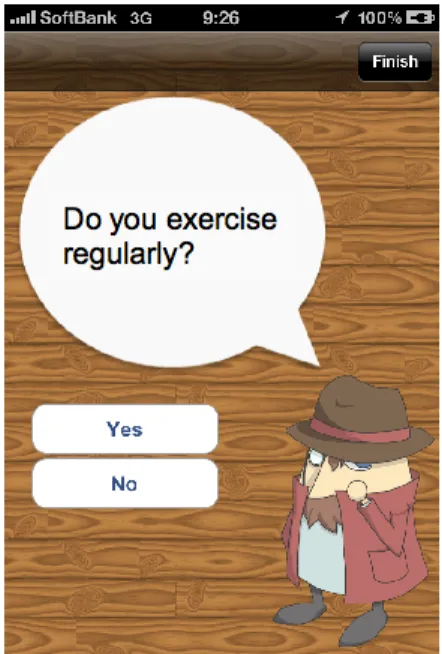
We implemented the unconscious persuasion adopting a conversation with a conversational agent and weaving a persuasive and sensing features into the casual conversation. Figure 2.2 shows a screenshot of a conversation with the agent.
Figure 2.2: A screenshot of the conversation with the agent
2.4.1 Design of conversations
In the iDetective, conversation can be divided into three types, sensing conversations, feedback conversationsand chats. The iDetective obtains a user’s current behavior stage based on the transtheoretical model by presenting the sensing conversation and this stage will be used for determining a type of feedback conversations.
A session of a conversation consists of multiple steps including sets of a speech text and options; and the user can choose and proceed to another step. In addition, a shape of the balloon and emotion of the agent can change among the steps.
Sensing conversations
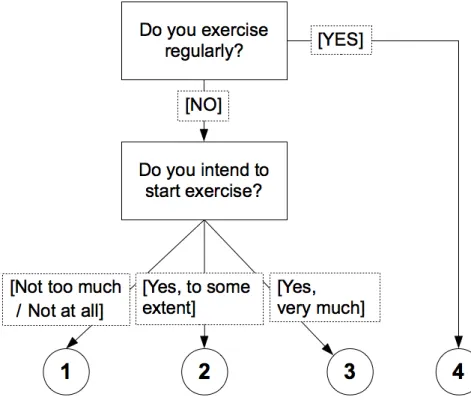
A sensing conversation has a single form and is based on the flow (Figure 2.3) used for determining an individual’s behavior stage [13]. This conversation is presented to the user with certain period intervals. This conversation is designed to be natural in the context of walking in order not to inform the fact of persuasion to the user.
Feedback conversations
The feedback conversations are designed according to theprocesses of a changecorrespond to each behavior stage.
The number of behavior stages was reduced into four stages because we excluded themaintenancestage which needs six months to be determined (Table 2.3). For example, the iDetective can present a conversation which states walking can prevent people from getting cancer to thecontemplationuser. This conversation corresponds to oneshowing a concrete benefit of taking an actionin the Table 2.3.
Table 2.3: The relationship among the iDetective’s consciousness levels, the theme of conversation based on [13] and corresponding processes[12]
Levels Feedback Corresponding processes
4 Giving a positive feedback when a user do the behavior Reinforcement management, Helping relationships 3 Helping a user on having motivation for the behavior Self-liberation
2 Showing a concrete benefit of taking an action Self-reevaluation 1 Making the users be conscious about their current status Consciousness-raising
Chats
Chats have been prepared for making the dialogue less “persuasive-like” and the iDetective more fun by burying the persuasive conversations into the chats. These have been constructed based on trivia and issues of the moment that have not been confined in a specific field.
2.5 Problems on which we focused in this research
We conducted a user study in order to evaluate the effectiveness of theunconscious persuasion. We recruited five participants (originally, the number of them was six; however, we could not obtain actual results from one participant) asking them to play the iDetective for 32 days and fill a questionnaire which was sent to them at the end of the study. From the results of the questionnaire, three participants said that they have chosen an option which does not correspond to their actual mind. The iDetective needs the users’ responses to the conversations in order to persuade them and sense the current behavior stage precisely. However, choosing options by their curiosity in the context of persuasion and sensing, this decreases the precision ofunconscious persuasion.
Figure 2.3: A flowchart of sensing
Chapter 3
System Design
We developed a web-based application where users can talk with the virtual agent. We will explain the purpose of this application first, and describe details of it.
3.1 Purpose
This application is named Agent Systemand this system functions like the conversation feature in the iDetective.
Unlike the iDetective, the device on which the Agent System runs do not have to be mobile device because we intend to discuss the effect of more general conversations under existence of other individuals. In addition, we can recruit more participants than the iOS application’s case because the Internet and web browser is common and the system requirements are lower.
This application simulates a persuasive application and persuasive features partially based on thetranstheoretical model. The main difference of the conversation feature compared to the iDetective is that a part of choices which a user makes is disclosed to other users. Thus the effect of observation by other individuals can be examined using this system.
3.2 System details
3.2.1 Overview and development process
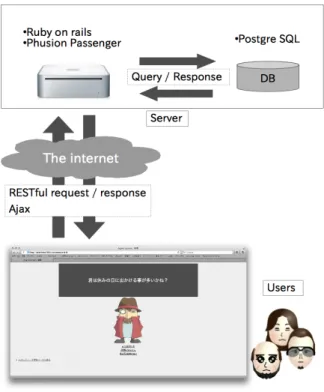
Figure 3.1 shows the entire structure of the system and the Table3.1 shows software components we used for develop- ing the web application. The Agent System was developed using Ruby on Rails1and deployed on a Mac mini server placed at our laboratory with being installed Phusion Passenger2as a module of Apache.
At the early process of the development, we adopted test driven development (TDD) using rspec3package. This package enables to use a domain-specific language (DSL) for testing and we developed a fundamental part of the system writing test cases calledexamples. This process are known as “Red, Green, Refactor” represents the sequence of writing a failing test, passing the test and refactoring; thus, we can be more confident the test is working through passing a test which has failed [9] and reduce bugs.
3.2.2 Database
Figure 3.2 shows an ER-diagram of the database. As the diagram shows, one-many relationships exist between a user and behaviors; and between a user and logs. These relationships are also specified in source codes of ActiveRecord objects. We implemented a user interface capable of manipulating tables and we stored data needed by functions of
1http://rubyonrails.org/
Figure 3.1: The entire structure of the system
Table 3.1: Software components
Functions Components Version
OS Mac OS X Server 10.6.8
Application framework Ruby on Rails 3.1.1
Database PostgreSQL 9.1
Deployment Phusion Passenger 3.0.11
Web server Apache 2.2.20
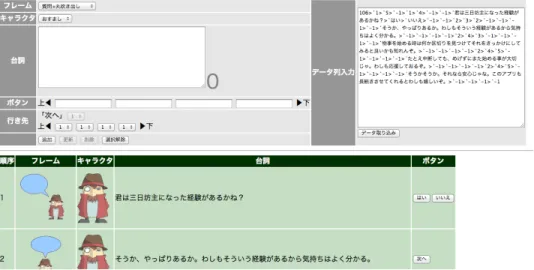
the system to a database in advance. As for the conversation, we reused the web based data insertion user interface with modifications and transfer conversation efficiently. The interface is shown in the Figure. 3.3 for reference.
Figure 3.2: ER-diagram of the database
Figure 3.3: Conversation insertion UI for the iDetective
Conversations
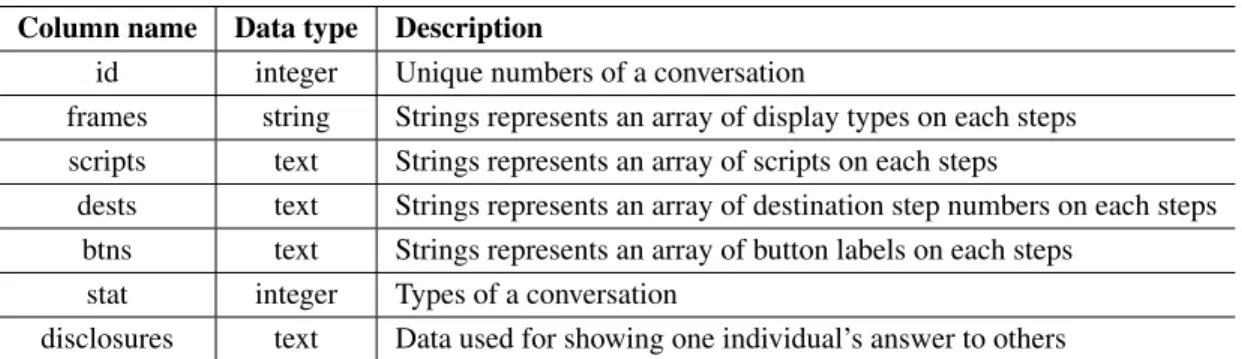
Table 3.2 shows data constructing each conversation.
The format of conversations is similar to the one in [17] except for the “disclosure” column to generatedisclosable conversationand subtle representations of “dests” and “btns”. One conversation consists of steps which represents a frame with a piece of scripts and associated options.
Thedisclosable conversationinforms other members of the one individual’s selection out of options in the conver- sation and such type of conversation has “disclosure” data which will be used for composing disclosure conversation.
The difference betweendisclosure conversationanddisclosable conversationis important. The former is the special type of conversation which becomes a template of texts and shown to individuals with strings from the “disclosure”
are embedded. On the other hand, the latter is a conversation which has “disclosure” column data regardless of con-
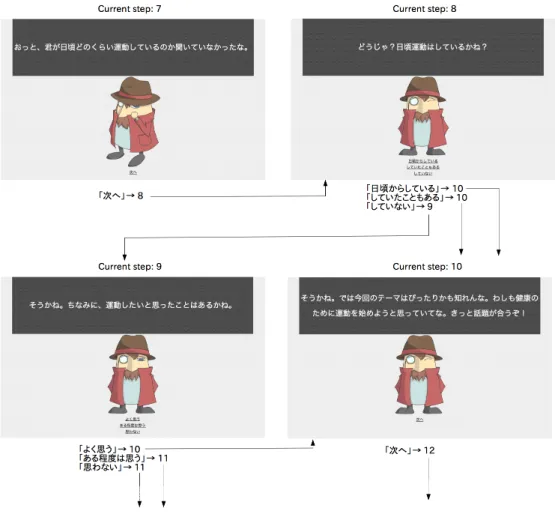
The “dests” data constructs a flow of a conversation; an example is shown in the Figure 3.4. Four steps are shown in this figure and each option(s) listed below the agent has a destination represents the next number of step. When a user clicks a link, the content of the conversation is transitioned to another one corresponding to the step.
Figure 3.4: Steps in a conversation
Users
The “users” table represents an each user and they are authenticated using identity information stored this table. Two flags determine states of a user. If the “admin” flag of a record is true, the user is an administrative user who can view and configure the details of the Agent System. For example, checking log data and registering a new user are permitted only for the administrator. If the “first” flag is true, the Agent System shows an “read me” text after the login and when the user finished the initial conversation with the agent, the flag turned off.
A user belongs to one of groups determined by two conditions. One is determined by whether one user’s answer is disclosed to the other members in the group and under this condition, anunknowngroup where a user’s choice would not be disclosed to others and vice versa as aknowngroup. The other is relationship with each of the members described in Table 3.3.
Behaviors
This table represents a behavior which user will target and consists of a brief description and a sentence represents a state which is considered to achieve the behavior. The latter part is determined based on [13] as an action criterion toward improving the target behavior.
Logs
A main part of a log data consists of a number represents a kind of event and data associated with specific event, which is constructed in a JSON4format. A kind of event is listed in Table 3.4. A log data was recorded along with the user id who has taken the action and this log data can be viewed by an administrator on the Agent System.
3.2.3 Conversations
Conversations are divided into seven categories (Table 3.5) and each conversation has a special type number. This type number is used as a filter when a user starts a conversation and the system chooses a conversation to show. For example, a conversation which has typed as 1 will not be presented to a user belongs to theunknown group.
Initial conversation
This conversation is presented to users who have logged in to the system for the first time. On this conversation, the agent not only introduces himself and explain an overview of the Agent System but also intends to obtain the user’s current behavior using a conversation same as the form of the sensing conversation.
Disclosure conversation
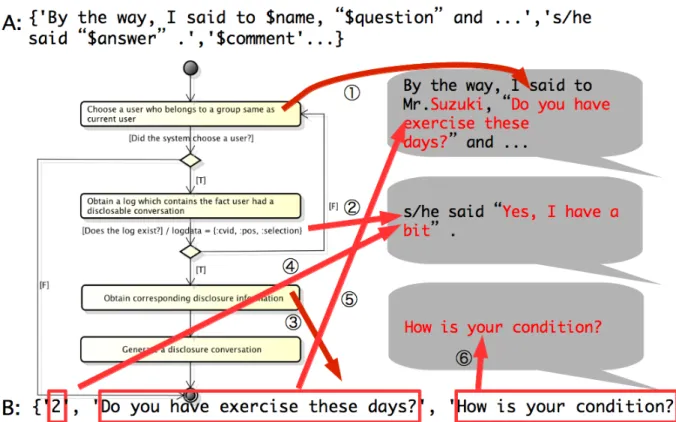
Thedisclosure conversationwhich reveals a user’s answer to others is composed by a process shown in Figure 3.5 and this type of conversation itself is a template whose parts prefixed with ‘$’ are replaced with proper data (A). First, the system attempts to select randomly (path 1⃝) another user whose group is same as the current user; who is about to be presented the disclosure conversation. If another user was found, the system inspects into log data generated by that user which represents that the user has had adisclosable conversationbefore. Next, if such log was found, the system extracts the number of option which was chosen by the user and this will be used for determining a label text corresponding to the option. At this point, the data in thedisclosurecolumn can be obtained (path 3⃝and B) and this data consists of three parts; the number of step which has the option in the data obtained in the former step, a text label of conversation which represents a question and an additional comment sentence. The reason for the existence of the second item is that the form of sentences in the conversation does not always fit into the template therefore, we need to prepare optimized version of the sentence embedded naturally. Using thedisclosuredata, all of variable parts of the template are replaced and the disclosure conversation is completed (path 2⃝, 4⃝, 5⃝and 6⃝).
Sensing conversation
A conversation which asks a user whether s/he is engaged in the behavior regularly has a type 2 and a form of this type of conversation has succeeded to the one of the iDetective; that is this conversation is composed based on the Figure 2.3.
Level conversation
The target behavior-related conversations are typed according to a part of stages of the transtheoretical model shown in the Table 2.3. We reduced them to four stages excluding theMaintenancestage and mapped to the response of the type 2 conversation. We prepared this conversation for future use and we did not implement the persuasive feature based on thetranstheoretical model.
A part of these conversations was succeeded from the feedback conversations in the iDetective or offered by Y.
Funabashi. Sources of the conversation were web sites such as All about5, and many other literatures.
Chatting
The function of this type of conversations is same as that of the iDetective.
Table 3.2: Data constructs each conversation Column name Data type Description
id integer Unique numbers of a conversation
frames string Strings represents an array of display types on each steps scripts text Strings represents an array of scripts on each steps
dests text Strings represents an array of destination step numbers on each steps btns text Strings represents an array of button labels on each steps
stat integer Types of a conversation
disclosures text Data used for showing one individual’s answer to others
Table 3.3: Criteria of determining relationship with the other members (“I” represents one member and “he” or “she”
represents one of the others)
Acquaintances Strangers
S/he is so intimate that I communicate I do not know him/her at all with each other frequently
I meet him/her at your workspace or I have only heard about laboratory or house him/her not knowing each other directly
I used to communicate with each other long ago but not now
Table 3.4: Kinds of events
ID Event Associated data
0 A user has logged in N/A
1 A user has logged out N/A
2 A user has selected an option on a conversation Conversation ID, Step of a conversation, Selected option’s number 3 A user has selected an option on a disclosure conversation Conversation ID,
Step of a conversation, Selected option’s number
4 A user started a conversation Conversation ID
5 A user has finished a conversation Conversation ID
6 A user has finished an initial conversation N/A
7 A user has completed a questionnaire N/A
Figure 3.5: The generation of disclosure conversations (the texts are originally written in Japanese)
Table 3.5: Conversation types Types Names Descriptions
0 Initial Presented just after the first login
1 Disclosure Informs other users of one individual’s answer 2 Sensing Obtains a user’s current behavior
3 Level1 Given toprecontemplationuser 4 Level2 Given tocontemplationuser 5 Level3 Given topreparationuser 6 Level4 Given tomaintenanceuser
7 Chatting Shows topics not related to the target behavior
3.2.4 Agent
An appearance of the agent and a form of a conversation are almost same as the one in the iDetective. However, we did not show a name of the agent whereas the name of the agent was “Zank” in the iDetective. The agent has originally been designed by Y. Haga with five types; besides we made new face types by modifying the original one. Thus the agent can present 8 kinds of expressions (Figure 3.6) and the behavior of the agent consists of a sequence of these still images. In addition, all interactions with a user are text-based; outputs are shown at a frame above the agent and inputs from a user are a multiple-choice form.
Figure 3.6: Expressions of the agent (the upper parts)
3.2.5 User interface
Each user has their own user page when they login to the Agent System. This page has a main menu and a user can choose an action available to him/her from the menu. Available actions change according to whether a user is an administrator. In the administrator case, a user can edit users and behaviors, register new conversations and view log data, on the other hand, in a normal user case, a user can only start conversation (Figure. 3.7). The target behavior is also shown at the top part of the user page (the upper part in the Figure 3.7a or Figure 3.7b). According to J. O.
Prochaska et al., understanding what an individual can do when s/he improve a problematic behavior is important and behavioral criteria of fifteen behaviors are specified [13]. In this research, persuasion based on the transtheoretical model is not a main issue; however, we adopted this feature as a pre-study of transtheoretical model based persuasive application.
When a user chooses “会話を始める”, a conversation page is shown and a user can start a conversation by clicking
“会話開始” link. On a conversation, two types of display are used. One is Q&A-type display (Figure 3.8a) where a user can select one of four options and the other is one without options (Figure 3.8b).
(a) A top page for a normal user (b) A top page for an administrative user
Figure 3.7: The difference of top page according to roles of a user
(a) Q&A-style display (b) Normal style display
Figure 3.8: Displays in the Agent System
Chapter 4
Evaluations
We conducted a user study in order to examine the effect of existence of another individual when a user interacts with a virtual agent. We recruited people and 21 individuals participated; however, 1 participant had retired from the study and the total number of participants was 20 at the end of the user study. The Table 4.1 shows the composition of the participants. They are asked to agree with personal information policy and condition of the user study in advance and a more detailed agreement page (Figure 4.1) was shown after the first login.
They are divided into four triad-groups described in the section 3.2.2 randomly (Table 4.2). The participants are confirmed the relationship according to their group in advance. Each groups have one common target behavior and in this research, we have only one behavior named “運動” (exercise) and all of participants have the same goal. The participants are asked to converse with the agent freely for about ten days and fill up a questionnaire at the last day. As described the previous section, main activities such as logging in and starting a conversation are recorded to thelogs table.
Figure 4.1: The agreement page
Table 4.1: Details of participants Gender 18 males and 3 females Nationality 18 Japanese, 2 Chinese and 1 Thai
Table 4.2: The actual groups of participants Acquaintances Strangers Known 1-1 1, 1-1 2 2-1 1, 2-1 2 Unknown 1-2 1, 1-2 2 2-2
Chapter 5
Results and Discussion
First of all, we will show the numbers of conversations of the participants and describe a tendency. Next, we will show the results of the questionnaire which we conducted at the end of the user study.
5.1 The number of conversations
Figure 5.1 shows how many times a user has started and finished a conversation. If a user escape from the conversation page after the user has started a conversation, the number of starts become more than ends. From this figure, 10 participants had escaped in the way of conversations; however, we cannot find the relationship between the total numbers of conversation and the numbers of escapes.
5.2 Results of the questionnaire
In this section, we will show the results of each questions of the questionnaire. Although the entire questionnaire was conducted in Japanese, we translate the text to English and simplify in this paper.
5.2.1 Q1. About the agent
a. How was an impression of the agent?
In the aspect of an impression of the agent, the agent was accepted by the participants except for one participant (Table 5.1).
Table 5.1: The result of Q1 Items Selections [person(s)]
Good 12
No opinion 7
Bad 1
b. If you did not choose the “Good” in the previous question, please describe, if any, the reason for your selection or the condition where you can have preferable impression of the agent
As we foresaw, those who told about the scarcity of the number of the conversations was the most frequent reason among the replies. Another opinion was related to the representation of the agent such as the use of animation or audio.
Participant number
Conversatins [times]
1 2 3 4 5 6 7 8 9 10 11 12 13 14 15 16 17 18 19 20
050100150200250
Start Finish
Figure 5.1: The number of conversations
A participant who has chosen the “Bad” said that what the agent speaks was selfish and he seemed not to establish trust with the agent.
5.2.2 Q2. Did you find that another member’s answer is disclosed to you when you have a conversation which starts with “By the way, I said to ***, *** and ...” ?
Those who can encounter the disclosure conversations are belong to theknowngroups and we prepared four groups of the type (Table 5.2). Among them, although four participants excluding those who has retired cannot have the disclosure conversation, a group whose all members did not experience the disclosure did not exist.
Table 5.2: The result of Q2 Items Selections [person(s)]
Yes 7
No 13
5.2.3 Q3. How did you feel about that your answer is disclosed to others?
18 participants did not reject all kinds of disclosure of their answer to others. From this result, the system can disclose an individual’s answer to other individuals considering a kind of a question.
5.2.4 Q4. About the conversations related to exercise
We presented conversations related to walking providing information useful when people walk as an exercise. The question Q4 queries an attitude of participants toward such conversations.
a. How did you think when you answered the question from the agent? Please choose from the list below.
15 participants answered according to their actual opinion or state and this result implies the disclosure to other members did not affect their answer.
b. The number of the conversations was limited. Did you change your attitude toward answering the questions if you are bored?
In contrast of the result of Q4.a, 11 participants answered just by their curiosity when they get to be bored.
c. Other members in your group are those who are your acquaintances (strangers to you). If all of them were strangers to you (your acquaintances), do you think that you change your attitude toward choosing the options?
5.2.5 Q5. About the conversations not related to exercise
In addition to conversations related exercise, we presented ones about topics from various fields rested to, for example, words, animals and history. In the Q5, we intended to inspect the attitude of the participants toward such conversations.
As a result, the number of participants who have chosen each of options was almost same.
a. How did you think when you answered the question from the agent? Please choose from the list below. (Table 5.7)
b. The number of the conversations was limited. Did you change your attitude toward answering the questions if you are bored? (Table 5.8)
c. Other members in your group are those who are your acquaintances (strangers to you). If all of them were strangers to you (your acquaintances), do you think that you change your attitude toward choosing the options?
(Table 5.9)
5.2.6 Q6. Did you intend to change your behavior through the conversation?
Four participants have chosen “Yes, I did”. Although persuasive features were not main issue in this application, we have to improve the effectiveness of the persuasion along with the disclosure method.
5.2.7 Q7. Did you use a mobile device such as a smartphone or a tablet PC to access the application?
Two participants have used a mobile device to access the Agent System.
5.3 Discussion
5.3.1 The e ff ectiveness of our hypothesis
From the results, although 17 participants out of 20 have chosen an option according to their real opinion or status, boredom in the conversations has more affected on the individuals’ behavior than the existence of other members.
One of the problems common to the iDetective was that the number of conversation was limited and run out earlier.
Therefore, a more precise evaluation under the condition where the boredom is decreased is needed.
However, the form of conversation can be limited like the sensing conversation and such conversation can be presented to the users multiple times. Instead of frequently use of sensing conversation, the system can combine with the sensing conversation and data obtained from sensors such as an accelerometer. If a user actually starts a target behavior, the stages can be evaluated using such sensors without asking the user directly.
Table 5.3: The result of Q3
Items Selections [person(s)]
I cannot accept the disclosure no matter kinds of questions 1
I cannot accept the disclosure as for the questions querying my knowledge 3 I cannot accept the disclosure as for the questions querying my opinion or situation 3 I do not mind the disclosure as for the questions described above 13
Table 5.4: The result of Q4.a
Items Selections [person(s)]
I did not get any question 1
I answered according to my actual opinion 17
or situation no matter whether my answer will be disclosed to others
I answered according to my actual opinion 1
or situation because my answer will be disclosed to others
I answered according to my actual opinion 0
or situation only to a question where my answer will be disclosed to others but as for the other ones, I answered just by my curiosity
I answered just by my curiosity only to a question where my 0
answer will be disclosed to others but as for the other ones, I answered according to my actual opinion or situation
I answered just by my curiosity because my answer will be disclosed to others 0 I answered just by my curiosity no matter whether my answer will be disclosed to others 1
Table 5.5: The result of Q4.b
Items Selections [person(s)]
I answered according to my actual opinion or situation until I get bored 11 but after that I get to answer just by curiosity
I answered just by my curiosity until I get bored but after that I get to answer 0 according to my actual opinion or situation
Whether I get bored did indeed or almost not affect my answer 7
I did not get bored 2
Table 5.6: The result of Q4.c Items Selections [person(s)]
Yes, I do 4
I cannot guess 5
No, I do not 11
Table 5.7: The result of Q5.a
Items Selections [person(s)]
I did not get any question 2
I answered according to my actual opinion 16
or situation no matter whether my answer will be disclosed to others
I answered according to my actual opinion 1
or situation because my answer will be disclosed to others
I answered according to my actual opinion 0
or situation only to a question where my answer will be disclosed to others but as for the other ones, I answered just by my curiosity
I answered just by my curiosity only to a question where my 0
answer will be disclosed to others but as for the other ones, I answered according to my actual opinion or situation
I answered just by my curiosity because my answer will be disclosed to others 0 I answered just by my curiosity no matter whether my answer will be disclosed to others 1
Table 5.8: The result of Q5.b
Items Selections [person(s)]
I answered according to my actual opinion or situation until I get bored 11 but after that I get to answer just by curiosity
I answered just by my curiosity until I get bored but after that I get to answer 0 according to my actual opinion or situation
Whether I get bored did indeed or almost not affect my answer 7
I did not get bored 2
Table 5.9: The result of Q5.c Items Selections [person(s)]
Yes, I do 4
I cannot guess 5
No, I do not 11
Table 5.10: The result of Q6 Items Selections [person(s)]
Yes, I did 4
No opinion 7
No, I did not 9
Table 5.11: The result of Q7 Items Selections [person(s)]
Yes, I did 2
No, I did not 18
5.3.2 Ethical issues
We asked the participants how they feel about the fact of disclosure of an individual’s answer to others (Q3). One participant has chosen the I cannot accept the disclosure no matter kinds of questions and 6 participants said that they cannot accept the disclosure as for either querying their knowledge or their opinion or situation. 13 participants do not mind the disclosure and if our method works more effectively by adjusting the condition, the system can encourage the users to answer according to their real situation or opinion. However, according to Berdichevsky et al., a golden principle has been proposed and taking this principle into consideration, the creators of a persuasive technology should not choose a target behavior which is not acceptable for they themselves [1]. That is, a designer of the system still has to choose target behavior or contents of disclosure carefully. For example, our method cannot be used with conversations which extract personal data.
5.3.3 Anonymity of the captology
According to [8], computers allow anonymity where they can obtain sensitive information from individuals or help individuals to experiment new attitudes and behaviors. Thus, an individual can act as a different kind of person in the computing environment.
From the results of Q4.a, Q4.c, Q5.a and Q5.c, 1 participant answered under the effect of the observation by others and a significant difference between the acquaintances-setting and the strangers-setting was not found. In our research, the main topic was exercise and we did not intend to ask sensitive question for an ethical reason. With the ethical consideration, we have to examine the effect of anonymity with conditions other than the sensitiveness of a conversation; for example, we can focus on existence of boredom or a kind of an application.
5.3.4 Di ff erence between kinds of an application
In this research, because the Agent System was designed as a persuasive application, the user can only have a con- versation with the agent. In the aspect of practicality, a kind of an application can be, for example, utility software such as anti-virus, web browsers or a game. If a function of an application varies, attitude of a user can also change according to such diversity of applications. That is, a choice of the user can lead to significant effect on him/her or others in some kinds of applications such as security related software. On the other hand, in the case of applications which are developed for an entertainment such as games, a user can easily choose an option as s/he likes.
5.3.5 The e ff ectiveness of the agent
Considering the result of the Q1, the impression of the agent was almost favorable. However, preferences of an appearance or a character of an agent can depends on cultures [5] or individuals. One of the participants said that the age of the agent was too old to talk about daily topics such as exercise. In addition, related work discusses the design of an agent including appearances. For example, the reality of the agent does not affect the persuasion however an individual can be more persuaded by different gender of an agent [18].
In the realm of robotics, according to M. Mori, an individual’s familiarity increases as human likeness increases until the likeness reaches to the minimal point calleduncanny valley[10].
Considering these theories, when we design an agent, the appearance of the agent can be important matter. How- ever, the design accepted all of cultures and individuals is difficult and we have to examine effectiveness of the agent in terms of reality, genders, characters and many other criteria.
The agent which was used in the Agent System was based on sequences of still images and it was not animated.
According to D. M. Dehn and S. V. Mulkin, depending on situations, an animated agent has possibility of giving positive impression to a user [6]. Therefore, we can consider animating the agent including nonverbal behaviors such as gestures or eye contacts. Especially in a web-based application, we can realize such animation by not only implementing programmatically but also using certain image format such as GIF animation.
5.3.6 Application to implicit persuasion and explicit persuasion
In the iDetective case, we adopted the conversation features for the unconscious persuasion. However, this method can be applied to more general case where the fact of the persuasion is more explicit to users. However, although we cannot obtain preferable result from the user study, we have to improve the conditions of the study.
5.3.7 Use in a mobile environment
The Agent System was designed considering only a browser on a PC and font size of links which are used for the options was small. Such design can be a trouble when it is used on mobile devices such as smart phones and tablets.
If an application is designed to persuade its users ubiquitously, the user interface has to be optimized to the mobile environment. For example, we can improve the style sheet and adopt larger buttons to clickable objects.
5.3.8 Synthesis of conversations
In our application, the method of construction of the disclosure conversation was substitution to the template conver- sation. However, an agent has to be able to present more natural conversation in order to good relationship with users.
We can use technologies of the knowledge engineering and natural language processing for composing more natural conversations.
5.3.9 Change of an attitude of an individual according to kinds of a conversation
We asked the participants their attitudes toward answering to questions in two conditions separately according to the topic of a conversation in Q4 and Q5. As a result, except for those who did not encounter the Q&A-type conversations under one of the conditions, no difference between these conditions was detected. In this case, conversations which are not related to the exercise did not include sensitive topics and materials used for the composition of the conversation were not based on interests of the participants. As future work, we can focus on a difference between topics which is based on an individual’s interest and ones which is not.
As the other type of question, we asked in Q3 in order to investigate the difference between impression of the disclosure conversations inquires knowledge of an individuals and current status or opinion. However, most of the participants do not mind the disclosure in the range of question this system presented. Therefore, we can use the disclosure conversations which are not sensitive to an individual.
Chapter 6
Related Work
In this chapter, we will introduce related work on an embodied conversational agent as a persuasive agent.
6.1 Persuasion through dialogue with a conversational agent
D. Shulman and T. Bickmore have compared an embodied conversational agent and conventional interface with menus and texts. In addition, they also have been examined an effect of social dialogue on building relationship with a user by conducting a user study [15]. The ECA (Figure 6.1) delivers output by synthesized speech and uses nonverbal behavior such as hand gestures whereas the conventional interface uses only text as an output.
The dialogue consists of two phases; one is an introductory dialogue and the other is a persuasive dialogue. The agent introduces herself in the introductory dialogue and persuades user by stating importance of regular exercise.
From the results of the study, although significant effect of agent type or the social dialogue on a persuasion, the combination of ECA and the social dialogue results in more positive perceptions of the dialogue.
An agent we used in our research is much simpler than the ECA; that is, nonverbal behavior is only facial expres- sion and output is text based without speech. Although most of participants did not have a negative perception on the agent, we have to improve the behavior of the agent.
Figure 6.1: Embodied conversational agent
Chapter 7
Conclusion
We described a persuasion using a virtual agent and the possibility of construction relationship between individuals and computers. We also introduced the iDetective as our previous work on which an agent is implemented and explained the problem we found from the result of the user study. This problem was that the existence of those who chooses an option just by their curiosity and in a situation where the option determines the persuasive performance, such curiosity can decrease the precision of the persuasion.
In order to cope with such problem, we focused an effect of other individuals because an individual has a bias calledsocial desirabilityand also can be affected by a group. In addition we developed web-based application where an individual can have conversations with the agent. This application can disclose answers to a part of conversations by one individual to others.
Using this application, we conducted a user study and ask the participants to converse with the agent freely. As a result, most of the participants have chosen an option according their real situation or opinion whereas most of them also said that they have responded to the conversation just by curiosity when they are bored with the conversation.
However, such disclosure was almost accepted by the participants and there is a possibility of further study changing the conditions.
We found that the effect of the boredom has stronger effect than the existence of other members and we have to conduct more detailed study under the condition not only reducing boredom with the conversations but also combining with quantitative sensing method. We also consider examining designs of an agent such as characteristics or modalities and more sophisticated methods of generating conversations using knowledge in other fields.
References
[1] D. Berdichevsky and E. Neuenschwander. Toward an ethics of persuasive technology.Commun. ACM, 42:51–58, May 1999.
[2] T. Bickmore and J. Cassell. Relational agents: a model and implementation of building user trust. InProceedings of the SIGCHI conference on Human factors in computing systems, CHI ’01, pages 396–403, New York, NY, USA, 2001. ACM.
[3] J. Cassell. Embodied conversational interface agents. Commun. ACM, 43:70–78, April 2000.
[4] C. Castelfranchi. Artificial liars: Why computers will (necessarily) deceive us and each other. Ethics and Information Technology, 2:113–119, 2000. 10.1023/A:1010025403776.
[5] H. Cramer, V. Evers, T. van Slooten, M. Ghijsen, and B. Wielinga. Trying too hard: effects of mobile agents’
(inappropriate) social expressiveness on trust, affect and compliance. InProceedings of the 28th international conference on Human factors in computing systems, CHI ’10, pages 1471–1474, New York, NY, USA, 2010.
ACM.
[6] D. M. Dehn and S. V. Mulkin. The impact of animated interface agents: a review of empirical research.Interna- tional Journal of Human-Computer Studies, 52(1):1 – 22, 2000.
[7] M. Deutsch and H. B. Gerard. A study of normative and informational social influences upon individual judg- ment.The Journal of Abnormal and Social Psychology, 51(3):629 – 636, 1955.
[8] B. J. Fogg.Persuasive Technology. Morgan Kaufmann Publishers, 2003.
[9] Michael Hartl.Ruby on Rails Tutorial. http://ruby.railstutorial.org/chapters/static-pages#sec:TDD.
[10] M. Mori. The uncanny valley. Energy, 7(4):33–35, 1970.
[11] T. Postmes, R. Spears, K. Sakhel, and D. de Groot. Social influence in computer-mediated communication: The effects of anonymity on group behavior.Personality and Social Psychology Bulletin, 27(10):1243–1254, 2001.
[12] J. O. Prochaska, C. C. DiClemente, and J. C. Norcross. In search of how people change: Applications to addictive behaviors.Journal of Addictions Nursing: A Journal for the Prevention and Management of Addictions, 5(1):2–
16, Spring 1993.
[13] J. O. Prochaska, J. C. Norcross, and C. C. DiClemente. Changing for Good. William Morrow, an imprint of Harper Collins Publishers, Inc., 1994.
[14] B. Reeves and C. Nass. The media equation : how people treat computers, television, and new media like real people and places. Stanford, Calif. : CSLI Publications ; New York : Cambridge University Press, 1996.
[15] D. Schulman and T. Bickmore. Persuading users through counseling dialogue with a conversational agent. In Persuasive ’09: Proceedings of the 4th International Conference on Persuasive Technology, pages 1–8, New
[16] M. T. Takeuchi, M. Edlefsen, S. M. McCurdy, and V. N. Hillers. Development and validation of stages-of-change questions to assess consumers’ readiness to use a food thermometer when cooking small cuts of meat. Journal of the American Dietetic Association, 106(2):262 – 266, 2006.
[17] A. Yoshii, Y. Funabashi, H. Kimura, and T. Nakajima. idetective: A location based game to persuade users unconsciously. InEmbedded and Real-Time Computing Systems and Applications (RTCSA), 2011 IEEE 17th International Conference on, volume 1, pages 115 –120, aug. 2011.
[18] C. Zanbaka, P. Goolkasian, and L. Hodges. Can a virtual cat persuade you?: the role of gender and realism in speaker persuasiveness. InProceedings of the SIGCHI conference on Human Factors in computing systems, CHI
’06, pages 1153–1162, New York, NY, USA, 2006. ACM.
Acknowledgment
The author would like to thank Professor NAKAJIMA, Tatsuo, Dr. KIMURA, Hiroaki, Dr. YAMABE, Tetsuo, who gave advice on this research, Mr. HAGA, Yuki, who has created images of the agents, Mr. FUNABASHI, Yoshio and Mr. EBISUI, Jun, who have composes a part of conversations and participants who have agreed to participate the user study.
![Figure 1.1: The overlap area between computer technologies and persuasion (based on [8])](https://thumb-ap.123doks.com/thumbv2/123deta/9785811.1869072/7.918.199.717.674.1003/figure-overlap-area-computer-technologies-persuasion-based.webp)
![Table 2.2: Processes in the transtheoretical model and preferable points for which the process is applied (extracted from [12] and edited partially, and a stage number is based on Table 2.1)](https://thumb-ap.123doks.com/thumbv2/123deta/9785811.1869072/12.918.105.881.815.1104/table-processes-transtheoretical-preferable-process-applied-extracted-partially.webp)
![Table 2.3: The relationship among the iDetective’s consciousness levels, the theme of conversation based on [13] and corresponding processes[12]](https://thumb-ap.123doks.com/thumbv2/123deta/9785811.1869072/14.918.105.847.312.424/table-relationship-idetective-consciousness-levels-conversation-corresponding-processes.webp)