Toshio MEGURO
Tokyo University of Foreign Studies
Abstract: Pastoralism is a mode of subsistence well-adapted to arid and semi-arid lands (ASAL). It is one of the prevailing lifestyles in East Africa, but it is also recognized that the change in land ownership is progressing and exerts great influences on pastoral societies. The main objective of this paper is to examine the conditions under which the subdivision of communal land is affirmed as development by its members. In order for it, this study examines the current practice and evaluation of major livelihood activities, with an attention to the way of livestock grazing, in a Maasai group ranch in Southern Kenya. In the studied society, cultivation had been realized and expanded through the land subdivision, and it is described as the community development. However, the result suggests that although cultivation came to attract growing interest among the Maasai people, the subdivision of communal land does not mean the abandonment of pastoralism. Also, the other result demonstrates that the customary land management system based on the section is still in effect and important to enable Maasai people to get through a crisis, pointing out that the antecedent discussion did not well distinguish a politically-formed group ranch from a traditional and cultural autonomous unit of section.
Keywords: Pastoralism, Maasai, Land privatization, Group ranch, Livelihood
1. Background
Pastoralism and Land Privatization
Pastoralism is a mode of subsistence well-adapted to arid and semi-arid lands (ASAL). It is one of the prevailing lifestyles in East Africa as most parts of it are covered by ASAL, where rainfall is unpredictable and unstable both in terms of time, place and intensity. Different from sedentary ranching which involves enclosing a certain space and containing livestock inside it, pastoralism together with nomadism centres on dividing livestock into groups according to species, sex and age, and grazing them differently around rangelands following rainfall
and grasses. In pastoralism, open access to natural resources among specific groups and communal management of vast areas without private ownership is considered an essential condition of the preservation of livestock and the nomadic lifestyle, as well as communal labour arrangements based on age-grade systems.
To one degree or another, land privatization is progressing in many pastoral societies in East Africa today. It is difficult to make a simple judgment on whether land privatization is based on extrinsic decision or intrinsic movement, but it is generally recognized that the change in land ownership is progressing and exerts great influences on pastoral societies (Homewood et al. 2009, Woodhouse 2003). As a preceding example of such a change, the outcomes of the subdivision of group ranches into individual parcels in Kenya s Maasai societies has been studied by several scholars so far (Campbell et al. 2005; Galaty 1992; Homewood et al. 2009; Lesorogol 2008; Meguro & Inoue 2011; Mwangi 2007; Rutten 1992; Thompson & Homewood 2002; Western et al. 2009).
Group Ranch Subdivision in Kenya s Maasai Societies
Maasailand comprises some 150,000 km2 straddling the Kenya/ Tanzania border, most parts of which are categorized into ASAL. Group ranches were introduced into Kenya s Maasai society through the Land (Group Representatives) Act of 1968. Prior to the introduction of the group ranch system, Maasai people communally managed and used their grazing land and other natural resources without private ownership. Maasai society has no single centralized political structure. Instead, it is consisted of around twenty local sections called il-oshon (singular: ol-osho), each of which has its own territory. The division of territorial land into grazing land for rain and dry seasons, as well as its utilization, have been arranged and supervised by local councils of elders.
Group ranches were designed to be smaller than these communally managed customary territories of sections, following specific government actions as discussed below. Maasai legal rights to their grazing lands were acknowledged for the first time upon forming group ranches. The Kenyan government and international donors assumed that by providing tenure security in the form of group ranches and enabling Maasai people to take out loans connected to development projects, they would settle down in a specific group ranch and convert their way of livestock keeping from a nomadic one to sedentary ranching (cf. Galaty 1992; Rutten 1992). Group ranch land was owned as a single entity by the group of people who were registered with the government as members of the same group ranch. At the outset, there was neither private ownership nor
individual share. However, since the 1980 s, Kenya s then President repeated encouragement to Maasai to subdivide their group ranches and modernise both their livelihood and societies, most of the Maasai group ranches have however been partitioned into individual plots (Mwangi 2007).
Discussion on Group Ranch Subdivision So Far
Existing literature on group ranch subdivision focus on two general points of argument, although most studies address both of them in different degrees. One is to examine the outcome of the introduction of the group ranch system. It is done by a comparison of the situation before and after the change in terms of economy, society or ecology, based on quantitative data on monetary income, livestock number, social capital, livestock/ wildlife production etc. (BurnSilver 2009; Homewood et al. 2009; Lesorogol 2008; Rutten 1992; Sundstrom et al.
2012; Thompson & Homewood 2002; Western et al. 2009). The general consensus among them is to be that the mere introduction of the group ranch system did not result in the perceptible modernization or development which the government and the donors had expected. The other point concerns the process that led to the deviation from government and donor expectation or theoretical models developed in academia. This discussion addresses questions such as what reasons or motives exist for pastoralists to make the decision to abolish the communal resource management system even if it could harm nomadic pastoral lifestyle and society? Who is assuming a central role as promoter, mediator, or persuader? How are interactions and negotiations among stakeholders developing? (Campbell et al. 2005; Galaty 1992; Mwangi 2007;
Thompson & Homewood 2002).
While the change in land management and livelihood of Maasai societies subsequent to the introduction and subdivision of group ranches has been studied, there appears to be at least two un-examined issues. First, while a widening of the gap between rich and poor members has been discussed in detail (Homewood et al. 2009), the evaluation of group ranch subdivision by usual members as distinct from entrepreneurs and elites (Thompson &
Homewood 2002) is lacking. The importance of objective and scientific evaluation by academic researchers and policy makers is not deniable. However, there exists a case in which group ranch land subdivision is being considered as development and approved by most of the group s members (Meguro &
Inoue 2011) against its negative evaluation by some scholars (BurnSilver 2009;
Western et al. 2009). In order to fill such a perception gap, it is necessary to investigate people s way of thinking.
Second, under an increasing awareness of the diversification of livelihood throughout Maasailand, recent studies are trying to ascertain the contribution to household livelihood of other economic options than pastoralism (e.g.
cultivation, tourism, other businesses and salary or wage labour, cf. Homewood et al. 2009). Then, the particulars of livestock grazing after group ranch subdivision are omitted from the main discussion (Lesorogol 2008; Mwangi 2007; Sundstrom 2012). There seems to be an assumption that group ranch subdivision means complete privatization/ individualisation, and once land subdivision is completed, there being no communal land left, group ranches lose the communal roles. Yet considering the fact that even after the formation of group ranches, Maasai people continued the customary livestock keeping inside sectional territories, there remain possibilities for them to move and graze their livestock in the same way even after the subdivision. Without knowing their current way of livestock grazing today, it is difficult to understand the aforementioned local assessment of group ranch subdivision.
Objectives of This Article
The main objective of this paper is to examine the conditions under which group ranch subdivision is affirmed as development by its members. In order for it, this study examines their current practice and evaluation of major livelihood activities with an attention to the way of livestock grazing. This study centres on Kimana Group Ranch (KGR) in Southern Kenya, where according to the preceding study, the majority of members consider the subdivision a development because it enabled them to own private land and practice cultivation, a subsistence activity more stable than pastoralism (Meguro & Inoue 2011). This study investigates the current situation and people s attitudes toward plural livelihood activities in KGR, examine the local opinion on group ranch subdivision, and clarify the current way of livestock grazing. Afterwards, the reason for locally positive evaluation of group ranch subdivision is reconsidered.
Concerning the practice of livestock keeping today, its movements during the historical drought of 2009/ 2010 are examined. Drought is a fact of life in ASAL, and how to dealt with it is of vital importance in the discussion of pastoralism. Then this study takes up the livestock movement during the drought as well as the change in their number before and after the disaster so as to consider the possibilities and effectiveness of a customary coping method.
2. Study Site and Method
KGR is situated in South Kajiado Constituency (6356.3 km2) in Kajiado County
(21292.7 km2, Figure 1). The constituency is sometimes called Loitokitok Constituency because it is a customary territory of Maasai of Loitokitok section and had been a Loitokitok Division/ District before the present constitution came into force in 2010. Amboseli National Park (390.2 km2) is located at the centre of the constituency. The park was formed in 1974 and is internationally famous for its abundant wildlife, especially a herd of African elephants, and scenic views of Mt. Kilimanjaro (in Tanzania). Now, the park is one of the most popular tourist destinations for non-consumptive safari in Kenya, but many local Maasai feel that tourism income is almost monopolized by the government of Kenya (Meguro & Inoue 2011). In order to reverse the situation, several community-based projects have been implemented. Due to the fame of Amboseli National Park, in the context of wildlife conservation and tourism, the constituency is called by the name of Amboseli (e.g. Amboseli area and Amboseli ecosystem so on).
Figure 1. Map of research site
The study site has two rain seasons: one between March and May, the other between October and December. Annual average rainfall inside the park is 346.5 mm (132.0 553.4 mm, SD = 120.0; Altmann et al. 2002). Toward the Kenya/ Tanzania border at the base of Mt. Kilimanjaro, increased altitude results in more rainfall, which together with groundwater aquifers from Mt. Kilimanjaro
welling up in the constituency creates permanent rivers, swamps and springs. As it is rich in water, cultivation has expanded in the constituency, first, mostly on individual ranches on the foothills subdivided after the 1960 s and later, among group ranches on the savannah plain (BurnSilver 2009; Campbell et al. 2005;
Meguro & Inoue 2011).
KGR has an area of 251.2 km2 and 843 registered members. In 1999 it was the first group ranch in the constituency to agree to subdivide the entirety of its land, allocating a 2-acre farmland plot with irrigation and a 60-acre rangeland plot to each of its 843 members. The major reason for subdivision is to secure land for cultivation and for development, and the mixture of cultivation and pastoralism became the mainstream of local livelihood (BurnSilver 2009; Meguro
& Inoue 2011). Kimana Town is not included in KGR, but it is situated at its geographical centre and affected the life of KGR member households. Having market places, many schools and the offices of local government, the town is in the process of development based on a growing business and commercial irrigation farming based on increasing immigrants (non-Maasai peoples) together with the coming of a paved road and electricity. Then, after its subdivision and the popularization of cultivation, KGR is considered to be different from or the most developed among the other six group ranches.
The main fieldwork for this study was carried out between July and August 2010, and between August and September 2012. Most quantitative data was collected through surveys with questionnaires in each period, carried out with local assistance in translating or using English, Swahili and Maa depending on informants. Basic livelihood information like acreage owned and cultivated (both in rainy seasons and dry seasons) by households, number of livestock, and the evaluation of different livelihood activities was recorded during both 2010 and 2012. Questions on livestock movement during the 2009/ 2010 drought and on changes in number of livestock during drought were additionally asked in the 2010 survey. In the 2012 survey, evaluations of group ranch subdivision and information on movement of livestock in each season was requested. Qualitative data was acquired through semi-structured interviews and participatory observation.
3. Results and Discussion
Current Livelihood Activities and Local Attitudes toward Them
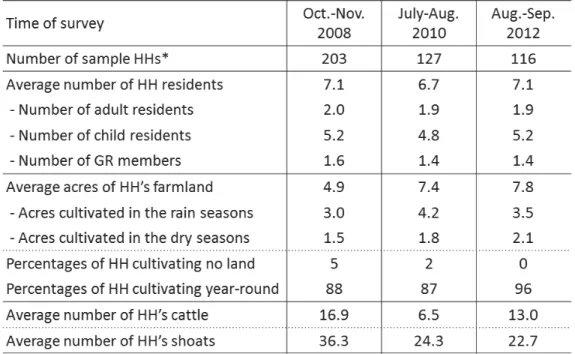
Meguro & Inoue (2011) conducted a questionnaire survey with 203 household in KGR between October and November in 2008. Table 1 summarizes the result of the questionnaire surveys of 2010 (July to August) and 2012 (August to
September), covering 127 and 116 households in each, together with that of Meguro & Inoue (2011) so as to clarify the general situation of household and the major livelihood, namely cultivation and livestock keeping, in KGR.
According to the results of these surveys, a typical household in KGR has an average of around seven residents with two adults and five children. Among them, there are usually less than two KGR members. When all of these member households had their own farms, the percentages of households which cultivate no land throughout the year had decrease, and all households performed cultivation in 2012. In the meantime, the acres cultivated increased markedly between 2008 and 2010. It is explained by local people that after the long drought in 2009/ 2010, local Maasai became more eager about cultivation (irrigation farming) because
Table 1. Result of three surveys about households and livelihood
Source: 2008; Meguro & Inoue (2011), 2012; Author
they learnt that it could provide food even during the period of such a drought.
Though less than the whole area was generally cultivated in the rainy seasons, the results suggested the possibility that during/ after the drought local people tried to expand their farmland. In 2012, the most recent time, the average percentages of cultivated acreages in the rain seasons is a little less than 50% and even less in
the dry seasons. Nevertheless, the fact remains that the percentage of those who cultivated the soil in both the rainy and dry seasons increased recently, meaning that cultivation is a year-round livelihood for the most of households.
On the side of livestock, the major subsistence for the majority of Maasai people, in July/ August 2010, local people were still struggling to survive the severe drought, but their herds recovered later. Four households (3.1%) without any livestock were found in 2010, while 21 (16.5%) had only shoats. In 2012, eight (6.9%) were without livestock and eleven (9.5%) had only small number.
Farmland acreage and livestock numbers varied in KGR, but most of them practiced cultivation and livestock keeping.
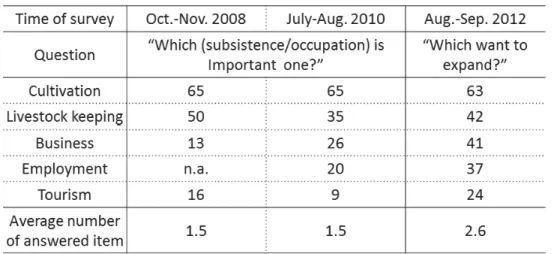
As an attempt to understand the people s evaluation of different livelihood, Meguro & Inoue (2011) asked informants whether cultivation, livestock keeping, tourism and business were important subsistence/ occupation to household or not. In the 2010 survey, I asked the same question with another choice of employment, whose typical examples mentioned by informants include well-paid ones like teachers, doctors and lawyers. In the 2012 survey, I asked a different question; Which subsistence or occupation you want to expand further? Table 2 shows the results of the three surveys. From these results, it is confirmed that cultivation is not only the more favourable livelihood practice than livestock keeping, but also is the most evaluated one in KGR. Besides, it is cultivation that the most people wanted to expand further. From the result of the 2008 survey,
Table 2. Results of three surveys about livelihood evaluation (%, multiple)
Source: 2008; Meguro & Inoue (2011), 2012; Author
agro-pastoral complex was the popular livelihood practice at that time, but as the other two recent surveys suggested that the other choices are getting more popularity. Although, the number of people who regarded tourism as important was small in 2010, the combination of answers to the latter two questions implies willingness to diversify livelihood beyond a mixture of cultivation and livestock keeping. Table 2 shows the possibility that the popularity of livestock keeping is on the wane. On the one hand, the 2012 survey shows that between August 2011 and September 2012, 63% of households (76 of 116) sold livestock (most of them to pay for school fees), and 64% reported that livestock numbers had decreased during the past few years (reasons mentioned include drought and disease, besides selling them for household needs like education). On the other hand, the perception of livestock keeping as an important tradition for Maasai was affirmed by 66%. It was an answer to the question; What is an important tradition to Maasai people? Other answers included traditional values and morals by 18%, circumcision by 17%, clothes by 6%, ceremonies and culture in general by 3%, and age sets and unity by 1% each (multiple answers, n.a.=9.5%).
Many elders admitted the importance of cultivation but left it to their children and wives, contenting themselves with looking after livestock and socializing with elderly friends. There is a tendency that a young householder in his 30 s mostly worked in his cultivated fields and asked friends to look after his cattle, while stating that his own preferences were to take care of livestock. More and more people started to give serious thought to other livelihood options than pastoralism, but more information is needed to draw a conclusion whether livestock keeping or traditional nomadic pastoralism will fade away.
Local Evaluation of Group Ranch Subdivision
Concerning an evaluation of group ranch subdivision, Rutten (2008: 113-114) summarized its positive and negative effects in Kenya s Maasailand. While he admitted that there are some positive points (e.g. restriction of misuse by neighbours, land renting from poor to rich, reintroduction of flexible pasture management), he placed emphasis on the fact that it caused increased poverty due to its negative outcomes like land sales. In the meantime, based on the household/ livelihood surveys in five Maasai societies in Kenya and Tanzania, Homewood et al. (2009) discussed the possibility of an increase in the gap between rich and poor in Maasai societies in the course of the change in landownership and the diversification of livelihood activities.
In the 2012 survey, 72% of respondents assessed the land subdivision of KGR as positive and 25% as negative. The main reason for the positive evaluation
of the subdivision was acquisition of private land with title deeds. Thanks to the land titles, many people said, they became able to construct permanent houses and make cultivated fields, both of which were typical example of development in the area. The major reasons for negative answers concerned the loss of access to former grazing areas, such as misgivings about selling land without serious consideration and diminished or insufficient grazing space for livestock, as entering land held by others without permission is now functionally prohibited.
Concerns about land grabbing by other peoples with an agricultural or trading focus have frequently been reported in literature because it can be detrimental to nomadic pastoralism (Galaty 1992; Lesorogol 2008; Rutten 1992;
Woodhouse 2003). Such opinions were sometimes mentioned in local assemblies concerning land. Once a local Member of Parliament suggested that he might propose a motion according to which no one in KGR could sell land to other peoples without inquiry by the governmental staff. As a result of the 2012 survey, it is revealed that 22% of informant household had sold their land in the period between the subdivision and the research period in 2012. Among them, 19%
sold farmland and 81% sold grazing land, and 15% (19% of those who sold grazing land) had sold all grazing land (60 acres) and had no private land left for grazing. However, there was no household who sold all farmland (2 acres) and all kept private farms and continued cultivation. In this way, not a few land parcels have been sold. However, it must be noted that while 25% said that the immigrating non-Maasai peoples had caused problems like land buying, 71% of respondents thought that they had brought positive things like cultivation, education and improved housing. Many people were concerned that those who sell land would be reduced to poverty, but it does not mean that they were critical of group ranch subdivision.
In addition, 81% stated that after the subdivision there was no need for group ranch committees, a management body elected by members. KGR has received school bursaries from the government and tourism income from a private company running the wildlife sanctuary on the GR communal land (Meguro & Inoue 2011), and 18% of respondents supported the continuance of group ranch committees based on their leadership or the need for managing such communal properties and income (n.a.=1). However, recently some members have stated that the income should be divided directly and equally among members. They said that it would be better because the committees were engaging in fraud. The evaluation of group ranch committees and the (dis)approval of group ranch itself is different thing but this result suggests that group ranch subdivision can be positively evaluated by local people when it is
constructed politically and handled by self-seeking persons without traditional authority (cf. Rutten 2008).
Current Way of Livestock Grazing
Land subdivision is considered to be problematic for nomadic pastoralism because once land becomes private, subdivided portions is too small to keep livestock throughout the year but its owners are able to prevent trespassing and grazing by others. In order to examine whether this story holds good in case of KGR, patterns of livestock grazing were asked in the 2012 survey. Table 3 displays its result, showing that almost more than three quarters of households grazed their livestock inside KGR, but a certain percentage (larger in the dry seasons) grazed outside KGR and inside neighbouring group ranches in the territory of Loitokitok section. Local elders stated that before the formation of group ranches, only a few households lived inside the current KGR and they used to graze livestock around the Chulu Hills (at the north-eastern border of Imbirikani Group Ranch) and Amboseli Swamp (inside of and next to the western part of Amboseli National Park) in the dry seasons. The data shown in Table 3 suggest that the way of livestock grazing has changed from the traditional nomadic pastoralism. Many members of KGR do not need utilise to land of other group ranches for livestock grazing.
Table 3. Places of livestock grazing by KGR members (%, multiple)
Source: Author
However, the distribution of livestock during the 2009/ 2010 drought was different from that of usual time. First of all, the seriousness of the drought is shown in Table 4, which summarizes the numbers of livestock counted from the air in eastern part of the current Kajiado County before and after the drought, in addition to the rate of change between three times. It is calculated that after around two years of drought, the number of cattle decreased by 73% and that of
small livestock dwindled by 35%. On the other hand, Table 5 summarizes the results of the surveys of Meguro and Inoue (2011) and mines. In comparison between Table 4 (Change rate (1) (2)) and Table 5 (Change rate (1) (2)), it is confirmed that the number of livestock in KGR decreased in the similar degree to that of the wider part of Kajiado County, meaning that the damage in KGR can be said average.
Table 4. Change in livestock number counted in eastern part of Kajiado Country
Source: Warden (2010a, 2010b)
Table 5. Change in average livestock number of household in KGR
Source: 2008; Meguro & Inoue (2011), 2012; Author
In fact, grazing places during the long drought varied and many people brought their livestock outside KGR. In the 2010 surveys, grazing places during the drought were inquired, and KGR was indicated by 33% of respondents, of which 83% (28% of total respondents) used KGR exclusively. It means that 72%
of households utilized areas outside KGR. Several places outside KGR were mentioned, which included Chulu Hills (38%), West Tsavo National Park (east of Kajiado County; 35%), Rombo GR (28%), Mombasa (18%), Tanzania (11%), Kuku GR (8%), Taveta (further east of West Tsavo National Park; 6%), Kanba Land (north of Kajiado County; 5%), Imbirikani GR (3%), Olgulului GR (2%), around Loitokitok Town (2%), Emali (north of Loitokitok Constituency; 2%), Voi (near Taveta; 2%), Kajiado Central (west of South Kajiado Constituency;
2%) and Namanga (west of South Kajiado Constituency; 1%). In total, 59% of household grazed (part of) their livestock outside KGR and inside Kajiado South
Constituency. Therefore, more than half of households utilised the traditional territory of the section in case of emergency, though it is not so common at ordinary times. The 2009/ 2010 drought decreased the number of livestock, but without the customary access to the other group ranches, the loss would be worse than average.
4. Conclusion and Issues Hereafter
Development with Cultivation and Pastoralism
When Meguro & Inoue (2011) described that KGR had realized community development through group ranch subdivision, it was based on the information that cultivation which had been realized and expanded through group ranch subdivision was regarded as the most important livelihood activity by the majority of KGR members. This study ratifies the fact that cultivation is practiced by the most of households throughout the year. It is also suggested that after the serious drought, cultivation came to attract growing interest among the members, provided that there is willingness to diversify livelihood beyond the current popular choice of cultivation and livestock keeping.
In comparison with cultivation which is the most popular alternative, livestock keeping come out second best to it and its popularity is relatively waning. However, pastoralism still keeps the second popularity even if other economic activities come close up on it. Further research is necessary to discuss the future of pastoralism but in the case of KGR, it is confirmed that group ranch subdivision does not mean the abandonment of pastoralism. Taking into consideration the fact that livestock keeping is still being conducted, being expected to expand and regarded as an important practice by not a few people, an assertion cannot be made that development after group ranch subdivision include livestock keeping rather than exclude it.
Difference between Group Ranch and Communal Section
In such circumstances of livelihood, around three-quarters of KGR members approved land subdivision. The main reason for the positive attitudes was acquisition of private land with title deeds, and the major reason for the negative ones concerned the less access to rangeland. Local people are conscious of the problem of land selling, but they did not criticize group ranch subdivision as a root cause of it. These results are in accordance with the previous studies on KGR (Meguro & Inoue 2011). In addition to it, a status quo that almost more than three quarters of households grazed livestock just inside KGR without utilizing other group ranches may justifies the assumption perceived in the
previous studies (cf. Lesorogol 2008, Mwangi 2007, Rutten 2008); group ranch subdivision means complete privatization or individualisation, meaning that once it is completed, the customary and communal way of livestock keeping/ grazing disappear. However, the real distribution of livestock during the terrible drought of 2009/ 2010 was different from the ordinary one. More than half of households grazed livestock outside KGR but inside the traditional territory of Loitokitok section. Consequently, the damage to livestock in KGR was average, and it means that by making the most of the sectional custom, they could hold down the loss to the average.
This result demonstrates that the customary land management system based on the section is still in effect and important to enable KGR members to get through a crisis. It is not certain whether this custom will be maintained if all land of the territory of Loitokitok section is subdivided. Almost all elders I met said that traditional pastoralism of Maasai would be difficult to continue in the future, but at the same time, they stated that Maasai would keep livestock as many/ little as their land affords. During the drought, many Maasai people use mobile phones and motor vehicles for the purpose of collecting information about and bringing their livestock to safe places. Some of them grazed their stock inside the customary territory and others moved with theirs to outside it.
Maasai people try to make use of both traditional and modern means. From the results of this study, it is pointed out that the antecedent discussion did not well distinguish a politically-formed group ranch from a traditional and cultural autonomous unit of section. To enlarge upon this point, it is important to expand the scope of discussion from a group ranch to wider relations and legal landownership to customary rules and practice on the ground.
References
Altmann, J., S. C. Alberts, S. A. Altmann & S. B. Roy 2002. Dramatic Change in Local Climate Patterns in the Amboseli Basin, Kenya, African Journal of Ecology 40(3):
248-251.
BurnSilver, S. B. 2009. Pathways of Continuity and Change: Maasai Livelihoods in Amboseli, Kajiado District, Kenya. In K. Homewood, K., P. Kristjanson & P. C.
Trench eds. Staying Maasai? Livelihoods, Conservation and Development in East African Rangelands. New York NY, Springer, pp. 161-207
Campbell, D., D. Lusch, T. Smucker & E. Wangui 2005. Multiple Methods in the Study of Driving Forces of Land Use and Land Cover Change: A Case Study of SE Kajiado District, Kenya, Human Ecology 33(6): 763-794.
Galaty, J. G. 1992. The land is yours : Social and Economic Factors in the Privatization, Sub-division and Sale of Maasai Ranches, Nomadic Peoples 30: 26-40.
Homewood, K., P. Kristjanson & P. C. Trench eds. 2009. Staying Maasai? Livelihoods, Conservation and Development in East African Rangelands. New York NY, Springer.
Lesorogol C. K. 2008 Land Privatization and Pastoralist Well-being in Kenya, Development and Change 39(2): 309-331.
Meguro T. & M. Inoue 2011. Conservation Goals Betrayed by the Uses of Wildlife Benefits in Community-based Conservation: The Case of Kimana Sanctuary in Southern Kenya, Human Dimensions of Wildlife 16(1): 30-44.
Mwangi, E. 2007. The Puzzle of Group Ranch Subdivision in Maasailand, Development and Change 38(5): 889-910.
Rutten, M. 1992. Selling Wealth to Buy Poverty: The Process of the Individualization of Land Ownership Among the Maasai Pastoralists of Kajiado District, Kenya, 1890-1990. Saarbr cken, Verlag f r Entwichlungspolitik Saarbr cken.
Rutten, M. 2008. Why De Soto s Idea might Triumph Everywhere but in Kenya: A Review of Land-tenure Policies among Maasai Pastoralists, In M. Rutten, A. Leliveld
& D. Foeken eds. Inside Poverty and Development in Africa: Critical Reflections on Pro-poor Policies. Leiden, Brill, pp. 83-118.
Sundstrom, S. J. F. Tynon & D. Western 2012. Rangeland Privatization and the Maasai Experience: Social Capital and the Implications for Traditional Resource Management in Southern Kenya, Society and Natural Resources 25(5): 483-498.
Thompson, M. & K. Homewood 2002. Entrepreneurs, Elites, and Exclusion in Maasailand: Trends in Wildlife Conservation and Pastoralist Development, Human Ecology 30(1): 107-138.
Western, D., R. Groom & J. Worden 2009. The Impact of Subdivision and Sedentarization of Pastoral Lands on Wildlife in an African Savanna Ecosystem, Biological Conservation 142(11): 2538-2546.
Woodhouse, P. 2003. African Enclosures: A Default Mode of Development, World Development 31(10): 1705-1720.
Worden, J., V. Mose & D. Western 2010a. Aerial Census of Wildlife and Livestock in Eastern Kajiado: February 2010. Nairobi, African Conservation Centre.
Worden, J., V. Mose & D. Western 2010b. Aerial Census of Wildlife and Livestock in Eastern Kajiado: October 2010. Nairobi, African Conservation Centre.