The future of nuclear technology
Kazunobu Oyama
The future of nuclear technology
Kazunobu Oyama
Kanagawa University
In this chapter, I would like to outline my predictions for the future of nuclear energy compared with other sources of electrical energy along the concept of technological hierarchy.(1)
I think we can systematically understand the various sources of electrical energy through utiliz- ing the technological hierarchy. Moreover, we can place the cause of the accident at Fukushima in the decision tree of the technological hierarchy. Consequently, we can correctly understand the ac- tual seriousness of the real cause of the accident.
Simultaneously, we can identify some solutions to the problems that were the causes of the acci- dent according to the design of the technological hierarchy as a means-ends analysis of problems and solutions.
1 .Technological Hierarchy of an electric power plant
Nowadays, there are three types of major core technologies of an electric power plant: hydroelec- tric, thermal, and nuclear power generation. Moreover, renewable energy generation includes solar, wind power, wave power, and geothermal power generation, biomass energy, and so on.
Although many countries are focusing on renewable generation systems, the percentage of re- newable energy is very low, except in Denmark and Northern Europe countries. As previously mentioned, there are currently three types of electricity generation systems.
I will investigate these three systems along the technological hierarchy. Although each type of system has a variety of mechanisms, I will attempt to design the technological hierarchy of these
論 説
( 1 )Oyama, K. ʻʻTwo Dysfunctions in High-Tech Research and Developmentʼʼ Public Policy and Administra- tion No.30 2009 pp.82 91 MYKOLAS ROMERIS UNIVERSITY
systems based on a fundamental core technological concept.
The core technological concept of hydroelectric power generation is the generation of electric power through directly harnessing the flow of water through a turbine. This core concept is differ- ent from that of thermal and nuclear power generation. Their core concept is generating electric power through moving a generator by steam, which is produced by boiling water.
There is a difference between thermal and nuclear power generation in the mechanism of how to boil the water. Of course, there are some different resources that can be used to boil water, such as coal, oil, or gas. In this sense, we can regard nuclear power generation as a type of thermal power generation that uses uranium as a source of energy.
However, the core technological concept of heating water through nuclear fission of a radioactive substance is quite different from burning coal, oil, or gas. Therefore, nuclear power generation is clearly divided from the thermal power generation system.
Although there are various types of nuclear plant, the core technological concept of the nuclear power generation system exists in the mechanism of heating water through nuclear fission of a ra- dioactive substance such as uranium.
Figures 1 to 3 represent the technological hierarchies of the design of hydroelectric, thermal, and nuclear power generation.
The Technological Hierarchy of Hydroelectric Power Generation
The fundamental principle of the hydroelectric power generation system is using the flow of wa- ter to move a generating motor. A key issue is how to make the water flow. Some solutions include utilizing natural rivers, constructing a controlling pool, constructing dams, or pumping water.
However, these methods have some sub-problems. In fact, the supply of water is also restricted by season or weather, and water shortages in the dry season. Specifically, a drought in summer is a serious problem. Furthermore, water may freeze in winter, which is also a serious problem in terms of water supply.
These problems are solved to some extent by utilizing large rivers, which have a stable quantity of water, particularly those situated in warm areas that never freeze, or utilizing watering pipes to prevent freezing. Moreover, scaling up dams is effective for strengthening durability against drought. A pumped-storage water system often utilizes electric energy at night, when such energy is relatively cheap.
However, the problem of coastal erosion, which has gained recent attention due to the serious- ness of the issue, remains unsolved. Because a dam blocks the flow of rivers with sands the sea waves constantly encroach on the land. The sands would be brought to the mouth of the river with river water, were it not for the dam. The sands ceaselessly would prevent the coast from erosion by sea waves.
Although large of concrete blocks are widely used instead along coastlines of natural sand, they are almost useless as they are broken by waves within ten or twenty years. To produce concrete blocks, a large quantity of rock and sand are scraped off from mountains. Dams can be considered
as doubly destructive due to this depletion of resources from mountains areas and coastal erosion caused by removal of sand. Furthermore, many broken concrete blocks are blots on coastal land- scapes.
Moreover, damsʼ utility is decreasing due to the decreasing volumes of water stored, which is caused by the depth of the dams becoming shallow due to the increase in sand deposits.
In summary, according to the concept of technological hierarchy, hydroelectric power generation systems may be categorized as being in the saturation or decline stages of the technology life-cycle (see Figure 4). According to the Boston Consulting Groupʼs PPM (product portfolio management) hypothesis (see Figure 6), these stages are categorized as ʻʻCash cow or ʻʻDogʼʼ. Hydroelectric pow- er generation system must be gradually abolished due to the unsolvable problems of coastal ero- sion and shallowing of dams through piling up sands with river water.
The Technological Hierarchy of Thermal Power Generation
The fundamental principle of the thermal power generation system is moving a generator using steam from hot water. How to heat the water is the key issue in the technological hierarchy. As methods to heat water including burning coal, oil, or gas, the next problem is how to eliminate nox- ious gases such as NOx, CO2, SO2, and so on, which are produced when fossil fuels are burnt. A de- sulfurization equipment is one of the solutions for the problem.
However, the problem of elimination CO2 remains unresolved. Recently, many countries have fo- cused on the CO2 problem because increasing CO2 is a cause of global warming. Since the formal- ization of the Kyoto Protocol in December 1997, the issue of global warming has become a major global environment issue in the world.
Figure 2 presents the technological hierarchy of thermal power generation.
We can also categorize the technology life-cycle of thermal power generation systems according to the technological hierarchy. Notwithstanding the existence of the argument about the phenome- non of global warming, it may be placed in the saturation stage due to the issue of CO2 emissions.
Figure 1.Technological hierarchy of hydroelectric power generation Flowing water moves generating motor
How to generate flow
Utilize natural rivers
Restriction by season or weather
Utilize large rivers in warm areas, utilize watering pipe, scale up dams, and utilize electric energy during the night
principle
key issues
controlling pool
coastal erosion Dam system
pump up energy pump up system
↓
↑ solutions
↓
↑
↓
↑ solutions
↓ ↓sub-problems
Whether increasing CO2 is the real cause for global warming, or the greenhouse effect, is still open to debate. In the future, CO2 as well as toxic gases emitted from burning coal, oil, or gas may be eliminated effectively through innovation of new devices. However, complete elimination will be impossible, and we cannot help thinking that burning fossil fuels has reached the saturation stage.
The Technological Hierarchy of Nuclear Power Generation
We can regard nuclear power generation as a solution device for the elimination of CO2, because CO2 is never discharged when producing steam from hot water that is heated through nuclear fis- sion instead of burning fossil fuels such as coal, oil, or gas.
The principle of the nuclear power generation system is the utilization of heat that is produced through nuclear fission of uranium. However, the most fundamental scientific knowledge is that nu- clear fission creates a significant amount of energy. The energy was initially harnessed as a weapon, but attempts were made to utilize it as a means of producing electrical energy after World War II.
The key issue of the nuclear system was how to maintain sequential nuclear fission that can be utilized for producing electrical energy. The principle of nuclear generation is that nuclear fission creates heat and this heat boils water. The boiled water produces steam that moves the motor of generator. The key issue is how to control the fission level. Methods to address this issue are main- ly a water-based cooling system and a system of control rods. Cooling water continuously cools the nuclear reactor to keep the certain level of the nuclear fission. Fission can be restricted through charging the control rods between the fuel rods.
Figure 3 represents the technological hierarchy of nuclear power generation.
According to the technological hierarchy of nuclear power generation, we can see that the acci- dent at Fukushima 1 Nuclear Power Plant occurred at a lower level of the technological hierarchy of the devices used as an alternative electrical power resource. Such devices are a subsidiary meth- od to solve subsidiary problems in the technological hierarchy.
The Fukushima nuclear accident was occurred caused of the loss of the alternative source of the electrical power through the flood by the great tsunami triggered by the Great East Japan Earth-
Figure 2.Technological hierarchy of thermal power generation Steam moves the motor of a generator
How to heat the water
Burn coal
How to eliminate noxious gas or CO2
Desulfurization equipment device to eliminate noxious gas principle
key issue
Burn oil
Sub-problems Burn gas Solutions
↓
↑
↓
↑
↓ ↓ Fuel alternatives
quake. Therefore, it is clear that the significant improvement point is how to protect the alternative electrical power source from tsunami.
Nowadays, defensive sea walls have been constructed along the seaside of some nuclear plants in Japan. Such construction is one of the suitable solutions to protect the alternative power source from tsunami. However, setting the source of alternative power on the top of a hill, a high place of a building, or the top of an exclusive tower may be an easier solution.
There are several risks in the higher level of the technological hierarchy of nuclear power gener- ation. In general, control of nuclear fission is difficult because the nuclear fissional reaction has a time lag from the operation. High skills of the operation by experience is very important to manage the time lag of the reaction.
Moreover, radioactive waste is a serious problem in the nuclear power generation system. One of the most effective solutions to this issue includes establishing a reprocessing cycle, using MOX (mixed oxide) fuel, and the use of breeder reactors.
However, despite the invention of the glassification method, the disposal of high-level radioactive waste is still a serious problem.
2 .Renewable energy generation
Various types of renewable energy generation such as solar, wind power, geothermal power, bio- mass energy, wave power generation, and so on are currently available.
In general, the efficiency of any renewable energy generation system is not high. Furthermore, solar and wind power generation systems are restricted by the seasons and weather. For example, there is no sunshine on rainy days, and wind turbines cannot move in less-wind day or night.
Figure 3.The technological hierarchy of nuclear power generation Nuclear fission produces large amounts of energy
Application for weapons
How to create a triggering device
Cooling system
The fundamental scientific
How to control the level of nuclear fission
Control rod system key issues
solutions
↓ ↓ knowledge
↓
Application for generation of electricity
↓
↑
↓
↑
How to maintain safety against accidents
Automatic stopping system
of nuclear reactor Automatic starting system of alternative
electrical power resources devices as solutions sub-problem
↑ ↑
Alfred D. Chandler Jr. suggested this restriction was characteristic of before the beginning of modern industrial society.(2) Constant durability or sustainability of natural sources of energy such as rivers or wind cannot be assumed in all seasons or in any weather. As I already mentioned in the explanation of the hydroelectric power generation system, natural rivers may be frozen in winter or may flood or may dry up in summer.
Therefore, solar and wind power generation systems have serious problem of durability and sus- tainability such as the period of ʻʻthe before the beginning daysʼʼ as Chandler mentioned.
Furthermore, there are very serious issues with solar generation systems such as the destruc- tion of forests due to vast areas of solar panels being constructed. As each solar panel can produce only weak electrical power, immense areas must be developed to set up a large quantity of solar panels.
Based on the extensive investigation of enormous historical cases of civilizations in places such as Easter Island, Greenland, North and South America, Australia, Africa, China, Japan, and so on, Jared Diamond highlighted that the collapse forests directly connected to the collapse of civiliza- tion.(3)
Roofs of buildings must be utilized for solar panels. Extensive deforestation in exchange for elec- trical power is a suicidal act on the part of human beings.
As each renewable energy generation system is a young technology, which are situated in the in- troduction stage of the technological lifecycle, there may be numerous options for possible im- provements.
3 .Energy portfolio management
The concept of a portfolio is used a financial theory and refers to the dispersion of risk through investment. In general, high-return assets have high-risk, and low-risk assets have low-return. Be- cause nobody wants a high-risk and low-return assets, such assets cannot exist in a financial mar- ket.
On the other hand, as high-return and low-risk assets are desirable, competition to gain such as- sets become very severe, which increases the risk and decreases the return of the asset.
Therefore, in an actual financial market, only two types of assets exist: high-risk and high-return assets, and low-risk and low-return assets. Portfolio should contain a mix of the aforementioned as- sets.
Table 1 presents a matrix of assets.
Boston Consulting Groupʼs P PM hypothesis applies financial portfolio selection to diversification of products and markets.(4) This theory is based on two fundamental hypotheses: product life cycle
( 2 )Chandler, A. D. Jr The Visible Hand The Managerial Revolution in American Business BELKNAP Har- vard 1977
( 3 )Diamond, J. COLLAPSE How Societies Choose to Fail or Succeed Penguin Books 2011
( 4 )アベグレン、J.C.『ポートフォリオ戦略』プレジデント社 1977
hypothesis(5) (R. Vernon) and experience curve hypothesis.
The product life cycle hypothesis assumes that any product has five stages of its life: introduc- tion, growth, maturity, saturation, and decline stage, as shown in Figure 4.
As shown in Figure 5, according to the experience curve hypothesis, the unit cost of a product decreases as cumulative production increases. Specifically, the unit cost decreases rapidly in the first stage.
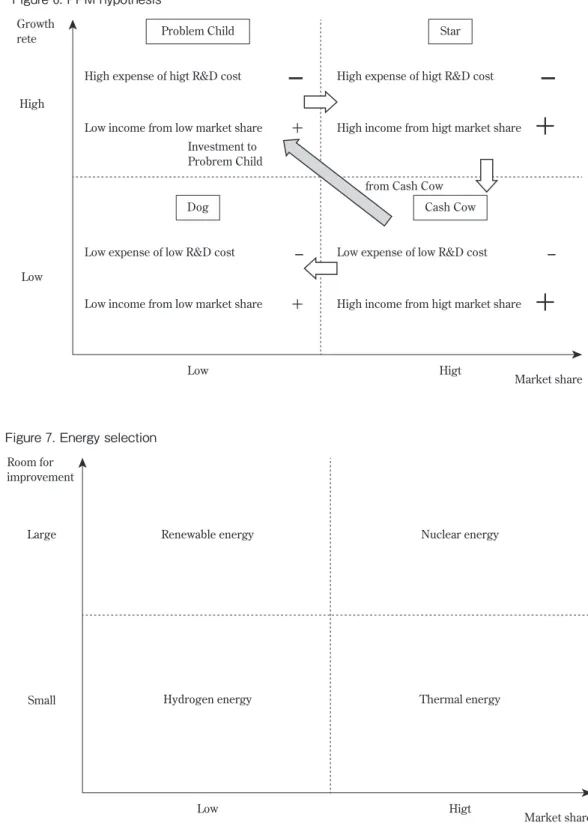
Product portfolio management theory categorizes products to four groups based on two mea- surements: market share and growth rate. The first stage of the life- cycle of a product, the intro- duction stage, is characteristic of high-growth rate and small market-share. This is categorized as a ʻʻProblem childʼʼ that requires significant R&D investment while gaining a few revenues because of a small market share.
Successful R&D investments leads to the growth stage and the ʻʻProblem childʼʼ becomes a ʻʻStarʼʼ that can gain significant revenue, although significant R&D investment is still necessary.
Table 1.Types of assets Return
Risk Low High
Low ×
High ×
Figure 4.Product life cycle
Introduction stage Quantity of
demand
Growth stage Maturity stage
Saturation stage
Time Decline stage
( 5 )バーノン、R.『多国籍企業の新展開』ダイヤモンド社 1977
The next stage of the product life cycle is the maturity, and saturation stage, in which the product is categorized as a ʻʻCash cowʼʼ in the product portfolio; the product can generate significant revenue with no further need for significant R&D investment. Boston Consulting Group cautioned that American companies are inclined to focus excessively on the ʻʻCash cowʼʼ due to over-consideration of short-term profitability. However, over the course of the product life-cycle, a ʻʻCash cowʼʼ becomes a ʻʻDogʼʼ in the decline stage. Any company that focuses on investment only in ʻʻCash cowsʼʼ con- cerned with only short-term profit will decline with the declining product.
Active investment of the revenue generated from the ʻʻCash cowʼʼ in the ʻʻProblem childʼʼ is recom- mended to realize the next ʻʻStarʼʼ product in the future. Moreover, it is recommended that ʻʻDogsʼʼ are withdrawn from the market as they generate little revenue with their cheap R&D cost. Figure 6 illustrates the PPM hypothesis.
We apply the PPM hypothesis to energy policy. As I already mentioned, we may approximately categorize hydroelectric, thermal, nuclear, and renewable power generation systems as follows.
Due to the lack of room for improvement, hydroelectric power generation is in the saturation or decline stage. Thermal power generation is in the saturation stage for the same reason. Therefore, they may be categorized as a ʻʻDogʼʼ or ʻʻCash cowʼʼ for electricity companies.
On the other hand, nuclear power generation has wider scope for technological improvement compared with hydroelectric and thermal power generation due to the shorter history of the tech- nological life cycle. Therefore, it may be categorized at ʻʻStarʼʼ.
Renewable power generation systems considered a ʻʻProblem childʼʼ due to their short histories Figure 5. Experience curve hypothesis
Unit-cost
Cumulative production =Experience
Figure 6. PPM hypothesis Growth
rete Problem Child
High expense of higt R&D cost
‒
Low income from low market share Investment to Probrem Child
+
Market share Dog
Low expense of low R&D cost High
Low
‒
Low income from low market share
+
Star
High expense of higt R&D cost
‒
High income from higt market share
+
Cash Cow
Low Higt
Low expense of low R&D cost from Cash Cow
‒
High income from higt market share
+
Figure 7. Energy selection Room for
improvement
Renewable energy
Market share Hydrogen energy
Large
Small
Nuclear energy
Thermal energy
Low Higt
and vast scope for technological improvement. Of course, energy selection, as shown in Figure 7, among the various renewable power generation systems is also important.
Figure 7 exhibits various types of energyʼs situation.
4 .Technological selection is working in nuclear systems
It is useful to analogize the technological hierarchy of nuclear power generation systems with Ab- ernathyʼs design hierarchy of automobiles.(6) In the first stage of the automobile industry, there were three types of fundamental engine systems, namely, electric, steam, and gasoline engine sys- tems. Then, each core concept of technology had the hierarchy of subsidiary devices to solve each subsidiary problem brought from each core technology during the application process.
Nowadays, nuclear power generation still has various fundamental core technologies to realize the core concept of technology that utilizes the heat generated from nuclear fission. This variation of core technology means the nuclear industry is partially still in a fluid stage of its life-cycle; The industry is not mature. Evidently, each core technology of nuclear power generation has subsidiary devices that construct each technological hierarchy. In summary, nuclear power generation sys- tems can be categorized as the beginning of the growth stage of the technological life-cycle, which is located at the beginning of a ʻʻStarʼʼ according to the PPM hypothesis.
Core technologies of nuclear power generation
The fundamental types of nuclear reactor are mainly categorized into four types according to type of coolant, fuel, moderator, or enrichment level. The first type of nuclear reactor is a ʻʻLight Water Reactorʼʼ (LWR); its core technology is boiling water through the heat generated by nuclear fission.
This type of reactor, which is popular in Japan, is cooled and moderated by normal water (H2O), and utilizes uranium-dioxide as a fuel. This type of the reactor is divided into two types: ʻʻBoiling Water Reactorʼʼ (BWR) and ʻʻPressurized Water Reactorʼʼ (PWR). A BWR boils normal water using the heat generated by nuclear fission, while PWR heats normal water to 300℃- under high pres- sure.
In a BWR system, steam is generated inside the reactor and goes directly to the turbine, while in a PWR system, steam is generated outside the reactor in a secondary heat transfer loop (stem line) connected via a pressurizer.
PWR is utilized for nuclear powered ships as well as electricity generation. In nuclear powered ships, steam directly goes to steam turbines that are connected screw not to electricity generator.
The second type of nuclear reactor is a ʻʻHeavy Water Reactorʼʼ (HWR). Most of this type of reac- tor are also PWR type reactors. HWR, which can utilize not only uranium dioxide but also metal as fuel, utilizes heavy water D2O as a coolant and moderator. Moreover, HWR can produce plutonium as well as electricity.
( 6 )Abernathy, W. J. The Productivity Dilemma The Johns Hopkins University Press 1981
The third type is a ʻʻGraphite Moderated Reactorʼʼ (GMR), which uses graphite as moderator, is classified as either gas-coolant type or water-coolant type reactors. Both types of GMR can produce plutonium as well as electricity. Uranium dicarbide (UC2) or uranium are used as fuel in gas-coolant type GMR, and water-coolant type GMR use uranium dioxide or metal.
Gas-coolant type GMR are widely used in Britain and France. Water-coolant type GMR were used in the former Soviet Union. For example, the former Soviet Union created an original nuclear reac- tor that was a combination of graphite moderator type and water-coolant type reactors, Reaktor Bol- shoy Moshchnosti Kenly (RBMK) in Chernobyl.
The cause of the Chernobyl disaster on 25 April 1986, was assumed to be the manipulation of the reactor, which proved to be too difficult. Therefore, this type of reactor is being weeded out.
The fourth type of nuclear reactor is a ʻʻFast Breeder Reactorʼʼ (FBR). The most common type of FBR is the ʻʻLiquid Metal Fast Breeder Reactorʼʼ (LMFBR), which can produce plutonium as well as electricity. The chemical composition of the fuel is plutonium dioxide and uranium dioxide in vari- ous arrangements.
LMFBR uses molten liquid sodium, which has about same specific gravity as water and a boiling point of 880℃. -These characteristics are very convenient for the operation as a coolant for nuclear reactors.
A notable purpose of LMFBR is enrichment of nuclear fuel. For example, LMFBR can breed plu- tonium 239 from uranium 238 through fission. LMFBR can use MOX fuel, which is produced from spent nuclear fuel contains plutonium 239 and uranium 238.
However, uranium 238 is not fissile. Moreover, natural uranium contains 99.3% of non-fissile ura- nium 238, and 0.7% fissile uranium 235. Therefore, the enrichment function of LMFBR, changing uranium 238 to plutonium 239, is quite important especially for countries with poor natural resourc- es.
As I mentioned above, there are still a variety of fundamental nuclear reactor technologies. The variety of the core technology means that the nuclear industry is not mature yet. In the near future, some subsidiary technological devices or the core technology itself may be weeded out.
The most attractive point of nuclear energy is the tremendous amount of energy generated from a small amount of fuel material. However, at the same time, there is a serious risk in terms of the difficulty of operating nuclear plants. Notably, chemical reaction has a time lag and irregularity, which often causes acceleration of the reaction; this leads to difficulty controlling the reactor. Spe- cifically, according to be large size of the plant, the time lag between the reaction and operation be- comes long. It makes more difficult to suitable operation.
Furthermore, one more serious risk of nuclear technology is widespread radioactive pollution af- ter an accident. The larger the nuclear plant, the wider the radioactive pollution after an accident.
We have already experienced some serious nuclear accidents around the world. For the future, we must make great efforts not only to make nuclear technology more secure and efficient, but also to create effective management models to overcome the nuclear accidents.
The technological hierarchy of nuclear generation will become more sophisticated through the
addition of new devices and weeding out of existing dead-end technologies through extensive trial and error with our limited rationality.
Concept of Dominant Design
As I mentioned above, Abernathy discussed ʻʻDesign Hierarchyʼʼ in his book.(7) He explained the history of the development of the automobile industry through detailed investigation of Ford Motor Company. He argued the existence of a dilemma between productivity and innovativeness.
In the beginning stage of the automobile industry, which he called the ʻʻFluid stage,ʼʼ there were many radical innovations concerned with core technology. For example, different types of engine system, namely, electrical, steam, or gasoline engine systems were invented and tried to be prac- tice.
However, a dominant design emerged after much trial and error. The dominant design means that the technological design of both of makers and customers were satisfied. Abernathy regarded the Model T produced by Ford Motor Company in 1908 as the first dominant automobile design.
The first Model T was equipped with a gasoline engine system, propeller shaft, rear-wheel-drive, mechanical brake system, and so on. Ford Motor Company developed the design hierarchies step by step into the acceptable form for their mass production system. These design hierarchies real- ized the performance that satisfied usersʼ needs, such as speed, safety, ease of driving, price, dura- bility, and so on.
Therefore, the Model T became the first dominant design because both of maker and users were satisfied by the design. Once the dominant design was established, prominent innovation no longer occurred. For example, the gasoline system became the engine system. In addition, more subsid- iary level technologies, such as the mechanical systems of transmission, gears, throttle, steering, brake, and so on were rapidly fixed.
On the other hand, productivity rose rapidly after the dominant design was established. Accord- ing to the fixing of the technologies of the hierarchy, product standardization was improved. Then, mass-production of automobiles became possible. Therefore, unit-cost and price decreased rapidly, leading to high productivity.
Once, high productivity was realized, company was inclined to maintain high productivity due to profitability. Radical innovation means destruction of highly productive mass-production systems.
Therefore, the maturity stage of industry occurs after the high-production stage, and radical tech- nological innovations tend to be avoided.
In summary, high productivity cannot be realized in the fluid stage when many radical innova- tions occur. However, once highly productive mass production systems are realized, radical techno- logical innovations are apt to be avoided. It means the dilemma between innovation and productivi- ty.
Then, we recognized that there are variety of fundamental core technologies in the nuclear power
( 7 )Abernathy, W. J. op. cit.
generation industry, indicating the industry is currently still partially in the fluid stage. The design hierarchy of nuclear power generation is not established yet. The efforts to create the technological hierarchy of the nuclear power generation are continuing through significant trial and error. In oth- er words, the dominant design of the nuclear power generation system is not established yet.
Hierarchical miniaturized system of S-curve
We must recognize the difference between breakthrough and improvement.(8) Breakthrough re- fers to a fundamental change concerned with core technology. For example, changing from steam to electric motor engines in locomotives, or from propeller engines to jet gas turbine engines in air- planes.
On the other hand, improvement means creating new subsidiary devices under the existing core technology. For example, creating new devices such as new transmission, or brake systems under the existing fundamental engine system.
However, through interviews with more than 200 R&D members concerned with semiconductor development in Hitachi and Toshiba, I found that improvement consists of a large number of small technological breakthroughs.(9)
Almost all scientists or engineers in R&D departments of the aforementioned companies believed that they executed a small breakthrough in their field of technology. In fact, solid construction of polysilicon was an epoch-making invention and contributed to increasing the density of semicon- ductors.
Evidently, invention of a semiconductor whieh used a transistor rather than a vacuum-tube sys- tem was genuine breakthrough. However, as I mentioned above, solid construction of polysilicon was a truly epoch-making invention that was concerned with core technology of computer systems.
According to high integration of circuits, the problem of electric noise occurred due to a narrow- ing of space between the circuits. Hitachi Corporation innovated some solution technologies, for ex- ample a two-intersection points system, dividing the system of the electrical source for the semicon- ductor, and solid construction of polysilicon.
The two-intersection points system unifies electrical signals between two neighboring circuits to avoid the electrical interference. The system of dividing the electrical source divides the source of strong electric voltage from the voltage itself to avoid interference of the two different voltages.
The solid construction through reconstructing the fundamental structure of a silicon chip to a three-dimensional one provides a wide space for circuits. This technological device is more innova- tive than other technological devices.
Therefore, the improvement can be observed as a small continuous S-curve, while the evident break-through is a large S-curb, as shown in Figure 8.
( 8 )Oyama, K. ʻʻCorporate Strategy in Japanese High-Tech Industriesʼʼ Public Policy and Administration No.24 2008 pp.67 71 MYKOLAS ROMERIS UNIVERSITY OF TECHNOLOGY
( 9 ) 小山和伸 『技術革新の戦略と組織行動[増補版]』第二章 白桃書房 1999
5 .What is a dead-end technology?
Dead-end technology refers to technology that has little way of improvement to practical technol- ogy. There are various cases of the dead-end of application. First, the fundamental theory or con- cept of technology has an essential problem. In this case, any application method is vain due to problematic core technology. For example, many people have actually tried to produce a helicopter based on the 15th century sketch by Leonardo da Vinci. However, any application of this basic idea has been unable to realize a practical product due to the theoretical mistake of the fundamental con- cept exhibited in the sketch.
Second, due to the limited application method, a potential application process is not developed. In this case, any subsidiary device cannot solve the main issue regarding application. According a technological hierarchy, we can recognize the relationship between the problem regarding applica- tion and solution. The application process can finally realize a practical product through reducing the problems regarding application step by step.
For example, when problem A causes on an application route, how to solve problem A is impor- tant to realize the application. Even if developing device B can solve the problem A, device B usually also has some problems. If problem C caused by device B is smaller than problem A, device B is useful for the application route.
However, if problem C is more serious than problem A, the device B is not useful for the applica- Figure 8.Continuous S-curve of technological improvement
Performance
Efforts
tion. In this case, device B cannot reduce the problem for the application in the application route.
Device B is therefore a type of dead-end technology. If no potential devise can be developed, the fundamental core technology is also a dead-end technology.
Comparatively superior technology sometimes drives inferior technology to become dead-end technology. For example, the airship industry became a completely dead-end technology due to the aircraft industry. Briefly, the Hindenburg Disaster in 1937, was reported all over the world invited the dead-end for the airship industry. However, useful improvement was realized after the disaster, for example, helium gas was utilized as a float gas rather than inflammable hydrogen gas.
Actually, despite the fact that airship safety was increased through the use of helium gas, the rise of the aircraft industry rapidly drove the airship industry to become a dead-end technology.
New fundamental technology created by breakthrough drives existing fundamental technology to become a dead-end technology. We can find many cases of such breakthrough such as semicon- ductors instead of vacuum-tubes, electric-motor trains instead of steam-engine locomotive, and so on.
In general, technological breakthrough drives existing technology as the new fundamental tech- nology develops its dominant design. As I mentioned above, in the fluid stage, as Abernathy called it, in the period until the dominant design is build up, new fundamental technology cannot take the place of existing fundamental technology.
For example, after the dominant design of gasoline engine system was established by Fordʼs Model T, steam and electrical engine systems became dead-end technologies.
However, we can find other cases such as a propeller and jet gas turbine engine airplanes. The jet gas turbine engine system was the real breakthrough. The propeller airplane has survived the es- tablishment of the jet airplane as the dominant design due to economic reasons for short range transportation and other uses.
How can we predict when the propeller airplane will disappear completely and when a new en- gine system will be brought about through the next breakthrough? Types of competition provide a clue for the prediction of technological conditions in the future.
The relationship between product life-cycle and type of competition
Based on Abernathy and Porter(10), Professor M. Tsuchiya suggested changing the type of com- petition according to the product life-cycle.(11) Tsuchiya argued that in the beginning stage of the product life-cycle, that is the introduction stage (see Figure 4), the main competition was concerned with product quality such as security, credibility, durability, sustainability, and so on. He stated that according to Porter, this type of competition was categorized as a differentiation strategy.
In the fluid stage, trial and error led to the development various core technologies. Finally, the dominant design was established, the product moved to the growth stage of the life-cycle. Once the
(10)Porter, M. E. Competitive Strategy Techniques for Analyzing Industries and Competitors Free Press 1985
(11)土屋守章 『企業と戦略 事業展開の論理』リクルート出版 1984
dominant design is developed, the number of relatively minor improvements increases rather than a radical innovation.
Tsuchiya argued that in this growth stage, competition type changes from quality competition to price competition. In other words, the competitive strategy changes from a differentiation strategy to a cost-leadership strategy as the life-cycle stage changes from the introduction to the growth stage.
In the growth stage, companies make efforts to decrease their costs and realize low price prod- ucts. During severe low-cost competition, the product life-cycle gradually reaches the maturity, and saturation stage. Low cost and low price reaches their limit, and market demand also reaches the maturity stage.
In the maturity stage, attempts are made to develop a new model of the products to create a re- growth stage. Tsuchiya highlighted the example of the Cadillac, the luxurious model of automobile produced by General Motors at the end of 1920s. This renewal model of automobile replaced the Model T produced by Ford as the dominant model. The new model changed the dominant design of automobiles from the viewpoint of appearance rather than the core technology.
Abernathy called this regrowth stage an ʻʻIndustrial Renaissanceʼʼ(12). Tsuchiya highlighted that the type of competition changed in the regrowth stage from cost-leadership strategy to the differen- tiation strategy, again due to changing the focus of competition from price to quality.
Of course, changing the model is not considered a true breakthrough due to the continued use the core technology of the gasoline engine system. Therefore, the regrowth stage remains in the same technological S-curb.
This regrowth stage gradually reaches the maturity stage, and cost-leadership strategy becomes main strategy again. Tsuchiya argued that from a historical view point, these waves of strategic change or repetition of change exists in any product.
By judging the product life-cycle based on our observation of the type of competition, we may be able to predict the appearance of a new model, dominant design, or breakthrough.
Incidentally, the hybrid engine system, which uses hydrogen gas, is a type of true breakthrough given the core technological innovation. This model of automobile is not stay the same S curb of Model T or other luxurious model of automobile any more.
Of course, the cost problem is always important for any company. However, regarding hybrid en- gine cars, the main competition is currently concerned with quality rather than price or cost.
The nuclear power industry is currently far from the price competition. We can therefore say that the nuclear industry is currently in the introduction or fluid. The dominant design of the nuclear power plant will be accomplished in future. We must understand that the important process of trial and error is continuing, in the nuclear power plant industry.
In the selection process for the dominant design, some sort of core concept of technology will
(12)Abernathy, W. J./ Clark, K. B./ Kantrow, A. M. Industrial Renaissance Producing a Competitive Future for America Basic Books 1983
disappear as occurred with RBMK after the Chernobyl disaster in 1986, which was caused by a fun- damental weak-point in construction.
6 .Conclusion
In this article, I summarized the technological hierarchy of four types of electric power genera- tion system: hydroelectric, thermal, nuclear, and renewable energy generation systems. According to the concept of the technological hierarchy, I put technological problems and solutions in order along the application process of each power generation system.
Moreover, through the concept of technological hierarchy, I investigate in which life-cycle stage each system is currently situated. Hydroelectric power systems may be categorized as being satura- tion or decline stage of the technological life-cycle. According to Boston Consulting Groupʼs PPM hypothesis, such systems are categorized as ʻʻCash cowsʼʼ or ʻʻDogsʼʼ due to the unsolvable problem of coastal erosion and shallowing of dams through accumulation of sand deposits from river water.
Thermal power generation systems may be categorized as being in the maturity or saturation stage: ʻʻCash cowʼʼ in PPM. There is a little room for improvement in terms of innovation of new de- vices to eliminate toxic gas and CO2 emitted by burning fossil fuel.
Nuclear power generation systems are categorized as being in the growth stage of the technolog- ical life-cycle, which is regarded as a ʻʻStarʼʼ in PPM theory. However, it is also in the fluid stage, that is the introduction stage, because a dominant design for nuclear reactors is yet to be established.
Renewable power generation is located in the introduction stage and is categorized as a ʻʻProblem childʼʼ according to PPM theory, due to the significant room for improvement. It has only a short history in the industry.
I proposed an energy portfolio for the future. According to the portfolio, we must gradually abol- ish the hydro power generation systems, maintain dependence on thermal power generation sys- tems while making efforts to innovate nuclear and renewable power generation.
●Bibliography
1.Oyama, K. ʻʻTwo Dysfunctions in High-Tech Research and Developmentʼʼ Public Policy and Administra- tion No.30 2009 pp.82 91 MYKOLAS ROMERIS UNIVERSITY
2.Chandler, A. D. Jr The Visible Hand The Managerial Revolution in American Business BELKNAP Har- vard 1977
3.Diamond, J. COLLAPSE How Societies Choose to Fail or Succeed Penguin Books 2011 4.アベグレン、J. C.『ポートフォリオ戦略』プレジデント社 1977
5.バーノン、R.『多国籍企業の新展開』ダイヤモンド社 1977
6.Abernathy, W. J. The Productivity Dilemma The Johns Hopkins University Press 1981 7.Abernathy, W. J. op. cit.
8.Oyama, K. ʻʻCorporate Strategy in Japanese High-Tech Industriesʼʼ Public Policy and Administration No.24 2008 pp.67 71 MYKOLAS ROMERIS UNIVERSITY OF TECHNOLOGY
9.小山和伸『技術革新の戦略と組織行動[増補版]』第二章 白桃書房 1999
10.Porter, M. E. Competitive Strategy Techniques for Analyzing Industries and Competitors Free Press 1985
11.土屋守章 『企業と戦略 事業展開の論理』リクルート出版 1984
12.Abernathy, W. J./ Clark, K. B./ Kantrow, A. M. Industrial Renaissance Producing a Competitive Future for America Basic Books 1983