Does Regulation Matter?
Effects of Corporate Governance Reforms on Relational Shareholdings in Japan
Johan Jidinger (KPMG Tax Corporation) Hideaki Miyajima (Waseda University)
JSPS Core-to-Core Program Waseda Institute for Advanced Studies
Waseda, Corporate Governance Research
WORKING PAPER Series
WCG WP #2019-002
ABOUT JSPS CORE-TO-CORE PROGRAM
This work was supported by “Core-to-Core Program, A. Advanced Research Networks” of Japan Society for the Promotion of Science (JSPS).
The main objectives of “Core-to-Core Program” are to create world-class research hubs in the research fields, and to foster young researchers through building sustainable collaborative relations among research/education institutions in Japan and around the world.
As a research hub in Japan for the project titled “Creation of a Research Hub for Empirical Analysis on the Evolving Diversity of Corporate Governance: Multidisciplinary Approach Combining Economics, Legal Studies and Political Science” which was selected for “Core-to-Core Program”, Waseda Institute for Advanced Studies (WIAS) works together with its overseas counterparts: University of Oxford (UK), Ecole des Hautes Etudes en Sciences Sociales (EHESS) (France), University of British Columbia (UBC) (Canada). Through strengthening the research networks, developing analysis methods, adopting a multifaceted international approach and promoting the joint use of basic data, this project aims to achieve remarkable advancements in empirical analysis of the economic systems associated with corporate governance.
1
Does Regulation Matter?
Effects of Corporate Governance Reforms on Relational Shareholdings in Japan
Johan Jidinger KPMG Tax Corporation
Hideaki Miyajima
Graduate School of Commerce, Waseda University, WIAS, and RIETI
November 2019
We would like to thank Ryo Ogawa, Kazunori Suzuki and Takuji Saito for sharing the data on the block shareholders of activist funds and corporate behaviors. We also thank the participants in the Japan Finance Association, and the seminars at RIETI, Waseda.
Daisuke, Miyakawa and Yishay, Yafeh for their helpful comments. This project is supported by a Ministry of Education, Culture, Sports, Science, and Technology (MEXT) research grant, KAKENHI (I5H01958). We were also supported by the JSPS Core-to-Core Program, A. Advanced Research Networks.
2 Abstract
In the wake of Abenomics, new regulations based on the “comply or explain” principle were introduced to alter the deep-rooted relational shareholding (seisaku-hoyu) practice among Japanese firms. The stewardship code encourages institutional investors to engage in corporate management, and one of the guidelines of such engagement is the management of a firm’s financial policy, such as the firm’s securities holding and payout policy. Regarding relational shareholding, the Corporate Governance Code introduced stricter corporate disclosure requirements, including guidelines for the self-assessment of appropriateness and the economic rationale for relational shareholding. We explore the consequences of the new regulation by using unique data on firms with high relational shareholding (the so called bedrock firms,
“Ganban Kigyo”). Our results provide evidence that following the reforms, Japanese corporations began to actively sell relational shareholding. The incentive to sell relational shareholdings was constrained by intercorporate relationships. However, this constraint was also mitigated after the reforms. We also provide evidence that despite the expected outcome of Abenomics, corporate policies in firms that reduced their relational shareholding are likely to result in an increase in cash holdings and in dividend payouts, while R&D, M&A and CAPX will be left unaffected.
Keywords: Regulation, Ownership Structures, Relational shareholding, Cross- Shareholding, Corporate Governance Code, Stewardship Code.
JEL classification: G30; G32; G38; L20; K22
3 1. INTRODUCTION
In the wake of Abenomics, by implementing a series of reforms based on the comply or explain rule, the Japanese government set out to regulate the relational shareholding, which is an unique features of the ownership structure of Japanese firms1. Relational shareholding is different proactice from the portfolio investment of firms, which aim is to maximize the share value. The aim of relational shareholding is not limited to maximize share value, but either to maintain the control power over or keeping long- term relationship to firms in which they invested.
Assuming that the relational shareholding could result in inefficient capital use, as well as making it possible for incumbent manager to be severely entrenched from the pressure of capital market. Japan's Corporate Governance Code (hereafter, CGC) requires full disclosure on the policy for holding shares in other listed companies, including an assessment of whether or not cross-shareholding can be reduced as well as its appropriateness (CGC, Principle 1.4). Additionally, the Japanese version of the Stewardship Code (hereafter JSC) introduced in 2014 required that institutional shareholders, such as trust banks, insurance firms, and asset management firms, as well as final asset owners, such as the GPIF (Government Pension Investment Fund), should actively engage in the firm’s business management. One of main principles of such engagement is to oversee each company’s financial (asset) policy, such as its relational shareholding and payout policy.
Historically, the stance of the government and the regulatory authorities toward relational shareholding had basically been promotional and by the early 1990s, it was at least neutral. It was just after the banking crisis in 1997 that the stance changed from a pro-relational to an anti-relational shareholding stance. A seminal event was the enactment in 2001 of the Act on Limitation on Shareholding by Banks and Other Financial Institutions, which had an enormous impact on the shareholding policies of
1 Representative works are Aoki (1990), Flath (1993), Odagiri (1994), Sheard (1994), Yosha and Yafeh (2004), Miyajima and Kuroki (2007), Franks, Mayer and Miyajima (2014).
4
banks and resulted in the rapid dissolution of cross-shareholding between banks and firms (Miyajima and Kuroki 2007).
After the dramatic change of the ownership structure among Japanese firms by the middle 2000s, the relational shareholding of nonfinancial firms and consequently the cross-shareholding among corporations was relatively stable again. In the middle 2010s, on the TSE, corporations held 22.6% of the total issued stock, while in 1996, corporations held 25.6% of the issued stock. Similarly, after the middle 2000s, the estimated cross-shareholding ratio among TSE firms remained stable at 9%.
In 2012, the new prime minister Abe and his cabinet launched a policy effort to reduce relational shareholding and dissolve cross-shareholding once again, implicitly assuming that the high level of relational shareholding of firms and cross- shareholding would have a negative impact on corporate performance by deteriorating the efficient use of capital and preventing the top management of firms from facing the pressures of a capital market.
However, it is not clear whether this assumption is correct. In theory, if relational shareholding enables top management to commit themselves to long-term management policies, the policy to reduce relational shareholding may have a negative impact on corporate behaviors. Moreover, increasing short-term investments by less committed investors has induced myopic decision-making, which is still a major Anglo-American economic concern (Stein, 1988, Porter 1992, 1994, Almeida et al. 2016).
Even if this assumption is correct, more importantly, it is not clear whether the governance reforms, such as the CGC and JSC, are effective enough to boost the reduction of relational shareholding, as these reforms are not mandatory. Note that the drastic dissolution of cross-shareholding between banks and firms in the early 2000s was realized due to a new powerful mandatory regulation, i.e., the law of Restriction of Bank Shareholding. Instead, the CGC and JSC serve as recommendations, i.e., soft laws, which are based on the comply or explain principle.
5
The question of whether and to what extent the comply or explain type regulation will impact the current high level of relational shareholding therefore remains open.
Assuming the soft-law reforms were effective enough to dissolve as originally intended the relational shareholding, it still raises the question of how this newly acquired money from selling relational shareholding assets has been utilized. A productive way of using this money could be to reinvest it in either physical investments, R&D or M&A, which denote the exact investment objectives that Abenomics wanted to achieve. Furthermore, such funds could also be used to increase dividend payouts or to make stock repurchases. This is an efficient use of money if a firm does not have enough growth opportunities. Conversely, such funds may also remain unutilized and could increase a firm’s cash holdings.
The task of this paper is to address the issues discussed above.To answer these questions, we take the following three steps. The first and preliminary step is to test, by using the entire First Section of the TSE as a sample for the period 2005 to 2017, whether the CG reforms had any significant impact on cross-shareholding. Our results provide evidence that consistent with the observations of previous studies, both foreign and domestic institutional investors are significantly associated with lower cross- shareholding. We also find that regarding cross-shareholding among companies, the CG reforms have a had a significant impact, decreasing cross-shareholding by approximately 0.5% to 0.7%. Taking cross-shareholding as a dependent variable is an indirect way for testing the policy effect because changes in cross shareholding are not limited to nor determined by the decision of the shareholders.
As a second step, focusing on the high-relational shareholding companies, which are often called bedrock companies (“ganban kigyo”) and are the implicit target of the CG reforms, we examine the impact of CG reforms and compare the determinants promoting relational shareholding before and after the reforms. The sample consists of 200 randomly selected firms listed on the First Section of the TSE and that are in the top 25% of firms in terms of the percentage of relational shareholding to total assets.
6
First, we find that the CG reforms have had a strong positive effect on dissolving the relational shareholding of firms. This magnitude translates to an increase from 2.5 company assets sold in the pre-reform period to 3.4 company assets sold in the post- reform period. Interestingly, different from the preliminary test, we found that the decision to sell relational shareholdings is negatively co-related to institutional shareholding, suggesting that the pressure of intuitional shareholders is not a driver but an obstacle to dissolving relational shareholding among those bedrock firms. We also find that after the CG reforms, this effect is still continuing and has become rather exaggerated.
Second, we test the determinants of the firms’ selling of individual relational shares, explicitly considering cross-shareholding. In deciding whether to sell specific relational shareholdings, the average likelihood of corporate management adhering to the CG reforms increased from 6.6% in the 2010 to 2013 period to 14% in the 2014 to 2017 period. Furthermore, a decision of a firm is significantly constrained via cross- shareholding. However, after the CG reforms, we also find that this effect is mitigated to some extent when we examine the interaction between the CG reforms and cross- shareholdings. In this regard, the comply or explain type of regulation is evidently influential.
In the last part of this paper, as the third step of our analysis, we address whether a decision to sell the relational assets has had a significant impact on corporate policies, such as share buybacks, dividend payouts, physical investments (CAPX), R&D expenditures and M&A decisions. We find that companies that sold relational assets are more inclined to increase dividend payouts and to conduct share buybacks, but there is no evidence that they increased CAPX, R&D and M&A. As a result, they associated with increasing cash holding.
The rest of the paper is organized as follows. Section 2 provides a brief overview of the stance of the regulatory authority toward relational shareholding. Section 3 summarizes the relation of relational shareholding and cross-share shareholding and in a preliminary test, reports what determines the cross-shareholding ratio. Section 4
7
addresses the determinants of relational shareholding decision-making, examining the activities of companies with a high level of relational shareholding assets. Section 5 examines the impact of a decision to sell relational assets on corporate policies. Section 6 concludes.
2 THE RISE AND FALL OF RELATIONAL/CROSS-SHAREHOLDING
The unique Japanese insider-dominated ownership structure appeared during the post-war reform era, and gradually evolved during the high growth era. In the post- war reforms, when GHQ implemented an initiative to dissolve the pyramidal concentrated ownership structure known as zaibatsu, the Japanese government took a clear pro-relational stance on shareholding in order to mitigate the shocks of the post- war drastic reforms. Former zaibatsu-affiliated firms, which were suddenly exposed to strong myopic market pressures under the dispersed ownership, sought to stabilize their ownership structure via existing corporate relationships. When the Tokyo Stock Exchange reopened in 1949, these firms bought each other’s shares. In this process, the government and financial authorities encouraged insurance companies and other corporations to purchase each other’s company stocks (Miyajima 1994, 1995).
This movement was increasingly accelerated subsequent to the anti-trust law amendment, which deregulated shareholding by corporation and banks, in 1949 and 1953. The Asset Revaluation Act (Shisan Saihyoka-ho) in 1950 and the Compulsory Asset Revaluation Act (Shihon-Jujitsu-ho) in 1954 exacerbated the problem, as these acts provided another mechanism that encouraged insider ownership by allowing firms to revalue their assets to current value (equivalent to replacement cost). This resulted in a decrease of leverage and a corresponding increase in reserves, which provided a source of free distributions to shareholders in the form of bonuses issued in the 1950s and early 1960s (Dakiawase-zoshi)2. According to Tokyo Stock Exchange statistics, the proportion of free distributions in total equity issuance was 17.9% from
2 See in detail, Miyajima (2004)
8
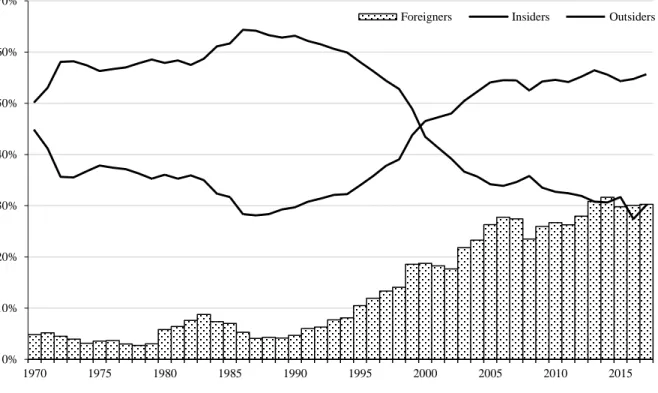
1950–1955 and 15.6% from 1956–1960 (Ministry of Finance 1978, 608). Those contributed to the gradual increase of insider ownership as is shown in Figure 1.
== Figure 1 about here ==
The next notable phase occurred in the middle of the 1960s. It is well documented that in 1965, the stock market collapsed due to excess new seasoned issues. Facing a stock price decline, financial institutions backed by financial authorities set up two price-keeping organizations, namely, the Japan Joint Securities Company (JJSC) and the Japan Securities Holding Union (JSHU). JJSC purchased shares in the open market to stabilize the equity market, and JSHU, with the help of funds supplied by the Bank of Japan, acquired stocks from investment trusts and securities companies.
By 1965, these two institutions had purchased 5% of the equity of all listed companies and held, on average, 5.8% of the ordinary shares of the top 100 companies (a maximum stake of 15.6% and a minimum stake of 0.01%)3. When the two organizations began to liquidate their frozen shares in 1968, the banks and other companies purchased their large proportion, creating the cross-holdings that were to be used to protect companies against hostile control changes arising from the opening of the Japanese stock market to foreign investors. These two organizations sold 37.2%
of their shares to insiders, and if insurance companies are included, the proportion rises to 52.2%. (Franks, Mayer and Miyajima 2014, hereafter FMM 2014).
The third and final phase in which relational/cross-shareholding was established was from 1969 until 1973 and coincided with the issuance of a significant number of new seasoned equity offerings through the placement of shares. This practice was supported by a rule change in 1966 that permitted Japanese companies to sell shares at a discount to third-party shareholders without offering pre-emption rights to existing shareholders (FMM 2014). For new seasoned issues, this legal amendment
3 For more information on this, see Miyajima, Haramura, and Enami (2003), Kawakita (1995), Prowse (1990), Nikami (1990), The top 100 firms’ estimation is based on Franks, Mayer and Miyajima 2014).
9
allowed firms to allot their new issued shares to friendly third parties. As result, the aggregate share held by banks and other corporation increased from 50.3% in 1970 to 58.5% in 1973.
All these facts illustrate that throughout the high growth era, the government was friendly to relational/cross-shareholding. Backed by this pre-relational shareholding stance, the insider dominated ownership structure that was established by the early 1970s (Figure 1) was supported from a regulatory perspective by a pro- relational shareholding framework.
2.2. Policy shift toward anti-insider ownership
As seen in Figure 1, the ownership structure from 1970 until the early 1990s was fundamentally stable, with relatively low foreign ownership. The sudden fall in stock prices following the burst of the bubble in the early 1990s, along with global financializaton, became the main catalyst for foreign institutional investors to start making substantial shareholding acquisitions in Japan, as high stock prices had kept them away prior to the bubble (Amadjian 2007, Jacoby 2010). The upsurge of foreign investors thus began to alter the once strong insider-based shareholding structure.
In the late 1990s, facing a financial crisis that centered on Japanese banks, the regulators started to make drastic decisions to limit the once problematic insider- based shareholding structure. This was a significant policy change in Japan’s post-war financial history. A symbolic event was the enactment of the Order for Enforcement of the Act on Limitation on Shareholding by Banks and Other Financial Institutions (LSB Act) in 2001.
The aim of the law was to reduce the bank shareholdings of client firms mainly because high equity holdings by banks could cause a significant contraction of lending under the BIS regulation and partly because the sales of equity holdings could contribute to the banks writing off non-performing loans (Miyajima and Kuroki 2007).
Consequently, as shown in Figure 2, the percentage share held by banks and
10
insurance companies in the TSE dropped from approximately 30% in 1995 to less than 10% in 2005. This contributed to a period of drastic change in the ownership structure on the Tokyo Stock Exchange from 1997 to 2004, and as banks began to unwind and dissolve their cross-shareholdings on a massive scale, the power balance shifted in favor of outsiders.
Nonetheless, the unwinding of cross-shareholding does prima facie appear to halt by 2004. Likewise, based on data provided by Nissay Research Institute, Figure 3 shows the strict sense of cross-shareholding: from 2004 to 2013, cross-shareholding among corporation remains substantially high, with little or no change. The dissolution of cross-shareholding reached its peak in 2004, when the LSB act set the deadline for companies to decrease their cross-shareholdings to a maximum of their TIER 1 equity capital (approximately 8% of their asset). On the other hand, the percentage share held by foreigners reached its peak of 28% in 2006. Hereafter, the ownership structure was once again stabilized (Figure 1). From Figure 3, cross- shareholding clearly declined dramatically from 1996 to 2005 and that it then remained stable. This drastic change was mainly caused by the dissolution of cross- shareholding between banks and corporation.
== Figure 2 / 3 about here==
There are two notable points on this phase. First, compared with the shareholding of banks and insurance firms, the shareholding of business corporations has in fact remained stable. The percentage share held by business corporations in the TSE continuously remained at approximately 30% in the early 1990s, as seen in Figure 2.
Although the increase in shareholding market value by these corporations did however start to decrease in the early 2000s following a period of economic turmoil, compared to the rapid decline of bank shareholding from 15% in 1996 to 4% in 2012, the size of business firm shareholding in terms of market capitalization has remained stable and was approximately 22% in 2012.
11
Second, strong market fluctuations following the collapse of Lehman Brothers in 2008 subsequently forced many corporations to write off their relational shareholdings as capital losses (Miyajima and Nitta, 2011). This reminded the top management of firms that depending on the existing accounting system, keeping relational shareholding can be associated with higher risk. On the other hand, there was a growing understanding among institutional investors and policy-makers that relational or cross-shareholding by corporations could be one of the reasons for low firm performance partly because it created an inefficient use of capital and partly because it could be used as an entrenchment mechanism of top management to free it from market discipline. It was documented that the profitability of companies with higher cross-shareholding was lower than that of companies with low cross- shareholding. (Miyajima and Kuroki, 2007, Ikeda et al. 2017)
Following the reelection of Prime Minister Shinzo Abe, the government of Japan once again set out to resolve the cross-shareholding issue, assuming that cross- shareholding could be one of the reasons for the low ROE of Japanese firms. The Japanese version of the Stewardship Code (JSC), which is based on the comply or explain principle, was introduced in 2014. The aim of the code was to engage otherwise noncontributing institutional investors in the business of the firms.4 Subsequently, unrelated to any actions of independent outside directors to encourage firms to disclose relational shareholdings, the corporate governance code (CGC), which was introduced in 2015, required firms to disclose the reason for maintaining relational shareholding. The main motivation of this requirement was to increase the return on equity by both realizing the efficient use of capital and by imposing the discipline of capital markets.
Immediately after the CGC was introduced, the three largest banks in Japan, Mizuho Financial Group, Mitsubishi UFJ Financial Group and Sumitomo Mitsui
4 The non-contributing institutional investors refer to the major institutional investors who do not actively engage in the business of the firms and increase its profitability. Such investors are usually characterized as insurance companies, banks and other domestic institutional investors, as well as the major Japanese Pension Funds.
12
Financial Group, assured regulators they would follow the new statutory reform and would accelerate the unwinding of cross-shareholding in 20155. However, note that in this stage, the main part of relational shareholding was no longer centered on banks, and cross-shareholding between banks and firms was not the major target of the policy. Note also that the remaining relational shareholding was very hard to dissolve because it was supported by mutual relationships between firms and was often associated with cross-shareholding.
3. HOW TO UNDERSTAND RELATIONAL AND CROSS-SHAREHOLDING 3.1. The relationship between two companies
The relational shareholding, which is an unique features of the ownership structure of Japanese firms, is different practice from the portfolio investment of firms. Different from portforio investment, which aim is to maximize the share value. The aim of relational shareholding is not limited to maximize share value, but either to maintain the control power over or keeping long-term relationship to firms in which they invested. Although relational shareholding and cross-shareholding are overlapping, they are different concepts. The latter focuses on the ownership structure of a company, while the former focuses primarily on the financial (investment) policy of a firm. Therefore, whereas relational shareholding is not necessarily associated with cross-shareholding, relational shareholding it . A firm often held the and On the other hand, cross-shareholding will be primarily determined by the shareholder’s preference, as under mutual ownership, the issuer’s decision will be secondary in the sense that the issuer’s selling is seemingly induced by the shareholder’s selling.
Table 1 summarizes the firm characteristics in 2012 (just before the launch of Abenomics) among the firms in the first and fourth quartile in terms of their relational shareholding ratio and those in the first and fourth quartile in terms of their cross-
5 Nikkei June 1, 2015, Lewis (2015).
13
shareholding ratio. The firms are mostly overlapping: for holdings in both categories, 63.1% of the firms in the top quartile the same, and 50.6% of the firms in the bottom quartile overlap. As a result of the overlap, the characteristics between the two categories appear the same.
== Table 1 about here ==
Compared the firm in the top 25% in the relational shareholding ratio with those in the bottom 25%, and the firms in the top 25% in cross-shareholding ratio with the firms in the bottom 25%, respectively, firms in the top of 25% of both categories on average are lower in profitability and volatility of performance, smaller in the market value, lower in the growth opportunities, capital expenditures, R&D, M&A, as well as lower in their percentage of foreign ownership,
It is this inverse correlation between high relational / cross-shareholding and corporate performance to which the Abe cabinets and other policy-makers have paid serious attention.6
Note that due to reverse causality, the exact causal relationship between high relational/cross-shareholding and low profitability, less volatility, and low growth opportunities is not clear: the decision to sell relational shareholding is voluntary, and, consequently, firms with low profitability and low growth opportunities are likely to keep their relational /cross-shareholdings to maintain a close relationship with other firms or due to their lack of institutional investors. This is exactly what happened during the 1997-2004 period, when the cross-shareholding of banks was rapidly dissolved (Miyajima and Kuroki 2007).
However, once ownership structures were stable post-2006, it is highly plausible that the high relational shareholding caused low performance (low ROA, low return and less active investment). Miyajima and Nitta (2011), Miyajima and Hoda (2015),
6 It used to be supposed that cross shareholding played positive role in Japanese economic growth. See, Aoki, 1990), Abeglen and Stark (1985), Frath (1993), Odagiri (1992).
14
Miyajima and Ogawa (2016) all reported that the high foreign or institutional ownership caused the low performance, while Ikeda, Inoue and Nagao (2018) documented that firms with high cross-shareholding were likely to have had low performance due to enjoying the so called “quiet life”.
3.2 Preliminary Test
To identify the effect of corporate governance reforms on relational shareholding, using the cross-shareholding ratio provided by Nissay Research Institute from 2005 to 2017, we conduct a primary test on the determinants of the cross-shareholding among all listed firms in the TSE from 2005 to 2017. The reason for testing the cross- shareholding instead of relational shareholding is that for all listed firms, only the cross-shareholding ratio is available for both the long term as well as the short term.
To measure the determinants of cross-shareholding for the all TSE firms, we adopt the following model:
𝐶𝑟𝑜𝑠𝑠 = 𝐹(𝑃𝑜𝑟𝑡, 𝐹𝑖𝑛𝑎𝑛𝑐𝑖𝑙 𝑁𝑒𝑒𝑑𝑠, 𝐸𝑛𝑡𝑟𝑒𝑛𝑐ℎ𝑚𝑒𝑛𝑡, 𝐺𝑜𝑣, 𝐶𝐺𝐶) (1)
where Cross is our dependent variable and denotes the percentage of cross- shareholding, i.e., the aggregate percentage of issued-firm shares held by other companies whose shares in turn are held by the issued firm divided by the total outstanding shares of an issued firm. These data is provided by Nissay Research Institute.7As explanatory variables, we exclusively focused on the variables related to a issued firm. Since this ratio, Cross, could also be decided by the characteristics of the shareholders side, the model is far more perfect. However, as preliminary approach to the issues, it would be helpful.
Here, Port is the portfolio factor, which is proxied by using the actual book value of marketable securities to total assets, and it captures the inherent risk of each investment portfolio. Financial needs is a variable that captures the needs of a firm in
7 Nikkei Cges provides the total shareholding ratio by a public company that can hold mutual shares.
15
the decision to keep or sell shareholdings, assuming that companies are expected to sell them if the firms are financially unhealthy: the debt to assets ratio is picked up as this proxy. The return on assets is used to control for a firm’s profitability.
Entrenchment is a series of variables that could capture the perception of management to the market pressure, including the takeover threat. As proxies, we use the firm size and market valuation. Shares of firms that are small in size and or undervalued by the market are expected to be kept by other firms to deter takeover threats from aggressive outside shareholders. The Gov is a series of variables related to corporate governance arrangements, such as the domestic and foreign institutional shareholder ratios, each related to formidable monitoring incentives. Domestic institutional investors comprise the shareholding by trust banks and asset management firms to whom government and private pension funds have delegated their money to manage. Many of these domestic institutional investors have been passive but subsequent to the amendment of fiduciary duties in the early 2000s, were encouraged to actively use their voting rights. Unlike its domestic counterparts, foreign institutional investors were and are known for not staying silent and have therefore in many cases been treated as an outside threat to corporate management of many Japanese corporations.
Last, we check for the effect of the CGC and control the interaction of the corporate governance factors. The CGC is captured by using a dummy variable that assumes the number 1 if the fiscal year is between 2014 and 2017.8 Estimation period is 2010-2017, the fixed effect model is applied.
The results are shown in Table 2. Considering the fact that corporate management might urge other companies to increase cross-shareholding when debt increases, note the following three points: First, the coefficient of the CG dummy is significantly negative, suggesting that following the CGC, firms were actively urging other companies to dissolve their shareholding in Japan. The magnitude is
8 Although the CGC was introduced in 2015, corporate management was assumingly already prepared to decide to sell. Given this assumption, we choose to include 2014 to capture the effects just prior to the enactment of the CGC.
16
approximately 1.0%–3% on average. This effect was further verified through various robustness checks (including but not limited to year dummies for 2014, 2015, 2016, and 2017).
--- Table 2 about here ---
Second, the coefficient of domestic and foreign institutional investors is significantly negative, suggesting that, in actions unrelated to the CGC reforms, these investors actively encouraged corporate management to dissolve cross-shareholding.
Third, conversely, after corporate governance reforms, institutional investors had a positive effect, which implies that the effect of the CGC is much stronger in firms with low institutional shareholding and that the role of the CGC is substitutional to the pressure of institutional shareholding. According to Model 3, suppose that a firm has foreign shareholding of zero %, 13.7% (median), and 30%: after the CGC reforms, the cross-shareholding decreases by -1.02% (CGC effect=-1.025%, the other pressure effect and the interaction term is zero), -0.84% and -0.63%, respectively.
In summary, these estimates provide evidence that following the regulatory change, companies were actively seeking to dissolve cross-shareholding in companies listed on the First Section of the TSE. This effect is especially clear among firms with low institutional ownership, which were thus far less likely to sell their relational shareholding.
However, taking cross-shareholding as a dependent variable is an indirect way for testing the policy effect because changes of cross-shareholding ownership may not be exclusively determined by the decision of the issued firms. Furthermore, ranging from the outsider- (institutional investors) dominated firms to the insider- (other corporations) dominated firms, the ownership structure of TSE firms was very diversified. To identify the consequences of the policy change, we conduct a test on the implicit target of the CG reforms, namely, the corporations with a high level of relational shareholdings.
17
4 DETERMINANTS OF SOLVING RELATIONAL SHAREHOLDING
4.1 Data
We now turn our focus to the direct shareholding of companies with a higher than average amount of relationship shareholding (Seisaku-hoyu kabu). Relationship shareholdings are one of the main focus areas of the CGC and refer to situations in which a company has relational shareholdings composed of block holdings and minority shareholdings, e.g., transactional relationships or stabilized equity structures.
For listed firms with relational holdings, the CGC required the firms to explain the reason for their relational shareholding and to address its appropriateness (CGC, Principle 1.4). To provide an in-depth estimation of the direct effect of the CGC on relationship-based shareholding, a focus on firms with a higher relational shareholding ratio is a reasonable approach. Here, the rational shareholding ratio (RSR) is defined as the aggregated relational shareholding divided by total assets. In our sample, we include the top 25 percent of firms, which comprises firms with an RSR higher than the 75th percentile: we use the cross-shareholding ratio provided by Nikkei Cges in 2016.9 Given the availability of the information availability, out of those top 25 percent firms, we randomly select 200 firms as a sample of companies.
Table 3 provides a comparison of the market capitalization size and the relational shareholding to total asset ratio between all companies listed on the First Section of the TSE, the bottom 25% of firms in relational-shareholding, the top 25% of firms in relational-shareholding and the randomly selected sample of 200 firms. While the relational shareholdings to total assets ratio (RSR) for all listed companies varies from a minimum of 0 to a maximum of 53%, it is approximately 4.6% on average. In comparison, the firms in the top 25% have a substantial RSR, ranging from a minimum of 6% to maximum of 53%, with a mean of 10.3% and a median of 8.5%.
Among those firms in the top 25%, we then randomly selected 200 companies
9 Nikkei Cges only started to publish the data on the amount of relational shareholding /total assets in FY2016.
18
(excluding financial institutions). Here, the relational shareholding ratio varies from a minimum of 6% to a maximum of 37%. The sample average is 11.5% and does not differ from the average of the top 25% firms. Compared to the market capitalization size of both the top 25% and the bottom 25% firms, although not larger in terms of the maximum size, the market capitalization size of the sample, however, is substantially larger for almost all percentiles in the dataset. Using the disclosed information on each relational shareholding, we create an aggregated sample and control for each specifically disclosed cross-shareholding and omit entities that lack a securities code (mostly foreign).
--- Table 3 About Here ---
For capturing the decision of a firm on relational shareholding, it is not appropriate to focus on the RSR based on its current value, as it is highly subject to the market fluctuations. Therefore, we use the actual number of shares of relational shareholding, which is available from the end of FY 2010, when the amendment of information disclosure rule first required firms to disclose the details of their relational shareholdings.10
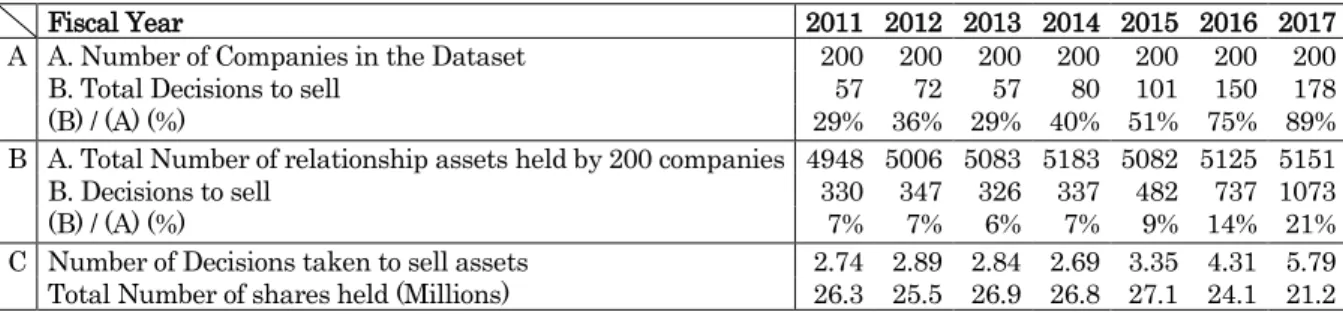
Table 4, row A shows the aggregated number of firms that sold at least one named stock from their relational shareholdings. In row A, the percentage of companies that decided to sell considerably increases from 36% in 2012 before the CGC to 51% in 2015 and to 89% in 2017. Row B represents the aggregated number of named stocks in relational shareholdings for all 200 companies and those that were sold. A substantial increase in the decision to sell is also observed following the enactment of the CGC in 2015. From 2015 to 2017, the total number of decisions to sell increased from 330 in 2012, to 482 in 2015, and to 1073 in 2017; consequently, the probability of a relational shareholding asset being sold increased from 7% in 2012 to 21% in 2017.
10 The amendment required all listed firms to disclose the following: the name of the firms, the number of holding shares, and the book and current values of those shares.
19
Last, row C shows the average number of sample firm decisions, which is the number of decisions to sell at time t standardized by the number of named stocks held at the beginning of t (i.e., at the end of t-1). It shows a discontinuous jump in 2015 from the previous 2.7 level to 3.4 and reaches as high as 5.8 in 2017. The last row represents the total number of shares per firm, which following the CG reforms, declined from 26.9 million to 21.2 million, roughly a 22% reduction.
--- Table 4 about here ---
In light of these simple descriptive statistics, we posit that the CGC reform has been effective not only for all listed companies but also implicitly for the top 25% of relational-shareholding companies (the core of cross-shareholding companies) as well.
To better understand the effects, we first estimate the aggregated data that may affect a company’s decision to sell relational shareholding.
4.2 Decision of selling stocks We adopt the following model:
𝑆𝑁𝐷𝑖 = 𝐹(𝑃𝑜𝑟𝑡𝑓𝑜𝑙𝑖𝑜, 𝐸𝑛𝑡𝑟𝑒𝑛𝑐ℎ𝑚𝑒𝑛𝑡, 𝐹𝑖𝑛𝑎𝑛𝑐𝑖𝑎𝑙 𝐻𝑒𝑎𝑙𝑡ℎ, 𝐺𝑜𝑣𝑒𝑟𝑛𝑎𝑛𝑐𝑒, 𝐶𝐺𝐶) (2)
Here, the dependent variable is SND, denoting the total number of decisions at time t.
As an explanatory variable, Portfolio is the proxy to capture the intrinsic value and risk of the relative size of relationship shareholding to total assets: we assume that management would liquidate sizable marketable securities to effectively lower risk. Unrealized capital is the ratio of the current fair market value over the acquired book value of the relational shareholding asset. It is expected that a low capital gain would be associated with the selling of relational shareholdings. As in the model in
20
section 3, financial health, on the other hand, aims to capture the financial needs, assuming that firms are more likely to sell when financial health deteriorates. The fiduciary duties of the major shareholders are captured via the governance proxy, as each shareholder is expected to act rationally and at the shareholders’ meeting, they are expected to actively vote to follow the CG reforms and dissolve each shareholding.
We also add the activist dummy, which equals one if the activist funds with more than 5% block shareholding can be identified in the previous firm year11. Having an aggressive outsider shareholder present is generally assumed to affect the decision- making: it is not clear whether the effect will cause corporate management to decide to increase the amount of cross-shareholding as a countermeasure or to choose to give in to the pressure and decrease the number of cross-shareholdings. The CGC is simply a dummy to capture the effect of the CGC reforms and equals one if a firm belongs to a firm year from 2014–2017. Table 5 provides the descriptive statistics of the variables.
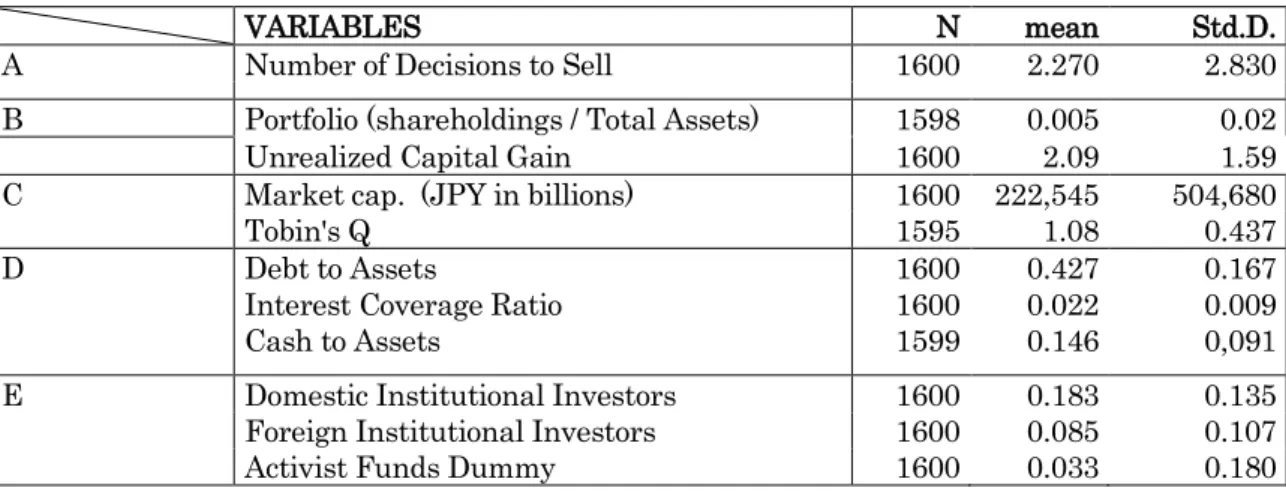
--- Table 5 About Here ---
The statistical summary has been divided into different categories for simplicity.
First, row A represents the independent variable, NSD, the number of decisions standardized by the number of named shares at the beginning of time t: its mean is 2.27. Row B represents the portfolio factor and includes the real size of relational shareholdings, i.e., the relational shareholdings balance sheet value to total assets and the unrealized capital gain. The acquired book value of the relational shareholding assets to total assets is on average 0.4%, while the current value over the book value is on average 2.09. Row C shows the statistics for each entrenchment factor. The financial needs in row D include the cash to assets ratio, the market capitalization size, Tobin’s Q, the debt to assets ratio, and a dummy variable for the interest coverage ratio; we use ICR as dummy variable, which equals one if the interest coverage ratio is below 2.
11 For identifying the activist funds, we use Hamao and Matos (2018), Becht et al (2017) and a new list produced by Ryo Ogawa and Kazunori Suzuki.
21
Governance is covered in the last row, E, denoted by the domestic and foreign institutional investors’ shareholding ratio as well as the frequency of the activist dummy. Activist fund block shareholder situations, where an outside investor aggressively can acquire a substantial portion of voting rights in order to change a company to maximize profit often against the will of corporate management, are relatively common in the United States,; however, this is a relatively new phenomena in Japan12. Among our sample, the percentage of firms that have a block shareholder activist fund is only 3.3%. Furthermore, each governance factor has been estimated separately from CGC estimations.
Table 6 summarizes the estimation results. There are three points to be noted.
== Table 6 about here ==
First, the portfolio factor and financial factors are basically working as we expected.
The coefficient of the size of shareholding is positive, although not sufficiently significant. The coefficient of the unrealized capital gain is negative, with a 1%
significant level, implying that a firm with the expectation of having on the whole a lower capital gain is likely to sell their relational shareholdings. On the other hand, firms with high debt and low Q are as likely to sell their relational shareholding.
Second, most remarkably, the SND is less likely when the outside ownership is high, which is in contrast to the previous section’s cross-shareholding estimation, where the cross-shareholding ratio is negatively correlated to the outsider ownership ratio. The coefficient of foreign and domestic institutional shareholding is all significantly negative, suggesting that firms with high outsider ownership are less likely to sell their relational shareholding. This fact is the main reason that those firms are called bedrock companies of cross-shareholding (Ganban Kigyo).
12 Most famous in Japan is perhaps the takeover bid by Steel Partners, an aggressive activist investor, to buy all the outstanding shares in Bull-Dog Sauce in 2007. In this situation, to effectively dilute the Steel Partners shares, the board of directors of Bull-Dog Sauce decided on an anti-takeover proposal, i.e., to take the poison pill. Ultimately, Steel Partners was forced to give up and sold all shares a year later.
22
Third, similar to previous estimates, the CGC dummy is significantly positive, with a 1% significance level, showing that the Corporate Governance Code once again has been effective. The magnitude of the CGC is approximately 0.8 to 0.9 (Models 1, 3, and 5). If we include the interaction term between the CGC dummy and ownership, it is estimated from 1.3–1.5 (Models 2, 4, and 6), although the discouraging effect of institutional shareholders on dissolving relational shareholding is strengthened.
Taking the same approach as that in section 3, suppose that firm has foreign shareholdings of zero %, the median of 8.5% and 30%; after the CGC reforms, the number of relational shareholding sales ranges from 1.3 for a firm with zero foreign ownership to 0.61 for a firm with median foreign ownership (CGC effect=1.33, constraint effect 0.36 and combined negative effect, 0.35) to -1.27 for firms with 30%
foreign ownership. Thus result suggests that the CGC encouraged relational shareholding, but it was highly conditioned by the ownership structures.
As in its analysis, the estimation above uses the yearly number of firm decisions to sell relational shareholdings, we cannot identify what type of firm share is likely to be sold or the extent to which the mutual relationship (cross-shareholding) influenced the decision. Next, in order to address this issue, instead of considering the total number of firm sales as the unit of analysis, we estimate the determinants of the individual relationships on relational shareholding.
4.4 Determinants of Individual relationship
For estimating the determinants concerning each relational shareholding asset, we use the following estimation model.
𝐷𝑆 = 𝐹(𝑋𝑖, 𝑌𝑗, 𝑍, 𝐶𝐺𝐶) (3)
Our independent variable, DS, is the decision of firm i to sell a firm j’s share and is a dummy variable which equals one if a share has been sold and zero otherwise (not a
23
sale or a purchase). As Table 4 shows, there are approximately 5000 total named stocks held by sample firms and 25 named stocks were originally held by a sample firm in 2012. On average, 2.74 out of 25 named stocks were sold in 2012, and the number sold increased to 5.79 in 2017.
For explanatory variables, the model includes the variable, Xi, denoting the characteristics of firm i; we employ the same proxies, namely, portfolio factor, financial needs, and entrenchment concern, as in model (2). In addition, we introduce, Yj, denoting the characteristics, such as market capitalization, rate of return of stock and Tobin’s Q, of firm j,. XiYj is the portfolio factor of firm j, i.e., the book value of firm j over the total relational shareholding of firm i, i.e., the unrealized capital gain of firm j.
The fourth variable is Zij, which captures the cross-shareholding between i and j.
CROSS is firm j's shareholding of firm i, and is a dummy variable for capturing the mutual relationship. Another variable is COM, denoting firm i's shareholding of firm j:
it represents the percentage share and captures the commitment of firm i to firm j. the expectation is that firm i is less likely to sell those firms in which it has a large stake.
Table 7 summarizes the descriptive statistics of the dataset comprising the 200 core cross-shareholding firms. The first row, DS, represents the decision to sell for each disclosed asset. On average, the probability of deciding to sell an asset among companies with high-relational shareholding is approximately 7%. The Xi rows include firm i’s investment portfolio, financial factors, and ownership structures. The Yj row shows the statistics for each entrenchment factor, and the XYij row shows the characteristics of each asset represented in the last panel.
The sixth row provides information on Zj, a new variable of this estimation. This row includes a series of characteristics of firm j. Regarding the cross-shareholding relationship for which we use a dummy variable, CROSS is observed in 4351 out of 39885 relational shareholdings (roughly 10% of the total relationships). As a reference, the average shareholding ratio of firmj to firm i is 2.5%, with a standard deviation of approximately 2.7%. Conversely, denoting company i’s shareholding of company j, COM is on average 0.3%.
24
--- Table 7 About Here ---
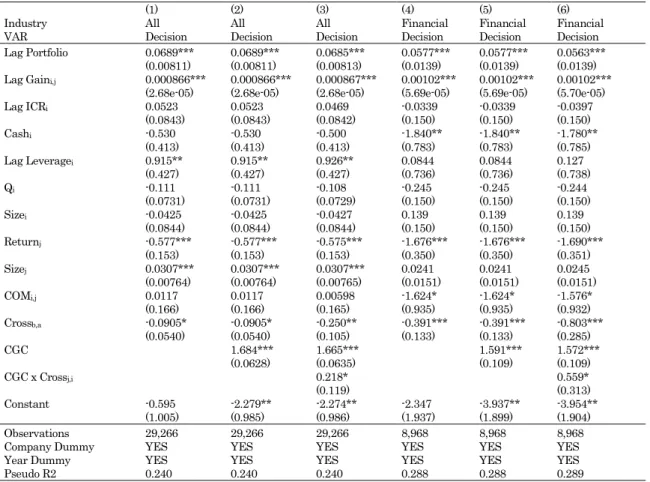
Table 7 summarizes the estimation results on equation (3). Models 1 to 3 consider all firms, and in Models 4 to 6, the sample is limited to the relational shareholding of financial institutions, i.e., banks, insurance firms and trust banks, which comprise the main portion of all relationship shareholdings. First, concerning XYij, the portfolio factors, namely, the book value of the relational shareholding of firm j to the total relational shareholding of firm i and the unrealized capital gains of firm j, are all significantly positive. Management is therefore concerned over certain risk factors in terms of asset size or the unrealized capital gain of firm j, both of which ultimately increase the chances of a decision to sell such assets. Additionally, financial distress also plays a role when determining whether to decide to sell. In particular, in all industries, corporate management is more likely to sell when leverage is high, although this would not be the case for financial institutions. As for variables related to Yi, the coefficient of size j is positive, while that of return is negative, suggesting that firm i is likely to sell shares that are easy to liquidate, as well as firm shares with low returns.
Understanding the financial factors reasonably explains the decision regarding individual relational shareholding; however, our concern is the effect of CGC and mutual relationships. First, the coefficient of the CGC dummy is significantly positive in all models. This result is in line with previous estimates and proves that the CGC in fact has encouraged corporate management to dissolve not only cross-shareholding among listed firms but also relational shareholding among firms within the top 25%
(“Ganban Kigyo”).
Second, the coefficient of COM is negative for the relational shareholding of firms in financial industries, suggesting that the high commitment of firm i to j is likely to result in the companies keeping their relational shareholding. On the other hand, the coefficient of Cross is negative, confirming that cross-shareholding relationships are
25
impediments to the sales of relational shareholdings. This is particularly the case for financial firms (Models 4–6). Most importantly, note that the interaction term of Cross and the CGC dummy is positive, suggesting that the impediments effect of cross- shareholding could be mitigated by the CGC reform. According to Model 3, the discouraging effect of CROSS (-0.25) is almost offset by the interaction term (+0.22), implying that compared to the pre CGC period, in the period after the implementation of the CGC reforms, 80% of the discouraging effect in cross-shareholding was reduced.
--- Table 8 About Here ---
4.5 Summary
In these estimates, we have shown that the CGC has been effective not only for all companies listed in the TSE but also for companies with high relational shareholdings (Ganban-kigyo). Through this in-depth view on cross-shareholding, we have proved that an increase in domestic and foreign institutional shareholders was unable to encourage corporate management to effectively mitigate the decision to dissolve cross- shareholdings. Last, through our estimation on each particular asset, we confirm that there is an intercorporate linkage trying to encourage the CGC reforms. The interaction effect between the cross-investment of shareholding and the CGC mitigates this effect to some extent but not entirely. Conclusively, we have determined that the overall change has been positive, but there have been a few drawbacks, as previously noted.
5.POST-REFORM FINANCIAL POLICY
5.1 Myopic Managerial Decision Making
In this final section, we aim to explore how corporations reallocate newly gained cash from selling relational shareholdings. The CG reforms aimed to make firms more
26
profitable via dialogue and the unwinding of the otherwise assumed unprofitable relational shareholdings. The government is focused on making firms reinvest their cash holdings to increase profitability, e.g., through active physical investment, research and developments and M&A. Managerial decision-making is however not easily budged. In many cases, poor corporate governance tends to foster the indulgence of corporations in less profitable management decisions, whereby many firms take on substantially higher levels of cash holdings (Harford et al. 2008, Dittmar and Mahrt- Smith, 2007). This effect has been observed in Japan for many years, as consistent with the understanding of weak corporate governance in Japan, market valuations of firms has been lower than those of U.S. firms in the 1990s (Kato, Li, and Skinner, 2012).
The decline of insider control throughout the 1990s drastically tilted the power balance of equity holders and proved to be a useful tool against entrenched corporate management, to improve corporate governance and to further unwind the deep-rooted cross-shareholding among firms (Miyajima and Ogawa 2016). To mitigate the threat of aggressive outside equity holders, some firms made large stock repurchases to prevent forceful takeovers (Stulz, 1998; Bagwell, 1991); however, the repurchased stock of Japanese firms was resold to insiders, thereby weakening the unwinding of cross- shareholding (Franks, Mayer, Miyajima and Ogawa 2018). Similar managerial behavior has been observed, as short-term investments are effectively being used to bolster stock performance: this has resulted however in negative long-term consequences, as management is willing to trade off investments to increase the dividend payout ratio and share repurchases, which in turn increase agency problems (Edmans, Fang, and Huang, 2018; Almeida, Fos, and Kronlund, 2016).
It is thus necessary to recognize the final use of sold shareholding assets, as these may affect the value of the firm and therefore also generate additional agency problems. This section addresses this issue. Our estimations take the same approach as that in Franks et al. (2018) who measure how management uses internal stock repurchase programs to coordinate the shareholding structure and deter outsider
27
threats. In addition, using our previous data on relational shareholding, to capture the short-term effects of managerial behavior on financial policy for share buybacks, dividend payouts as well as real investments, we include the number of decisions taken.
5.2 Effect on Corporate Policy
For addressing the decision of relational shareholding on corporate policies following the CGC reforms, our model follows that of Franks et al. (2018).
𝑃𝑂𝐿𝑖, 𝑡 = F(𝑄𝑖,𝑡, 𝐶𝐹𝑖,𝑡−1, 𝐿𝐸𝑉𝑖,𝑡−1, 𝐷𝐸𝑆𝑖,𝑡, 𝐷𝐸𝑆𝑖,𝑡−1, 𝐶𝐺𝐶) (4)
Here, POL is a series of corporate policy variables. The first group is related to real investment: M&A, the amount of the increase of an asset by M&A to total assets; the ratio of CAPX physical investment to fixed assets; and R&D, the total R&D expenditure to total sales ratio. The second group is related to financial policy:
buyback represents the ratio of the share buyback amount to the market capitalization of a company and is used to capture the relative size of each executed repurchase amount. Moreover, dividend is the yearly change in the dividend payout ratio, and cash holdings are standardized by the amount of total assets.
Estimating real investment, we follow the standard investment function based on the Q theory and add financial factors such as cash flow and leverage. As explanatory variables, Q is the lagged Tobin’s Q, while CF is the lagged cash flow: we use them to capture the companies’ financial capabilities. Leverage is the debt to assets ratio.
Our main variable of concern is DES, the actual number of decisions taken to sell relational shareholding assets. To fully capture the effect of DES, we introduce DES at time t and DES in time t-1. CGC is a dummy for the CG reform years. The results are presented in Table 9, Panels A and B.
28
--- Table 9 about here ---
Panel A shows the estimation results of the relational shareholding sales decision to the investment behaviors. The results show that highly leveraged firms are more inclined to decrease overall expenditures, as is seen in all models (1-6), while R&D and CAPX are constrained by cash flow. The number of decisions made to sell in either time t or in the previous year does not affect management’s decision to alter R&D, M&A, or CAPX
Panel B shows the estimation results of the relational shareholding sales decision to the financial decision. Different from the effect on real investment, the sales decision has a significant effect. Whereas the actual number of decisions to sell does not significantly impact share buybacks, it significantly increases the yearly dividend payout ratio (model 3 and 4). Since the number of decisions of selling relational shareholding increased after the CGC, the effect could be understood as substantial.
On the other hand, cash holding is also positively related to the number of decisions, implying that the dissolving of relational shareholding resulted in the increase of cash holding.
Since the CG reforms are ongoing, it is too early to conclude their effect. Thus far, what we have found is that in post-reform decisions connected to the sales of a relational shareholding asset, corporations are more inclined to increase dividend payouts rather than investment as well as to increase short-term cash holdings once a decision has been made.
In these concise estimates, we have shown that despite the intention of Abenomics, following the CG reforms, firms with substantial relational shareholding are more inclined to increase dividend payouts and cash holdings.
29 6.CONCLUSION
In this paper, we have shown that a series of corporate governance reforms that mainly comprised the Corporate Governance Code and the Stewardship Code regulations have been effectively implemented for dissolving relational shareholding.
The companies listed on the Tokyo Stock Exchange are now proactively seeking to re- evaluate relational shareholding and determine its appropriateness. At the same time, domestic and foreign institutional shareholders have played active roles in encouraging corporate management to further dissolve cross-shareholdings for all listed companies, although not in conjunction with the CGC reforms.
Given this situation, the CGC reforms also had a substantial impact on firms with substantial portions of relational shareholdings (“Ganban kigyou”). They were reluctant to dissolve the relational shareholdings in the face of the pressure of domestic and foreign shareholders. However, after the CG reforms were implemented, they began to sell their relational shareholdings. Similarly, firms with substantial portions of relational shareholdings were likely to keep their relational shareholdings of firms with which they have a cross-shareholding relationship. After the CG reforms, they also reduced their relational shareholdings of those firms. In these situations, the CG reforms had a substantial impact in dissolving the relational shareholdings among the bedrock firms (“ganban Kigyo”)
Last, we find that inconsistent with the objectives of CG reform, firms that dissolved relational shareholdings are more inclined to increase dividend payouts and cash holdings rather than to increase actual investments (physical investment, R&D and M&As). As a tentative conclusion, we can say that the regulations might have partially contributed to the efficient use of capital, but they did not encourage the actual investment as originally planned in Abenomics.
30 REFERENCES
[1] Abegglen, J. C. and Stalk, G. Jr. (1985). Kaisha: the Japanese Corporation (Charles E.
Tuttle).
[2] Almeida, H., Fos, V., and Kronlund, M. (2016). The real effects of share repurchases. Journal of Financial Economics, 119(1), 168-185.
[3] Ahmadjian, C. L. (2007) “Foreign investors and corporate governance reform in Japan”
in Aoki, M., Jackson, G., and Miyajima, H. (eds.) Corporate Governance in Japan:
Institutional Change and Organizational Diversity (New York: Cambridge University Press), pp. 125-50.
[4] Aoki, M. (1990). Information, incentives and bargaining in the Japanese economy: a micro theory of the Japanese Economy. Cambridge University Press.
[5] Ono, A., Suzuki, K. and Uesugi, I. (2017). When Japanese Banks Become Pure Creditors: Effects of declining shareholding by banks on bank lending and firms' risk taking, RIETI Discussion Paper, No. 17079.
[6] Bagwell, L. S. (1991). Share repurchase and takeover deterrence. The Rand journal of economics Vol 22 nr 1, 72-88.
[7] Dittmar, A. and Mahrt-Smith, J. 2007. Corporate governance and the value of cash holdings. Journal of Financial Economics 83: 599-634.
[8] Edmans, A., Fang, V. W. and Huang, A. (2018). The long-term consequences of short- term incentives. CEPR Discussion Papers No. DP12305
[9] Fama, E. F. (1980). Agency problems and the theory of the firm. Journal of political economy, 88(2), 288-307.
[10] Flath, D. (1993). Shareholding in the keiretsu, Japan's financial groups. The Review of Economics and Statistics, 249-257.
[11] Franks, J., Mayer, C. and Miyajima, H. (2014). The ownership of Japanese corporations in the 20th century. The Review of Financial Studies, 27(9), 2580- 2625.
[12] Franks, J., Mayer, C., Miyajima, H. and Ogawa, R. (2018). Stock Repurchases and Corporate Control: Evidence from Japan (No. 18074).
[13] Hamao, Y. and Matos, P. (2018) “U.S.-Style Investor Activism in Japan: The First Ten Years,” Journal of the Japanese and International Economies, Vol. 48, 29-54 [14] Harford, J., Mansi, S. and Maxwell, W. 2008, Corporate governance and a firm’s cash
holdings, Journal of Financial Economics. 87: 535–555.
31
[15] Ikeda, N., Inoue, K. and Watanabe, S. (2018). Enjoying the quiet life: Corporate decision-making by entrenched managers. Journal of the Japanese and International Economies, 47, 55-69.
[16] Jacoby, S. (2010) “Foreign Investors and Corporate Governance in Japan: The Case of CalPERS,” in Whittaker, H. and Deakin, S. eds., Corporate Governance and Managerial Reforms in Japan, Oxford University Press, pp. 93-133.
[17] Jensen, M. C. (1986). Agency costs of free cash flow, corporate finance, and takeovers. The American Economic Review, 76(2), 323-329.
[18] Kato, K., Li, M. and Skinner, D.J., 2012. Is Japan Really a" Buy"? The Corporate Governance, Cash Holdings, and Economic Performance of Japanese Companies. [19] La Porta, R., Lopez-de.Silanes, F., Shleifer, A. and Vishny, R. (1998), “Law and
Finance,” Journal of Political Economy, 106(6), pp. 1113-1155.
[20] Miyajima, H. (1994). “The Transformation of Zaibatsu to Postwar Corporate Groups:
From Hierarchical Integrated Group to Horizontally Integrated Groups”, Journal of the Japanese and International Economies, Vol8 (3), pp293-328, 1994
[21] Miyajima, H. (1995). The privatization of ex-zaibatsu holding stocks and the emergence of bank-centered corporate groups in Japan. In Aoki, M. and Kim, H.
eds. Corporate governance in transitional Economies, The World Bank, Washington D.C. pp.361-399.
[22] Miyajima, H. (2004), Sangyo Seisaku to Kigyo Tochi no Keizaishi: Nihon Keizai Hatten no Micro Bunseki (Indsutry Policy and Corporate Governance in Historical Perspective: Institutional Analysis of Japanese Economic Development), Yuhikaku
[23] Miyajima, H., Haramura, K. and Enami, Y., 2003. Sengo Nihon Kigy¯ o no Kabushiki Shoy¯ u-k¯ oz¯ o [Evolution of ownership structure in postwar Japan:
Formulation and unwinding of stable shareholders] in Japanese. Financial Review 68:203–36, Policy Research Institute of MOF.
[24] Miyajima, H. and Kuroki, F. (2007). The Unwinding of Cross-Shareholding in Japan:
Causes, effects, and Implications1, in Corporate Governance in Japan:
Institutional Change and Organizational Diversity: Institutional Change and Organizational Diversity, Oxford University Press.
32
[25] Miyajima, H. and K. Nitta (2011) “Kabushiki Shoyukozo no Tayoka to sono Kiketsu,” [Diversity of Ownership Structure and Its Consequences: Unwinding and Revival of Cross-Shareholding and the Role of Foreign Shareholders]in H.
Miyajima eds., Nihon no Kigyo Tochi – Sono Saisekkei to Kyosoryoku no Kaifuku ni Mukete [Corporate Governance in Japan: Towards the Redesign of Corporate Governance and the Revival of Competitiveness ], Toyo Keizai Shinposya, pp. 105- 149 (in Japanese).
[26] Miyajima,H. and T. Hoda (2015) “Ownership structure and corporate governance:
has an increase in institutional investors’ ownership improved business performance”, Public Policy Rev., 11 (2015), pp. 361-393.
[27] Nikami, K. 1990. NihonnoShoken Gaisha Keiei [Management of securities houses in Japan] in Japanese. Tokyo: Toyo Keizai Shinpo-sha.
[28] Odagiri, H. (1994). Growth through competition, competition through growth:
Strategic management and the economy in Japan. OUP.
[29] Porter, M. E. (1992). Capital disadvantage: America's failing capital investment system, Harvard Business Review, 70(5), 65-82.
[30] Porter, M. E. (1994), Capital Choices (Harvard University Press).
[31] Prowse, S. D. (1990). Institutional investment patterns and corporate financial behavior in the United States and Japan. Journal of Financial Economics, 27(1), 43-66.
[32] Sheard, P. (1994). Interlocking shareholdings and corporate governance. The Japanese firm: The sources of competitive strength, New York: Oxford University Press, 310-349.
[33] Shleifer, A. and Vishny, R. W. (1989). Management entrenchment: The case of manager-specific investments. Journal of financial Economics, 25(1), 123-139.
[34] Stein, J. C. (1989). Efficient capital markets, inefficient firms: A model of myopic corporate behavior. The Quarterly Journal of Economics, 104(4), 655-669.
[35] Stulz, R. (1988). Managerial control of voting rights: Financing policies and the market for corporate control. Journal of Financial Economics, 20, 25-54.
[36] Weinstein, D. E. and Yafeh, Y. (1998). On the costs of a bank‐centered financial system: Evidence from the changing central bank relations in Japan. The Journal of Finance, 53(2), 635-672.
[37] Yafeh, Y. and Yosha, O. (2002). Large shareholders and banks: Who monitors and how?, The Economic Journal, 113(484), 128-146.
[38] Lewis, L. (2015). Japanese banks to accelerate unwind of cross-shareholdings.
Financial Times.
33
[39] Miyajima, H. and Nitta (2011). A Diversification of Ownership Structure and its Effect on Corporate Performance: Unwinding and resurgence of cross-shareholdings and the role of surging foreign investors (in Japanese) (No. 11011).