COMMUNICATION
Stereoselective Total Synthesis of Myriocin Using Rh(II)- Catalyzed C–H Amination Followed by Alkylation
Hisanori Nambu, Narumi Noda, Wenqi Niu, Tomoya Fujiwara, and Takayuki Yakura* [a]
Abstract: The stereoselective total synthesis of myriocin was achieved by using the Du Bois Rh(II)-catalyzed C−H amination of sulfamate 6 and a subsequent alkylation. The reaction of sulfamate 6 with PhI(OAc)
2and MgO in the presence of Rh
2(OAc)
4gave oxathiazinane N,O-acetal as the sole product in high yield. Alkylation of the N,O-acetal using vinylmagnesium bromide in the presence of ZnCl
2proceeded stereoselectively to provide an oxathiazinane bearing a quaternary chiral center in high yield. This route includes the first application of the Du Bois procedure for the construction of a quaternary chiral center.
Myriocin (1) is a complex α,α-disubstituted amino acid natural product structurally related to sphingolipids. It was initially isolated from the fermentation broth of the thermophilic fungi Myriococcus albomyces
[1]and Mycelia sterila (Figure 1).
[2]In 1994, it was also found in the culture broth of Isalia sinclairii.
[3]Notably, myriocin exhibits 10–100 times more potent immunosuppressive activity than cyclosporine A
[3]and has also been shown to have potent inhibitory activity against serine palmitoyltransferase (SPT), which is an essential enzyme in the biosynthesis of sphingolipids.
[4]Its challenging structural motif with a quaternary chiral center and three contiguous chiral centers and interesting biological activity make myriocin an attractive target for total synthesis.
[5]In our laboratory, we have been exploring the synthesis of sphingosine natural products using Rh(II)-catalyzed reactions as key steps.
[6]As part of this program, we developed a novel strategy for the concise synthesis of myriocin and its analogues, such as mycestericins
[7]OH
OH
NH
2O
myriocin ( 1 ) HO
HO
2C
1 2
OH
NH
2O
HO HO
2C
OH
NH
2O
HO
HO
2C OH OH
mycestericin D
sphingofungin E
Figure 1. Structure of myriocin (1).
and sphingofungins,
[8]by applying Du Bois’ Rh(II)-catalyzed C–H amination–alkylation procedure.
[9]Herein, we report the stereocontrolled total synthesis of myriocin (1).
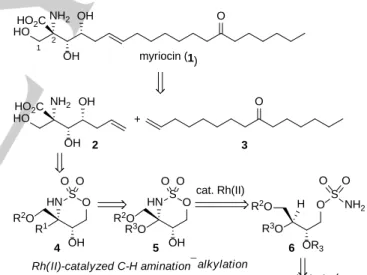
Our retrosynthetic strategy for myriocin (1) is outlined in Scheme 1. Because it would provide high flexibility for analogue synthesis, introduction of the long side chain at a later stage in the synthesis was proposed. This reaction would involve cross metathesis of amino alkene 2, which contains all of the asymmetric carbons of myriocin with their desired configurations, and the known alkene 3.
[10]It was anticipated that 2 would be accessible from oxathiazinane 4 by ring opening followed by stereoselective allylation. The construction of the key quaternary chiral center of 4 can be realized stereoselectively by applying of Du Bois’ Rh(II)-catalyzed C−H amination reaction
[11]of sulfamate 6, followed by stereoselective alkylation.
[9]Although Du Bois’
pioneering work has been applied to the synthesis of propargylic amine derivatives
[9a]and (+)-saxitoxin,
[9b,c]there are no reported examples of its use for the construction of quaternary chiral centers. Sulfamate ester 6 would be prepared from commercially available diethyl L -tartrate (7).
2
OH R
1Rh(II)-catalyzed C-H amination -
alkylation
O O
S O NH
2OR
3R
3O R
2O
OH
OH NH
2HO
2C HO
R
2O H S O
HN O O
OH R
3O R
2O
S O HN
O O
4 5 6
cat. Rh(II)
diethyl L -tartrate ( 7 ) OH
OH
NH
2O
myriocin ( 1 ) HO
HO
2C
1 2
+
O
3
Scheme 1. Retrosynthetic analysis of myriocin (1).
Our synthesis commenced from 7, as shown in Scheme 2.
Conversion of 7 to the known alcohol 8 was conducted according to the literature.
[12]Reaction of 8 with chlorosulfonyl isocyanate, formic acid, and pyridine in dichloromethane afforded sulfamate ester 9 in 87% yield.
[13]Rhodium(II)- catalyzed C–H amination of 9 using Du Bois’ conditions
[11]proceeded stereospecifically to give oxathiazinane N,O-acetal 10. Thus, treatment of 9 with 4 mol% of dirhodium(II) tetraacetate, 1.1 equivalents of phenyliodine(III) diacetate, and 2.3 equivalents of magnesium oxide in dichloromethane at room temperature for 1 h gave the corresponding C–H amination product 10 in 84% yield. Fortunately, alkylation of 10 worked [a] Dr. H. Nambu, N. Noda, W. Niu, Dr. T. Fujiwara, Prof. Dr. T. Yakura
Graduate School of Medicine and Pharmaceutical Sciences Institution University of Toyama
Sugitani, Toyama 930-0194 (Japan) Fax: (+81)76-434-5053
E-mail: [email protected]
Supporting information for this article is given via a link at the end of the document.((Please delete this text if not appropriate))
This is the peer-reviewed version of the following article: Nambu H, Noda N, Niu W, Fujiwara T, Yakura T, Stereoselective total synthesis of myriocin using Rh(II)-catalyzed C-H amination followed by alkylation, 2015, 4, 11, 1249-9, which has been published in final form at http://doi.org/10.1002/ajoc.201500318.
This article may be used for non-commercial purposes in accordance with Wiley-VCH Terms and Conditions for Self-Archiving.
COMMUNICATION
very well with high stereoselectivity to form oxathiazinanes 11 and 12. Reaction of 10 and 4.2 equivalent of vinylmagnesium bromide in the presence of zinc chloride (2.2 eq) in dichloromethane at room temperature for 6 h produced 11 as the sole product in 86% yield. When ethynylation of 10 was performed,
[14]a slight modification of the Du Bois’ conditions was required; 10 was reacted with trimethylsilylethynylzinc chloride generated from 4.2 equivalents of trimethylsilylacetylene, butyl lithium (4.0 eq) and zinc chloride (4.2 eq) in the presence of boron trifluoride diethyl etherate (4.2 eq) in tetrahydrofuran at 50 °C for 1 h to afford 12 in 71% yield as the sole product.
These results demonstrate that Du Bois’ C−H amination–
alkylation procedure was effective for the stereoselective construction of the quaternary chiral center. The stereoselectivities of the C−H amination–alkylation reaction were observed in a similar manner as those reported by Du Bois.
[9, 15]Thus, the alkylation would proceed through intermediate A,
[9c]which may be intramolecularly coupled to nucleophiles.
CO
2Et
OH CO
2Et HO
diethyl L -tartrate ( 7 )
O pyridine O CH
2Cl
2, rt
(87%) ClSO
2NCO
HCO
2H
O S NH
2O O TBDPSO O
O TBDPSO OH
cat. Rh
2
(OAc)
4PhI(OAc)
2MgO, CH
2Cl
2rt, 1 h (84%)
O O
S O HN TBDPSO
vinylMgBr ZnCl
2THF rt, 6 h
(86%) OH
TBDPSO S O HN
O O O
O
10 11
3 steps ref. 12
8 9
BuLi ZnCl
2BF
3·OEt
2
THF, 50 °C, 1 h (71%)
OH TBDPSO
S O HN
O O
12 TMS
TMS S O
HN O O
A Zn O TBDPSO
R = CH CH
2C C TMS R
L L
Scheme 2. Construction of the quaternary chiral center.
With the stereoselective construction of the quaternary chiral center in 1 accomplished, attention was focused on the formation of the three contiguous chiral centers, as illustrated in Scheme 3. Considering the yields of 11 and 12 and the necessary further conversions, vinyl compound 11 was selected for the synthesis of 1. Prior to the opening of the oxathiazinane ring, the OH and NH groups were protected. Acetylation of the hydroxy group in 11 followed by Boc protection of the amino group gave protected oxathiazinane 13 in high yield. However, the ring opening of 13 was somewhat troublesome. When 13 was warmed in acetonitrile–water (11:2) at 50 °C,
[9b,c, 11b]decomposition was observed. Use of 0.1 M phosphate buffer instead of water led to ring-opening and an interesting 1,2-acetyl group shift to give secondary alcohol 14 as the major product in 31% yield and the initially expected primary alcohol 14' in 7%
yield. As a result of an examination of solvent effects,
[16]warming of 13 in a tetrahydrofuran-buffer solution (11:2) at 50 °C
for 24 h was found to afford 14 and 14' in 73% and 23% yields, respectively. Longer reaction times led to low yields of the desired products due to decomposition; however, treatment of purified 14' under the same reaction conditions gave 14 in 80%
yield. Protection of the secondary OH group with chloroacetyl chloride and pyridine gave chloroacetate 15. Reductive ozonolysis of 15 resulted in conversion of the vinyl group to a hydroxymethyl substituent and chloroacetyl deprotection to form diol 16 in 82% yield. After protection of the diol as an acetonide, methanolysis of the acetoxy group and subsequent Swern oxidation produced aldehyde 17.
To form the third stereocenter, chelation-controlled allylation of 17 was investigated. Reaction of 17 with allylmagnesium bromide in THF gave a 1:3.5 mixture of desired 18 and undesired 18' in 36% combined yield. The low yield and undesired stereoselectivity were addressed using indium chemistry.
[17]Thus, the treatment of 17 with allylbromide and indium metal in the presence of tetrabutylammonium iodide and magnesium iodide in N,N-dimethylformamide gave 18 as the major product (18:18' = 6.6:1) in 84% yield.
[18]The two diastereomers were then readily separated by column chromatography.
OH TBDPSO
S O HN
O O
TBDPSO
H NH
O O
O Boc 11
1) Ac
2O pyridine 2) Boc
2O Et
3
N, DMAP
OAc TBDPSO
S O N
O O
13 Boc
(84%)
THF-buffer*
(11:2)
*buffer: 0.1 M phosphate buffer
50 °C
OH TBDPSO
NHBoc OAc +
OAc TBDPSO
NHBoc OH
14 14 '
THF-buffer* (11:2) 50 °C (80%)
(73%) (23%)
14
ClCH
2COCl pyridine
O TBDPSO
NHBoc OAc 15
O Cl
1) O
3, MeOH-CH
2
Cl
2-
78 °C
(82%) 2) NaBH
4, -
78 °C CH
2Cl
2(73%)
OH TBDPSO
NHBoc
OH
OAc
16 17
MeO OMe
1) TsOH⋅
H
2O benzene 2) K
2CO
3, MeOH 3) Swern oxidation
(88%)
(84%) allyl bromide In, TBAI, MgI
2DMF, rt
TBDPSO NH
O O
OH Boc
18
+ 18 '
OH
18 : 18 ' = 6.6:1
Scheme 3. Formation of the three continuous chiral centers.
COMMUNICATION
The stage was now set for completion of the synthesis of myriocin (1). After protection of the secondary hydroxy substituent in 18 as an acetoxy group, the long alkyl chain was introduced using Grubbs’ cross metathesis chemistry with the known alkene 3
[10]and coupling product 20, which has all of the carbons of the myriocin skeleton, was obtained in 96% yield.
Desilylation of the primary silyl ether in 20 and subsequent Swern oxidation of the resulting hydroxyl group gave aldehyde 21. Oxidation of 21 to the corresponding carboxylic acid and global deprotection by sequential alkaline and acidic hydrolyses produced crude myriocin (1). Since it was difficult to directly obtain 1 in high purity, the crude product was acetylated with acetic anhydride in pyridine to afford the known γ-lactone 22:
[α]
D18+55.6 (c=1.0, CHCl
3) {lit.
[5d][α]
D23+52.5 (c=0.85, CHCl
3)}.
Finally, saponification of 22 followed by neutralization with Amberlite ® IRC-86 furnished pure 1. The synthetic compound 1 was spectroscopically (
1H and
13C NMR, and IR) identical to natural 1, and its melting point (165–168 °C) and optical rotation {[α]
D23+5.6 (c=0.30, DMSO)} were in good agreement with literature values for the natural product {mp 164–168 °C,
[3][α]
D20+6.1 (c=0.26, DMSO)
[5d]}.
Ac
2O pyridine
(96%)
TBDPSO NH
O O
OAc Boc
CH
2Cl
2, reflux
20 TBDPSO
NH
O O
OAc Boc
5 5
O 1) TBAF, AcOH THF
1) NaClO
2, NaH
2
PO
4⋅ H
2O 2-methyl-2-butene t -BuOH, H
2
O OHC NH
O O
OAc Boc
5 5
O
myriocin ( 1 ) AcHN O
OAc OAc O
21
(96%)
(68%)
10% NaOH-MeOH (1:1) reflux;
neutralized with Amberlite
IRC-86
(82%)
2) 10% NaOH, MeOH, reflux 3) 10% HCl, MeOH, reflux 4) Ac
2O, pyridine
(51%)
5 5
O
22
3 (4 eq) Grubbs 2nd
19 18
2) TEMPO, PhI(OAc)
2MgO, CH
2
Cl
2Scheme 4. Synthesis of myriocin (1).
In summary, the stereoselective synthesis of myriocin was achieved, with Rh(II)-catalyzed C−H amination of sulfamate followed by stereoselective alkylation and In-mediated stereoselective allylation as key steps. This synthesis is the first example of the construction of a quaternary chiral center using sequential Rh(II)-catalyzed C−H amination/alkylation reactions.
Since the quaternary chiral center can be easily and stereoselectively constructed and the long side chain can be introduced at a later stage in the synthesis, the present method
would provide high flexibility for analogue synthesis. Thus, the synthesis of myriocin analogues including mycestericin D and sphingofungin E is currently in progress.
Experimental Section
Procedure for Rh(II)-catalyzed C −H amination and subsequent alkylation
Rh
2(OAc)
4(270 mg, 0.611 mmol), PhI(OAc)
2(5.39 g, 16.7 mmol) and MgO (1.41 g, 35.0 mmol) were added to a solution of sulfamate 9 (7.29 g, 15.2 mmol) in CH
2Cl
2(96 mL). After stirring at room temperature for 1 h, the reaction mixture was filtered through a pad of Celite. The filter cake was rinsed with CH
2Cl
2, and the combined filtrates were concentrated in vacuo. The residue was purified by column chromatography (silica gel, 10% EtOAc in hexane) to provide 10 (6.11 g, 84%) as a white solid.
Next, ZnCl
2(0.92 mL, 0.92 mmol) was added dropwise to a solution of vinylmagnesium bromide (1.76 mL, 1.0 M in THF, 1.76 mmol) at –78 °C under nitrogen, and the resulting mixture was warmed to room temperature and stirred for 0.5 h. The reaction mixture was then cooled to 0 °C, and a solution of 10 (200 mg, 0.42 mmol) in THF (1.0 mL) was added dropwise via cannula. After completion of the addition, the reaction mixture was allowed to warm to room temperature and stirred for 6 h, after which time it was quenched with saturated NH
4Cl and the whole mixture was extracted with EtOAc (10 mL x 3). The combined organic layers were washed with water (10 mL) and brine (10 mL), and dried over anhydrous MgSO
4. Filtration was concentrated in vacuo, and the residue was purified by column chromatography (silica gel, 10%
EtOAc in hexane) to provide 11 (163 mg, 86%) as a white solid.
Keywords: myriocin • C–H amination • dirhodium(II) catalyst • stereoselective alkylation • total synthesis
[1] a) D. Kluepfel, J. Bagli, H. Baker, M.-P. Charest, A. Kudelski, S. N.
Sehgal, C. Vézina, J. Antibiot. 1972, 25, 109−115; b) J. F. Bagli, D.
Kluepfel, M. St-Jacques, J. Org. Chem. 1973, 38, 1253−1260.
[2] F. Aragozzini, P. L. Manachini, R. Craveri, B. Rindone, C. Scolastico, Tetrahedron 1972, 28, 5493−5498.
[3] T. Fujita, K. Inoue, S. Yamamoto, T. Ikumoto, S. Sasaki, R. Toyama, K.
Chiba, Y. Hoshino, T. Okumoto, J. Antibiot. 1994, 47, 208−215.
[4] a) Y. Miyake, Y. Kozutsumi, S. Nakamura, T. Fujita, T. Kawasaki, Biochem. Biophys. Res. Commun. 1995, 211, 396−403; b) J. K. Chen, W. S. Lane, S. L. Schreiber, Chem. Biol. 1999, 6, 221−235; c) J. M.
Wadsworth, D. J. Clarke, S. A. McMahon, J. P. Lowther, A. E. Beattie, P. R. R. Langridge-Smith, H. B. Broughton, T. M. Dunn, J. H. Naismith, D. J. Campopiano, J. Am. Chem. Soc. 2013, 135, 14276−14285.
[5] For total syntheses of myriocin, see: a) L. Banfi, M. G. Beretta, L.
Colombo, C. Gennari, C. Scolastico, J. Chem. Soc., Chem. Commun.
1982, 488−490; b) L. Banfi, M. G. Beretta, L. Colombo, C. Gennari, C.
Scolastico, J. Chem. Soc., Perkin Trans. 1983, 1613−1619; c) A. V. R.
Rao, M. K. Gurjar, T. R. Devi, K. R. Kumar, Tetrahedron Lett. 1993, 34, 1653−1656; d) S. Hatakeyama, M. Yoshida, T. Esumi, Y. Iwabuchi, H.
Irie, T. Kawamoto, H. Yamada, M. Nishizawa, Tetrahedron Lett. 1997, 38, 7887−7890; e) S. Deloisy, T. T. Thang, A. Olesker, G. Lukacs, Tetrahedron Lett. 1994, 35, 4783−4786; f) S. Deloisy, T. T. Thang, A.
Olesker, G. Lukacs, Bull. Chim. Soc. Fr. 1996, 133, 581−585; g) M.
Yoshikawa, Y. Yokokawa, Y.; Okuno, N.; Murakami, Chem. Pharm. Bull.
1994, 42, 994−996; h) M. Yoshikawa, Y. Yokokawa, Y. Okuno, N.
Murakami, Tetrahedron 1995, 51, 6209−6228; i) S. Sano, Y. Kobayashi, T. Kondo, M. Takebayashi, S. Maruyama, T. Fujita, Y. Nagao, Tetrahedron Lett. 1995, 36, 2097−2100; j) K.-Y. Lee, C.-Y. Oh, Y.-H.
Kim, J.-E. Joo, W.-H. Ham, Tetrahedron Lett. 2002, 43, 9361−9396; k)
T. Oishi, K. Ando, N. Chida, Chem. Commun. 2001, 1932−1933; l) T.
COMMUNICATION
Oishi, K. Ando, K. Inomiya, H.; Sato, M. Iida, N. Chida, Bull. Chem. Soc.
Jpn. 2002, 75, 1927−1947; m) S. Torrente, R. Alonso, Org. Lett. 2001, 3, 1985–1987; n) M. Inai, T. Goto, T. Furuta, T. Wakimoto, T Kan, Tetrahedron: Asymmetry 2008, 19, 2771–2773; o) M. C. Jones, S. P.
Marsden, Org. Lett. 2008, 10, 4125–4128.
[6] a) T. Yakura, Y. Yoshimoto, C. Ishida, S. Mabuchi, Synlett 2006, 930−932; b) T. Yakura, Y. Yoshimoto, C. Ishida, S. Mabuchi, Tetrahedron 2007, 63, 4429−4438; c) T. Yakura, S. Sato, Y. Yoshimoto, Chem. Pharm. Bull. 2007, 55, 1284−1286.
[7] a) S. Sasaki, R. Hashimoto, M. Kiuchi, K. Inoue, T. Ikumoto, R. Hirose, K. Chiba, Y. Hoshino, T. Okumoto, T. Fujita, J. Antibiot. 1994, 47, 420−433; b) T. Fujita, R. Hirose, M. Yoneta, S. Sasaki, K. Inoue, M.
Kiuchi, S. Hirase, K. Chiba, H. Sakamoto, M. Arita, J. Med. Chem. 1996, 39, 4451−4459; c) T. Fujita, N. Hamamichi, M. Kiuchi, T. Matsuzaki, Y.
Kitao, K. Inoue, R. Hirose, M. Yoneta, S. Sasaki, K. Chiba, J. Antibiot.
1996, 49, 846−853.
[8] a) F. VanMiddlesworth, R. A. Giacobbe, M. Lopez, G. Garrity, J. A.
Bland, K. Bartizal, R. A. Fromtling, K. E. Wilson, R. L. Monaghan, J.
Antibiot. 1992, 45, 861−867; b) W. S. Horn, J. L. Smith, G. F. Bills, S. L.
Raghoobar, G. L. Helms, M. B. Kurtz, J. A. Marrinan, B. R. Frommer, R.
A. Thornton, S. M. Mandala, J. Antibiot. 1992, 45, 1692−1696; c) M. M.
Zweerink, A. M. Edison, G. B. Wells, W. Pinto, R. L. Lester, J. Biol.
Chem. 1992, 267, 25032−25038.
[9] a) J. J. Fleming, K. W. Fiori, J. Du Bois, J. Am. Chem. Soc. 2003, 125, 2028−2029; b) J. J. Fleming, J. Du Bois, J. Am. Chem. Soc. 2006, 128, 3926−3927; c) J. J. Fleming, M. D. McReynolds, J. Du Bois, J. Am.
Chem. Soc. 2007, 129, 9964−9975.
[10] C. J. Hayes, D. M. Bradley, N. M. Thomson, J. Org. Chem. 2006, 71, 2661−2665.
[11] a) C. G. Espino, J. Du Bois, Angew. Chem. 2001, 113, 618−620;
Angew. Chem. Int. Ed. 2001, 40, 598−600; b) C. G. Espino, P. M.
Wehn, J. Chow, J. Du Bois, J. Am. Chem. Soc. 2001, 123, 6935−6936;
c) P. M. Wehn, J. Lee, J. Du Bois, Org. Lett. 2003, 5, 4823−4826; d) C.
G. Espino, K. W. Fiori, M. Kim, J. Du Bois, J. Am. Chem. Soc. 2004, 126, 15378−15379; e) K. W. Fiori, J. J. Fleming, J. Du Bois, Angew.
Chem. 2004, 116, 4449−4452; Angew. Chem. Int. Ed. 2004, 43, 4349−4352; f) M. Kim, J. V. Mulcahy, C. G. Espino, J. Du Bois, Org.
Lett. 2006, 8, 1073−1076; g) R. M. Conrad, J. Du Bois, Org. Lett. 2007, 9, 5465−5468; h) D. N. Zalatan, J. Du Bois, J. Am. Chem. Soc. 2008, 130, 9220−9221; i) D. E. Olson, J. Du Bois, J. Am. Chem. Soc. 2008, 130, 11248−11249; j) K. W. Fiori, C. G. Espino, B. H. Brodsky, J. Du Bois, Tetrahedron 2009, 3042−3051; k) P. M. Wehn, J. Du Bois, Angew.
Chem. 2009, 121, 3860−3863; Angew. Chem. Int. Ed. 2009, 48, 3802−3805; l) J. Du Bois, Org. Process Res. Dev. 2011, 15, 758−762;
m) D. E. Olson, D. A. Roberts, J. Du Bois, Org. Lett. 2012, 14, 6174−6177; n) J. L. Roizen, D. N. Zalatan, J. Du Bois, Angew. Chem.
2013, 125, 11553−11556; Angew. Chem. Int. Ed. 2013, 52, 11343−11346; o) E. N. Bess, R. J. DeLuca, D. J. Tindall, M. S.
Oderinde, J. L. Roizen, J. Du Bois, M. S. Sigman, J. Am. Chem. Soc.
2014, 136, 5783−5789.
[12] a) K. Uchida, K. Kato, H. Akita, Synthesis 1999, 1678−1686; b) J.-H.
Yang, J. Liu, R. P. Hsung, Org. Lett. 2008, 10, 2525−2528; c) O. David, J. Blot, C. Bellec, M.-C. Fargeau-Bellassoued, G. Haviari, J.-P. Célérier, G. Lhommet, J.-C. Gramain, D. Gardette, Bioconjugate Chem. 2008, 19, 1855−1863.
[13] a) C. G. Espino, P. M. Wehn, j. Chow, J. Du Bois, J. Am. Chem. Soc.
2001, 123, 6935−6936; b) A. R. Thornton, V. I. Martin, S. B. Blakey, J.
Am. Chem. Soc. 2009, 131, 2434−2435.
[14] In Du Bois’ original report on the construction of tertiary centers, ethynylation gave better results than vinylation. See ref. [9c].
[15] The stereochemistry of the quaternary chiral center in 11 was temporally determined by consideration of literature results and finally established by its conversion to myriocin.
[16] We also examined other solvent systems, including CH
2Cl
2-buffer (11:2), acetone-buffer (11:2), THF-buffer (5:1), and THF-buffer (3:1) solutions.
[17] a) S. Araki, H. Ito, Y. Butsugan, J. Org. Chem. 1988, 53, 1833−1835; b) E. Kim, D. M. Gordon, W. Schmid, G. M. Whitesides, J. Org. Chem.
1993, 58, 5500−5507; c) L. A. Paquette, T. M. Mitzel, J. Am. Chem.
Soc. 1996, 118, 1931−1937; d) T. H. Chan, Y. Yang, J. Am. Chem. Soc.
1999, 121, 3228−3229.
[18] The stereochemistry of the newly formed chiral center in 18 was
determined by its conversion to myriocin.
COMMUNICATION
Entry for the Table of Contents (Please choose one layout)
COMMUNICATION
The stereoselective total synthesis of myriocin was achieved by using Du Bois’
Rh(II)-catalyzed C−H amination of sulfamate followed by alkylation. This synthesis is the first application of Du Bois’ procedure for the construction of a
H. Nambu, N. Noda, W. Niu, T. Fujiwara, T. Yakura*
Page No. – Page No.
Stereoselective Total Synthesis of Myriocin Using Rh(II)-Catalyzed C–H Amination Followed by Alkylation RO O
O O
S NH
21) Rh PhI(OAc)
2(OAc)
4 22) vinylMgBr ZnCl
2
OH
RO S O HN
O O O
O
OH
OH NH
2myriocin HO HO
2C
5
C-
H amination-
stereoselective alkylation
5