RIMS-1716
On the universal sl
2
invariant of boundary bottom tangles
By
Sakie SUZUKI
March 2011
R ESEARCH I NSTITUTE FOR M ATHEMATICAL S CIENCES
On the universal sl 2 invariant of boundary bottom tangles
Sakie Suzuki
∗March 11, 2011
Abstract
The universalsl2invariant of bottom tangles has a universality property for the colored Jones polynomial of links. Habiro conjectured that the universalsl2invariant of boundary bottom tangles takes values in certain subalgebras of the completed tensor powers of the quantized enveloping algebraUh(sl2) of the Lie algebrasl2. In the present paper, we prove an improved version of Habiro’s conjecture. As an application, we prove a divisibility property of the colored Jones polynomial of boundary links.
1 Introduction
In the 80’s, Jones [9] constructed a polynomial invariant of links. After that, Reshetikhin and Turaev [20] defined an invariant of framed links whose components are colored by finite dimensional representations of a ribbon Hopf algebra. The colored Jones polynomial is the Reshetikhin-Turaev invariant of links whose components are colored by finite dimensional representations of the quantized enveloping algebraUh(sl2).
The universal invariant associated with a ribbon Hopf algebra is an invariant of framed links and tangles which are not colored by any representations, see Hennings [8], Lawrence [15, 14], Reshetikhin [20], Ohtsuki [19], Kauffman [10], and Kauffman and Radford [11]. The universal invariant has the universality property for the Reshetikhin-Turaev invariant. By the universalsl2invariant, we mean the universal invariant associated withUh(sl2). In particular, one can obtain the colored Jones polynomial from the universalsl2 invariant.
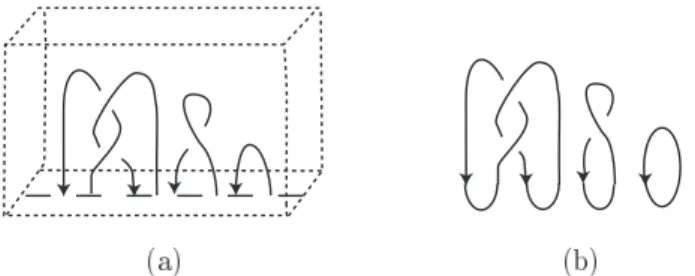
Abottom tangle is a tangle consisting of arc components in a cube such that each boundary point is on the bottom line, and the two boundary points of each component are adjacent to each other, see Figure 1 (a) for example. We can define the closure link of a bottom tangle, see Figure 1 (b). For each link L, there is a bottom tangle whose closure isL. In [4], Habiro studied the universal invariant of bottom tangles associated with a ribbon Hopf algebra, and in [6], he studied the universalsl2 invariant in detail.
The universalsl2invariant ofn-component bottom tangles takes values in the completed n-fold tensor power Uh(sl2)⊗ˆn of Uh(sl2). By using bottom tangles, we can restate the universality of the universalsl2invariant: the colored Jones polynomial of a linkLis obtained from the universalsl2invariant of a bottom tangle whose closure isL, by taking the quantum traces associated with the representations attached to the components of links (cf. [4]).
We are interested in relationships between the algebraic properties of the colored Jones polynomial and the universalsl2invariant and the topological properties of links and bottom tangles.
∗Research Institute for Mathematical Sciences, Kyoto University, Kyoto, 606-8502, Japan. E-mail address:
Figure 1: (a) A bottom tangleT (b) The closure link ofT
Figure 2: A boundary bottom tangle
Eisermann [2] proved that the Jones polynomial of ann-component ribbon link is divisible by the Jones polynomial of then-component unlink. This result is generalized to links which are ribbon concordant to boundary links by Habiro [7]. Habiro [6] proved that the universal sl2 invariant of n-component, algebraically-split, 0-framed bottom tangles takes values in certain small subalgebras of the completed tensor powers of Uh(sl2), and gave a divisibility property of the colored Jones polynomial of algebraically-split, 0-framed links.
In [21], the present author proved an improvement of Habiro’s result for algebraically-split, 0-framed bottom tangles, in the special case ofribbon bottom tangles and ribbon links.
In the present paper, we study the universalsl2invariant of boundary bottom tangles. A bottom tangle is called boundary if its components admit mutually disjoint Seifert surfaces, see Figure 2 for example. We can obtain each boundary link from a boundary bottom tangle by closing. Habiro [6] conjectured that the universalsl2invariant of boundary bottom tangles takes values in certain subalgebras of the completed tensor powers ofUh(sl2). We prove an improved version of Habiro’s conjecture (Theorem 1.2).
1.1 Main result
The quantized enveloping algebraUh=Uh(sl2) is anh-adically completedQ[[h]]-algebra (see Section 2.2 for the details). We setq= exph.
Habiro [6] proved that the universal sl2 invariant JT of an n-component, algebraically- split, 0-framed bottom tangleT is contained in the Z[q, q−1]-subalgebra ( ˜Uqev)⊗˜n ofUh⊗ˆn. In [21], we defined another Z[q, q−1]-subalgebra ( ¯Uqev)ˆ⊗ˆn ⊂ ( ˜Uqev)⊗˜n, and prove the following theorem. (See Section 2.3 for the definition of ¯Uqev, and see Sections 6.1–6.4 for the definition of the completion ( ¯Uqev)ˆ⊗ˆn of ( ¯Uqev)⊗n.)
Theorem 1.1 ([21]). Let T be an n-component ribbon bottom tangle with 0-framing. Then we have JT ∈( ¯Uqev)ˆ⊗ˆn.
The main result of the present paper is the following.
Theorem 1.2. Let T be an n-component boundary bottom tangle with 0-framing. Then we haveJT ∈( ¯Uqev)ˆ⊗ˆn.
Remark 1.3. Habiro [6, Conjecture 8.9] conjectured Theorem 1.2 with ( ¯Uqev)ˆ⊗ˆn replaced with the Z[q, q−1]-subalgebra ( ¯Uqev)˜⊗˜n, which includes ( ¯Uqev)ˆ⊗ˆn. We do not know whether the inclusion ( ¯Uqev)ˆ⊗ˆn ⊂( ¯Uqev)˜⊗˜n is proper or not. The definition of our algebra ( ¯Uqev)ˆ⊗ˆn appears to be more natural.
Since every 1-component bottom tangle is boundary, Theorem 1.2 forn= 1 gives a possible improvement of the following theorem.
Theorem 1.4 (Habiro). Let T be an 1-component bottom tangle with 0-framing. Then we haveJT ∈( ¯Uqev)˜.
Theorem 1.4 follows from [6, Theorem 4.1] and the equalities Inv( ˜Uqev) =Z( ˜Uqev) =Z(( ¯Uqev)˜),
which is implicit in [5, Section 9]. Here, for a subset X ⊂ Uh, we denote by Inv(X) the invariant part ofX, and byZ(X) the center ofX.
If we use the one-to-one correspondence described in [4, Section 13] between the set of bottom tangles and the set of string links, then we can define the Milnor ¯µinvariants [17, 18]
of a bottom tangle as that of the corresponding string link. See [3] for the Milnor ¯µinvariants of string links. In fact, all Milnor ¯µ invariants vanish both for ribbon bottom tangles and boundary bottom tangles. It is natural to expect the following conjecture.
Conjecture 1.5. If T be an n-component bottom tangle with 0-framing with vanishing all Milnor µ¯ invariants, then we haveJT ∈( ¯Uqev)ˆ⊗ˆn.
The converse of Conjecture 1.5 is also open.
1.2 Application to the colored Jones polynomial
We give an application (Theorem 1.6) of Theorem 1.2 to the colored Jones polynomial of boundary links. This result is parallel to the result for ribbon links [21].
We use the following q-integer notations:
{i}q =qi−1, {i}q,n={i}q{i−1}q· · · {i−n+ 1}q, {n}q! ={n}q,n, [i]q ={i}q/{1}q, [n]q! = [n]q[n−1]q· · ·[1]q,
·i n
¸
q
={i}q,n/{n}q!, fori∈Z, n≥0.
For m ≥ 1, let Vm denote the m-dimensional irreducible representation of Uh. Let R denote the representation ring ofUhoverQ(q12), i.e., Ris theQ(q12)-algebra
R= Span
Q(q12){Vm |m≥1}
with the multiplication induced by the tensor product. It is well known thatR=Q(q12)[V2].
Forl≥0, set
Pl=
l−1
Y
i=0
(V2−qi+12 −q−i−12)∈ R, P˜l0= q12l
{l}q!Pl∈ R,
which are used in [6] to construct the unified Witten-Reshetikhin-Turaev invariants for integral homology spheres. We denote by JL; ˜P0
l1,...,P˜0
ln
the colored Jones polynomial of L with ith component Li colored by ˜Pl0
i. Habiro proved that Theorem 1.2 implied the following result.
Forl≥0, letIl denote the ideal inZ[q, q−1] generated by{l−k}q!{k}q! fork= 0, . . . , l.
Theorem 1.6([6, Conjecture 8.10]). LetLbe ann-component boundary link with0-framing.
Forl1, . . . , ln≥0, we have JL; ˜P0
l1,...,P˜ln0 ∈ {2lj+ 1}q,lj+1
{1}q
Il1· · ·Iˆlj· · ·Iln,
wherej is an integer such thatlj = max{li}1≤i≤n, andIˆlj denotes the omission ofIlj. Remark 1.7. Form≥1, let Φm(q) =Q
d|m(qd−1)µ(md)∈Z[q] denote themth cyclotomic polynomial, whereQ
d|mdenotes the product over all the positive divisorsdofm, andµis the M¨obius function. It is not difficult to prove that forl≥0,Ilis contained in the principal ideal inZ[q] generated byQ
mΦm(q)f(l,m)withf(l, m) = max{0,¥l+1
m
¦−1}, where, forr∈Q, we denote bybrcthe largest integer smaller than or equal tor.
Theorem 1.6 is an improvement in the special case of boundary links of the following result.
Theorem 1.8 (Habiro [6, Theorem 8.2]). Let L be an n-component, algebraically-split link with0-framing. Forl1, . . . , ln ≥0, we have
JL; ˜P0
l1,...,P˜ln0 ∈ {2lj+ 1}q,lj+1
{1}q
Z[q, q−1].
1.3 Examples
LetTB be the Borromean bottom tangle depicted in Figure 3 (a), whose closure is the Bor- romean rings. Since we haveJTB ∈/( ¯Uqev)ˆ⊗ˆ3(cf. [21]), it follows from Theorem 1.2 that the Borromean rings is neither boundary nor ribbon, as is well known.
More generally, for n ≥ 3, let Mn be Milnor’s n-component Brunnian link depicted in Figure 3 (b). Note that M3 is the Borromean rings. Since there is a non-trivial Milnor ¯µ invariant ofMn of lengthn(cf. [17]),Mn is neither boundary nor ribbon. We can prove this fact also from Theorem 1.6 and
JM
n; ˜P10,...,P˜10 = (−1)n−2q−2n+4Φ1(q)n−2Φ2(q)n−2Φ3(q)Φ4(q)n−3
∈/Φ1(q)nΦ2(q)Φ3(q)Z[q, q−1], which we will prove in a forthcoming paper [22].
・・・
Figure 3: (a) Borromean rings (b) Milnor’s linkMn
Figure 4: (a) A tangle (b) The framing on the boundary
1.4 Organization of paper
The rest of the paper is organized as follows. Section 2 contains preliminary results about bottom tangles, the quantized enveloping algebraUh, and the universalsl2invariant of bottom tangles. In Section 3, we recall from [6] Habiro’s formula for the universal sl2 invariant of boundary bottom tangles, and then give a modification of his formula. In Sections 4, 5, and 6, we prove Theorem 1.2.
2 Preliminaries
In this section, we recall basic things about bottom tangles, the universal enveloping algebra Uh, and the universalsl2invariant of bottom tangles.
2.1 Bottom tangles and boundary bottom tangles
Atangle (cf. [12]) is the image of an embedding
³am [0,1]
´t³an S1
´
,→[0,1]3,
withm, n≥0,whose boundary is on the two lines [0,1]× {12} × {0,1}on the bottom and the top of the cube, see Figure 4 (a) for example. We equip the image with both an orientation and a framing. Here, at each boundary point, the framing is fixed on the lines [0,1]× {12} × {0,1} as in Figure 4 (b), where the thin arrows represent the strands of the tangle, and the thick arrows represent the framing.
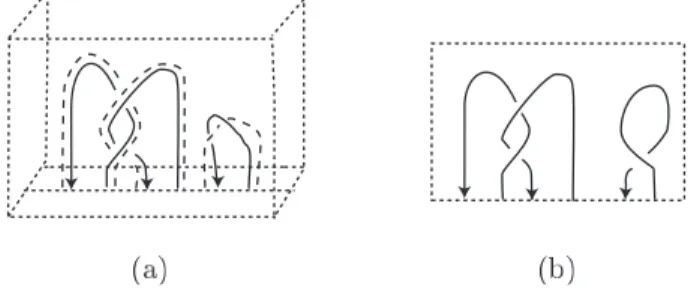
A bottom tangle (cf. [4, 6]) is a tangle consisting of arc components such that each boundary point is on the line [0,1]× {12} × {0}on the bottom, and the two boundary points of each component are adjacent to each other. We give a preferred orientation of the tangle so that each component runs from its right boundary point to its left boundary point. For example, see Figure 5 (a), where the dotted lines represent the framing. We draw a diagram of a bottom tangle in a rectangle assuming the blackboard framing, see Figure 5 (b).
Figure 5: (a) A 3-component bottom tangleT (b) A diagram ofT
For eachn≥0, letBTn denote the set of the ambient isotopy classes, relative to boundary points, ofn-component bottom tangles.
Theclosure link cl(T) of a bottom tangleT is defined as the link in R3 obtained fromT by closing, see Figure 1 again. For eachn-component linkL, there is ann-component bottom tangle whose closure is L. For a bottom tangle, we can define its linking matrix as that of the closure link.
A Seifert surfaceof knotK is a compact, connected, orientable surfaceF in R3bounded byK. Ann-component linkL=L1∪ · · · ∪Lnis calledboundary if it hasnmutually disjoint Seifert surfacesF1, . . . , Fn in R3such thatLi boundsFi fori= 1, . . . , n.
For a 1-component bottom tangle T ∈BT1, there is a knot KT =T ∪γ ∈[0,1]3, where γ is the line segment in the bottom [0,1]× {12} × {0}such that ∂γ =∂T. ASeifert surface of a 1-component bottom tangleT is a Seifert surface of the knotKT contained in [0,1]3. A bottom tangleT =T1∪· · ·∪Tnis calledboundary if it hasnmutually disjoint Seifert surfaces F1, . . . , Fnin [0,1]3such thatKTiboundsFifori= 1, . . . , n. For example, see Figure 2 again.
Obviously, for each boundary linkL, there is a boundary bottom tangle whose closure isL.
2.2 Quantized enveloping algebra U
hWe recall the definition of the universal enveloping algebraUh(sl2) of the Lie algebrasl2, and its ribbon Hopf algebra structure. We follow the notations in [6].
We denote byUh=Uh(sl2) theh-adically completeQ[[h]]-algebra, topologically generated byH, E,andF, defined by the relations
HE−EH = 2E, HF−F H =−2F, EF −F E= K−K−1 q1/2−q−1/2, where we set
q= exph, K=qH/2= exphH 2 .
We equipUhwith the topologicalZ-graded algebra structure such that degE= 1, degF =
−1, and degH = 0. For a homogeneous elementxofUh, the degree ofxis denoted by|x|. There is a complete ribbon Hopf algebra structure on Uhas follows. The comultiplication
∆ : Uh→Uh⊗ˆUh, the counitε: Uh→Q[[h]], and the antipodeS: Uh→Uhare given by
∆(H) =H⊗1 + 1⊗H, ε(H) = 0, S(H) =−H,
∆(E) =E⊗1 +K⊗E, ε(E) = 0, S(E) =−K−1E,
∆(F) =F⊗K−1+ 1⊗F, ε(F) = 0, S(F) =−F K.
Set
D=q14H⊗H= exp¡h
4H⊗H¢
∈Uh⊗ˆ2, (1)
F˜(n)=FnKn/[n]q!∈Uh, (2)
e= (q1/2−q−1/2)E∈Uh, (3)
forn≥0. The universalR-matrix and its inverseR±1∈Uh⊗ˆUh are given by R=DX
n≥0
q12n(n−1)F˜(n)K−n⊗en, R−1=D−1X
n≥0
(−1)nF˜(n)⊗K−nen. We haveR±1=P
n≥0α±n ⊗βn±, where forn≥0,we set formally αn⊗βn( =α+n ⊗βn+) =D
³
q12n(n−1)F˜(n)K−n⊗en
´ , αn−⊗βn−=D−1
³
(−1)nF˜(n)⊗K−nen
´ .
Note that the right hand sides are infinite sums of tensors of the form asx⊗ywithx, y∈Uh. We denote them byα±n ⊗βn± for simplicity.
The ribbon element and its inverse r±1∈Uh are given by r=X
n≥0
α−nK−1βn−=X
n≥0
βn−Kα−n, r−1=X
n≥0
αnKβn =X
n≥0
βnK−1αn. We use a notationD=P
D0⊗D00. We use the following formulas.
XD00⊗D0=D, (4)
(∆⊗1)D=D23D13, (1⊗∆)D=D13D12, (5)
(ε⊗1)(D) = 1 = (1⊗ε)(D), (6)
(1⊗S)D=D−1= (S⊗1)D, (7)
D(1⊗x) = (K|x|⊗x)D, D(x⊗1) = (x⊗K|x|)D, (8) whereD13=P
D0⊗1⊗D00,D23= 1⊗D, D12=D⊗1, andx∈Uh homogeneous.
2.3 Subalgebras of U
hIn this section, we recall from [6] subalgebrasUZ,q,U¯q and ¯UqevofUh. Recall from (2) and (3) the definitions of ˜F(n)∈Uhande∈Uh, respectively. Similarly, set
E˜(n)= (q−1/2E)n/[n]q!∈Uh, f = (q−1)F K ∈Uh,
forn≥0.
Let UZ,q denote the Z[q, q−1]-subalgebra of Uh generated by K, K−1,E˜(n), and ˜F(n) for n≥1.
Let ¯Uq denote theZ[q, q−1]-subalgebra ofUZ,q generated byK, K−1, eandf. Let ¯Uqev be theZ[q, q−1]-subalgebra of ¯Uq generated byK2, K−2, eandf.
Remark 2.1. Set [i] = qq1/2i/2−−qq−i/2−1/2 for i∈ Z and [n]! = [n]· · ·[1] for n≥0. Let UZ be the Z[q1/2, q−1/2]-subalgebra ofUhgenerated byK, K−1, E(n)=En/[n]!, andF(n)=Fn/[n]! for n≥1 (Lusztig’s integral form, cf. [16]). We have
UZ=UZ,q⊗Z[q,q−1]Z[q1/2, q−1/2].
Let ¯U denote theZ[q1/2, q−1/2]-subalgebra ofUh generated byK, K−1, (q1/2−q−1/2)E, and (q1/2−q−1/2)F (cf. [1]). We have
U¯ = ¯Uq⊗Z[q,q−1]Z[q1/2, q−1/2].
There is a Hopf Z[q, q−1]-algebra structure onUZ,q inherited from Uh (cf. [16, 21]). We have
∆( ˜E(m)) = Xm j=0
E˜(m−j)Kj⊗E˜(j), (9)
∆( ˜F(m)) = Xm j=0
F˜(m−j)Kj⊗F˜(j), (10) S±1( ˜E(m)) = (−1)mq21m(m∓1)K−mE˜(m), (11) S±1( ˜F(m)) = (−1)mq−12m(m∓1)K−mF˜(m), (12) fori∈Z, m≥0. Similarly, there is a Hopf Z[q, q−1]-algebra structure on ¯Uq inherited from Uh (cf. [1, 6]).
Let Uh0 denote the Cartan part of Uh, i.e., the subalgebra of Uh topologically generated byH. Let ¯Uq0 denote theZ[q, q−1]-subalgebra of ¯Uq generated by K andK−1. Let ¯Uqev 0 be theZ[q, q−1]-subalgebra of ¯Uq generated byK2 andK−2. We have
U¯q0= ¯Uq∩Uh0, U¯qev 0= ¯Uqev∩Uh0.
2.4 Adjoint action
In what follows, we use the following notations. Form≥0, let ∆[m]: Uh→Uh⊗ˆmdenote the m-output comultiplication defined by ∆[0]=ε,∆[1]= idUh,and
∆[m] = (∆⊗id⊗Um−2
h )◦∆[m−1], form≥2. Forx∈Uh, m≥1, we write
∆[m](x) =X
x(1)⊗ · · · ⊗x(m). Form1, . . . , ml≥0, set
∆[m1,...,ml]= ∆[m1]⊗ · · · ⊗∆[ml]: Uh⊗ˆl→Uh⊗ˆm1+···+ml. (13) We use the left adjoint action ad : Uh⊗ˆUh→Uh defined by
ad(x⊗y) =x . y:=X
x(1)yS(x(2)), (14)
forx, y∈Uh. We use the following proposition.
, , , ,
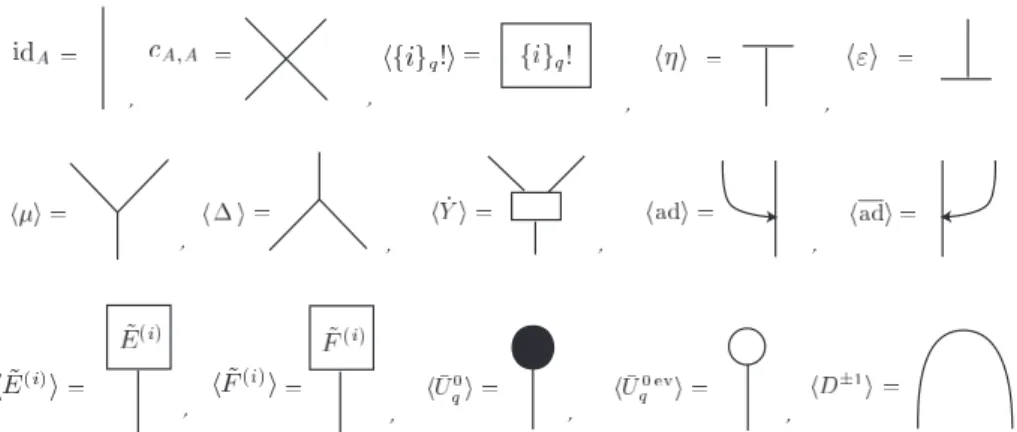
Figure 6: Fundamental tangles, where the orientations of the strands are arbitrary
Figure 7: (a) A bottom tangleB∈BT2 (b) A diagram ofB (c) The labels which are put on the diagram ofB
Proposition 2.2 ([21, Proposition 3.2]). We have
UZ,q.U¯qev⊂U¯qev, UZ,q. KU¯qev⊂KU¯qev.
We also use a right action ad : Uh⊗ˆUh →Uh, which is the continuous Q[[h]]-linear map defined by
ad(y⊗x) =y / x: =X
S−1(x(2))yx(1),
=X
S−1(x). y.
forx, y∈Uh. Proposition 2.2 implies the following.
Corollary 2.3. We have
U¯qev/ UZ,q ⊂U¯qev, KU¯qev/ UZ,q⊂KU¯qev.
2.5 Universal sl
2invariant of bottom tangles
For an n-component bottom tangle T = T1∪ · · · ∪Tn ∈ BTn, we define the universal sl2
invariantJT ∈Uh⊗ˆn as follows ([19, 4]).
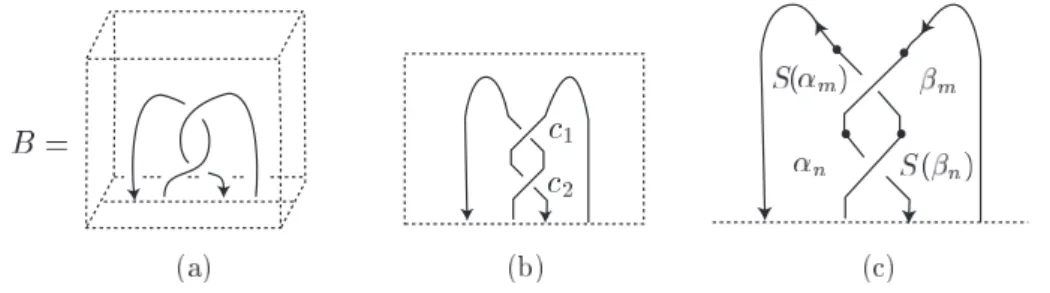
We choose and fix a diagram of T obtained from the copies of the fundamental tangles depicted in Figure 6, by pasting horizontally and vertically. For example, for the bottom tangleB depicted in Figure 7 (a), we can take a diagram depicted in Figure 7 (b). We denote byC(T) the set of the crossings of the diagram. We call a map
s: C(T) → {0,1,2, . . .} astate. We denote byS(T) the set of states of the diagram.
Given a state s∈ S(T), we attach labels on the copies of the fundamental tangles in the diagram following the rule described in Figure 8, where “S0” should be replaced with id if the string is oriented downward, and withSotherwise. For example, for a statet∈ S(B), we put
, , ,
Figure 8: How to place labels on the fundamental tangles
labels on the diagram ofB as in Figure 7 (c), where we setm=t(c1) and n=t(c2) for the upper and the lower crossingsc1andc2, respectively.
We define an element JT ,s ∈ Uh⊗ˆn as follows. Theith tensorand ofJT ,s is defined to be the product of the labels put on the component corresponding toTi, where the labels are read off alongTi reversing the orientation, and written from left to right. We identify the labels S0(α±i ) and S0(βi±) with the first and the second tensorands, respectively, of the element S0(α±i )⊗S0(βi±)∈Uh⊗ˆ2. Also we identify the labelK±1 with the element K±1∈Uh. Then, JT ,s is a well-defined element inUh⊗ˆn. For example, we have
JB,t=S(αm)S(βn)⊗αnβm
=X
q12m(m−1)q12n(n−1)S(D01F˜(m)K−m)S(D200en)⊗D02F˜(n)K−nD100em
= (−1)m+nq−n+2mnD−2( ˜F(m)K−2nen⊗F˜(n)K−2mem)∈Uh⊗ˆ2, whereD=P
D01⊗D001 =P
D20 ⊗D002.Note thatJT ,s depends on the choice of the diagram.
Set
JT = X
s∈S(T)
JT ,s. For example, we have
JB= X
t∈S(B)
JB,t= X
m,n≥0
(−1)m+nq−n+2mnD−2( ˜F(m)K−2nen⊗F˜(n)K−2mem).
As is well known [19],JT does not depend on the choice of the diagram, and defines an isotopy invariant of bottom tangles.
3 Universal invariant of boundary bottom tangles
In this section, we recall Habiro’s formulas for boundary bottom tangles at the topological level (Proposition 3.1), and at the algebraic level on the universal sl2 invariant (Proposition 3.3). Then, we modify these formulas into a form more convenient for our purpose. After that, we study the commutator maps of Uh. In the last section, we give an outline of the proof of Theorem 1.2.
In what follows, we use the following notations. Letη: Q[[h]]→Uhbe the unit morphism ofUh andµ: Uh⊗ˆ2→Uh the multiplication ofUh. Forg≥0, letµ[g]: Uh⊗ˆg→Uhdenote the g-input multiplication defined byµ[0]=η,µ[1]= idUh,and
µ[g] =µ[g−1]◦(µ⊗id⊗Ug−2
h ), forg≥2.Forg1, . . . , gn≥0, set
µ[g1,...,gn] =µ[g1]⊗ · · · ⊗µ[gn]: Uh⊗ˆg1+···+gn→Uh⊗ˆn. (15)
・・・
・・・ ・・・
・・・
・・・
Figure 9: How to arrange Seifert surfaces
・・・
・・・
・・・ ・・・
・・・
・・・ ・・・
Figure 10: (a)Yb⊗g(V)∈BTg forV ∈BT2g(b)µ[gb1,...,gn](W)∈BTn forW ∈BTg
3.1 Habiro’s formula (topological level)
LetT =T1∪ · · · ∪Tn ∈BTn be a boundary bottom tangle andF1, . . . , Fn mutually disjoint Seifert surfaces such that∂Fi=KTifori= 1, . . . , n.We can arrange the surfacesF1, . . . , Fnas depicted in Figure 9, where Double(T0) is the tangle obtained from a bottom tangleT0∈BT2g, where g = g1+· · ·+gn with gi = genus(Fi), by first duplicating and then reversing the orientation of the inner component of each pair of duplicated components.
The above arrangement of the Seifert surfaces implies the following result, which appears in the proof of [4, Theorem 9.9].
Proposition 3.1. For a bottom tangle T ∈BTn, the following conditions are equivalent.
(1) T is a boundary bottom tangle.
(2) There is a bottom tangle T0 ∈ BT2g, g ≥ 0, and integers g1, . . . , gn ≥ 0 satisfying g1+· · ·+gn =g, such that
T =µb[g1,...,gn]Yb⊗g(T0), (16) whereYb⊗g: BT2g→BTg andµb[g1,...,gn]: BTg→BTn are defined as depicted in Figure 10 (a) and (b), respectively.
3.2 Habiro’s formula (algebraic level)
Recall from [4, Proposition 9.7] the commutator morphismYH: H⊗H →Hfor a ribbon Hopf algebraH. In the present case H =Uh, the morphism YUh: Uh⊗ˆUh→Uhis the continuous Q[[h]]-linear map defined by
YUh(x⊗y) =X
k≥0
x .
³ βkS¡
(αk. y)(1)
¢´(αk. y)(2)
forx, y∈Uh.
・・・
・・・
・・・
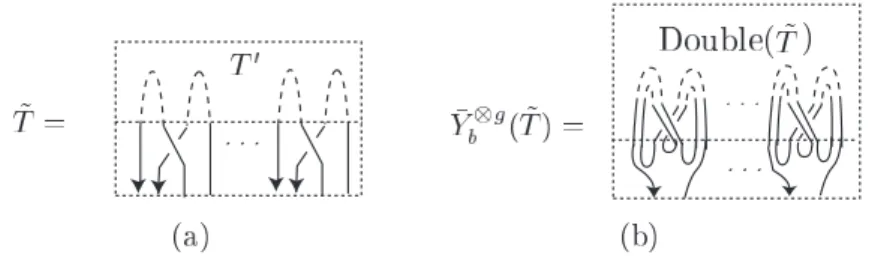
Figure 11: (a) The tangle ˜T =νb⊗g(T0) (b) The bottom tangle ¯Yb⊗g( ˜T)∈BTg
Lemma 3.2 (Habiro [4]). For each bottom tangleT ∈BT2g,g≥0, we have JY⊗g
b (T)=YU⊗g
h(JT).
For each bottom tangleT ∈BTg1+···+gn,g1, . . . , gn≥0, we have Jµ[g1,...,gn]
b (T)=µ[g1,...,gn](JT).
Proposition 3.1 and Lemma 3.2 imply the following.
Proposition 3.3 (Habiro [4]). For a boundary bottom tangleT ∈BTn and a bottom tangle T0∈BT2g satisfying (16), we have
JT =µ[g1,...,gn](YUh)⊗g(JT0).
3.3 Modification of Habiro’s formula (topological level)
In this section, we modify Proposition 3.1.
LetT ∈BTnbe a boundary bottom tangle andT0a 2g-component bottom tangle satisfy- ing (16). We decompose the operationYb⊗g into the two operations νb⊗g and ¯Yb⊗g as follows.
Let ˜T =νb⊗g(T0) be the 2g-component (non-bottom) tangle as depicted in Figure 11 (a). Set Y¯b⊗g( ˜T) =Yb⊗g(T0) ∈BTg, i.e., ¯Yb⊗g( ˜T) is the bottom tangle as depicted in Figure 11 (b), where Double(T0) is defined in the same way as that for bottom tangles.
We have
T =µ[gb1,...,gn]Yb⊗g(T0)
=µ[gb1,...,gn]( ¯Yb⊗g◦νb⊗g)(T0)
=µ[gb1,...,gn]Y¯b⊗g¡
νb⊗g(T0)¢
=µ[gb1,...,gn]Y¯b⊗g( ˜T).
Thus, we can modify Proposition 3.1 by replacing (2) with (2’) as follows.
(2’) There is a 2g-component tangle ˜T = νb⊗g(T0) with T0 ∈ BT2g, g ≥ 0, and integers g1, . . . , gn≥0 satisfyingg1+· · ·+gn=g, such that
T =µb[g1,...,gn]Y¯b⊗g( ˜T).
For a boundary bottom tangle T ∈BTn, we call ( ˜T;g, g1, . . . , gn) as in (2’) a boundary data forT.
3.4 Modification of Habiro’s formula (algebraic level)
Let ¯Y: Uh⊗ˆUh→Uh be the continuousQ[[h]]-linear map defined by Y¯(x⊗y) =X
x(1)KS(y(2))KS(x(2))y(1), (17) forx, y∈Uh.
We modify Proposition 3.3 as follows.
Proposition 3.4. LetT ∈BTnbe a boundary bottom tangle and( ˜T;g, g1, . . . , gn)a boundary data forT. We have
JT =µ[g1,...,gn]Y¯⊗g(JT˜).
Here, we can define the universalsl2 invariant JT˜ ∈Uh⊗ˆ2g of the tangle T˜ in a similar way to that of bottom tangles (cf. [4]).
Letν: Uh⊗ˆUh→Uh⊗ˆUh be the continuousQ[[h]]-linear map defined by ν(x⊗y) =X
k≥0
xβk⊗αky, forx, y∈Uh. We reduce Proposition 3.4 to the following lemma.
Lemma 3.5. We have
YUh = ¯Y ◦ν. (18)
Proof of Proposition 3.4 by assuming Lemma 3.5. LetT0∈BTgthe bottom tangle such that T˜ =νb⊗g(T0). We depict in Figure 12 the labels put on the new crossings c1, . . . , cg at the bottom of ˜T associated a states∈ S( ˜T). Since (1⊗S)(R−1) =R, we have
JT˜ =ν⊗g(JT0). (19)
By Proposition 3.3, Lemma 3.5, and (19), we have JT =µ[g1,...,gn]YU⊗g
h(JT0)
=µ[g1,...,gn]( ¯Y ◦ν)⊗g(JT0)
=µ[g1,...,gn]Y¯⊗g¡
ν⊗g(JT0)¢
=µ[g1,...,gn]Y¯⊗g(JT˜).
・・・
Figure 12: The labels which are put on the crossingsc1, . . . , cg at the bottom of ˜T


![Figure 10: (a) Y b ⊗ g (V ) ∈ BT g for V ∈ BT 2g (b) µ [g b 1 ,...,g n ] (W ) ∈ BT n for W ∈ BT g](https://thumb-ap.123doks.com/thumbv2/123deta/5797089.1529996/12.892.201.691.160.481/figure-y-bt-for-bt-bt-for-bt.webp)