RIMS-1778
Bisubmodular Polyhedra, Simplicial Divisions, and Discrete Convexity
By
Satoru FUJISHIGE
April 2013
Bisubmodular Polyhedra, Simplicial Divisions, and Discrete Convexity
S
ATORUFUJISHIGE
Research Institute for Mathematical Sciences Kyoto University, Kyoto 606-8502, Japan
April 15, 2013
Abstract
We consider a class of integer-valued discrete convex functions, called BS-convex functions, defined on integer lattices whose affinity domains are sets of integral points of integral bisubmodular polyhedra. We examine discrete structures of BS- convex functions and give a characterization of BS-convex functions in terms of their convex conjugate functions by means of (discordant) Freudenthal simplicial divisions of the dual space.
1. Introduction
Kazuo Murota [9] has developed the theory of discrete convex functions such as M- and M♮-convex functions and L- and L♮-convex functions (also see [7, Chapter VII]). The class of integer-valued such discrete convex functions defined on integer lattices is the most fundamental, where M♮-convex functions have generalized polymatroids as their affinity domains and L♮-convex functions have convex extensions with respect to the Freudenthal simplicial divisions.
We consider a class of integer-valued discrete convex functions, called BS-convex functions, which are defined on integer lattices and whose affinity domains are sets of integral points of integral bisubmodular polyhedra. We give a characterization of BS- convex functions by means of the Freudenthal simplicial divisions and the Union-Jack
2. Bisubmodular polyhedra
LetV be a finite nonempty set and3V be the set of ordered pairs(X, Y)of disjoint subsets X, Y ⊆ V. Denote byZ and Rthe set of integers and that of reals, respectively. Also define 12Z ={k2 |k ∈Z}. Any element in 12Z is calledhalf-integraland is called ahalf- integerif it is not an integer. Any vectorxin(12Z)V is called half-integraland is called integralifx(v)is an integer for eachv ∈V. For anyX ⊆ V defineχX ∈ {0,1}V to be the characteristic vector ofX, i.e.,χX(v) = 1forv ∈X andχX(v) = 0forv ∈ V \X.
WhenX is a singleton {w}, we also write χw asχ{w}. For any x ∈ RV andX ⊆ V definex(X) =∑v∈Xx(v), wherex(∅) = 0.
Letf : 3V → Rbe abisubmodular function, i.e., for every(X, Y),(W, Z)∈ 3V we have
f(X, Y) +f(W, Z)≥f((X, Y)⊔(W, Z)) +f((X, Y)⊓(W, Z)), (2.1) where(X, Y)⊔(W, Z) = ((X∪W)\(Y∪Z),(Y∪Z)\(X∪W))and(X, Y)⊓(W, Z) = (X∩W, Y ∩Z). We assumef(∅,∅) = 0. Define
P(f) ={x∈RV | ∀(X, Y)∈3V :x(X)−x(Y)≤f(X, Y)}, (2.2) which is called thebisubmodular polyhedronassociated withf. Whenfis integer-valued, we call the set PZ(f) of all the integral points of P(f) a BS-convex set (BS stands for
‘bisubmodular’). Note that the convex hull ofPZ(f)is equal toP(f)(see [3, 4] and [7, Sect. 3.5.(b)]). Occasionally we identify a BS-convex set with its corresponding bisub- modular polyhedron.
Now consider an integer-valued functiong : ZV → Z∪ {+∞}on the integer lattice ZV. Suppose that for every vectorµ:V →Rthe convex hull of the affinity (or linearity) domain given by
Argmin{g(x)− ⟨µ, x⟩ |x∈ZV}, (2.3) if nonempty, is a BS-convex set. Then we callg a BS-convex function. Note that every face of a bisubmodular polyhedron (or a BS-convex set) is a bisubmodular polyhedron (or a BS-convex set).
We have the following theorem, which can be shown by using characterizations of base polyhedra due to Tomizawa [7, Th. 17.1] and of bisubmodular polyhedra due to Ando and Fujishige [1]. We define anedge vectorto be an edge-direction vector identified up to non-zero scalar multiplication.
Theorem 1: A pointed polyhedron Qis a bisubmodular polyhedron if and only if every edge vector ofQhas at most two nonzero components that are equal to1or−1.
3. BS-convex functions
Now, let us examine the combinatorial structures of BS-convex functions. Letg : ZV → Z∪ {+∞}be a BS-convex function. In the sequel we suppose that the effective domain of BS-convex functiong is full-dimensional and every affinity domain ofgis pointed.
Consider an affinity domain Q, of g, of full dimension and suppose that the affine function supportingg onQis given by
y=⟨µ, x⟩+α. (3.1)
Note thatµis the gradient vector ofg onQ.
Letqbe an extreme point of Q. Then we have a signed posetP(q) = (V, A(q))that expresses the signed exchangeability associated withqforQ(see [1, 2, 6]). Signed poset P(q)has possible bidirected arcsaas follows:
(a) a=u+−v for distinct verticesu, v ∈V, which means thatq+χu −χv ∈Q.
(b) a=u++vfor verticesu, v ∈V, which means thatq+χu+χv ∈Qifu̸=v, and q+χu ∈Qifu=v.
(c) a=u−−v for verticesu, v ∈V, which means thatq−χu−χv ∈Qifu̸=v, and q−χu ∈Qifu=v.
For any arca = u±±v define∂a =±χu ±χv ifu ̸= v, and ∂a = ±χu ifu= v. Note that (a), (b), and (c) mean that for any arca∈A(q)we haveq+∂a ∈Q.
For a half-integral vector x ∈ (12Z)V we call U0 = {v ∈ V | x(v) ∈ Z} theinteger supportofxandU1 =V \U0 thehalf-integer supportofx, respectively.
Then we have the following.
Theorem 2: Letg :ZV →Z∪{+∞}be a BS-convex function. For every affinity domain Qofg of full dimension the gradient vector µofg onQand the constantαin(3.1)are half-integral, and for the half-integer supportU1 ofµwe have evenz(U1)for allz ∈ Q or oddz(U1)for allz∈Qaccording asαis an integer or a half-integer.
PROOF: Since Q is full-dimensional, letting q be an extreme point of Q, the gradient vectorµis the unique solution of the following system of linear equations with integral right-hand sides:
⟨∂a, µ⟩=g(q+∂a)−g(q) (∀a ∈A(q)), (3.2) which has a half-integral solution.
Moreover, it follows from the above argument thatµis expressed asµ0+12χU1, where µ0 =⌊µ⌋, the integral vector obtained fromµby roundingµ(v) (v ∈V)downward to the
Example 3: The set of four points
Q={(0,0,0),(1,1,0),(1,0,1),(0,1,1)} inZ3is a BS-convex set due to Theorem1. A linear function
y= 1
2{x(1) +x(2) +x(3)}
with a half-integer gradient takes on integers onQsincex(1) +x(2) +x(3) is even for allx∈Q. ActuallyQis an even-parity delta-matroid(see[3, 8]).
A BS-convex set Q ⊆ ZV is said to haveconstant parity if x(V)for all x ∈ Q are even or are odd.
Conjecture 4: Every constant-parity BS-convex set of full dimension is a translation of a delta-matroid.
Note that BS-convex sets are exactly jump systems without any hole ([3, 8]) and that all the points of every constant-parity BS-convex setQof full dimension lie on the bound- ary of the convex hull ofQ.
4. BS-convex functions and Freudenthal simplicial divi- sions
For the unit hypercube[0,1]V aFreudenthal cellis defined as follows. Letλ = (v1,· · ·, vn) be a permutation ofV, wheren=|V|. For eachi= 0,1,· · ·, ndenote bySithe set of the firstielements ofλ. Then the simplex formed byχSi (i = 0,1,· · ·, n)is a Freudenthal cell. The collection ofn!such Freudenthal cells corresponding to permutations ofV gives us the(standard)Freudenthal simplicial divisionof the unit hypercube[0,1]V.
For anyS ⊆ V, transforming the standard Freudenthal simplicial division of[0,1]V by making pointsχX correspond to points χ(X\S)∪(S\X) for all X ⊆ V, we get another simplicial division of[0,1]V, which we call the Freudenthal simplicial division reflected byS and each cell of it aFreudenthal cell reflected byS.
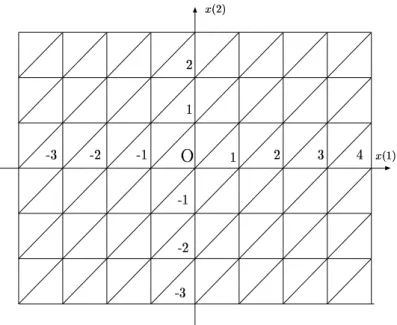
The (standard) Freudenthal simplicial division of RV is obtained by translations of the standard Freudenthal simplicial division of [0,1]V to translated unit hypercubes [0,1]V +z(= [z, z+χV])by all integralz ∈ZV (see Figure 1).
Figure 1. The Freudenthal simplicial division.
Figure 2. A discordant Freudenthal simplicial divisionD.
For each integral point z ∈ ZV let us consider a Freudenthal simplicial division of [0,1]V +z reflected by a set (depending on z) in such a way that it gives us a simplicial division ofRV. We call such a simplicial division ofRV adiscordant Freudenthal sim- plicial divisionofRV (see Figure 2). Given a discordant Freudenthal simplicial division
f• :RV →R∪ {+∞}off is defined by
f•(p) = sup{⟨p, x⟩ −f(x)|x∈ZV} (∀p∈RV). (4.1) The restriction off• on the integer latticeZV is denoted byfZ•.
Theorem 5: Given a discordant Freudenthal simplicial division DofRV, letf : ZV → Z∪{+∞}be aD-convex function having full-dimensional pointed affinity domains. Then fZ• is a BS-convex function. Moreover, the gradient offZ• on every full-dimensional affinity domain is an integral vector.
PROOF: Since facets of any (standard) Freudenthal cell have normal vectors of form χu−χv foru, v ∈V withu≠ v and±χv forv ∈V and sincef has an integral gradient on every reflected Freudenthal cell, the present theorem follows from Theorem 1 and the definitions off• andfZ•. 2
Now, for a discordant Freudenthal simplicial division Dfor integer lattice ZV let us consider the simplicial division 12Dfor the half-integral lattice(12Z)V. Then, Theorem 5 leads us to the following.
Corollary 6: Consider any 12D-convex functionf : (12Z)V → 12Z∪ {+∞}having full- dimensional pointed affinity domains. Let Q be an affinity domain (a BS-convex set), of f•, of full dimension that corresponds to a point p ∈ (12Z)V giving a vertex of the epi-graph of f. Then, the subdifferentialˆ ∂f(p) of f at p (the affinity domain Q of fZ• corresponding top)is a BS-convex set.
It should be noted that for any 12D-convex function f (in Corollary 6)fZ• defined on ZV takes on values in 12Z, possibly half-integers.
Theorem 7: Let f : (12Z)V → 12Z ∪ {+∞} be a 12D-convex function having full- dimensional pointed affinity domains. Suppose that for every pointp∈ 12Zcorresponding to a vertex of the epi-graph offˆ, putting Q = ∂f(p) and letting U1 be the half-integer support ofp, z(U1)is even for allz ∈ Qorz(U1)is odd for allz ∈Qaccording asf(p) is an integer or a half-integer. Then,fZ• is a BS-convex function.
PROOF: Note that for the affine function (3.1) that supportsf• onQ = ∂f(p)we have µ = pand α = −f(p). We can thus see from the assumption thatfZ• is integer-valued (cf. Theorem 2). Hence the present theorem follows from Corollary 6. 2
We call a12D-convex functionfin Theorem 7 aBS•-convex function. From Theorems 2 and 7 we now have the following.
Theorem 8: A functiong : ZV → Z∪ {+∞}is a BS-convex function if and only if we haveg =f• for a BS•-convex functionf : (1Z)V → 1Z∪ {+∞}.
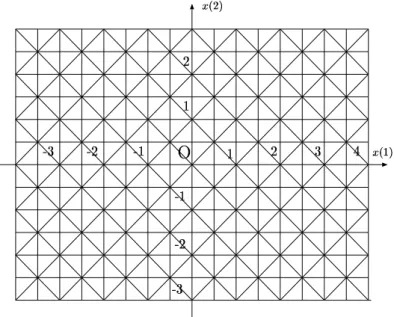
Let us denote by UJ theUnion-Jack simplicial division forZV ofRV. (The Union- Jack simplicial division is a discordant Freudenthal simplicial division obtained in a some- what concordant way as follows. For each integral pointz ∈ZV zis expressed asz0+χW where z0 has all even values z0(v) (v ∈ V) and W is a subset of V. Then consider a Freudenthal simplicial division of[z, z+χV]reflected by W.) Also denote by 12UJ the half Union-Jack simplicial division for (12Z)V (see Figure 3). Similarly we define the quarter Union-Jack simplicial division 14UJ for(14Z)V. Then we have
Theorem 9: Every discordant Freudenthal simplicial division D for ZV of RV is a coarsening of the half Union-Jack simplicial division 12UJ for (12Z)V. Hence the class of the convex extensions of BS-convex functions is a subclass of the convex conjugate functions of 14Z-valued 14UJ-convex functions for thefixedquarter Union-Jack simplicial division 14UJ for(14Z)V.
Figure 3. The half Union-Jack simplicial division 12UJ.
5. Concluding Remarks
We have examined structures of BS-convex functions, which are integer-valued discrete convex functions having BS-convex sets (sets of integral points in integral bisubmodular polyhedra) as their affinity domains. We have shown the following relations.
and by duality (or conjugacy)
{D-convex functions(∀D)}• ⊂ {BS-convex functions}
⊂ {12D-convex functions(∀D)}•, where{f,· · ·}• ={f•,· · ·}. We also have
{12D-convex functions(∀D)} ⊂ {14UJ-convex functions}.
Murota [10] considered M-convex functions on constant-parity jump systems, which are closely related to BS-convex functions since the convex hulls of BS-convex sets and of jump systems are both integral bisubmodular polyhedra (see [3, 8]). Domains of M- convex functions on jump systems considered in [10] may have holes. Moreover, the convex extension of such an M-convex function restricted on the underlying integer lattice may take on non-integral values on the holes. A special case of BS-convex functions defined on delta-matroids was also considered in [5, 11].
Acknowledgments
The author is grateful to Hiroshi Hirai, Shin-ichi Tanigawa, and Kenjiro Takazawa for their useful comments that improved the presentation. The present research is supported by JSPS Grant-in-Aid for Scientific Research (B) 25280004.
References
[1] K. Ando and S. Fujishige: On structures of bisubmodular polyhedra.Mathematical Programming74(1996) 293–317.
[2] K. Ando, S. Fujishige, and T. Nemoto: Decomposition of a signed graph into strongly connected components and its signed poset structure. Discrete Applied Mathematics68(1996) 237–248.
[3] A. Bouchet and W. H. Cunningham: Delta-matroids, jump systems, and bisubmod- ular polyhedra.SIAM Journal on Discrete Mathematics8(1995) 17–32.
[4] R. Chandrasekaran and S. N. Kabadi: Pseudomatroids. Discrete Mathematics 71 (1988) 205–217.
[5] A. W. M. Dress and W. Wenzel: A greedy algorithm characterization of valuated
∆-matroids.Applied Mathematics Letters4(1991) 55–58.
[6] S. Fujishige: A min-max theorem for bisubmodular polyhedra. SIAM Journal on Discrete Mathematics10(1997) 294–308.
[7] S. Fujishige: Submodular Functions and Optimization Second Edition, Elsevier, 2005.
[8] J. F. Geelen: Lectures on jump systems. Notes of lectures presented at the Center of Parallel Computing, University of Cologne, Germany, 1996.
[9] K. Murota: Discrete Convex Analysis, SIAM, 2003.
[10] K. Murota: M-convex functions on jump systems: a general framework for minsqure graph factor.SIAM Journal on Discrete Mathematics20(2006) 213–226.
[11] K. Takazawa: Optimal matching forests and valuated delta-matroids. IPCO 2011, LNCS 6655, pp. 404–416.