Oxidative Stability of Linoleoyl Trehalose and the Effect on Coexisting Lipid
Takahiro ISHIGAKI, Satoshi ONO and Yoshiyuki WATANABE
Abstract
Mono- and dilinoleoyl trehaloses were synthesized through the condensation of trehalose with linoleic acid using immobilized lipase. The oxidative stabilities of linoleoyl trehaloses and their effects on the oxidation of soybean oil were examined. The oxidation process of linoleoyl moiety in linoleoyl trehalose was expressed by a kinetic model and the introduction of trehalose to linoleic acid was shown to be effective for the oxidation. In addition, trehalose would decrease lower the efficiency of relative humidity on the oxidation of soybean oil due to its high hydration ability and the suppressive effect of linoleoyl trehalose on the oxidation was almost independent of relative humidity. Many linoleoyl trehalose molecules may also act in the oil phase.
Key Word: Enzymatic synthesis, Linoleic acid, Peroxide value, Soybean oil, Trehalose.
1. Introduction
Lipid oxidation occurs due to a free radical chain reaction between unsaturated fatty acyl groups in lipids and active oxygen species1). The overall process of lipid oxidation occurs in three stages, which are defined as initiation, propagation, and termination stages. The initiation stage involves the formation of free radicals, resulting from the abstraction of hydrogen atoms from a fatty acid. At the propagation stage, lipid peroxyl radicals are produced, which can then produce lipid hydroperoxide and new alkyl radicals. This propagation continues until one of the radicals is removed by reaction with another radical or with an antioxidant. The hydroperoxide decomposes to form low molecular weight compounds, which polymerize and are also responsible for off-flavors and odors. Therefore, lipid oxidation can lead to the deterioration of quality in food.
Trehalose has recently gained the attention of food producers owing to its unique properties. Trehalose is effective sugar for protecting biomolecules against desiccation stresses and has stabilizing effect on food systems during freezing and thawing processes2).
We synthesized acyl monosaccharide through the condensation of monosaccharide, such as glucose, fructose, mannose and galactose, with a fatty acid using a lipase in a water-miscible organic solvent3). Enzymatic syntheses of acyl mono- and disaccharides are more advantageous than using a chemical method because of the simplicity of its reaction process and high regioselectivity. In addition, continuous production can be achieved by using immobilized lipase. The
Department of Biotechnology and Chemistry, Faculty of Engineering, Kindai University
lipase-catalyzed reaction in conventional aqueous systems thermodynamically favors the hydrolysis.
Therefore, an organic medium was used to shift the reaction toward synthesis. Because acyl saccharide consists of a saccharide part as a hydrophilic group and an acyl residue as a hydrophobic group, it may be an edible emulsifier with surface-activity.
In this study, the effect of two products, such as mono- and dilinoleoyl trehaloses, from the lipase-catalyzed condensation of trehalose and linoleic acid on the oxidation of soybean oil was examined. The application of a kinetic model for peroxide value to the oxidation was tried and the relationship between the peroxide value and relative humidity was investigated.
2. Materials and methods 2.1 Materials
Trehalose (purity >99%) and linoleic acid (purity
>99%) were purchased from Kanto Chamical Co., Inc.
(Tokyo, Japan) and Tokyo Chemical Industry Co., Ltd.
(Tokyo), respectively. Immobilized lipases from Candida antarctica, Chirazyme® L-2 c.-f. C2 was obtained from Roche Molecular Biochemicals (Mannheim, Germany).
Soybean oil and all other chemicals were purchased from Wako Pure Chemical Industries (Osaka, Japan).
2.2 Synthesis and purification of linoleoyl trehalose Trehalose (3.0 mmol) and linoleic acid (0.4 mmol) were weighed into an amber glass vial with a screw-cap, and 160 mg of immobilized lipase and 8.0 mL of acetonitrile were added to the vial. The headspace of the vial was filled with nitrogen gas to prevent the oxidation of the substrates and product, and the vial was tightly sealed over the blowing gas. The vial was then immersed
27
近畿大学工学部研究報告 No.50,2016年,pp.27-30 Research Reports of the Faculty of Engineering, Kindai University No.50 2016, pp.27-30
for 48 h in a water-bath at 60oC to commence the condensation reaction with vigorous shaking. Products were purified by preparative HPLC (LC-10AT, Shimadzu, Kyoto, Japan) with an YMC-Pack ODS-AQ column (20 mmφ X 250 mm, YMC, Kyoto) using a mixture of methanol and water (85:15 by vol.) as the eluent4). The volume of sample applied was 1 mL, and the flow rate of each eluent was 7.0 mL/min.
The purification was repeated until an amount of each product sufficient for oxidation experiments was obtained. The 13C-NMR (100 MHz, CD3OD, TMS, 297 K) analyses for linoleoyl trehaloses were carried out using NMR (JNM-EX400WB FT, JEOL. Ltd., Tokyo).
2.3 Measurement of oxidation processes of linoleoyl moiety and soybean oil
The oxidation processes of linoleoyl trehaloses and unmodified linoleic acid were observed as follows:
About 2 and 5 mg of linoleoyl terhalose and linoleic acid were placed in flat-bottomed glass cups (1.5-cm i.d. and 3.0-cm height), and methanol and hexane were then evaporated under reduced pressure, respectively. The cups were placed in a plastic container with a Petri dish containing a saturated aqueous solution of potassium carbonate to regulate the relative humidity at 44%. For measurement of the oxidation process of soybean oil, linoleoyl trehaloses and unmodified trehalose were added to a cup at the weight ratios of 1 and 2 of trehalose moiety to the oil. The cups were placed in each container regulated at the relative humidity of 0, 12, 44, 75 100%
by phosphorus pentoxide, lithium chloride, potassium carbonate, sodium chloride and distilled water, respectively. The container was stored in the dark at 65oC.
A cup was removed at appropriate intervals. The peroxide value for the oxidation process of linoleoyl moiety was measured with a slight modification according to reported methods5). A 2.7 mL mixture (methanol/ chloroform = 2/1 (v/v)) was added to the cup.
Each 120 μL of a 25 mmol/L hydrochloric acid methanol solution and 12.5 mmol/L ammonium iron(II) sulfate solution was added, and the mixture was fully agitated using a test tube mixer. Eighty microliters of a saturated potassium iodide aqueous solution was added, and the sample was centrifuged at 3,000 rpm for 3 min. The absorbance for the supernatant at 15 min after the addition of a saturated potassium iodide solution was measured at 363 nm using a spectrophotometer (V-520, JASCO Co., Tokyo). Each measurement was done in duplicate, and the mean value was calculated.
3. Results and discussion
3.1 Oxidative stability of linoleoyl moiety
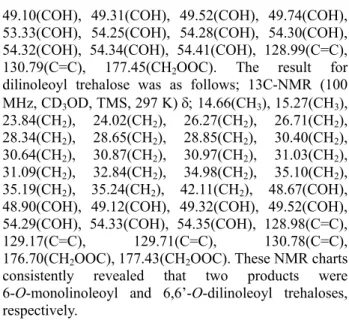
The result of NMR analysis for monolinoleoyl trehalose was as follows; 13C-NMR (100 MHz, CD3OD, TMS, 297 K) δ; 14.64(CH3), 23.80(CH2), 26.27(CH2), 26.71(CH2), 28.32(CH2), 30.23(CH2), 30.38(CH2), 30.65(CH2), 30.85(CH2), 32.74(CH2), 32.82(CH2), 35.14(CH2), 48.48(COH), 48.68(COH), 48.88(COH),
49.10(COH), 49.31(COH), 49.52(COH), 49.74(COH), 53.33(COH), 54.25(COH), 54.28(COH), 54.30(COH), 54.32(COH), 54.34(COH), 54.41(COH), 128.99(C=C), 130.79(C=C), 177.45(CH2OOC). The result for dilinoleoyl trehalose was as follows; 13C-NMR (100 MHz, CD3OD, TMS, 297 K) δ; 14.66(CH3), 15.27(CH3), 23.84(CH2), 24.02(CH2), 26.27(CH2), 26.71(CH2), 28.34(CH2), 28.65(CH2), 28.85(CH2), 30.40(CH2), 30.64(CH2), 30.87(CH2), 30.97(CH2), 31.03(CH2), 31.09(CH2), 32.84(CH2), 34.98(CH2), 35.10(CH2), 35.19(CH2), 35.24(CH2), 42.11(CH2), 48.67(COH), 48.90(COH), 49.12(COH), 49.32(COH), 49.52(COH), 54.29(COH), 54.33(COH), 54.35(COH), 128.98(C=C), 129.17(C=C), 129.71(C=C), 130.78(C=C), 176.70(CH2OOC), 177.43(CH2OOC). These NMR charts consistently revealed that two products were 6-O-monolinoleoyl and 6,6’-O-dilinoleoyl trehaloses, respectively.
0 10 20 30
0 2 4 6 8
Ratio of peroxide value
Time [h]
Fig.1. The transient changes in ratio of peroxide value to initial peroxide value for the oxidation of linoleic acid with (●) no additive and trehalose at (□) 0.5 and (○) 1 of molar ratio to linoleic acid and (△) monolinoleoyl and (◇) dilinoleoyl trehalose at 65ºC and 44%
relative humidity. The solid curves were calculated using the estimated kinetic parameters of the oxidation model.
Figure 1 shows the transient changes in ratio of peroxide value to initial peroxide value for the oxidation of linoleic acid and linoleoyl moiety in mono- and dilinoleoyl trehaloses at 65ºC and 44% relative humidity.
In the coexistent system of linoleic acid with trehalose, trehalose was added at molar ratio of 0.5 and 1 to linoleic acid. The ratio of peroxide values for linoleic acid rapidly increased and then decreased because of the decomposition of peroxides. On the other hand, the ratios for the oxidation of linoleic acid with trehalose and
28
近畿大学工学部研究報告 No.50
linoleoy moiety in linoleoyl trehalose were significantly suppressed at similar level. Since the quantitative kinetic model of lipid oxidation is useful to analyze the retardation of lipid oxidation, a simple kinetic model for oxidation was adopted6):
products secondary PV
S⎯⎯→k1 ⎯⎯→k2 Eq. 1
where S is the concentration of the lipid substrate (meq/kg-oil), which produces peroxide through oxidation, PV is the peroxide value (meq/kg-oil), and k1 and k2 are the assumed first-order kinetic reaction rate constants for the formation and degradation of hydroperoxides, respectively (h-1). We could estimate the value of PV at any time (t) from
PV0
PV= at t = 0 Eq. 2
[ ]
1/ 1
1 PV / S PV
PV ( ) ( )
1 2
0 0 0
0 1 0
2 − +
−
= − e−k t−t e−k t−t k
k
at t ≥ 0 Eq. 3 where S0 and PV0 are the initial concentration of the lipid substrate and PV, respectively. The k1 and k2 values estimated to be 0.530 and 0.102 for the oxidation with no additive, 0.372 and 0.147 with trehalose at molar ratio of 0.5, 0.144 and 0.108 with trehalose at molar ratio of 1, 0.458 and 0.148 of monolinoleoyl trehalose and 0.306 and 0.177 of dilinoleoyl trehalose, respectively. The k2
values of linoleoyl trehaloses were a little lower than those with no additive and unmodified trehalose. There were no tendency in these kinetic parameters for the oxidation but the effectiveness of trehalose and its esterification with linoleic acid was shown for the oxidation of linoleic acid and linoleoyl moiety. Trehalose might retard the abstraction of hydrogen atoms from linoleoyl moiety and formation of lipid free radicals and peroxides through its action as a barrier to a trace proxidant and oxygen molecules.
3.2 Effect of added amount of linoleoyl trehalose on the oxidation of soybean oil
Figure 2 shows the oxidation processes of soybean oil with no additive, trehalose, monolinoleoyl and dilinoleoyl terhalose for at 65ºC and 44% relative humidity. Trehalose and linoleoyl terhaloses were mixed at 1 and 2 of weight ratios of trehalose moiety to the oil.
The ratios of peroxide value for the oxidation of the oil with no additive was the highest in the tested systems.
The ratio was suppressed by the addition of trehaloses and was lower at the weight ratio of 2 than that at the ratio of 1. Most of ratios for the oxidation with linoleoyl trehaloses were lower than unity. Therefore, the above-mentioned kinetic model could not be applied to these oxidation processes. There was no different between the ratios of peroxide value for the oxidation with mono- and dilinoleoyl trehaloses, though the
potential amount for oxidation was different in each system.
0 1 2 3 4 5
0 40 80 120
Ratio of peroxide value
Time [h]
Fig.2. The oxidation processes of soybean oil with (●) no additive, (□,■) trehalose, (△, ▲) monolinoleoyl and (◇, ◆) dilinoleoyl terhalose for at 65ºC and 44% relative humidity. The open and closed symbols represented 1 and 2 of weight ratios of trehalose moiety to the oil, respectively. The solid curves were empirically drawn.
3.3 Relationship between peroxide value for the oxidation of soybean oil with linoleoyl trehalose and relative humidity
Figure 3 shows the time courses of ratio of peroxide value to initial peroxide value for the oxidation of soybean oil with no additive, trehalose, mono- and dilinoleoyl terhalose at 65ºC and various relative
0 2 4 6 8 10
0 40 80
Ratio of peroxide value
Time [h]
(a) (b) (c) (d) (e)
0 40 80 0 40 80 0 40 80 0 40 80 Fig.3. The transient changes in ratio of
peroxide value to initial peroxide value for the oxidation of soybean oil with (●) no additive, (□) trehalose, (△) monolinoleoyl and (◇) dilinoleoyl terhalose at 65ºC and (a) 0%, (b) 12%, (c) 44%, (d) 75% and (e) 100% relative humidity. Each weight ratio of trehalose moiety to the oil was 1. The solid curves were empirically drawn.
29
Oxidative Stability of Linoleoyl Trehalose and the Effect on Coexisting Lipid
0 1 2 3 4 5
0 20 40 60 80 100
Average of peroxide value ratios
Relative humidity [%]
Fig.4. Effect of relative humidity on average of peroxide value ratios for the oxidation of soybean oil at 65ºC with (●) no additive, (□) trehalose, (△) monolinoleoyl and (◇) dilinoleoyl terhalose. Each weight ratio of trehalose moiety to the oil was 1. The solid curves were empirically drawn.
humidity. Average of peroxide value ratios were calculated for all oxidation systems and the effect of relative humidity on the averages was shown in Fig. 4.
The average ratios for soybean oil with no additive and trehalose increased as the relative humidity increased.
The averages with linoleoyl trehalose also slightly increased but the increasing rates were very low. It was indicated that the suppressive effect of linoleoyl trehalose on the oxidation of soybean oil was almost
independent of relative humidity. Lipid oxidation is exclusively known to depend on water activity. Water enhanced the peroxide value for the oxidation in all the tested systems. Trehalose would lower the efficiency of water on the oxidation due to its high hydration ability.
Many linoleoyl trehalose molecules, whose lipophilicity increased by introduction of acyl residue, may act not only on the surface but also in the oil phase.
References
1) McClements, D.J., Decker, E.A.; Lipid oxidation in oil-in-water emulsions: Impact of molecular environment on chemical reactions in heterogeneous food systems, J. Food Sci., 65, 1270-1282 (2000).
2) Richards, B., Krakowka, S., Dexter, L. B., Schmid, H., Wolterbeek, P. M., Waalkens-Berendsen, D. H., et al.; Trehalose: A review of properties, history of use and human tolerance, and results of multiple safety studies, Food Chem. Toxicol., 40, 871-898 (2002).
3) Watanabe, Y., Adachi, S.; Lipase-catalyzed synthesis of edible surfactants in microaqueous organic solvents, In Organic Solvents: Properties, Toxicity, and Industrial Effects, Nova Science Publishers, Inc.
NY, pp.35-55 (2011).
4) Watanabe, Y., Sawahara, Y., Nosaka, H., Yamanaka, K., Adachi, S.; Enzymatic synthesis of conjugated linoleoyl ascorbate in acetone, Biochem. Eng. J., 40(2), 368-372 (2008).
5) Lφvaas E.; A sensitive spectrophotometric method for lipid hydroperoxide determination, J. Am. Oil Chem.
Soc., 69, 777-783 (1992).
6) Watanabe, Y., Khuwijitjaru, P., Hamai, Y., Wiboonsirikul, J., Adachi, S.; Antioxidative property of acyl ascorbate in cookies containing iron, Jpn J.
Food Eng., 17(2), 77-81 (2016).
30