Accumulation of heavy metals in the organs of wild rodents
Takeshi Minamia, Hideo Yamazakia, Noboru Ohamab
a Department of Life Sciences , School of Science & Engineering, Kinki University, 3-4-1 Kowakae, Higashi-osaka, Osaka 577-8502, Japan
Tel.: +81-66721-2332; Fax: +81-66723-2721; E-mail. minamita @ life.kindai. ac j
b Public Health Center,
,Higashi-osaka City,
2-8-27 Takaida-Motomachi, Higashi-osaka, Osaka 577-0054, Japan (Received December 31, 2008)
Abstract
The aim of the present study was to observe the effects of long-term exposure of environmental pollu- tants during human life. For this purpose, we measured the basal levels of heavy metals in the tissue of the organs of wild rodents. Wild rodents were caught in six localities within Higashi-osaka city in the suburbs of Osaka, Japan, and the Cr, Cd and Pb content in the organs of the rodents were compared. In addition, isotope ratios of Pb were measured. No detectable Hg was measured by ICP-MS in the liver, kidney, lung, and brain of the wild rodents. When the metal contents of the organs were compared, the contents of Cr, Cd, and Pb in the kidney were higher than in the liver and brain. The lung Cr content was similar to the kidney; however, no Pb content was detected in the lungs in any rodents. Also, lung Cd content was lower than in the kidney. When metal content in the rodent organs was compared with the collection locality, only Cd content in the brain was observed as different. Next, when the 207/206 ratio of Pb was compared with the organs and collection locality, the ratios were different between the brain and kidney, and between the brain and liver. The ratio of Pb in the brain was a significant difference between No 1 and No 4 localities. In conclusion, metals may be absorbed into organs by different absorption routes. The spread of heavy metal environmental pollution is well reflected in the organs of wild rodents living in the suburbs of Osaka, Japan.
Key words:wild rodent, environmental pollution, Cd, Cr, Pb, Pb isotope ratio, brain, lung, liver, kidney
1 Introduction
After the Industrial Revolution, the use of metals, especially heavy metals, increased dramatically and gradually accumulated in the biosphere. Heavy met- als are widely used for metallic processed products, and are also used for medical supplies and catalysts.
They are extensively used and therefore detected in housing complexes of heavy industries developed as residential areas [1,2]. In addition, the development of information technology has caused new metal pol- lution as rare elements are needed for IC chips. Pol- lution of food as well as groundwater is due to our wide usage of metals. Furthermore, it has been noted that air pollution does not only settle in one coun- try. Atmospheric pollutants, including heavy met- als, for example, those found in Japan, originated in
China where heavy industries are now common [3,4].
Therefore, it is important to know how heavy metal pollution is encroaching into urban areas. We know that chronic toxicity and/or malformation is induced by pollutants, but the effect of long-term exposure to these pollutants is still not clear. There are sev- eral species of wild rodents, and one in particular is a close model of our lifestyle. These rodents eat left- overs in the form of human rubbish and drink domes- tic waste water. As the living environment of wild rodents is very similar to humans, it is interesting to understand how pollutants are accumulated in the tis- sues of these wild rodents and, from the results, it can be speculated how heavy metal pollutants progress into urban areas [5-8]. Biomonitor and biomarker
— 11 —
Brain Kidney Liver
Brain Lung Kidney Liver Brain Lung Kidney Liver
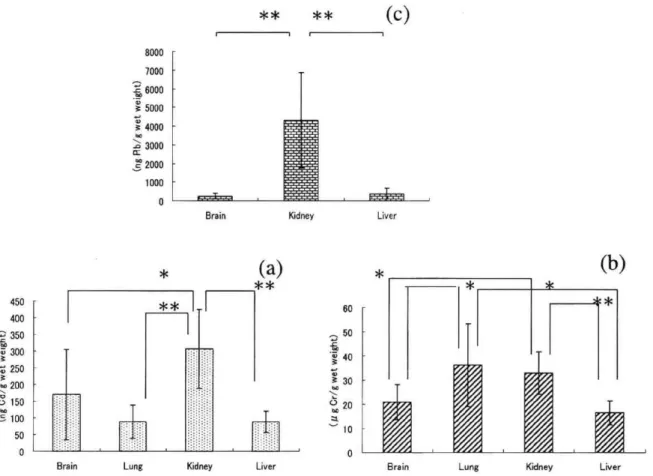
Figure 1: Heavy metal contents in organs of wild rodents (a) Cd content in organs, (b) Cr content in organs, (c) Pb content in organs. Mean ±S.D. * p < 0.05, * * p < 0.01
system is known to identify hazards to human health and the environment [9], and we used four metals,
Cd, Cr, Hg, and Pb, because these toxic heavy metals are closely related to our daily life.
2 Materials and Methods
Animals
Wild rodents were caught in a spring-type trap at point No. 1 to No. 6 in January and February 2004.
The traps were set in the evening and collected in the morning. There are many small factories in the loca- tions of No. 1 to 4. No. 5 is a residential area and No.
6 is a residential area beside a railroad. Eighteen wild rodents were caught in area No. 1, while nine were caught in area No. 5, and 3 rodents were captured in the other designated areas. The collected rodents were kept in a freezer until the organs were removed.
Chemicals
Standard heavy metal solutions, Cd, Cr, Hg, and Pt, were used in the solution for atomic absorption anal- ysis, and were purchased from Wako Pure Chemi-
cals, Co., Ltd (Osaka, Japan). The standard Pb used was NIST 981. Other reagents used were extra-grade from Wako Pure Chemicals.
Preparation of tissues and measurement of heavy metals using ICP-MS
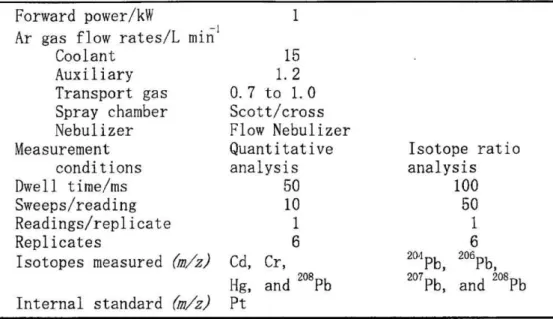
The tissue was dried for 2 days at 80° C after mea- suring the wet weight, dissolved by adding 2 ml of conc. nitric acid and 1 ml of conc. perchloric acid, and made up to 10 ml after the addition of ultra-pure water. The solution was diluted with 1 % nitric acid solution and measured by ICP-MS (ICPM-8500, Shi- mazu Co., Ltd, Kyoto, Japan). Pt (50 ppb) was used as an internal standard. Isotope content of Pb was cal- culated by the correction of isotope contents in stan- dard Pb, NIST 981. The instrument operating condi-
Brain Kidney Liver
Figure 2: Isotope ratio of Pb (207/206) in organs
*p < 0.05 vs. brain.
The values show the average of all samples collected.
lions are shown in Table 1.
Statistical analysis
All results are expressed as the mean with S.D., and differences among groups were determined by a one-
way analysis of variance. Means were compared with Newman-Keuls' multiple comparison test using Scheffe's method. Significance was set at p < 0.05 and p<0.01.
3 Results
Hg was detected in a limited number of specimens in the present study with a detection limit of 0.125 ppb. Figure 1 shows the average content of metals in organs of all rodents. Cd content in the kidney was significantly higher than in other organs, and the con- tent of Cd in the liver was the same as in the lung.
By comparison, the Cr content was higher in the lung and kidney than in the liver. Cr content in the brain was similar to the liver. Very high contents of Pb were detected in the kidney in comparison to the liver and brain. Pb could not be detected in the lung. The difference of metal content in the collection areas is shown in Table 2. When the data were processed sta- tistically, there was almost no significance. Cd con- tent in the rodent brain from location No. 1 was sig-
nificantly higher than in rodents from location No.
5. The ratio of 207/206Pb was compared in the brain, kidney, and liver (Fig. 2). The ratio in the brain was significantly higher than in the kidney, with no dif- ference between the ratio of Pb isotopes in the liver and kidney. Next, the ratio of 207/206Pb in organs was compared in the areas of collection (Table 3). There were no differences between the ratio of Pb isotopes in the liver and kidney between the collection areas, but the ratio in the brain was significantly different between location No. 1 and No. 4. When the ratio was compared with organs in the same area, signifi- cant differences were observed in the brain and kid- ney of wild rodents in the No. 1 collection area.
4 Discussion
Heavy metal pollution is a serious environmental is- sue for not only advanced nations but also develop-
ing nations, because pollution has gradually been in-
-13—
Table 1 ICP—MS operating parameters
Forward power/kW
Ar gas flow rates/L mini Coolant
Auxiliary Transport gas
Spray chamber Nebulizer Measurement
conditions Dwell time/ms Sweeps/reading Readings/replicate Replicates
Isotopes measured 67/z) Internal standard (m/z)
1
15 1.2 0. 7 to 1. 0 Scott/cross Flow Nebulizer Quantitative
analysis 50
10 1
6 Cd, Cr,
Hg, and 208Pb Pt
Isotope ratio analysis
100 50 1 6 204Pb
, 206Pb, 207Pb
, and 208Pb
creasing, but decreasing pollutants is a difficult prob- lem [5-8]. As the habitat of wild rodents is very sim- ilar to that of humans, we therefore wanted to ob- serve tissue pollutant accumulation in wild rodents caught in traps; however, it was surprising that Hg was not detected in any organs. Maybe Hg easily evaporates, or maybe it is not detected by the present detecting method. When the other three heavy met- als were measured, the accumulation of metals was different in the tissues, as shown in Figure 1, with high amounts of metal in the kidney. The metals were possibly excreted from the kidney after they were taken from the wild rodent body. However, as shown in Table 2, there was no change in the levels of Cr, Cd and Pb in organs between the collecting locations except the brain Cd level. One reason is thought that mixed pollution occurred in the collect- ing areas in the present study, because the collecting locations were near each other. In Japan, there are numerous mines with Cd being generally included in the ore, especially zinc ore; therefore, the Cd content in rice is higher in Japan than in other countries. In Cd non-polluted areas, it is reported that rice includes about 0.06 ppm, but other locations have a high Cd value [10]. In addition, until recently, Ni-Cd batteries widely used Cd and their compound was discharged into the atmosphere as well as falling into river wa- ter. As shown in Fig l a, Cd content was higher in the kidney and brain than in the liver and lung. Clark et al. [11] described that Cd was distributed in rat brain after being orally administered for 67 days. Cd
is also reported to be accumulated in rat brain after chronic Cd and ethanol were co-administered from the drinking water [12]. However, Kaleekal et al.
[13] observed that Cd was accumulated in the lungs and kidneys of rats after being chronically exposed to cigarette smoke. Therefore, Cd in wild rodents in the present study may have been absorbed by orally, not inhalation. Wild rodents living in a residential area are thought to absorb high amounts of Cd from rubbish and/or domestic water waste. And the in- take route of Cd may be different between No. 1 and No. 5 (Table 2). Cr is not only included in ore, but is also used for leather production and washing pre- cious metal. Although Cr is one of the main causes of water pollution in the city, Cr may be taken from the air as the level of Cr in the lungs was observed to be at a similar level in the kidney, and then ex- creted into the kidney, as both had a similar level of Cr (Fig. Ib). However, Pb may be absorbed from the intestine as Pb was not detected in the lung (Fig.
1c). As Pb is found in contaminates, soil, trees, and many types of ore, it is continually being used in the environment as countries develop economically and more industries are developed [14]. For that reason, Pb continues to be a source of air and soil pollution.
Pb has four stable isotopes, 204Pb, 206Pb, 207Pb,and 208Pb. 204 Pb does not decay, while 206Pb decays from 238U, 207Pb from 235U, and 208 Pb from 232Th. The ra- tio of Pb isotopes differs in each mine and ore source [15]. Accordingly, the ratio is used to determine the originating mine of any ore sample in geochemistry.
Table 2. Metal content in organs of wild rodents by location
Cr
Cd
Pb NO.I
No. 2 No. 3 No. 4 No. 5 No, 1 No. 2 No. 3 No. 4 No. 5 No, 1 No. 2 No. 3 No. 4 No. 5
liver 16.31 ± 17.50 ± 18.62 ± 14.18 ± 16.52 ± 171d +
8.23 6.70 2.75 5.17 102.88 ± 33.85 88.95 ± 42.07 89.27 ± 32.51 69.57 ± 10.21 74.45 ± 25.18 7179 + 1F41 327.32 ± 227.51 214.17 ± 128.93 341.86 ± 113.45 737.49 ± 898.68 310.10 ± 354.61 1771d + 9nn 7;
kidney 29.72 ± 45.06 ± 38.04 ± 36.24 ± 33.74 ± 21 22 +
11.02 6.06 16.47 9.26 309.28 ± 309.58 ± 225.08 ± 384.94 ± 329.84 ± 99A2 +
135.82 75.67 67.96 147.09 101.47 3269.22 ±
4028.95 ± 6663.02 ± 4252.19 ± 4393.84 ± R1U d1 +
1987.05 1671.37 1694.90 1293.33 3033.52
brain 20.78 32.66 24.27 17.96
4.98 8.99 5.47 5.95 255.60
108.82 127.69 88.70 73.70
+
158.65 15.28 38.92 35.81 11.39 307.57
171.07 341.81 184.61 164.39
169.82 24.01 23.38 81.77 132.57
lung 38.67 43.66 46.54 30.20
16.84 13.84 17.64 14.71 68.88
104.56 110.34 138.76 90.99
39.33 49.54 10.40 69.60 59.16
**p<0A1: No. 1 vs. No. 5 Cd in brain (Cr g/g wet weight) (Cd, Pb ng/g wet weight)
The ratio is also used to evaluate Pb in environmental pollution, using tree rings, sediment, clay, and bio- logical specimens such as human urine and plasma [16-18]. Gulson et al. [16] observed that the ratio of 2061204Pb in blood differed between people in main - land Australia and migrant women, because it is well known that the ratio of Pb isotopes in Australian ores are significantly different from that in European ores.
Also, there are several reports using Pb isotopes in biological materials like urine and blood to evaluate the household environment and environmental pollu- tion [17,18]; therefore, the ratio of the Pb isotopes is useful to determine the source of Pb. From the results of Figure 2 and Table 3, the history of accumulating
Pb in the brain may differ in the liver and kidney, and the history of brain Pb probably differs between No.
1 and 4 collecting locations. In conclusion, we expect to demonstrate how and where pollutants are gradu- ally accumulated in organ tissue. Also, to demon- strate that the intake routes of Cr and Pb are possibly different, it will be necessary to observe the amount of heavy metals in the brain. From the results, it can be seen that the metal content in wild rodents col- lected from within a narrow range of locations within Osaka demonstrates a difference in metal pollution, and these measurements may become an index for the progress of environmental pollution that humans are exposed to daily.
-15-
Table 3. The ratio of 207/206Pb in organs of wild rodents by location
liver kidney brain
No. 1 0.871
0.858 0.887
± 0.034
± 0.019
± 0.030
No. 2 0.902 ± 0.071 0.865 ± 0.007 0.946 ± 0.048
No. 3 0.861 0.888 0.908
0.010 0.010 0.044
liver kidney brain
No.4 0.902
0.881 0.975
± 0.021
± 0.008
± 0.049
No. 5 0.902 ± 0.032 0.880 ± 0.016 0.901 ± 0.031
No.6 0.902 0.881 0.943
0.031 0.015 0.018
*p< 0.05 No. 1 vs. No. 4 in brain
*p< 0.05 brain vs. kidney in No.1 area
References
[1] Burger, J (1993) Metals in avian feathers:
col 5: 203-311
Bioindicators of environmental pollution. Rev Environ Toxi-
[2] Burger J, Eichhorst B (2005) Heavy metals and selenium in grebe eggs from Agassiz national wildlife refuge in northern Minnesota. Envirn Monitor Assess 107: 285-295
[3] Ohta A, Tsuno H, Kagi H, Kanai Y, Nomura M, Zhang R, Terashima S, Imai N (2006) Chemical
compositions and XANES speciations of Fe, Mn and Zn from aerosols collected in China and Japan during dust events. Geochemical J 40: 363-376
[4] Yang XY, Okada Y, Tang N, Matsunaga S, Tamura K, Lin JM, Kameda T, Toriba A, Hayakawa K (2007) Long-range transport of polycyclic aromatic hydrocarbons from China to Japan. Atmospheric Environ 41 (13): 2710-2718
[5] Ieradi LA, Cristaldi M, Mascanzoni D, Cardarelli E, Grossi R, Campanelia L (1996) Genetic damage in urban mice exposed to traffic pollution. Environ Pollut 92: 323-328
[6] Dey S, Stafford R, Roy MKD, Bhattacharjee CR, Khathing DT, Bhattacharjee PC, Dkhar PS (1999) Metal toxicity and trace element deficiency in some wild animal species from north-east India, as re-
vealed by cellular, bio-inorganic and behavioral studies. Current Sci 77: 276-280
[7] da Silva J, de Freitas TRO, Heuser V, Marinho JR, Bittencourt F, Cerski CTS, Kliemann LM, Erdtmann
B (2000) Effects of chronic exposure to coal in wild rodents (Ctenomys torquatus) evaluated by multiple methods and tissues. Mutation Res 470: 39-51
[8] Swarup D, Patra RC (2005) Environmental pollution and its impact on domestic animals and wildlife.
Ind J Animal Sci 75: 231-240
[9] Butterworth FM (1995) Introduction to biomonitors and biomarkers as indicators of environmental
change, in: Butterworth BE, Corkukm LD, Guzman-Rincon J (Eds.) Biomonitors and Biomarkers as Indicators of Environmental Change, Plenum Press, New York pp. 1-8
[10] Ikeda M, Ezaki T, Tsukahara T, Moriguchi J (2004) Dietary cadmium intake in polluted and non- polluted areas in Japan in the past and in the present. Int Arch Occup Environ Health 77: 227-234.
[11]
[12]
[13]
[14]
[15]
[16]
Clark DE, Nation JR, Bourgeois A, Hare MF, Baker DM, Hinderberger EJ (1985) The regional distri- bution of cadmium in the brains of orally exposed adult rats. Neurotoxicology 6: 109-114.
Murthy RC, Saxena DK, Lal B, Chandra SV (1989) Chronic cadmium-ethanol administration alters metal distribution and some biochemicals in rat brain. Biochemistry International 19: 135-143.
Kaleekal T, Lall SB, Dan G (1998) Cadmium accumulation in the lung, liver and kidney of rats chroni- cally exposed to cigarette smake. J For Med Toxicol 15: 1-4.
Nikula KJ, Avila KJ, Griffith WC, Mauderly JL (1997) Lung tissue responses and sites of particle retention differ between rats and cynomogus monkeys exposed chronically to diesel exhaust and coal
dust. Fundam Appl Toxicol 37: 37-53.
Rabinowitz MB (1995) Stable isotopes of lead for source identification. Clin Toxicol 33: 649-655.
Gulson BL, Mahaffey KR, Mizon KJ, Korsch MJ, Cameron MA, Vimpani G (1995) Contribution of tissue lead to blood lead in adult female subjects based on stable lead isotope methods. J Lab Clin Med 125: 703-712.
[17]
[18]
Gwiazda RH, Smith DR (2000) Lead isotopes as a supplementary tool in the routine evaluation of household lead hazards. Environ Health Perspect 108: 1091-1097.
Gulson BL, Mizon KJ, Palmer JM, Korsch MJ, Patison N, Jameson W, Donnelly JB (2000) Urinary lead isotopes during pregnancy and postpartum indicate no preferential partitioning of endogenous lead into plasma. J Lab Clin Med 136: 236-242.
— 17 —