Estimating
Discrete-Time Periodic Software
Rejuvenation
Schedules under
Cost Effectiveness Criterion
岩本 一樹\dagger, 土肥 正\dagger, 海生 亘人\ddagger
K. Iwamoto\dagger, T. Dohi\dagger and N. Kaio\ddagger
\dagger 広島大学大学院工学研究科情報工学専攻
\ddagger 広島修道大学経済科学部経営情報学科
\dagger GraduateSchool of Engineering, Hiroshima University, Japan
\ddaggerFacu1ty of Economic Sciences, Hiroshima Shudo University, Japan
1.
INTRODUCTION
Software faults should ideally have been removed during the debugging phase. Even if software may have been thoroughly tested, it still may have
some
design faults thatare
yet to be revealed. Such faults are called bohrbugs and may exist
even
in mature softwaresuch as commercial operating systems. Also,
even
mature softwarecan
be expected tohave what areknown as heisenbugs[11]. These
are
bugs in the software thatare revealed only duringspecific collusions of events. For example, asequenceofoperationsmay leave the software in astate that results in anerror on
an operation executed next. Simply retrying afailed operation,orif the applicationprocess hascrashed, restarting the processmight resolve the problem. Another tyPe of fault observed in software systems is due to
the phenomenon of
resource
exhaustion. Operating systemresources
suchas
swap space and free memory availableare
progressively depleted due to defects in software suchas
memory leaks and incomplete cleanup of
resources
afteruse.
These faults may exist in the operating system, middleware and the application software.In fact, when software application executes continuously for longperiodsof time,
some
of the faultscause
software toagedueto theerror
conditions thataccrue
with time$\mathrm{a}\mathrm{n}\mathrm{d}/\mathrm{o}\mathrm{r}$load.
Software
aging will affect the performanceof the application and eventuallycause
it to fail [1, 4, 8, 16]. Software aging has also been observed in widely-used software like Internet Explorer, Netscape and xrnas
well as commercial operating systems andmid-dleware. Acomplementary approach to handle software aging and its related transient
software failures, called
software
rejuvenation, are becoming popular [12]. Software reju-venation isapreventiveand proactivesolution that is particularly useful for counteractingthephenomenon of software aging. Itinvolves stopping the running software occasionally,
cleaning its internal state and restarting it. Cleaning the internal state of asoftware might involve garbage collection, flushing operating system kernel tables, reinitializing internal data structures, and hardware reboot.
Huang et al. [12] report the software aging phenomenon in real telecommunications
billing application where over time the application experiences acrash or ahang failure,
and propose to perform rejuvenation occasionally or periodically. More specifically, they
consider the degradation as atwo stepprocess. From the clean state the softwaresystem
jumpsinto adegradedstatefrom whichtwo actionsarepossible: rejuvenation withreturn
to the clean state or transition to the complete failure state. They model the four-state process as acontinuous-time Markov chain and derive the steady-state availability and
the expected cost per unit time in the steady state. Avritzer and Weyuker [2] discuss
aging in atelecommunication switching software where the effect manifests as gradual
performance degradation. Garg et al. [9] introduce the idea of periodic rejuvenation
(deterministic interval between successiverejuvenations) into the Huang et al. model [12]
and represent thestochasticbehaviorby using aMarkov regenerativestochastic Petri net.
Dohi et al. [5] extend the original Huang etal. model to semi-Markov models and develo$\mathrm{p}$
数理解析研究所講究録 1306 巻 2003 年 152-161
anon-parametric algorithm to estimate the optimal software rejuvenation schedule from the complete sample offailure time.
As another examples, it is interesting to consider both effects ofaging as $\mathrm{c}\mathrm{r}\mathrm{a}s\mathrm{h}/\mathrm{h}\mathrm{a}\mathrm{n}\mathrm{g}$
failure, referred to as hard failures, and of aging as soft failures that can lead to
per-formance degradation. Pfening et al. [18] model the performance degradation process
by the gradual decrease of the service rate and formulate the determination problem of
the optimal software rejuvenation schedule and formulate the determination problem of
the optimal software rejuvenation schedule by aMarkov decision process. Garg et al.
[10] consider the transaction based software systems, which involve arrival and queueing
ofjobs, and analyze both effects of aging; hard failures that result in an unavailability
and soft failures that result in performance degradation. Bobbio et al. [3] present afine grainedsoftware rejuvenationmodel with the degradation process consisting of asequence
ofadditive random shocks. Liu et al. [14] model acablemodem termination system with rejuvenation by stochastic Petri nets. Park and Kim [17] carryoutthe availability analysis for $\mathrm{a}\mathrm{c}\mathrm{t}\mathrm{i}\mathrm{v}\mathrm{e}/\mathrm{s}\mathrm{t}\mathrm{a}\mathrm{n}\mathrm{d}\mathrm{b}\mathrm{y}$cluster systems with rejuvenation.
This paper treats the similar periodic software rejuvenation model to Garg et al. [9] under the different operation circumstance. That is, we model the stochastic behavior of telecommunication billing applications by usingadiscrete-time Markov regenerative
pr0-cess, and determine the optimal periodic software rejuvenation schedule in discrete-time
setting. Recently, Dohi et al. $[6, 7]$ reconsider the semi-Markov models [5] in discrete
time and characterize the optimal non-periodicsoftware rejuvenation schedules
minimiz-ing and maximizing the long-run average cost and the steady-state system availability,
respectively. Also, they develop non-parametric algorithms to estimate the optimal
soft-ware
rejuvenation schedules, based upon the discrete total timeon
test (DTTT) concept. Iwamoto et al. [13] introduce the cost effectivenessas acriterion of optimality and obtain the optimal non-periodic software rejuvenation policy in discrete time. Here,we
derivethe optimal periodicsoftwarerejuvenationschedule which maximizes the cost effectiveness
in discrete-time setting, and provide astatistical estimation method based on the similar
DTTTconcept.
2. MODEL
DESCRIPTION
2.1 Notation and Assumption
$Z$:time interval from highly robust state to failure probable state (discreterandom
vari-able)
Fo(n), Fo(n), $\mu_{0}(>0):\mathrm{c}\mathrm{d}\mathrm{f}$, pmf and meanof $Z$, where $n=0,1,2$,$\cdots$
$X$:failuretime from failure probable state (discrete random variable)
$F_{f}(n)$
,
$f_{f}(n)$,
$\mu f(>0):\mathrm{c}\mathrm{d}\mathrm{f}$, pmfandmean
of$X$‘ $*’$:discrete convolution operator, $i.e$
.
$F0^{*F}f(n)= \sum_{j=\circ}^{n}F_{0}(n-j)ff(j)=\sum^{n}j=0Ff(n-$$j)f_{0}(j)$
$\overline{\psi}(\cdot)$:survivor function $(=1-\psi(\cdot))$
$r_{0f}(n):=f_{0}*ff(n)/\overline{F_{0}*Ff}(n-1)$
$Y$:recovery timefrom failure state (discrete random variable)
1
Fo(n), Fo(n), $\mu_{a}(>0):\mathrm{c}\mathrm{d}\mathrm{f}$, pmf and meanof$\mathrm{Y}$
$N$:rejuvenation time from failure probable state (discreterandomvariable)
$F(n)$
,
$n_{0}(\geq 0)$:cdfandmean
of$N$$R$:system overhead incurred by software rejuvenation (discrete random variable) $F_{c}(n)$
,
$f_{c}(n)$,
$\mu_{\mathrm{C}}(>0):\mathrm{c}\mathrm{d}\mathrm{f}$, pmf and meanof$R$$c_{s}$: recovery cost from system failure per unit time $c_{p}$: rejuvenation cost per unit time
Assumption: $c_{s}\mu_{a}>c_{p}\mu_{c}$.
2.2 Model 1
Supposethat the software system is started foroperationattime$n=0$andisin the highly robust state (normal operation state). Let $Z$ be the random time to reach the
failure-probable state from the highly robust state. Let $\mathrm{P}\mathrm{r}\{Z\leq n\}=\mathrm{F}\mathrm{o}(\mathrm{n})$, $(n=0,1,2, \cdots)$
.
Just after the state becomes the failure-probablestate, asystemfailure mayoccur
witha
positive probability. Let $X$ be the time to failure from the failure-probable state havingthe probability distribution function $\mathrm{P}\mathrm{r}\{X\leq n\}=Ff(n)$. If the failure
occurs
beforetriggering asoftware rejuvenation, then the recovery operation is started immediately. The time tocompletetherecoveryoperation$\mathrm{Y}$ isalso the positiverandom variable having
the probability distribution function$\mathrm{P}\mathrm{r}\{Y\leq n\}=F_{a}(n)$
.
Without any loss of generality,it is assumed that after completing repair the system becomes
as
good as new.On the other hand, rejuvenation is performed at arandom time interval measured
fromthestart (or restart) of the software in the robust state. The probability distribution
function of the time to invoke the software rejuvenation, say $N$, and the probability
distributionfunction ofthe timetocompletesoftware rejuvenation
are
representedby$F(n)$and$F_{c}(n)$, respectively. Suppose that thetimeto rejuvenate the software is aconstant$n_{0}$, $i.e$
.
thesoftware rejuvenation is performed periodically. Then, theprobabilitudistributionfunction $F(n)$ has to be replaced by
$F(n)=U(n-n_{0})=\{$ 1: $(n\geq n_{0})$
0: $(n<n_{0})$, (1)
where $U(\cdot)$ is the unit step function. We call
no
$(\geq 0)$ thesoftware
rejuvenative scheduleinthis paper. Aftercompletingthesoftwarerejuvenation, the software system becomesas
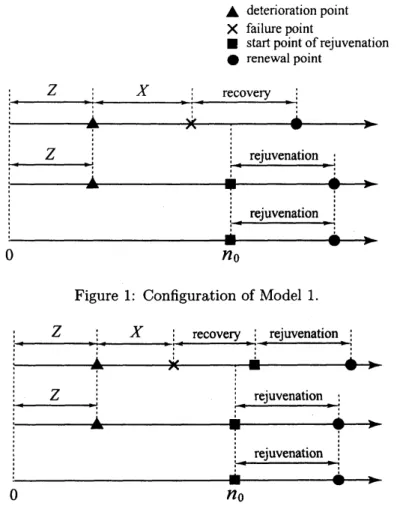
good as new, and the software ageis initiated at the beginning of the next highly robust state. Wecall theabovemodel Model1inthis paper. Figure 1illustrates the configuration
ofModel 1.
2.3 Model 2
Next, consider the other model. When the recovery operation is completed after the
system failure, it is assumedinModel 1thatthesystem is renewed and the stateismoved
to the highly robust state. However, since restarting the system after recovery operation
may require
some
cleanup and resuming the process execution at the checkpointed state,asoftware rejuvenation after completing recovery operation will be needed to
renew
the system $[6, 7]$.
Inthis case, the correpondingstochastic modelshould bedistinguished fromModel 1. We call this model in which the software rejuvenation is performed just after
the completion of recovery operation as well as at the prespecified time after the robust
state is entered, Model 2. Figure 2depicts the configurationof Model 2.
3. COST
EFFECTIVENESS ANALYSIS
Define the time lengthfrom the beginning of the system operation to the completion
of the preventiveor corrective maintenance as onecycle, and suppose thatthe same cycl
A deteriorationpoint
$\cross \mathrm{f}\mathrm{a}\mathrm{i}\mathrm{l}\mathrm{u}\mathrm{r}\mathrm{e}$point
$\blacksquare$ startpoint ofrejuvenation
\bullet renewalpoint
Figure 1: Configuration ofModel 1.
Figure 2: Configurationof Model 2.
is repeated again and againover an infinite time horizon. Then, themean operative time
during
one
cycle inModel 1is given by$S_{1}(n_{0})$ $=$ $\sum_{n=0}^{n0-1}\overline{F_{f}*F_{0}}(n)$
.
(2)The total expected cost for
one
cycle is obtainedas
Vi(no) $=c_{s}\mu_{a}F_{f}*F_{0}(n_{0})+c_{p}\mu_{cf}\overline{F}*F_{0}$(no). (3)
Then the cost effectiveness for Model 1is defined as the mean operative time per unit expected cost [13] as
$E_{1}(n_{0})=S_{1}(n_{0})/V_{1}(n_{0})$ (4)
and the problem is to seek the optimal software rejuvenation schedule $n_{0}^{*}$ maximizing it.
Takingthe difference of$E_{1}(n_{0})$ withrespect tonO, define thefollowingfunction $[13, 15]$:
$V_{1}(n_{0})V_{1}(n_{0}+1)$[$E_{1}(n0+1)-E_{1}$ n0-1
$q_{1}(n_{0})$ $=$
$\overline{F_{0}*F_{f}}(n_{0})$
$=$ $V_{1}(n_{0})-(c_{s}\mu_{a}-c_{p}\mu_{c})S_{1}(n_{0})r_{0f}(n_{0}+1)$, (5)
where $ff*f\mathrm{o}(n)$ is the pmf of the probability distribution$Ff*F_{0}(n)$
.
The following result gives the optimal software rejuvenation schedule for Model 1.
Theorem 1: For Model 1, (1) suppose that the probability distribution $F_{0}*F_{f}(n)$ is
strictly FR (increasingfailure rate) under the assumption $c_{s}\mu_{a}>c_{p}\mu_{c}$
.
(i) If$q_{1}(\infty)<0$, thenthereexist(at leastone, at mosttwo) optimal softwarerejuvenation
schedules $n_{0}^{*}(0<n_{0}^{*}<\infty)$ satisfying $q_{1}(n_{0}^{*}-1)>0$ and $q_{1}(n_{0}^{*})\leq 0$
.
Then, themaximum cost effectiveness is given by
$\underline{E}_{1}(n_{0}^{*})\leq E_{1}(n_{0}^{*})<\overline{E}_{1}(n_{0}^{*})$, (6) where
$\underline{E}_{1}(n_{0}^{*})$ $=$ $\frac{1}{(c_{s}\mu_{a}-c_{p}\mu_{c})r(n_{0}^{*}+1)}$, (7)
$\overline{E}_{1}(n_{0}^{*})$ $=$ $\frac{1}{(c_{s}\mu_{a}-c_{p}\mu_{c})r(n_{0}^{*})}$
.
(8) (ii) If$q(\infty)\geq 0$, then the optimalsoftware rejuvenation schedule becomes $n_{0}^{*}arrow\infty$, $i.e$.
it is optimal not to carry out the software rejuvenation. Then, the maximum cost
effectiveness is given by
$E_{1}( \infty)=\frac{\mu_{f}+\mu_{0}}{c_{s}\mu_{a}}$
.
(9)(2) Suppose that the probability distribution $F0*Ff(n)$ is DFR (decreasing failurerate)
underthe assumption
csfia
$>c_{p}\mu_{c}$.
Then,thecosteffectiveness$E_{1}$(no) isaconvex
function ofno, and the optimal software rejuvenation schedule is$n_{0}^{*}=0$or
$n_{0}^{*}arrow\infty$.
Next, consider Model 2. The
mean
length of operative time forone
cycle and the totalexpected cost during
one
cycleare
given by$S_{2}(n_{0})$ $=$ $\sum_{n=0}^{n_{0}-1}\overline{Ff*F_{0}}(n)$ (10) and
$V_{2}$(10) $=$ $c_{S}\mu aFf*F\mathrm{o}$(no)+CpMc, (11)
respectively. Then, the cost effectiveness for Model 2is formulated as
E2
$(n\mathrm{o})=S_{2}(n\mathrm{o})/V_{2}$(10) (12)In afashion similar to Model 1, define the following function:
$q_{2}(n_{0})=V_{2}(n_{0})-c_{s}\mu_{a}r_{0f}(n0+1)S_{2}$(10) (13)
Theorem 2: For Model 2, (1) suppose that the probability distribution $F_{0}*Ff(n)$ is
strictly IFR.
(i) If$q_{2}(\infty)<0$, then there exist (at least one, at mosttwo) optimalsoftware rejuvenation
schedules $n_{0}^{*}(0<n_{0}^{*}<\infty)$ satisfying $q_{2}(n_{0}^{*}-1)>0$ and $q_{2}(n_{0}^{*})\leq 0$. Then, the
maximum cost effetiveness is given by
$\underline{E}_{2}(n_{0}^{*})\leq E_{2}(n_{0}^{*})<\overline{E}_{2}(n_{0}^{*})$, (11) where $\underline{E}_{2}(n_{0}^{*})$ $=$ $\frac{1}{c_{s}\mu_{a}r(n_{0}^{*}+1)}$, (15) 1 $\overline{E}_{2}(n_{0}^{*})$ $=$ (16) $c_{s}\mu_{a}r(n_{0}^{*})$
.
156
157
(ii) If$q_{2}(\infty)\geq 0$, thenthe optimal software rejuvenation schedule becomes$n_{0}^{*}arrow\infty$, and the maximum cost effectiveness is given by
$E_{2}( \infty)=\frac{\mu_{f}+\mu_{0}}{c_{p}\mu_{c}+c_{s}\mu_{a}}$
.
(17)(2) Suppose that the probability distribution$F_{0^{*F}f(n)}$ isDFR. Then,thecost effectiveness
$E_{2}(n_{0})$ is aconvexfunction ofno,and theoptimalsoftwarerejuvenation schedule is$n_{0}^{*}=0$
or $n_{0}^{*}arrow\infty$.
4.
ESTIMATION ALGORITHMS
4.1 Graphical Method
Forthe discrete $\mathrm{c}\mathrm{d}\mathrm{f}Ff*F_{0}(n)$, define thescaled DTTT transform $[6, 7]$:
$\phi(p)=\sum_{n=0}^{(F_{f}*F_{0})^{-1}(p)}\frac{\overline{F_{f}*F_{0}}(n)}{\mu_{f}+\mu 0}$, (18)
where
$(F_{f}*F_{0})^{-1}(p)= \min\{n : F_{f}*F_{0}(n)>p\}-1$, (19)
if the inverse function exists. Then it is evident that
$\mu_{f}+\mu 0=\sum_{n=0}^{\infty}\overline{F_{f}*F_{0}}(n)$
.
(20)After afew algebraic manipulations,
we can
obtain the following result:Theorem 3: For Model $i(i=1,2)$, obtaining the optimal software rejevenation schedule
$n_{0^{*}}$ maximizing the cost effectiveness $E_{i}(n\mathrm{o})$ is equivalent to obtaining $p^{*}(0\leq p^{*}\leq 1)$ such
as
$\max\underline{\phi(p)}$ (21) $0\leq p\leq 1p+\beta_{i}$’
where $\beta_{1}=c_{p}\mu_{c}/(c_{s}\mu_{a}-c_{p}\mu_{c})$ and $\mathcal{B}_{2}=c_{p}\mu_{c}/c_{s}\mu_{a}$
.
Theorem 3is the dual ofTheorem 1and Theorem 2. From this result, it is
seen
that theoptimalsoftware rejuvenation schedule$n0^{*}=(Ff*F_{0})^{-1}(p^{*})$ isdetermined by calculating
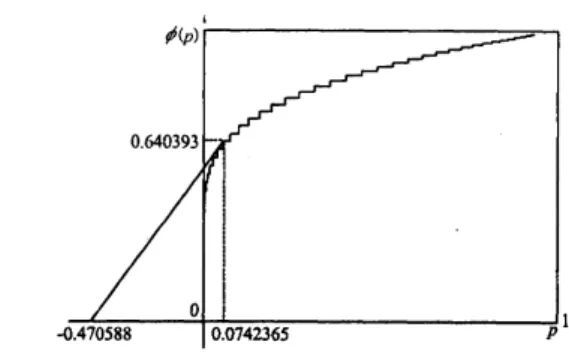
the optimal point $p^{*}(0\leq p^{*}\leq 1)$ maximizing the tangent slope from the point $(-\beta_{i}, 0)$
$(i=1,2)$ to the curve $(p, \phi(p))\in[0,1]\cross[0,1]$ in the twodimensional plane.
4.2 Statistical Non-parametric Method
Next, suppose that the optimal software rejuvenation schedule has to be estimated
from $k$ ordered complete observations: $0=x_{0}\leq x_{1}\leq x_{2}\leq\cdots\leq xk$ of the times from
adiscrete $\mathrm{c}\mathrm{d}\mathrm{f}F_{0}*F_{f}(n)$, which is unknown. Then, the empirical distribution for this
sample, is given by
$F_{fk}(n)=\{$$i/k$ for
$x_{i}\leq n<x_{i+1}$, (22)
1for $x_{k}\leq n$
.
Then the numerical counterpart of the scaled DTTT transform, called the scaled DTTT
statistics, based on this sample, is defined by
$\phi_{ik}$ $=$ $\psi_{i}/\psi_{k}$, $i=0,1,2$ ,$\cdots$,$k$, (23)
Figure 3: Determination ofthe optimal software rejuvenation schedule for Model 1.
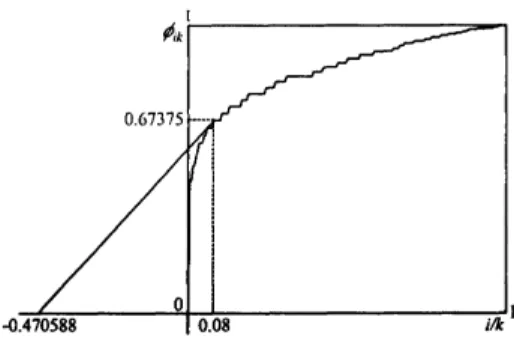
Figure 4: Determination of the optimalsoftware rejuvenation schedule for Model 2. where
$\psi_{i}$ $=$ $\sum_{j=1}^{i}(k-j+1)(x_{jj-1}-x)$, $i=1,2$,$\cdots$,$k;\psi_{0}=0$. (24)
The resulting stepfunction by plotting thepoints $(i/k, \phi_{ik})(i=0,1,2, \cdots, k)$ is called the scaled DTTT plot
The following theorem gives statistically non-parametric estimation algorithms for the
optimal software rejuvenation schedules.
Theorem4: Supposethat the optimalsoftwarerejuvenationschedulehasto beestimated from $k$orderedcomplete sample $0=x0\leq x_{1}\leq x_{2}\leq\cdots\leq xk$ofthetimes from adiscrete
$\mathrm{c}\mathrm{d}\mathrm{f}Ff*F_{0}(n)$, whichisunknown. Then, anon-parametric estimatoroftheoptimalsoftware
rejuvenation schedule $\hat{n}_{0}^{*}$ which maximizes $E_{i}$(no) $(i=1,2)$ is given by
$x_{j}*$, where
$j^{*}= \{j|0\leq j\leq n\mathrm{m}\mathrm{a}\mathrm{x}\frac{\phi_{jk}}{j/k+\beta_{i}}\}$, $i=1,2$
.
(25)5. NUMERICAL
EXAMPLES
5.1 Illustrative Examples
We present
some
examples to determine the optimal software rejuvenation schedulewhich maximizes the cost effectiveness. Suppose that the time $X$ obeys the negative
binomial distribution with $\mathrm{p}\mathrm{m}\mathrm{f}$:
$ff(n)=(\begin{array}{ll}n -1r -1\end{array})$ $q^{r}(1-q)^{n-r}$, $n=1,2,3$,$\cdots$ , (24)
Figure 5: Estimation of the optimal software rejuvenation schedule for Model 1.
Figure 6: Estimation of the optimalsoftware rejuvenation schedule for Model 2. where $q\in(0,1)$ and $r=1,2$,$\cdots$ is the natural number. Also, it is assumed that $Z$ is
a
geometrically distributed random variable having $\mathrm{p}\mathrm{m}\mathrm{f}$:
$f_{0}(n)=p(1-p)^{n}$, $n=0,1,2$,$\cdots$
.
(27)In the rest part of this section, we
assume
that $(r, q)=(10,0.3)$, $p=0.3$, $c_{s}=5.0\cross 10$[$/day], $c_{p}=4.0\cross 10$ [$/day], $\mu_{a}=5.0$ [day] and $\mu_{c}=2.0$ [day].
Figures 3and 4illustrate the determination of the optimal software rejuvenation sched-ule on the two dimensional graph for Model 1and Model 2, respectively. Since $p^{*}=$
0.0742365 has the maximum slope from $(-\beta_{1},0)=$ (-0.470588, 0) in Fig. 3, the optimal
software rejuvenation schedule for Model 1is given by $n_{0}^{*}=(Ff*F\circ)^{-1}(0.0742365)$$=24$
.
On the otherhand, weobtain$n_{0}^{*}=(Ff*F_{0})^{-1}(0.0546002)$ $=23$inModel 2. In both cases,
the maximum cost effectiveness are given by $E_{1}(24)=0.246606$ and E2(23) $=0.233799$,
respectively.
Figures 5and6showtheestimation results oftheoptimalsoftware rejuvenation sched-ule for Model 1and Model 2, respectively, where the time data
are
generated from the negative binomial distribution. For 200 simulation data (negative binomial distributed random number), the estimates ofthe optimal rejuvenation schedule and its associated cost effectiveness are $\hat{n}_{0}^{*}=x_{17}=25$ and $E_{1}(\hat{n}_{0}^{*})=0.264209$ in Model 1. On the otherhand, one estimates $\hat{n}_{0}^{*}=x_{14}=24$ and $E_{2}(\hat{n}_{0}^{*})=0.246961$ in Model 2.
5.2 Asymptotic Behavior
Of our next interest is the investigation of the asymptotic behavior of the estimates
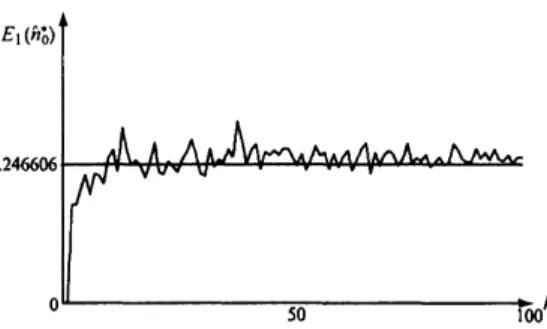
for the optimal software rejuvenation schedule. In Figs. 7 and 8, the estimates of the
maximum cost effectiveness are plotted where the horizontal line denotes the real
maxi-mum calculatedbased onthe negative binomial distributionwithsame parameters. Rom these figures, it is observed that the estimate of the cost effectiveness fluctuates around
thereal maximum and that the non-parametricmethod proposedhere
can
provideagoodFigure 7: Asymptotic behavior of the estimatesforthemaximumcosteffectiveness(Model 1).
Figure 8: Asymptotic behavior of the estimates for themaximumcost effectiveness (Model 2).
Acknowledgments: This research was partially supported by the Ministry of
Ed-ucation, Science, Sports and Culture, Grant-in-Aid for Scientific Research (B), Grant
No. 13480109 (2001), and the Research Program 2002 under the Institute for Advanced
Studiesofthe Hiroshima Shudo University, Hiroshima, Japan.
REFERENCES
[1] Adams, E. (1984), Optimizing preventive service of the software products, IBM
Journal
of
Research aDevelopment, 28, 2-14.[2] Avritzer, A. and Weyuker, E. J. (1997), Monitoringsmoothly degrading systems for
increased dependability, Empirical
Software
Engineering, 2, 59-77.[3] Bobbio, A., Sereno, M. and Anglano, C. (2001), Fine grained software degradation
models foroptimal rejuvenation policies,
Perfor
mance
Evaluation, 46, 45-62.[4] Castelli, V., Harper, R. E., Heidelberger, P., Hunter, S. W., Trivedi, K. S.,
Vaidyanathan, K. V. and Zeggert, W. P. (2001), Proactive management ofsoftware
aging, IBM Journal
of
Research &Development, 45, 311-332.[5] Dohi, T., $\mathrm{G}\mathrm{o}\check{\mathrm{s}}\mathrm{e}\mathrm{v}\mathrm{a}$-Popstojanova, K. and Trivedi, K. S. (2001), Estimating software
rejuvenation schedule in high
assurance
systems, The Computer Journal, 44 (6),473-485.
[6] Dohi, T., Iwamoto, K., Okamura, H. andKaio, N. (2002), Discrete-time cost analysis
for atelecommunication billing application with rejuvenation, Proc. Second
EurO-Japanese Workshop onStochastic RiskModelling
for
Fianance, Insurance, Productionand Reliability, 181-190
161
[7] Dohi, T., Iwamoto, K., Okamura, H. and Kaio, N. (2002), Discrete availability
models to rejuvenate atelecommunication billing application, Proc. lth IEEE Int’l
Symposium on High Assurance Systems Engineering, 159-166.
[8] Dohi, T., $\mathrm{G}\mathrm{o}\check{\mathrm{s}}\mathrm{e}\mathrm{v}\mathrm{a}$-Popstojanova, K., Vaidyanathan, K., Trivedi, K. S. and Osaki,
S. (2003), Software rejuvenation –modeling and applications, $Sp_{7}\dot{\mathrm{u}}nger$ Reliability
Engineering Handbook (H. Pham, ed.), Springer-Verlag, in press.
[9] Garg, S., Telek, M., Puliafito, A. and Trivedi, K. S. (1995), Analysisof software reju-venation using Markov regenerative stochastic Petri net, Proc. 6th Int’l Symposium
on
Software
Reliability Engineering, 24-27.[10] Garg, S., Pfening, S., Puliafito, A., Telek, M. and Trivedi, K. S. (1998), Analysis of
preventive maintenance in transactions based software systems, IEEE Transactions
on Computers, 47, 96-107.
[11] Gray, J. (1986), Whydo computers stop and what
can
bedone about it?, Proc. 5thInt’l Symposium on Reliability in Distributed
Software
and Database Systems, 3-12.[12] Huang, Y., Kintala, C,Kolettin, N.and Funton,N. D. (1995), Softwarerejuvenation:
analysis, module and applications, Proc. 25th Int’l Symposium
on
Fault TolerantComputing,
381-390.
[13] Iwamoto, K.,Dohi, T., Okamura, H. and Kaio, N. (2003), Estimation ofdiscrete-time
software rejuvenation schedule based
on
thecost effectiveness,Transactions
of
IEICE(A), in press.
[14] Liu, Y., Ma, Y., Han, J. J., Levendel, H. and Trivedi, K. S. (2002), Modeling and
analysisof software rejuvenation in cable modem termination syste
m,
Proc. 13thInt’lSymp. on
Software
Reliability Engineering, 159-170.[15] Nakagawa, T. (1984), Asummaryof discrete replacement policies, European Journal
of
Operational Research, 17 (3), 382-392.[16] Parnas, D. L. (1994), Softwareaging, Proc. 16thInt’l
Conf.
onSof
tware Engineering,279-287.
[17] Park,K. andKim, S. (2002), Availabilityanalysisandimprovementof$\mathrm{a}\mathrm{c}\mathrm{t}\mathrm{i}\mathrm{v}\mathrm{e}/\mathrm{s}\mathrm{t}\mathrm{a}\mathrm{n}\mathrm{d}\mathrm{b}\mathrm{y}$
cluster systems using software rejuvenation, Journal
of
Systems and Software, 61,121-128.
[18] Pfening, S., Garg, S., Puliafito, A., Telek, M. and Trivedi, K. S. (1996), Optimal rejuvenation fortoleranting soft failure,